Introduction
In regions where tabanid flies are abundant, livestock, especially cattle and horses can be strongly annoyed by the constant attacks of blood-sucking tabanid females. Thus, the host animals' ability to graze is disrupted. The consequences of this are that meat and/or milk production is reduced in cattle farms, and horses cannot be ridden (Hunter & Moorhouse, Reference Hunter and Moorhouse1976; Harris et al., Reference Harris, Hillerton and Morant1987; Lehane, Reference Lehane2005). Furthermore, tabanid bites cause visible scars on the cattle skin. The bigger the scarless area of cattle hides, the higher their values. Numerous tabanid bites can drastically lower the value of cattle bred for hide. Tabanid females also vector the pathogens of several diseases (e.g. tularaemia, anaplasmosis, hog cholera, equine infectious anaemia, filariasis, anthrax, Lyme disease) and induce allergic reactions when sucking blood (Foil, Reference Foil1989; Luger, Reference Luger1990; Maat-Bleeker & van Bronswijk, Reference Maat-Bleeker and van Bronswijk1995; Veer, et al., Reference Veer, Parashar and Prakash2002; Lehane, Reference Lehane2005). Because of these problems, effective tabanid control traps are in high demand, especially for stock-breeders. Scientists studying the biology and ecology of tabanid flies also need appropriate tabanid traps. It is, therefore, important to develop tabanid traps, which can be beneficial in all regions of the world where tabanids occur in abundance (e.g. between the latitudes of±60°).
Nowadays the most widespread tabanid trap type is the canopy trap. It is essentially a conical/pyramidal canopy resting on a tripod/tetrapod, or hanging from a large vertical hook stuck into the ground with an insect collector fitted at its apex (Muirhead-Thomson, Reference Muirhead-Thomson1991, p. 215). Suspended beneath the canopy is the visually attractant decoy target in the form of a shiny black sphere (Bracken et al., Reference Bracken, Hanes and Thorsteinson1962; Thorsteinson et al., Reference Thorsteinson, Bracken and Hanec1965). The efficacy of this trap type has been frequently demonstrated (Muirhead-Thomson, Reference Muirhead-Thomson1991, p. 216). Its tabanid-capturing efficiency can be enhanced by the addition of CO2 or certain other chemical attractants, e.g. ammonia, phenol, octenol or acetone (Hribar et al., Reference Hribar, LePrince and Foil1992; Mihok, Reference Mihok2002; Mihok et al., Reference Mihok, Carlson, Krafsur and Foil2006; Mihok & Mulye, Reference Mihok and Mulye2010; Mihok & Lange, Reference Mihok and Lange2012). However, the canopy trap captures only host-seeking female tabanids attracted to the shiny black sphere, because this visual target imitates the dark silhouette of a host animal (Muirhead-Thomson, Reference Muirhead-Thomson1991, p. 216).
Horváth et al. (Reference Horváth, Majer, Horváth, Szivák and Kriska2008) showed that male and female tabanids are attracted to horizontally polarized light, because these insects find water by the horizontal polarization of light reflected from the water surface. They emphasized that this polarotaxis can be the basis of the design of new and better tabanid traps composed of different kinds of horizontal black surfaces reflecting strongly and horizontally polarized light. The attracted tabanids can be captured by oil-filled trays, for example, a method used frequently in choice experiments with scientific purposes (Horváth & Kriska, Reference Horváth, Kriska, Lancaster and Briers2008; Horváth et al., Reference Horváth, Blahó, Egri, Kriska, Seres and Robertson2010a, Reference Horváth, Blahó, Kriska, Hegedüs, Gerics, Farkas and Åkessonb; Blahó et al., Reference Blahó, Egri, Barta, Antoni, Kriska and Horváth2012a, Reference Blahó, Egri, Báhidszki, Kriska, Hegedüs, Åkesson and Horváthb; Egri et al., Reference Egri, Blahó, Sándor, Kriska, Gyurkovszky, Farkas and Horváth2012a, Reference Egri, Blahó, Kriska, Farkas, Gyurkovszky, Åkesson and Horváthb). Kriska et al. (Reference Kriska, Bernáth, Farkas and Horváth2009) showed that the darker a colourless (white, grey, black), shiny, horizontally polarizing oil-filled tray laid on the ground is, the higher the degree of linear polarization d of oil-reflected light is, and thus, the greater is its attractiveness to tabanids.
On the basis of these findings, we developed a new polarization tabanid trap composed of a black liquid-filled tray. In this work we describe this new polarization liquid trap, being a concrete realization of the concept suggested by Horváth et al. (Reference Horváth, Majer, Horváth, Szivák and Kriska2008). We show here that male and female tabanids can be caught by our weather-proof, liquid-filled, black tray laid on the ground, because the strongly and horizontally polarized light reflected from the black liquid surface is very attractive to water-seeking polarotactic tabanids. In field experiments, we established the ideal elevation of the liquid trap: the liquid trap should be placed on the ground to ensure its maximal efficacy. Then, to compare the tabanid-capturing efficiency of the classic canopy trap, the new polarization liquid trap, and the combination of the two traps, we performed further field experiments.
Materials and methods
Polarization liquid trap
Our new trap is essentially a circular black plastic tray (with a diameter of 50 cm) possessing an overflow tube (fig. 1). Every black tray was filled with 2 litres tap water, and then 1 litre common vegetable oil was poured onto the water. As oil is less dense than water, it sits in a thin layer on the water. In rain, surplus water collected in the tray flowed out through the overflow tube (fig. 1B). The result was an always ideally horizontal black liquid surface, which reflected strongly and horizontally polarized light, and thus attracted polarotactic tabanids.
Left: The new polarization liquid trap composed of a circular black plastic tray (with a diameter of 50 cm) possessing an aluminium overflow tube. The tray should be filled with 2 litres tap water until the surplus water flows out the overflow tube, then 1 litre vegetable oil is poured onto the water. Right: Close-up photograph of the overflow tube, through which the surplus water is flowing out.

We conducted two different types of field experiment (fig. 2): height experiment (fig. 2A,B) and combined trap experiment (fig. 2C,D). In the former, the influence of height of the liquid trap from the ground on the tabanid-capturing efficiency was studied, while in the latter, the tabanid-catching efficiencies of canopy traps, liquid traps and combined traps were compared.
Schematic drawings of the arrangements of the different tabanid traps used in our field experiments. Insets: photographs of the different traps. We conducted two different types of field experiment: height experiment to reveal the ideal elevation of the liquid trap (A,B), and combined trap experiment to compare the tabanid-capturing efficiency of canopy traps, liquid traps and their combinations (C,D).
Experiment 1 (height experiment 1)
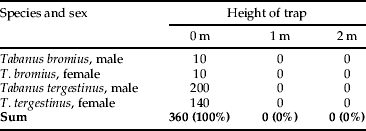
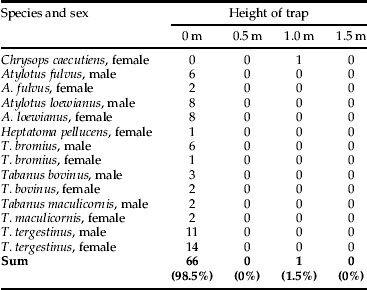
This experiment was performed on a Hungarian horse farm in Göd (47° 43′ N, 19° 09′ E) between 28 June and 28 August 2009. This horse farm was chosen, since in our earlier similar field experiments (Kriska et al., Reference Kriska, Bernáth, Farkas and Horváth2009; Horváth et al., Reference Horváth, Blahó, Egri, Kriska, Seres and Robertson2010a, Reference Horváth, Blahó, Kriska, Hegedüs, Gerics, Farkas and Åkessonb; Blahó et al., Reference Blahó, Egri, Barta, Antoni, Kriska and Horváth2012a, Reference Blahó, Egri, Báhidszki, Kriska, Hegedüs, Åkesson and Horváthb; Egri et al., Reference Egri, Blahó, Sándor, Kriska, Gyurkovszky, Farkas and Horváth2012a, Reference Egri, Blahó, Kriska, Farkas, Gyurkovszky, Åkesson and Horváthb, Reference Egri, Blahó, Száz, Barta, Kriska, Antoni and Horváth2013) we have experienced an abundance of tabanid flies in every summer. Three vegetable-oil-filled black trays (50 cm×50 cm, manufacturer: MFKK Invention and Research Center Services Co. Ltd, Budapest, Hungary) were positioned at heights of 0 m (ground), 1 and 2 m from the ground 2 m apart horizontally along a straight line (fig. 2A). The tabanids trapped by these trays (table 1) were collected weekly (when the order of the traps was randomly changed), stored in ethyl alcohol and identified later in the laboratory. This experiment was repeated in a garden next to a range at Tarnalelesz, Hungary (48° 3′ N, 20° 10′ E) on the following days in the summer of 2009: 28–29 June; 5–6, 12–13, 26–31 July, 1–2 August (table 2). To half the height increment between the elevated traps from 1 to 0.5 m, four vegetable-oil-filled quadratic black trays (50 cm × 50 cm) were positioned at heights of 0 m (ground), 0.5 m, 1.0 m and 1.5 m from the ground 2 m apart horizontally.
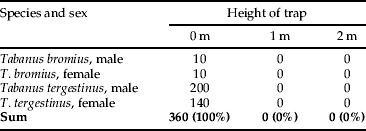
Species, sex and number of tabanid flies captured by the polarization liquid traps positioned at three different heights in experiment 1 at Göd (fig. 2A).
Species, sex and number of tabanid flies trapped by the polarization liquid traps positioned at four different heights in experiment 1 (fig. 2A) at Tarnalelesz.
Experiment 2 (height experiment 2)
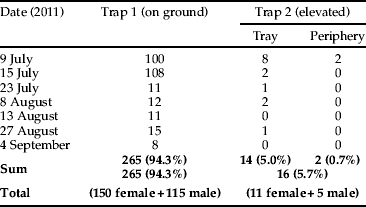
This experiment was performed between 3 July and 4 September 2011 on the same horse farm as experiment 1. The aim of this experiment was twofold: (1) To test the influence of a relatively small elevation (20 cm) of the liquid trap on the tabanid-capturing efficiency. (2) To test whether a strongly and horizontally polarizing, sticky black annular plastic sheet around the liquid trap (called a ‘skirt’ hereinafter) can enhance the tabanid-capturing efficiency. Two circular (diameter=50 cm) black plastic trays were laid 10 m apart on the grassy ground (fig. 2B): The first tray was on the ground, and the second tray was elevated at a height of 20 cm from the ground positioned on the top of a truncated conical platform covered by a shiny black plastic sheet (skirt) lubricated with insect-monitoring glue (BábolnaBio mouse trapping glue, Hungary). The function of the skirt was to enhance the visibility of the liquid trap, since the skirt can be seen by flying tabanids already from a remote distance, not like the flat liquid surface. Both black trays were filled with tap water and vegetable oil on the water surface. The tabanids trapped by these two trays were collected periodically (days of collection are given in table 3) when the sites of the two traps were reversed.
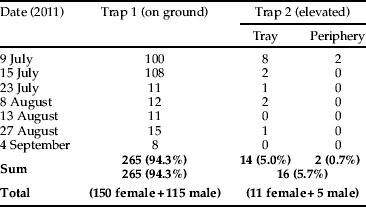
Number of tabanids (T. tergestinus) trapped by the two polarization liquid traps in experiment 2 (fig. 2B) as a function of time. Trap 1 was on the ground. Trap 2 was elevated +20 cm from the ground on the top of a sticky black truncated conical skirt.
Experiment 3 (combined trap experiment 1)
This experiment was performed between 19 July and 25 September 2010 on a Hungarian horse farm in Szokolya (47°52′ N, 19°00′ E), where tabanids are abundant in summer (Kriska et al., Reference Kriska, Bernáth, Farkas and Horváth2009; Horváth et al., Reference Horváth, Blahó, Egri, Kriska, Seres and Robertson2010a, Reference Horváth, Blahó, Kriska, Hegedüs, Gerics, Farkas and Åkessonb; Blahó et al., Reference Blahó, Egri, Barta, Antoni, Kriska and Horváth2012a, Reference Blahó, Egri, Báhidszki, Kriska, Hegedüs, Åkesson and Horváthb; Egri et al., Reference Egri, Blahó, Sándor, Kriska, Gyurkovszky, Farkas and Horváth2012a, Reference Egri, Blahó, Kriska, Farkas, Gyurkovszky, Åkesson and Horváthb, Reference Egri, Blahó, Száz, Barta, Kriska, Antoni and Horváth2013). Our aim was to compare the tabanid-capturing efficiency of a conventional canopy trap and a combined trap (fig. 2C). The latter was composed of a conventional canopy trap and a liquid trap. Both canopy traps were composed of a white pyramidal canopy made from a common tulle and a shiny black beach ball sprayed by black paint with a diameter of 50 cm at a height of 1 m from the ground. In the combined trap the liquid trap was a circular (diameter=80 cm) black plastic tray laid on the grassy ground below the canopy and filled with water and vegetable oil as described above (see Polarization liquid trap). The tabanids trapped by both traps were collected weekly when the sites of the two traps were reversed.
Experiment 4 (combined trap experiment 2)
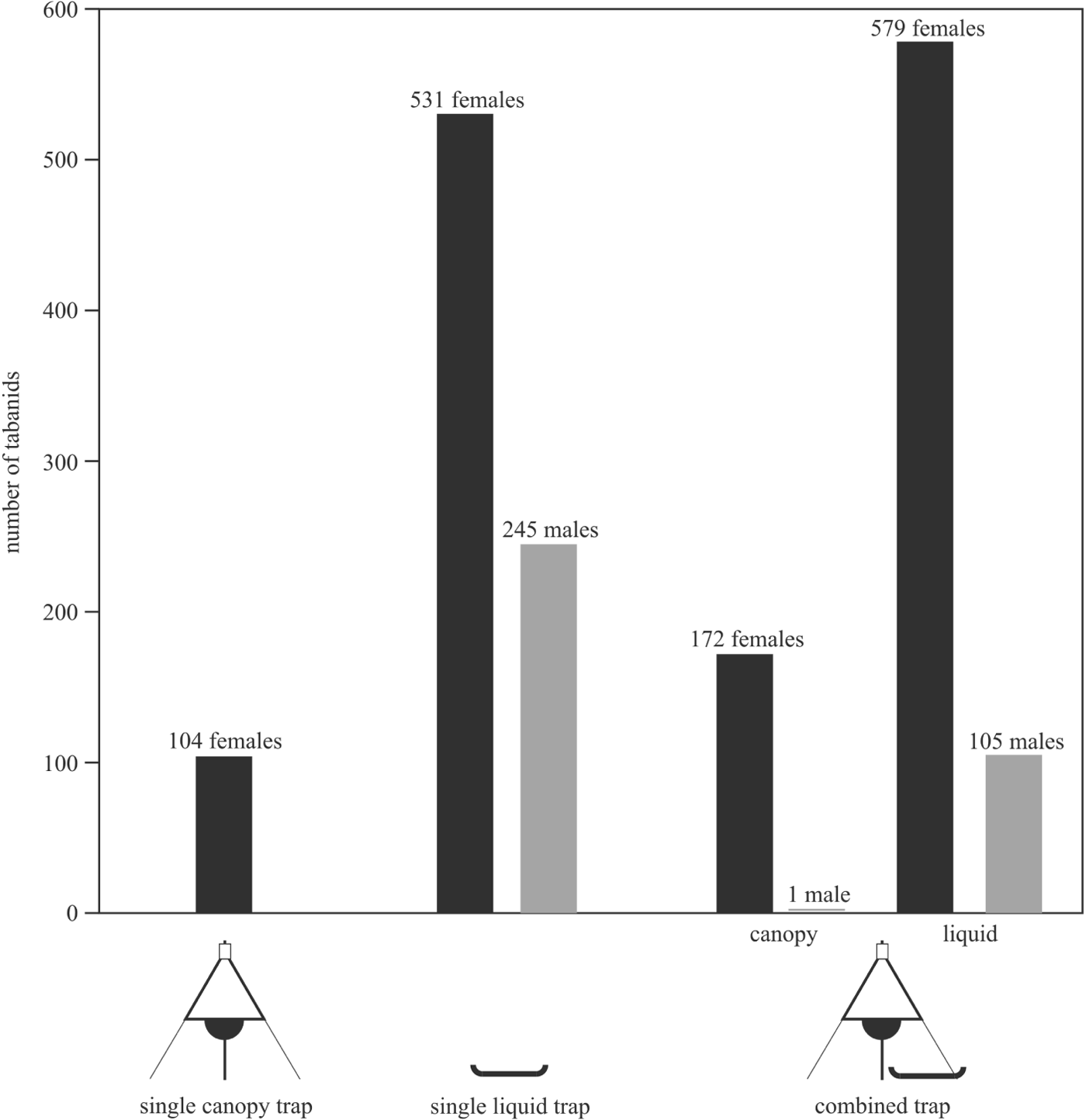
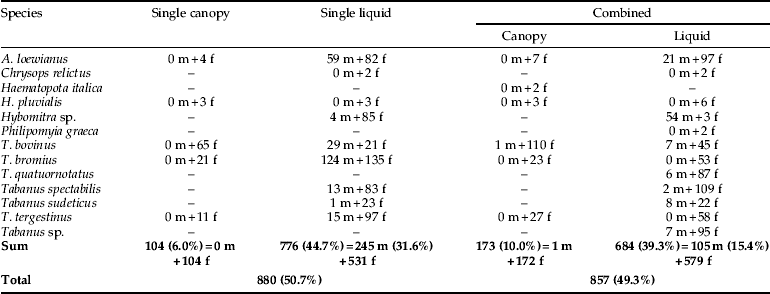
This experiment was performed between 15 June and 12 September 2012 on the same horse farm as experiment 3. The aim of this experiment was to determine whether a combined trap captures more tabanids than its component traps alone. Therefore, we compared the tabanid-capturing efficiencies of the following three traps (fig. 2D): (i) A conventional canopy trap with a shiny black sphere (50 cm diameter beach ball sprayed by a black paint) at a height of 1 m from the ground below a pyramidal canopy composed of a common white tulle. (ii) A liquid trap composed of a circular black tray (diameter=50 cm) placed on the ground. The tray was filled with 2 litres tap water and 1 litre common vegetable oil on the water surface. (iii) A combined trap composed of the canopy trap and the liquid trap below the canopy. The distance between the canopy trap and the combined trap was 15 m, and the single liquid trap was between them in the middle. The tabanids captured by the liquid traps (table 4, fig. 3) were counted weekly (when the order of the traps was randomly changed), while the tabanids caught by the canopies (table 4) were counted only at the end of the experiment, since due to the construction of the canopies, their insect-collecting plastic containers could not have been emptied without the difficult and time-consuming mounting down of the canopies.
Duration and repetition of experiments
In our experiments, traps with different reflection–polarization characteristics captured tabanids, which were counted and removed periodically. Thus, the new arrivals were not influenced by the view of tabanid carcasses. Consequently, after tabanid counting actually a new replication of each experiment began. The number of replications R and the number of days D of a given experiment were: R=8+5, D=62 (experiment 1); R=7, D=64 (experiment 2); R=9, D=75 (experiment 3); R=13, D=90 (experiment 4). According to the results of our earlier quite similar field experiments with tabanids and tabanid traps (Kriska et al., Reference Kriska, Bernáth, Farkas and Horváth2009; Horváth et al., Reference Horváth, Majer, Horváth, Szivák and Kriska2008, Reference Horváth, Blahó, Egri, Kriska, Seres and Robertson2010a, Reference Horváth, Blahó, Kriska, Hegedüs, Gerics, Farkas and Åkessonb; Blahó et al., Reference Blahó, Egri, Barta, Antoni, Kriska and Horváth2012a, Reference Blahó, Egri, Báhidszki, Kriska, Hegedüs, Åkesson and Horváthb; Egri et al., Reference Egri, Blahó, Sándor, Kriska, Gyurkovszky, Farkas and Horváth2012a, Reference Egri, Blahó, Kriska, Farkas, Gyurkovszky, Åkesson and Horváthb, Reference Egri, Blahó, Száz, Barta, Kriska, Antoni and Horváth2013), these numbers of replications and experimental days were large enough to detect significant differences.
Identification of tabanids
The tabanid flies captured in our experiments were conserved in ethyl alcohol. Using a binocular microscope (magnification: 50–100×), their sex and species were identified later in the laboratory on the basis of the taxonomical features of Hungarian tabanid flies (Majer, Reference Majer and Szekessy1987).
Imaging polarimetric measurements
The reflection–polarization characteristics of the tabanid traps used in our experiments (fig. 4) were measured by imaging polarimetry in the red (650±40 nm=wavelength of maximal sensitivity±half bandwidth of the CCD detectors of the polarimeter), green (550±40 nm) and blue (450±40 nm) spectral ranges. The method of imaging polarimetry has been described in detail by Horváth & Varjú (Reference Horváth and Varjú1997, Reference Horváth and Varjú2004). Here we present only the polarization patterns measured in the blue part of the spectrum, since practically the same patterns were obtained in the red and green spectral ranges, because the trap surfaces were colourless (white or black), consequently, their reflection–polarization characteristics did not depend on the wavelength (e.g. red, green, blue) of light.
Colour photograph, patterns of the degree of linear polarization d and the angle of polarization α (clockwise from the vertical), and areas detected as water (for which the reflected light has the following characteristics: d>20%, 80°<α<100°) of a polarization liquid trap measured in the green part of the spectrum when it was sunny (A–C) or shady (D,E) for different directions of view relative to the solar meridian. Towards SM: the polarimeter saw towards the solar meridian. Towards ASM: the polarimeter saw towards the anti-solar meridian. Normal to SM: the polarimeter saw normal to the solar meridian. In the shady situation (D,E), the trap was illuminated by skylight from the totally overcast sky. The angle of elevation of the optical axis of the polarimeter was nearly –35° from the horizontal. In row 3, double-headed arrows show the local direction of polarization of light reflected from the horizontal oil surface.
Statistical analyses
The binomial χ2 tests (Zar, Reference Zar2010) were performed with the use of the program Statistica 7.0. Since the distributions of our tabanid catches were too far from normal (which therefore cannot be compensated by any preliminary data transformation), parametric ANOVA tests could not be used.
Results
Reflection–polarization characteristics of the liquid trap
Fig. 4 shows the reflection–polarization characteristics of the polarization liquid trap when it is sunlit or shady measured from different directions of view relative to the solar meridian. These polarimetric measurements were performed to show that the liquid trap functions well under all illumination conditions: The light reflected from the sunlit horizontal shiny black oil surface is always horizontally polarized, independently of the viewing direction with respect to the sun. The degree of linear polarization d of oil-reflected light is higher or lower, depending on the elevation angle from the horizontal, but it is always high enough to attract polarotactic tabanids. Under overcast sky conditions the illumination of the liquid trap has approximately a rotational symmetry, and thus the reflection–polarization characteristics of the trap are independent of the viewing direction relative to the (invisible) sun, as can also be seen in fig. 4. Row 4 in fig. 4 displays the areas detected as water by polarotactic tabanid flies. Light with degrees of polarization d>20% and angles of polarization 80°<α<100° is indicative of water for polarotactic tabanids (Kriska et al., Reference Kriska, Bernáth, Farkas and Horváth2009). In row 4 of fig. 4, we can see that the shiny black horizontal oil surface reflects light with high degrees of polarization (represented by dark grey and black shades in the d-patterns of fig. 4), and with exactly or nearly horizontal direction of polarization (represented by bright green and blue colours in the α-patterns of fig. 4). The consequence of these polarizing features is that the whole oil surface of the liquid trap is strongly attractive to polarotactic tabanids.
Experiment 1 (height experiment 1)
In experiment 1 (fig. 2A) performed in Göd only the polarization liquid trap on the ground (height=0 m) caught male and female tabanids (N=360), the other two elevated traps (height=1 and 2 m) did not capture any tabanid flies (table 1). This is obviously a highly significant difference. In experiment 1 in Tarnalelesz (table 2), 98.5% (N=66) of the male and female tabanids were captured by the trap on the ground (height H 0=0 m), the trap at 1 m above the ground (H 1.0=1.0 m) caught only one female tabanid fly, which is a statistically highly significant difference (H 0versus H1.0: df=1, χ2=63.06, P<0.00001). The other two elevated traps (H 0.5=0.5 m and H 1.5=1.5 m) did not capture any tabanid.
Experiment 2 (height experiment 2)
In experiment 2 (fig. 2B, table 3) the polarization liquid trap on the ground (height=0 m) caught 94.3% (N=265) of tabanids, while the elevated liquid trap (height=20 cm) on the top of a sticky black truncated conical skirt captured only 5.7% (N=16) of tabanids. The single liquid trap on the ground caught significantly more tabanids than the elevated liquid trap at 20 cm from ground level together with its sticky black truncated conical skirt (df=1, χ2=220.64, P<0.00001). The sticky black truncated conical skirt of the elevated liquid trap caught much less tabanids (0.7%) than the elevated liquid trap itself (5.0%). This difference is statistically significant (df=1, χ2=9, P<0.0027).
According to our polarimetric measurements, the light reflected from the horizontal shiny black oil surface of both liquid traps used in experiment 2 (fig. 2B) was strongly polarized with high degrees of linear polarization d>70% with horizontal direction of polarization. On the other hand, the sticky black truncated conical skirt around the elevated liquid tray reflected not only horizontally, but also obliquely and vertically polarized light with higher (d>50%) or lower (d<50%) degrees of polarization. The consequence of these reflection–polarization characteristics was that only the strongly and horizontally polarizing oil surface of these traps could be visually attractive to polarotactic male and female tabanids.
Experiment 3 (combined trap experiment 1)
In experiment 3 (fig. 2C) the combined trap (composed of a canopy trap with a shiny black aerial sphere and a liquid trap on the ground) caught 71% [N=568=canopy: 301 (37.6%, all female Tabanus) + liquid: 267 (33.4%, 145 female +122 male Tabanus sp.)] and the single canopy trap (canopy with an aerial shiny black sphere) captured 29% (N=232) of tabanids (all female Tabanus sp.), which is a statistically significant difference (df=1, χ2=141.12, P<0.00001). In the case of the combined trap used in experiment 3 (fig. 2C), the canopy captured slightly more (37.6%, N=301) tabanids than the liquid trap (33.4%, N=267), which is not a statistically significant difference (df=1, χ2=2.04, P<0.1537).
According to our polarimetric measurements, the white canopies of the canopy traps reflected practically unpolarized light (d<10%) with non-horizontal directions of polarization. The shiny black rubber sphere reflected strongly polarized light (d>50%) from its periphery, when the angle of reflection was near to Brewster's angle [=θBrewster=arctan (n) from the local normal vector of the spherical surface, where n is the refractive index of rubber. The light component reflected at this angle from a surface is totally linearly polarized and its direction of propagation is perpendicular to that of the refracted component penetrating into the refractive medium]. Otherwise, the sphere-reflected light was only weakly polarized (d<50%). Furthermore, the direction of polarization of sphere-reflected light was always perpendicular to the horizontal, oblique or vertical plane of reflection, thus being vertically, obliquely or horizontally polarized, depending on the direction of view.
Experiment 4 (combined trap experiment 2)
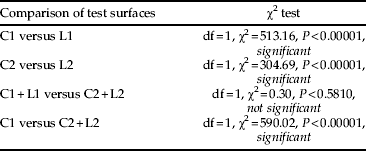
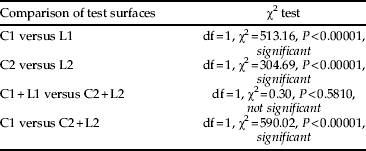
Table 4 contains the species, sex and number of tabanids captured by the three different traps in experiment 4 (fig. 2D). The combined trap (canopy trap with liquid trap on the ground) caught 49.3% (N=857) of tabanids. The single liquid trap captured 44.7% (N=776) of tabanids, while the single canopy trap captured only 6.0% (N=104) of tabanids. These differences are statistically significant (table 5). The liquid trap part of the combined trap caught statistically significantly more tabanids (N=684, 39.3%) than the canopy trap part alone (N=173, 10.0%). From these we conclude that the combined trap is (combined/single canopy=857/104=) 8.2 times more efficient than the classic canopy trap alone. According to table 4, the canopy traps captured practically only female tabanids, while the liquid traps caught both male (15.4–31.6%) and female (68.4–84.6%) tabanid flies. The percentages of males and females depended on the species.
Statistical comparisons (χ2 test) between the numbers of tabanids captured by the different traps (canopy trap with an aerial shiny black sphere, polarization liquid trap on the ground, combined trap: canopy trap together with liquid trap) in experiment 4 (fig. 2D, table 4). C1: single canopy trap with an aerial shiny black sphere. L1: single liquid trap on the ground. C2: canopy part of the combined trap. L2: liquid part of the combined trap.
Discussion
From the results of Kriska et al. (Reference Kriska, Bernáth, Farkas and Horváth2009) it follows that the ideal colour of a polarization liquid trap is black, because only a horizontal, smooth, black surface reflects always strongly and horizontally polarized light, independently of the meteorological, illumination conditions (shady or sunlit) and direction of view (fig. 4). The physical reason for this is the effect of Umow (Reference Umow1905): in a given spectral range, the darker a reflecting surface is, the higher the degree of linear polarization of reflected light.
The advantage of our new polarization liquid trap is that it attracts both male and female tabanids by means of the strongly and horizontally polarized light reflected from the liquid surface (Horváth et al., Reference Horváth, Majer, Horváth, Szivák and Kriska2008; Blahó et al., Reference Blahó, Egri, Barta, Antoni, Kriska and Horváth2012a; Egri et al., Reference Egri, Blahó, Sándor, Kriska, Gyurkovszky, Farkas and Horváth2012a, Reference Egri, Blahó, Száz, Barta, Kriska, Antoni and Horváth2013). The mechanical trapping of tabanids touching the liquid surface is performed by a thin layer of oil being hydrophilic to the chitinous body of flies. The weather proofing of the trap is ensured by an overflow tube: if rain water falls into the tray, the rain drops sink below, the surplus water flows out through the tube, and the ideal horizontal smooth black oil surface remains intact. Furthermore, the oil layer on the water hinders the evaporation of water. The polarization liquid trap is a patented design in Hungary (Patent number P-07-00104: Polarization insect trap, especially tabanid trap).
In experiments 3 and 4, we compared the tabanid-catching efficiencies of canopy traps, liquid traps and their combinations. We found that the combination of the canopy and liquid traps is much more efficient than the classic canopy trap alone: the combined trap captured 2.4 (experiment 3) and 8.2 (experiment 4) times more tabanids than the single canopy trap. The reason for the larger efficiency of the combined trap is that it captures simultaneously the host-seeking and the water-seeking tabanids (Horváth et al., Reference Horváth, Majer, Horváth, Szivák and Kriska2008; Blahó et al., Reference Blahó, Egri, Barta, Antoni, Kriska and Horváth2012a; Egri et al., Reference Egri, Blahó, Sándor, Kriska, Gyurkovszky, Farkas and Horváth2012a, Reference Egri, Blahó, Száz, Barta, Kriska, Antoni and Horváth2013). Due to these advantages, we suggest using the polarization liquid trap as an accessory of the traditional canopy trap capturing only the host-seeking female tabanids (Gressitt & Gressitt, Reference Gressitt and Gressitt1962; Catts, Reference Catts1970; Wall & Doane, Reference Wall and Doane1980; Sasaki, Reference Sasaki2001; Lehane, Reference Lehane2005; van Hennekeler et al., Reference van Hennekeler, Jones, Skerratt, Fitzpatrick, Reid and Bellis2008; Egri et al., Reference Egri, Blahó, Sándor, Kriska, Gyurkovszky, Farkas and Horváth2012a).
In our earlier field studies (Horváth et al., Reference Horváth, Majer, Horváth, Szivák and Kriska2008; Kriska et al., Reference Kriska, Bernáth, Farkas and Horváth2009; Blahó et al., Reference Blahó, Egri, Barta, Antoni, Kriska and Horváth2012a; Egri et al., Reference Egri, Blahó, Sándor, Kriska, Gyurkovszky, Farkas and Horváth2012a), we experienced that tabanids may ignore horizontally polarizing surfaces placed above the ground level, because this is an unnatural situation (a water surface is generally on the ground level). Since this factor has not been systematically studied and is relevant to the positioning of our liquid trap, we conducted experiments 1 and 2. Another practical goal of these experiments was to test whether the liquid trap could be installed on an elevated mount in herds of cattle or horses. Such an elevated position of the trap could prevent the animals from stepping onto the trap.
In experiments 1 and 2, the liquid trap captured tabanids only when its oil surface was at ground level. One of the reasons for this finding may be that the liquid trap could imitate a horizontally polarizing water surface to polarotactic tabanids seeking water always at ground level, which is the natural situation. Remarkably, non-biting midges (chironomids) as polarotactic aquatic insects (Lerner et al., Reference Lerner, Meltser, Sapir, Erlick, Shashar and Broza2008) can also be trapped by elevated polarization liquid traps placed on the roof of a car at a height of about 1.5 m (Horváth et al., Reference Horváth, Móra, Bernáth and Kriska2011). Another example is the case of dragonflies, which are also polarotactic (Wildermuth, Reference Wildermuth1998, Reference Wildermuth2007) and can be attracted by the horizontally polarizing elevated roofs of dark or red cars (Wildermuth & Horváth, Reference Wildermuth and Horváth2005). This could result from the heights at which the various species tend to fly, which might then determine whether they see the horizontally polarized light beneath them.
The ideal height of the liquid trap to capture maximal numbers of tabanids is the ground level. If the trap is elevated (≥20 cm), its tabanid-capturing efficiency is drastically reduced. Hence, the polarization liquid trap has to be settled on the ground to keep its large tabanid-catching efficiency. Thus, this trap must be installed in places where livestock cannot tread on it or drink the liquid (vegetable oil and water). Unfortunately, this trap cannot be installed on an elevated mount in herds of cattle or horses. The advantage of such an elevated mount would be that the animals could not step or drink into the liquid trap.
Egri et al. (Reference Egri, Blahó, Sándor, Kriska, Gyurkovszky, Farkas and Horváth2012a) showed that tabanids possess two different kinds of positive polarotaxis: (1) Female and male tabanids are attracted to horizontally polarized light. This polarotaxis is governed by the direction of polarization, and serves to detect water by means of the horizontal polarization of light reflected from the water surface. Male and female tabanids have to find water in order (i) to drink, (ii) to cool their body, and (iii) to find each other to copulate near water bodies. Furthermore, (iv) females need water to lay eggs on plants next to water or in mud. (2) Female tabanids have to suck blood of vertebrates to develop their eggs. Host animals are partly detected by the linearly polarized light reflected from the coats of hosts. The higher the degree of polarization, the more attractive is the host, independently of the direction of polarization of coat-reflected light (Egri et al., Reference Egri, Blahó, Sándor, Kriska, Gyurkovszky, Farkas and Horváth2012a). This polarotaxis is governed by the degree of polarization, and serves to find host.
It is well known that the shiny black sphere of traditional canopy traps attracts exclusively female tabanids, since the sphere, hanging above the ground and beneath the canopy, imitates a host animal. Thus, canopy traps capture only female tabanids (Muirhead-Thomson, Reference Muirhead-Thomson1991; Lehane, Reference Lehane2005; Egri et al., Reference Egri, Blahó, Sándor, Kriska, Gyurkovszky, Farkas and Horváth2012a, Reference Egri, Blahó, Kriska, Farkas, Gyurkovszky, Åkesson and Horváthb, Reference Egri, Blahó, Száz, Barta, Kriska, Antoni and Horváth2013). Egri et al. (Reference Egri, Blahó, Sándor, Kriska, Gyurkovszky, Farkas and Horváth2012a) also demonstrated that the sphere must be smooth (shiny), that is highly polarizing, in order to attract female tabanids efficiently. The reason for this may be that in nature the hosts of tabanids usually have relatively dark coats that polarize reflected light strongly. If the black sphere in a canopy trap is matte, i.e. non-polarizing or weakly polarizing, its tabanid-attracting capability is lost or drastically reduced (Egri et al., Reference Egri, Blahó, Sándor, Kriska, Gyurkovszky, Farkas and Horváth2012a). These explain why only female tabanids are attracted to the shiny black spherical visual target of canopy traps, and which polarization characteristics attract them in different behavioural contexts. The Epps horsefly trap is composed of shiny black vertical panels with elongated trays filled with water containing soap to reduce surface tension (Watson et al., Reference Watson, Denning, Calibeo-Hayes, Stringham and Mowrey2007). The efficacy of this trap should also be related to the polarization characteristics of reflected light. In environments with plentiful water, the efficacy of traps based on this concept may, however, be challenged.
Finally, we mention that in the combined trap the liquid trap component could be replaced by a horizontal sticky black board, which reflects also strongly and horizontally polarized light and it catches all tabanids touching its sticky surface as the horizontal black liquid surface. Such a polarization sticky trap (so-called ‘horseflypaper’) was recently designed and successfully tested by Egri et al. (Reference Egri, Blahó, Száz, Barta, Kriska, Antoni and Horváth2013).
In this work, we illustrated the relative improvement of the combined canopy–liquid trap over previous designs. In the future, it would be useful to know under what conditions this could matter to livestock producers. It would be worth investigating how the innovation in trap design suggested here (i) reduces the abundance of tabanids and disease transmission, or increases the quality of hides due to reduced biting scars. (ii) How does the impact depend on the density at which the combined traps are deployed? Only after such further studies guidance can be provided on how many combined traps might be needed in a given situation.
Acknowledgements
This work was supported by the grant TabaNOid 232366 (Trap for the Novel Control of Horse-flies on Open-air Fields) funded by the European Commission under the 7th Framework Programme received by G. Horváth and G. Kriska. Gábor Horváth acknowledges the German Alexander von Humboldt Foundation for an equipment donation. Many thanks to Csaba Viski (Szokolya, Hungary) and István Simon (Göd, Hungary), who allowed our experiments on their horse farms. We are also grateful to Orsolya Buza and András Havasi (MFKK Invention and Research Center Services Co. Ltd, Budapest, Hungary) for their valuable help and advice in some field experiments. We thank two anonymous reviewers for their constructive comments.