1. Introduction
In March 1977, two Boeing 747 airliners collided on the fog-covered runway at the Los Rodeos Airport on the island of Tenerife in the Canary Islands. The crew on one of the airliners, operated by KLM Royal Dutch Airlines, had mistaken an air traffic controller’s “you are cleared” as clearance for take-off instead of clearance for their route (Kalajian, Reference Kalajian2002; Smith, Reference Smith2014). The KLM flight proceeded down the runway where, unbeknownst to them, a Pan Am airliner was still taxiing. The KLM 747 crashed into the Pan Am 747 and burst into flames, killing everyone on board; less than a fifth of the passengers aboard the badly damaged Pan Am flight managed to escape before it too, exploded. Of the 644 passengers on board the two planes, 583 died.
The Tenerife Air Disaster highlights how miscommunication can lead to disaster, particularly when individuals are distracted by other information. The crew of the KLM flight, experiencing poor weather and under pressure to leave Tenerife before they reached their flight time limitations, were facing demands on their cognitive resources that likely played a role in the crash (Weick, Reference Weick1990). Specifically, under pressure and either unwilling or unaware of the need to ask for clarification, misinterpretations about the language used by the pilot and air traffic controller resulted in one of the deadliest accidents in aviation history.
Fortunately, most ambiguous conversations will not end in disaster. However, in situations where speaker clarity is important and the listener’s ability to ask for (or receive) clarification may be limited, understanding the factors contributing to miscommunication is critical. We investigated how cognitive pressure affects people’s ability to avoid ambiguity, as well as whether a short directive can promote communication clarity in cognitively demanding situations.
1.1. background
1.1.1. What I think you know: establishing common ground
Despite our ability to communicate relatively successfully on a daily basis, all utterances have the potential for misunderstanding. The ability to understand the intended meaning of most utterances draws on the fact that, in many cases, the communicants share context and can make inferences about meaning based on that mutual information. The shared “knowledge, beliefs, and even suppositions” or common ground (Clark & Carlson, Reference Clark, Carlson, Long and Baddeley1981, p. 320) is critical for clearing up any statements whose meaning would otherwise be confusing. For example, if Janet is staring at a book on Michael’s desk and asks him, “Could you please hand that to me?”, we would assume that the that in Janet’s question is referring to the book. Yet without knowing what Janet is looking at, the question is ambiguous; after all, there is nothing in the wording of the question itself to make it clear what Janet wants. If Michael is in another room and failed to notice that Janet was looking at the book, he would be unlikely to know what the referent for that is. Therefore, to ensure that her communication is clear, Janet must base her request on what information she believes that she and Michael share – in other words, she must rely on their common ground.
Although common ground is defined as the context and information that is shared between two interlocuters, establishing what actually is shared knowledge is a continuous process. People must use the information gained from the conversation to constantly update their understanding of what their interlocuters know and what they don’t know. In this way, common ground has been conceptualized as a form of social meta-cognition (Keysar, Barr, Balin, & Paek, Reference Keysar, Barr, Balin and Paek1998), as people must make assumptions about and calibrate their communication to what others know. In fact, there is evidence that people do tailor their messages to addressees based on information revealed over the course of a conversation. Isaacs and Clark (Reference Isaacs and Clark1987) found that people familiar with New York City were more likely to use proper nouns to refer to city landmarks when speaking to people who were similarly familiar with the city. When speaking to those unfamiliar with New York City, however, they were more likely to pair these proper nouns with descriptions. Further, because the speakers rarely discussed their level of familiarity with the city or its landmarks explicitly, Isaacs and Clark’s findings suggest that speakers rely on both explicit and implicit conversation cues to determine the level of knowledge of their addressees and adjust their own utterances accordingly.
Unfortunately, even when actively updating their assumptions about what their addressee knows or believes, speakers are not always able to avoid ambiguity completely. People may make incorrect assumptions about what information is in common ground. According to Krauss and Fussell (Reference Krauss and Fussell1991), people’s assumptions about what a listener knows are likely based on heuristics, schema, and other mental short-cuts. For instance, speakers may assume that what they know is already known to the listener and thus does not require further explanation. Even if a speaker does manage to determine what their addressee knows accurately, they may still fail to avoid ambiguity because speakers tend to monitor and update their utterances ‘after the fact’ to account for their listener’s level of knowledge (Horton & Keysar, Reference Horton and Keysar1996; Keysar et al., Reference Keysar, Barr, Balin and Paek1998). That is, they tend to employ a ‘speak first, adjust later’ strategy rather than planning to produce clear utterances. Although speakers are able to avoid producing potentially ambiguous utterances in the first place, they are often unaware that an utterance may be unclear until it has already been produced (see Ferreira, Slevc, & Rogers, Reference Ferreira, Slevc and Rogers2005).
1.1.2. Barriers to perspective-taking
Monitoring utterances for potential ambiguity requires the speaker not only to establish what the addressee knows but also to view the conversation from their addressee’s perspective. By placing themselves in the position of their interlocuter, a speaker can make a more educated guess about what information is shared and likely to be understood. But perspective-taking is not a cost-free process. Wardlow (Reference Wardlow2013) found that those with smaller working memory capacity or lower levels of executive control were less able to tailor their messages to addressees in a referential communication task. Speakers with fewer available cognitive resources could not fully engage in perspective-taking or otherwise monitor and adjust their utterances for their listeners.
Perspective-taking is made even more challenging by the fact that egocentric, non-shared information is easier to access than shared information, and suppressing this egocentric information requires cognitive effort (Keysar, Barr, Balin, & Brauner, Reference Keysar, Barr, Balin and Brauner2000; Keysar et al., Reference Keysar, Barr, Balin and Paek1998). For example, Keysar and colleagues (2000) found that people in a referential communication task tended to fixate on possible referents that were occluded from their interlocuter’s view. Although people frequently corrected themselves to focus on those items in shared view, this error correction cost time. Using a similar referential communication task, Lin, Keysar, and Epley (Reference Lin, Keysar and Epley2010) found that individuals with lower working memory capacity looked at competing items that were hidden from the interlocuter more often, took longer to make a decision about which item to choose, and made more errors compared to higher working memory participants. Clearly, accounting for another’s perspective and adjusting accordingly taxes a person’s limited cognitive capacity.
Perspective-taking is an effortful process, but people are usually able to determine what information is shared and can tailor their utterances without much strain. However, in the face of competing cognitive demands, people are less able to adopt or otherwise make assumptions about the perspective of others (e.g., Davis, Conklin, Smith, & Luce, Reference Davis, Conklin, Smith and Luce1996). Thus, under cognitive pressure people may be more likely to rely on egocentric information. Horton and Keysar (Reference Horton and Keysar1996) found that speakers were more likely to rely on shared information in a communication task when communicating at their own pace, but were equally likely to rely on both shared and non-shared information when under a time constraint. Similarly, Epley, Keysar, Boven, and Gilovich (Reference Epley, Keysar, Boven and Gilovich2004) discovered that participants were more likely to assume that other people would interpret potentially sarcastic messages in the same way as them when they were hurried through the task than when they completed the task at their leisure.
Speakers may be less likely to update to others’ perspectives when under cognitive constraint and instead anchor in their own perspective. Roßnagel (Reference Roßnagel2000, Reference Roßnagel2004) found that people under higher cognitive load are not only less able to adjust their speech to their addressee’s level of knowledge but are also less able to sufficiently process addressee feedback. Separately, Lin and colleagues (2010) gave participants one or four two-digit numbers to recall during every trial of a referential communication task. When under higher cognitive load, participants made more fixations on non-shared competing items, took longer to make a decision about which item to choose, and made more mistakes. Thus, when it comes to communication, people are less likely or less able to adjust their perspectives to those of others when fewer cognitive resources are available, regardless of whether this restriction is due to smaller working memory capacity, time pressure, or cognitive load.
Promisingly, people are able to moderate the effect of additional cognitive pressure on their ability to take another’s perspective when sufficiently motivated to do so. When told that their speech would be reviewed later, participants in Roßnagel’s (Reference Roßnagel2000) study were more likely to tailor their language to the level of understanding of their addressees even when under higher cognitive constraint. In a similar vein, Epley and colleagues (2004) found that participants who were offered a financial incentive made more accurate estimations of what others would know compared to those who received no such incentive. Together, these findings suggest that people are likely to rely on egocentric information and resort to strategies that minimize any additional cognitive costs unless motivated to do otherwise. Nevertheless, it is worth examining whether individuals can be encouraged to overcome the effects of cognitive constraint by even simpler incentives than judgment and money.
If additional cognitive strain increases the chances of a speaker producing an unclear utterance and a listener’s ability to ask for clarification is limited, there may be instances where these situations can have serious consequences. Further, given that additional cognitive pressure is detrimental to speech, it is unclear whether simple instructions to speakers, such as those that could appear on a screen before beginning a task, would be sufficient to overcome these effects. Over two experiments, we attempted to replicate the effect of cognitive constraint on people’s ability to communicate clearly in non-interactive situations, as well as to explore the role of a simple directive on perspective-taking. In Experiment 1, we examined how cognitive pressure and a perspective-taking directive affect people’s labeling of potentially ambiguous homophones. In Experiment 2, we extended our investigation to examine cognitive pressure and our directive on giving potentially syntactically ambiguous instructions.
2. Experiment 1
2.1. method
Experiment 1 served as a replication study of the effect of cognitive constraint using a new methodological context: the production of ambiguous homophones. Experiment 1 also served as an initial examination of a simple directive on a speaker’s ability to avoid ambiguity. The basic methodology for this experiment was modeled after that used by Kempe, Rooks, and Swarbrigg (Reference Kempe, Rookes and Swarbrigg2013), who adapted it from Ferreira et al. (Reference Ferreira, Slevc and Rogers2005). Participants were instructed to label a series of images to a listener in a non-interactive setting. Some of the images included homophones, either paired or alone, which provided opportunities for participants to make or avoid lexically ambiguous utterances. During the labeling task, participants were assigned to recall a series of words while labeling the images. The number of words to recall was manipulated to serve as low or high conditions of cognitive constraint. Additionally, half of the participants were randomly assigned to receive instructions to imagine themselves as the listener at the beginning of the study. We expected that speakers with higher cognitive burdens would be more likely to label the homophone images with bare homophones (e.g., nail when presented with a fingernail), and that those who received the perspective-taking instruction would be more likely to avoid ambiguity. We also predicted that receiving the directive would moderate the effect of greater cognitive constraint.
2.1.1 Participants
One hundred and eleven undergraduate students received course credit for participating in this study. Three participants’ data were removed because they did not have sufficient English proficiency, ten participants’ data were lost due to technical error, and three participants’ data were removed for failure to follow instructions. Thus, our final sample consisted of 95 participants (Male = 35.79%; M Age = 19.16, SD = 0.99; Age Range = 18–22); ninety-one were native English speakers, and four spoke English as a foreign language with native proficiency as noted on a 5-point Likert-type scale adapted from the US Department of State language proficiency definitions (1 = No real proficiency, 5 = Fluent, equivalent or nearly equivalent to a native; US Department of State, 2018).
2.1.2. Materials
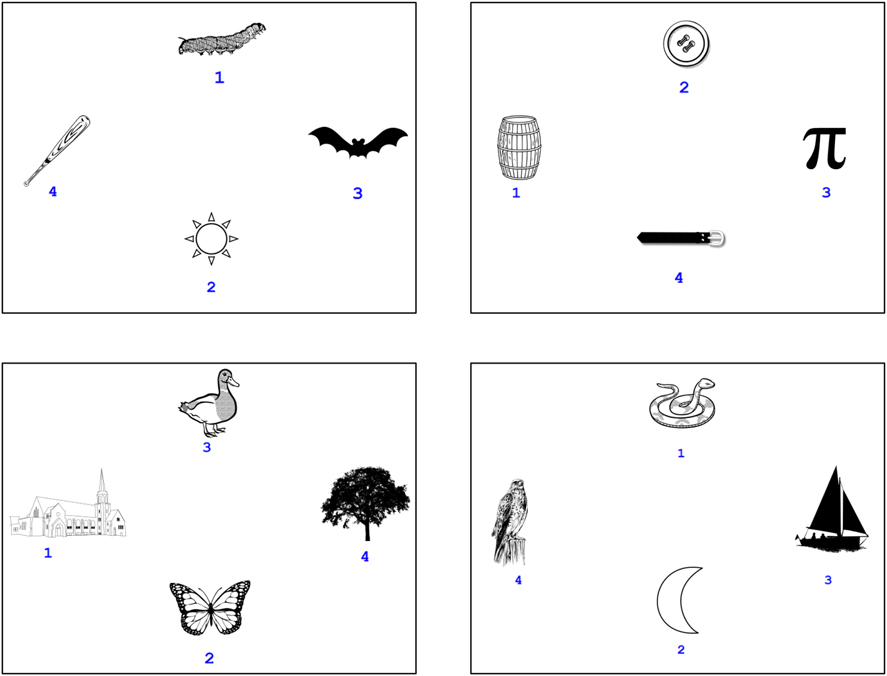
Sets of images. Participants were shown 40 arrays of four images each, for a total of 160 images. Images were taken from Bates and colleagues (Reference Bates, D’Amico, Jacobsen, Székely, Andonova, Devescovi and Tzeng2003), Ferreira and Cutting (Reference Ferreira and Cutting1997), Snodgrass and Vanderwart (Reference Snodgrass and Vanderwart1980), and the Internet. Fourteen pairs of targets and their lexically ambiguous foils, e.g., bat (animal) and bat (sports equipment), were chosen from the list of 18 pairs developed by Ferreira and colleagues (2005). Two of the target–foil pairs were used in practice trials before the main experiment. Of the remaining 12 pairs, six were used in critical trials and the six remaining target homophones were paired with non-homophones to serve as control trials. Critical trials with the target homophone and foil were intended to make the ambiguity of the target homophone more obvious to speakers. The remaining 24 arrays served as filler trials. Half the filler trials contained images which could be described with simple descriptions such as ball to encourage the production of bare homophones, and the final 12 filler trials contained at least one image which could be described with a compound noun, such as birthday cake, to encourage participants to add clarifying descriptors to their utterances. Examples of these stimuli can be seen in Figure 1.
Participants in Experiment 1 were shown a series of arrays, each with four images which were to be labeled in numerical order. Critical trials (top-left) included a homophone target with its homophone foil, in this case bat and baseball bat. Control trials (top-right) included a homophone target, e.g., pi, without its foil. Filler trials (bottom images) did not include homophones, but some included images that could be described with a compound noun, e.g., boat vs. sailboat, to encourage participants to use more specific descriptors. Images in this example are from Openclipart and licensed under Creative Commons Zero 1.0 Universal (CC0 1.0) Public Domain Dedication.

Constraint condition. Based on the results from our pilot study,Footnote 1 we decided to utilize word spans both to increase the level of cognitive load and to introduce semantic interference to the task. Thus, speakers would face not only the difficulty of maintaining a set of information over time, but this information could also affect their performance in the labeling task itself. In addition, we included a time constraint of 10s for participants in the high constraint condition. This duration was piloted with a research assistant to ensure participants had enough time to make their utterances while still feeling speeded. A red countdown bar on each array alerted participants in the high constraint condition to their remaining time. All participants were asked to remember a set of words (Low Constraint: two words; High Constraint: four words) for every block of trials, for a total of six sets of word spans. We selected monosyllabic words with moderate imageability ratings (Range: 3.4–4.9 on a 1–7 scale; M = 3.68, SD = 1.43; Cortese & Fugett, Reference Cortese and Fugett2004). These words were found to have moderate to high frequency on the Zipf scale from the SUBTLEX-US American English word frequency data (Range: 3.00–5.11 on a logarithmic 1–7 scale; M = 4.16, SD = 0.63; Brysbaert & New, Reference Brysbaert and New2009; Van Heuven, Mandera, Keuleers, & Brysbaert, Reference Van Heuven, Mandera, Keuleers and Brysbaert2014). The selected words were then assigned to lists to ensure that they were not noticeably semantically related.
Perspective-taking condition. Before beginning the study, participants in the perspective-taking condition viewed a simple directive that encouraged them to take the perspective of the listener. The slide read:
Now that you know the format of the study, think about the role of the listener. The listener must record the order of the images on the slides, but s/he cannot see the images. Take a moment to imagine being in the listener’s position. As you name the images during the study, please keep the listener’s viewpoint in mind.
The rest of the participants did not see this screen before beginning the study.
2.1.3. Procedure
Participants were told that the experiment was intended to study ambiguous words and phrases. The experiment was conducted using E-Prime software (Psychology Software Tools, Pittsburgh, PA <https://www.pstnet.com>) on a desktop computer. Participants were randomly assigned subject numbers before beginning the study. Demographic information, to include gender, age, and whether they were a native or fluent English speaker, was recorded on a separate hand-out tied to their subject number. Participants were randomly assigned to condition in a 2 (Constraint: Low = 47; High = 48) × 2 (Perspective-taking: No Directive = 47; PT Directive = 48) between-subjects factorial design. All participants were given instructions on wearing the microphone headset and how to speak into the microphone to ensure clear audio-recordings.
In the study, participants were shown arrays of four images each, with a number located next to each image. Participants were instructed to label the images in numerical order to the listener (a research assistant sitting in the room behind the participant but who was facing in the opposite direction), who could not see the screen. Participants were told that listeners had to record the images in order, but were not able to see the images. Thus, the listener could only know what image was in what order based on the speaker’s description. The position of the images was randomized across trials; however, for critical and control trials, the homophone target was always the third object, followed by either a homophone foil (critical trials) or non-homophone foil (control trials). For filler trials, the numbers that appeared under the images were presented in a pseudo-random order determined before the study. Trials were also presented in a pseudo-randomized order; a critical and control trial were present in every block of six trials, but the order of the trials in the block and the order of blocks were randomized.
After reading the instructions, participants completed a practice word span and four practice trials, both to acquaint them with the task and to ensure that participants were using the microphone correctly. The practice trials included critical, control, and filler trials. Participants were corrected by research assistants if they did not complete the task correctly (e.g., were labeling objects in the wrong order), and participants were encouraged to ask questions about the task before the practice session ended. Once participants started the main experiment, an asterisk appeared in the center of the screen at the beginning of each block of trials. This asterisk served as a fixation point and appeared for 750ms before being replaced by the word spans. The words stayed on the screen for 3s before moving on to the labeling task. In all arrays, the images remained onscreen while the participant labeled them for either an infinite amount of time (Low Constraint) or for 10s (High Constraint). Participants were able to move on to the next trial by pressing the spacebar or, for those in the high constraint condition, by letting the timer reach its end. At the end of each block of trials, participants were asked to recall the words. Upon completing the experiment, participants were debriefed.
2.2. results
2.2.1. Data preparation
Members of the research team transcribed the audio-recordings for critical and control trials, and a separate member of the team reviewed each transcription to ensure its accuracy. A member of the research team then coded each participant’s responses for whether the labels for the target and foil homophones were bare; that is, whether the label used to describe the homophone target (in critical and control trials) or homophone foil (in critical trials) contained only the homophone without further modification (e.g., bat rather than baseball bat). Following the method described by Ferreira and colleagues (2005), only the first fluent label was coded. Descriptions that were missing or failed to describe the image (e.g., saying something to label the image of a fish tank) were removed from analyses, resulting in five descriptions being removed. Separately, the word span data from a participant in the high constraint / no directive condition were missing due to experimenter error; this participant was removed from analyses on word span recall. Transcribers and coders were blind to participants’ condition, although they were not blind to the study hypotheses.
Data were imported into R Studio (Version 1.0.153; RStudio Team, 2016) using the haven package (Wickham & Miller, Reference Wickham and Miller2019). Data were analyzed using R software (version 3.4.1; R Core Team, 2017) with the stats (R Core Team, 2017), psych (Revelle, Reference Revelle2017), car (Fox & Weisberg, Reference Fox and Weisberg2011), afex (Singmann, Bolker, Westfall, Aust, & Ben-Shachar, Reference Singmann, Bolker, Westfall, Aust and Ben-Shachar2019), and lme4 (Bates, Maechler, Bolker, & Walker, Reference Bates, Maechler, Bolker and Walker2015) packages.
2.2.2. Data analysis
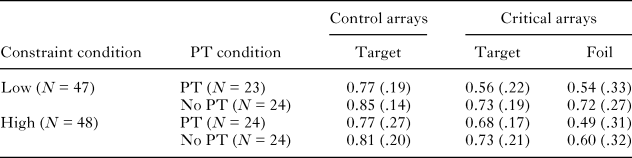
Participants recalled 52.90% of the word spans on average. Participants differed in their performance by constraint condition (Welch’s t (86.77) = 6.93, p < .001) (Levene’s test indicated unequal variances). Those in the low constraint condition remembered a significantly greater proportion of words than those in the high constraint condition (M Low = 0.68, SEM Low = 0.02; M High = 0.38, SEM High = 0.02), suggesting that it was more difficult to recall the words in the higher constraint condition. Further, participants produced mostly bare homophones overall (68.68% of valid utterances coded as bare).
We fit the data to a mixed logistic regression model with fixed effects for constraint (Between: High or Low), perspective-taking (Between: PT Directive or No Directive), homophone type (Within: Critical Target, Critical Foil, or Control Target), and their interactions; with random intercepts for participants and individual arrays; and random slopes for homophone type by participant and load by individual array. Predictors were sum coded, with low constraint, no directive, and the control target homophone as reference groups. Significance tests were conducted using likelihood ratio tests comparing the full model to the restricted model without the effect for all predictors. All data and code have been made publicly available at <https://osf.io/snkbr/>
There was no effect of homophone type. Participants were just as likely to produce bare homophones for critical targets (B = –0.19, SE = 0.64, 95% CI[–1.44, 1.06], p = .769) and critical foils (B = –0.69, SE = 0.65, 95% CI[–1.95, 0.58], p = .288) as they were for control targets. Additionally, level of cognitive constraint alone did not have a significant effect on the production of bare homophones (B = –0.12, SE = 0.20, 95% CI[–0.50, 0.26], p = .544). However, perspective-taking condition did have a significant effect (B = –0.51, SE = 0.20, 95% CI[–0.90, –0.12], p = .011). Those who did not receive the directive produced more bare homophones than those who did (M NoPT = 0.74, SD = 0.19; M PT = 0.64, SD = 0.21).
There were also significant interactions between homophone type and level of constraint (B = 0.34, SE = 0.13, 95% CI[0.09, 0.59], p = .007; and B = –0.36, SE = 0.16, 95% CI[–0.68, –0.04], p = .028). Speakers under lower constraint avoided ambiguity at a similar rate for both the critical target and critical foil homophones (M LowxCriticalTarget = 0.65, SD = 0.22; M LowxCriticalFoil = 0.63, SD = 0.31), whereas those under higher constraint avoided ambiguity more for critical foils (M HighxCriticalTarget = 0.70, SD = 0.19; M HighxCriticalFoil = 0.55, SD = 0.32); all speakers were more likely to produce bare homophones for the control target homophones (M LowxControlTarget = 0.81, SD = 0.17; M HighxControlTarget = 0.79, SD = 0.24). There were no other significant interactions among our three fixed effects (ps > .149). Controlling for the proportion of load words recalled (n = 94) did not change our pattern of results, and proportion of load words recalled did not account for significant variance in our model (B = 0.34, SE = 0.66, 95% CI[–0.95, 1.63], p = .603). The proportion of bare homophones by participant condition are reported in Table 1.
Mean proportion of bare utterances by experimental condition

notes: Mean proportion collapsed across participants and arrays. Standard deviations are shown in parentheses. PT = Perspective-taking.
2.3. discussion
Participants were generally likely to label homophones without additional descriptors. Although the percentage of bare utterances appears high, the rate of bare homophones is similar to that reported by Kempe and colleagues (2013; mean proportions for bare homophones ranged from 0.34 to 0.68 in the critical arrays to 0.77 to 0.78 in the control arrays). We did not find any main effects of homophone type. After data had already been collected, we noticed that some of the non-target images in both the critical and control arrays were also homophones (e.g., sun, bear). This undoubtedly altered the intended level of homophony in our arrays and may have masked any main effect of homophone type.
However, there were significant interactions between homophone type and the level of cognitive constraint, suggesting that the effect of load differed based on which arrays speakers viewed. Further, we observed a general pattern for all participants to produce fewer bare homophones in critical compared to control arrays, consistent with previous findings that speakers would be less likely to produce bare utterances when they viewed a target homophone with its homophone foil (Ferreira et al., Reference Ferreira, Slevc and Rogers2005; Kempe et al., Reference Kempe, Rookes and Swarbrigg2013). These results are in line with claims that speakers are mostly unaware of the potential ambiguity of the homophones unless the context makes the ambiguity explicit. It is possible that speakers, particularly those under higher constraint, did not realize that the homophones had multiple meanings until they viewed both the homophone target and its foil. Audience design may have also informed speaker utterances. Previous work by Lockridge and Brennan (Reference Lockridge and Brennan2002) found that speakers are more likely to mark atypical information when their addressees do not have access to the same visual information. Speakers in our study may have assumed that the meaning of the homophones were typical and thus understood, only avoiding ambiguity when they realized the listener likely needed clarity.
We also found that the likelihood of producing bare homophones significantly differed by perspective-taking condition. Those who received the simple perspective-taking direction were less likely to produce bare utterances than those who did not. Nearly 74% of all utterances by those who received no directive were bare homophones, whereas those who received the instruction to imagine themselves as the listener produced bare homophones around 64% of the time. While not a large difference, these findings provide some indication that even a simple instruction could benefit clear communication.
We did not replicate previous work that found additional cognitive load and pressure directly impairs communication clarity (e.g., Lin et al., Reference Lin, Keysar and Epley2010; Roßnagel, Reference Roßnagel2000, Reference Roßnagel2004). This failure to replicate may have been due in part to the nature of the method used in this experiment. All speakers in Experiment 1 were under additional cognitive constraint, which may have limited our ability to detect a main effect. Speakers in this study also produced a high percentage of bare utterances overall, and it may be the case that the effects of cognitive constraint can only be observed in situations where the ambiguity is more likely to be avoided.
3. Experiment 2
3.1. method
In Experiment 2, we sought to replicate the effect of cognitive constraint in another novel context: potentially syntactically ambiguous utterances. We again explored the utility of a simple perspective-taking directive in moderating ambiguity avoidance. Adopting the methodology used by Kempe et al. (Reference Kempe, Rookes and Swarbrigg2013), we instructed speakers to give directions to a listener on where to move certain objects within a given array. Again, listeners were not able to communicate with the speaker. In the critical arrays, one of the objects in the array was duplicated (e.g., two snakes), requiring speakers to add a modifying clause to make clear which of the two objects was being referred to. Participants could produce either an unreduced relative clause (clauses that include pronouns such as which or that; e.g., Move the snake that is next to the star left of the ant), a reduced relative clause (clauses that omit pronouns such as which or that; e.g., Move the snake next to the star to the left of the ant), or fail to modify the object altogether (e.g., Move the snake to the left of the ant).
As in Experiment 1, participants were randomly assigned to a constraint and perspective-taking condition; however, to maximize our chances of observing an effect of cognitive constraint, we assigned participants to receive either no additional load or the higher cognitive constraint condition from Experiment 1. We expected that those under higher constraint would be more likely to produce syntactically ambiguous instructions; that is, they would produce fewer unreduced clauses, which are unambiguous, and would instead produce more reduced clauses (which are ambiguous without the other information in the array) and unmodified clauses (which are entirely ambiguous). Separately, those who received the perspective-taking instruction would be more likely to produce unreduced clauses, and the instruction would moderate the effects of cognitive constraint.
3.1.1. Participants
Ninety-five undergraduate students received course credit for participating in this study. Eight participants’ data were removed due to technical error with the recording, and three participants’ data were removed because they self-reported insufficient English proficiency as indicated on the same scale as in Experiment 1. This left us with a final sample of 84 participants, 82 of whom provided demographic data (Male = 36.58%; M Age = 19.21, SD = 2.52; Age Range = 18–38). Five participants indicated that they were not native English speakers, but all five stated they spoke English with native proficiency. All participants in Experiment 2 were naive to the study procedures.
3.1.2. Materials
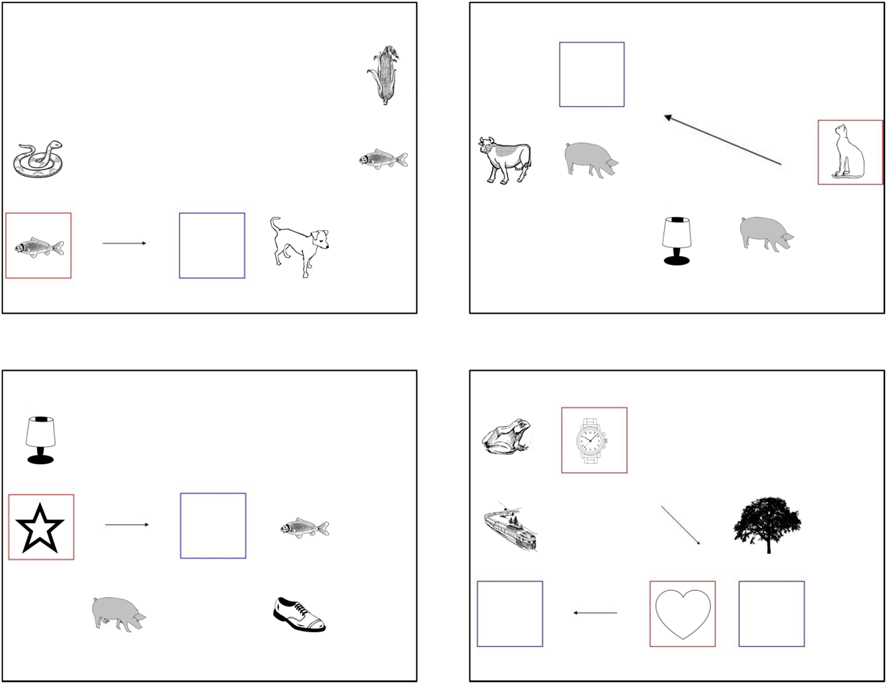
Sets of images. Participants were shown 34 arrays featuring five images each. These images were pulled from a total of 20 images of monosyllabic nouns following the method by Kempe and colleagues (2013). Although some of the images were taken from Experiment 1, we also chose new monosyllabic noun images from Bates and colleagues (Reference Bates, D’Amico, Jacobsen, Székely, Andonova, Devescovi and Tzeng2003), Ferreira and Cutting (Reference Ferreira and Cutting1997), Snodgrass and Vanderwart (Reference Snodgrass and Vanderwart1980), and the Internet. On each array the five images were arranged such that some images were near each other and others were not. A red box surrounded the object to be moved, and an arrow pointed to an empty blue box that indicated the object’s destination. In the 16 critical trials, either the image to be moved (direct object) or the image near the destination (oblique object) was duplicated. An unrelated image was located near the duplicated ones so that participants could specify which object they were describing. In arrays with a duplicated direct object (direct arrays), participants were required to modify the direct object to avoid ambiguity. For example, if a fish was duplicated, participants would need to say, Move the fish (that’s) under the snake to the left of the dog. In arrays with duplicated oblique objects (oblique arrays), participants would need to clarify the oblique object. Therefore, if a pig was the duplicated object, participants would need to specify, Put the cat above the pig (which is) next to the cow.
We designed two sets of direct and oblique arrays: our original designs and another two sets where the direct objects were turned into oblique objects and vice versa. The resulting four design combinations were counterbalanced across participants. Of the remaining arrays, 14 served as filler trials. Half the fillers included a single arrow, and the other half included two arrows to indicate the movement of two objects to encourage the production of more complex sentences. The remaining four arrays served as practice trials for each of the array types. Examples of these arrays are presented in Figure 2.
Participants in Experiment 2 were shown a series of arrays that included five images. Red boxes indicated which item was to be moved, with arrows leading to a blue box indicating where the item was to be moved to. Participants saw either critical trials (top) or filler trials (bottom). In critical trials, one of the images was duplicated – either the item to be moved (direct arrays; top-left) or an item near the destination (oblique arrays; top-right). Filler trials did not have duplicated images; however, filler trials had either one or two items to be moved to encourage participants to vary their sentence structures. Images in this example are from Openclipart and licensed under Creative Commons Zero 1.0 Universal (CC0 1.0) Public Domain Dedication.

Experimental conditions. Experiment 2 used the same constraint and perspective-taking materials as Experiment 1. However, we only assigned word spans and time limits to those in the high constraint condition. Other participants did not receive any word spans or time pressure. As a result, participants with no additional constraint had only one task, while the remaining participants had two tasks to complete while under added cognitive pressure. The perspective-taking instructions were modified to reference the current task.
3.1.3. Procedure
Participants were told that the experiment was intended to study how people give instructions. Once again, the listener was in the room with the participants, but could not see the computer screen. Participants were told that the listener they were directing had a copy of the arrays but that this copy did not show the boxes or arrows. Thus, listeners would only know which object to move based on the speaker’s directions. The experiment was again conducted on a desktop computer using E-Prime software. Participants were randomly assigned subject numbers before the experiment and randomly assigned to one of four groups in a 2 (Constraint: None = 44; High = 40) × 2 (Perspective-taking: No Directive = 44; PT Directive = 40) between-subjects factorial design. All participants were given instructions on wearing and operating the microphone headset.
Before beginning the experiment, participants completed four practice trials. One of the practice trials was a direct array (with a duplicated direct object), another was an oblique array (with a duplicated oblique object), and the other two practice trials were fillers. These same arrays were not used in the main experiment. Participants in the high constraint condition also completed a practice trial for the word spans. To discourage participants from giving lengthy, awkward directions, we added an example response following each of the practice slides. These examples included both reduced relative clauses and unreduced relative clauses to avoid priming participants to follow any one response pattern. Participants were corrected by the research assistant if they failed to follow the instructions (e.g., were not describing the correct objects), and once again were given the opportunity to ask questions before beginning the experiment.
The order of the arrays was pseudo-randomly determined; at least one direct and one oblique array was present in every block (no more than three per block), but the order of the trials in the block and the order of blocks were randomized. In the main experiment, each block of five trials was preceded by an asterisk functioning as a fixation point that would appear for 750ms. Participants in the no constraint condition would then proceed to the instruction task with no time limit. Those in the high constraint condition, however, would see the word spans for 3s before beginning the task. Further, these participants would only have 5s per array, as indicated by a red countdown bar, before being forced to move on to the next array. The images remained on screen while the participant labeled them either until they pressed the spacebar or until the timer ran out. At the end of each block, a screen appeared requiring the high constraint participants to recall the word span for that set. At the end of the experiment, all participants were debriefed.
3.2. results
3.2.1. Data preparation
Members of the research team transcribed the participants’ audio-recordings. Once the direct and oblique trials were transcribed, a member of the research team coded the utterances for two factors: whether the utterance contained an unreduced relative clause and whether the utterance failed to provide any clarifying modifiers at all. Once again, transcribers and coders were not blind to the hypotheses of the study but were blind to the conditions to which participants had been assigned. Twelve utterances were removed from analyses because participants did not give complete instructions (n = 6), provided incorrect instructions (e.g., telling the listener to move the wrong item; n = 3), or could not otherwise be coded (i.e., failed to mention the duplicated item or used a pronoun with an unclear referent; n = 3).
3.2.2. Data analysis
To explore how our manipulations affected participants’ utterances, we ran a mixed logistic regression model with constraint (Between: High or None), perspective-taking (Between: PT Directive or No Directive), array type (Within: Oblique or Direct), and their interactions entered as fixed effects; participants and the specific arrays as random intercepts; and array type by participant and constraint by specific array entered as random slopes. The predictors were sum coded, with no constraint, no perspective-taking directive, and direct arrays as reference groups. Once again, for all predictors we conducted significance tests using likelihood ratio tests that compared the full model to the restricted model without the effect of interest. We ran the same analyses separately to predict the likelihood of producing unreduced relative clauses and omitted object modifiers. All data and code for this experiment can be found at <https://osf.io/snkbr/>
Participants’ proportion of unreduced relative clauses were negatively correlated with their proportion of omitted object modifiers (r(82) = –0.55, p < .001). Of all valid utterances, nearly half were unreduced relative clauses (42.72%). Only 26.20% of valid utterances had no object modifiers. Additionally, participants in the high constraint condition recalled 8.35 out of 24 possible load words (M proportion = 0.35, SEM = 0.03) on average.
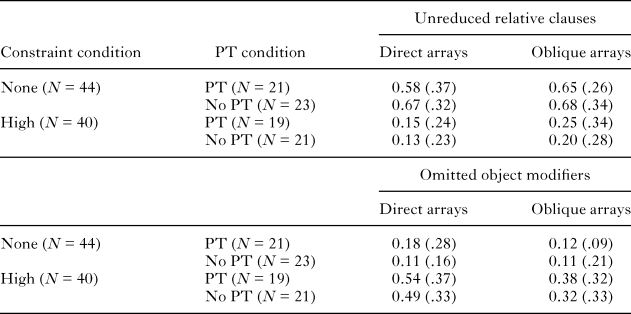
Constraint had a significant effect on the production of unreduced relative clauses (B = –1.87, SE = 0.28, 95% CI[–2.41, –1.32], p < .001). Participants with the additional load task and time pressure were less likely to produce unreduced relative clauses than those with no additional constraints (M High = 0.18, SD = 0.25; M None = 0.65, SD = 0.30). There was also a significant effect of array type (B = –0.31, SE = 0.14, 95% CI[–0.58, –0.03], p = .028). Speakers produced unreduced relative clauses at a greater rate when the duplicated image was the oblique object (M Oblique = 0.46, SD = 0.38; M Direct = 0.39, SD = 0.38). However, the perspective-taking directive did not have a significant effect (B = –0.05, SE = 0.26, 95% CI[–0.56, 0.46], p = .841). There were no significant interactions among our three fixed effects (ps > .314).
Cognitive constraint also had a significant effect on the omission of object modifiers altogether (B = 1.34, SE = 0.25, 95% CI[0.85, 1.84] p < .001). Participants in the high constraint condition were more likely to produce entirely ambiguous utterances when describing the duplicated item (M High = 0.41, SD = 0.32; M None = 0.12, SD = 0.17). Additionally, there was an effect of array type (B = 0.56, SE = 0.18, 95% CI[0.22, 0.91], p = .002). Speakers were more likely to omit object modifiers in direct arrays (M Oblique = 0.20, SD = 0.29; M Direct = 0.32, SD = 0.34). There was again no effect of perspective-taking (B = 0.08, SE = 0.25, 95% CI[–0.40, 0.56], p = .751), and no interactions among our fixed effects were significant (ps > .294). The mean proportion of unreduced relative clauses and omitted object modifiers by experimental condition are reported in Table 2.
Mean proportion of unreduced relative clauses and clauses without object modifiers by condition

notes: Mean proportion collapsed across participants and arrays. Standard deviations are shown in parentheses. PT = Perspective-taking.
3.3. discussion
Participants’ ability to produce syntactically unambiguous instructions differed by level of cognitive constraint. Those who were assigned to the high constraint condition were less likely than their counterparts to produce unreduced relative clauses, instead producing more utterances with no object modification whatsoever. When under additional cognitive pressure, our speakers were less likely to correct information that could be unclear to the listener. These findings are in line with previous research that has found an effect of cognitive load on speaker clarity (e.g., Lin et al., Reference Lin, Keysar and Epley2010; Roßnagel, Reference Roßnagel2000, Reference Roßnagel2004), and extend this literature to syntactically ambiguous utterances.
We also observed effects of array type on speakers’ likelihood to produce completely unambiguous or completely ambiguous utterances. Although it was explicitly highlighted during the practice that both direct and oblique objects could be duplicated, speakers were more likely to provide unreduced relative clauses in oblique arrays and entirely omit modifiers to the duplicated object in direct arrays. By focusing on where the item was to be moved, speakers may have been more likely to notice and therefore modify the duplicated oblique object. Alternatively, speakers may have missed the duplicated direct object as they quickly looked across the array to form their instructions or may have realized their mistake but were unable or unwilling to correct it. Eye-tracking technology would provide insight into what speakers were attending and how their attention changed over time while forming their utterances.
The findings from this experiment replicate previous work on the negative effect of cognitive load on speakers’ ability to tailor their messages. Our speakers were less able to avoid potential ambiguity when under higher cognitive constraint, suggesting that they were unable to monitor or adjust for common ground effectively. Unlike Experiment 1, however, the results from Experiment 2 did not provide support for our hypotheses regarding the simple perspective-taking instruction. Those who received the perspective-taking instruction were no more ambiguous than those who didn’t receive the directive, and there was no evidence to support our hypothesis that receiving the directive moderated the effect of cognitive constraint. Additional cognitive constraint may impair one’s ability to give clear instructions, but an appeal to imagine oneself in the place of the listener is not enough to overcome those effects.
4. General discussion
Although it is rare that a speaker’s failure to clearly communicate would be cause for serious concern, incidents such as the Tenerife Air Disaster highlight the importance of producing clear and understandable utterances, particularly in situations where competing cognitive demands may draw attention elsewhere. Investigating how higher levels of cognitive constraint affect the clarity of a speaker’s message is particularly important as people increasingly engage in multitasking during both their working and leisure hours (Carrier, Cheever, Rosen, Benitez, & Chang, Reference Carrier, Cheever, Rosen, Benitez and Chang2009; Russ & Crews, Reference Russ and Crews2014). This research replicates previous work on the effect of cognitive pressure on a speaker’s ability to avoid confusion in non-interactive communication tasks and provides an initial examination of a simple perspective-taking directive as a means of moderating the negative effects of constraint.
In both of our studies, increased cognitive constraint impaired speakers’ ability to avoid ambiguous utterances. We observed a significant main effect of cognitive constraint on the level of ambiguity in speakers’ directions in Experiment 2, replicating previous work that found cognitive load impairs a person’s ability to sufficiently adjust for the perspective of their addressee (Epley et al., Reference Epley, Keysar, Boven and Gilovich2004; Roßnagel, Reference Roßnagel2000, Reference Roßnagel2004). Compared to speakers with only the instructions task, speakers who were assigned to recall the word spans and provide instructions under time pressure were more likely to produce completely ambiguous statements. In contrast, the effect of constraint on speaker clarity in Experiment 1 depended not only on the level of constraint, but also on the type of homophone speakers were labeling. This distinction between the two studies suggests that utterance-specific factors likely moderate the impact of cognitive constraint on speaker clarity.
Based on these findings, it may be the case that speakers’ ability to avoid confusion depends on the type of ambiguity they encounter. Previous work on this topic has found speakers are less confident in their ability to convey the correct meaning of lexically compared to syntactically ambiguous sentences and in fact are less likely to clearly communicate the meaning of lexically ambiguous utterances (Fay, Page, Serfaty, Tai, & Winkler, Reference Fay, Page, Serfaty, Tai and Winkler2008; Keysar & Henly, Reference Keysar and Henly2002). In line with these findings, speakers overall in Experiment 1 were more likely to produce ambiguous, bare homophones, whereas in Experiment 2 speakers rarely produced entirely unmodified utterances. However, since speakers in non-interactive situations would more likely be directing their addressees than labeling homophones to them, the fact that over a quarter of utterances in Experiment 2 were unmodified is still of particular concern.
The different findings regarding the effect of cognitive constraint between Experiments 1 and 2 could also be due to our use of different cognitive constraint conditions in the two studies. All speakers in Experiment 1 were engaged in two tasks at some level of cognitive constraint, whereas half the speakers in Experiment 2 only had one task. Separately, speakers in Experiment 2 not only had to process the information from the boxes and arrows, but also retrieve the labels for the images involved, as well as produce the instructions. The addition of a secondary task may have constricted aspects of the advance production planning necessary in these longer utterances (Wagner, Jescheniak, & Schriefers, Reference Wagner, Jescheniak and Schriefers2010), resulting in the observed effect of cognitive constraint. By contrast, speakers in Experiment 1 only needed to process numerical order and retrieve and produce the lexical forms of the images. The addition of load may not have been enough to interrupt this process, but it may have impaired speakers’ ability to identify the homophony associated with the produced label. We note that it is unclear if we would have still found an effect of constraint if all participants in Experiment 2 completed the word spans. The use of parallel study designs would have allowed us to make more definitive comparisons of the effect of constraint on lexical and syntactic ambiguity avoidance.
Although we did replicate previous findings that cognitive constraint impacts speakers’ ability to be clear, evidence for our simple perspective-taking directive was mixed. Those who received the instruction in Experiment 1 were less likely to produce bare homophones, but speakers in Experiment 2 were not affected by the presence of the directive. Compared to social judgment, monetary incentive, or direct experience as the listener in the task (e.g., Traxler & Gernsbacher, Reference Traxler and Gernsbacher1993), a simple slide encouraging speakers to imagine themselves as the listener was not enough to noticeably increase participants’ ambiguity avoidance when they were already less likely to produce ambiguous utterances. Further, the effects of imagining oneself in the place of another and imagining how another person will act can have distinct effects (see Batson, Early, & Salvarani, Reference Batson, Early and Salvarani1997; Vorauer & Sasaki, Reference Vorauer and Sasaki2014), and may not have been a particularly effective strategy in Experiment 2. Because speakers have access to both egocentric and shared information (Horton & Keysar, Reference Horton and Keysar1996; Keysar et al., Reference Keysar, Barr, Balin and Brauner2000), speakers imagining themselves as the listener could have easily conflated their privileged and shared information when forming their instructions, and what speakers anticipated as clear may in fact have been unclear to others. Despite its simplicity, this manipulation was not enough to overcome all potentially ambiguous utterances, and individuals and organizations should be advised that, based on our findings, such directives are unlikely to be effective in more realistic scenarios.
Our results highlight the need for further work on one factor critical to avoiding miscommunication: awareness. No matter the level of cognitive load or time pressure an individual is under, or their motivation to be clear, speakers who are unaware that an utterance could be confusing are unlikely to correct it. Speakers are often unaware that their messages could be unclear, with some studies finding that around 80% of speakers feel that their listeners should understand their message when in fact they do not (Fay, Page, & Serfaty, Reference Fay, Page and Serfaty2010; Keysar & Henly, Reference Keysar and Henly2002). Thus, the speakers in our studies may have not only missed the potential for an utterance to be unclear but also overestimated how well they were communicating when making efforts to be unambiguous. Future research on how cognitive load affects speaker clarity should explore not only how conscious speakers are of potential ambiguity, but also whether making speakers more aware of the type of potential ambiguity and how to avoid it can improve communication effectiveness.
Our speakers in Experiment 1 were generally more likely to avoid the potential ambiguity around a given homophone when the target homophone was labeled alongside its homophone foil, in line with previous findings using this methodology (Ferreira et al., Reference Ferreira, Slevc and Rogers2005; Kempe et al., Reference Kempe, Rookes and Swarbrigg2013). In a similar vein, all speakers in Experiment 2 were more likely to avoid ambiguity when the duplicated object was near the target destination rather than when the target itself was duplicated. Thus, context appears to be an important indicator for speakers’ ability to avoid confusion and may moderate the effects of cognitive constraint in some instances. Understanding which contexts are likely to be ambiguous and go unnoticed by speakers should be a critical first step in forming guidelines that promote clear communication in non-interactive situations.
Several experimental limitations restrict the extent to which we can generalize our findings. First, our experiments investigated a speaker’s ability to avoid ambiguity solely through the content of their messages. Our research team transcribed spoken text that raters independently evaluated. However, speakers can avoid ambiguity through means other than content alone. For instance, Kraljic and Brennan (Reference Kraljic and Brennan2005) found that speakers consistently used prosodic cues to disambiguate syntactically ambiguous utterances. Although speakers used these cues with no real regard to their listener, listeners benefited from their use and were able to avoid potential ambiguity. Therefore, our conclusions are limited to the verbal content of speakers’ messages, and it may be the case that speakers were employing other means of disambiguating that we did not explore here. Second, although we placed speakers in a room with a listener, speakers were aware of the experimental nature of our work. Research assistants who instructed participants on the task also served as the listener once the main task began, and speakers may have approached the task differently than if they were engaged in a communication task with a person who had no association or unknown association with the research team. Finally, although research assistants provided guidance to ensure that speakers were clear on the nature of the task, participants in this study may not have seriously attended to all of the instructions presented on screen, including the critical instruction to imagine themselves as the listener.
Our findings add to the work on the impairing effects of cognitive constraint on communication. Although a simple directive to imagine oneself as the listener showed promise in avoiding lexical ambiguity, this directive was not sufficient to improve speaker clarity when giving directions. These results speak to a need for a reliable method to encourage and maintain clear and effective one-way communication, and future research should explore other interventions to investigate their effectiveness in non-interactive situations. Speakers in multitasking situations or whose cognitive resources are otherwise tasked may be especially at risk for producing unclear utterances. As situations where cognitively constrained speakers are unable to receive immediate feedback are more likely to result in unresolved ambiguity, speakers and listeners in these situations should be particularly cognizant of the content of their messaging, and organizations should implement current best practices regarding communication to avoid adverse outcomes.