

Introduction
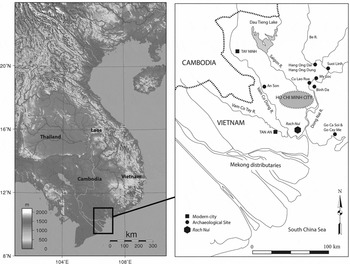
While ground stone tools are common at Neolithic sites in Vietnam, archaeological attention has, until recently, focused more on typological and chronological sequencing than on technology. Recent research into the ground stone implements recovered from the Neolithic (3500–3200 cal BP) sites of Rach Nui and An Son in southern Vietnam, however, has provided interesting insights into ground stone technology at this period (Figure 1). The discovery of a single, particularly interesting grinding stone is taken here as a starting point for a wider discussion of the context and sequence of the production of ground stone tools at these sites. Comparison with the more abundant evidence available from prehistoric Europe is drawn upon in exploring Neolithic stone technology in Vietnam. In particular, the movement of lithic raw materials and the knowledge with which to work them must be carefully considered as we begin constructing more complex models of the economy and society of Neolithic southern Vietnam.
Locations of the archaeological sites mentioned in the text.

Archaeological background
The archaeological site of Rach Nui is located at coordinates 106o40’37”E/10o32’45”N, close to the town of Can Giuoc in Long An Province, near the confluence of the Vam Co Dong, Vam Co Tay and Dong Nai Rivers, approximately 22km from the modern coastline. The contemporary environment is probably similar to that when the settlement was occupied c. 3500 cal BP, and consists of low-lying tidal mangrove and nipa swamp forest, intersected by numerous small channels. Rach Nui consists of a mound approximately 75m in diameter that rises between 5 and 6m above the surrounding landscape. The Linh Son Buddhist pagoda was constructed on top of the mound in 1867 (Oxenham et al. Reference Oxenham, Piper, Bellwood, Bui, Nguyen, Nguyen, Campos, Castillo, Wood, Sarjeant, Amano, Willis and Ceron2015).
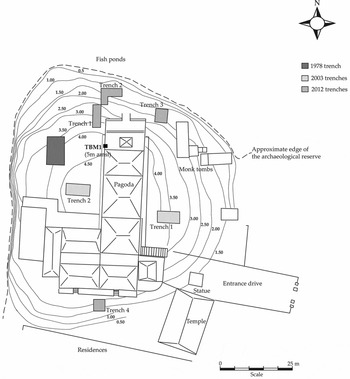
Three phases of excavation at the site revealed a complex stratigraphic history indicative of continuous occupation during the early Neolithic period. Initial excavation of a single trench 10m long and 6m wide north-west of the pagoda was undertaken in 1978 by staff from the Ho Chi Minh Institute of Social Sciences and the Culture and Information Service in Long An Province, led by Phạm Quang Son (Figure 2). The archaeologists identified floor surfaces and dark ash layers within the 5m-deep stratigraphy. They also recovered thousands of artefacts, including sherds of coarse pottery, ground stone adzes and grinding stones (Phạm Reference Phạm1978). In 2003, members of The National Museum of Vietnam History in Hanoi and the Long An Provincial Museum conducted further excavations at Rach Nui (Code RN03), opening two east–west-oriented trenches to the east (trench 1) and west (trench 2) of the pagoda, close to the top of the mound. As in the 1978 excavation, vast quantities of pottery were recovered throughout the archaeological sequence, along with stone artefacts and ornaments manufactured from bone and shell. Charcoal from trench 1 at a depth of 2.35m produced dates of 3434–3126 cal BP (95.4%) and 3531–3258 cal BP (95.4%; HNK-177/2; all dates herein have been re-calibrated using OxCal 4.2 and IntCal13). A further single piece of charcoal at a depth of 4.7m produced dates of 3695–3447 cal BP (92.9%) and 3903–3611 cal BP (95.1%; HNK-177/3) (Nguyen Manh Thang Reference Thang2005).
Plan of the Rach Nui site and excavation trenches.

A collaborative team, from the Australian National University, Center for Archaeology, Southern Institute of Social Sciences, Ho Chi Minh City and Long An Provincial Museum, returned to the site in 2012 (Oxenham et al. Reference Oxenham, Piper, Bellwood, Bui, Nguyen, Nguyen, Campos, Castillo, Wood, Sarjeant, Amano, Willis and Ceron2015). Three trenches (1–3) investigating the north and north-east sides of the Rach Nui mound (Figure 2) yielded Neolithic deposits up to 4.5m deep. These deposits consisted of a complex sequence of platforms and structures surrounded by fences. The platforms and associated structures appear to have been routinely demolished and completely replaced, with at least 13 reconstruction phases identified. Bayesian statistical analysis of 14 radiocarbon charcoal samples ranging from the basal deposits to Phase 13 indicate that the remaining construction sequences at Rach Nui were erected within 33 and 175 years, commencing c. 3500 cal. BP and probably terminating c. 3300 cal BP (Oxenham et al. Reference Oxenham, Piper, Bellwood, Bui, Nguyen, Nguyen, Campos, Castillo, Wood, Sarjeant, Amano, Willis and Ceron2015).
No flaked stone artefacts have been recorded at Rach Nui. Stone flakes were recovered, however, that were deliberately or inadvertently removed from polished stone adzes and/or chisels. Unshouldered quadrangular forms dominate the polished stone adze assemblage, with fewer shouldered specimens. Several complete and fragmented grinding stones were also retrieved, as well as a number of hammer stones. The presence of a variety of stone implements at Rach Nui and other Neolithic sites elsewhere in the region is particularly significant, as no high-quality stone for formal implement (e.g. adze) production is present anywhere in lowland southern Vietnam. Consequently, the inhabitants of Rach Nui, and Go Ca Soi and Go Cay Me in Vung Tau Province, must have imported stone implements from outside the region. Archaeological investigations in the northern reaches of the Dong Nai River, at sites such as Hang Ong Dai, Hang Ong Dung and Suoi Linh (all approximately 80km to the north-east of Rach Nui), have yielded evidence for specialist stone-working workshops established at lithic raw material sources (Figure 1). The presence at these sites of thousands of stone flakes produced during the initial shaping of preforms, and large grinding tables for the shaping and polishing of the implements, has been read as suggesting that the entire chaîne opératoire of tool production took place at these sites, and that completed stone adzes circulated outwards from there to settlements such as Rach Nui (Nguyen Reference Nguyen2017).
A stone tool for making stone tools
Among the 22 complete and partial grinding stones catalogued from the 2003 excavations at Rach Nui was an oblong grinding stone, with distinct wear traces on four surfaces (RN.03.H2.L10.72—BTLA2312.Da538). The artefact was originally illustrated by Nguyen Manh Thang (Reference Thang2005: fig. 12 ‘Ban Mai [grinding stone]’), but was not described in the report. It was recovered from trench 2 in layer 3 (see above), at a depth of approximately 2.5–2.7m below the modern ground surface. The stratigraphic location of the grinding stone probably places it towards the later stages of site occupation, perhaps between 3400 and 3300 cal BP.
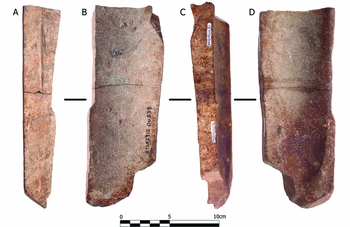
The grinding stone (Figure 3) was originally manufactured from light blue-grey, fine-grained sandstone that has since become discoloured by iron staining. Concreted sediments also adhere to some surfaces. It was found broken into two easily reassembled pieces, although a fragment is still missing from one corner. It is more or less rectangular in plan and quite slim, but considerably thinner at the centre than at the edges due to the deeply worn grinding depressions. It measures 210mm in length (along the unbroken edge) and 75mm in width. The edge with the missing corner is 168mm long. The thickness at the longer edge is 34mm, and it is 21mm at the shorter edge. The thickness within the central depressions varies across the piece due to grinding, but the thicker end is 18mm thick, while the thinner end is only 14mm thick.
Grinding stone Ban Anh 12/RN.03.H2.L10.72. A–D represent the four grinding surfaces identified.

Four of the six faces show distinctly different wear traces that, as suggested below, would have resulted from different stages in the process of stone adze maintenance and repair. The two faces that do not show wear are the edge faces on the thin ends of the grinding stone.
Surface 1 (Figure 3A) is the longer of the two long edges, opposite surface 3, and not bearing a label. This face was clearly used for honing or sharpening blade edges. Near the thin edge, at the centre of the face, is a long, thin depression (88 × 7mm and approximately 22mm deep), which can only have functioned to sharpen the cutting edge of stone tools. Some longitudinal striations are present on the thicker part of the edge face, one of which is longer and slightly deeper and may represent the start of a second blade-sharpening notch.
Surface 2 (Figure 3B) is the wide face of the grinding stone that bears the written-on accession number (starting BTLA). This surface is characterised by a shallow, basin-shaped depression that runs the length of the piece. This depression varies in depth, and the implement is slightly thicker at one narrow end. Concretion makes the surface texture difficult to assess, but it appears somewhat rough. There are numerous very fine striations oriented with the long axis of the grinding stone, indicating that a regular and repetitive grinding motion clearly followed the long axis. For abrasive striations such as these to form, the material being ground on this stone must have been more durable than the sandstone itself (cf. Adams Reference Adams2002: 30).
Surface 3 (Figure 3C) is the shorter of the two long edges, and the one bearing written-on accession numbers. Near the thinner end, close to the broken corner, is a small area of longitudinal grinding striations. These striations are very even and unidirectional, consistent with repeated grinding actions.
Surface 4 (Figure 3D) is the unlabelled wide face of the grinding stone opposite surface 2. As with surface 2, a shallow grinding depression is present, but here the depression is visibly shallower and considerably smoother, with no visible striations. The surface is divided into two separate, smaller depressions with a slightly raised area between them. One of the two shallow depressions is heavily stained a dark, reddish-brown colour. Staining within one of the working facets may have been intentional, and possibly contributed to the tool's primary function. Pigmented materials, including ochres and other iron ores, have been used as abrasive polishing agents for centuries (e.g. at the Thai Neolithic site of Khok Phanom Di; Pisnupong Reference Pisnupong, Higham and Thosarat1993: 92). Although little is known about the availability or use of these types of raw material at Rach Nui, orange-pigmented shells found at the site may have served as small containers for pigment or abrasive powders. Unfortunately, it has not yet been possible to analyse the stain; this is a priority for future research. That the staining is present in only one of the depressions could indicate that this surface was specifically chosen for staining, or that the polishing activity using pigment was confined to this depression.
Without clear ethnographic parallels or microscopic wear traces, identifying the function of ground stone tools is not straightforward. Microscopic analyses are often confounded by the many uses of these tools (Adams Reference Adams2002; Rowan & Ebeling Reference Rowan, Ebeling, Rowan and Ebeling2008). Recent research on heavy (10–20kg) tabular grinding stones from early Neolithic sites in China suggests that these were primarily used for food processing, particularly the grinding of acorns (e.g. Liu et al. Reference Liu, Field, Fullagar, Bestel, Chen and Ma2010, Reference Liu, Ge, Bestel, Jones, Shi, Song and Chen2011; Tao et al. Reference Tao, Wu, Guo, Hill and Wang2011). Portable tools, such as the piece considered here, may have been used for a variety of functions, from the production of colourants to the crushing of shells and other materials for ceramic temper. A use for grinding grain is unlikely because of its small size with narrow grinding facets, and the lack of a silica patina characteristic of grain-grinding stones. Moreover, de Capitani et al. (Reference de Capitani, Deschler-Erb, Leuzinger, Marti-Grädel and Schibler2002: 56) note that European Neolithic grain-grinding stones are typically made from harder rock sources, as the use of softer sandstone (preferred in tool manufacture) would result in too much sand in the grain meal. The proportions and morphology of this piece, when considered along with the variety of other tools and technologies from the site, suggests that this grinding stone was primarily used to shape and maintain tools, particularly stone adzes.
Grinding stones for making stone axes are known from European Neolithic contexts, particularly in the well-preserved Alpine lake villages. The preservation of complete stone tool workshops—including tool assemblages—at these sites allows for their comparison with the Rach Nui artefact. At Chalain 3 (Jura, France), 41 grinding stones were recovered. These were made from raw materials imported from as far away as 70 or 100km. They are generally no more than 300–350mm in length and less than 250mm in width, with an average size of about 200 × 150mm (Monnier et al. Reference Monnier, Pétrequin, Praud, Pétrequin, Rossy and Pétrequin1986: fig. 1)—a similar size to the Rach Nui stone. Several of these are indicative of different grinding activities. Much like the Rach Nui artefact, a number have long, shallow grinding depressions on one face and smaller, circular depressions on the opposite face. These wear patterns have been linked directly to stone axe production; the former are the result of grinding the preform into a finished axe, while the latter are characteristically produced when the still-hafted axe is resharpened (Monnier et al. Reference Monnier, Pétrequin, Praud, Pétrequin, Rossy and Pétrequin1986: 449–50). Similar Neolithic examples have been found in central France, including portable grinding stones for axe manufacture featuring multiple, distinct grinding facets and blade-sharpening grooves (Audoux et al. Reference Audoux, Coulon and Girault1992). The Neolithic layers at Arbon Bleiche 3 (Zurich, Switzerland) have also yielded evidence for all stages of stone axe production, from waste flakes from roughing out axe blanks, to failed or broken preforms, to older axes that show clear signs of breakage and reworking (de Capitani et al. Reference de Capitani, Deschler-Erb, Leuzinger, Marti-Grädel and Schibler2002: 40–56). Thirty-eight fragments of red ochre, believed to be primarily used for pigment (de Capitani et al. Reference de Capitani, Deschler-Erb, Leuzinger, Marti-Grädel and Schibler2002: 70–71), were also found. These could additionally have served as an abrasive for polishing. Over 300 sandstone grinding stones, believed to be part of stone- and bone-tool production, were also recovered (de Capitani et al. Reference de Capitani, Deschler-Erb, Leuzinger, Marti-Grädel and Schibler2002: 56).
When considered alongside European Neolithic examples, the grinding stone from Rach Nui seems well suited for the shaping, maintenance and repair of stone adzes. It was probably a specialist tool for this purpose. Monnier et al. (Reference Monnier, Pétrequin, Praud, Pétrequin, Rossy and Pétrequin1986: 448) estimate that a roughly rectangular grinding stone with a 250mm-long polishing facet is adequate for the production of a polished stone axe 150–200mm in length. Thus, the 210mm-long Rach Nui grinding stone would have allowed for the production or maintenance of adzes up to 100–150mm in length. A random selection of 15 shouldered stone adzes from Rach Nui and nearby An Son, however, fall below this, with maximum sizes between 63 and 118mm (including some quite heavily resharpened examples), and with an average length of 84mm.
Moreover, the different use-wear on the four worked surfaces is suggestive of specialist functions for various phases in the adze manufacture and/or maintenance process. For example, the short longitudinal striations on surface 3 could have developed through shaping of the narrow tangs characteristic of shouldered stone adzes. The tang edges are generally less highly polished than the adze (and tang) faces, but they are ground flat, and any sharp edges from knapping or pecking are effaced. The sharp, right-angled shoulder that distinguishes the tool type would, however, make smoothing these surfaces on a wider grinding stone (such as surface 2 or 4) almost impossible. Similarly, production of the glassy polish of the shouldered stone adzes would probably have required the use of an abrasive, perhaps the same ground, red-stained material present in the shallower grinding facet on surface 4. The extremely smooth surface of the larger grinding facet certainly suggests that it was used for much finer grinding or polishing than the rougher, large facet on surface 2.
A specialist use in stone adze production clearly does not exclude other uses. Monnier et al. (Reference Monnier, Pétrequin, Praud, Pétrequin, Rossy and Pétrequin1986) report that polishing stones from Chalain 3 were often re-used after breakage, and remained valued and functional long after they ceased to be useful for producing stone axes. At Arbon Bleiche 3, grinding stones were specially sourced from sandstone outcrops at some distance from the settlement. They were highly fragmented, frequently showing evidence for continued use or recycling after breakage (de Capitani et al. Reference de Capitani, Deschler-Erb, Leuzinger, Marti-Grädel and Schibler2002: 56). The wear traces of all four functional surfaces on the Rach Nui grinder suggest a small, light and easily portable tool, primarily (and initially) produced with distinct stages of adze maintenance in mind.
Vietnamese Neolithic ground stone adze manufacture based on the Rach Nui grinding stone
There is currently little to no evidence that the working of lithics took place on early Neolithic sites in the southern Vietnamese deltaic regions. Masanari and Nguyen (Reference Masanari and Nguyen2002), for example, found no evidence for the manufacture of stone adzes at An Son, despite recovering 50 of the finished tools. Nor did they recover unworked raw material, blanks or resharpening flakes. Consequently, they suggest that adzes circulated in their finished form, and that Neolithic people living in Long An Province did not manufacture their own adzes. While Bellwood et al. (Reference Bellwood, Oxenham, Bui, Nguyen, Willis, Sarjeant, Piper, Matsumura, Tanaka, Beavan-Athfield, Higham, Nguyen, Dang, Nguyen, Nguyen, Van, Tran, Nguyen, Campos, Sato, Nguyen and Amano2012: 160) report finding rejuvenation flakes at An Son, they too found no evidence of stone axe or adze manufacture. Archaeological investigation elsewhere in southern Vietnam has demonstrated that polished stone adzes and other complex ground lithic tools were principally manufactured close to raw material sources in the Dong Nai region, to the north-east of the Mekong delta (Bui et al. Reference Bui, Nguyen and Dang2017). By contrast, analysis of ground stone tools from Khok Phanom Di, an intensely studied coastal Neolithic site in central Thailand, showed that, while the raw material sources for adze production were 60–100km distant from the site, blanks or preforms were probably circulating alongside finished adzes (Pisnupong Reference Pisnupong, Higham and Thosarat1993).
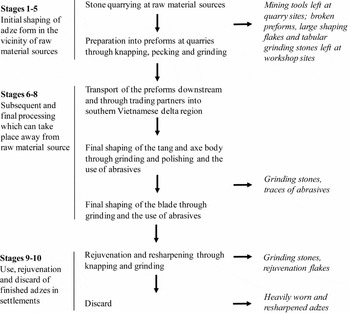
To assess the significance of the Rach Nui grinding stone, we will outline a general chaîne opératoire of Neolithic adze production in southern Vietnam (Figure 4). This has been extrapolated from evidence from lithic workshops in the Dong Nai region (Bui et al. Reference Bui, Nguyen and Dang2017) and the processes implied by the grinding stones for stone tool production. It draws also on comparative data for manufacturing processes reconstructed by experimental archaeology, from Neolithic European axe-making debris and workshops, and from observations of a selection of shouldered stone adzes from An Son and Rach Nui (Hansen & Madsen Reference Hansen and Madsen1983; Madsen Reference Madsen1984; Monnier et al. Reference Monnier, Pétrequin, Praud, Pétrequin, Rossy and Pétrequin1986; Kelterborn Reference Kelterborn1992; de Capitani et al. Reference de Capitani, Deschler-Erb, Leuzinger, Marti-Grädel and Schibler2002).
Schema of hypothesised chaîne opératoire of ground stone adze production, with notes on expected and observed archaeological evidence.

Once the raw material was acquired (stage 1), blanks for adze production were shaped—probably through rough knapping (stage 2)—and some pecking may have been carried out to shape the shoulders and tang (stage 3). Following rough shaping, the blank would probably have been knapped and pecked all over (stage 4) to produce a recognisable adze preform (stage 5). The preform would then be ground down on a somewhat rough surface, perhaps with the additional use of abrasives (such as wet silt), to even out the shape and reduce any pecking or flake scars (stage 6a). Thinning of the blade end would also be a key part of this grinding process and probably included grinding to even out the faces of the tang end (stage 6b). Once the adze body and blade were even, an extended phase of polishing would take place (stage 7). This probably included the use of fine sand, ochre or other abrasives. Finally, the blade would be sharpened through careful, finely controlled polishing (stage 8). Adze profiles are generally plano-convex, with the blade thinning being carried out from one face only, giving the adze a bevelled edge. Bevelled edges can be resharpened either through knapping or grinding. Less skill is required to resharpen them with grinding, as more obtuse angles are very difficult to knap with control and accuracy, depending on the raw material used. Finished adzes with evidence for resharpening suggest that blade edges were typically kept even and straight, or only slightly crescentic. Several very small and heavily resharpened shouldered adzes from An Son and Rach Nui clearly show that these implements were carefully curated. When they became dull or suffered breakage, they were not immediately discarded, but were resharpened and retained in use (stage 9) (Figure 5). After a phase of use and sometimes quite heavy resharpening, these adzes were discarded (stage 10). Stages 1–5 took place close to raw material sources in Dong Nai Province, far from Rach Nui; realistically, all other stages (save their resharpening and deposition—stages 9 and 10) may also have been carried out there (Figure 6). That said, whereas attention was often paid at the Dong Nai workshops to blade-edge polishing and shaping, less effort was expended on grinding the body, and many implements retain flake scars from the process of preform shaping. This implies that manufacturing and finishing concentrated on the functional aspects of the implement, enabling fairly rapid production of only just-finished preforms, and achieving high productivity (Bui et al. Reference Bui, Nguyen and Dang2017). As the majority of adzes from Rach Nui are highly polished, it is possible that the final stages in tool preparation occurred once the adzes reached their destination, and that the Rach Nui stone could have been used for a number of these stages. The rough grinding of the adze faces and edges, and of the tang end (stages 6a and 6b), could have been carried out on surfaces 2 and 3. Surface 1 has facets that would have been used for honing blade edges (stage 8). Fine polishing of the finished adze and the grinding of suitable abrasives (stage 7) appears to have been carried out on surface 4, which could also have been used for grinding and resharpening still-hafted adzes (stage 9), as Monnier et al. (Reference Monnier, Pétrequin, Praud, Pétrequin, Rossy and Pétrequin1986) suggested occurred at Chalain 3.
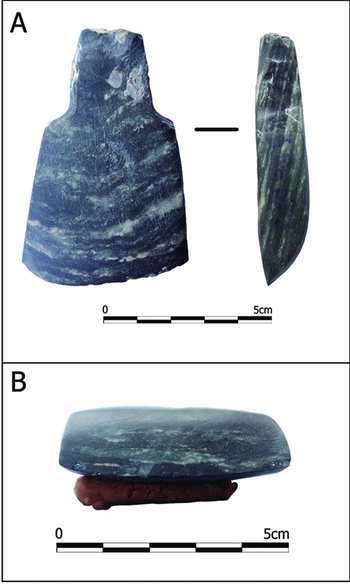
A) Ground stone shouldered adze RN03.H2L24.117—BTLA 2307.Da 533 from Rach Nui, demonstrating heavy resharpening prior to discard; B) the blade bevel of this adze. This level of resharpening is characteristic of the Rach Nui ground stone adzes.

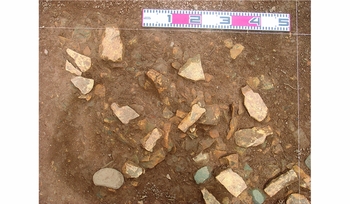
Broken preforms and production debris under excavation at the Hang Ong Dai site, a specialist lithic-working workshop near raw material sources in the Dong Nai region (photograph © Nguyen Khanh Trung Kien).

Maintaining the integrity, symmetry and sharpness of adzes at settlement sites through multiple phases of hafting and usage required knowledgeable practitioners, able to work all sides and edges of these artefacts. People living in Neolithic Rach Nui not only knew how to make and then resharpen their groundstone adzes, they could also carry out most of the later manufacturing stages themselves, with the aid of little more than water, abrasives, grinding stones and time. In light of this new analysis, a re-examination of Rach Nui stone adzes shows a number of quite coarsely finished pieces with highly visible knapping scars. These are very probably unfinished adze blanks or preforms. At least some adze preforms were, therefore, travelling extremely long distances into regions where no raw materials were available, but where people evidently had the skills necessary to shape, maintain and resharpen very fine stone adzes. The significant focus on grinding activities as part of these later stages of manufacture and maintenance (including sharpening) may explain why very little resharpening debitage was found at An Son and other nearby sites.
As a specialist tool, the Rach Nui grinding stone suggests not only that the technology was well understood and regularly practised, but also that there was a formally structured and specialised process that was carefully followed for adze manufacture. Whether the creator of this grinding stone was a settled, permanent member of the Rach Nui population, or was someone from elsewhere carrying with them the tools and skills required to produce and repair stone adzes is, of course, unknown. We also know, however, that this person had cultivated a specific skill-set, which had presumably been learned either through apprenticeship or through a less formal style of teaching and learning. We know that this person (or persons) produced enough stone adzes that a tool specially adapted for their manufacture, and made from an imported sandstone, was deemed necessary, and that this production process followed several clearly defined stages, each of which had its own special purpose tool.
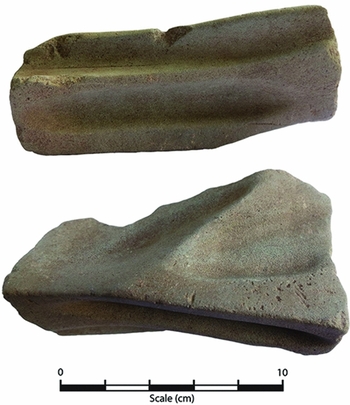
Although grinding stones of this type were not common in the Rach Nui archaeological record, four fragments with various grooves on different facets were recorded in 2003 in trench 1 (Nguyen Manh Thang Reference Thang2005). Another almost complete specimen was recovered in trench 3 during the 2012 excavations (Figure 7). This artefact (accessioned as 12RN-H3-20) was 116mm in length, with a maximum breadth of 71mm and depth of 47mm. It bore three principal grinding surfaces. The first had a large depression 47mm wide and 20mm deep, with smooth sides and an evenly rounded base. Another face had two elongated depressions approximately 67mm long and 50mm wide, and depths of 5mm and 5–10mm respectively. A further face had two parallel elongated depressions along its length, with breadths of 17mm and depths of 7 and 5mm. One of the depressions has a very thin groove in the base, indicating that very sharp objects, such as adze blades, were ground within this facet. Although Rach Nui is 80km distant from the primary sources of lithic raw materials, close ties appear to have existed between Rach Nui and the Dong Nai region. With easily navigable river networks connecting the two regions, Rach Nui inhabitants would probably have travelled upstream for fresh water (which is absent in the tidal channels surrounding Rach Nui), and raw materials for tool production. The shape, form and manufacturing techniques used in the production of pottery sherds from Hang Ong Dai and Hang Ong Dung suggest that the vessels originated farther downstream on the Dong Nai River in the Binh Duong and Dong Nai regions at sites such as Cu Lao Rua, My Loc and Binh Da, dating between 3500 and 3000 BP (Bui et al. Reference Bui, Nguyen and Dang2017). Similar ceramic sherds have also been recovered at Rach Nui (Oxenham et al. Reference Oxenham, Piper, Bellwood, Bui, Nguyen, Nguyen, Campos, Castillo, Wood, Sarjeant, Amano, Willis and Ceron2015). Thus, it is presumably from these upstream areas that the stone implements were redistributed into the southern Vietnamese delta region. This certainly parallels patterns recorded elsewhere in Southeast Asia, where the exchange of lithic tools seems to have been key in regional exchange networks focused around major river systems (e.g. Pisnupong Reference Pisnupong, Higham and Thosarat1993).
The complete grinding stone recovered from the 2012 excavations at Rach Nui: 12RN-H3-20.

Conclusions
Previous research on stone adzes in southern Vietnam has been largely typological (e.g. Duff Reference Duff1970; although see Boer-Mah (Reference Boer-Mah2008) for an emerging focus on Thai tool production and use). Technological analyses such as that presented here can only be preliminary. Examination of the Rach Nui grinding stone, however, has offered several new observations about southern Vietnamese Neolithic technology and society. Our understanding of adze manufacture and exchange processes has, in particular, been blurred by the discovery that at least some elements of stone-working took place far from material sources, in settlements such as Rach Nui. It is clear that preforms or barely finished pieces, rather than fully finished adzes, came into Long An Province. Along with the former came the knowledge of how to shape, repair and maintain them over long periods of time. One potential chaîne opératoire has been outlined in this paper, but others may have developed elsewhere in this exchange network. It is possible that some of the morphological variability included in typological schema derives from different manufacture, maintenance and resharpening technologies (cf. Boer-Mah Reference Boer-Mah2008).
That specialised adze manufacture was taking place at such a great distance from raw material sources and specialist lithic workshops clearly shows that systems were in place across Neolithic southern Vietnam to support the development of specialist manufacturing processes. This includes the communication of specialist knowledge through apprenticeships or other forms of learning and teaching. Specialist tool-making skills extended to the creation of tool kits, such as the Rach Nui grinding stone. This was created with a well-understood and preconceived manufacturing process in mind, and one which was shared over quite a wide area.
The evidence presented here supplements the pottery data (see Sarjeant Reference Sarjeant2014), and suggests that Neolithic southern Vietnam was integrated into broader networks of material culture and information exchange. The presence of transportable grinding stones for the specialist maintenance and repair of polished stone adzes also hints at the movement of people, including technological specialists, around the landscape. Furthermore, the linkages noted between the movement of people, tools and technologies demonstrate that ground stone tools excavated in Neolithic settlements can contribute more than just a chronological sequence. Although these tools are far from rare on Neolithic Vietnamese sites, they are infrequently discussed in excavation reports and have not previously been the focus of a technological study. We suggest that technological analyses of lithic assemblages have the potential to open new avenues of inquiry into the social organisation, networks of contact and communication, value systems and daily life of the Neolithic Vietnamese.
Acknowledgements
This research was funded by a small research grant from the Research School of Humanities and the Arts, Australian National University. We thank our colleagues at the Long An Provincial Museum and Fredeliza Campos Piper for their assistance and support while this research was being carried out. The two anonymous reviewers made valuable suggestions and we thank them. All leaps of logic or errors in fact are our own responsibility.