Introduction
Chamarita sheep are farmed in La Rioja (Spain) and are considered an Endangered Native Breed in the Official Catalogue of Spanish Livestock Breeds. In the past, Chamarito meat was either commercialized as suckling lamb (12–14 kg live weight) or the heavier Ternasco-type (20–22 kg live weight; Doménech et al., Reference Doménech, Barrio, Falceto and González Jiménez1992), but suckling lambs are now more preferred by consumers. After being officially recognized as a quality brand in April 2010, the production system complies with strict animal welfare and health programmes, sheep are pasture-fed extensively and lambs receive their mother's milk and are slaughtered under 13.5 kg (maximum 40 days old). Their meat is very tender and juicy with a pleasant, mild flavour (Warren, Reference Warren2011).
In Mediterranean countries, consumers prefer meat from light lambs fed either milk or mainly concentrate diets (Vergara & Gallego, Reference Vergara and Gallego1999; Sañudo et al., Reference Sañudo, Alfonso, San Julián, Thorkelsson, Valdimars-dottir, Zygoyiannis, Stamataris, Piasentier, Mills, Berge, Dransfield, Nute, Enser and Fisher2006). Among light lambs, suckling lambs reared exclusively on maternal milk are the lightest on the market (Gorraiz et al., Reference Gorraiz, Beriain, Chasco and Iraizoz2000). Some authors report that increasing the carcass weight of suckling lambs has little influence on meat quality traits (Russo, Preziuso & Verità, Reference Russo, Preziuso and Verità2003, Díaz et al., Reference Díaz, de la Fuente, Lauzurica, Pérez, Velasco, Álvarez, Ruiz de Huidobro, Anega, Blázquez and Cañeque2005a), but others have found large differences in tissue composition and meat quality over a narrow range of carcass weights in light lambs (Sañudo, Sánchez & Alfonso, Reference Sañudo, Sánchez and Alfonso1998; Díaz et al., Reference Díaz, Velasco, Pérez, Lauzurica, Huidobro and Cañeque2003). Carcass weight is one of the most important factor affecting carcass and meat quality (Sañudo et al., Reference Sañudo, Santolaria, Sierra, Alcalde and Touraille1992; Vergara & Gallego, Reference Vergara and Gallego1999). Moreover, in meat production systems, a small increase in the slaughter weight of lambs may result in higher farmerś incomes.
In addition to carcass weight, diet may affect meat quality within a short range of slaughter weights. Most of the studies on lamb meat quality consider pH, colour, texture and water-holding capacity. More recently, there has also been an emphasis on the fatty acid profiles of lamb tissues, which appear to be strongly affected by dietary fat composition (Osorio et al., Reference Osorio, Zumalacárregui, Cabeza, Figuerira and Mateo2008).
Although highly appreciated on the local market, little is known about the instrumental quality of Chamarito lamb meat, which makes it very difficult to be able to compare with other similar products or to improve production within or among farms. Thus, in this study we aimed to characterize the instrumental meat quality of commercial Chamarito lambs and compare those characteristics among lambs of two different ages.
Materials and methods
This study is a collaboration between the Autonomous Regions of Aragon and La Rioja (Spain). A flock of 50 Chamarita adult ewes and 45 lambs were transported from La Rioja to the Animal Experimentation Support Service (SAEA) of the University of Zaragoza, Aragón (41°41_N). All the sheep used were raised, transported and slaughtered according to present regulations of the European Community Commission (1986) for Scientific Procedure Establishments. All the protocols were approved by the Animal Experimentation Ethics Committee of the University of Zaragoza.
Animals
The flock of 50 Chamarita multiparous adult sheep were housed in pens during pregnancy and lactation at a density of 2 m2/ewe. They were fed twice a day, in the morning between 08.00 and 08.30 hours and in the afternoon between 15.00 and 15.30 hours All ewes received pellet concentrate (11.5 MJ ME/kg DM and 15.5 percent crude protein; approximately 0.3 kg/ewe), and lucerne chaff (Medicagosativa) ad libitum. The pen was equipped with a metallic water trough (1.5 m × 0.60 m) and two metallic feeders (4.5 m × 0.80 m, 27 cm/ewe), and a lick stone for minerals.
Productive traits
Controlled natural mating was used. The resulting lambs were kept together in the same pen with their mothers (2 m2/sheep and lamb). All animals had ad libitum access to water. Lambs were weighed at birth and at weaning. The pre-weaning average daily gain (AGD) was calculated as weaning weight− birth weight divided by the total milking period (30 days). Lambs subjected to a short fattening period were also weighed before slaughter.
Carcass and meat quality parameters
A total of 20 lambs were used to study carcass and meat quality. Ten were slaughtered within the weight range of the suckling lamb-type category and ten more within the weight range of the Ternasco-type category (Sañudo et al., Reference Sañudo, Santolaria, María, Osorio and Sierra1996), at an EU-approved abattoir in the city of Zaragoza. After overnight lairage, lambs were electrically stunned and dressed using standard commercial procedures. After slaughter, the carcasses were stored in cold rooms at 2 °C for 24.00 hours. Cold carcasses were weighed at 24.00 hours (at 1–2 °C) in the cold room. The extent of bruising on the carcasses was estimated visually using scale adapted from Miranda-de la Lama et al. (Reference Miranda-de la Lama, Villarroel, Olleta, Alierta, Sañudo and Maria2009), with a score of 0 (no bruises), 1 (slight bruising), 2 (moderate bruising) or 3 (high bruising). The carcass conformation and fatness were scored according to the European classification system (European Union, 1993), the EUROP conformation scale (converted to a 15 point scale) and the carcass fatness scale (converted to a 15 point scale). To determine pH 24.00 hours of the longissimus dorsi muscle, we used a portable pH meter (fitted with a penetration electrode 52-00 from Crison), which was inserted into a small incision in the right loin (L2–L3 vertebrae). The pH meter was re-calibrated after every five samples, using two standard buffer solutions at pH 7.02 and 4.00. After chilling for 24.00 hours, carcasses were transferred to the Meat Laboratory at the Faculty of Veterinary Medicine of the University of Zaragoza without disrupting the cold chain.
The left back of each carcass was separated according to the standard cut method used for lamb carcasses defined by Boccard & Dumont (Reference Boccard and Dumont1955), vacuum packed and frozen at −20 °C until further dissection. The samples were thawed for 24.00 hours in a refrigerator (2–4 °C) in sealed plastic bags under a vacuum, before testing. After weighing, each piece was dissected into its components: subcutaneous fat, intermuscular fat, muscle, bone and waste (lymph, large blood vessels, nerves, tendons, ligaments and fascia of conjunctive tissue) according to the protocol described by Colomer-Rocher et al. (Reference Colomer-Rocher, Morand-Fehr, Kirton, Delfa and Sierra1988). Fatty pre-scapular deposits were also dissected and included as part of the total fat.
The M. longissimus was removed, wrapped and stored at −20°C. The loin was divided into three sections. The first section was wrapped, aged for 72.00 hours at 4 °C and then vacuum-packaged before being frozen and stored at −20 °C. The samples were thawed for 24.00 hours in a refrigerator (2–4 °C) in their sealed plastic bags under a vacuum before testing. Then the samples were weighed and heated in a water bath to an internal temperature of 70 °C and then cooled for 30 min under cold running water, analysing thawing losses (fresh weight-thawed weight) and cooking losses (thawed weight-cooked weight). Instrumental colour was evaluated using a Minolta CM 202 calibrated chromameter with a standard illuminant D65. A 10° observer with an aperture size of 2.54 cm, following the CIE L*a*b* system, measured the colour of fresh meat on the cut surface of the 13th thoracic vertebra of the M. longissimus. The colourimetric indices of chromaticity [chroma* = (a*2 + b*2)1/2, quantity of colour] and hue [h* = 1/tan (b*/a*), real colour] were calculated. Final values were the average of three measurements. To perform the Warner–Bratzler test, samples were cooked in their vacuum-sealed plastic bags in a 75 °C water bath (GLF-D3006), until the internal temperature of the meat (measured with a penetration thermometer) reached 70 °C, then cooled for 30 min under flowing cold water. The samples were randomly allocated in two batches. The texture of the cooked meat was measured with a Warner–Bratzler device, using an Instron 4301 equipped with a Warner–Bratzler shear. To cut 1 cm2 pieces (in the direction of the muscle fibres), we used a digital calibre MITUTOYO Series 500 (Mitutoyo Corporation, Aurora, IL, USA). For each animal, three measurements were taken. Maximum load, maximum stress and toughness were measured as described by Campo et al. (Reference Campo, Santolaria, Sañudo, Lepetit, Olleta, Panea and Albertí2000). The sample gauge was 10 mm, gauge length was 30 mm, load cell was 100 kg (minimum load level 0.001 kg), crosshead speed was 150 mm/min (high extension limit = 30 mm), and the sampling rate was 20 points/s.
The second section of M. longissimus was wrapped, aged for 72.00 hours at 4 °C and then vacuum-packaged before being frozen and stored at −20 °C for further determination of fatty acid composition. The samples were thawed for 24.00 hours in a refrigerator (2–4 °C) in their sealed plastic bags under vacuum before testing. The muscle tissue was blended using a small food processor. Duplicate 1 g samples were hydrolysed in 6 ml of 5 M KOH in methanol:water (1:1, v/v) at 60 °C. After acidification, the fatty acids and aldehydes were extracted in petroleum spirit (BP 40 ± 60 °C), methylated with a solution of diazomethane in diethyl ether and analysed on a 50 mm × 0.25 mm ID CP Sil 88 FAME column (Chrompack, UK) (Whittington et al., Reference Whittington, Prescott, Woood and Enser1986). Fatty acids were quantified using heneicosanoic acid methyl ester as internal standard added prior to saponification. Peaks were identified using standards where available (Sigma Chemical Co., Ltd, Poole, UK). Linearity of response was confirmed using GLC-50 monoenoic reference mixture (Superlco, Poole, UK) and on-column injection of test samples. The third section of M. longissimus was wrapped, aged for 72.00 hours at 4 °C and then vacuum-packaged before being frozen and stored at −20 °C for sensory analysis.
Data analysis
Data were analysed using the least squares methods of the GLM procedure using SAS/STAT (9.1 SAS Inst. Inc., Cary, NC, USA) by SAS (1998), fitting a one-way model with a fixed effect of type of lamb (suckling or Ternasco-type). A probability of P < 0.05 values was considered statistically significant.
Results and Discussion
The average weight of lambs (from both groups) at birth was 3.72 ± 0.18 kg. Average daily gain was 0.2 ± 0.008 kg during the milking period, resulting in a weaning weight of 10.97 ± 0.3 kg. The ADG of lambs fattened to the Ternasco-type category during the fattening period (30 days) was 0.15 ± 0.02 kg with a final weight of 16 ± 0.72 kg before slaughter.
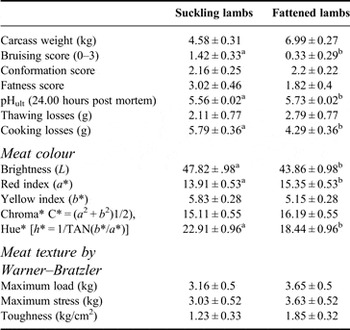
Table 1 summarizes the results for carcass and meat quality traits in both types of lambs. According to the Order of September 18, 1975 (BOE, 1975), amended by the Order of September 24, 1987 (BOE, 1987), which sets the quality standards for ovine carcasses for the national market, suckling lambs must be fed mainly on milk, be less than 45 days old and have a carcass weight below 8 kg. In our study, suckling lambs were 30 days old when slaughtered, with an average carcass weight of 4.58 (±0.31) kg after 24.00 hours in the cold room, which is very similar to the type of lamb commercialized in La Rioja. On the other hand, animals with a short fattening period (30 days) were slaughtered at 60 days of age, with a carcass weight of 6.99 (± 0.27) kg. That product is new on the market in La Rioja and could be used as an alternative since it improves the performance of the production system by increasing individual lamb productivity. It is also a way of reducing stress since it dissociates the stress of pre-slaughter handling from weaning stress.
Least square means (±SE) for carcass and meat quality traits in suckling and light Ternasco type Chamarito lambs.

a,bDifferent letters (a,b) represent significant differences (p < 0.05) between groups.
Carcass weight is the most important criterion to classify sheep (Miguélez et al., Reference Miguélez, Zumalacárregui, Osorio and Mateo2007). It is a good indicator of the quality traits of the carcass (Hammond, Reference Hammond1932). The optimal slaughter weight varies with breed, type of feeding, sex, litter size and the number of lambings (Sañudo et al., Reference Sañudo, Sierra, Alcalde, Rota and Osorio1993, Reference Sañudo, Campo, Sierra, María, Olleta and Santolaria1997; Sánchez et al. Reference Sánchez, Alfonso, Sañudo, Pardos, Delfa, Sierra and Fisher1998; Vergara, Berruga & Gallego Reference Vergara, Berruga and Gallego2001; Diaz et al., Reference Díaz, Velasco, Pérez, Lauzurica, Huidobro and Cañeque2003; Gutiérrez, Reference Gutiérrez2006). In this study, animals were selected for slaughter by age instead of by weight. The weaning and slaughtering of Chamarito lambs is very early compared with other breeds, which explains why the average weights recorded are lower than other suckling lambs such as “Lechazo de Castilla y Leon” with an average cold carcass weight of 5.5 kg (Sánchez et al., Reference Sánchez, Alfonso, Sañudo, Pardos, Delfa, Sierra and Fisher1998). The lambs are probably managed in this way since they are well adapted to a hard environment and may undergo pasture shortages. Later weaning may create serious competition between lambs and ewes for grazing resources. The establishment of a short fattening period could reduce those differences, improving the competitiveness of Chamarito lambs on the market. Another alternative to compensate for that loss of competitiveness would be to develop a brand that highlights the special characteristics of suckling Chamarito.
Carcass conformation is determined by general shape, degree of roundness and compactness (De Boer et al., Reference De Boer, Dumont, Pomeroy and Weniger1974). Breed is one of most important factors influencing carcass conformation in lambs (Miguélez et al., Reference Miguélez, Zumalacárregui, Osorio and Mateo2007). For suckling lambs, “Lechazo de Castilla y León” the average carcass conformation is low (with a mean of 2.00 points, Sánchez et al., Reference Sánchez, Alfonso, Sañudo, Pardos, Delfa, Sierra and Fisher1998), and our results are very similar (average of 2.16). The degree of fatness of lamb carcasses is seen primarily on the outer and inner surfaces, in the loins, in the omentum and in the tail (García-Díez, Reference García-Díez1990). Similarly to the conformation, the fatness of suckling Chamarito carcasses closely resembles the “Lechazo deCastilla y León”, corresponding to a slight fat cover that is hardly noticeable at the extremities (Sánchez et al., Reference Sánchez, Alfonso, Sañudo, Pardos, Delfa, Sierra and Fisher1998). Miguélez et al. (Reference Miguélez, Zumalacárregui, Osorio and Mateo2007) suggests that local breeds deposit more internal fat compared with more productive breeds. Carcasses of animals subjected to short fattening did not improve much in conformation or degree of fatness, and no significant differences were found between groups, contrary to what might be expected. That may be because the short fattening period does not allow enough time for the animals to adapt to new feeding and housing conditions after weaning. Animals may even lose some weight at the beginning of the fattening period due to weaning stress. Thirty days may not be enough to improve the performance at this stage of growth.
Regarding carcass bruising, it was significantly higher (P ≤ 0.05) in suckling lambs compared with light Ternasco-type lambs. That may be because of the cumulative effect of weaning stress, pre-slaughter management and slaughter itself. Bruising produces colour changes in the carcass and is an important indicator in post-mortem examination, with commercial and animal welfare implications (Cooper & Cooper, Reference Cooper and Cooper2007.) The transport used had few standardized divisions of space so it is possible that smaller animals had more space to move around and bump into walls.
The pH measured 24 hours post-slaughter is probably one of the most important commercial indicators of meat quality (Gregory, Reference Gregory2007). In our study, the pH values were always below 6.0, within the range of optimum commercial quality. The pHult of lambs fattened for 30 days was slightly higher than the suckling lambs (+3 percent, P ≤ 0.05), but within a range of optimum meat quality. There is a tendency towards increased pH with age (Alexandrova et al., Reference Alexandrova, Banskalieva, Angelov, Ivanov, Laleva and Slavova1996; Sañudo et al., Reference Sañudo, Santolaria, María, Osorio and Sierra1996), which coincides with our study. Some authors suggest it might be because of the increased susceptibility to management stress in older animals (Devine et al., Reference Devine, Grafhuis, Muir and Chrystall1993).
Colour is one of the main criteria used by consumers to judge the quality of meat (Sañudo et al., Reference Sañudo, Campo, Sierra, María, Olleta and Santolaria1997). In our study, meat colour was also significantly different between different types of carcasses in terms of L* (lightness), which was higher in suckling lambs (+9 percent, P ≤ 0.05), while a* (red index) was significantly higher in Ternasco-type lambs (+10.4 percent, P ≤ 0.05) and hue* was 24.2 percent higher in suckling lambs (P ≤ 0.05). Colour variables are generally affected by carcass weight (Field et al. Reference Field, Maiorano, McCormick, Riley, Russsell, Williams and Crouse1990; Rashid & Faidhi, Reference Rashid and Faidhi1990; Sañudo et al., Reference Sañudo, Santolaria, María, Osorio and Sierra1996; Rousset-Akrim, Young, & Berdague, Reference Rousset-Akrim, Young and Berdague1997), although colour evolution is not linear and at certain ages may remain stable (Alexandrova et al., Reference Alexandrova, Banskalieva, Angelov, Ivanov, Laleva and Slavova1996). Changes in meat colour can also be related to diet: a diet based exclusively on milk produces paler meat with less pigment (Sañudo, Sánchez & Alfonso, Reference Sañudo, Sánchez and Alfonso1998). Specifically, a* values vary in relation to the amount of haemoglobin pigments, and therefore the lower content of suckling animals is probably related to the milk-based diet with low iron content (Sañudo et al., Reference Sañudo, Santolaria, María, Osorio and Sierra1996).
Cooking losses were higher in suckling lambs (+35 percent, P ≤ 0.05), whereas no differences were found in thawing losses. In general, cooking losses are positively correlated with fatness (Kemp et al., Reference Kemp, Shelley, Ely and Moody1972; Babiker, El Khider, & Shafie, Reference Babiker, El Khider and Shafie1990). Regarding the texture, estimated by Warner–Bratzler, no significant differences were detected between the two types of lamb.
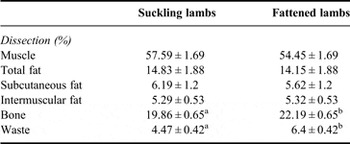
Table 2 shows the least square means (± SE) for dissection composition of the back (percentage of total weight) from suckling and light Ternasco type Chamarito lambs. The carcass has a large number of tissues which influence its quality, depending on their proportions. Those tissues are grouped from a functional standpoint into muscle, fat and bone. There were no significant differences in percentage of muscle, total fat, intermuscular fat or subcutaneous fat between types of lambs. However, the percentage of bone was significantly higher in fattened lambs (+11.7 percent, P ≤ 0.05), as well as the proportion of waste (43.2 percent higher in fattened lambs, P ≤ 0.05). Muscle tissue has the greatest economic value (Sañudo et al., Reference Sañudo, Santolaria, María, Osorio and Sierra1996) but the percentage of muscle was not significantly different among treatments. The percentage of muscle in suckling lambs was similar to that found in “Lechazos de Castilla y León” by Sánchez et al. (Reference Sánchez, Alfonso, Sañudo, Pardos, Delfa, Sierra and Fisher1998). There were no significant differences in fat percentage between types of lambs, which were very similar to Miguélez et al. (Reference Miguélez, Zumalacárregui, Osorio and Mateo2007) for suckling lamb carcasses from different breeds. The differences in percentage of bone and waste may be because of the short duration of the fattening, increasing the percentage of bone and waste in relation to the amount of muscle and fat.
Least square means (±SE) for dissection composition (percentage of total weight) of the back from suckling and light Ternasco type Chamarito lambs.

a,bDifferent letters (a,b) represent significant differences (p < 0.05) between groups.
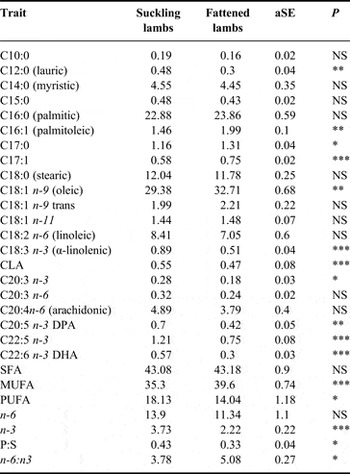
Finally, regarding fatty acid composition (Table 3), there were significant differences in both the ratio of the percentage of polyunsaturated fatty acids (PUFAs) vs saturated fatty acids (SFAs, P:S) and the ratio of the percentage of omega-6 vs the percentage of omega-3 fatty acids (n-6/n-3). Those two variables suggest that the fatty acid profile of suckling lamb meat is healthier for human consumption than fattened lambs. Suckling lambs had a P:S ratio of 0.43, while the recommended level is above 0.4 (Wood et al., Reference Wood, Richardson, Nute, Fisher, Campo, Kasapidou, Sheard and Enser2003), well above the 0.33 obtained for the fattened lambs. In the first stages of fattening the concentration of saturated relative to unsaturated fatty acids increases (Wood et al., Reference Wood, Richardson, Nute, Fisher, Campo, Kasapidou, Sheard and Enser2003), since the majority of dietary PUFA is hydrogenated in the rumen leading to higher values for SFAs (Scollan et al., Reference Scollan, Choi, Kurt, Fisher, Enser and Wood2001). Our results agree with Cifuni et al. (Reference Cifuni, Napolitano, Pacelli, Riviezzi and Girolami2000) who attributed the differences between lambs of different age to the differential development of tissues in young animals and different physiological condition and digestive capabilities of the animals being younger lambs characterized by a fatty acid profile more compatible with good health and nutrition of consumers. Moreover, there is evidence that an inappropriate n-6/n-3 ratio is a risk factor in cancer and coronary heart disease (Enser, Reference Enser and Rosell2001) and it should be lower than 4 (Wood et al., Reference Wood, Richardson, Nute, Fisher, Campo, Kasapidou, Sheard and Enser2003). The values obtained in this study for the fattened lambs exceed this limit, while suckling lambs showed a significantly lower ratio of 3.78. That difference between types of animals is sustained by the percentages of n-3 fatty acids, which were higher in suckling lambs. This makes the PUFA percentage higher in suckling lambs, increasing the P:S ratio and the n-6/n-3 ratio. Our results agree with Cañeque et al. (Reference Cañeque, Diaz, Alvarez, Lauzurica, Perez and De la Fuente2005), who found that this ratio, as well as some fatty acids such as palmitoleic (C16:1) and heptadecenoic (C17:1) acids, increased as carcass weight increased. That is especially the case for 18:3 and 20:5, related to the consumption of grass (Fisher et al., Reference Fisher, Enser, Richardson, Wood, Nute, Kurt, Sinclair and Wilkinson2000), which are higher in suckling lambs. In our study those fatty acids may have been transmitted via the ewe's milk, since they had access to lucerne chaff during the whole milking period. Those results agree with Díaz et al. (Reference Díaz, Alvarez, De La Fuente, Sañudo, Campo, Oliver, Font i Furnols, Montossi, San Julian, Nute and Cañeque2005b) who found higher levels of n-6 fatty acids and therefore a high n-6/n-3 ratio in lambs with an exclusively concentrate based diet, but lambs fed grass had high levels of n-3 fatty acids and low n-6/n-3 ratios. Nevertheless, it remains necessary to explore the possibility of developing new feeding strategies for lactating ewes with by-products (e.g. from the wine industry) which may favour healthier fatty acid profile for human consumption, with particular reference to the n-6/n-3 ratio.
Least square means (±SE) for fatty acid composition (percentage of total fatty acids) of intramuscular fat from suckling and light Ternasco type Chamarito lambs.

NS, not significant; PUFA, polyunsaturated fatty acid; SFA, saturated fatty acid; MUFA: Monounsaturated fatty acid; DPA: Docosapentaenoic acid; DHA: Docosahexaenoic acid
aMeans; SE: standard errors.
*Values between columns are significantly different (within trait) (P < 0.05).
Conclusions
Meat from the Chamarito lamb is a distinct quality product with high potential in La Rioja and its surroundings. The quality of suckling Chamarito lamb meat is comparable to other recognized suckling lambs. Fattening lambs for 30 days (Ternasco-type lamb) did not have important effects on conformation or degree of fatness and the percentage of muscle and fat were similar to suckling lambs. However, the pHult of the heavier lambs was slightly higher, which may be because of the increased amount of or susceptibility to management stress. It appears that a short fattening period is not enough to improve the performance at that stage of autonomous growth. The fatty acid profile of suckling lambs was healthier for human consumption. Further studies are needed to ascertain whether lambs should be fattened further to increase individual productivity, but it could also have detrimental effects on the sustainability of the system and on differential characteristics compared with other lambs.
Acknowledgements
This study was funded by the Spanish Ministry of Science and Innovation (projects AGL-2009-10794/GAN and AGL2012.37219). Many thanks to the Autonomous Community of La Rioja for the Scholarship PhD Program (Programa de AyudasPredoctoralesdelGobierno de la Rioja) of M. Pascual-Alonso. Special thanks to AROCHA and PROCORCHA associations for their support and their invaluable help. This appreciation is special for the veterinary responsible of these associations, Don José Antonio González. Special thanks are given to Julia Pomed for her help in laboratory work. Many thanks to the staff of the Animal Research Centre of the University of Zaragoza (SEA), and the other components of the Research Group in Quality and Meat Technology at the University of Zaragoza.