INTRODUCTION
In Brazil, baleen whales are represented by eight species distributed in two families: Balaenidae and Balaenopteridae. They occur in Brazilian waters mainly during winter and spring when they are moving to their reproductive areas in warm waters (Zerbini et al., Reference Zerbini, Secchi, Bassoi, Rosa, Higa, Sousa, Moreno, Möller and Caon2004). From the eight extant species, two are considered data deficient, three are endangered, and the others are considered as of least concern by the IUCN (IUCN, 2012). Whales have been found beached throughout human history and different reasons for this phenomenon have been proposed (Geraci & Lounsbury, Reference Geraci and Lounsbury2005). The reasons whales strand are not yet fully understood. While some single strandings may be accounted for by a whale dying at sea and being washed ashore, many strandings are believed to occur due to other factors (Walsh et al., Reference Walsh, Odell, Young, Asper, Bossart and Dierauf1990). There could be many natural reasons like rough weather, weakness due to old age or infection, difficulty giving birth, hunting too close to shore and navigational mistakes (Weisburd, Reference Weisburd1984; Reynolds & Odell, Reference Reynolds and Odell1991). Human-related causes, such as military sonar use, vessel collision, by-catch and marine pollution, have also been implicated in some cetacean strandings (Geraci Lounsbury, 2005).
Carcasses provide much valuable information on the natural history of a species. However, many carcasses are washed ashore in advanced decomposition preventing further investigations, principally in tropical regions. On several occasions, even positive identification is not possible due to the advanced decomposition of the carcasses. In these cases, the identification can be made using the sequencing of the mitochondrial DNA (Kocher et al., Reference Kocher, Thomas, Meyer, Edwards, Pääbo, Villablanca and Wilson1989; Carr et al., Reference Carr, Marshall, Johnstone, Pynn and Stenson2002). Such source of DNA is present in high copy number in vertebrate cells; and any particular mitochondrial gene is far more likely to survive post-mortem degradation, enzymatic breakdown, and mechanical damage than is any typical nuclear sequence (Hermann & Hummel, Reference Hermann and Hummel1994).
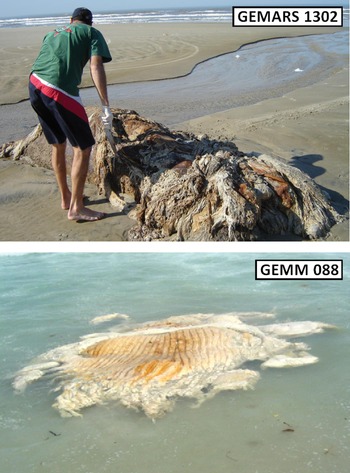
In this study, we report the molecular identification of four carcasses washed ashore in Rio de Janeiro (south-eastern Brazil) and Rio Grande do Sul State (Southern Brazil). The carcasses were found through a regular beach survey carried out at the central-north coast of Rio de Janeiro State (22°55′S 42°30′W–21°25′S 41°00′W) and at the north region of the coast of Rio Grande do Sul State (29°19′S 49°43′W–31°26′S 51°07′W), Brazil. During beach surveys some cetaceans were found in advanced stage of decomposition not allowing precise taxonomic identification. On some occasions, only unidentified soft tissues were found (Figure 1). A small sample of about 10 g of the unidentified carcasses were collected and stored in alcohol 70% for further laboratorial analyses.
Figure showing images of two baleen whale carcasses stranded on the Brazilian coast and sampled for the present study: (GEMARS 1302) baleen whole carcass, lately identified as Balaenoptera acutorostrata, washed ashore on the coast of Tramandaí, Rio Grande do Sul State, southern Brazil, (GEMM 088) carcass later identified as Balaenoptera edeni, washed ashore on the beach from Restinga da Massambaba, Arraial do Cabo, Rio de Janeiro State, south-eastern Brazil.

MATERIALS AND METHODS
Genomic DNA was extracted from four samples (GEMM 075, GEMM 088, GEMM 135 and GEMARS 1302) of unidentified baleen whale carcasses following a modified standard phenol–chloroform protocol described by Sholl et al. (Reference Sholl, Nascimento, Leoncini, Bonvicino and Siciliano2008).
Under continuous agitation, 30 mg of tissue were digested in 500 µl of lysis buffer (100 mM NaCl; 10 mM TRIS pH7,5), 25 µl of SDS 20%, 3 µl of Rnase (20 mg/ml−1) and 3 to 5 µl of Proteinase XIV (20 mg/ml−1) for 2 hours, subsequently disrupted inside a 1.5 ml microcentrifuge tube with a plastic rod, and incubated at 37°C for at least 12 hours. Following incubation, DNA extraction was carried out by the standard phenol–chloroform protocol (Sambrook et al., Reference Sambrook, Fritsch and Maniatis1989). DNA was diluted in 30 µl of sterile water.
The complete cytochrome b gene (1140 base pairs) was amplified using primers CBout1 (5′AATGAYATGAAAARYCATCGTTG-3′) and CB-out2 (5′TCTTCCTTGAGTCTTAGGGAG-3′) (Cassens et al., Reference Cassens, Vicario, Waddell, Balchowsky, Van Belle, Ding, Fan, Lal Mohan, Simões-Lopes, Bastida, Meyer, Stanhope and Milinkovitch2000). Amplifications were carried out in 50 ml reactions containing 250 ng to 1.0 mg of DNA, dNTPs (0.5 mM/ml), primers (0.3 pmol/ml), Taq DNA polymerase (Invitrogen, 0.04 U/ml) and amplification buffer under the following conditions: 94oC (1 minute), and 35 cycles at 94oC (1 minute), 55oC (1 minute) and 72oC (90 seconds). Four primers were used for sequencing: CB-out1 and CB-out2, which were used as external primers, and two internal primers: CB-in1 (5′-TTRTTRGATCCTGTTTCRTG-3′) and CB-in2 (5′-TGAGGACAAATATCATTYTGAG-3′) (Cassens et al., Reference Cassens, Vicario, Waddell, Balchowsky, Van Belle, Ding, Fan, Lal Mohan, Simões-Lopes, Bastida, Meyer, Stanhope and Milinkovitch2000). The polymerase chain reaction (PCR) products were purified with ‘GFXTM PCR DNA and Gel Band Purification’ kit (Amersham Pharmacia), and both strands were sequenced in ABI Prism 3730 automatic sequencer. Sequences were edited with BioEdit Sequence Alignment Editor version 7.0 (Hall, Reference Hall1999).
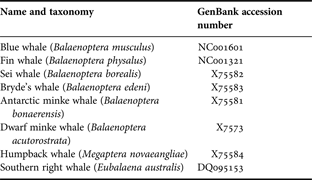
A blast search using the nucleotide–nucleotide basic local alignment (blastn) search tool was conducted using the sequences generated. A neighbour-joining tree was generated using the software Molecular Evolutionary Genetics Analysis (MEGA3) (Kumar et al., Reference Kumar, Tamura and Nei2004) adding eight sequences from GenBank from all species of baleen whales that occur on the coast of Brazil (Table 1) and two delphinids as outgroups (GenBank accession numbers EF488216 and X92526).
GenBank seguences of mysticeti cetaceans used to compare with sequences obtained from carcasses.

RESULTS
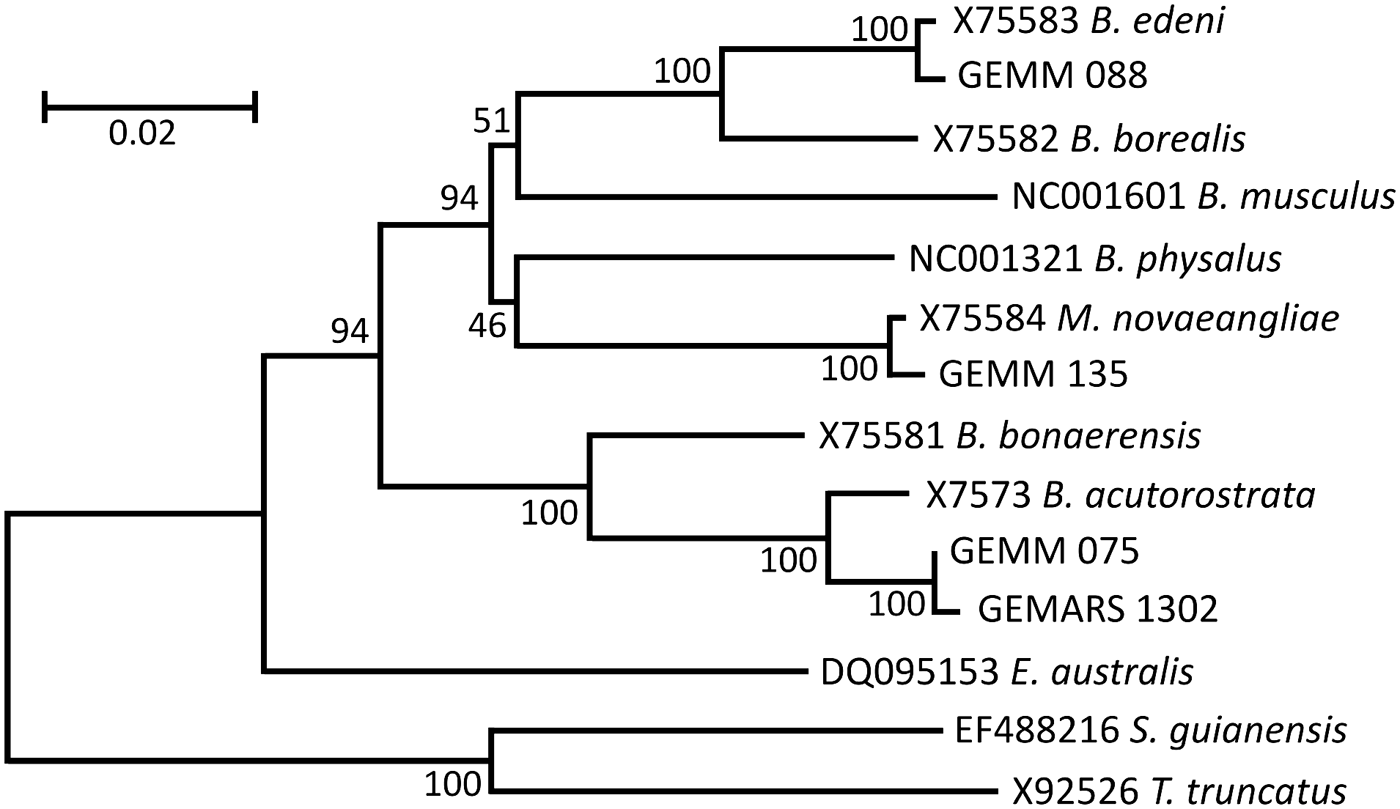
GEMM 075 and GEMARS 1302 showed 98% identity to one sequence of dwarf minke whale (Balaenoptera acutorostrata) (AP006468). Samples GEMM 088 and GEMM 135 showed 99% identity to sequences from Bryde's whale (Balaenoptera edeni) (X75583) and humpback whale (Megaptera novaeangliae) (AP006467), respectively. The magnitude of the genetic differences found (i.e. less than 2%) is consistent with expected intraspecific variation in cetaceans (e.g. Viricel & Rosel, Reference Viricel and Rosel2012).
The neighbour-joining analyses corroborated the one found using blastn, showing that all carcasses analysed demonstrated a correspondence to species of Balaenoptera already recorded in Brazil (Figure 2). Our results are in agreement with the pattern of seasonal distribution of baleen whales identified here, given that the three strandings occurred during winter and one during spring.
Neighbour-joining tree between carcasses sequences and sequences from GenBank from all species of baleen whales that occur on the coast of Brazil and two delphinids as outgroup.

DISCUSSION
Dwarf minke whale is the most frequently stranded species of baleen whale on the Brazilian coast. The occurrence of B. acutorostrata in Brazil has been observed throughout the year, except during March, with peaks from June to September (Zerbini et al., Reference Zerbini, Secchi, Siciliano and Simões-Lopes1996, Reference Zerbini, Secchi, Siciliano and Simões-Lopes1997).
In contrast to the highly migratory balaenopterid species, it is suggested that dwarf minke whales may spend the summer in mid-latitudes and feed in sub-tropical and warm temperate waters (Zerbini et al., 1996). Hassel et al. (Reference Hassel, Venturotti, Magalhães, Cuenca, Siciliano and Marques2003) sighted this species in January 2001 in eight different days and suggested that B. acutorostrata even take advantage of the prey species associated with the productive upwelling waters off Arraial do Cabo, Rio de Janeiro State.
The occurrence of humpback whales in Brazil is fairly well-understood. In the south-west Atlantic Ocean the wintering breeding grounds of M. novaeangliae are located on the north-eastern coast of Brazil, in the Abrolhos Bank (16°55′S 38°50′W) and its surroundings (Zerbini et al., Reference Zerbini, Secchi, Bassoi, Rosa, Higa, Sousa, Moreno, Möller and Caon2004). The breeding period of the whales in the Abrolhos Bank begins in June and ends in December of each year. Due to the coastal migratory movement on the south-eastern Brazil coast this species is frequently found stranded (Siciliano, Reference Siciliano1997). Unlike the previous two species identified, B. edeni does not realize an extensive latitudinal migratory pattern. This species is frequently found in tropical and temperate waters, and is commonly sighted in coastal tropical waters of south-eastern Brazil, generally associated with other species of cetaceans, fishes and sea birds (Siciliano et al., Reference Siciliano, Santos, Vicente, Alvarenga, Zampirolli, Lailson-Brito, Azevedo and Pizzorno2004; Moura & Siciliano, Reference Moura and Siciliano2012). This species seems to take advantage of the trophic resources of this region associated with the coastal upwelling system present in this region, principally around Arraial do Cabo, Rio de Janeiro State (23°00′S 42°00′W).
The record of marine mammal strandings on coastlines helps to increase relevant information for conservation. Long term monitoring and detailed post-mortem analysis of strandings provide us with vital evidence of the causes of death and the ability to apply this knowledge for future conservation measures. This study reinforces the importance of using the DNA as a forensic tool to identify carcasses found on the beaches.
ACKNOWLEDGEMENTS
The authors express their gratitude to the team involved with the research groups GEMM-Lagos (Grupo de Estudos de Mamíferos Marinhos da Região dos Lagos) and GEMARS (Grupo de Estudos de Mamíferos Aquáticos do Rio Grande do Sul) for their help during field and laboratory activities. E.C.R. is supported by Fundação Carlos Chagas Filho de Amparo à Pesquisa do Estado do Rio de Janeiro—FAPERJ (Processo no. E-26/100.861/2010) and is a PhD student of PPGEE–UERJ (Programa de Pós-graduação em Ecologia e Evolução–Universidade do Estado do Rio de Janeiro). S.S. is supported by Conselho Nacional de Desenvolvimento Científico e Tecnológico—CNPq (Processo no. 301544/2008-5). J.F.M. is supported by Fundação Oswaldo Cruz (FIOCRUZ) and is a PhD student of the Escola Nacional de Saúde Pública Sérgio Arouca (ENSP–FIOCRUZ). P.H.O. is supported by CNPq (process No. 572180/2008-0).