Introduction
Greater that 53% of all radiotherapy (RT) courses are administered with palliative intent.Reference Nieder, Pawinski, Haukland, Dokmo, Phillipi and Dalhaug1 Incidence of bone metastases is high in patients with solid tumours, with 60–84% of patients developing bone metastases.Reference Sztankay2 RT plays a major role in symptom alleviation for this cohort of patients.
Accuracy and precision are fundamental to the delivery of RT treatment, and positional reproducibility is a prerequisite for successful treatment delivery and to minimise toxicity. One of the key starting points for accurately positioning a patient is the alignment of localisation skin marks with the in-room laser system, this is especially true in palliative RT where intensive image guided RT is not the standard of care. Palliative patients often require re-irradiation, with treatment sites regularly abutting, further emphasising the need for accurate positioning of this patient group to prevent overdosing to organs at risk.
Set-up errors are deviations between actual treatment position and intended treatment position. Reduction of these errors results in delivery of treatment as intended, which is crucial in alleviating distressing symptoms for palliative patients. The issue of set-up errors has been addressed for a variety of sites, and recommendations to reduce errors have been suggested.Reference Hurkmans, Remeijer, Lebesque and Mijnheer3–Reference Kataria, Abhishek, Chadha and Nandigam5 However, published evidence focuses primarily on radical patient groups, with no specific recommendations for palliative patients. Furthermore, the literature regarding the optimal number of skin marks to be used for accurate patient set-up is sparse. A study conducted by Young and Blyth,Reference Young and Blyth6 concluded that the use of extra skin marks results in an increased accuracy in patient set-up for bone and spinal RT. Similarly, Easton et al.Reference Easton, Vavda, Cops, Goodridge, Leon and Scott7 found that the addition of lateral marks reduced the rate of patient position re-adjustment for spinal RT.
Imaging protocols vary between departments. Often greater tolerances and less frequent imaging are practiced in the verification of palliative patients. Nonetheless, minimising set-up errors are equally as important for patients with a reduced life expectancy, to ensure the optimal treatment outcome is reached and toxicity is minimised.
The aim of this study is to compare two methods of the localisation marking for palliative patients by retrospectively calculating set-up errors observed using one skin mark (Group 1) versus three skin marks (Group 2), in a single institution and to assess the accuracy of the two approaches. Previous literature in this area has focused on bony treatment site, this is the first study to investigate this topic in a range of different palliative treatment sites over an extended period of time.
Methods
Ethical approval was obtained for this study from the Trinity College Dublin, School of Medicine Research Ethics Committee. The data for all palliative patients treated in 1 calendar year were collected and anonymised by a gatekeeper in a single large institution. The institution had no protocol for the number of localisation skin marks to be used; this was at the discretion of the radiation therapists. All palliative patients treated with multiple fractions in the supine position were included. Patients immobilised with thermoplastic mask or patients receiving aggressive RT regimes were excluded.
Treatment sites were divided into Group 1 (one skin mark) and Group 2 (three skin marks). Set-up displacements were defined as any deviation observed in megavoltage electronic portal images taken prior to treatment when compared to the planned position on digitally reconstructed radiographs.
Analysis and statistics
The analysis was undertaken using Graphpad Prism 6 software. Normality tests were performed and the data were shown to be unevenly distributed, as a result non-parametric statistical tests were used for comparison.
Set-up errors were calculated in each direction as described in RCR and Society and College of Radiographers On Target Guidelines.8 Comparisons between the set-up errors in each direction of Group 1 and Group 2 were made using Mann–Whitney U tests.
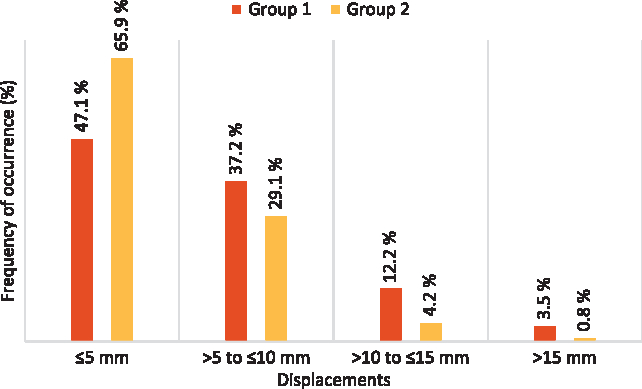
The frequency of deviations for each group was examined by calculating the percentage of fractions with set-up errors within the following tolerances: ≤5, >5 to ≤10, >10 to ≤15 and >15 mm. The tolerances were examined with the L–R and S–I directions combined. Chi-square tests were used to assess whether the number of skin marks affected frequency of deviations and to determine whether treatment site affects number of skin marks used for positioning. A p-value <0·05 was considered statistically significant.
Results
A total of 552 sites in 383 patients were identified, with the number of sites per patient ranging from 1 to 7. A total of 175 sites met the inclusion criteria and were included in set-up error analysis.
Displacements could only be analysed in the left–right (L–R) and superior–inferior (S–I) directions, as the majority of sites were only imaged anteriorly/posteriorly. Lateral images were available for 93 sites (23%), of which only 1·2% were positioned using a single mark, so statistical comparisons could not be made for the A–P direction due to this lack of data.
Set-up errors
The population mean, median, systematic and random errors are shown in Table 1, with the associated distribution of displacements depicted in Figure 1. No statistical significance was observed between the median displacements for Group 1 and Group 2.
Population mean, standard deviation (SD), median, range and systematic and random set-up errors, shown in the left–right and superior–inferior directions

Notes: Group 1 – sites with one skin mark (n = 61 sites). Group 2 – sites with three skin marks (n = 114 sites). Bold values denote statistical significance.
The distribution of displacements for Group 1 and Group 2 shown using box and whisker plots.

The variation observed between the population mean errors, in the S–I plane, was statistically larger (p-value = 0·0418) for Group 2 compared to Group 1 (0·1 versus 1·2 mm). Differences in the L–R direction were not significant (p-value = 0·8070).
Both the population systematic and random errors were smaller for Group 2 compared to Group 1. The difference between random errors was statistically significant in both directions (L–R p-value = 0·0006 and S–I p-value = 0·0146).
Frequency of deviations
The use of three skin marks resulted in a higher percentage of images within the ≤5 mm institutional tolerance, for palliative patients, shown in Figure 2. About 65·9% of images were within this tolerance for Group 2 compared to 47·1% of images for Group 1. Only 0·8% of images had deviations greater than 15 mm for Group 2, compared to 3·5% for Group 1. Significantly, more images for Group 1 were outside tolerance for all displacement categories when compared with Group 2 (p < 0·0001).
Frequency of deviations with left–right and superior–inferior directions combined.

Analysis of extreme values showed deviations ≥20 mm for six sites, five of which were in Group 1. All displacements ≥20 mm occurred in the L–R plane, with the greatest displacement of 26 mm. The only site with three tattoos having a deviation >20 mm was an extremity.
Significant variation was reported between the number of marks used and treatment site (p-value < 0·0001). Single marks were more commonly used for spinal (81%) and limb/extremity treatments (74%). Three skin marks were more routinely used for sites in the thorax (69%) and pelvis/abdomen (70%).
Discussion
The importance of evaluating set-up errors in RT and recommendations for their reduction have been well established.8 However, no well-established guidelines are available for the optimal number of skin marks for accurate patient set-up in the palliative setting. This study found that the use of multiple skin marks resulted in reduced systematic and random errors in both the L–R and S–I directions, and a greater frequency of set-ups were within the 5 mm tolerance. Therefore, it can be concluded that for patients treated with multiple fractions, three skin marks result in a more reproducible patient position over the course of treatment and has the potential to reduce Clinical Target Volume–Planning Target Volume margins in this group.
Easton et al. found that the addition of lateral skin marks reduced the rate of patient position re-adjustment for spinal patients from 55 to only 17%.Reference Easton, Vavda, Cops, Goodridge, Leon and Scott7 Similarly, Morgan et al. in a quality-assurance study found position reproducibility improved with three skin marks in pelvic treatments.Reference Morgan, Banks and Kagan9 Furthermore, our study also found, the use of three marks results in more accurate patient set-up within the clinically acceptable tolerance of ≤5 mm. With the L–R and S–I directions combined, three skin marks result in almost two-thirds (65·9%) of images within the ≤5 mm tolerance, compared to less than half of images (47·1%) within the same tolerance for patients with a single skin mark. Young and Blyth also found an increased incidence of images within 5 mm tolerance for multiple marks (45%) compared to a single skin mark set-up (36%) for bony and spinal treatment sites.Reference Young and Blyth6 Deviations over 15 mm are significantly reduced using multiple skin marks, with less than 1% of images from Group 2 falling beyond this threshold, a similar finding to Young and Blyth.Reference Young and Blyth6 Clinically, it is important to reduce the incidence of such large gross deviations, particularly when using a hypofractionated schedule. Errors of this magnitude could result in geographic miss of the target, resulting in an excessively high dose to normal tissues, potentially increasing toxicity and reducing the efficacy of treatment.
The use of additional lateral skin marks, with a single anterior mark, is recommended to minimise rotation.Reference Creutzberg, Althof and de Hoog10,Reference Johnston, Vial and Wiltshire11 While rotational errors could not be assessed in this analysis, Elsner et al.Reference Elsner, Francis, Hruby and Roderick12 demonstrated lateral skin marks minimise rotation (roll and yaw) when used in conjunction with the anterior skin mark in pelvic patients. Similar to our study, systematic and random errors in the S–I directions were also reduced, and isocentre reproducibility improved.Reference Thilmann, Adamietz, Mose, Saran, Buchner and Böttcher13 Easton et al. recommended lateral set-up marks be incorporated as a standard requirement for patient positioning for spinal treatments.Reference Easton, Vavda, Cops, Goodridge, Leon and Scott7
No institutional protocol existed regarding the number of skin marks to use for any given disease site; however, single marks were more frequently used for spinal and limb treatments in this institution. Three skin marks were more frequently used for thorax and pelvic sites. An analysis of the relationship between the number of skin marks and treatment site was beyond the scope of this analysis, but is worth further consideration.
Set-up accuracy is not solely determined by number of skin marks. Recommendations for palliative patient image verification have acknowledged that set-up reproducibility is more likely to be affected by random variables due to, for example, less rigid immobilisation.8 As a result, greater planning margins and imaging tolerances are used for palliative patients. A review by Hurkmans et al.Reference Hurkmans, Remeijer, Lebesque and Mijnheer3 concluded that set-up accuracy varies widely, depending on the treatment site, method of immobilisation and institution. Thilmann et al. reported that palliative patients; patients with feeling of anxiety, restlessness or pain during simulation or treatment; and obese patients have higher incidence of field misalignment.Reference Thilmann, Adamietz, Mose, Saran, Buchner and Böttcher13 All these characteristics are often typical of palliative patients. Evaluation of specific patient factors such as performance status, pain, weight, mobility, positioning and immobilisation and their impact on set-up variation was not assessed in this study but are points for consideration in future research.
Limitations
The heterogeneity of the population and the variation in the number and frequency of imaging made direct comparisons difficult. Analysis could not be completed on displacements in the anterior–posterior direction, where three skins marks may have further improved set-up reproducibility.
Conclusion
This research demonstrated how a minor change to a palliative localisation procedure may help in improving position reproducibility. Three skin marks are recommended for palliative patient receiving a fractionated course of RT, as it reduces set-up error, reduces the number of gross displacements (>10 mm) and increases the number of displacements within the clinically acceptable tolerance of 5 mm.
Acknowledgements
None.
Financial Support
None.
Conflicts of Interest
None.