Introduction
Natural disasters are becoming a significant concern worldwide as the effects of climate change intensify.1, 2 With the frequency and severity of extreme weather events such as hurricanes, wildfires, floods, and heatwaves on the rise, the downstream consequences of these natural disasters are far-reaching, particularly for high-quality health care delivery.Reference Maboloc3 Indeed, these natural disasters can exacerbate barriers that prevent patients from receiving timely and high-quality recommended health care interventions.Reference Romanello, Napoli and Green4, Reference Bushong and Welch5 Consequently, there is evidence that individuals diagnosed and treated for advanced prostate and lung cancer during extreme weather events may experience worse cancer outcomes.Reference Nogueira, Sahar, Efstathiou, Jemal and Yabroff6, Reference Cole, Qian and Gupta7
Although much research on natural disasters has focused on fragmentation of acute care, natural disasters may also affect preventive services such as cancer screening. There is evidence that use of colorectal and cervical cancer screening services may decline following natural disasters, but there is limited data about the impact of natural disasters on prostate cancer screening.Reference Ginex, Dickman and Elia8–Reference Ortiz, Gierbolini-Bermúdez and Ramos-Cartagena10 Prostate cancer is the second most common cancer and the fifth leading cause of cancer-related death among men globally.Reference Bray, Laversanne and Sung11 Because many prostate cancers are slow-growing and the benefits of prostate-specific antigen (PSA) screening remain controversial, some men may be particularly likely to defer or delay screening, with possible impacts on subsequent cancer outcomes. A decline in PSA screening prevalence was observed following the 2008 and 2012 United States Preventive Services Task Force (USPSTF) recommendations against PSA screening.12, Reference Moyer13
Natural disasters may further amplify these trends by disrupting health care access and continuity, potentially impacting screening and compounding the risk of delayed diagnosis and progression to advanced disease. We have previously shown that PSA screening is highly sensitive to contextual factors such as insurance coverage, language barriers, hospital system-related factors, health literacy, substance abuse, and patient race.Reference Frego, Beatrici and Labban14–Reference Cole, Jiang and Lipsitz18 We therefore hypothesized that PSA screening would be reduced in periods of time following extreme weather-related natural disasters. To do this, we evaluated changes in county-level PSA screening prevalence after climate-related natural disasters using an ecological, self-controlled retrospective analysis of county-level screening prevalence.
Methods
Study Population and Design
In this quasi-experimental ecological study, we analyzed county-level survey data from the Behavioral Risk Factor Surveillance System (BRFSS).19 The BRFSS is an annual national health-related telephone survey system operated by the Centers for Disease Control and Prevention (CDC) in collaboration with all 50 U.S. states and territories. The surveys focus on behaviors and preventive practices related to major health issues. We collected data between 2004 and 2012 to avoid the potential confounding effects of the 2012Reference Moyer13 and 2018Reference Grossman, Curry and Owens20 USPSTF recommendations, which changed PSA screening guidelines and may have influenced screening behaviors. We analyzed county-level PSA screening prevalence among U.S. men aged 40 and 79 years without a diagnosis of prostate cancer. We used a previously described method to generate small area estimates for county-level PSA screening prevalence.Reference Stone, Labban and Beatrici21
We used the Federal Emergency Management Agency (FEMA)’s Disaster Declarations Summaries database to identify climate-related natural disasters. These natural disasters included extreme weather events such as hurricanes, floods, wildfires, and storms. The specific types and frequencies of disasters affecting the included counties are presented in Supplementary Table 1. We focused on counties that experienced a single natural disaster during the study period to enhance internal validity. This was done to allow for a 2-year “wash in” and 2-year “wash out” period after the natural disaster in order to better isolate the impact of the disaster on the clinical outcome of interest. For each county affected by a single natural disaster, the year of the disaster was defined as the index date. To ensure comparable data, the included counties were those that met the criteria for experiencing a natural disaster in either 2006, 2008, or 2010, while having only one recorded disaster event between 2004 and 2012.
Outcomes
Proportion of men in each county who self-reported a PSA screening test in the past two years was derived from a previously reported model, which estimated county-level PSA screening prevalence using data from BRFSS for the years 2004 to 2012. This approach employed a multilevel mixed-effects logistic regression model, linking BRFSS data to the 2010 Decennial Census and the 2010 American Community Survey 5-year county-level poverty estimates. The model included individual- and county-level fixed effects (age, race, ethnicity, and county-level poverty rates), as well as county- and state-level random effects.Reference Stone, Labban and Beatrici21–Reference Berkowitz, Zhang, Richards, Sabatino, Peipins and Smith23 While the model produces estimates at the county level, it leverages individual-level survey data and census-based demographic structure to improve the representativeness of estimates across diverse populations.
Statistical Analysis
To account for county-level factors that could influence PSA screening over time, we performed a self-controlled study design where each county functioned as its own control.Reference Frego, Alkhatib and Labban16–Reference Cole, Jiang and Lipsitz18 We then applied log-linear regression to estimate prevalence ratios for the association between the 2-year pre-disaster and the 2-year post-disaster on county-level PSA screening prevalence. The parameters of the log-linear regression model were calculated using weighted least squares with a log-link, along with a robust standard error to account for repeated measures (yearly data) within each county. The “weights” in the weighted least squares were the inverse of the variance of the yearly county-level PSA screening prevalence; the variance was defined as the square of the standard error of the adjusted (age and sociodemographic) PSA screening rate.Reference Daniel and Lincoln24, Reference Lipsitz25 The model accounted for multiple geographic and demographic strata, ensuring a comprehensive assessment of the impact of the natural disaster. Socioeconomic status and demographic factors were accounted for through the weighting strategy, which adjusted for variability across counties and populations. This approach allowed for a more accurate estimation of the disaster’s association with PSA screening while minimizing confounding influences. Lastly, a stratified analysis was performed to examine differences in PSA screening prevalence in the 2 years pre- and post-disaster based on key county-level socioeconomic and demographic factors. The year of the natural disaster was used as the reference year to obtain socioeconomic characteristics for each county. We performed a stratified analysis after ranking each county based on quartiles of key socioeconomic variables, including the percentage of Black or African American residents (aged 40-79 years), the percentage of the population without high school diploma, the percentage of uninsured individuals, median household income, and geographic location (categorized as metro, urban, or rural). Screening rate ratios were calculated separately within each stratum, comparing PSA screening prevalence 2 years before (T-2) and 2 years after (T+2) the natural disaster for each quartile. This approach allowed us to evaluate whether the relative impact of natural disasters on PSA screening differed across socioeconomic subgroups. The study was deemed exempt by the Brigham and Women’s Hospital IRB under a general protocol (2023P003498) studying trends in cancer screening from large national surveys.
Results
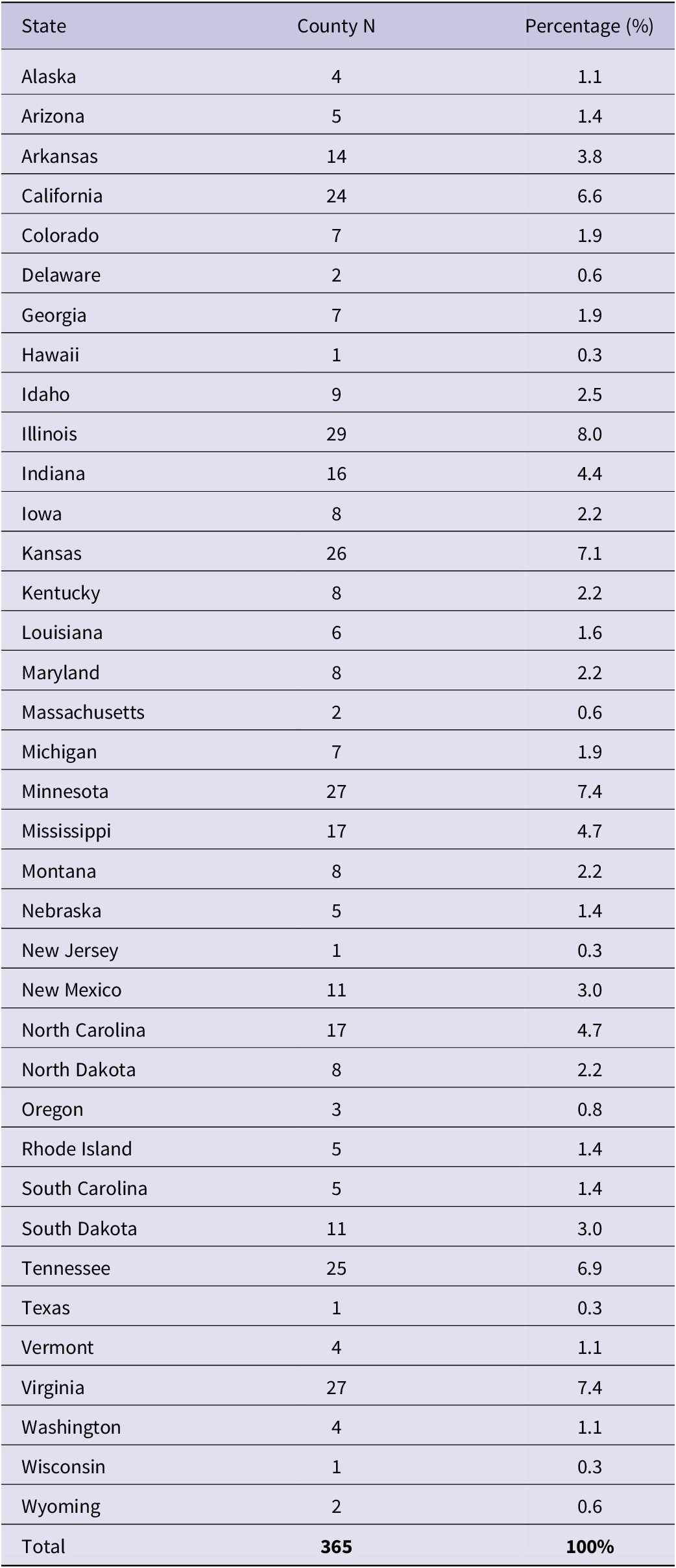
Overall, 365 U.S. counties in 37 states that experienced a single climate event between 2004 and 2012 were included. After applying survey weights, the respondents in these counties comprised a weighted population of 7,584,059 men aged 40 to 79 years, covering the age range in which screening might potentially be used. Table 1 shows the number of counties in the FEMA database, by state, that experienced a single climate event.
Counties in FEMA database, by State, with a single climate event* occurring in either 2006, 2008, or 2010 while having only one recorded disaster event between 2004 and 2012

N = number; *We included: Fire, Flood, Hurricane, Severe Ice Storm, Severe Storm, Snowstorm, and Tornado
Screening Pre- and Post-Disaster
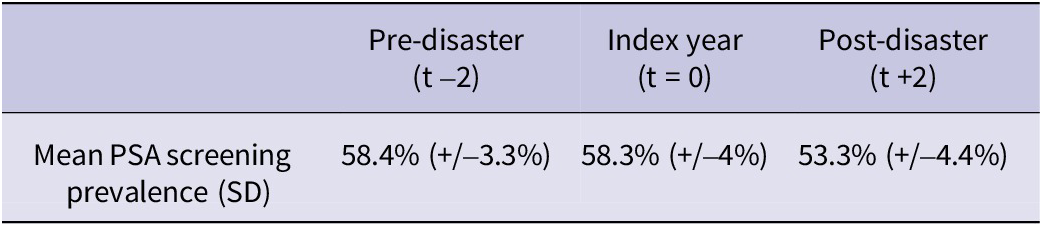
Across all counties included in the study, we found that the mean proportion of respondents who underwent a PSA screening test in the “pre-disaster” period was 58% (95% Confidence Interval [CI]: 57.6-58.3), with screening ranging from a minimum of 47.2% to a maximum of 66.1%. In the “post-disaster” period, the mean proportion of respondents who endorsed PSA test was 53% (95% CI: 52.5-53.4), ranging from 40.2% to 63.5% (Table 2).
The proportion of respondents who report Prostate-Specific Antigen (PSA) screening during the 2 years pre-disaster, the year of disaster, and the 2 years post-disaster

SD = Standard deviation.
Prevalence Ratio Pre- and Post-Disaster
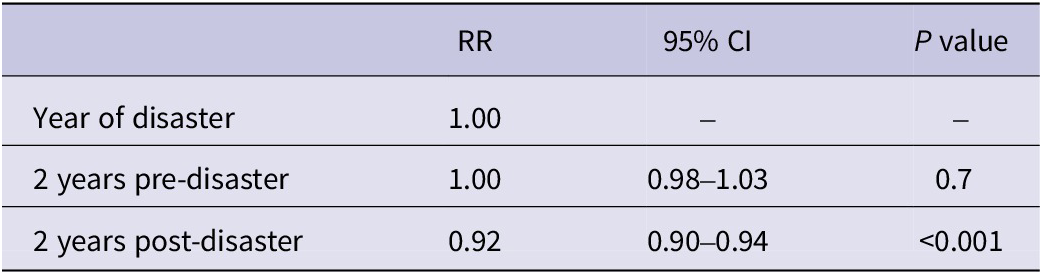
To further quantify the impact of natural disasters on PSA screening prevalence, we calculated the prevalence ratio of PSA screening pre- and post-disaster compared to the index year. Compared to the pre-disaster wash-in period, there was an 8% lower county-level probability of receiving PSA screening after a natural disaster, with a prevalence ratio of 0.92 for receiving a PSA screening 2 years after a disaster (95% CI: 0.90-0.94, P < 0.001, Table 3).
Rate Ratio of receiving PSA screening at the county level 2 years before and after a natural disaster (with the year of the disaster serving as the index year)

RR = Rate ratio; CI = confidence interval.
Stratified Analysis by County-Level Characteristics
The results of the stratified analysis are presented in Supplementary Table 2. A similar pattern of lower prevalence of screening was observed across all quartiles of Black or African American percentage of population. While no significant changes were observed two years before the natural disaster, screening rates significantly decreased 2 years after the event in all racial quartiles, with RRs ranging from 0.90 to 0.93 (P < 0.001). Counties with lower levels of uninsured population experienced the most substantial declines in PSA screening. In the 3rd quartile, screening significantly declined 2 years after the natural disaster (RR: 0.88, 95% CI: 0.84-0.93, P < 0.001). In contrast, counties with the highest uninsured rates (12.4%-28.6%) exhibited a smaller significant decline (RR: 0.97, 95% CI: 0.95-0.99, P = 0.004). Additionally, counties in the highest-income quartile experienced a more pronounced screening decrease compared to those in lower-income quartiles, with a 9% reduction in the 2 years post-disaster county-level probability of PSA screening (RR: 0.91, 95% CI: 0.88-0.94, P < 0.001).
Discussion
In this ecological quasi-experimental study, we investigated whether counties that experienced climate-related natural disasters experience declines in self-reported PSA screening relative to that county’s own baseline screening prevalence. On average, the counties’ PSA screening prevalence was 8% lower in the 2 years following a natural disaster, compared to the pre-disaster period. Assuming that no major time-varying confounders related to screening practice co-occurred alongside the natural disaster, these data support the hypothesis that climate-driven events may reduce use of cancer screening in the years following the event.Reference Guihenneuc, Ayraud-Thevenot, Roschnik, Dupuis and Migeot26
Previous county-level analyses found that disparities in cancer screening uptake were largely mediated by factors such as poverty status, lack of health insurance or employment, urban-rural location, and access to primary care physicians.Reference White and Itzkowitz27–Reference Friedlander, Meyer and Choi30 When a natural disaster occurs, it can further delay or reduce routine cancer screenings, leading to long-term effects on cancer detection, outcomes, and mortality.Reference Ginex, Dickman and Elia8 Studies examining the association between natural disasters and cancer screening uptake demonstrated significant disruptions in access to preventive services for breast, colorectal, and cervical cancer, with substantial declines in screening rates following environmental disasters.Reference Ortiz, Gierbolini-Bermúdez and Ramos-Cartagena31, Reference Colón-López, Contreras-Mora and Pérez32 In our stratified analysis, we observed no consistently larger effect of natural disasters on minority-predominant counties or those with higher uninsured rates. Interestingly, the decline in the proportion of men screened was more pronounced in wealthier and better-insured communities. This finding may be explained by baseline differences in screening utilization. Counties with higher poverty and uninsured rates likely have lower baseline screening access, limiting the extent of further decline after a disaster. In contrast, wealthier, insured counties may see a greater drop due to higher initial proportion of men screened. While disasters may worsen disparities, their impact appears more pronounced where preventive care is routine. Notably, the greater decline in screening observed in better-insured counties may also partially reflect variation in the representativeness of BRFSS data across geographic and sociodemographic contexts. While our model enhances geographic resolution, it is still dependent on self-reported survey data, which may be more complete or reliable in areas with higher baseline health care engagement. These factors may have contributed to the observed trend and warrant further exploration in future studies.
Our findings of decreased screening prevalence in the 2 years following a natural disaster gain further relevance considering recent evidence on PSA screening uptake. Stone et al.Reference Stone, Labban and Beatrici21 found that a 10% decrease in screening rates from 2010 to 2012 was linked to a significant rise in metastatic prostate cancer cases between 2015 and 2019. Other studies reported a nationwide decline in PSA screening rates alongside rising local and metastatic prostate cancer in men aged 50 and older.Reference Jemal, Culp, Ma, Islami and Fedewa33, Reference Vetterlein, Dalela and Sammon34 Recent evidence further suggests that higher county-level PSA screening rates are linked to lower odds of advanced prostate cancer, as well as of all-cause and prostate cancer-specific mortality.Reference Iyer, Stone and Roscoe35 Given these findings, which emphasize the critical impact of reduced screening on prostate cancer outcomes, our results underscore the need for heightened awareness in disaster-affected areas regarding the potential consequences of decreased PSA testing, especially in men at higher risk.
Gender differences in preventive health behaviors may also contribute to the results of our study. Women showed higher participation in preventive care programs in previous studies.Reference Otterbring and Festila36 Additionally, recent research indicates that individuals who perceive weather-related threats as a personal health risk are more likely to engage in preventive health behaviors, including cancer screening. Women, in particular, tended to be more concerned about severe weather events and their potential health effects.Reference Qian, Beatrici and Trinh37 Enhancing pre-disaster education on health information access and communication strategies may improve health care system connectivity, ultimately supporting preventive care efforts.
A strength of our study is the use of a model that controls for time-invariant sociodemographic variations within counties, thereby reducing unmeasured confounding of the association between natural disaster and PSA screening. Moreover, most published studies focused on adherence to preventive screening for breast, colorectal, and cervical screening.Reference Saito, Ozaki and Murakami9, Reference Ortiz, Gierbolini-Bermúdez and Ramos-Cartagena10, Reference Ozaki, Saito and Kaneda38 To the best of our knowledge, this is among the first studies to report on the relationship between climate-related natural disasters and PSA screening participation. Our analysis adds to the growing body of evidence on how climate impacts health care delivery, and in particular adherence to cancer screening programs. By documenting the decline in PSA screening prevalence following natural disasters, we highlight the need for adaptive strategies that support patient access to screening during and after these events. Notably, in addition to access-related disruptions, individuals may also deprioritize preventive health care in the wake of disasters due to psychological stress, competing survival needs, or shifting priorities. This pattern was observed after Hurricane Katrina, where preventive services were often delayed despite health care availability, and has similarly been reported following other major U.S. hurricanes such as Hurricane Sandy and Hurricane Maria, where interruptions of coordinated cancer care and delays in preventive health behaviors were documented.Reference Abramson39–Reference de Arzola41 These findings underscore the importance of addressing both access- and sentiment-level drivers in disaster-response planning. Effective strategies for maintaining continuity of care in the face of climate disruption will be increasingly important for improving and optimizing cancer outcomes as climate-related disasters are becoming more frequent and severe.
Health care systems should also anticipate and address the potential for service disruptions. Future research might focus on identifying targeted interventions to maintain access to preventive services like PSA screening during and after disasters. Telemedicine, mobile screening units, and patient outreach programs could be valuable tools to mitigate the impact of disruptions and to preserve access to essential cancer screenings.
Limitations
Despite its strengths, this study has several limitations. First, our approach assumes relatively stable county-level demographics and predictors of PSA screening over time. The small-area estimation approach is based on multilevel regression with post-stratification and combines BRFSS individual-level responses with 2010 census-derived demographic weights. Nonetheless, potential limitations include selection bias among BRFSS respondents, unmeasured confounding from factors not captured in the model (e.g., changes in local health infrastructure), and migration from counties with higher to lower screening rates. However, we assume such migration occurred randomly, and the resulting bias is likely minimal. While this method assumes stable demographics and representative survey responses, it remains appropriate for generating reliable county-level estimates of screening uptake. Second, our study categorized all climate change-related natural disasters together in the analysis, potentially overlooking differences in the severity and impact of various disaster types. Additionally, the analysis used data from 2004 to 2012, a period that predates more recent increases in the frequency and severity of natural disasters. This time frame was chosen to minimize confounding from 2 major changes in PSA screening guidelines but does represent a less recent data source. Specifically, the 2012 USPSTF recommendation against PSA screening led to declines in screening, subsequent increases in metastatic disease, and was later revised to support screening in at-risk groups.Reference Drazer, Huo and Eggener42, Reference Desai, Cacciamani and Gill43 While more recent temporal shifts in screening practices may limit generalizability, the observed associations remain relevant for understanding how disasters disrupt preventive care, as the underlying mechanisms affecting cancer screening are likely similar across time. Moreover, to preserve internal validity, we included only counties with a single disaster and “disaster-free” periods before and after the event, resulting in a relatively small sample of U.S. counties. This restriction reduced the geographic scope and excluded regions with higher cumulative disaster burden. However, counties with multiple disasters may experience even greater disruptions, suggesting that our findings may represent a more conservative estimate. Factors such as baseline health infrastructure and local health care policies were not directly accounted for; nonetheless, unless these factors changed concurrently with the disaster, they are unlikely to introduce substantial bias. Our reliance on self-reported survey data instead of administrative billing codes may also introduce recall bias, as some individuals might not accurately report prior PSA testing. Lastly, our study is limited by its ecological design, which cannot assess individual-level behaviors or directly attribute changes in PSA screening to natural disasters. Addressing these limitations in future research may strengthen the understanding of how climate-related natural disasters affect cancer screening and other preventive health care services.
Conclusion
The impact of natural disasters on cancer care is increasingly recognized. Herein, we report a decrease in PSA screening prevalence during the 2-year period following weather-related natural disasters. Possible explanations include disruptions in continuity of care, closure of medical facilities, and relocation of patients and health workers. As climate-related disasters become more frequent, ensuring access to cancer screening in disaster-prone areas will be essential.
Supplementary material
The supplementary material for this article can be found at http://doi.org/10.1017/dmp.2026.10343.
Author contribution
*A Piccolini: Conceptualization, data curation, formal analysis, investigation, methodology, validation, visualization, writing—original draft, writing—review and editing; *F Dagnino: Conceptualization, data curation, formal analysis, investigation, methodology, validation, visualization, writing—original draft, writing—review and editing; Y Chen: Data curation, formal analysis, investigation, methodology, validation, visualization, writing—original draft, writing—review and editing; Z Qian: Investigation, methodology, validation, visualization, writing—original draft, writing—review and editing; S Lipsitz: Data curation, formal analysis, investigation, methodology, validation, visualization, supervision; S Korn: Investigation, methodology, validation, visualization, writing—review and editing; B Xiao: Investigation, methodology, validation, visualization, writing—review and editing; K Pohl: Investigation, methodology, validation, visualization, writing—review and editing; H Zurl: Investigation, methodology, validation, visualization, writing—review and editing; DR Stelzl: Investigation, methodology, validation, visualization, writing—review and editing; B Stone: Data curation, formal analysis, investigation, methodology, validation, visualization, supervision, writing—review and editing; G Lughezzani: Methodology, validation, visualization, supervision, writing—review and editing; NM Buffi: Methodology, validation, visualization, supervision, writing—review and editing; H Iyer: Investigation, methodology, Validation, Visualization, Supervision, Writing—review and editing; QD Trinh: Investigation, Methodology, Validation, Visualization, Supervision, Writing—review and editing; AP Cole: Conceptualization, Investigation, Methodology, Validation, Visualization, Supervision, Writing—review and editing.
Financial disclosures
QDT: reports consulting fees from Astellas, Bayer, Intuitive Surgical, Janssen, Novartis, Pfizer, and research funding from the American Cancer Society, Pfizer Global Medical Grants (Prostate Cancer Disparities #63354905), and a Health Disparity Research Award from the Department of Defense Congressionally Directed Medical Research Program (#PC220551). APC: reports research funding from the Bruce A Beal and Robert L Beal Surgical Fellowship of the BWH Department of Surgery, from the Prostate Cancer Foundation and American Cancer Society (#23YOUN25) and from a Physician Research Award from the Department of Defense Congressionally Directed Medical Research Program (#PC220342). The other co-authors declare that they have no known competing financial interests or personal relationships that could have appeared to influence the work reported in this paper. SMK: reports speaker fees from Janssen, Astellas, and research fund from the Max Kade Foundation/Austrian Academy of Science.
Funding statement
This research did not receive any specific grant from funding agencies in the public, commercial, or not-for-profit sectors.
Competing interests
The authors declare that they do not have any conflicts of interest.
Ethical approval
For this study, we received a waiver from the Institutional Review Board (IRB protocol number 2023P003498) in accordance with institutional regulations for the use of de-identified administrative data.
Declaration of generative AI and AI-assisted technologies in the writing process
During the preparation of this work, the authors used ChatGPT 4.0 in order to correct syntax and grammar during the drafting of the manuscript. However, the content and analysis presented were independently generated and did not involve the use of any AI model.