1. INTRODUCTION
We imagine that we live in secular times and that the great accomplishment of political democracy is that it eliminated political theology, freeing authoritative collective decision making from the command of God. The “great separation” (Lilla Reference Lilla2007) between political philosophy and theology that characterizes the West underpins our understanding of politics as exclusively dealing with human rather than divine affairs. A crucial condition for democracy concerns the “twin tolerations,” where democratically elected governments are free from interference by religious authorities, and religious organizations in civil and political society are free from state intrusion (Stepan Reference Stepan2001). The separation of church and state has been held a vital condition for democratic politics.
Yet, at the same time, we realize that the great separation, the twin tolerations and the separation of church and state did not bring about (or were not meant to introduce, for that matter) the complete severance of politics and religion. In fact, paradoxically, 19th century liberal anti-clericalism, for instance, produced on the European continent a fierce state-church social cleavage that impregnated the, at the time, modernizing political systems with politicized religious issues, and inadvertently caused the formation of parties of religious defence (Kalyvas Reference Kalyvas1996; Ertman Reference Ertman, van Kersbergen and Manow2009), thus firmly establishing a political role for religion in politics in Europe. Also, religion has long held sway over political attitudes and behavior (e.g., voting) and to a considerable extent still does, as evidenced by the survival and continuing importance of Christian democratic, and other religious political parties (Van Kersbergen Reference Van Kersbergen2008). And in spite of the constitutional “wall of separation” between church and state in the United States, there is a pervasive presence of “God” in American politics (Gunn Reference Gunn, Hargreaves, Kelsay and Twiss2007), which is not limited to the Christian right, but continues to permeate the whole political spectrum. United States President Barack Obama's inaugural speech, for instance, can be seen as an attempt to revive or revitalize American civil religion, particularly by grounding American ideals in religious convictions (Bellah Reference Bellah2009; Copulsky Reference Copulsky2009; Kim Reference Kim2009). Obama spoke of “the God-given promise that all are equal, all are free, and all deserve a chance to pursue their full measure of happiness.”
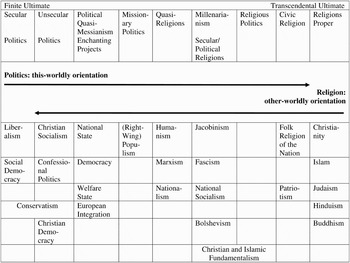
Moreover, it was to appreciate the various ways in which religious forms, concepts, explanations, and predictions are carried over into secular politics, where concepts of “political religion” were developed and are still thought to be useful. I am thinking of such notions as “missionary politics,” “political messianism,” “quasi-religions,” “millenarianism,” “political religion,” “implicit religion,” “invisible religion,” “public religion,” and “secular religion” (Zúquete Reference Zúquete2007; Smith Reference Smith1994; Talmon Reference Talmon1960; Gray Reference Gray2007; Bailey Reference Bailey1998; Lord Reference Lord2008; Besecke Reference Besecke2005; Casanova Reference Casanova1994; Voegelin Reference Voegelin2000; Maier Reference Maier2004; Burrin Reference Burrin1997; see Fig. 1). Eisenstadt (Reference Eisenstadt, Giesen and Šuber2005, 161), in his work on multiple modernities, has argued that “many central and continual dimensions and tensions of the cultural and political program of modernity and of modern political dynamics are deeply rooted in the religious components of the civilization which they developed, and that these dimensions and tensions constitute in many ways the transformation, even if in secular terms, of some of the basic religious orientations and the tensions that have been constitutive of these civilizations.” In Eisenstadt's view, it is particularly the Jacobin component of modernity that transfers to politics much of the religious past. Jacobinism, moreover, nurtures the clash between pluralism and totalitarianism. Eisenstadt uses this specific term for that feature in the program of modernity, which promulgates the extreme revolutionary opinion. Its various manifestations are linked to the religious past to the extent that they translated visions of how to bring the Kingdom of God to earth into a political program of how to build heaven on earth. They thus carried such visionary programs from the margins of religious eccentricity to the center stage of politics.
A continuum of politics and religion: Politics traversing the boundaries of religion and vice versa.

Such concepts of political religion were developed, and then applied, in order to capture the important feature of the political realities of a secularizing Europe that was, and still is, not quite secular. Political religions can be seen as “surrogates for traditional religion in an age of increasing disbelief or doubt” (Burleigh Reference Burleigh2005, 10), essentially providing a secular solution to existential angst. The political religions were secular, but still followed the internal structural design of religions. This is what Raymond Aron (Reference Aron1996, quoted in Burleigh Reference Burleigh2005: 10) had in mind when he defined the secular religions as “the doctrines that in the souls of contemporaries take the place of a vanished faith, and that locate humanity's salvation in this world, in the distant future, in the form of a social order that has to be created.” Burleigh (Reference Burleigh2005, 11) asks whether political religions perhaps embodied “some halfway stage in times when the symbolic world of Christianity was still a known reality, albeit challenged by secular creeds so untried that their dangers were not widely apparent?”
The emergence of political religions seems to be one way in which the structural differentiation of society, one of modernity's crucial characteristics, has unfolded, whereby politics and religion developed into increasingly more strictly separated subsystems of society, in which the function of the religious subsystem became to contend with other-worldly affairs and the political subsystem emerged to deal, among other things, with this-worldly matters (Luhmann Reference Luhmann1982). It points to the phenomenon that even in secularization as differentiation (that is, in secularity 1 in Taylor's (Reference Taylor2007) vocabulary and narrative), something of the religious past is transcribed into the secularized political ventures of modernity. In other words, the differentiated subsystems still overlap or intersect to a considerable extent, and it is here that we find various mixtures of religion and politics in more or less veiled forms. Structural differentiation, of course, implies competition between religion and politics, while the various modes of fusion between the two also generate confusion: ambiguity of authority (legitimate power to decide) and uncertainty of jurisdiction (legitimate power to execute). Both competition and confusion generate conflict (see Stark and Bainbridge Reference Stark and Bainbridge1996, ch 9) and in the process, some of the religious components in political projects might be either accentuated or played down.
This nexus between religion and politics tended to be studied by looking at how religious structure and substance came to permeate and shape such grand (Jacobin) political ideologies as fascism and communism. At the same time, however, we have largely, and in my view erroneously, downplayed the relevance of various relatively veiled forms of religion in modern day-to-day democratic politics,Footnote 1 basically assuming that in such systems, religion has retreated (or would very soon do so) to the private sphere, and that the struggle over power is carried out on purely secular conditions (Bruce Reference Bruce2003). As a result, we have missed, underestimated, or failed to recognize, to what extent and how, in fact, religious structure and substance have penetrated and influenced conventional democratic politics.
The point of my undertaking here is that, because we have trouble seeing the enclosed religious dimension of democratic politics, we do not comprehend that it is the progressive abolition of what I call political quasi-messianism in politics that is currently causing the widely recognized existential problem of democracy, namely massive political disaffection. Quasi-messianism, as embodied in certain political projects and missions, concerned the visionary anticipation of a better world that is attainable, here and in the distant, yet foreseeable future. In contrast to the religions proper, this better world was defined as within reach in this world through human collective intervention that aimed to implement improvements in the human condition, which, because of their promise, had an enchanting quality. In this quasi-messianism, political callings assumed a role that is similar to the savior in messianism proper, offering relief and hope for this-worldly redemption.
Quite down-to-earth political projects, say major social security projects, got charged with an inspiring and imaginative sense of purpose, direction and meaning, but equally with this-worldly catalysts, which, in contrast to the political-religious grand utopias (the political religions), were operational and practical. In this quality, some mass political projects or elite missions — and my European examples are Nation-State Building, Democratization, Welfare State, and European Integration — developed a capacity to enchant the political elite and the public alike, without invoking the Jacobin temptation so dangerously present in the political religions. Taking on this analysis yields the thesis that it is the disenchantment of politics, that is to say, the abolition of the quasi-messianism in the projects or missions, which lies at the heart of the contemporary phenomenon of waning political allegiance.
There is a long tradition of comparative research — starting with De Tocqueville's (Reference De Tocqueville, Mansfield and Winthrop2000) Democracy in America via Almond and Verba's (Reference Almond and Verba1963) The Civic Culture to Putnam's (Reference Putnam1993) Making Democracy Work and further — that connects the fate of democracy to the vitality of civil society. In recent decades, we have learned much about how social capital, that is to say, people's extended bonds within and between social networks, and trust function as the societal glue, which holds a society together. This adhesive also secures, to cross-nationally variable degrees of course, an orderly, stable, vital, and well-performing democratic system and a healthy political life. Although recently receiving somewhat less attention, we also know quite a bit about the reverse causal arrow, namely how democratic politics can help to pacify and resolve deep social, economic and cultural conflicts, and how politics contributes to societal and cultural integration (particularly, but not exclusively, through consociational devices, see Steiner and Ertman Reference Steiner and Ertman2002).
Indeed, politics is decisive for the fate of society (which can be anything between the extremes of thriving existence and total breakdown) and concerns all social activities of (groups of) individuals to handle their collective problems and resolve their conflicts of interests. Ultimately, it is the threat of violence, also in democracies, which is the most important source of power in the struggle over who decides which collective solutions will prevail. Constitutional democracies, however, are polities that have institutionalized the conditions under which public power, which is ultimately derived from the sovereign demos, is to be accumulated, distributed, constrained, and exercised legitimately and without the use of brute force or naked violence. Democratic politics is therefore the legitimate way of competing for and acquiring the constrained public power to make decisions for a society as a whole — and of enforcing those decisions. Such collective choice usually takes the form of public laws, policies, and regulations and is the authoritative means by which society is ordered, disciplined, coordinated, organized, controlled, monitored, punished, directed, corrected, or — in a word — ruled.
Echoing Bernard Crick's (Reference Crick1962) renowned defense of politics, Stoker (Reference Stoker2006, 7) has recently given a passionate justification of the importance of (democratic) politics:
“… politics can provide a means of getting on with your fellow human beings that aims to find a way forward through reconciliation and compromise without recourse to straightforward coercion or outright violence. It provides a way to live in an ordered manner with your neighbours, but one that unavoidably often calls on you to sign up to deals and compromises that might not be your first or even tenth choice, but which nevertheless have something in them that enables you to put up with them. It might not be very inspiring, but when it works politics delivers one great benefit: it enables you to choose, within constraints, the life you want without fear of physical coercion and violence being used against you. Politics creates space for human choice and diverse lifestyles. Politics, if done well, creates the positive context and stable environment for you to live your life. That's why politics matters.”
(Democratic) politics, then, is critical for the integration of modern societies, each and every one of which is after all, to varying degrees, characterized by large differences between citizens in sources of power, identities, interests, and opinions. Politics in general is the way in which the social and cultural conflicts, which emanate from these differences, are dealt with in an imposing yet non-violent way. Democratic politics goes one step further, for the reason that it aims to solve potentially disruptive conflicts by institutionalizing both the conflict lines themselves (as with the translation of social and cultural cleavages into parties and political institutions) and the solutions to deal with such conflicts (as in public laws, policies, and regulations). When democratic politics fails to live up to the promise of peaceful reconciliation, the constitution of society is at risk.
The distressing observation, which motivates this essay, is that — in spite of the growing popularity of democracy as a political regime around the globe — all well established (and new) democracies are confronted with increasing public dissatisfaction and disillusionment with politics. Ultimately, this is not only jeopardizing democracy as a system of governance, but also endangering the brittle fabric of a well integrated society.
I proceed as follows. In Section 2, I focus on how the current democratic predicament is perceived and explained. I notice a somewhat one-sided orientation on the citizen as ultimately the one to blame for the sorry condition of democracy. In Section 3, I offer a reconceptualization of the democratic crisis, in terms of the relationship of political allegiance between democratic rulers and the public. I argue that three large scale political projects (Nation-State Building, Democratization, Welfare State) and one primarily elite mission (European Integration) have been structuring favorably the long-term relationship between the rulers and the ruled under democratic conditions. These political projects and mission were capable of enchanting the ruled and the rulers, because they were characterized by a form of political quasi-messianism. In Section 4, I elaborate the thesis that the disenchantment of politics, understood as the gradual elimination of politics as an instrument of this-worldly salvation, is causing the decline of political allegiance and that this occurs because of (1) the failure, (2) the growth beyond limits, (3) the success, and (4) the unintended effects of interaction of the projects and mission. Ironically, then, just as the great separation, the twin tolerations and the separation of church and state were existential conditions for democratic politics, it is the complete elimination of even the remnants of political religion from democratic political projects and missions that seems to be undermining the very political vigor of the democratic polities of the West. In Section 5, I summarize the argument and discuss some possible consequences of the thus created political void in democracies. The trend in Europe seems to be that this void is offering opportunities for anti-political entrepreneurs and hazardous political experiments, including (xenophobic) populism and (utopian) fundamentalisms of various sorts, while the American case and President Obama may be indicating that a further personalization of politics with a messianistic type of charismatic leadership is an option too.
2. UNIVERSAL DISAFFECTION
It is not difficult to notice, as many have done, the great paradox of democratic politics of our time. On the one hand, if anything, in the past three decades, we have witnessed the increasing esteem, legitimacy, and triumph of democracy as a regime throughout the world, while, on the other hand, we have been observing an increasing dissatisfaction with politics, and the loss of confidence in the performance of government in new and well established democracies (Stoker Reference Stoker2006; Torcal and Montero Reference Torcal and Montero2006a; Hay Reference Hay2007). Democracy is at once becoming more and less well-liked, or so it seems.
If we look at the bright side, we see that, in spite of a recent setback, there has been a remarkable increase in the number of countries with a free and democratic political system in the past 30 years or so, from 42 (24 percent) in 1974 to 90 (47 percent) in 2007, and a decline in the number of not free countries, from 64 (41 percent) to 43 (22 percent) over the same period). In 2007, about 46 percent (3,004,990,000 people) of the world's population lived in a free country (Freedom House 2008; Puddington Reference Puddington2007). Moreover, support for democracy as the best possible form of government is remarkably high in all regions of the world. The World Values Survey, for instance, includes the thesis “Democracy may have problems but it's better than any other form of government.” In all nations except one (Nigeria), an overwhelming majority (ranging from 62 percent in Russia to 99 percent in Denmark) of respondents agrees with this statement (Inglehart Reference Inglehart and Moaddel2007).
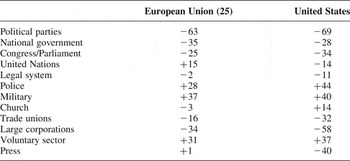
At the same time, however, there is a dark side, since all well established and new democracies are confronted with increasing dissatisfaction and disillusionment with politics. This is evidenced by such indicators as the decline in electoral turnout and party membership, increasing voter volatility (= decreasing partisan commitment), dwindling levels of trust in political institutions and actors, and growing political cynicism. Table 1, for instance, shows for various institutions net levels of trust, that is to say, “the proportion of respondents indicating a tendency to trust minus those indicating a tendency not to trust” (Hay Reference Hay2007, 34). It is evident that political parties are by far the least trusted institutions, closely followed by government, parliament, large corporations, and trade unions. In neither the United States nor any of the European Union countries do the three core institutions of democracy — political parties, Congress/parliament and government — score positive for trust and confidence (Mair Reference Mair2006, 45; Torcal and Montero Reference Torcal, Montero, Torcal and Montero2006b).
Net Levels of Trust in Public Institutions in the United States and the European Union, 2004a

aAdopted from Hay (Reference Hay2007, 34).
Particularly intriguing is the observation (on the basis of data from the Worlds Values Survey; Hay Reference Hay2007) that, although democracy is considered to be the best form of government, there is declining support for democracy as inherently a good form of government. As Hay (Reference Hay2007, 33) explains this discrepancy, there is evidence for “a rising tide of cynicism and fatalism about the capacity of even the best — democratic — system of government to provide good outcomes.” If democracy is considered to be the best form of government, but not essentially a good form, and if at the same time satisfaction with this least bad alternative is declining, then its future as a, in all senses, popular form of governance is perhaps more gloomy than some may believe.
One might add, somewhat speculatively perhaps, but no less worrisome, that decreasing expectations in the established and new democratic world of what this system of governance is capable of delivering, may reinforce what Freedom House recently has identified as “freedom stagnation,” namely that “the percentage of countries designated as Free has failed to increase for nearly a decade” (Puddington Reference Puddington2007, n.p.). Increasing levels of political disaffection in advanced democracies may not only dampen popular expectations in countries that are currently not free (after all, why put your hopes on a system that apparently generates estrangement among the public in free countries?), but also negatively affect the authoritarian elites' appraisal of “the people” as a possible source of legitimate political power and, accordingly, lessen their willingness even to engage in (small-scale) democratic experiments. In fact, key authoritarian regimes (China, Iran, Pakistan, Russia, and Venezuela) “are pursuing a comprehensive set of illiberal policies that are contesting democracy in practical terms, as well as in the broader battle of ideas. Increasingly sophisticated and backed by considerable resources, these efforts are challenging assumptions about the inevitability of democratic development” (Freedom House 2008, 3).
The explanations for the disquieting reality in functioning democracies are manifold, ranging from those who emphasize bad performance of economic and political institutions, to those who highlight lack of social capital and civic engagement as causes of the public's distrust of politics and declining democratic proclivities (Torcal and Montero Reference Torcal and Montero2006a). A survey of the literature shows that actually only a small number of accounts stress as the source of political disengagement the questionable role of a worn-out, unimaginative and deficient political elite, and ill-adapted political institutions more generally. Most (academic and journalistic) accounts are, certainly, very critical of what political parties and politicians do, but remain generally supportive of politics as a process and of democracy as a regime. However, although there are important exceptions (Hardin Reference Hardin, Pharr and Putnam2000; Mair Reference Mair2008), there is a surprisingly large number of analyses that, directly or indirectly, tend to blame the citizen for a lack of commitment to and responsibility for the public domain.
As Hay (Reference Hay2007, 39) argues, most explanations of political disaffection and disengagement have been citizen or demand-side oriented, with a tendency “to see its origins as resting not with changes in the supply of political goods so much as with changes in the responsiveness to, and desire for, such goods by their political consumers” (Hay Reference Hay2007, 39). The dominant conviction seems to be that, when all is said and done, there is something wrong with “the people,” the public, or the citizen: (s)he lacks social capital and trust, is deprived socio-economically and culturally, lacks information about good governance or is simply better informed by the media about bad than about good performance, has no interest in politics, does not participate, is too individualized and calculating, is indifferent to what politicians do, simply lacks the intellectual capacity to understand politics, or has rising expectations that can never be met (Stoker Reference Stoker2006; Torcal and Montero 2006; Hay Reference Hay2007). The modern disengaged citizen is eager to claim rights (for instance, freedom of expression), but fails to appreciate that these rights come with (participatory) obligations to the very system that guarantees them. The citizenry is criticized for ignoring that voting, for instance, is both a political right and a moral obligation or civic duty (Lijphart Reference Lijphart1997).
The political elites in established democracies have since long discovered, even before dissatisfaction was expressed in popular and electoral political apathy or protest (for instance, very low turnout, populist revolts, inexplicable electoral swings), that their position is threatened by declining popular support, not haphazardly for the political party upon which their own power depends, but systematically for the very political order of which their parties are an intrinsic constituent. They above all blame the citizens (well documented in Hay Reference Hay2007, 39–54), as can be deduced from the fact that they have started to experiment with political-institutional innovations to restore or increase citizen involvement in politics, so as to remedy the dissatisfaction and disillusionment with politics, and cope with the ensuing problems of legitimacy and effectiveness of the system. Interestingly enough, contradictory solutions — depending on the specific historical, institutional, and political context of a country — are contemplated, including increasing and decreasing electoral proportionality, strengthening and weakening parliamentary power, centralizing and decentralizing public administration, expanding and contracting the authority of the executive, outsourcing and reclaiming public power, broadening and narrowing the opportunities for political participation and contestation (Smith Reference Smith2005; Wright Reference Wright2006).
The most conspicuous fact of all this is perhaps not the contradictory nature of the various experiments in democratic engineering we observe, but rather that evidently in all established democracies, no matter what system prevails, elites consider reforms of the system of governance necessary as they are faced with citizens who do not seem prepared, or are ill-equipped, to fulfill their political duties. We are facing the puzzling and disquieting truth that political disaffection is a universal attribute of democracies and that citizens are to be blamed for this unhappy condition.
The observation that “the malaise afflicting democratic governance today is that many citizens rather wish they could do without politics” (Stoker Reference Stoker2006, 203) is a crucial insight to the extent that it points to the accomplishments of politics in and of democracy that are now taken for granted. Many citizens are convinced that they can do without politics, and, to some extent, they can indeed. However, neither the political elite nor the public seems to realize enough, or is ready to admit, that their joint political projects, such as the project of democracy or the welfare state, have empowered citizens to become more independent individuals (instead of, for instance, dependent members of a class, gender, or other social group), by granting individual political and social rights that are collectively guaranteed. Such successful political projects are neither recalled nor appreciated for their provision of well-being and physical, social, and economic security. At the same time, there are no new political projects that are deemed necessary for the provision of these important political goods and that could fill the void.
One pivotal exception might be President Obama, whose inaugural address set out to promote and disseminate civic virtues and values (“honesty and hard work, courage and fair play, tolerance and curiosity, loyalty and patriotism”) that are “rooted in an ethic of the common good” (Kim Reference Kim2009, n.p.). Kim (Reference Kim2009) suggests the following: “With his combination of charisma and the attribution of elevated purpose to the work of politics, Obama has proven astonishingly effective in generating an enchantment about new possibilities, about a renewed American dream, and about the centrality of a public language of hope.” It shows that under conditions of political disaffection and personalization or candidate-centered politics (Wattenberg Reference Wattenberg1991; also see King Reference King2002), charismatic leadership is still possible and capable of stirring up an extraordinary political passion. However, in the context of my argument, it must be stressed that, no matter how impressive Obama's magnetism and political performance are, it remains to be seen how far this remarkable fervor surpasses his personal appeal and extends to his political project. Obama's “project,” program or agenda is officially summarized as “a plan to revive the economy; provide affordable, accessible health care to all; strengthen our public education and social security systems; define a clear path to energy independence and tackle climate change; end the war in Iraq responsibly and finish our mission in Afghanistan; work with our allies to prevent Iran from developing a nuclear weapon” (change.gov 2009). However, it is doubtful that this agenda is of the same caliber as the enchanting projects I identify.
Overall, then, successful political projects seem to have been losing their capacity to arouse enthusiasm and passion for politics as a collective undertaking; yet no new political projects of this kind have come up as a replacement. It seems to me that a sense of purpose has been lost. What is the point of citizens participating massively and enthusiastically if they cannot identify any worthy purpose other than solving petty daily problems of party power and personal position? If politics is a struggle between different views of the good life or good society, with underlying value conflicts between equality and liberty, as Stoker (Reference Stoker2006) suggests, and if this is what once incited people to engage, then we must conclude that the sources of disengagement and dissatisfaction concern the evaporation of precisely this kind of struggle. At a deeper level, then, I would suggest, we are concerned with the loss of appeal of politics as comprising projects that were worth believing and even participating in, that is to say, projects that once promised to help bring about a better world, perhaps not here and now, but at least in the foreseeable future, and that because of this quality were enchanting. It is this property that seems to have been exhausted and it is this process that is described by the disenchantment of politics.
Therefore, in order to understand better the current condition of dissatisfaction and disaffection, it seems crucial to appreciate what, to begin with, were the sources of satisfaction and affection. If we wish to grasp how we lose our political aspirations and get disappointed, we need to appreciate what it was that once made politics attractive, appealing, captivating, yes even mesmerizing in terms of ambition, animation, and engagement. In other words, for a convincing answer to the puzzle of universal political disaffection in established and new democracies, we need to take into account both what citizens expect from politics and what politics has to offer.
This seems all the more pressing because there is something deeply disturbing about the citizen-oriented explanations of universal political disaffection and therefore about the remedies proposed. Since it is the political elite itself that identifies the political tragedy in terms of civic misbehavior and builds its contradictory remedies on this, this very definition of the democratic predicament as caused by the public tends to aggravate the problem rather than contribute to its solution. Moreover, the blame-the-citizen explanations are “dangerously circular (or tautological),” as they do not offer more than a re-description of the explanandum, for instance, “accounting for voter turnout by appeal to voter apathy — where apathy is understood as little more than the propensity of potential voters not to vote” (Hay Reference Hay2007, 40). This demonstrates that, in addition to the focus on the citizen, at least part of the democratic predicament needs to be explained by referring also to the actions of the political elite and/or the quality of their political programs and projects.
3. POLITICAL ALLEGIANCE AND ENCHANTMENT
In order to be able to capture better the current democratic predicament, explain it, and reflect on its possible consequences, we need to rethink the very issue, conceptualizing the problem, not so much in terms of the disaffection and disengagement of the public or the malfunctioning of the political elite, but above all in terms of the relationship between the political elite (the rulers) and the public (the ruled). This relationship, which is fundamentally one of exchange and power and which is conceptualized in terms of political allegiance, is deteriorating. The decline of political allegiance results from the disenchantment of politics, that is to say, the gradual elimination of politics as an instrument of this-worldly salvation.
Alan Milward (Reference Milward, Gowan and Anderson1997, 11) defined allegiance as “the range of all those elements which induce citizens to give their loyalty to institutions of governance, whether national, international or supranational.” Building on this, I see political allegiance as a relationship of exchange and power between the rulers and the ruled. It refers to the willingness of the ruled to approve of and to support the decisions, made and imposed on the public by a government, that affect their material and nonmaterial interests, in return for a more or less immediate and straightforward reward or benefit (security and well-being) to which the public feels entitled on the basis of it having rendered approval and support (Van Kersbergen Reference Van Kersbergen2000, Reference Van Kersbergen2003).
The “goods” of security and well-being are varied and manifold. Security and well-being offered by a government can be territorial, physical, psychological, economic, and social. It must in principle be understood in the broadest possible sense and ranges from issues of war and peace to economic (for instance, employment and price stability), social (for instance, income maintenance), and psychological (for instance, peace of mind and sense of belonging) security and well-being. Diffuse support and obedience can be political, economic, social and civil, and includes all forms of social and political participation, ranging from the willingness to pay taxes and general law-abidingness to voting and standing for office.
I propose three large scale political projects (Nation-State Building, Democratization, and Welfare State) and one primarily elite mission (European Integration) as having been crucial in structuring the long-term relationship of allegiance between the ruler and the ruled. These projects and mission have provided the key mechanisms of exchange and investments in power. The exchanges and investments have produced benefits for both the ruler (power) and the ruled (security and well-being), establishing political allegiance.
What were the components of the political projects and mission that were capable of enchanting the ruled and the rulers, generating a beneficial relationship of allegiance between them? This, at a minimum, we need to know, so as to be able to explain in some detail what disenchantment (explanans) is and what the key mechanisms are that link it to declining political allegiance (explanandum). The answer, I think, has to do with the fact that the projects and the mission were characterized by a form of political quasi-messianism, which concerns the visionary anticipation of a better world that is attainable, here and in the distant, yet foreseeable future. This better world is within reach through human collective intervention that aims to implement improvements in the human condition, which, because of their promise, have an enchanting quality. In this quasi-messianism, political callings assume a role that is similar to the savior in messianism, offering relief and hope for this-worldly redemption. In this quality, political projects, laden with an inspired and imaginative sense of purpose, direction, and meaning, but also with this-worldly catalysts, which are operational and practical, have the capacity to enchant the political elite and public alike.
I introduce the concept of quasi-messianism here, so as to bring to light some affinity with Talmon's (1960) notion of political messianism as a mind-set, a faith, a belief in the possibility of salvation here and now, through the establishment of a just social order. Political messianism, as Talmon saw it, however, is inherently totalitarian as it places the collective realization of political ideals above individual freedom. To highlight the contrast particularly with this latter aspect, I use the term quasi to indicate that the quality of messianism I refer to has only some resemblance, particularly by virtue of the attribute of the belief in the possibility of salvation here and now, but is evidently not quite like Talmon's necessarily totalitarian notion of messianism.
Political quasi-messianism once was an important feature of politics as a vocation and a quality of political projects and missions that aimed to reform the social order through political exchange and the exercise of power. Political projects promised to liberate people from existential insecurity and material want. For some, such projects almost represented a messiah in whom they could vest their hope for security and well-being. For others, the projects were so abhorrent, that they were eager to contest them, perhaps because they stood to lose much or conceivably for the reason that they happened to believe in another one. The political causes and the movements they inspired contained for some the promise of triumph and the salvation of the world and for others perhaps no less than perdition. But be that as it may, the political quasi-messianism in these projects aroused political enthusiasm and passion; it led to zealous devotion to leadership (not necessarily a leader), the cause, and the movement, but therefore also gave rise to ardent conflicts that mobilized large numbers of people, transferring them as active participants from the private or depoliticized public domain into the realm of politics.
In an attempt to create some clarity in the conceptual field of political religions and to designate, the theoretical location of the enchanting projects, I propose to represent the various fusions and confusions of religion and politics as a continuum, arranged according to the extent to which secular politics invades religion or religion penetrates politics (see Fig. 1). The continuum ranges from the exclusively this-worldly focus on the “finite ultimate” of the realm of worldly power and physical violence to the exclusively other-worldly focus on the “transcendental ultimate” of ultimate truth and other-worldly salvation. Analytically, we could look at this as politics traversing the boundaries of religion and vice versa (this is indicated by the thick arrows between the two boxes in Fig. 1). On the extreme, purely political, left of the continuum, we find the secular politics of, for instance, liberalism and social democracy. On the extreme, purely religious, right of the continuum, the world religions are placed.
Moving from the right to the left, religion moves into the political sphere, from the world religions proper (Christianity, Islam, Judaism, Hinduism, Buddhism) to civic religion, religious politics (Christian and Islamic Fundamentalism), the political religions (Jacobinism, Fascism, National Socialism, Bolshevism), and further to missionary politics (right wing populism), the quasi-religions (Humanism, Marxism, Nationalism), and — via the enchanting projects (Nation-State, Democracy, Welfare State, European Integration) — to the “unsecular politics” of Christian Socialism, Confessional Politics, and Christian Democracy (with Conservatism in between secular and unsecular politics). Moving from the left to the right, politics penetrates the religious sphere, from unsecular politics all the way back to civic religion.
In the projection of the continuum in Figure 1, missionary politics and the quasi-religions are closest to the enchanting projects (quasi-messianism), the former two much more infused by the religious domain and the latter far more by the political realm. More generally, we could say that the general structure that the religions proper all have in common (Smith Reference Smith1994) remains intact if we move from the right to the left in the continuum of the figure. This general structure ensues from the fact that all religions proper deal with the same basic problem. They share the diagnosis of the human predicament: “based on the nature of the religious ultimate aimed at locating what is wrong with our natural existence and what separates us from an ideal fulfilment in God, or Nirvana or the One”; this, in turn, leads to a quest “for that reality which has the power to overcome the flaw in our being disclosed in the diagnosis”; the quest, finally, is for a deliverer “which overcomes the flaw and restores the wholeness of our being” (Smith Reference Smith1994, 3). Characteristic for the religions proper is that the ultimate goal is not any finite reality. And this is precisely the difference with quasi-religions (Humanism, Marxism and Nationalism in Smith's case) that also have a structure of diagnosis, quest and deliverer, but define their ultimate as finite and of this world, and consider the transformation of man and the solution to the human predicament a distinct possibility within historical reach.
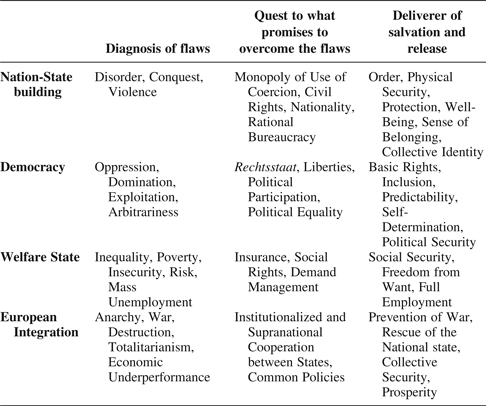
My treatment of Nation-State Building, Democratization, and the Welfare State as enchanting projects and European Integration as an enchanting political mission, can now be justified and explained. It is founded on the idea that as projects and a mission, they certainly lacked the strong religious connotations, which are so characteristic of the quasi-religions and the political religions more generally, but they still embodied somewhat of a visionary anticipation of a better world through human intervention. Most importantly, they also had the same basic structure of the quasi-religions. The analysis of the quasi-religions offers the conceptual tools to map the fundamental characteristics of the enchanting projects and mission (see Table 2).
The Fundamental Characteristics of Enchanting Projects
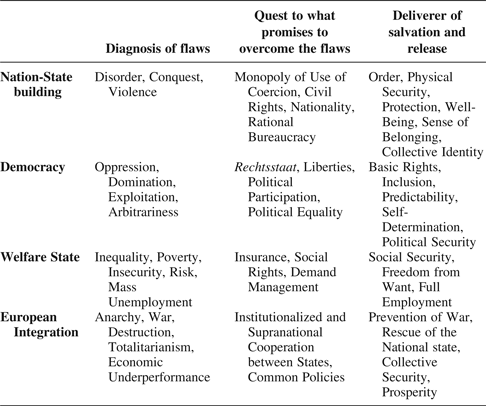
Nation-State Building is a reaction to the problems of internal disorder and the risk of conquest by other states and the violence this entails. The state project is about achieving territorial order and stability that provides physical security and protection against violence. In addition, when order is guaranteed, well-being can become an option. The nation project concerns the creation of a sense of belonging and the construction of a collective identity of the population tied to the state and its territory. Among the various means that promised to achieve all this were the establishment of the state monopoly of the use of coercion and violence, the granting of civil and nationality rights to define the populace and its character, and the creation and reinforcement of a national bureaucracy (army, tax collector) so as to multiply the resources (soldiers, money, personnel) and, with that, the power of the state.
Similarly, Democracy was about achieving liberty, political equality, just exchanges in social and economic life, political and legal reliability, and protection against the arbitrary power of the state. With the means of the Rechtsstaat, various liberties, the extension of the possibilities of active and passive political participation, and equal political rights (for instance, one person, one vote), democratization established fundamental and inalienable basic rights, included the whole population in the political system, increased the predictability of state and government behavior, greatly advanced the opportunities of self-determination, all of which instituted a crucial sense of political security.
The Welfare State project was about fighting inequality, poverty, and the social insecurity that resulted from industrial society and the market economy. It organized for the population compelling ways to deal with social risks and implemented public policies to stimulate economic growth and to combat the societal disruption that emanates from poverty and mass unemployment. The welfare state did this by making compulsory social insurance and enforcing solidarity on society, granting and guaranteeing social rights, and by experimenting with various ways of managing economic demand. The welfare state aspired to provide protection against, and freedom from, want, and full employment. It therefore offered, literally, social security.
The mission of European Integration was inspired by the specters of anarchy in inter-state relations, the large destruction from two World Wars, the fear of a possible third World War, the costs of competition with totalitarian systems, and the economic underperformance of national yet interdependent nation-states, which aggravated the other risks. By institutionalizing ever closer forms of (supranational) cooperation between sovereign states and developing common policies, European Integration's aim was to prevent a new war, help re-establish the nation-states of Western Europe, provide a sense of collective security among the European populations and stimulate economic and social prosperity.
In sum, the three projects and the elite mission therefore share one important feature: they established and reinforced political allegiance in terms of a beneficial exchange of power/support and (physical, political, social and collective) security and well-being.
4. DISENCHANTMENT AND THE WANING OF ALLEGIANCE
Now that the fundamental characteristics of the enchanting projects and mission have been determined, I can discuss the notion of disenchantment. This concept is of course taken from Max Weber's “Entzauberung der Welt”. Disenchantment of the world, according to Weber (Reference Weber1905, 114; 2005, 71) is “die Ausschaltung der Magie als Heilsmittel” (the elimination of magic as an instrument of salvation). This “great historic process in the development of religions … had repudiated all magical means to salvation as superstition and sin” (Weber Reference Weber2005, 61). Paraphrasing this, the disenchantment of politics, then, is defined as the gradual elimination of politics as an instrument of this-worldly salvation.
Disenchantment is the gradual disappearance of the enthusiastic belief in the quest to what promises to overcome the flaws and the fading of the conviction that the deliverer of salvation and release is known and immanent, which are delineated by disenchantment. It concerns the progressive abolition of quasi-messianism in politics and attempts to depict the demise of the transformative vista in these political projects as redemption and revelation, and, with it, the loss of the fervent commitment of both the rulers and the ruled. A corollary is that disenchantment lies at the heart of the contemporary decline of political allegiance. An important feature of politics gone astray concerns this idea of an almost religious collective human experience of captivating projects and leaders and faithful and devoted followers — and ever so many ardent opponents with challenging visions of the redemptive projects. Such political projects obtained their enchanting disposition to the extent that they were capable of offering hope of redemption and an end to human suffering in this world through the provision of various kinds of security. They did this, not by posing grand utopias that assumed a complete makeover of imperfect human nature, as in the case of the political religions, nor by relapsing into the genuine religious guarantee of a better life after the present, as in the case of the religions proper. No, they were enchanting because they presented far-reaching yet level-headed reforms that took into account the human condition without relinquishing every bit of utopian zest.
The political projects of Nation-State Building, Democracy, Welfare State, and the mission of European Integration, once promised to liberate people from existential insecurity and material want. All dealt, in one way or other, with how best to guaranty security (safety) and prosperity (well-being). The promise of salvation and release of these projects and mission fostered the relationship of allegiance between rulers and ruled. The loss of this promise (or, ironically, its fulfilment) is what is summarized in the disenchantment of politics.
Several possible ways of looking at the relationship between disenchantment and political allegiance can be identified. Most obviously, we could conceive of disenchantment in terms of the failure of the projects, for instance, the Nation-State and Democracy because of internationalization (most notably migration), the relocation of power and the emergence of new forms of governance, or the Welfare State because of various endogenous (ageing) and exogenous (economic interdependence) pressures. Allegiance is the victim when the projects fail, because in this case, the projects are losing what made them enchanting in the first place: their promise of salvation. This directly disrupts the relationship between the ruler and the ruled and leads to the decline of political allegiance. In the absence of new enchanting projects, this increases disillusionment with the projects, and adds to the disenchantment of politics, reinforcing the decline of political allegiance.
We could also imagine that the political projects of the Nation-State, the Welfare State and Democracy, and the mission of European Integration have reached a point where they have grown beyond their limits. For instance, the further enlargement of the European Union eastwards (Turkey) might seriously put at risk what is left of the permissive consensus. The fiscal deficits of the state and increasing tax demands might dangerously strain the moral willingness of state subjects to behave as good and law-abiding citizens. Further democratization might again overload the democratic system of governance with demands that cannot be met. A vicious causal sequence of project disillusionment, further disenchantment, and reinforced decline of political allegiance would be the result.
Ironically, the disenchantment of politics is also most likely having detrimental effects on political allegiance, because of the immense success of the projects, as a result of which they are largely, but erroneously, taken for granted and lose their enchanting disposition. There is, however, yet another, and in my understanding most important way, in which the projects are connected to the decline of political allegiance, namely through the mechanism of unintended effects of interaction. This is, for instance, most clearly the case, where the mission of European Integration meets the other projects. In the view of many people, European integration formally puts into question the sovereignty of the participating member states. The mission of European Integration does not seem to enhance, but rather shrink the policy making efficacy of the nation-state and is threatening its very survival as a sovereign institution. This causes great anxiety among both the elite and the public, because it damages the nation's sense of belonging and its constructed collective identity, and erodes the political elite's position of power. If the physical and psychological security offered by the nation-state ceases to be the benefit for the ruled, support for the rulers comes to an end. This anxiety is intensified by the fear that the European Union is assaulting democracy and rapidly turning into a super-state. Finally, the weakening and even vanishing of national borders as a result of European integration is threatening national integration and social solidarity. There are serious risks that the territorially based solidarity, which was elaborated in the welfare state in the post-war era, is undermined (Ferrera Reference Ferrera2005) as European integration continues to de-structure the nation-state and the social spaces contained within it, while not restructuring at the supranational level the kind of solidarity that is still currently expressed in the national welfare state.
5. CONCLUSION
The disenchantment of politics, that is to say, the gradual elimination of politics as an instrument of this-worldly salvation (once embodied in the enchanting political projects of Nation-State Building, Democracy and the Welfare State, and the elite mission of European Integration), is causing the decline of political allegiance, that is to say, a deteriorating relationship of exchange and power between the rulers (political elite, government) and the ruled (people, citizens, voters). Disenchantment occurs, because of the failure, the growth beyond limits, the success, and the unintended effects of interaction of the projects.
Pondering over the possible consequences of waning political allegiance, we might hypothesize that the disenchantment of politics causes a political void in contemporary democratic societies, an emptiness of collective power, which exerts a pull on various political enterprises, experiments and escapades. Some of these, such as Obama's charismatic leadership and his impressive performance so far (as of June 2009), may be beneficial to democratic governance and an inspiration for politicians and citizens around the globe. Still, his unspecified conception of “change” and his overemphasis of political primacy and capacity (“yes we can!”) may have generated expectations that are hard if not impossible to satisfy and are therefore bound to disappoint.
Other political ventures — to a lesser or greater extent — could imperil the very existence of democracy. We could think of the decomposition of the political center and the increasing importance of fringe (flank) politics that many advanced democracies are currently experiencing. As a result of this, coalition building, and effective government on the basis of beneficial exchanges are becoming increasingly difficult. The resulting ungovernability not only would contribute directly to the further disenchantment of politics, but would also reinforce the image of a, by and large, impotent elite that seems to have only one rationale left to govern: the protection of its own petty profitable position.
Here, both the toothless elite and the frustrated public become an easy victim for populist entrepreneurs. Populists effectively turn around the blame-the-citizen explanations of political disaffection and when these political adventurers manage to link the existing general frustration about politics with concrete problems of social and cultural integration, an explosive mix occurs that seriously stirs up normal democratic politics as we know it. Most European democracies seem to be captured by the populist “Zeitgeist” (Mudde Reference Mudde2004), especially, but not exclusively, articulated and pronounced on the right-side of the political spectrum. We can observe a sharper and vaster political mobilization of latent xenophobia that is essentially directed against migration and the multicultural society. There is an increasingly expressive discontent with political culture that is being translated into a critique of political correctness and of prevailing public morality. Latent xenophobia in society surfaces in the form of a frontal assault on the moral pressure exerted on citizens not to speak negatively about any aspect related to migration, particularly religion (Islam). In addition, the articulation and politicization of popular dissatisfaction with the performance of government, and the political cynicism with respect to political elites that comes with it, is being converted into a revolt that attacks elitism, intellectualism, the closed nature of political recruitment, and the lack of representativeness of politicians more generally.
In a broader perspective, however, we should perhaps also recognize that even the most vehement populist revolts — so far and to some extent — have been channeled via democratic outlets and managed surprisingly well. However, it is not excluded that much less innocuous political enterprises are now seeking to fill the void. Europe does not have an Obama and the success of contemporary Western populism insinuates that popular sentiments and political enthusiasm predominantly hover around the edges of the radical right. In the context of the imperfect integration of religious and ethnic minorities and continuing migration, there is no guarantee that political firebrands will not find ways to tap into xenophobic undercurrents too.
John Gray (Reference Gray2007) has suggested that American foreign policy, in the last decades or so, has lost its realism and increasingly has been permeated by an apocalyptic, millennial belief in the immanent coming of democracy. The democratic void has allowed utopianism to enter the mainstream and September 11 has led to the Americanization of the apocalypse, exemplified by United States neo-conservatism. It has turned Americans into armed missionaries for democracy and led to a war that had no achievable goals. Democracy cannot be established in most of the Middle East countries, nor can terrorism be exterminated. Hence, as Gray stresses, Iraq is a 21st century utopian experiment, with the same disastrous results as the utopian experiments of the 20th century: “the picture of post-war Iraq that neo-conservatives disseminated was a tissue of disinformation and wishful thinking, while the willingness to use intolerable means to achieve the impossible end showed the utopian mind at its most deluded” (Gray Reference Gray2007, 160).
In other words, perhaps less easily recognizable, but equally if not more inauspicious political ventures may already have been filling the democratic void. Some sinister political enterprises, such as American missionary democracy, have not been launched from the outside, but from within, that is to say, they have been operating as “normal” democratic politics, but are dangerously utopian in their dogma. At the same time, from the outside, we see various fundamentalisms, including Christian, Islamic, Hebrew, and Eco-, organizing, penetrating the system, and influencing the conditions and possibility of democratic politics and debate. Fundamentalism is, of course, deeply at odds with democracy, because it denies every single principle on which democracy thrives (Taverne Reference Taverne2005). So far, it is unclear whether President Obama's difficult mission to “renormalize” American foreign policy on this point and eradicate utopianism will be successful.
Reluctantly, but forced to do so, I end with a pessimistic note. Currently, I see no real project or mission on the horizon, which could be interpreted as comparably enchanting, sagacious, yet still cautious, as the projects of the Nation-State, Democracy, the Welfare State, and European Integration. Yes, the Obama phenomenon, even though it does not entail such a project, does leave a gleam of hope because of its reinvigoration of politics. But most political enterprises that are filling the democratic void seem to be endangering democracy.