




No CrossRef data available.
Sixty years of bilingualism affects the pronunciation of Latvian vowels
Published online by Cambridge University Press: 27 April 2006
Abstract
For fifty years after World War II, Latvia was incorporated into the former Soviet Union. Although in theory the use of regional languages was not discouraged, in practice knowledge of Russian was obligatory. Since 1991, Latvian has again become the official language, and knowledge of Russian is widespread but optional. These political events have created a natural experiment in the effects of almost universal bilingualism on a language. To assess the impact on pronunciation, native speakers of Latvian, ranging from retirement age to teens, were recorded reading a word list and a short narrative. Vowel pronunciation differed across the generations both in quantity relationships and in formant structure.Research for this project was supported by a grant from the International Research and Exchange Board, with funds provided by the U.S. Department of State (Title VII Program) and the National Endowment for the Humanities. None of these organizations is responsible for the views expressed here.
Information
- Type
- Research Article
- Information
- Copyright
- © 2006 Cambridge University Press
In his groundbreaking book, Language Contact, Weinreich (1968:11) observed, “In speech, interference is like sand carried by a stream; in language, it is the sedimented sand deposited on the bottom of a lake. The two phases of interference should be distinguished. In speech, it occurs anew in the utterances of the bilingual speaker as a result of his personal knowledge of the other tongue.”
The perspective that Weinreich suggested is ultimately psychological. Contact between languages takes place in the mind of an individual. The languages that a bilingual individual speaks are interconnected and are able to influence each other. Undoubtedly the nature and strength of the interconnection between languages varies, and some properties of languages influence each other more than others. Nevertheless, all aspects of a bilingual's languages are ultimately capable of making contact (Cook, 2003). If they do, then language contact may lead to language change.
The past fifty years of the linguistic situation in Latvia has created a natural experiment for examining the effects of bilingualism, specifically the effect of Russian on Latvian. After World War II, Latvia was incorporated into the USSR. During the years of Soviet rule, Latvians were strongly encouraged, if not required, to use Russian in most aspects of life. According to Druviete (2000), it was almost impossible to function in daily life without knowledge of Russian. One needed the language to deal with the government bureaucracy, to receive medical care, even to go shopping. During this same time period, the demographic situation of the country changed through extensive immigration, so that currently almost half of the population is ethnic Russian. These immigrants had little motivation to learn Latvian because they could function perfectly well with knowledge only of their native language. Since 1991, Latvian has again become the official language of the country and much effort has been devoted to enabling ethnic Russians to learn the language sufficiently to function in their professions. In this linguistic situation, different generations of Latvians have had to become proficient to various levels in Russian, and ethnic Russians are currently speaking Latvian at various levels of proficiency.
SECOND LANGUAGE EFFECTS ON A FIRST LANGUAGE
Although the phonetics and phonology of a first language (L1) are less likely to be affected by a second language (L2) than, for example, the lexicon, a number of experimental investigations have detected changes in either perception or production in both cases, showing bilingual speakers, to be differentiated from the monolingual norm. These studies imply that knowledge and use of a second language may, under some circumstances, affect a bilingual speaker's first language (see Cook, 2003; Schmid, 2002).
One thread in experimental studies of bilingual perception and production has focused on voicing as specified by voice onset time (VOT). One of the first was conducted by Caramazza, Yeni-Komshian, Zurif, and Carbone (1973). They found that their subjects' first language, French, was affected by their second language, English, in the perception of voicing but not in production. The bilingual participants were all native speakers of French and had begun to learn English as children, by no later than their seventh birthday. Bilinguals did not switch from one perceptual set to another in order to match the perceptual functions of the monolingual speakers. Rather, they appear to have based their perceptual decisions on the same criteria in both French and English. In production, the participants' use of VOT in French was not affected by their second language. Williams (1976, 1977, 1978) and Elman, Diehl, and Buchwald (1977) replicated the Caramazza et al. study with Spanish–English bilinguals, and found—just as Caramazza et al. had—that the bilingual speakers preserved the phonetic characteristics of each language in production but not in perception. On the other hand, Mack (1984, 1989) found no significant differences between the performance of bilingual and monolingual talkers in either perception or production of voicing.
Flege and Hillenbrand (1984) and Major (1992) have suggested that laboratory studies may underestimate the effects of a strong second language on a first language. Major (1992) investigated the English pronunciation of five native speakers of American English who had been living permanently in Brazil from 12 to 35 years. All were middle-class college educated speakers who used English on a daily basis in connection with their professions as English teachers or administrators in an English language institute. In spite of both practice in English and, presumably, a desire to maintain their first language, all of the speakers showed some changes in their pronunciation of voiceless stops, as indicated by VOT measurements, in either casual or formal settings, or in both. All of the changes were in the direction of Portuguese voice onset time values even for speakers whose Portuguese pronunciation differed markedly from that of native speakers. Flege and Hillenbrand (1984) examined the production of native French speakers who were living in an English-speaking environment and using English on a daily basis. None of these talkers resembled monolinguals. Rather, all of them employed VOT values substantially in excess of the values observed in the speech of French monolinguals, showing the effects of extensive use of a second language. These shifts in perception and production can take place relatively rapidly, over months rather than years (Sancier & Fowler, 1997). All these studies agree, however, in their finding that some aspect of the phonetics of L1 shifts so that bilingual talkers employ phonetic values in their L1 that are more similar to the phonetic values of L2 than the values employed by monolingual talkers.
Although much of the research has examined voicing, L2 effects on the production and perception of vowels in L1 have also been reported. The characteristics of L2 influence are not always easy to specify. For example, Mack (1984, 1989) reported that English–French bilinguals treated vowel quality for the /i/-/I/ contrast differently from monolinguals. She concluded that bilingual phonetic transfer or systematic restructuring of the phonetic component can occur in a dominant language used regularly and productively since early childhood. A case study of contact between French and English, Bullock and Gerfen (2004) showed a pattern that might be related, that is, the merger of mid front rounded vowels as schwar (

). Baker and Trofimovich (2005) reported that the acoustic structure of Korean vowels was “colored” by the English vowel system for some Korean–English bilinguals.
Although L2 influence on L1 vowel production or perception has been documented, the exact specification of the influence appears to be quite complex, reflecting age, similarity between the phonological systems of languages, patterns of use of the two languages, and so forth. In particular, although it is possible for the categories of the two languages to become more similar, the reverse pattern of phonetic influence in bilingualism has also been reported. In this pattern, the phonetic values of L1 differ from a monolingual norm by exaggerating differences. This development has been found for both voicing and vowels. Flege and Eefting (1987a) examined the voicing contrast in the speech of three groups of English–Spanish bilinguals. In this study, the second language, English, affected the pronunciation of Spanish, but, instead of using a compromise value for both languages, the bilingual talkers produced the Spanish voiceless stops with significantly shorter VOT values than monolingual Spanish speakers. That is, their Spanish productions were less, rather than more, English-like. In a similar study examining Dutch–English bilinguals, Flege and Eefting (1987b) found that proficient Dutch speakers of English produced Dutch /t/ with shorter VOT values than less proficient speakers, emphasizing the contrast between the phonetic realizations of voiceless stops in the two languages. Similarly, Flege, Schirru, and MacKay (2001) found that native speakers of Italian who had started to learn English before adolescence tended to produce English /e/ with more diphthongization than native English speakers, suggesting that they were dissimilating the category of the English vowel from the Italian monophthongal /e/. Finally, Guion (2003) found that Quichua vowels produced by Spanish–Quichua bilinguals were raised in comparison with the vowels produced by monolingual Quichua speakers. She also argued that this vowel reorganization serves to enhance the distinctiveness of vowels in the two languages.
On the basis of such findings, Flege (1995) has argued that bilinguals create a perceptual representation of phonological contrasts that serve as a compromise between their two languages. If bilingual talkers consider two sounds in their languages to be instances of the same category, then these two sounds will come to be produced and perceived in similar ways; that is, the first language and the second language sounds will be produced with characteristics that are a compromise between the two languages. On the other hand, if bilingual talkers consider a sound in their second language to be “new,” not equivalent to a sound found in L1, they may create a new category for the sound. Because the sounds of the two languages exist in a common phonological space, bilinguals may modify differences among the sounds of L1 in order to maintain phonological contrasts. The effects may take place at the level of phonetic implementation of contrasts, and, apparently, occur without conscious awareness.
Because the production of vowels allows for relatively direct measurement of gradient influences, in this study we examined the pronunciation of Latvian vowels by native Latvian talkers representing various generations since the Russian occupation after World War II. Our objective is to investigate the phonetic structure of Latvian over time, to determine how the pronunciation of the language has been affected by nearly universal bilingualism on the part of Latvians, coupled with exposure to accented Latvian as produced by ethnic Russians.
LATVIAN AND RUSSIAN VOWELS
The vowel systems of the two languages differ in inventory and in the way that prosodic patterns interact with vowel quality. Latvian employs the vowels

. Although there are differences in the distribution of vowels, all can be contrastively long or short in any syllable of a word. Stress is fixed on the first syllable. Unstressed short vowels are sometimes extremely abbreviated or even absent, but they do not appreciably change in quality (Laua, 1984). Latvian does not have any series of consonants that systematically affect vowel quality.
The traditional analysis of the standard Russian vocalic system posits five vowels

, with considerable variability of positional allophones, the most salient being the difference between the so-called hard and soft vowels, that is, vowels following palatalized consonants. In fact, because of these differences, some analyses of Russian posit a sixth vowel, a high, unrounded

. The formant structure of Russian vowels has been extensively described by Fant (1970), Lobanov (1971), and Jones (1971), among many others. Russian employs variable stress, and the vowel system reduces in unstressed syllables: after nonpalatalized consonants, /e/ rises to /i/ and /o/and /a/ merge as either a low central vowel or as

(Padgett, 2005). According to Jones (1971), the most salient differences are found in values of the second formant. Russian does not employ contrastive vowel length; rather vowel length is associated with stress. It is not known whether Russian as spoken in Latvia has developed any characteristics that distinguish it from the standard.
These differences between the two languages suggest that habitual use of Russian has the potential to influence the Latvian pronunciation of vowel quantity and vowel quality. If Latvian vowel production has been directly modified to conform to the Russian pattern, then we might expect the following tendencies:
Weakening of the contrast between long and short vowels.
Weakening of contrast between Latvian

.
Reduction of vowels in unstressed syllables according to the Russian pattern.
METHOD
Participants
Eleven Latvian females, long-term residents of Riga and its environs, provided materials for analysis. Two of the oldest talkers (L4-57 and L4-41) were of retirement age and would have been young adults at the time when Russian became an obligatory language; they provide a baseline for the pronunciation of Latvian before extensive bilingualism became the rule. The next two groups (L3 and L2) were professionals who received their education and established themselves in their fields during the time of maximum pressure from Russian. The youngest talkers (L1 and L0), high school and university students, have grown up while Russian is no longer the politically dominant language. However, they would be expected to hear a considerable amount of Latvian produced with a Russian accent, as ethnic Russians are using Latvian in the context of employment. All but the oldest of the participants began to study Russian as a second language when they entered elementary school and all but the youngest claim to be proficient in all aspects of the language: speaking, listening, reading, and writing. These talkers claimed to use Latvian most of the time in their daily activities (over 90%).
Four talkers were selected for inclusion because they claimed to be limited in the amount of Latvian they used in their daily life, using Latvian from 50% to 60% of the time. One elderly talker (L4-13) had received most of her early education in Russian and spoke both languages at home. The other three talkers used Russian with neighbors or family members. In addition, vowel duration measurements for one male Latvian talker (JE) born in 1873 are included; these are derived from a study of Latvian syllable “intonations” conducted by Ekblom (1933).
Materials and measurements
The participants were recorded in Riga, using digital audio recording equipment, in as quiet a recording situation as could be found, primarily in empty classrooms or in a small room in a house or apartment. Each participant recorded her name, age, and a word list designed to inventory the vowels and consonants of the language. The durations and the first two formants of long and short vowels were measured using the Kay Elemetrics CSL system. Formant and duration measurements were made for 468 vowel tokens.
RESULTS
Vowel quantity
The average long vowel durations in stressed syllables ranged from the longest, almost 300 milliseconds (ms) to the shortest, 200 ms. The durations of short vowels varied somewhat less, from about 100 to 150 ms. In general, the durations of both long and short vowels were reduced in unstressed syllables.
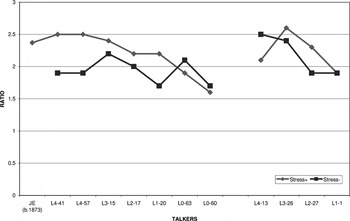
Because speaking rate influences the absolute durations of vowels, long to short vowel ratios were calculated for each talker. These ratios ranged from 2.5 to 1.5; that is, long vowels ranged from 2.5 to 1.5 times the duration of short vowels. These differences are perceptible, sufficiently distinctive to serve a contrastive function. The younger talkers tended to produce vowels that showed the length contrast less clearly than the older talkers. The ratios of long to short vowels in stressed and unstressed syllables are shown in Figure 1.

Ratios of long to short vowels for Latvian talkers. The talkers whose data are given on the left-side speak Latvian almost all of the time; the talkers on the right-side use Latvian less. Both groups are arranged by age, from oldest to youngest. The younger talkers do not contrast long and short vowels as clearly as the older talkers do.
The vowel duration ratios for the five groups were submitted to one-way analyses of variance (ANOVAs), in which the talkers were grouped by age. The stressed vowel ratios differed significantly across the age groups [F(4,44) = 7.11, p < .001]. Post hoc tests indicated that the long to short vowel ratios of the youngest two groups of talkers (L0 and L1) were significantly different from the ratios employed by the older groups. The short to long stressed vowel ratio produced by JE is 2.7, quite typical of the older talkers. In unstressed syllables, the long to short vowel ratios were highly variable and did not reach statistical significance among the talker groups.
The four talkers who use Latvian less than the others tell a mixed story. In comparison with her age-mates, the oldest talker (L4-13) uses vowel duration ratios that appear to minimize the duration contrast somewhat; the other three talkers do not appear to differ from their age-mates.
Vowel quality
In informal listening to the recorded word lists, native speakers of Latvian identified every vowel token as intended by the talkers. There were no pronunciations of any words in which the talkers produced a vowel that would be misidentified. Nevertheless, the acoustic-phonetic structure of some of the vowels differed across the generations represented by the talkers.
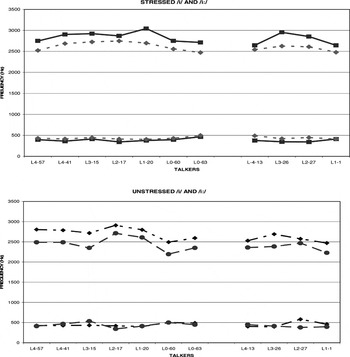
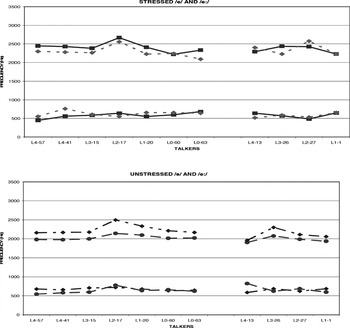
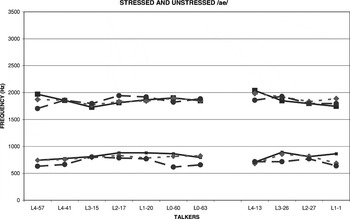
The average values of the first two formants of the vowels as produced by the Latvian talkers are given in Figures 2, 3, 4, and 5. The figures display the first two formants of vowel production across the generations. Because Russian vowel allophones differ primarily in the value of the second formant (F2), we hypothesized that any effects of Russian patterns on Latvian would manifest themselves as changes in F2. For statistical comparisons, one-way ANOVAs were employed for talkers grouped by age, using the values of F2 as the dependent variable.
The first two formants of the vowel /i/ for all talkers are given in Figure 2. In stressed position, and even more in unstressed position, the younger talkers employed lower values of F2 than the older talkers. The differences were marginally significant [F(4,29) = 2.57, p = .058]. According to post hoc tests, the youngest talkers differed from the oldest as well as from young professionals. The youngest talkers (L0-60 and L0-63) employed formant values for unstressed short /i/ below 2500 Hz. Although they are older, the Latvians who used the language about half the time seem to anticipate the lowered F2 values; in particular, L4-13 used a lower F2 than any of her age-mates.

The first two formants of long and short /i/ in stressed and unstressed position. The long variant of the vowel exhibits higher F2 values for all talkers. The younger talkers tend to use lower F2 values than the older talkers, most clearly in the unstressed position, suggesting some backing or centralization. Speakers who use Latvian about half the time are on the right-side of the figure.
The pattern for the vowel /e/ can be seen in Figure 3. The F2 values for /e/ were significantly different [F(4,25) = 7.726, p < .001], but the talkers who differed were not the younger groups but rather the talkers identified as young professionals (L2). They tended to produce /e/ with higher F2 values than the other talkers did, exaggerating vowel height.

Formants of long and short stressed and unstressed /e/. The young professionals (L2) exaggerate vowel height. Whether this articulation is related to the pattern of vowel reduction in Russian is not clear.
The vowel

does not exist in the Russian vowel inventory. Not surprisingly, Russian learners of Latvian have difficulty pronouncing this vowel. In fact, substituting /e/ for

is a stereotype which Latvians use in imitating a Russian accent. In Figure 4, the average formant values for

are given for the five age groups. As can be seen from the figure, there was some variability in the formant values, but the differences among talkers did not reach statistical significance. All Latvians produced this vowel with similar formant values, quite different from the values they employed for the vowel /e/.

The first two formants for the vowel long, short, and unstressed. There are no statistically significant differences in the formant values among the talker groups for any version of the vowel.
Figure 5 gives the values of the first two formants for the vowel

. The younger talkers employed significantly higher values of F2 than the older talkers did [F (4, 29) = 5.468, p = .002]. Just as for the vowel /i/, the short unstressed variant of the vowel is most affected, with the younger talkers using formant values suggesting vowel centralization, over 1500 Hz. Two of the talkers who use Latvian about half the time, L4-13 and L1-1, anticipate this trend.

The first two formants of short and long , in stressed and unstressed position. The younger talkers employ higher values of F2 than the older talkers do, suggesting vowel reduction similar to the Russian pattern. The tendency to centralization appears strongest in the speech of the Latvians who use the language about half of the time.
The same pattern of higher F2 values for younger than for older talkers were observed for the vowel /o/, though the differences across talker groups just missed statistical significance, perhaps because of relatively high variability. The formant values for /u/ did not vary significantly across the talker groups.
DISCUSSION
According to Thomason and Kaufman's (1988) borrowing scale, language contact with extensive bilingualism can involve phonological borrowing including new contrastive features, syllable structure constraints, and perhaps even new and relatively natural allophonic or morphophonemic rules.
In comparing the vowel pattern of the two languages, it seemed plausible to hypothesize three direct effects from Russian on Latvian: (1) the contrast between Latvian stressed vowels

might weaken, (2) the vowel quantity contrast would weaken and (3) unstressed vowels would show reduction patterns similar to those found in Russian.
The hypothesized weakening or near-merger of the

did not occur. On the contrary, all variants of the vowel

—stressed, unstressed, long, short—were very similar across the generations showing no systematic effects of bilingualism in Russian. It seems likely that the talkers were aware that this vowel is often mispronounced in accented Latvian and emphasized their mastery of correct pronunciation as an indicator of ethnic solidarity.
The duration contrast and short unstressed vowels showed changes across the generations. The younger talkers reduced the magnitude with which the length opposition was maintained and centralized some vowels, most obviously in unstressed syllables. The front vowel /i/ and the two back vowels /a/ and /o/ showed the F2 shifts suggestive of centralization. In general, the talkers who used Latvian about half of the time were advanced in showing centralization. Both of the tendencies shown by the younger talkers are phonetic rather than phonological. All their vowel productions would be identified as intended.
In attempting to provide mechanisms responsible for these shifts in pronunciation, it is probable that both production and perception are involved. Sancier and Fowler (1997) argued that individuals are disposed to imitate what they perceive, so that the gestures responsible for production shift towards those characteristic of an ambient language. Certainly exposure to Russian-accented Latvian would provide speech targets that would differ from the speech of previous generations.
Another way to conceptualize the shifts in pronunciation would invoke the idea that the vowels of the two languages occupy a common phonological space (c.f., Flege, 1995). In this space,

exists as a distinctly Latvian vowel, required for accurate pronunciation of the language. Consequently, this vowel does not shift towards the Russian variety. Other vowels, however, are identified with Russian vowels and receive a pronunciation congruent with the pronunciation characteristic of Russian.
Before concluding that extensive bilingualism is responsible for the changes in pronunciation, we wish to offer a significant caution. Although both the reduction in the magnitude of the length contrast and the tendency towards centralizing unstressed vowels are congruent with interference from Russian, we have by no means proven that bilingualism is responsible. Even though the younger talkers differ from the older talkers, it is possible that they would be speaking in the same way without their experience with Russian. We have no talkers from the same population who have not been immersed in Russian. In other words, we have no control group. In cities, educated talkers invariably know Russian. In the rural areas, talkers might have less exposure to Russian but would also speak a different variety of Latvian.
These limitations make it helpful to examine the pronunciation patterns of Latvians talkers who use the language about half the time. The elderly talker, L4-13, maintains the vowel quantity contrasts but shows a tendency to centralize some vowels. Because her pronunciation characteristics seem to be similar to those of younger talkers, it is plausible to argue that bilingualism in Russian is responsible for at least some of the changes observed in her speech and in the speech of younger talkers. Of the other talkers who use Latvian about half of the time, an established professional (L3-26) uses a very high version of /e/ but does not show other indicators of influence from Russian. The young professional and university student (L2-27, L1-1), both seem to be in advance of their age-mates in weakening the vowel quantity contrast and centralizing some vowels. In short, it appears that talkers who use Latvian less also show more Russian phonetic influence.
Nevertheless, some of these limitations could be further filled by future research in this area, which might examine both the Latvian of ethnic Russians and the Latvian of talkers who have spent their lives immersed in a different language, like the Latvian expatriates living in North America or Sweden.
References
REFERENCES
Baker, Wendy, &
Trofimovich, Pavel.
(2005).
Interaction of native- and second-language vowel system(s) in early
and late bilinguals.
Language and Speech
48:1–27.Google Scholar
Bullock, Barbara, &
Gerfen, Chip.
(2004).
Phonological convergence in a contracting language variety.
Bilingualism: Language and Cognition
7(2):1–10.Google Scholar
Caramazza, Alfonso,
Yeni-Komshian, Grace H.,
Zurif, E. B., &
Carbone, E.
(1973).
The acquisition of a new phonological contrast: The case of stop
consonants in French–English bilinguals. Journal of the
Acoustical Society of
America
54:421–428.Google Scholar
Cook, Vivian.
(2003).
Effects of the second language on the first.
Clevedon, UK:
Multilingual Matters.
Druviete, Ina.
(2000).
Sociolinguistic situation and language policy in the Baltic
states.
Riga:
University of Latvia Baltic Studies Programme.
Ekblom, R.
(1933).
Die lettischen akzentarten: Eine experimental-phonetische
untersuchung.
Uppsala:
Almqvist & Wiksells.
Elman, Jeffrey L.,
Diehl, Randy L., &
Buchwald, Susan E.
(1977).
Perceptual switching in bilinguals.
Journal of the Acoustical Society of America
62:971–974.Google Scholar
Fant, Gunnar.
(1970).
Acoustic theory of speech production.
The Hague:
Mouton.
Flege, James Emil.
(1995).
Second-language speech learning: Theory, findings and
problems. In
W. Strange (ed.),
Speech perception and linguistic experience.
Baltimore:
York Press.
233–273.
Flege, James Emil, &
Eefting, Wieke.
(1987a).
Production and perception of English stops by native Spanish
speakers.
Journal of Phonetics
15:67–83.Google Scholar
Flege, James Emil, &
Eefting, Wieke.
(1987b).
Cross-language switching in stop consonant perception and production
by Dutch speakers of English.
Speech Communication
6:185–202.Google Scholar
Flege, James Emil, &
Hillenbrand, James.
(1984).
Limits on phonetic accuracy in foreign language speech
production.
Journal of the Acoustical Society of America
78:708–721.Google Scholar
Flege, James Emil,
Schirru, Carlo, &
MacKay, Ian R. A.
(2001).
Interaction between the native language and second language speech
systems: An effect of phonetic category dissimilation.
Unpublished manuscript,
University of Alabama,
Birmingham.
Guion, Susan G.
(2003).
The vowel systems of Quichua–Spanish bilinguals.
Phonetica
60:98–128.Google Scholar
Jones, L. G.
(1971).
Contextual variants of the Russian vowels. Addendum to Morris
Halle,
The sound pattern of Russian.
The Hague:
Mouton.
Laua, Alise.
(1984).
Latviesu literaras valodas fonetika
[The phonetics of literary Latvian].
Riga:
Zvaigzne.
Lobanov, B. M.
(1971).
Classification of Russian vowels spoken by different
speakers.
Journal of the Acoustical Society of America
49:606–608.Google Scholar
Mack, Molly.
(1984).
Early bilinguals: How monolingual-like are they? In
Michel Paradis &
Yvan Lebrun (eds.),
Early bilingualism and child development.
Lisse:
Swets & Zeitlinger.
161–173.
Mack, Molly.
(1989).
Consonant and vowel perception and production: Early English-French
bilinguals and English monolinguals.
Perception & Psychophysics
46:187–200.Google Scholar
Major, Roy C.
(1992).
Losing English as a first language.
Modern Language Journal
76:190–208.Google Scholar
Padgett, Jaye.
(2005).
Russian vowel reduction and dispersion theory.
Unpublished manuscript,
University of California,
Santa Cruz.
Sancier, Michele L., &
Fowler, Carol A.
(1997).
Gestural drift in a bilingual speaker of Brazilian Portuguese and
English.
Journal of Phonetics
25:421–436.Google Scholar
Schmid, Monika S.
(2002).
First language attrition, use and maintenance: The case of German
Jews in Anglophone countries.
Amsterdam:
Benjamins.
Thomason, Sarah Grey, &
Kaufman, Terrence S.
(1988).
Language contact, creolization, and genetic linguistics.
Berkeley:
University of California Press.
Weinreich, Uriel.
(1968).
Languages in contact: Findings and problems.
The Hague:
Mouton.
Williams, Lee.
(1976).
The perception of stop consonant voicing by Spanish–English
bilinguals.
Perception and Psychophysics
21:289–297.Google Scholar
Williams, Lee.
(1977).
The modification of speech perception and production in
second-language learning.
Perception and Psychophysics
26:95–104.Google Scholar
Williams, Lee.
(1978).
Phonetic variation as a function of second-language
learning. In
Grace H. Yeni-Komshian,
James F. Kavanagh, &
Charles A. Ferguson (eds.),
Child phonology volume 2: Perception.
New York:
Academic Press.
185–215.
Ratios of long to short vowels for Latvian talkers. The talkers whose data are given on the left-side speak Latvian almost all of the time; the talkers on the right-side use Latvian less. Both groups are arranged by age, from oldest to youngest. The younger talkers do not contrast long and short vowels as clearly as the older talkers do.
The first two formants of long and short /i/ in stressed and unstressed position. The long variant of the vowel exhibits higher F2 values for all talkers. The younger talkers tend to use lower F2 values than the older talkers, most clearly in the unstressed position, suggesting some backing or centralization. Speakers who use Latvian about half the time are on the right-side of the figure.
Formants of long and short stressed and unstressed /e/. The young professionals (L2) exaggerate vowel height. Whether this articulation is related to the pattern of vowel reduction in Russian is not clear.
The first two formants for the vowel long, short, and unstressed. There are no statistically significant differences in the formant values among the talker groups for any version of the vowel.
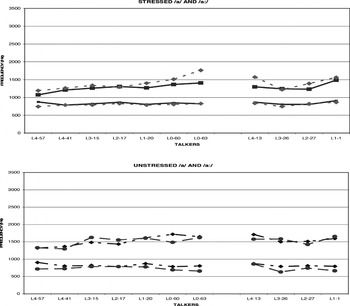
The first two formants of short and long , in stressed and unstressed position. The younger talkers employ higher values of F2 than the older talkers do, suggesting vowel reduction similar to the Russian pattern. The tendency to centralization appears strongest in the speech of the Latvians who use the language about half of the time.
 You have
Access
- 4
- Cited by