Kahramanmaraş-centered 7.7 and 7.6 earthquakes affected Kahramanmaraş, Hatay, Adana, Gaziantep, Malatya, Kilis, Adıyaman, Diyarbakır, Şanlıurfa, and Osmaniye on Monday, February 6, 2023. After the earthquake, thousands of aftershocks occurred in the region. This earthquake caused thousands of people to die, be injured, become homeless, lose their relatives, and become unemployed. On the 54th day of the earthquake, the Disaster and Emergency Management Presidency (DEMP) reported that the number of people who lost their lives in these earthquakes was 50 096, and the number of injured people was 107 204. Reference Haber1 As it is known, earthquakes are one of the leading disasters that cause physical, economic, and social losses to individuals and societies. In addition, earthquakes have a lot of psychological effects. The severity of the earthquake, its unpredictability, loss of life, feelings of helplessness, changes in life, and problems such as housing and financial resource problems cause psychological problems in individuals.
The earthquake disaster in the region also negatively affected university students. Universities where the destruction was great in the earthquake were paired with other universities, and it was tried to ensure that students continue their education through distance education. In our city, which was adversely affected by the earthquake, education and training practices, which continued with distance education (online), started to continue with the hybrid education option as of April 2023.
Being affected by traumatic events does not occur to the same degree in every individual. Factors such as the age, gender, and previous experiences of individuals can change the degree of influence. Reference Kurt and Gülbahçe2 It has been reported that the methods used to cope with earthquake stress may also lead to a change in the level of individuals being psychologically affected by earthquake trauma. Reference Udomratn3 Even if the earthquake is experienced momentarily, its psychological effect lasts for a long time. Persons may think as if an earthquake will happen again or may experience the event in their nightmares. Reference Buran4 The condition characterized by a series of acute stress reactions, including anxiety, dissociation symptoms, and other findings occurring within the first 30 days following the traumatic event, is defined as Acute Stress Disorder (ASD) according to DSM-5. 5 If the signs and symptoms last longer than a month, the condition is referred to as Post-Traumatic Stress Disorder (PTSD). 6 PTSD is a psychological disorder caused by unusual threats or disruptive events. Reference Dai, Chen and Lai7 In a meta-analysis, the combined incidence of PTSD after earthquakes was reported to be 23.66%; this suggests that earthquakes cause psychological stress for survivors. Reference Dai, Chen and Lai7 In another meta-analysis study, Reference Liang, Cheng, Ruzek and Liu8 it was stated that PTSD symptoms are associated with a number of risk factors such as sociodemographic factors, trauma exposure characteristics, post-disaster cognitive and emotional states, and social support. Post-Traumatic Stress Disorder is one of the leading psychiatric problems seen after earthquake trauma. According to the results of the research, it is reported that university students exposed to earthquakes have high levels of PTSD. Reference Zhang, Shi, Wang and Liu9–Reference Fu, Chen and Wang11
The aim of this research is to examine the levels of post-traumatic stress, coping with stress, and post-traumatic change in university students after the Kahramanmaraş-centered earthquakes in February 2023.
Materials and Methods
The research is descriptive and relational. This research was conducted with Gaziantep University Faculty of Health Sciences students. The G Power program was used to calculate the sample size. The sample size (confidence interval α = 0.05, power of the test [1-β] 0.90) was calculated as a total of 221.
Data Collection
Data collection was delayed for 1 month due to the earthquake that resulted in great destruction and loss in the region. Data were collected between April 27 and May 15, 2023, with the start of hybrid training. The criteria for inclusion in the study were to be 18 years of age or older, to be able to understand the study, and to give informed consent. The students who formed the sample of the study were informed about the purpose and process of the research and signed the Informed Voluntary Consent Form. Afterward, the Personal Information Form, Post-earthquake Trauma Level Determination Scale, Earthquake Stress Coping Strategies Scale, and Post-Traumatic Change Scale were applied by the researcher.
Personal Information Form
This form consists of 12 questions that include sociodemographic and earthquake-related information.
Post-Earthquake Trauma Level Determining Scale (PETLDS)
The scale was first developed by Tanhan and Kayri in 2013 by studying the people affected by the Van earthquake in 1999. Reference Tanhan and Kayri12 The scale consists of 20 items and has a 5-dimensional structure. Factors constituting the scale include behavioral problems, emotive limitedness, affective response, cognitive structuring, and sleep problems. There is no reverse item in the scale, and the score to be obtained from the scale varies between 20 and 100. The range of 52 385 ± 5051 points to be taken from the scale indicates a threshold value at which individuals are traumatized. The internal reliability coefficient calculated for all items of the scale was found to be 0.87. Reference Tanhan and Kayri12 In this study, Cronbach’s alpha was calculated as 0.90.
Coping with Earthquake Stress Scale (CESS)
The Turkish validity and reliability of the scale, which was developed by Yondem et al. in 2016, Reference Yöndem and Eren13 were determined in the same study. The scale includes the most frequently used sub-dimensions of Religious Coping, Positive Reappraisal, and Social Support Seeking in response to earthquake stress. A score of 1–4 is taken for each item. The total score cannot be calculated on the scale. The score ranges of the Religious Coping and Social Support Seeking, each consisting of 5 items, are 5–20, and the score range of the Positive Reappraisal subscale, consisting of 6 items, is 6–24. A high score for each dimension indicates that the individual uses that coping strategy more, whereas a low score indicates less use. In the validity and reliability study of the scale, the Cronbach’s α internal consistency coefficient was found to be 0.85 for Religious Coping, 0.69 for Positive Reappraisal, and 0.74 for Seeking Social Support. Reference Yöndem and Eren13 In this study, the Cronbach’s alpha coefficient was calculated as 0.76 for Religious Coping, 0.77 for Positive Reappraisal, and 0.73 for Seeking Social Support.
Post-Traumatic Change Scale (PTCS)
PTCS was developed by Nordstrand et al. (2017) Reference Nordstrand, Hjemdal and Holen14 and adapted into Turkish by Yazıcı et al. in 2022. Reference Yazıcı, Özdemir and Ardıç15 The scale measures the change (positive, negative, neutral) that occurs in the individual after a traumatic experience. PTCS consists of 26 five-point Likert-type items. It has 4 sub-dimensions: Self-Confidence, Interpersonal Involvement, Awareness, and Social Adaptability. The consistency indices show that the 4-factor model defined for the original factor structure of the scale was confirmed. In the validity and reliability study, the Cronbach’s α reliability coefficient of the measurements obtained from the scale was 0.91 for the combined scale. Reference Yazıcı, Özdemir and Ardıç15 In this study, Cronbach’s alpha was calculated as 0.94.
Analysis of Data
IBM SPSS Statistics 22.0 (IBM Corp., Armonk, New York, USA) program was used to analyze the data. A value of P < 0.05 was considered statistically significant. Descriptive analyses (percentage, arithmetic mean, etc.) were used for the data obtained from the Personal Information Form. It was evaluated with the Shapiro–Wilk test to test whether the data conformed to normal distribution. Correlation analysis was used to examine the relationship between scales; multiple regression analysis was used to explain cause-and-effect relationships. Multiple regression analysis was performed separately for continuous and categorical variables.
Ethics of the Research
Before starting the study, approval was obtained from the Clinical Research Ethics Committee of the relevant university (Decision date: April 26, 2023; Decision no: 2023/144). Permissions were obtained from the institution where the study would be conducted and for the use of measurement tools. The purpose of the study was explained to the sample group, and it was based on volunteerism. The students who agreed to participate in the study completed an informed consent form and their permission was obtained. All procedures were carried out in accordance with the ethical rules and the principles of the Declaration of Helsinki.
Results
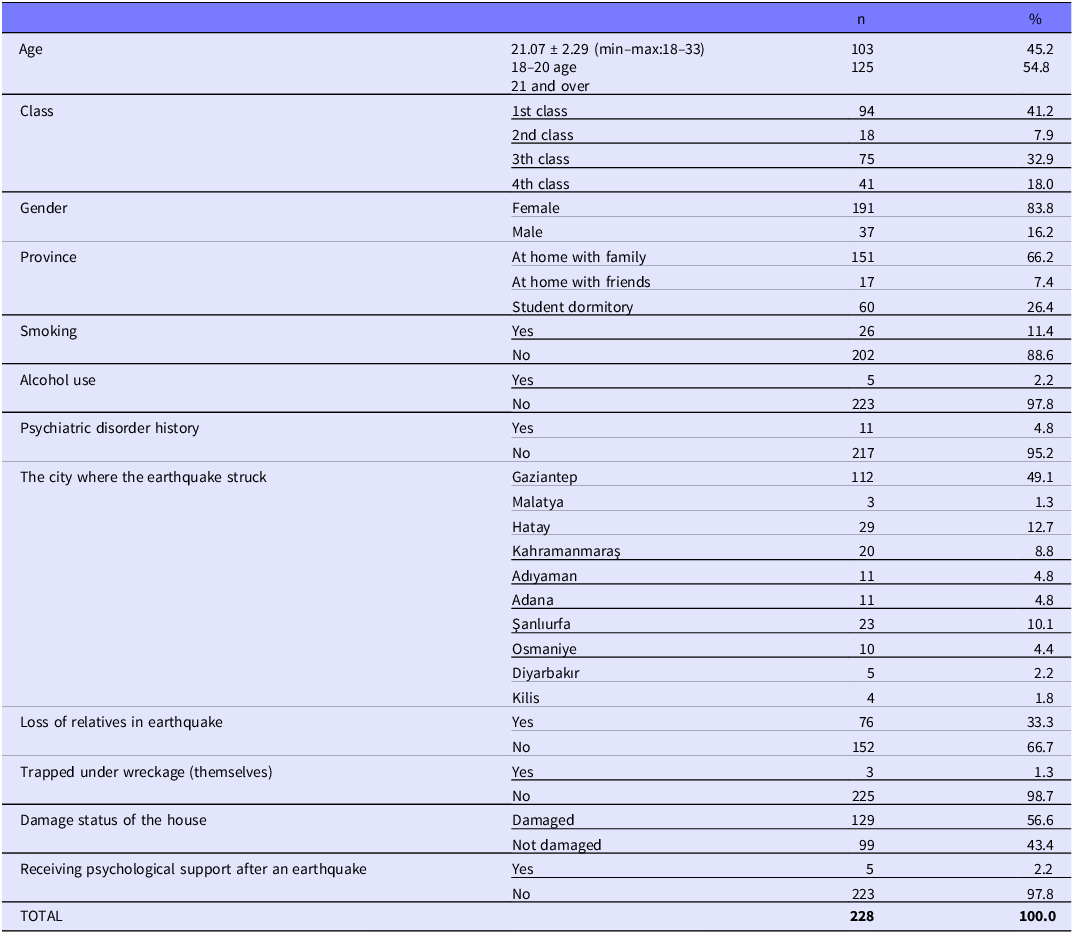
The mean age of the students within the scope of the study was 21.07 ± 2.29 (min–max: 18–33), and more than half of them were in the group of age 21 and over (54.8%); 41.2% of the students are in the first grade and 32.9% of them are in the third grade. Female students constituted 83.8%. The majority of the students participating in the research stated that they live with their families (66.2%). The rates of smokers and alcohol users are low (11.4% and 2.2%, respectively), and 4.8% of the students have a history of psychiatric illness. When students were asked to identify which province they were in at the time of the earthquake, the most commonly identified area was Gaziantep (49.1%). This is followed by Hatay (12.7%) and Şanlıurfa (10.1%); 33.3% of the students within the scope of the study lost a relative, 1.3% remained under the rubble (themselves), and 56.6% of homes were damaged. When the status of receiving psychological support after their losses was questioned, 97.8% stated that they did not receive support (Table 1).
Distribution of characteristics identifying students

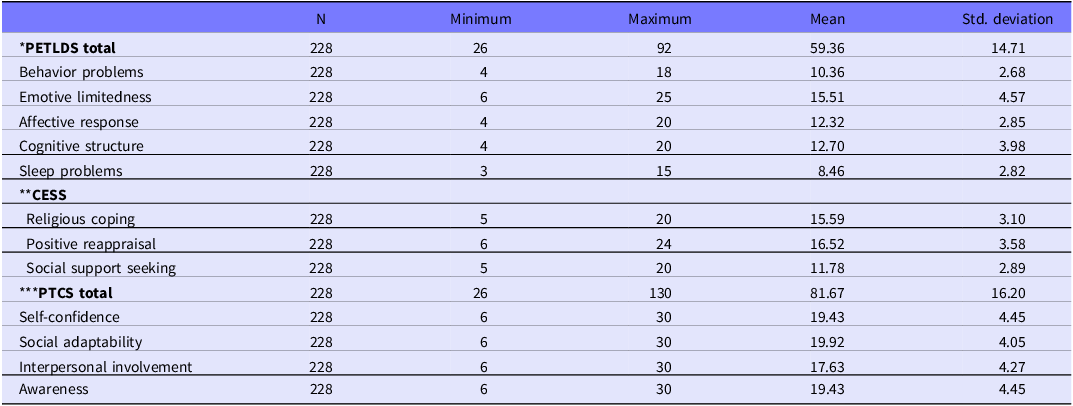
Table 2 shows the average scores obtained from the scale and its sub-dimensions used in the study. The mean score of the students on the PETLDS scale was determined as 59.36 ± 14.71 (subscales: Behavioral Problems 10.36 ± 2.68, Emotive Limitedness 15.51 ± 4.57, Affective Response 12.32 ± 2.85, Cognitive Structure 12.70 ± 3.98, Sleep Problems 8.46 ± 2.82). The mean score of the students’ religious coping subscale of the CESS was 15.59 ± 3.10, Positive Reappraisal was 16.52 ± 3.58, and Social Support Seeking was 11.78 ± 2.89. The mean score of the students on the PTCS was found to be 81.67 ± 16.20 (Self-confidence 19.43 ± 4.45, Social Adaptability 19.92 ± 4.05, Interpersonal Involvement 17.63 ± 4.27, and Awareness 19.43 ± 4.45).
Post-Earthquake Trauma Level Determining Scale, Coping with Earthquake Stress Scale, and Post-Traumatic Change Scale scores of the students

* Post-earthquake Trauma Level Determination Scale;
** Strategies for Coping with Earthquake Stress Scale;
*** Post-Traumatic Change Scale
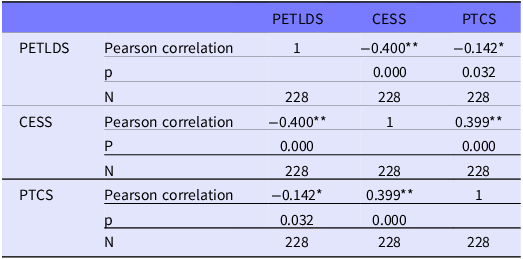
Table 3 shows the correlations between the scales. As a result of the statistical analysis, there was a moderate, negative, and significant relationship between CESS and PETLDS (P < 0.01). A low-level, positive, and significant relationship was found between CESS and PTCS (P < 0.01). A low, negative, and significant relationship was found between PTCS and PETLDS (P < 0.05).
Correlations between Post-Earthquake Trauma Level Determining Scale, Coping with Earthquake Stress Scale, and Post-Traumatic Change Scale scores of the students

* Correlation is significant at the 0.05 level;
** Correlation is significant at the 0.01 level.
PETLDS, Post-earthquake Trauma Level Determination Scale; CESS, Strategies for Coping with Earthquake Stress Scale; PTCS, Post-Traumatic Change Scale.
According to the regression analysis, the level of trauma after the earthquake and the level of coping with earthquake stress are significant predictors of post-traumatic change. In our study, it was determined that each score obtained from the scales changed the post-traumatic change scores of PETLDS: −0.319 and CESS: 0.980, respectively. According to the model we established, the scores obtained from the scales significantly predicted the level of post-traumatic change by 30% (Table 4).
Regression analysis between continuous variables and the Post-Traumatic Change Scale

* Multiple regression analysis
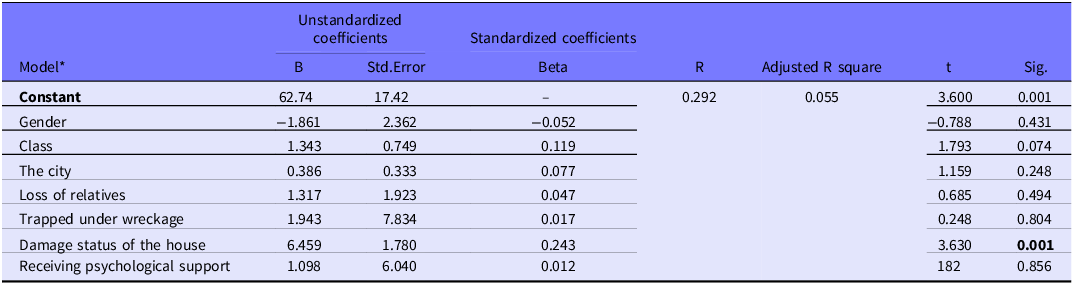
According to the regression analysis made with some variables, the damage to the houses in the earthquake significantly affects the post-traumatic change. No significance was found with other variables (Table 5).
Regression analysis between categorical variables and the Post-Traumatic Change Scale

* Multiple regression analysis
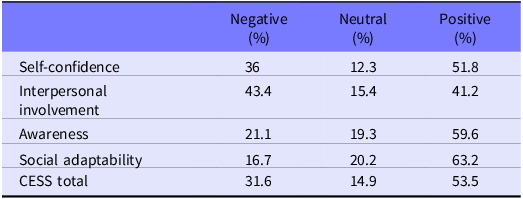
The change of individuals after trauma was divided into 3 groups (negative, neutral, and positive) according to their individual arithmetic mean scores. Average scores between 1 and 2.99 represent negative change, mean scores between 3.1 and 5 represent positive change, and mean value 3 represents the group without change. Reference Tanhan and Kayri12 It was determined that the participants showed positive changes for all scales, except the “interpersonal involvement” subscale (Table 6).
Frequency analysis of post-traumatic change

Discussion
Knowing the psychological effects of earthquake traumas and identifying risk groups are important factors in taking precautions against trauma. In individuals who experienced an earthquake, the symptoms observed due to trauma are mostly in the form of post-traumatic stress disorder. It is stated that the risk of developing post-traumatic stress after traumatic events is higher than the risk of major depression. Reference Fu, Chen and Wang11 According to international research results, post-traumatic stress levels of university students who were exposed to earthquakes are reported to be high. Reference Zhang, Shi, Wang and Liu9–Reference Fu, Chen and Wang11 Even after 1 year after the earthquake, it was stated that the prevalence of post-traumatic stress was found to be high among university students in the region. Reference Fu, Chen and Wang11 In a national study, post-traumatic stress symptoms were found to be moderate. Reference Sakarya and Güneş10
As a special group of young adults, college students are in a period of significant physical and mental development. Reference Fu, Chen and Wang11 College students are more emotionally vulnerable to the devastating effects of a disaster because of their developmental status. The level of trauma may be higher in students who lost their relatives, remained in the wreckage, became homeless, or were injured as a result of the disaster. The post-earthquake trauma level mean score of the students in our study was calculated as 59.36 ± 14.71. Considering the threshold value, it was determined that the students were highly traumatized after the earthquake. This result, in line with the sources, indicates that a significant majority of individuals exposed to trauma have symptoms of post-traumatic stress. One of the variables of the study was whether or not to receive psychological support after the earthquake; 97.8% of the students stated that they did not receive psychological support after this devastating earthquake. Considering this situation, appropriate psychological support should be provided against trauma-related problems for students who are among high-risk groups.
Earthquakes and natural disasters become embedded in the memory of societies when they occur and after. It is known that people who experienced the disaster could not get rid of the effects of the event even years later, and experienced psychological problems. Reference Erdoğan and Aksoy16 Successful coping and improving relationships with others after trauma can be determining factors that can lead to positive changes, such as greater personal power, new possibilities in life, greater appreciation of their lives, and reduced anxiety. Reference Platte, Wiesmann, Tedeschi and Kehl17
It is emphasized that coping strategies have an important role in anticipating and preventing stress-related disorders. Reference Yöndem and Eren13 Although serious disasters such as earthquakes can cause pain, coping strategies can help individuals positively manage extremely stressful events and reduce psychological distress. Reference Kim and Oh18
Belief in a religion may increase post-traumatic growth and may also contribute as a coping mechanism for finding meaning. The first of the coping strategies used by students while seeking an answer to the question—How can I deal with this stressful situation or event that I am going through?—is religious coping. Religious coping is to try to overcome problems and find a way out with religious belief by exhibiting behaviors such as praying and worshipping. Reference Bala19 In our study, it was determined that students’ religious coping was at a high level (15.59 ± 3.10). As a result of individually confronting the stressful and traumatic event, the individual experiences a kind of perception of religious belief and growth in religious or spiritual matters. Reference Lindstrom, Cann, Calhoun and Tedeschi20 According to our results, religion has supported individuals in coping with difficulties. Religion is an important part of the coping process.
Positive Reappraisal is a dimension that is commonly observed and associated with psychological well-being. Reference Yöndem and Eren13 Positive Reappraisal is known as thoughts that will contribute to personal development to create positive meanings about the event. Reference Temizel and Dağ21 In our study, students’ Positive Reappraisal scores were found to be high (16.52 ± 3.58). The presence of social supports may have contributed to reducing the value of the event by helping students cope with trauma successfully.
Social Support is thought to be a factor that supports the cognitive processes of individuals to understand their traumatic experiences and to overcome their psychological distress due to trauma. Reference Tedeschi and Calhoun22 In addition, it has been stated that Social Support protects individuals from crises and buffers high levels of stress. Reference Kim and Oh18 In our study, students’ Social Support Seeking scores were moderate (11.78 ± 2.89). Social relationships, material, and moral encouragement from family and friends balance the negative effects of trauma in a positive way. Aid policies applied to the earthquake zone in our country can also be considered as a kind of social support and may cause positive changes in individuals. In our study, it was determined that the scores obtained from the post-traumatic change scale and its subscales were above the average. It was determined that the students got high scores in the areas of self-confidence, interpersonal participation, awareness, and social cohesion.
In recent years, the focus of research has shifted toward finding health resources and supporting and emphasizing the potentially positive aspects of people after trauma. Reference Kim and Oh18 Finding “something positive” as a result of difficulties is a characteristic feature of culture and religion. Post-traumatic growth can occur following traumatic events. Difficult events are all very common in people’s lives, but the effects of these events are not necessarily negative and can even include an enhanced sense of self. Reference Malhotra and Chebiyan23 Tedeschi and Calhoun (2004) argued that change in growth patterns occurs in situations with high levels of psychological distress. Reference Tedeschi and Calhoun22 Post-traumatic growth generally includes situations such as a greater willingness toward life, a perception of changing priorities, establishing closer relationships with other individuals, greater personal power, realizing new possibilities in one’s life, and spiritual development. Reference Lykins, Segerstrom and Averill24 As a matter of fact, the results of studies conducted in recent years point to the predictive role of PTSD on positive change after trauma. Reference Kim and Oh18,Reference Magid, El-Gabalawy, Maran and Serber25 In a study, a positive correlation was found between post-traumatic stress disorder and post-traumatic psychological growth levels. Reference Kardaş and Tanhan26 In studies, these positive changes are labeled as post-traumatic growth, stress-related growth, perceived benefits, improvement, and positive adjustment. Reference Linley and Joseph27 In this study, the positive, neutral and negative changes that occurred after the earthquake were evaluated. While a positive change was observed in 53.5% of the individuals participating in this study, a negative change was observed in 31.6%; it was determined that 14.9% did not experience any change. In the literature, there are research results showing that positive change is more common than negative change after a traumatic event. Reference Bala19,Reference Barrington and Shakespeare-Finch28–Reference Nordstrand, Bøe and Holen30
When the correlations between the scales were examined, it was found that there was a negative correlation between the PETLDS and PTCS and a positive direction between PTCS and CESS; a negative and significant correlation was found between CESS and PETLDS (P < 0.01). Multiple regression results also show the effect of post-earthquake trauma level and coping status on post-traumatic change. Our findings show that traumatic events can cause significant changes in human life.
Another result obtained from the regression analysis is that the post-traumatic change states of those whose homes were damaged are affected. The destruction of the safe space in which students live can shake their basic sense of trust. However, social solidarity could facilitate recovery from this trauma. Our society showed a very intense sense of cooperation with this earthquake. Many countries contributed to this cooperation. Providing a sense of security may have contributed to recovery by reducing stress responses. Being in a safe area and staying calm can strengthen individuals’ belief that they will cope with difficult events by regulating their thoughts, feelings, and behaviors.
Social relationships, material, and moral encouragement from family and friends balance the negative effects of trauma in a positive way. Aid policies applied to the earthquake zone in our country can cause positive changes in individuals. In our study, a high rate of positive change in the sub-dimensions of self-confidence, awareness, and social cohesion draws attention. College students are young adults. At this age, it is expected that the self-perceptions of young people will increase. In particular, the tendency to build a stronger self-concept by accepting and overcoming traumatic experiences may have provided a positive change in self-confidence, adaptability, and awareness skills. The change experienced by traumatized people can vary from individual to individual. In addition, the fact that all the students had taken psychology and communication courses may have strengthened their coping skills.
Limitations
The fact that the impact of social and economic problems that may occur after an earthquake of this magnitude has not been evaluated is an important limitation of ours. Our second limitation is that, in addition to the trauma experienced after the earthquake, other traumatic situations (childhood traumas, abuse, etc.) were not taken into account. Third, most of the participants were females. Fourth, we used self-psychometric scales; these lack objective evaluation, and the results cannot fully demonstrate causality. Data cannot be generalized as they were collected from a small group within a short period of time after the earthquake.
Conclusion
In this study, post-earthquake trauma levels, strategies for coping with earthquake stress, and post-traumatic change status of university students who were exposed to earthquake trauma were investigated. It is hoped that the findings of this study will assist researchers, practitioners, and policymakers to better understand the needs of victims and to implement effective strategies for post-disaster recovery management. Health professionals tasked with developing strategies to help traumatized individuals overcome trauma and move on with their lives should also support individuals to experience opportunities for positive change and growth in their lives. At this point, we believe that the planning and implementation of psychological support services for students after disasters such as earthquakes can be effective in preventing psychological problems that may arise after disasters. Identifying the characteristics that will affect students’ coping with problems and positive post-traumatic change and strengthening their positive coping and social support resources can contribute to traumas being processes that can result in growth. It will be important to provide guidance and support to students in the specified areas.
Acknowledgments
We sincerely thank all the students who participated in the study and in this process.
Author contributions
Study design: AB; Data collection: AB; Data analysis: DÇ and AB; Manuscript writing: DÇ and AB.
Funding statement
This study did not have any sources of funding.
Competing interests
The authors report no actual or potential conflicts of interest.