Introduction
Although bryozoans have been mentioned in several papers, few systematic descriptions of this group are available from the late Paleozoic of western Gondwana, particularly from the Permian sequences. In South America, bryozoan faunas have been reported from the Permian of Venezuela (Laya and Tucker, Reference Laya and Tucker2012), Perú, and Bolivia (Sakagami, Reference Sakagami1995 and references therein). In Argentina, the late Paleozoic bryozoan faunas have been described mainly from the Carboniferous deposits of the central-western Precordillera Basin (Sabattini, Reference Sabattini1986 and references therein). Few Permian records were reported from northwestern Argentina (Arizaro Formation; Aceñolaza et al., Reference Aceñolaza, Benedetto and Salfity1972) and in the siliciclastic postglacial marine deposits from Patagonia (Sabattini, Reference Sabattini2002; Pagani and Taboada, Reference Pagani and Taboada2010).
Permian bryozoan records were mentioned in two sections from northern Chile, with reports of scarce indeterminate forms (Rivano and Sepúlveda, Reference Rivano and Sepúlveda1985; Díaz Martínez et al., Reference Cisterna, Sterren and Niemeyer2000).
The aim of this contribution is to provide a new record of a bryozoan species from northern Chile, based on material collected from the Cerro El Árbol Formation in the Augusta Victoria area (Fig. 1). The faunal content and the lithological characteristics are analyzed in the context of the paleogeographic position of this area, along the western Gondwana margin.
(1) Geographic location of the late Paleozoic sediments in Chile. (2) Stratigraphical section of the Cerro El Árbol Formation (modified from Cisterna et al., Reference Cisterna, Sterren and Niemeyer2014) with fossiliferous level. (3) Bioclastic accumulations composed by bryozoans, bivalves, gastropods, and crinoids (IPI 4344).

Geological setting
The studied section, Cerro El Árbol Formation (Fig. 1), belongs to the marine mixed siliciclastic-carbonate sequences extended along 1,200 km between 32° and 20° south latitudes and deposited in a shallow platform environment during the early to middle Permian interval (Charrier et al., Reference Charrier, Pinto, Rodríguez, Moreno and Gibbons2007 and references therein).
The Cerro El Árbol Formation (Maksaev et al., Reference Maksaev, Marinovic, Smoje and Mpodozis1991) is exposed in the Augusta Victoria area, in the homonymous locality, as well as in the Cerro 1584 to the north. It was defined as a sequence formed by arkosic and calcareous sandstones, red shales, conglomerates, and limestones with marine fossils (Maksaev et al., Reference Maksaev, Marinovic, Smoje and Mpodozis1991).
The studied section runs in an east–west trend, and the stratigraphic succession reaches a thickness of approximately 370 m (24°8′2"S, 69°30′14"W). Cisterna et al. (Reference Cisterna, Sterren and Niemeyer2014) have recognized in this section three fossiliferous levels. The lower level (CEA1) has a scarce and poorly preserved fauna of bivalves, gastropods, and isolated bryozoans that occur in 10 cm thick layers of mudstones and limestones with chert (Fig. 1). The middle fossiliferous level (CEA 2) is dominated by bryozoans and bivalves, accompanied by gastropods and disarticulated crinoids. The upper fossiliferous level (CEA 3) is represented by brachiopod-dominated calcareous beds up to 20 cm thick.
The stratigraphic section of the Cerro El Árbol represents a transgressive sequence in a shallow marine mixed siliciclastic-carbonate platform that can be extended to other coeval units from nearby areas in northern Chile, such as the Huentelauquén Formation (Coquimbo area) and Juan de Morales Formation (Iquique area).
Díaz Martínez et al. (Reference Díaz Martínez, Mamet, Isaacson and Grader2000) proposed a late Cisuralian age for Cerro El Árbol Formation and equivalent units of Chile, southernmost Perú, Bolivia (Copacabana Formation), and northwestern Argentina (Arizaro Formation).
Materials
Repository and institutional abbreviation
The bryozoan specimens were found in calcitic preservation, and zoaria occur as isolated branches in the limestone levels (CEA 1 and CEA 3) or concentrated in calcareous reddish sandstone as a coquinoid level (CEA 2). The specimens are housed under the prefix IPI in the paleontological collection of the Instituto de Paleontología, Fundación Miguel Lillo, San Miguel de Tucumán, Argentina.
Systematic paleontology
Order Cryptostomata Vine, Reference Vine1884
Suborder Rhabdomesina Astrova and Morozova, Reference Astrova and Morozova1956
Family Nikiforovellidae Gorjunova, Reference Gorjunova1975
Genus Pinegopora Shishova, Reference Shishova1965
Type species
Pinegopora delicata Shishova, Reference Shishova1965, by original designation. Upper Permian (lower Kazanian); northwestern Russia.
Type specimens
Holotype IPI 4343 and 13 paratypes IPI 4344–4351 and IPI 4319–4321, IPI 4338, and IPI 4306. Cerro El Árbol Formation (lower Permian) level CEA2, 5 km northeast of the homonymous hill and to the southeast of the Km. 99 station of the Antofagasta to Salta railway, Augusta Victoria area.
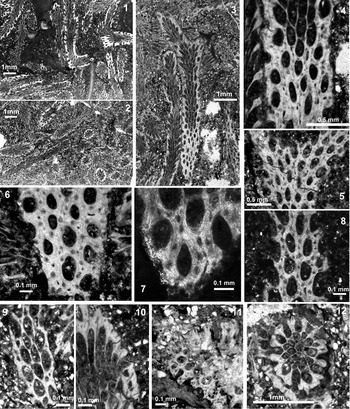
Pinegopora chilensis n. sp. from the early Permian Cerro El Árbol Formation, Northern Chile. (1–3) General view of bryozoan coquinoid bed, level CEA2. (1) Bryozoan coquina fragment with mostly longitudinal colony views, IPI 4345. (2) Bryozoan coquina fragment including transversal colony views, IPI 4346. (3) General view of a longitudinal thin section of a branched colony, holotype IPI 4343. (4) Tangential to longitudinal thin section, showing oval autozooecia, acanthostyles, and metazooecia, IPI 4343. (5) Tangential section of a branched colony, IPI 4343. (6) Enlargement of (5) to show autozooecia surrounded by acanthostyles. (7) Tangential section showing oval autozooecia apertures surrounded by six to seven acanthostyles, IPI 4350. (8) Tangential section of a fragmented colony showing autozooecia, acanthostyles, and scarce metazooecia, IPI 4343. (9) Tangential section of fragmented colony showing well-defined metazooecia, IPI 4348. (10) Longitudinal view of a fragmented colony showing development of acanthostyles in the exozone with distinct hyaline cores, IPI 4345. (11) Longitudinal section of a fragmented, isolated colony of level CEA3 showing acanthostyles having distinct hyaline cores and laminated sheaths, IPI 4347. (12) Transversal section showing polygonal axial zooecia, IPI 4346.

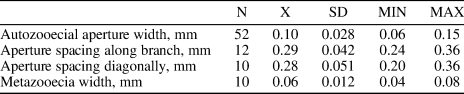
Descriptive statistics for Pinegopora chilensis n. sp. N = number of measurements; X = mean; SD = sample standard deviation; MIN = minimal value; MAX = maximal value.

Diagnosis
Branched colonies 0.8–1.1 mm in diameter. Autozooecial apertures oval, 0.06–0.15 mm wide (average 0.10 mm wide), arranged in regular diagonal rows. Diaphragms and hemisepta absent. Thick autozooecial walls in exozone. Average distance between autozooecial apertures 0.29 mm along branch and 0.28 mm diagonally. Metazooecia present, three to four surrounding zooecial apertures. Acanthostyles abundant, five or six surrounding each autozooecial aperture in a single row. Axial zooecia in transversal section polygonal.
Occurrence
Cerro El Árbol Formation (lower Permian), 5 km northeast of the Cerro El Árbol hill, Augusta Victoria area, northern Chile.
Description
Ramose dichotomously branched colonies, 0.80–1.1 mm in diameter, with endozone 0.60–0.72 mm wide and exozone 0.22–0.26 mm wide. Tubular autozooecia diverging at low angles in exozones. Autozooecial apertures oval, 0.06–0.15 mm wide (average 0.10 mm wide), arranged in regular diagonal rows on branches. Autozooecial diaphragms absent. Autozooecial walls granular, 0.01–0.02 mm thick in endozone; finely laminated, remarkably thickened in exozone. Average distance between autozooecial apertures 0.29 mm along branch and 0.28 mm diagonally. Metazooecia originating at the base of exozone, 0.04–0.08 mm in maximum diameter, three or four surrounding each autozooecial aperture. Acanthostyles having distinct hyaline cores and laminated sheaths, 0.02–0.03 mm in diameter, five or six surrounding each autozooecial aperture in a single row. Axial zooecia in transversal section polygonal 0.08 to 0.12 mm in maximum diameter. No hemisepta.
Etymology
Species name chilensis refers to finding this species in Chile.
Remarks
The characteristics found in the studied material fit well with those of the genus Pinegopora Shishova, Reference Shishova1965. This genus has oval zooecial apertures in the exozone surrounded by metazooecia and acanthostyles; the axial part consists of polygonal axial zooecia with no hemisepta and rare or lacking diaphragms. Two species of Pinegopora are known: Pinegopora delicata Shishova, Reference Shishova1965 from the upper Permian of Russia (also recorded in Iran; Ernst et al., Reference Ernst, Yarahmadzahi and Gorgij2010) and Pinegopora petita Gilmour and Snyder, Reference Gilmour and Snyder2000 from the upper Permian of the United States.
The new species Pinegopora chilensis shares some characteristics with the type species P. delicata, such as autozooecial dimensions and presence of conspicuous metazooecia and acanthostyles. However, the new species has thicker walls, and the distance between autozooecial apertures is larger. It shows more regularly distributed acanthostyles surrounding the zooecial apertures and less and irregularly distributed metazooecia.
Pinegopora petita from the upper Permian, Steven County, Washington (USA), has larger autozooecial width and no metazooecia, which clearly differs from the features found in the Chilenian material.
Paleobiogeographic remarks
Permian marine carbonate successions developed along the paleo-Pacific margin of the American continent have been recorded from the Arctic Canada to northern Chile. In North America, conspicuous tropical carbonate deposits are found from Canada to Mexico and Guatemala, in Central America. The records of Permian carbonate rocks and reef structures in the northwestern United States, including the classic Permian basin of Texas and New Mexico, imply a shallow tropical sea throughout the paleo-Pacific margin of North America. This tropical sea can be extended to Venezuela, Bolivia, and Perú (Sakagami, Reference Sakagami1995; Laya and Tucker, Reference Laya and Tucker2012 and references therein), showing a continuity of Permian carbonate deposits in South America. The studied deposits in northern Chile may belong to the southern portion of lower Permian marine platform complexes developed from Venezuela through Perú, Bolivia, and northwestern Argentina.
Although the presence of bryozoans was mentioned throughout the entire margin, taxonomic identifications and descriptions are scarce. Bryozoan reports in North America come from Permian rocks of the Canadian Arctic, western North American Cordillera, and the midcontinent area (Ross and Ross, Reference Ross, Ross, McKerrow and Scotese1990; Gilmour and Morozova, Reference Gilmour and Morozova1999; Gilmour and Snyder, Reference Gilmour and Snyder2000; Snyder and Gilmour, Reference Snyder and Gilmour2006, and references therein).
The South American records include abundant indeterminate bryozoans from the Palmarito Formation, Venezuela (Laya and Tucker, Reference Laya and Tucker2012), and a varied bryozoan fauna was described from the Copacabana Group, Bolivia and Perú (Sakagami, Reference Sakagami1995 and references therein). In northwestern Argentina (Arizaro Formation) the bryozoan genera Tabulipora and Fenestella were described associated with a varied shelly fauna including foraminifers (Aceñolaza et al., Reference Aceñolaza, Benedetto and Salfity1972). In southern South America, a highly diverse Permian bryozoan fauna was recorded in Patagonia, Argentina (Sabattini, Reference Sabattini2002; Pagani and Taboada, Reference Pagani and Taboada2010).
Pinegopora chilensis n. sp. is the first bryozoan formally described from the Permian of Chile. The previous records of the genus Pinegopora come from the upper Permian of northwestern Russia (the type species P. delicata), the lower Permian of Iran (Ernst et al., Reference Ernst, Yarahmadzahi and Gorgij2010), and the upper Permian of Steven County, Washington (the species P. petita). These widespread records imply cosmopolitan capabilities for larval distribution.
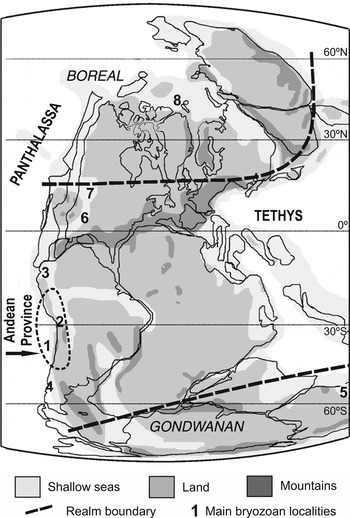
Ross and Ross (Reference Ross, Ross, McKerrow and Scotese1990), in their biogeographic analysis of the Permian bryozoan distribution, grouped the records from the northwestern Andean Cordillera in the Andean Province. More recent reports from the Andean regions of Perú and Bolivia showed an important diversity, including eight new species endemic to the Andean Province (Sakagami, Reference Sakagami1995). A relationship with the midcontinent province in North America and a considerable migration from the Tethyan realm were also noted. The paleogeographic proximity and the information from the associated fauna (Cisterna et al., Reference Cisterna, Sterren and Niemeyer2014) allow us to include the northern Chilenian and the Argentinean associations in the Andean Province (Fig. 3).
Paleogeographic distribution of the main Permian bryozoan localities from the Boreal and Gondwanan realms and the Andean province (after Ross and Ross, Reference Ross, Ross, McKerrow and Scotese1990; Reid and James, Reference Reid and James2010). 1 = Northern Chile and Argentina (Cerro El Árbol and Juan de Morales formations, Navidad Basin and Arizaro Formation, Arizaro Basin). 2 = Bolivia and Perú (Copacabana Group). 3 = Venezuela (Palmarito Formation). 4 = Southern Argentina, Patagonia (Tepuel Group, Tepuel-Genoa Basin). 5 = Southern Gondwana (Australia-New Zealand-Tasmania). 6 = Permian Basin of Texas and New Mexico. 7 = North American Cordillera (Washington-Wyoming-NE Nevada). 8 = Sverdrup Basin-East and North Greenland-Zechstein Basin-Svalbard (modified from Reid and James, Reference Reid and James2010).

The bryozoans studied in this contribution occur typically associated with crinoids, benthic foraminifers, bivalves, and brachiopods, showing a clearly different composition in comparison to those associations from North America and even those of northern South America (Venezuela and Perú) related to typical tropical carbonate deposits usually with corals and sponges. By contrast, the bryozoans from northern Chile are related to heterozoan communities, more typical of modern subtropical to temperate cool-water marine platforms (heterozoan carbonates; James, Reference James1997; Mutti and Hallock, Reference Mutti and Hallock2003 and references therein). The terms ‘foramol’ (foraminifer-molluscan) and ‘bryomol’ (bryozoan-molluscan) are also commonly used, according to main biotic components.
Reid and James (Reference Reid and James2010) distinguished records of Permian bryozoan provinces in high latitude locations: the boreal realm (including the Artic Canada and northern Eurasia margin) and the southern Gondwana realm (including records from Australia and Tasmania). Gondwana was in a high-latitude position during the Permian, experiencing the polar climatic conditions of the late Paleozoic Ice Age.
A transitional zone was also recognized by these authors, including bryozoans from midlatitude areas such as the northwestern Cordillera in the United States, which is also contrasted with the typical equatorial locations as, for example, the midcontinent area in Nevada, Texas, and New Mexico. In particular, the genus Pinegopora, among other bryozoan genera, was considered antitropical and occurs in the Boreal realm and at middle latitudes (Reid and James, Reference Reid and James2010).
The sedimentological characteristics of Cerro el Árbol Formation and its biotic composition are distinctive of a subtropical to temperate shallow marine setting. We can conclude that the Andean bryozoan province is part of a climatic latitudinal gradient from the equatorial to subtropical areas in Venezuela, Perú, and Bolivia to temperate conditions in northern Chile. This gradient can be followed southward in Patagonia and southern Gondwana with the development of typical high-latitude bryozoan associations.
Acknowledgments
This study was supported by CONICET (Consejo Nacional de Investigaciones Científicas y Técnicas): PUE 2016 (CICTERRA-CONICET). PIP 114-200801-00017 (AFS) and PIP 6144-0091 (GAC) that allowed the stay in Chile of two of the authors. We also thank the reviewers of the manuscript, Drs. A. Ernst and P. Wyse Jackson.