Introduction
The association between eustachian tube dysfunction and middle-ear effusion is well established, and studies have identified eustachian tube dysfunction as a major risk factor for benign middle-ear diseases.Reference Hulse1–Reference Maier and Krebs5 Previous studies have shown that a number of sinonasal diseases are associated with ear symptoms.Reference Sismanis6–Reference Scarano, Fetoni, Picciotti, Cadoni, Galli and Paludetti10 Studies have also demonstrated pathological changes affecting the middle-ear mucosa that are associated with chronic sinonasal inflammatory diseases.Reference Kennedy, Jyonouchi, Kajander, Sun and Rimell11, Reference Irander, Borres and Björkstén12
No previous studies have evaluated the presence or absence of symptoms related to sinonasal inflammatory conditions in different ear diseases. This study primarily aimed to assess the presence and degree of sinonasal symptoms in different ear diseases using the Dundee Rhinogram. The study also examined the correlation between sinonasal symptoms and specific subgroups of ear diseases.
Materials and methods
Study design and patients
A prospective cohort study was conducted in the period February–October 2011. A cohort of new and follow-up adult patients attending the otology clinic was assessed for sinonasal symptoms using the Dundee Rhinogram (Figure 1). The degree of sinonasal symptomatology was graded (using the Dundee Rhinogram) in relation to various ear diseases. Questions concerning the presence or absence of sinonasal symptoms were asked as part of the clinical history process. A data proforma was designed and completed at the end of each consultation by the authors. Patients with cognitive impairment were excluded from the study.
The Dundee Rhinogram.

Data gathering
Data were collected prospectively by all three authors and stored using an Excel spreadsheet. Diseases were classified into external-, middle- and inner-ear diseases. Data collected were subdivided into groups according to the type of ear disease. Group A comprised patients with external-ear diseases, group B represented middle-ear diseases, and group C represented inner-ear diseases. Group B was further subdivided into mucosal (B1) and squamous (B2) disease subtypes. Inactive squamous chronic otitis media (retraction pockets, epidermisation and atelectasis) and active squamous chronic otitis media (i.e. acquired cholesteatoma) were considered under the umbrella of squamous middle-ear disease. Otitis media with effusion, and active or inactive mucosal chronic otitis media, were included under mucosal middle-ear diseases. The classification of ear diseases into each subgroup was confirmed by the senior author (SSMH).
Statistical analysis
Statistical analysis was conducted using SPSS statistical software, version 15 (Chicago, Illinois, USA). The Student's t-test analysis for trend was performed to identify any statistically significant association between ear diseases and sinonasal symptoms. Associations between sinonasal symptoms and external-, middle- and inner-ear diseases were examined.
Ethical considerations
Local research and development department approval was formally obtained. No ethics approval was sought as the assessment did not affect the patient care at any level, and the questions asked were part of the routine ENT clinical history assessment. All study data were recorded and kept in accordance with Caldicott Guardianship protocols.
Results
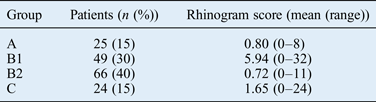
There were 164 patients in the study (a male to female ratio of 9:11). Mean patient age was 50.4 years (range, 16–94 years). Groups A (external-ear disease), B (middle-ear disease) and C (inner-ear disease) each respectively comprised 15 per cent, 70 per cent (with 30 per cent in B1 (mucosal middle-ear disease) and 40 per cent in B2 (squamous middle-ear disease)) and 15 per cent of the whole population (Table I).
Patient data
Patients from groups A, B1, B2 and C scored respective averages of 0.80, 5.94, 0.72 and 1.65 on the Dundee Rhinogram (Table I). All patients were also asked about their previous ear operations. This information is summarised in Table II.
Previous ear operations
Data represent numbers of patients.
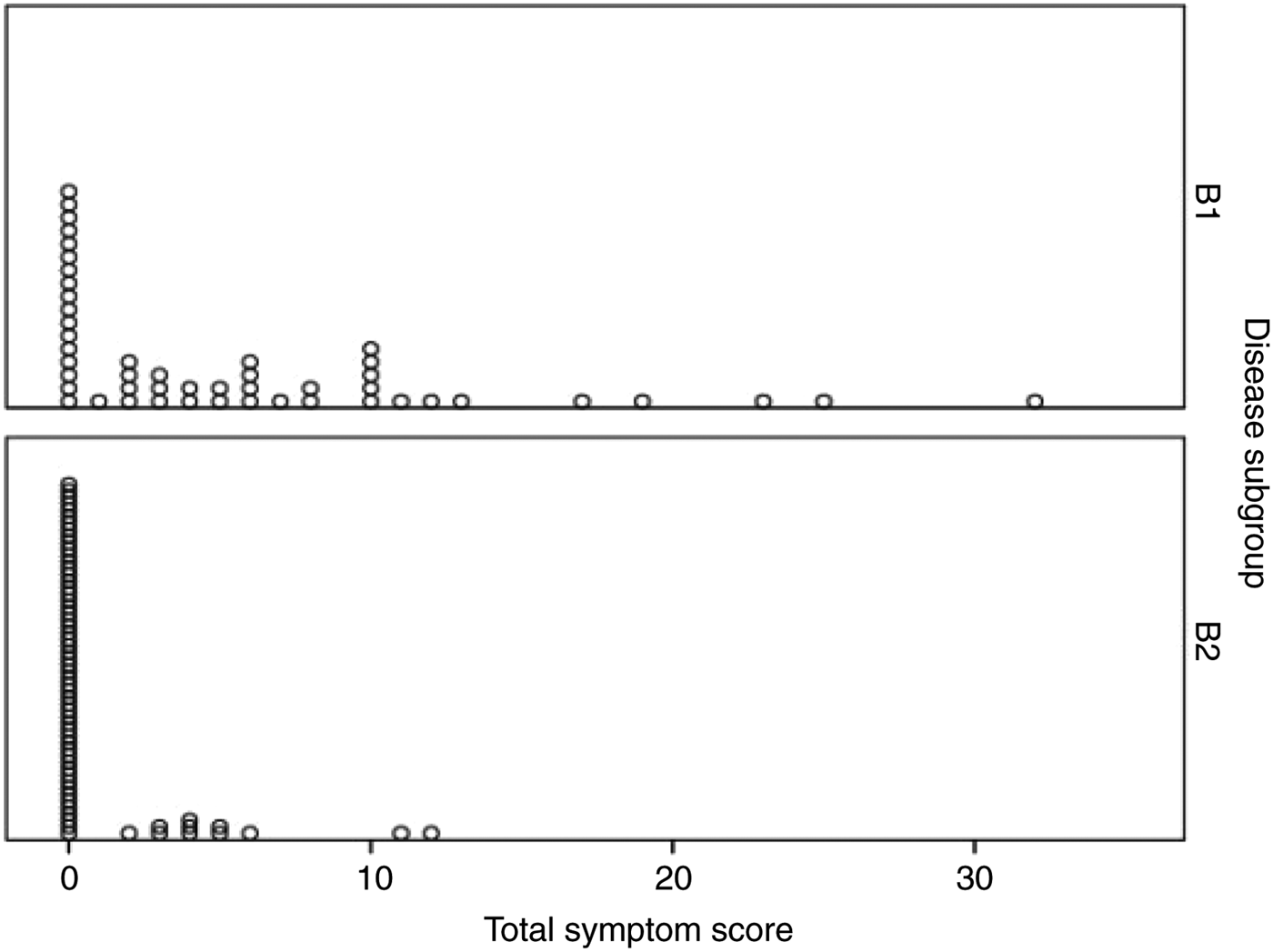
The rhinogram scores for each middle-ear disease patient (in subgroups B1 and B2) are shown in Figure 2. Patients in group B1 (mucosal middle-ear disease) scored considerably fewer zeros and had a higher mean score than those in group B2 (squamous middle-ear disease).
Dundee Rhinogram symptom scores for each patient in subgroups B1 and B2.
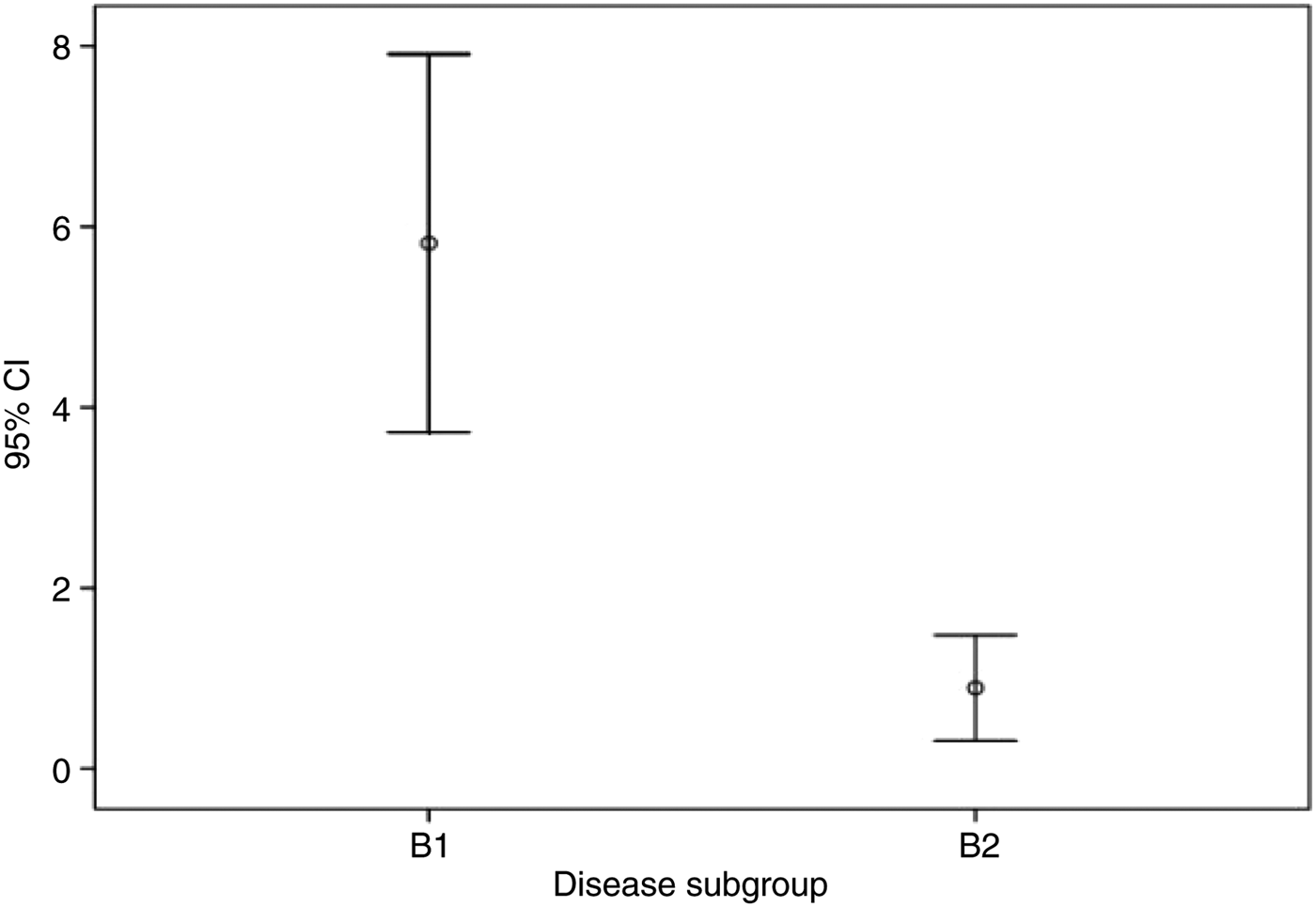
A Student's t-test was performed using the mean rhinogram scores from the different groups (A, B1, B2 and C). This demonstrated no statistical differences between the group populations. No statistically significant association was demonstrated between sinonasal symptoms and (sub)groups A, B2 or C (p = 0.057). However, when the Student's t-test was used to compare subgroups B1 and B2, there was a significant difference between the means of the two populations (p = 0.003), with unequal variances; the mean difference was 4.92. This finding is further supported by the graph in Figure 3.
Ninety-five per cent confidence intervals (CIs) for the mean Dundee Rhinogram symptom scores of subgroups B1 and B2; the lack of overlap of CIs indicates a significant difference between the two populations.
Discussion
Principal results
The mean sinonasal symptom scores (based on the Dundee Rhinogram) for groups A (external-ear disease), B1 (mucosal middle-ear disease), B2 (squamous middle-ear disease) and C (inner-ear disease) were 0.8, 5.94, 0.72 and 1.65, respectively. There was no statistically significant association between sinonasal symptoms and external-ear, squamous middle-ear or inner-ear diseases (p = 0.057, Student's t-test). However, the association between sinonasal symptoms and mucosal middle-ear disease was statistically significant (p < 0.005, Student's t-test).
Oto-nasopharyngeal system
The eustachian tube, nasopharynx and mastoid air cells can be considered as a functional system, which helps in the ventilation, clearance and protection of the middle-ear cavity.Reference Bluestone and Doyle3, Reference Bluestone9 Ventilation of the middle-ear cavity is primarily achieved by contraction of the tensor veli palatini muscle.Reference Scarano, Fetoni, Picciotti, Cadoni, Galli and Paludetti10 The clearance and protection of the middle-ear cavity are maintained by the co-operation of the eustachian tube and other surrounding structures.Reference Bluestone and Doyle3, Reference Maier and Krebs5, Reference Scarano, Fetoni, Picciotti, Cadoni, Galli and Paludetti10 It has also been suggested that different parts of the eustachian tube are responsible for different roles. For instance, the roof of the eustachian tube is primarily involved in ventilation, and the floor of the eustachian tube helps mainly with clearance, although both parts are responsible for protecting the middle-ear cavity.Reference Bluestone and Doyle3, Reference Maier and Krebs5, Reference Bluestone9, Reference Scarano, Fetoni, Picciotti, Cadoni, Galli and Paludetti10
Previous studies
The association between eustachian tube dysfunction and otitis media with effusion (OME) is well established, predominantly based on studies of paediatric subjects.Reference Bluestone and Doyle3, Reference Umapathy, Alles and Scadding4, Reference Sismanis6, Reference Bluestone9 Furthermore, studies have identified eustachian tube dysfunction as a major risk factor for both squamous and inflammatory middle-ear diseases.Reference Sismanis6, Reference Kennedy, Jyonouchi, Kajander, Sun and Rimell11 Chronic eustachian tube dysfunction has been observed in a number of sinonasal diseases, including chronic rhinosinusitis (allergic or non-allergic), septal deformity and sinonasal polyposis.Reference Deron, Clement and Derde2, Reference Umapathy, Alles and Scadding4–Reference Kennedy, Jyonouchi, Kajander, Sun and Rimell11 Studies have also demonstrated chronic inflammatory pathological changes affecting the middle-ear mucosa that are associated with chronic sinonasal inflammatory diseases.Reference Kennedy, Jyonouchi, Kajander, Sun and Rimell11, Reference Irander, Borres and Björkstén12
The European position paper on rhinosinusitis and nasal polyps published in 2007 states that 40–68 per cent of patients with rhinosinusitis have complained of recurrent purulent otitis media or OME.Reference Fokkens, Lund and Mullol13 This association with ear symptoms is due to eustachian tube dysfunction, which leads to negative middle-ear pressures, causing patients to develop recurrent purulent otitis media or OME.
Study merits
No previous studies have evaluated the presence or absence of sinonasal symptoms associated with specific anatomical ear diseases. This study has clearly demonstrated a statistically significant association between mucosal middle-ear diseases and sinonasal symptoms. It is not surprising there was no association between sinonasal symptoms and external- or inner-ear diseases, as there is no anatomical or physiological link between the eustachian tube and external- or inner-ear systems. The association with middle-ear diseases is more reasonable due to the middle-ear ventilation from the nasopharynx through the eustachian tube.
• The association between eustachian tube dysfunction and middle-ear effusion is well established
• Pathological changes affecting middle-ear mucosa are associated with chronic sinonasal inflammation
• No previous studies have evaluated symptoms related to sinonasal inflammatory disease in different ear diseases
• This study demonstrated an association between mucosal middle-ear diseases and sinonasal symptoms, possibly due to inflammatory sinonasal diseases
• Assessment of sinonasal symptoms is paramount in patients presenting with an ear symptom
• Inflammatory sinonasal disease treatment may be necessary in middle-ear mucosal disease management
Study limitations
This study makes no distinction between specific sinonasal inflammatory diseases; the aim was to ascertain an association between sinonasal symptoms and ear diseases. Furthermore, the number of patients in each subgroup varied; however, this did not affect the overall statistical analysis and correlation. This study cannot explain the lack of association between sinonasal symptoms and squamous middle-ear diseases, despite previous studies showing an association with eustachian tube dysfunction. Considering the pathogenesis of squamous middle-ear diseases, in particular acquired cholesteatoma, it is perhaps not surprising there was no direct association with sinonasal symptoms. We suspect that the association between squamous middle-ear diseases and eustachian tube dysfunction is indirect.