Coronavirus disease 2019 (COVID-19) was first reported in Wuhan, China, in late December 2019. Since then, COVID-19 has rapidly spread worldwide and has resulted in > 3.1 million deaths. 1 Although the number of new cases has been declining, COVID-19 is still a significant burden throughout the world. Currently, >1.0 billion doses of the COVID-19 vaccine, which is considered the most promising way of ending the pandemic, have been administered in >180 countries. 1 In Japan, the Minister of Health, Labour, and Welfare is overseeing vaccine distribution, and the mRNA-based severe acute respiratory coronavirus virus 2 (SARS-CoV-2) vaccine manufactured by Pfizer/BioNTech was approved for use in Japan on February 14, 2021. The Japanese government is strongly recommending citizens to receive COVID-19 vaccination and has announced plans to provide vaccinations to all individuals aged ≥16 years free of charge. 2 Healthcare personnel (HCP), considered a high-priority group, were the first to begin receiving their vaccinations beginning on February 17, 2021.
Although the COVID-19 vaccine is reportedly effective, few data are available regarding associated adverse events among Asian populations, Reference Polack, Thomas and Kitchin3,Reference Dagan, Barda and Kepten4 and many nations in Asia have adopted a cautious stance resulting in rollout lags. The public’s lack of familiarity with the new, mRNA-based vaccine may be stirring vaccine skepticism. Reference Fisher, Bloomstone, Walder, Crawford, Fouayzi and Mazor5,Reference Dror, Eisenbach and Taiber6 Moreover, Japan’s relatively low cumulative number of confirmed infections and COVID-19–related mortality rate compared with those of Europe and North and South America, 1 as well as religious and cultural considerations, may be contributing to vaccine hesitancy among the Japanese. Reference Wong and Wong7,Reference Shimizu, Sorano and Iwai8 A recent study reported that HCP also felt hesitant about receiving the COVID-19 vaccine. Reference Grumbach, Judson and Desai9 In the present study, we investigated the current attitudes toward COVID-19 vaccination among HCP at a Japanese tertiary-care center, and we evaluated the impact of a multifaceted intervention on the vaccination uptake rate in this population.
Methods
Study design and setting
The present interventional study was conducted from January 2021 to March 2021 at Tokyo Metropolitan Tama Medical Center, a 790-bed tertiary-care center with 34 subspecialties in Tokyo, Japan, including a division of infectious diseases, department of infection control, and an occupational health and safety committee. The latter organized a COVID-19 vaccination program for HCP at the study center, which does not mandate COVID-19 vaccination for its HCP but strongly recommends complying with the Japanese government’s promotion of COVID-19 vaccination. 2 Each HCP at the study center had access to Groupware (Cybozu, Tokyo, Japan), which was used for hospital-wide communication (eg, intranet e-mailing), e-learning, and administering surveys. The study center has been admitting patients with COVID-19, including critically ill patients, since February 2020, and by April 2021, >850 patients with the disease were admitted.
Participants
All healthcare personnel directly employed by the study center (ie, physicians, registered nurses, nursing aides, pharmacists, other allied health professionals, and administrative personnel) were included. HCP with part-time status were excluded because their vaccine schedule was determined by their primary employer. The institutional review board at the study institution approved this study.
Prevaccination questionnaire survey
A prevaccination questionnaire survey, consisting of 6 items asking about the respondents’ perception of the COVID-19 vaccine, was conducted using the e-learning system. HCP were required to answer all the items once they started the questionnaire. Supplementary Table 1 (online) shows the details of the questionnaire items. The respondents were assured that their information would be kept confidential. To improve the response rate, multiple reminders from the infection control department were delivered via intranet e-mail to all HCP, and a telephone call was placed to each department manager during the survey period (Fig. 1).
Timeline from preinterventional to postvaccination questionnaire survey. Note. HCP, healthcare personnel.

Intervention
A multifaceted intervention was conducted by the department of infection control and occupational health and safety committee. Figure 1 shows the intervention timeline. After the prevaccination questionnaire survey period, all HCP received a double-sided, color leaflet in Japanese with information on the COVID-19 vaccine and answers to frequently asked questions, such as (1) an explanation of the mRNA vaccine, (2) current evidence of its safety, efficacy, and common adverse events, (3) vaccinations for HCP with allergies and pregnant HCP, (4) the cost of vaccination, and (5) general information about COVID-19 (Supplementary Fig. 1 online). Posters promoting COVID-19 vaccination were displayed in employee lounges and at the hospital entrance. In addition, a vaccine recommendation was sent to all HCP by the hospital vice president by e-mail, and a mandatory, e-learning–based lecture on the COVID-19 vaccine was provided. An educational session about vaccinations for pregnant and lactating HCP, an outpatient clinic for allergy testing, and consultation on the COVID-19 vaccine ingredients (eg, polyethylene glycol) were provided for HCP who were interested.
Vaccination
The first wave of vaccinations was provided from March 8 to 19, 2021, at a large lecture hall at the study center. The Pfizer/BioNTech COVID-19 vaccine was available only during the study period. When HCP willingness to be vaccinated was confirmed, and after the vaccination, HCP were carefully observed for at least 15 minutes on site in case any critical adverse events occurred.
Postvaccination questionnaire survey
A postvaccination survey was administered in the same manner as the prevaccination survey (Fig. 1). The questionnaire consisted of 12 questions, including questions on the efficacy of each intervention, the incidence of adverse events within 48 hours and 7 days after vaccination, and the vaccine recipients’ impression of the vaccination process (Supplementary Table 2 online).
Statistical analysis
The HCP characteristics, vaccine-related adverse events, assessment of each intervention, vaccination acceptance rate in the prevaccination questionnaire survey, actual immunization rate after intervention, and factors determining vaccination uptake were summarized using frequencies and percentages. Vaccination acceptance status (willing vs unwilling or unsure) and reasons for hesitation in receiving the vaccination (unwilling vs unsure) were compared. Categorical variables were compared using the χ 2 test or Fisher exact test as appropriate, and continuous variables were compared using the Mann-Whitney U test. All tests for significance were 2-tailed, and P < .05 was considered to indicate statistical significance. All analyses were performed using SPSS version 25 software (IBM, Armonk, NY) and Stata version 15 software (StataCorp, College Station, TX).
Results
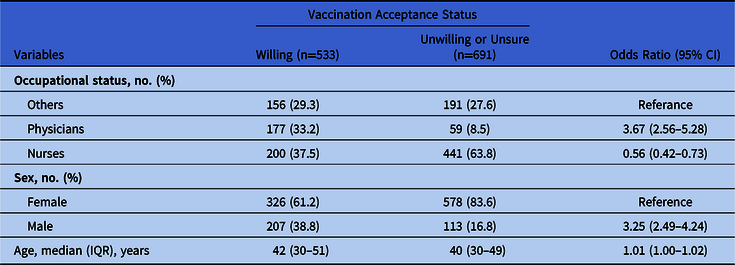
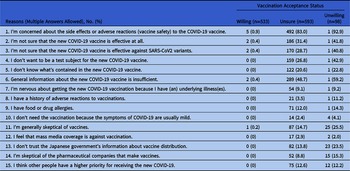
In total, 1,576 HCP were included; of these, 1,224 HCP (77.7%) answered the prevaccination questionnaire. Table 1 summarizes the characteristics of the respondents; 671 (54.8%) of the respondents thought it likely that they would contract COVID-19 in the future, and 691 (56.5%) responded that they were unwilling or unsure about being vaccinated. On univariate analyses, factors associated with a willingness to be vaccinated among HCP were physician occupation (odds ratio [OR], 3.67; 95% confidence interval [CI], 2.56–5.28), male sex (OR, 3.25; 95% CI, 2.49–4.24), and increasing age (OR, 1.01; 95% CI, 1.00–1.02) (Table 2). Despite our concern about an interaction between sex and occupational status (physicians vs nurses) due to the preponderance of female nurses, we detected no significant difference in the vaccine acceptance rates between female physicians and female nurses: 53 (65.4%) of 81 physicians versus 160 (29.1%) of 549 nurses (P < .001). Table 3 lists the reasons for hesitation. HCP who responded that they were unsure about or unwilling to be vaccinated appeared to have a number of concerns regarding vaccination, and the degree of each concern in the latter group was higher than that in the former. The main concern in both groups was the safety rather than the efficacy of the vaccine.
Characteristics of Respondents to Prevaccination Questionnaire Survey (N = 1,224)

Comparison of Vaccine Acceptance by Demographic Information in the Prevaccination Survey (n = 1,224)

Note. IQR, interquartile range; CI, confidence interval.
Comparison of Reasons for Vaccine Hesitancy by Acceptance Status in the Prevaccination Survey (n = 1,224)

The overall vaccination uptake rate at the study center reached 89.7% (1,413 of 1,575), which was substantially higher than the proportion expressing willingness to receive the vaccine before the intervention. Vaccination uptake among the 1,224 HCP who responded to the prevaccination questionnaire survey reached 92.1% (1,127 of 1,224). Of the 691 respondents who were unwilling or unsure before the intervention, 614 (88.9%) subsequently accepted vaccination. Of the 98 who responded “unwilling,” 66 (67.3%) subsequently accepted vaccination, and of the 593 who responded “unwilling, 513 (92.4%) subsequently accepted vaccination. Supplementary Table 3 (online) shows the details of the vaccination rate.
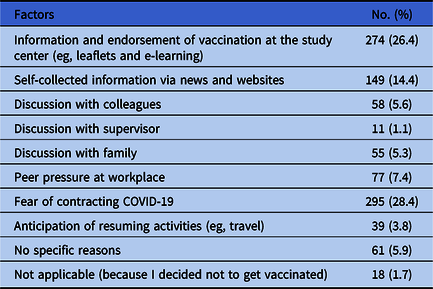
In total, 1,037 HCP (65.7%) responded to the postvaccination questionnaire. Among them, 915 HCP (88.2%) felt that the distribution of the informational leaflets was the most effective method of promoting COVID-19 vaccination, and 873 (84.2%) felt that the e-learning opportunity was the most effective method of promoting COVID-19 vaccination (Supplementary Fig. 2 online). The most important factor leading to vaccination acceptance was the fear of contracting COVID-19 (295 of 1,037, 28.4%) followed by the information about and endorsement of vaccination at the study center (274 of 1,037, 26.4%) (Table 4). In the postvaccination questionnaire, 620 of HCP (59.8%) responded that the administration of COVID-19 vaccination was satisfactory, and 716 (69.1%) responded that they would recommend vaccination to their close family members and friends. Common adverse reactions following the first vaccination included (1) local pain at the injection site within 48 hours of administration (814 of 1,037, 78.5%) and (2) persistent local pain at the injection site at 7 days (311 of 1,037, 30%).
Single Most Important Factor Leading to Receiving the COVID-19 Vaccination in the PostVaccination Survey (Multiple Answers Not Allowed) (n =1,037)

Discussion
In this study, we ascertained current perceptions among HCP toward COVID-19 vaccination. Implementation of our multifaceted intervention changed the perception of COVID-19 vaccination among HCP and resulted in a higher vaccination rate. A detailed questionnaire survey before and after the intervention revealed the factors that contributed to either promoting or hindering vaccination among HCP.
Vaccine hesitancy is a potentially serious obstacle to improving the vaccination rate among any given population. In the present study, fewer than half of the HCP responding to the preintervention survey were willing to be vaccinated. Studies in various countries around the world have reported an unwillingness among HCP to be vaccinated despite the significant risk of COVID-19 among those working at the frontline. Reference Dror, Eisenbach and Taiber6,Reference Grumbach, Judson and Desai9–Reference Di Gennaro, Murri and Segala12 Furthermore, this tendency varied demographically, and ethnicity, age, gender, educational status, and previous experience of COVID-19 care significantly influenced attitudes. Reference Fisher, Bloomstone, Walder, Crawford, Fouayzi and Mazor5,Reference Dror, Eisenbach and Taiber6,Reference Grumbach, Judson and Desai9,Reference Lazarus, Ratzan and Palayew13,Reference Machida, Nakamura and Kojima14 In the present study, female sex, nursing occupation, and younger age were factors associated with lower willingness to be vaccinated, which is in line with the findings of previous studies. Reference Dror, Eisenbach and Taiber6,Reference Shekhar, Sheikh and Upadhyay10–Reference Di Gennaro, Murri and Segala12 However, the root cause of their unwillingness lay in each individual’s calculation of the perceived benefits and risks of vaccination.
Under a voluntary vaccination policy, improving the vaccination rate among HCP requires considerable effort, mainly because the recently released mRNA vaccine is still unfamiliar to many people even in healthcare services, and various facts, such as the long-term effects and potential adverse reactions to COVID-19 vaccines in general are not clearly understood. On an individual level, vaccine hesitancy might be influenced by religious reasons (eg, non-halal components in vaccines) and cultural considerations (eg, predominance of pseudoscientific beliefs and antivaccine conspiracy theories). Reference Wong and Wong7 Moreover, skepticism regarding the COVID-19 vaccine among the HCP stemmed from insufficient information, which has also been demonstrated by previous studies. Reference Fisher, Bloomstone, Walder, Crawford, Fouayzi and Mazor5,Reference Dror, Eisenbach and Taiber6,Reference Grumbach, Judson and Desai9–Reference Qattan, Alshareef, Alsharqi, Al Rahahleh, Chirwa and Al-Hanawi11 In addition, insufficient information about the risks to particular populations, such as pregnant and lactating women, Reference Dagan, Barda and Kepten4 contributed to vaccine hesitancy, and general uncertainty was compounded by misinformation on social media. Reference Laine, Cotton and Moyer15,Reference Montagni, Ouazzani-Touhami and Mebarki16 Despite these challenging circumstances, our multifaceted intervention achieved a high COVID-19 vaccine uptake rate among the HCP at the study institution. The pre- and postvaccination survey results demonstrated that at each stage of the intervention, providing transparent and scientifically accurate information on the COVID-19 vaccine appeared to be effective in encouraging HCP to get vaccinated. Repeated dissemination of evidence-based information about the COVID-19 vaccine by various means, including leaflets, poster campaigns, and e-learning, was likely to have improved awareness about the vaccine itself, diminishing skepticism and promoting acceptance. Moreover, special educational lectures targeting HCP with special concerns, such as pregnant women, and pre-vaccination allergy testing for those worried about potential allergic reactions, may contribute to promoting vaccination safety, which, as stated previously, was a greater concern than vaccine efficacy among most of the HCP polled in the prevaccination survey. The results of this study also revealed that the concept of hospital-wide nudge approaches with a multilevel intervention are essential to increasing the COVID-19 vaccine uptake rate. Reference Patel17–Reference Finney Rutten, Zhu and Leppin19
Although we achieved a COVID-19 vaccine uptake rate of almost 90% among HCP at the study center, an even higher vaccine uptake rate can potentially be achieved. A mandatory vaccine policy is another possible strategy for achieving a high vaccine uptake rate. Reference Babcock, Gemeinhart, Jones, Dunagan and Woeltje20 In Italy, COVID-19 vaccination has become mandatory for HCP Reference Paterlini21 ; however, mandatory vaccination raises ethical and legal concerns about individual autonomy. Recent surveys of HCP demonstrated poor support for a policy of mandatory COVID-19 vaccination. Reference Shekhar, Sheikh and Upadhyay10,Reference Ledda, Costantino, Cuccia, Maltezou and Rapisarda22 Nonetheless, mandating vaccination may be more acceptable among HCP if an annual COVID-19 booster becomes the norm. Reference Lovelace23
Notably, more than two-thirds of the HCP at the study center responded that they would recommend COVID-19 vaccination to close family members and friends. A previous study revealed that positive attitudes among HCP toward vaccination may positively impact the vaccine uptake rate in the general public. Reference Schwarzinger, Verger and Guerville24 Some individuals relied on information from their primary physician and cited their physician’s recommendations as their reason for being vaccinated. Reference Nowak, Sheedy, Bursey, Smith and Basket25 Improving HCP satisfaction with COVID-19 vaccination may help optimize the vaccination effort. Moreover, strong messages from vaccinated HCP highlighting the personal benefits of vaccination as well as the importance of the concept of altruistic or prosocial behavior may help increase the COVID-19 vaccination rate in the general public. Reference Finney Rutten, Zhu and Leppin19
The present study has several limitations. It was conducted at a single, Japanese institution, and although the interventions tested substantially increased the overall COVID-19 vaccination rate, they may not apply to other healthcare settings. We were unable to test the differences in the efficacy of the multifaceted intervention in various ethnic groups or individuals of other cultural backgrounds because nearly all the HCP at the study center are of Japanese ethnicity. Moreover, HCP may not have had enough time to consider fully the information provided because the time from the implementation of the prevaccination questionnaire to vaccination was relatively brief. Third, a response bias may have been introduced because the questionnaire depended entirely on self-reporting. Finally, we were unable to conclude whether the vaccination rate was increased solely by the multifaceted intervention given the nature of a before-and-after trial.
In summary, a certain number of HCP were cautious about COVID-19 vaccination, with the chief concern being the safety of the vaccine. The present study revealed that a multifaceted intervention consisting of a supportive, informative approach is critically important for promoting COVID-19 vaccination among HCP. This strategy may also be applied to the general population to enhance their vaccination rate. Because HCP can play a key role in vaccine promotion, increasing vaccine literacy among them can positively impact the adoption of successful immunization policies for the general public.
Supplementary material
To view supplementary material for this article, please visit https://doi.org/10.1017/ice.2021.325
Acknowledgments
We would like to thank Mr. James R. Valera for his assistance with editing the manuscript.
Financial support
No financial support was provided relevant to this article.
Conflicts of interest
All authors report no conflicts of interest relevant to this article.