


In politics and government, institutions—both rules and norms—operate as important constraints that structure the decision-making processes of actors. Legislators, judges, bureaucrats, voters, and other actors make decisions within an institutional context defined by formal and informal rules that constrain individual discretion and ultimately shape actors’ choices (e.g., March and Olsen Reference March and Olsen1984; McCubbins, Noll, and Weingast Reference McCubbins, Noll and Weingast1987; North Reference North1990; Rohde Reference Rohde1991; Shepsle Reference Shepsle1979). On the U.S. Supreme Court, the justices' institutional context is almost completely dominated by a web of informal rules, or norms (e.g., Epstein and Knight Reference Epstein and Knight1998; Maltzman, Spriggs, and Wahlbeck Reference Maltzman, Spriggs and Wahlbeck2000; Murphy Reference Murphy1964). Perhaps the most important norm on the Court is stare decisis, or precedent, which is a facet of “the law” prescribing how past decisions should guide choices in current and related cases.Footnote 1
Supreme Court justices make rules by issuing precedents that contain legal doctrines intended to constrain not only lower court judges and actors in the political environment, but also themselves and future justices. Legal doctrines, like rules in other contexts, prescribe certain outcomes under various conditions. Consequently, legal doctrine is capable of restricting the range of viable policy alternatives, which serves to limit individual discretion in decision making by lower courts and future Supreme Courts (a la McCubbins, Noll, and Weingast Reference McCubbins, Noll and Weingast1987). Through this mechanism, legal doctrine allows the Court to exert control over the future course of legal policy (Bueno de Mesquita and Stephenson Reference Bueno de Mesquita and Stephenson2002; Jacobi and Tiller Reference Jacobi and Tiller2007). From a normative point of view, adherence to precedent sends a signal to the legal community and the mass public that the Court's legal interpretations contain considerable continuity and do not change simply because of membership change on the Court. Such signals, it is often argued, enhance the legitimacy of the Supreme Court in the eyes of the public and the other branches of government (e.g., Epstein and Knight Reference Epstein and Knight1998). The Court's legal rules also have significant real world implications for rights, liberties, and democracy. Strong rights-protective rules can be viewed as “democracy foreclosing” because they restrict the degree to which elected representatives can make policy on the topic, whereas more innocuous and minimalistic rules are “democracy promoting” in that they leave considerable room for elected officials to pass laws on the topic (Sunstein Reference Sunstein1999).
In this article, I revisit one of the central inquiries in judicial politics: how, and to what extent, does legal doctrine genuinely constrain justices' choices? Although some scholars contend that justices are strongly guided by legal considerations (e.g., Gilman Reference Gilman, Clayton and Gillman1999, Reference Gilman2001; Kahn Reference Kahn, Clayton and Gillman1999), others argue that legal doctrine represents a flexible norm that has a minimal bearing on the justices. Proponents of the attitudinal model (Rohde and Spaeth Reference Rohde and Spaeth1976; Schubert Reference Schubert1974; Segal and Spaeth Reference Segal and Spaeth2002; Spaeth and Segal Reference Spaeth and Segal1999) claim that because Supreme Court justices are electorally unaccountable and sit atop the federal judicial hierarchy, they have unbridled discretion to decide cases on the basis of their ideological, or personal policy, preferences. By ideology and policy preferences, which I treat as synonymous, I mean that justices are predisposed to hold views on legal issues that range from liberal positions to conservative positions. In one test of the legal model, Spaeth and Segal (Reference Spaeth and Segal1999; Segal and Spaeth Reference Segal and Spaeth1996) find that dissenters in landmark cases adhered to precedent in subsequent and related (i.e., progeny) cases only 12% of the time. They boldly conclude that “the justices are rarely influenced by stare decisis” (Spaeth and Segal Reference Spaeth and Segal1999, 288).
Critics claim that Spaeth and Segal present an antiquated “mechanical jurisprudence” perspective of legal reasoning that incorrectly suggests how justices should automatically adhere to prior controlling precedents (e.g., Friedman Reference Friedman2006; Gilman Reference Gilman2001). Supreme Court decision making involves greater complexity, and the effect of the law is often highly nuanced and difficult to validate with social science research designs. Moreover, the legal doctrines stipulated by the Supreme Court are not necessarily determinative of certain outcomes given a configuration of facts (Tiller and Cross Reference Tiller and Cross2006). Instead, they are frameworks that structure justices' decision processes (Richards and Kritzer Reference Richards and Kritzer2002), and the contextual characteristics of the case carry considerable sway as well (Winkler Reference Winkler2006). In addition, although lower court judges are bound to a greater extent by Supreme Court precedent, the Supreme Court itself is not explicitly bound to follow its own precedents. However, there are several reasons why the justices would want to be faithful to and constrained by the Court's own precedents. First, justices are socialized to be accountable to the body of law that has preceded them. Justices are, at the least, sensitive to the norm of respect for past precedents and legal frameworks (e.g., Baum Reference Baum2006; Braman Reference Braman2004; Knight and Epstein Reference Knight and Epstein1996). They are also accountable to the legal audiences—other judges, lawyers, the media, the intellectual community—who comment on and interpret justices' decisions (see Baum Reference Baum2006). Second, although ideological motivations might lead the Court to create certain legal doctrines, once they are created, it is often in the Court's interests to abide by them in order to impose stability and predictability within the legal system (Bueno de Mesquita and Stephenson Reference Bueno de Mesquita and Stephenson2002; Richards and Kritzer Reference Richards and Kritzer2002). The Supreme Court sits at the apex of an extensive federal judicial hierarchy. Therefore, it is charged with the responsibility of providing guidance and clear signals to lower court judges and lawyers about how its doctrines should be interpreted. Efficient management of the lower courts and an instinct to maintain its institutional legitimacy prevents the Court from producing frequent, wholesale reversals of its precedents.
Adopting some of these arguments in response to the attitudinal model, alternative perspectives contend that although ideology influences justices' choices, the law exerts an independent and concurrent influence as well (e.g., Bailey and Maltzman Reference Bailey and Maltzman2008; Baum Reference Baum1997; George and Epstein Reference George and Epstein1992; Pritchett Reference Pritchett1954; Richards and Kritzer Reference Richards and Kritzer2002). I refer to such models as “hybrid models,” and one of the most influential is Richards and Kritzer's (Reference Richards and Kritzer2002) “jurisprudential regimes theory,” which posits that certain precedents create jurisprudential regimes—essentially legal doctrines created by the justices to structure future decision making—highlighting how legal standards should apply to certain types of fact situations. In sum, although hybrid models argue for a genuine influence of the law, they also concede that ideology exhibits an impact on decision making that is independent from the law. That is, they focus on the discrete channels of influence exhibited by law and ideology, which I argue leaves a significant gap in our understanding of precisely how legal doctrine constrains justices. Moreover, these perspectives do not place an explicit emphasis on the differential impacts of legal rules.
In this article, I offer a new perspective on how and to what extent law constrains justices' decision making. I provide two central contributions. First, although hybrid models highlight the discrete and orthogonal effects of law and ideology, I offer a theoretical departure from hybrid models and posit how legal rules permit varying degrees of ideological discretion justices have in a given case, which in turn shapes the magnitude of ideological voting (i.e., the degree to which ideology influences justices' choices). I present competing models of how the levels-of-scrutiny legal doctrine—employed for numerous legal issues—shapes ideological discretion among the justices.
The article's second key contribution centers on the notion that not all rules emanating from a legal doctrine carry with them the same constraining capacity. Political scientists often think of rules as necessarily limiting an actor's discretion; the same logic is often applied to legal doctrine on courts. However, my theoretical framework specifically highlights how some rules significantly constrain ideological discretion, whereas others give justices a significant amount of discretion to act on the basis of ideological preferences. I test these propositions using cases from free expression law. The theory and findings provide a compelling and more complete portrait of law's influence in Supreme Court decision making, focusing on the mechanisms underlying the constraining—and nonconstraining—capacity of legal rules on the Supreme Court.
THE CONSTRAINING CAPACITY OF LEGAL DOCTRINE: A NEW PERSPECTIVE
I begin this section by explaining the function of a widely used legal doctrine on the Supreme Court: the levels-of-scrutiny framework. I then present competing models for how the rules within this framework constrain or do not constrain ideological discretion.
The Levels-of-Scrutiny Doctrine
In setting legal doctrine, the Supreme Court prescribes different levels of scrutiny to various types of governmental laws and regulations. In constitutional law, these levels of scrutiny reflect the Court's interpretation of how protective the Constitution should be of rights and liberties, such as equality, the right to privacy, and the freedoms of speech, press, and religious exercise. Higher levels of scrutiny are highly rights protective and coincide with a strong presumption that a rights-restrictive government act will be struck down by the Court as a violation of the Constitution. By a “government act,” I mean either a law passed by a federal, state, or local government or an action of a government official. Lower levels of scrutiny reflect a lower degree of rights protectiveness and presume that a government act is valid. Where do these rules come from? Although one could argue that the Supreme Court has always used the logic underlying levels of scrutiny when deciding whether the Constitution should invalidate a government act, the Court first formalized such a framework in the “famous footnote 4” in U.S. v. Carolene Products (1938) (Chemerinsky Reference Chemerinsky2002; Tribe Reference Tribe1988; Winkler Reference Winkler2006). In the footnote, Justice Stone argued that governmental regulations of the economy should receive low judicial scrutiny and should therefore possess presumptive validity. However, Stone argued that government acts placing restrictions on fundamental constitutional rights and liberties (e.g., freedom of speech, press) should receive greater judicial scrutiny.
In the development of constitutional law in various issue areas, three legal rules have emanated from this doctrine (see Winkler Reference Winkler2006). Each suggests different standards of balancing individual rights and liberties versus governmental interests.Footnote 2 The first is strict scrutiny, which is the most rights-protective level of review and places the burden of proof on the government to demonstrate a compelling state interest for the existence of a rights-restrictive government act. Under strict scrutiny, there is a presumption that such an act will be struck down—unless it is narrowly tailored to achieve a compelling state interest—because it violates a right or liberty deemed to be fundamentally protected by the U.S. Constitution. It is often said that this rule is “‘strict’ in theory and fatal in fact” because a law accorded strict scrutiny will hardly ever pass the very high bar that constitutes a “compelling state interest” (Gunther Reference Gunther1971, 8; Winkler Reference Winkler2006). However, Winkler (Reference Winkler2006, 796) finds that a nontrivial proportion of federal court cases has been upheld under strict scrutiny review, suggesting that strict scrutiny is “survivable in fact” (see also Baldez, Epstein, and Martin Reference Baldez, Epstein and Martin2006). In equal protection law, at least since Brown v. Board of Education (1954), laws discriminating on the basis of race are accorded strict scrutiny. For free expression, government acts that regulate the content of speech (i.e., content-based regulations) have traditionally been accorded strict scrutiny (Richards and Kritzer Reference Richards and Kritzer2002). In Roe v. Wade (1973), the Court prescribed strict scrutiny to laws regulating abortion during the first two trimesters (the previability stage) of pregnancy.
The second and least rights-protective rule is rational basis, which places the burden of proof on the individual challenging a government act to show that one's individual rights and liberties have been significantly infringed upon. This standard of review grants the government the maximum amount of latitude in making rights-restrictive restrictions that serve a legitimate or reasonable purpose. In rational basis review, the Court presumes a government act will be upheld. In Roe v. Wade (1973), the Court assigned rational basis review to laws regulating abortion during the third trimester of pregnancy. The Court argued that during this advanced stage of pregnancy, a government has a legitimate interest in protecting a fetus that could survive outside the womb. In free expression law, traditionally less protected forms of speech, such as obscenity (Miller v. California 1973) and “fighting words” that could incite violence (Chaplinski v. New Hampshire 1942), have been given the lowest amount of scrutiny, and therefore, the lowest amount of constitutional protection (Richards and Kritzer Reference Richards and Kritzer2002).
In between these two levels of scrutiny falls the third rule: intermediate scrutiny. For this rule, which is moderately rights protective, a government act will be upheld if it is “substantially related to an important government interest” (Chemerinsky Reference Chemerinsky2002, 519). For intermediate scrutiny, the government bears a fraction of the burden of proof to demonstrate why it passed a particular rights-restrictive law, but the individual also bears a fraction of this burden to demonstrate that the law violates a fundamental constitutional freedom. Importantly, there is no presumption for whether a government act accorded this level of review should be upheld or struck down. In the Court's Planned Parenthood v. Casey (1992) decision, which amended the Roe v. Wade doctrine, the Court prescribed that governmental regulations of previability abortions be accorded a form of intermediate scrutiny known as the “undue burden” test. By lowering the standard from strict to intermediate scrutiny, the Court gives states more discretion to place certain restrictions on abortion, yet it still suggests a constitutional threshold that states cannot exceed. In free expression law, content-neutral regulations—those not based on content but on time, place, and manner restrictions—have been accorded intermediate scrutiny (Richards and Kritzer Reference Richards and Kritzer2002). In equal protection issues, laws discriminating on the basis of sex are accorded intermediate scrutiny (Craig v. Boren 1976), which gives government some latitude to legislate sex classifications (see also Baldez, Epstein, and Martin, Reference Baldez, Epstein and Martin2006).
Levels of Scrutiny and Ideological Discretion: Competing Theoretical Models
I contend that the rules within the levels-of-scrutiny framework permit varying degrees of discretion justices have to decide the case on the basis of their ideological preferences. They do so by restricting or expanding the set of feasible outcomes available to the justices. Here, I present competing models of this process. Importantly, the models highlight the differential constraining capacities of legal rules. Figure 1 aids in the discussion of the models.
Constraining Capacity of Legal Rules: (A) Legal Presumptions Model, and (B) Rights-Protectiveness Model

I refer to the first model as the “legal presumptions” model, which emphasizes that constraint is a function of how strongly a legal rule presumes a certain case outcome. For the strict scrutiny and rational basis rules, the strong presumptions of striking and upholding a rights-restrictive regulation, respectively, means that justices have fewer legally justifiable alternatives available to them compared to a case where there is no presumptive outcome, as in intermediate scrutiny. Thus, where the presumption of a certain outcome is high, the legal rule stipulates a particular outcome and therefore leaves a low degree of discretion for ideologically driven behavior. However, for intermediate scrutiny, where no presumption exists, justices possess a considerably higher degree of ideological discretion (compared to strict scrutiny and rational basis), where they can more freely decide cases on the basis of their ideological preferences.
It is important to note here that even though rational basis does not always lead to a justice to cast a pro-government (conservative) vote and strict scrutiny does not always lead a justice to cast a proindividual (liberal) vote (e.g., Baldez, Epstein, and Martin, Reference Baldez, Epstein and Martin2006; Winkler Reference Winkler2006), each rule can still constrain ideological discretion. Indeed, one would not expect judges, especially Supreme Court justices, to cast votes in accord with a legal presumption 100% of the time. Other contextual characteristics of the case come into play, and, as Winkler (Reference Winkler2006) shows, strict scrutiny is indeed “survivable in fact,” with judges sometimes able to find a compelling state interest that justifies a rights-restrictive regulation. Given this, though, legal presumptions can still exhibit constraint on individual discretion because they restrict the range of legally justifiable conclusions for ruling against the presumption. However, for intermediate scrutiny, where the range of viable alternatives is greater because of the lack of a legal presumption, judges have a greater ability to decide the case on the basis of ideological preferences.
Figure 1A depicts the “legal presumptions model.” The x-axis represents the three levels of scrutiny, ranging from rational basis to strict scrutiny. The y-axis represents the amount of ideological discretion justices have in a given case. The legal presumptions model posits that ideological discretion is a nonlinear function of the levels of scrutiny. This model implies that for rational basis and strict scrutiny, where there is a strong presumption for a particular outcome, ideological discretion is low. But for cases involving intermediate scrutiny, discretion is quite high. For strict scrutiny, rights-protective standards are maximized, and there is a presumption that the rights-restrictive regulation should be struck down. Thus, if strict scrutiny operates as a constraint, it significantly limits a justice's freedom to reach a conclusion that the act should be upheld. For rational basis, if a strong norm of deference toward the government is operative, which presumes a government act should be upheld, it significantly limits a justice's freedom to reach the conclusion that the act should be struck down. For intermediate scrutiny, the model posits that ideological discretion is maximized relative to the other two rules because there is no strong presumption about the fate of a government act.
Thus, the expectation from the legal presumptions model is that the impact of ideological preferences on justices' choices will be significantly higher for intermediate scrutiny compared to both rational basis and strict scrutiny. Importantly, the model highlights the differential capacities of legal rules to exhibit constraint. Rules that presume the validity or invalidity of a government act are posited to significantly constrain ideological discretion. But intermediate scrutiny, which does not presume an outcome, will not constrain justices, therefore leaving them wide-ranging discretion to pursue ideological preferences.
Unlike the legal presumptions model, the “rights-protectiveness model” posits that it is not the presumption of an outcome, per se, that constrains justices, but the degree to which a doctrine deems that the Constitution is protective of rights and liberties. Put another way, legal rules that prescribe greater constitutional scrutiny of a law will exhibit more constraint on ideological discretion compared to rules that prescribe lower scrutiny. Figure 1B depicts this logic, where ideological discretion is a linear function of scrutiny. For strict scrutiny, ideological discretion is minimized because legal doctrine stipulates that the Constitution is explicitly prescribing a certain outcome (i.e., striking down a rights-restrictive government act). As the level of scrutiny decreases (from intermediate scrutiny to rational basis), ideological discretion increases. In this model, it is the degree to which the Constitution protects a right or liberty that constrains justices. The rational basis rule suggests that the Constitution is not significantly rights protective for a class of rights-restrictive government acts, and therefore, the doctrine does not impose any constitutional constraint on ideological discretion. Intermediate scrutiny suggests greater rights protectiveness than rational basis but less than strict scrutiny. Therefore, this rule should impose moderate constraint on ideological discretion.
The rights-protectiveness model's expectation for the rational basis rule accords with classic behavioral studies (e.g., Spaeth Reference Spaeth1964; Spaeth and Teger Reference Spaeth, Teger, Halpern and Lamb1982) in suggesting that a deference norm toward the government is not operative on the Court. The legal presumptions model rests on the assumption that, under rational basis review, the Court will defer to the government via a presumption to uphold the law. The rights protectiveness model, however, suggests that the Court will not defer to a government under rational basis because the Court is only constrained by the degree of constitutional scrutiny given to a class of cases; rational basis review is associated with a very low degree of constitutional scrutiny. Under this model, the Court is only responsive to, and constrained by, high levels of constitutional scrutiny in conjunction with the intent of the Constitution. The First Amendment states that “Congress shall make no law. . .abridging the freedom of speech. . . .” The Court has used doctrine to fill in the gaps of this language, but the Constitution is clear about protecting the freedom of speech against government restrictions. However, it is not explicit about when the government should receive deference when passing rights-restrictive laws. Thus, this model posits that the more explicitly the Constitution speaks toward a particular law, the less ideological discretion justices will have.
In sum, the expectation from the rights-protectiveness model is that ideological discretion will be higher for rational basis than for intermediate scrutiny, and discretion for intermediate scrutiny will in turn be higher than for strict scrutiny. Like the previous model, the rights-protectiveness model highlights the differential constraining capacities of legal rules. Here, rules that prescribe greater constitutional scrutiny will constrain ideological discretion. But rules that prescribe low constitutional scrutiny will not constrain justices, leaving them significant discretion to act on the basis of their ideological preferences.
FREE EXPRESSION LAW
To test these competing theoretical models, I analyze Supreme Court justices' behavior in cases from the free expression issue area, which includes freedom of speech and press issues. This issue area presents a clean test of the perspective presented previously. Through a qualitiative and quantitative assessment, Richards and Kritzer (Reference Richards and Kritzer2002) argue that two 1972 Supreme Court cases, Chicago Police Department v. Mosley and Grayned v. Rockford, instituted a legal doctrine (hereinafter, the “Grayned doctrine”) prescribing levels of scrutiny that should be applied to four different types of governmental regulations of expression. Richards and Kritzer found empirical support for their theory that jurisprudential regimes structure justices' decision making.
The key difference between my theoretical perspective and Richards and Kritzer's is that they focus on how the probability of justices' proexpression voting differs between the four legal categories, and whether these differences are distinct after Grayned compared to before. The theoretical propositions I have posited entail comparing the impact of ideology on vote choices among these legal categories as a result of the Grayned doctrine. As discussed previously, my perspective posits a more fully specified portrait of legal constraint by (1) examining the conditions under which legal doctrine constrains justices from acting on the basis of their ideological preferences, and (2) examining the differential constraining capacities of legal rules. Before stating specific hypotheses related to free expression law, I briefly describe and give examples of the legal categorizations in free expression law.
First, the Grayned doctrine assigns a strict scrutiny rule to content-based regulations—when government regulates expression based on the substance or impact of communication. The case Lamb's Chapel v. Center Moriches School District (1993) provides an example of a content-based regulation. In this case, a New York school district prohibited the after-school use of school property for a religious organization to show religious films related to family values.Footnote 3 The district's restriction of the religious group's expression constituted a content-based regulation because it was not “viewpoint neutral.” The Court ruled unanimously that the district's restriction violated the First Amendment's freedom of speech clause because it restricted speech on the basis of the religious group's views.
Second, the Grayned doctrine prescribed that content-neutral regulations—those not based on the content of expression but on time, place, and manner restrictions—be given intermediate scrutiny. The government must demonstrate a valid interest in making such regulations. In Heffron v. International Society for Krishna Consciousness (ISKC) (1981), the Court considered whether a Minnesota State Fair rule confining solicitors and vendors to fixed locations—as opposed to allowing for mobile solicitation—on the fairgrounds violated the First Amendment. The ISKC claimed that the rule significantly restricted the group's ability to communicate its viewpoints. In a 5–4 decision, the Court ruled that the State Fair rule did not violate the First Amendment because it did not discriminate among groups on the basis of a group's viewpoint. Also, the rule was a valid time, place, and manner restriction because the state had an interest in maintaining order at the State Fair for all patrons, an objective that was fulfilled by enforcing the fixed location for vendors.
To the third and fourth categories—traditionally less protected forms of speech and regulations where the threshold for First Amendment protection was not met—the Grayned doctrine assigned the lowest amount of scrutiny, and therefore, the lowest amount of constitutional protection.Footnote 4 Less protected speech includes obscenity, commercial speech, broadcast media expression, expression in nonpublic forums and schools, union picketing, and libel against private figures (Richards and Kritzer Reference Richards and Kritzer2002, 311). In the case of obscenity, many states have restricted the use of and distribution of obscene materials. In Miller v. California (1973), the Court considered whether a California restriction prohibiting the mailing of adult material violated the First Amendment. The Court reiterated that such restrictions be given a low amount of constitutional scrutiny, and moreover, such restrictions pass constitutional muster if the obscene material “lacks serious literary, artistic, political, or scientific value.”
An example of where the threshold of First Amendment protection is not met comes from Regan v. Taxation Without Representation (TWR) (1983). In this case, TWR, a nonprofit corporation, sought tax-exempt status from the Internal Revenue Service (IRS) but was denied on the basis that its mission was to exhibit an impact on legislation, which, according to federal law, prohibits tax-exempt status. The Supreme Court sided with the IRS, arguing that Congress—vis-à-vis the federal law—did not expressly restrict any activity related to the First Amendment's freedom of speech clause; the law merely states conditions under which nonprofit corporations may receive tax-exempt status.
Hypotheses for Free Expression Law
Because the Grayned doctrine assigns levels of scrutiny to various regulations of expression, I can state hypotheses about how legal rules constrain or do not constrain ideological discretion, and therefore, the magnitude of ideological voting in the free expression area. From the theoretical discussion associated with Figure 1, two competing hypotheses posit how the impact of ideology on justices' votes differs between the four categories discussed previously once the Grayned doctrine is instituted.
Legal Presumptions Hypothesis: The magnitude of ideological voting will be higher for cases involving content-neutral regulations compared to cases involving content-based regulations and the low scrutiny categories; the content-based and low scrutiny categories will evince similar magnitudes of ideological voting.
Rights-Protectiveness Hypothesis: The magnitude of ideological voting will be greater for the low scrutiny categories compared to cases involving both content-neutral and content-based regulations; cases involving content-neutral regulations will evince a higher degree of ideological voting than cases involving content-based regulations.
I will also test whether these factors shape the degree of ideological voting in significantly different ways after the Grayned doctrine is instituted compared to before.Footnote 5
DATA AND EMPIRICAL ANALYSIS
A multilevel (hierarchical) modeling framework is well qualified to test these hypotheses. Hierarchical data structures contain more than one level of analysis, where units from one level are nested within units from a higher level. Using Bayesian inference via Markov Chain Monte Carlo (MCMC), I estimate a model employing a three-level hierarchical structure: justices' choices (level 1 units) nested within cases (level 2 units) nested within years (level 3 units). This methodology provides a unique modeling opportunity to translate the theoretical propositions presented previously onto a statistical modeling specification with a high degree of congruence. The specification of a random coefficient model (discussed later in this article) allows for a potent empirical assessment of how legal doctrine shapes and constrains the magnitude of ideological voting. The framework also facilitates a secondary goal of assessing the direct effects—in line with extant hybrid models—of legal factors on the probability of a proexpression vote.
I analyze data gathered and examined by Richards and Kritzer (Reference Richards and Kritzer2002) consisting of justices' votes on all free expression cases decided from 1953 to 1998. Richards and Kritzer (Reference Richards and Kritzer2002, 312) code free expression cases as those that include a “free press, free expression, or free speech issue” according to Spaeth's (Reference Spaeth2005) Supreme Court database and Westlaw. The data consist of 4,985 choices (level 1 units) nested within 570 cases (level 2 units) nested within 45 years (level 3 units).Footnote 6 For all analyses, the dependent variable—a justice's choice in a case—is dichotomous, where “1” is a vote to strike down a speech-restrictive government act (a liberal, or proexpression, vote) and “0” is a vote to uphold such an act (a conservative, or antiexpression, vote). The key independent variables of interest are justices' ideological preferences (IDEO), the categories of free expression regulations prescribed certain legal (or jurisprudential) categories, and the indicator for whether a case came before or after the Grayned doctrine (G) was instituted.Footnote 7
Measuring ideological preferences is a complicated issue in judicial politics that requires careful attention in various types of judicial decision-making analyses. I employ Martin and Quinn (Reference Martin and Quinn2002) scores, which are estimates of justices' ideological preferences from a Bayesian item response measurement model; higher values indicate more liberal preferences.Footnote 8 Although the measure possesses strengths and weaknesses, it possesses some major strengths compared to alternatives, particularly Segal-Cover (1989) scores. I provide a more detailed discussion of measuring preferences in Appendix A, but I highlight some of these issues here. First, Martin-Quinn scores allow for valid, relative comparisons of ideology between justices, thus allowing one to ascertain, for example, how much more liberal Justice Stevens is compared to Justice Breyer. Second, in an analysis covering a long time span such as this one, it is crucial to use a measure that possesses intertemporal comparability, meaning that justices' ideological positions, regardless of whether they served with each other, are in the same ideological space. Third, the measure allows justices' ideological positions to change over time, which is important given the dynamic properties of many justices' ideological preferences (e.g., Epstein, Hoekstra, Segal, and Spaeth Reference Epstein, Hoekstra, Segal and Spaeth1998; Epstein, Martin, Quinn, and Segal Reference Epstein, Martin, Quinn and Segal2007).
Some scholars highlight that the measure is tautological because it comes from an item response model of justices' votes. Martin and Quinn (Reference Martin and Quinn2005) directly address the issue of using ideal point estimates as independent variables in a model explaining justices' votes. The authors perform several analyses, including estimating preferences that escape the tautology issue—using all cases to estimate ideal points, except for those in a particular issue area that one wants to analyze subsequently. Martin and Quinn (Reference Martin and Quinn2005, 5, emphasis added) conclude that “if the dependent variable is votes on the merits, using Martin-Quinn scores is reasonable, even while recognizing the circularity problem, if the subject of the study is a single issue area. While circularity is still technically a problem, [our] results . . . demonstrate that as a practical matter it is not a significant concern.” My use of Martin-Quinn scores falls squarely within the authors’ recommendations. I analyze justices' votes on the merits within a single issue area (free expression law), so using Martin-Quinn scores should pose no practical concerns with respect to the tautology issue. However, as a robustness check, I estimated a model using Segal-Cover scores. The results from that model are presented in Appendix B. Substantive results were similar across models employing the different measures.
The types of free expression regulations, which are connected to the Grayned legal doctrine, are operationalized as a nominal variable, so I include dummy variables for whether a case involves a government restriction that is content based (CB), a traditionally less protected category (LP), or whether the threshold for First Amendment protection was not met (TN). Cases involving content-neutral regulations (CN) serve as the baseline group (see Richards and Kritzer Reference Richards and Kritzer2002, Appendix A, for measurement details). A Grayned dummy variable (G) indicates whether cases came before (“0”) or after (“1”) the Grayned doctrine was instituted. Before Grayned (1953–1972), there were 164 cases (1,408 votes of the justices) involving content-based regulations, 8 cases (72 votes) involving content-neutral regulations, 53 cases (467 votes) involving the less protected category, and 5 cases (44 votes) where the issue failed to meet the First Amendment threshold. After Grayned (1972–1998), there were 162 (1,432 votes) cases involving content-based regulations, 31 cases (269 votes) involving content-neutral regulations, 132 cases (1,158 votes) involving the less protected category, and 15 cases (135 votes) where the issue failed to meet the First Amendment threshold. Finally, control variables (Xqjt) include case facts variables (specified by Richards and Kritzer) indicating the type of action involved, the level of government making the regulation, and the identity of the speaker.
Before discussing model specification, I address the potential consequences of selection bias for the analysis. The key issue is whether Grayned may have induced changes in the types of cases being heard within each legal category that artificially bias the magnitudes of ideological voting predicted by the theoretical models. Such changes could result from changes in the kinds of cases brought to the Court or from changes in the kinds that the Court selects from that pool. Because there is no feasible way to measure these potential changes systematically, it is difficult to ascertain the actual magnitude of selection bias. However, it is possible to theoretically explore the potential effects of these changes in case composition. One possibility is that after Grayned, content-based cases raising difficult issues not necessarily anticipated by Grayned were prime candidates for case selection, leaving considerable ideological discretion for this legal category. Such a mechanism would decrease the presumptive pull and thus the constraining capacity of strict scrutiny as theorized. This kind of selection bias would work against finding any constraint in ideological voting for strict scrutiny predicted by either theoretical model. For content-neutral cases, accorded intermediate scrutiny, any changes in the types of cases being heard after Grayned (e.g., if they are more difficult) should not significantly alter the degree of ideological discretion because intermediate scrutiny allowed for wide-ranging discretion already. Because the Court had long-standing precedents regarding the treatment of the low scrutiny categories and was primarily seeking to clarify between content-based and content-neutral categories, selection bias induced by Grayned should not pose significant concerns for these categories either. In sum, any differences found between categories will be especially significant in that they may be working against a selection mechanism induced by Grayned.
Three-Level Random Coefficient Model Specification
Here, I describe the multilevel modeling specification used to test the hypotheses. Because I have a binary dependent variable, a hierarchical generalized linear model is required. A Bernoulli sampling model is specified, and I use a logit link. pijt is the probability of a liberal (proexpression) vote for choice i in case j in year t. ηijt is the log-odds of pijt (i.e., ηijt = log[pijt / (1 – pijt)]). The log-odds can be written as a linear function of the level 1 independent variables. I specify a three-level random coefficient model and discuss it further here.

Testing the legal presumption and rights-protectiveness models entails a further transformation of this main model, which I discuss as follows. But first, I describe the underpinnings of the previous specification. β 0jt is a random intercept that varies across cases and years, and it can be thought of as the average case-level propensity of a liberal voting outcome. The γ parameters in the level 2 β 0jt equation—henceforth, the “voting outcome equation”—represent effects of case-level variables on vote outcomes. β 1jt represents the impact of ideological preferences on justices' choices (i.e., the magnitude of ideological voting) and is specified to vary across cases and time. The γ parameters in the level 2 β 1jt equation—henceforth, the “ideological voting equation”—are cross-level interaction effects and represent how case-level variables shape and constrain ideological voting. By interacting the free expression regulations dummies with the Grayned dummy (i.e., CBjt * Gjt, CNjt * Gjt, and TNjt * Gjt), parameters in the ideological voting equation are capable of testing whether the magnitude of ideological voting between legal categories is significantly different after Grayned compared to before. In other words, it tests whether the legal doctrine instituted by Grayned constrained justices in a distinct manner compared to the time period before Grayned.
The random intercept contains stochastic components at levels 2 (u 0jt) and 3 (r 00t) that represent unobserved heterogeneity in the response, that is, unmeasured variability in both case-level and year-level factors that could affect the outcome. The specification of r 00t in the level 3 equation allows one to be more confident in the inferences regarding the parameters of interest because it controls for unobserved year-to-year variation—due to, e.g., membership change—in the propensity of a liberal vote outcome. Appendix C contains a graphical depiction of how the model accounts for this year-level variation in the intercept. The random slope (for the impact of ideology) also contains two stochastic components, u 1jt and r 10t, that account for unobserved case-level and year-level heterogeneity, respectively, that may explain variation in ideological voting.
Connecting Model Parameters and Hypotheses
To facilitate interpretation of the model's parameters, I perform two crucial steps. First, to produce critical tests of the legal presumptions and rights-protectiveness models, I calculate separate pre- and post-Grayned effects of the free expression legal categories on both the magnitude of ideological voting and the probability of a proexpression vote from the main model discussed previously. Following common methods of understanding interaction terms (e.g., Brambor, Clarke, and Golder Reference Brambor, Clarke and Golder2006; Friedrich Reference Friedrich1982), the effects of the free expression categories from the ideological voting equation (β 1jt), which are relative to the baseline of the content-neutral category, can be rewritten as a function of the Grayned dummy (G) as follows: CB = γ 12 + γ 15Gjt; LP = γ 13 + γ 16Gjt; TN = γ 14 + γ 17Gjt. The effects of the free expression categories from the voting outcome equation (β 0jt) can be rewritten analogously. Then, to calculate the pre- and post-Grayned effects for each dummy (for each equation), I simply plugged in the corresponding value of the Grayned dummy. In the Bayesian computational context (discussed further later in this article), one can simply fold these calculations into the joint posterior and then retrieve posterior summaries (including Bayesian credible intervals to determine statistical significance) for each conditional effect.
Testing the hypotheses central to the competing theories involves making inferences from the post-Grayned effects discussed previously. If the legal presumptions model is correct, the following effects on the magnitude of ideological voting should occur after the Grayned doctrine is instituted:
1. Effect of content-based (CB) dummy: negative; the magnitude of ideological voting will be lower for content-based compared to content-neutral regulations.
2. Effect of less protected (LP) dummy: negative; the magnitude of ideological voting will be lower for cases involving less protected expression compared to content-neutral regulations.
3. Effect of threshold not met (TN) dummy: negative; the magnitude of ideological voting will be lower for cases where the threshold for constitutional protection is not met compared to content-neutral regulations.
If the rights-protectiveness model is correct, the following effects on the magnitude of ideological voting should occur after the Grayned doctrine is instituted:
1. Effect of content-based (CB) dummy: negative; the magnitude of ideological voting will be lower for content-based compared to content-neutral regulations.
2. Effect of less protected (LP) dummy: positive; the magnitude of ideological voting will be higher for cases involving less protected expression compared to content-neutral regulations.
3. Effect of threshold not met (TN) dummy: positive; the magnitude of ideological voting will be higher for cases where the threshold for constitutional protection is not met compared to content-neutral regulations.
I also present postestimation presentations of the results that will illuminate further how the empirical results relate to the hypotheses.
For the second step, I transformed the right-hand-side variables so that I can make intuitive interpretations about how the free expression legal categories exhibit direct effects on the probability of a proexpression vote. These transformations do not alter the interpretations discussed previously in the first step. To motivate the variable transformation issue, Figure 2 contains the reduced-form representation of the model, which is written by substituting the level 2 and level 3 equations into the level 1 equation. The equation is partitioned into its four primary components, the two most important being (1) effects of the case-level variables on voting outcomes and (2) effects on ideological voting.
Reduced-Form Representation of the Multilevel Model

Because of the cross-level interaction terms, parameters representing effects on voting outcomes, as well as the typical effect of preferences, represent conditional effects. For example, because the content-based dummy (CB) and ideology variable are interacted, γ 02 represents how much more liberal votes were in content-based compared to content-neutral regulations (the baseline), when ideological preferences are equal to zero. Moreover, π 100 represents the impact of ideology on choices when all case-level variables with which ideology is interacted are zero. Because a secondary goal of the analysis is to assess the “typical” direct effects of free expression legal categories on voting outcomes, I perform a “cluster median-centering approach” on the ideology variable. This entails subtracting the median value of the ideology variable for a given case (i.e., cluster) from the original value of the variable. For the transformed ideology variable, the value of the median justice's ideology measure is now “0.” Thus, with the cluster median-centering approach, the parameters in the voting outcome (β 0jt) equation represent the effects of the case-level variables on the median justice's choice. Because the median justice is pivotal, these parameters can be considered estimated effects on the case outcome.Footnote 9 Furthermore, I mean-centered all of the level 2 (case-level) variables, which means that π 100 represents the typical impact of ideology (the effect when all case-level variables are set at their mean values).
One can estimate this model via maximum likelihood or Bayesian simulation via Markov chain Monte Carlo (MCMC). For reasons of computational feasibility, particularly given the three-level aspect of the model, I employ MCMC (Gibbs sampling) as implemented in WinBUGS 1.4.1 (Spiegelhalter, Thomas, and Best Reference Spiegelhalter, Thomas and Best2004). In Bayesian inference, one estimates the posterior distribution—the distribution of a parameter conditional on the data. The posterior is constituted by the prior distribution of the parameter and the likelihood, or the “data.” I use noninformative (diffuse) priors, meaning that the likelihood (the data) dominates the prior, resulting in inferences that are similar to what would be made using ML. Inferences are based on summarizing the posterior distribution for each parameter, specifically estimating the mean, standard deviation, and Bayesian credible intervals. The mean and standard deviation of the posterior are roughly analogous to a coefficient and standard error from classical inference. Inferences regarding statistical significance are made using Bayesian credible intervals, which are analogous to confidence intervals in classical statistics. A credible interval communicates the probability that a parameter lies in the constructed interval, conditional on the data.Footnote 10 To make inferences regarding statistical significance, I report 90% credible intervals—the 5th and 95th percentiles—in order to assess whether at least 95% of the posterior is greater than zero (for a positive effect) or less than zero (for a negative effect). This strategy is consistent with one-sided Bayesian hypothesis testing (Gill Reference Gill2002, 203–7), which is analogous to a one-tailed test in classical hypothesis testing. Using the Gelman-Rubin (1992; see also Gelman and Hill Reference Gelman and Hill2007) diagnostic, model convergence was achieved after 15,000 iterations (using the initial 7,500 iterations as a burn-in). Results are based on 7,500 samples. Further details on model estimation are presented in Appendix D.
RESULTS
Table 1 presents posterior means, standard deviations, and 90% Bayesian credible intervals for three sets of estimates: (1) effects of case-level covariates on voting outcomes, (2) effects of case-level covariates on the magnitude of ideological voting, and (3) the variance–covariance components of the random effects. Due to space considerations, Table 1 does not include the posterior summaries for the case facts variables (Xqjt) from the voting outcome equation. Results for these variables are included in Appendix E. Table 2 presents pre- and post-Grayned estimates of the jurisprudential factors, calculated from the full model in Table 1 via the procedure discussed previously.
MCMC Estimates of Three-Level Random Coefficient Model, Free Expression Cases, 1953–1998

N = 4,985 (choices); J = 570 (cases); T = 45 (years)
Deviance information criterion (DIC) 3,412.0
Pooling factor, level 2 random intercept .29
Pooling factor, level 3 random intercept .80
Pooling factor, level 2 random coefficient .49
Pooling factor, level 3 random coefficient .42
MCMC Estimates of the Effect of Free Expression Categories, Pre-Grayned and Post-Grayned

Before presenting the core results, I discuss two goodness-of-fit issues. The first concerns whether Grayned does indeed represent a significant regime break in the Court's decision making on free expression. Richards and Kritzer (Reference Richards and Kritzer2002) provide both qualitative and quantitative evidence that Grayned represents such a break. Recall that Grayned occurs during the 1971 term (calendar year 1972). To address this issue for my model, which tests a different mechanism of legal constraint, I compare my model fit to the fit of ten models using ten alternative counterfactual regime breaks—five years before Grayned and five years after. To compare model fit, I use the deviance information criterion (DIC) measure, which is a Bayesian model comparison statistic that combines deviance (−2 × log-likelihood) with a measure of a model's complexity (Spiegelhalter, Best, Carlin, and van der Linde Reference Spiegelhalter, Best, Carlin and van der Linde2002). This statistic is particularly useful in comparing nonnested models. Lower values indicate better fit. Figure 3 presents the DIC values for my model with Grayned as the regime break, along with DICs for the ten alternatives using different breaks. Figure 3 shows that using Grayned as the regime break provides the best model fit (lowest DIC value) compared to the alternatives, which provides strong evidence that Grayned does indeed represent a significant break in the Court's decision making on free expression.
Model Fit for Grayned as a Regime Break Compared to Counterfactual Breaks

Second, the pooling factors reported in Table 1 provide an indication of model fit and the overall appropriateness of the random coefficient specification versus reduced models not accounting for unobserved heterogeneity. Pooling factors, calculated as in Gelman and Hill (Reference Gelman and Hill2007, 479), indicate the extent to which the random intercepts and slopes—conditional on the covariates—at both level 2 and level 3 are either different from each other or pool toward a global mean. A pooling factor of 1 suggests complete pooling: conditional on the covariates, no significant unobserved heterogeneity exists between the random slopes or coefficients at a given level due to unobserved factors. A pooling factor of 0 suggests no pooling: conditional on the covariates, there is complete unobserved heterogeneity in a random slope or coefficient. Multilevel models allow for partial pooling, so that the pooling factor is allowed to range between 0 and 1. The pooling factor for the level 2 (case-level) random intercept is .29, which suggests that conditional on the covariates, there is a fairly low degree of pooling. This suggests a large presence of unobserved heterogeneity in the response at the case level. At level 3 (the year level), the quite high pooling factor of .8 suggests a fairly low degree of unobserved heterogeneity in the response at the year level. The pooling factors for the random coefficient at both levels 2 and 3 are similar (.49 for level 2 and .42 for level 3), suggesting a moderate degree of pooling and, thus, a moderate degree of unobserved heterogeneity in the degree of ideological voting. In sum, the fact that these pooling factors are quite different from 1 supports the use of the random coefficient specification that accounts for unobserved heterogeneity in both the intercept and the slope (for ideology) at levels 2 and 3.Footnote 11 Note also the variance–covariance components in Table 1, which suggest that case- and year-level unobserved heterogeneity exists in both the intercept and the slope for ideology.
I now discuss the results in Tables 1 and 2, in conjunction with Figure 4, that test the hypotheses discussed previously. The primary purpose of Table 1 is to test whether the jurisprudential factors shape ideological voting in significantly different ways after the Grayned doctrine was instituted compared to before. The post-Grayned results in Table 2 directly test the legal presumptions and rights protectiveness models and their associated hypotheses. Also important for testing the hypotheses is Figure 4, which can be compared to the depictions of the theoretical models in Figure 1. Figure 4 displays the predicted impact of ideological preferences on justices' votes ( , or the magnitude of ideological voting) broken down by the four free expression legal categories for both the pre- and post-Grayned eras. Calculating each simply requires plugging in parameter estimates and the relevant covariate values into the ideological voting equation (β 1jt) from the multilevel model:

In the Bayesian computational context, one can simply plug these calculations into the joint posterior and then retrieve posterior summaries for the impact of ideology on choices under each condition. These posterior means for each jurisprudential category are reported in Figure 4.
Predicted Magnitudes of Ideological Voting for Each Free Expression Category Before and After the Grayned Doctrine: (A) Post-Grayned and (B) Pre-Grayned

First, in looking at Table 1, it is no surprise that the typical impact (π 100) of ideological preferences—that is, the impact when variables with which the preferences variable is interacted are held at zero, their mean values—is positive and clearly distinguishable from zero. Thus, on average, typical left–right ideological cleavages exist in the propensity to strike down an expression-restrictive regulation; liberals are more likely than conservatives to strike down such regulations.
The competing theoretical frameworks described in this article posit that, after the Grayned doctrine was instituted, ideological voting in free expression law should differ across legal rules. Post-Grayned results from the ideological voting equation in Table 2 show that, first, the effect of the content-based dummy is negative and statistically significant. Substantively, this means that after the Grayned doctrine was instituted, cases involving content-based regulations elicited a significantly lower magnitude of ideological voting than cases involving content-neutral regulations. This finding is consistent with both the legal presumptions model and the rights-protectiveness model; both posit that justices will have less ideological discretion in cases involving content-based regulations compared to content-neutral regulations. The post-Grayned results from the ideological voting equation also indicate that the posterior means for the low scrutiny categories are negative but statistically insignificant. Substantively, these findings suggest that the degree of ideological voting for the low scrutiny categories was not significantly different from that for cases involving content-neutral regulations; this evidence fails to support either model.
To get a better sense of how the evidence compares to the competing theoretical models depicted in Figure 1, consider Figure 4A. Since Grayned was instituted, content-based regulations have induced the lowest magnitude of ideological voting compared to content-neutral regulations and the low scrutiny categories, indicating that strict scrutiny has served as a significant constraint on ideological discretion among the justices. I estimated whether each difference between the legal categories in the magnitude of ideological voting was statistically significant; those results are reported at the bottom of each graph in Figure 4. The differences between content-based and both content-neutral and the less protected category are statistically significant, whereas the difference between content-based and the threshold not met category is only marginally significant. The fact that the magnitude of ideological voting is significantly lower for content-based versus content-neutral regulations provides support for both the legal presumptions and rights-protectiveness models. The magnitude of ideological voting for the two low scrutiny categories from Figure 4A fails to provide definitive support for either theoretical model. First, the differences between each low scrutiny category and the content-neutral category are not statistically significant; the difference between the two low scrutiny categories is not significant either. Recall that for the low scrutiny categories, the legal presumptions model posited that a legal doctrine's presumption to uphold a government act (and therefore to defer to the government) would constrain ideological discretion and thus elicit a low magnitude of ideological voting. That part of the legal presumptions model is rejected because justices behave just as ideologically when there is a presumption to uphold a regulation (for the low scrutiny categories) as they do when there is no presumption at all (content-neutral regulations accorded intermediate scrutiny).
The results from Table 2 and Figure 4A instead support a modified view of the rights-protectiveness model. Recall how this model posits that justices are constrained by the degree to which a legal doctrine places constitutional scrutiny on a government act. The greater the scrutiny, the lower the ideological discretion. Again, the evidence with respect to strict scrutiny supports this aspect.Footnote 12 But the rights-protectiveness model also suggests that the low scrutiny categories will elicit the highest magnitude of ideological voting because constitutional scrutiny is minimized under this condition. This aspect of the model is not supported, as the low scrutiny categories exhibit statistically indistinguishable magnitudes of ideological voting compared to the content-neutral category (intermediate scrutiny). In sum, the evidence supports the notion that only when constitutional scrutiny is maximized (i.e., strict scrutiny) will ideological discretion will be constrained. Anything less than strict scrutiny will not exhibit a constraint on the magnitude of ideological voting. As discussed throughout the article, the evidence highlights the differential constraining capacities of legal rules. In free expression law, as a result of the Grayned doctrine, strict scrutiny poses a constraint on ideological discretion, whereas intermediate scrutiny and rational basis do not constrain discretion and instead allow justices to act more strongly on the basis of ideological preferences.
Although I have discussed the primary evidence in relation to the main theoretical arguments, Tables 1 and 2 and Figure 4 present striking results concerning the before-and-after Grayned comparison of the magnitude of ideological voting. As mentioned previously, after Grayned, content-based regulations induced significantly lower ideological voting compared to content-neutral regulations. However, as seen in Table 2 and Figure 4B, before Grayned, the opposite pattern is evident. Content-based regulations induced a higher magnitude of ideological voting compared to content-neutral regulations, although the effect is not statistically significant, as seen in ideological voting equation in Table 2. In fact, none of the differences in magnitudes in Figure 4B are statistically significant, yet the results are instructive. Table 2 also shows that before Grayned, ideological voting did not significantly differ between cases involving content-neutral regulations and the low scrutiny categories. Figure 4B displays that, before Grayned, of the four jurisprudential categories, content-based regulations induced justices to engage in the highest level of ideological voting. Contrast this pattern with Figure 4A, which shows that after Grayned was instituted, content-based regulations induced the lowest degree of ideological voting. The Grayned doctrine's application of strict scrutiny to content-based regulations did indeed significantly alter the structure of ideologically driven behavior for this category.
The three interaction terms from the ideological voting equation in Table 1 provide critical tests of whether the jurisprudential factors altered ideological voting in significantly different ways before compared to after Grayned. The content-based by Grayned interaction effect (γ 15) is negative and statistically significant. The results strongly indicate, then, that the constraining effect of content-based regulations—relative to content-neutral regulations—that existed after Grayned is significantly different from the enhancement effect that existed before Grayned. In other words, the manner in which ideological voting differed between cases involving content-based versus content-neutral regulations was significantly altered after the Grayned doctrine was instituted. The remaining two interaction terms in the ideological voting equation are statistically insignificant, suggesting that Grayned did not significantly alter the magnitude of ideological voting in cases involving content-neutral regulations compared to both low scrutiny categories.
Table 1 also provides a test of the Grayned doctrine's net effect on the magnitude of ideological voting, as seen in the ideological voting equation with the parameter γ 11. The effect of Grayned is negative and marginally significant (at the 90% level), suggesting that on the whole, the Grayned doctrine reduced the net degree of ideological voting.
Aside from the central results just discussed relating to the theory and hypotheses, results from the voting outcome equation (β 0jt) in Tables 1 and 2 test the extent to which the jurisprudential factors exhibited effects on the probability of a proexpression (liberal) vote. Recall that these results test the same mechanism of influence of jurisprudential factors that Richards and Kritzer (Reference Richards and Kritzer2002) examined. First, the pre-Grayned voting outcome equation in Table 2 shows, before Grayned, cases involving content-based regulations were significantly more likely to be struck down (i.e., decided liberally) than content-neutral regulations. The same result emerges after Grayned, although the magnitude of the impact is lower than before Grayned. The statistically insignificant content-based by Grayned interaction in the voting outcome equation of Table 1 shows that the greater propensity of striking content-based regulations compared to content-neutral regulations was not significantly altered after Grayned.
Table 2 also reveals that cases falling in the less protected category were decided significantly more liberally than content-neutral cases before Grayned, yet after Grayned, the difference in voting outcomes between these two case types was statistically insignificant. The statistically significant less protected by Grayned interaction in the voting outcome equation of Table 1 shows that the relative comparison of voting outcomes between less protected types of expression and content-neutral regulations was significantly transformed after Grayned. Finally, Table 2 shows that cases where the threshold for First Amendment protection was not met did not attain significantly different voting propensities compared to content-neutral regulations. The interaction in Table 1 between threshold not met and Grayned is also statistically insignificant.
Figure 5 provides a substantively clear depiction of the results from the voting outcome equation. The figure reports average predictive comparisons (see Gelman and Hill Reference Gelman and Hill2007) for each jurisprudential category separately for pre- and post-Grayned periods. In other words, the figure reports the predicted probabilities of a justice casting a proexpression (liberal) vote for each category, while averaging over other independent variables and the distribution of the unobserved heterogeneity (at the case level and year level). Most interesting in Figure 5 is how the probability of proexpression voting for content-based regulations is quite high—above .60—both before and after Grayned. After Grayned, this suggests that strict scrutiny has led justices to cast proexpression votes quite frequently, although not always (Baldez, Epstein, and Martin Reference Baldez, Epstein and Martin2006; Winkler Reference Winkler2006). Note also how the propensity of a liberal vote for content-based regulations is actually slightly higher before Grayned (.69) compared to after (.63) (note that this difference is not statistically significant). Combining this evidence with the core findings from Table 2 and Figure 4 augments the article's story of legal rules and discretion. That is, although the propensity to strike down content-based regulations has always been quite high, proexpression voting by the Court was significantly more rooted in ideological considerations before Grayned compared to after.Footnote 13 After Grayned, decision making has been less ideological (as shown in Figure 4) because strict scrutiny has constrained ideological discretion and lessened a reliance on ideology in rendering these decisions. Before Grayned, liberal and conservative justices were much more polarized in their decision making on these cases, but after Grayned, there has been less ideologically polarized voting, with conservative justices more willing to join with the liberals.
Predicted Probabilities of a Liberal Choice for Each Free Expression Category Before and After the Grayned Doctrine: (A) Post-Grayned and (B) Pre-Grayned

In comparing Figures 5A and 5B, it is evident how the relative comparison, in terms of the probability of casting a liberal vote, changes after Grayned. In terms of before-and-after comparisons, note how the probability of a liberal vote decreases for one of the low scrutiny categories (less protected category) after Grayned, whereas it increases slightly for the other (threshold not met). After Grayned, the propensities of liberal votes for the low scrutiny categories converge more closely together compared to before Grayned. Note also how voting on content-neutral regulations is slightly liberal after Grayned compared to before. And the fate of content-neutral regulations converges more closely to the low scrutiny cases after Grayned.
DISCUSSION AND CONCLUSION
This article began by posing perhaps the fundamental question in the study of judicial politics: does law genuinely influence Supreme Court decision making, and if so, how? Perspectives across the law-ideology spectrum offer various explanations ranging from a negligible effect of legal considerations (Spaeth and Segal Reference Spaeth and Segal1999) to a “hybrid model” view suggesting that law and ideology exhibit discrete, concurrent effects on the voting choices. This article has sought to reframe this debate by casting legal doctrine as rules that constrain Supreme Court justices. Unlike previous theories, I have posited a more fully specified portrait of constraint by emphasizing how legal doctrine permits varying degrees of ideological discretion, which shapes the magnitude of ideologically driven behavior on the Court. Also representing a break from previous work, this article has sought to examine differential constraining capacities of legal rules. That is, although some legal rules constrain ideological discretion, others permit wide-ranging discretion for justices to pursue their ideological goals. The legal presumptions and rights-protectiveness models present competing underpinnings for how legal rules constrain or do not constrain ideological discretion.
The evidence from free expression law did not support the legal presumptions model, but it also did not provide overwhelming support for the rights-protectiveness model. Instead, I concluded that the evidence supports a modified view of the rights-protectiveness model. According to that model, the greater the constitutional scrutiny prescribed by a legal doctrine, the lower the ideological discretion. The evidence for content-based regulations—accorded strict scrutiny—supports this aspect. However, the evidence does not support the aspect of the rights-protectiveness model suggesting how the rational basis rule will elicit the highest magnitude of ideological voting because constitutional scrutiny is minimized under this condition. The low scrutiny categories elicited similar magnitudes of ideological voting as the content-neutral category (intermediate scrutiny). This evidence suggests that only when constitutional scrutiny is maximized, as in strict scrutiny, will ideological discretion will be constrained. Anything less than strict scrutiny (i.e., intermediate scrutiny or rational basis) will not exhibit a constraint on the magnitude of ideological voting.
Importantly, the article emphasizes the differential constraining capacities of legal rules. In free expression law, as a result of the Grayned doctrine, strict scrutiny poses a constraint on ideological discretion, whereas intermediate scrutiny and the rational basis do not constrain discretion and instead allow justices to act more strongly on the basis of ideological preferences. In judicial politics and political science in general, most scholars think of rules and norms as necessarily limiting individual discretion. Rules place restrictions on the set of feasible alternatives. However, I have argued and shown that although some rules, particularly strict scrutiny, significantly constrain discretion, others allow justices considerable discretion to vote on the basis of their ideological preferences. In the case of free expression, rules—like intermediate scrutiny and rational basis—that prescribe low to moderate levels of constitutional scrutiny to a governmental restriction of expression do not constrain discretion. For these rules, no strong force exists to pull justices in a particular direction and constrain them ideologically. In contrast, strict scrutiny maximizes constitutional rights protectiveness, restricts the range of legally justifiable outcomes, and therefore constrains ideological discretion.
Overall, the theory and results suggest a compelling and previously undocumented mechanism of influence for legal doctrine in Supreme Court decision making. I have focused on a legal doctrine—the levels-of-scrutiny framework—that is widely applicable to many legal issues, including equal protection issues, free exercise of religion, establishment of religion, the right to privacy, and other areas. Therefore, opportunities abound for testing the constraining capacity of legal doctrine in other issue areas. Moreover, although I have focused on the constraining capacity of legal doctrine on the Supreme Court, an interesting avenue of research would be to apply this framework to lower courts. How do lower court judges respond to highly indeterminate legal rules, such as intermediate scrutiny? If intermediate scrutiny gives judges wide-ranging discretion, how can the Supreme Court's doctrine guide lower court judges? These and other questions remain important inquiries to pursue in the future.
APPENDICES: THE CONSTRAINING CAPACITY OF LEGAL DOCTRINE ON THE U.S. SUPREME COURT
Appendix A: Issues in Measuring Justices’ Ideological Preferences
In measuring preferences for longer time spans like what is used in this article, researchers should look to three central qualities. First, it is crucial to use a valid measure that accurately orders the justices from liberal to conservative. A coefficient for ideology is interpreted as how increasing levels of liberalism (conservatism) increase the propensity to cast a liberal (conservative) vote. Thus, a measure that accurately taps, for instance, how much more liberal Justice A is than Justices B and C, is a necessity for this analysis.
Second, measures of ideological preferences should be independent of the behavior they are predicting. This invokes the standard “tautological” criticism of some measures that use vote-based measures of preferences and then use those measures to predict the same votes. Congressional scholars have been less worried about this tautological criticism than judicialists. Numerous studies of legislative behavior and organization use vote-based measures (e.g., ADA or NOMINATE) to predict votes.
Third, particularly in an analysis like in this article, it is necessary to use a measure that captures over-time comparability within and between justices, that is, how to gauge accurately both interjustice and intrajustice comparability in preferences (e.g., Baum Reference Baum1989; Martin and Quinn Reference Martin and Quinn2002). Intrajustice comparability accounts for potential changes in justices' ideological positions over time (Epstein et al. Reference Epstein, Hoekstra, Segal and Spaeth1998). Interjustice comparability accounts for comparing preferences between justices who served in different eras (e.g., Baum Reference Baum1989; Martin and Quinn Reference Martin and Quinn2002).
Although Segal-Cover scores rank higher in quality 2, Martin-Quinn scores rank higher in both qualities 1 and 3. Segal and Cover (Reference Segal and Cover1989) argue that their measure has high correlational validity, but this is based on a correlation between the measure and justices' percent liberal measures aggregated over their entire careers. That is, it is an assessment of validity at a different level of analysis than the one I am examining. Martin-Quinn scores outrank Segal-Cover scores in validly ordering the justices, both within and across terms, from a face validity standpoint. I provide an example here. In addition, unlike Segal-Cover scores, Martin-Quinn scores allow for justices' preferences to change over time, and importantly, they allow for comparisons of ideological positions for justices who never served with each other. The big advantage Segal-Cover scores have over Martin-Quinn scores is quality 2. That is, Segal-Cover scores are completely independent of justices' behavior on the Court, whereas Martin and Quinn's item response model relies on votes and item response theory to generate the estimates of justices' ideal points that produced those votes. Although Martin-Quinn scores do not escape the independence assumption, per se, in an analysis where justices' choices are level 1 units of analysis, the measure seems reasonable, especially when assessed using all three criteria outlined previously. Moreover, in an extensive analysis, Martin and Quinn (Reference Martin and Quinn2005) contend that the tautological issue (related to quality 2) actually has little practical consequences when Martin-Quinn scores are used as an independent variable in a choice-level analysis, particularly when analyzing justices' votes within a particular issue area. Martin-Quinn scores tap a justice's average propensity to cast a liberal vote. Put another way, the measure represents each justice's central tendency of liberalism in comparison to his or her colleagues for a given term.
Table A1 provides an example of how Martin-Quinn scores outrank Segal-Cover in quality 1 and, to a certain extent, in the third quality as well. The table shows how both sets of scores order the justices from the 1994 term, which was the first term of the Rehnquist natural court that existed from the 1994 to 2004 terms. Note that the Segal-Cover measure codes Justice Stevens as the fourth most conservative justice, which clearly does not account for Stevens' ideological change over his career. Moreover, Justice Souter, who has also undergone ideological change in the liberal direction, is coded by Segal-Cover scores as a conservative and also as the median justice on this court, despite the fact that he is widely considered to be a member of the liberal group of four. If one were to use Segal-Cover scores in a vote choice model, one would have a priori expectations that Justices Stevens and Souter are more likely to cast conservative votes in a given case than Justices Kennedy and O'Connor. From a face validity standpoint, Martin-Quinn scores more accurately capture ideological differences between justices. This is seen in the ideological ordering of the justices based on Martin-Quinn scores in Table A1. As opposed to Segal-Cover scores, the Martin-Quinn ordering accords more closely with scholarly and popular understandings of the justices' ideologies.
Comparison of Segal-Cover Scores and Martin-Quinn Scores, 1994 Term
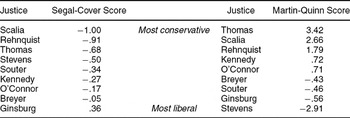
Appendix B: Results Using Segal-Cover Measure for Justices’ Ideological Preferences
MCMC Estimates of Three-Level Random Coefficient Model, Free Expression Cases, 1953–1998 (Using Segal-Cover Scores)

N = 4,985 (choices); J = 570 (cases); T = 45 (years).
MCMC Estimates of Jurisprudential Variables, Pre-Grayned and Post-Grayned

Appendix C: Illustration of Accounting for Year-Level Unobserved Heterogeneity in the Propensity of Liberal Outcomes
The dashed series in Figure C1 plots the Bayesian estimates of the level 3 residuals from the random intercept portion of the model. The solid curve is a lowess-smoothed plot used to ascertain the overall pattern of movement. Overall, the graph shows how the multilevel model, via the random intercept specification, accounts for unobserved variation in the propensity of a liberal vote that could result from, among other things, membership change. These residuals represent unobserved year-level heterogeneity in the propensity of a liberal vote. The “0” line in the graph represents the expected value of the level 3 residual. Deviations above the “0” line represent years where the Court was more liberal compared to the global mean, whereas deviations below the “0” line represent more conservative years. The graph is intuitive and shows how, for instance, portions of the later Warren Court (in the 1960s) were more liberal than average, and portions of the later Burger and Rehnquist Courts became more conservative.
Bayesian Estimates of Level 3 Residuals from the Random Intercept

Appendix D: Details on Model Estimation
Maximum likelihood estimation of multilevel models with a binary response requires integrating out the random effect(s) to acquire the unconditional distribution of the outcome. This requires either numerical integration using quadrature-based methods or Monte Carlo integration (see Skrondal and Rabe-Hesketh Reference Skrondal and Rabe-Hesketh2004). Other procedures, such as penalized quasilikelihood (PQL) and marginal quasilikelihood (MQL), can produce biased estimates of the variance components for binary response models (see Rodriguez and Goldman Reference Rodriguez and Goldman1995, Reference Rodriguez and Goldman2001). Numerical integration becomes more computationally demanding as the number of random effects increases. In a three-level model with four random effects as I have specified in this article, quadrature-based ML becomes unfeasible. Markov Chain Monte Carlo (MCMC) avoids numerical integration of multidimensional integrals inherent in multilevel models with random effects by relying on the Monte Carlo principle: we can learn anything about a random variable, Y, by sampling many times from the probability distribution that generated Y. MCMC applies this principle to a joint posterior distribution, treating the parameters as random variables. The joint posterior is the joint distribution of the unknown parameters conditional on the known “data.” To approximate the joint posterior, the Gibbs sampler samples iteratively from the full conditional distributions derived from the joint posterior (see Gelman, Carlin, Stern, and Rubin Reference Gelman, Carlin, Stern and Rubin2003; Gill Reference Gill2002, 311–16; Rodriguez and Goldman Reference Rodriguez and Goldman2001, 342–43). As the number of simulations increases, the process approaches the “target” distribution (i.e., the joint posterior). One can then simply summarize the posterior for a given parameter by communicating the mean, standard deviation, and certain percentiles of the posterior draws.
Convergence was assessed by first specifying three parallel Markov chains. In setting the initial values for each chain, the first set was from a reduced random intercept logit model and the other two sets of start values specified the upper and lower bounds, respectively, of the 95% confidence interval for each coefficient. I experimented with other start values for the three-chain model and used various start values for two-chain models as well, employing suggestions from Congdon (Reference Congdon2003), and the results are highly stable across all specifications. Next, I relied on the Gelman and Rubin (Reference Gelman, Rubin and Bernardo1992) test (see also Congdon Reference Congdon2003; Gelman, Carlin, Stern, and Rubin Reference Gelman, Carlin, Stern and Rubin2003), which requires monitoring the potential scale reduction (R) that taps differences between the 3 chains, for all parameters. Convergence is achieved when R is very close to 1 for all parameters of interest. When R is close to 1, it indicates that the chains are overlapping and the Gibbs sampler is approaching the target distribution.
For a comprehensive overview of Bayesian data analysis using MCMC, see, e.g., Gelman, Carlin, Stern, and Rubin (Reference Gelman, Carlin, Stern and Rubin2003), Gill (Reference Gill2002), and Congdon (Reference Congdon2003).
Appendix E: MCMC Results from Table 1, Including the Case Facts (Control) Variables
MCMC Results from Table 1 Including the Case Facts Variables

N = 4,985 (choices); J = 570 (cases); T = 45 (years)
Deviance information criterion (DIC) 3,412.0
Pooling factor, level 2 random intercept .29
Pooling factor, level 3 random intercept .80
Pooling factor, level 2 random coefficient .49
Pooling factor, level 3 random coefficient .42
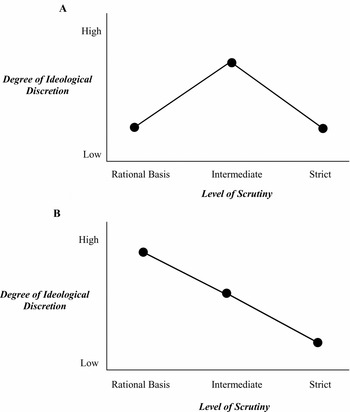
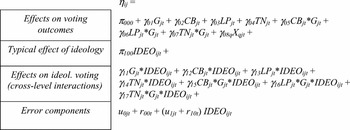
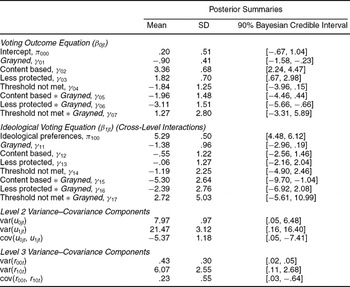
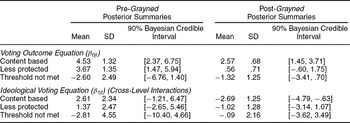
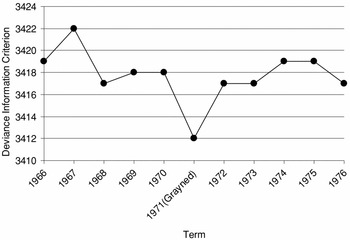
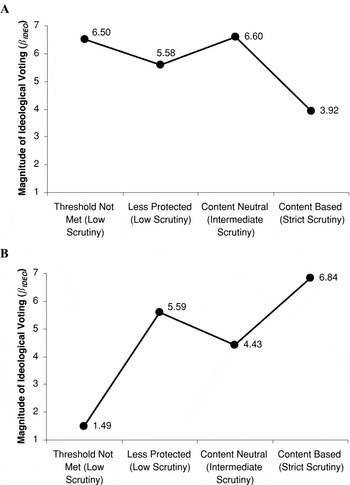
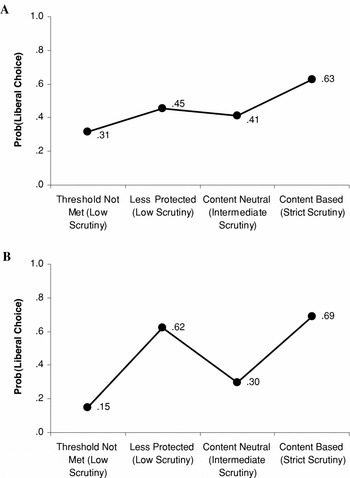
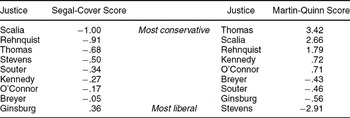
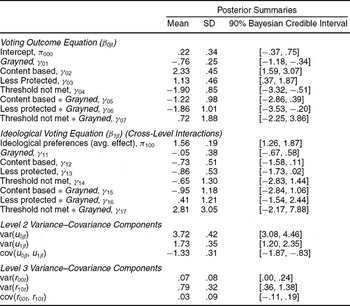
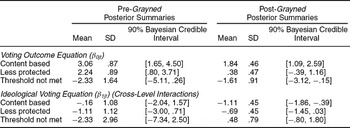
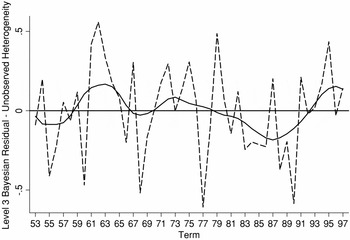
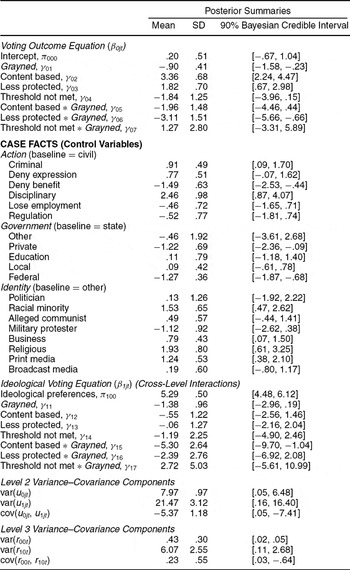



Comments
No Comments have been published for this article.