Implications
This study addresses the estimation of genetic parameters of four indicator traits of parasite resistance in a commercial population of dairy sheep. The phenotypes studied, which included two faecal egg counts (LFEC0 and LFEC1) and two serum indicator traits, the anti-Teladorsagia circumcincta fourth stage larvae IgA and the pepsinogen levels, were measured in adult ewes. This study represents the first step to implement genetic selection for parasite resistance in the Churra breed. The results presented herein could have very important implications through the reduction in the use of anthelmintic treatments and the production of safer sheep products.
Introduction
Internal parasite infections pose a major health problem to domestic livestock worldwide (Perry et al., Reference Perry, Randolph, McDermott, Sones and Thornton2002), particularly in those animals reared in the grazing livestock systems. In sheep, gastrointestinal nematode (GIN) parasites cause important economic losses. The direct losses are because of the control of the infection, veterinary care and the death of the severely affected animals. Additionally, there are indirect losses due to a reduction in performance (Nieuwhof and Bishop, Reference Nieuwhof and Bishop2005), which is in many cases caused by the subclinical effects of the infections. Several studies have shown that subclinical diseases can result in a reduction in live weight (Coop et al., Reference Coop, Graham, Jackson, Wright and Angus1985; Mackay et al., Reference Mackay, Betteridge, Devantier, Budding and Niezen1998), wool weight (Donald, Reference Donald1979) and milk production (Leyva et al., Reference Leyva, Henderson and Sykes1982; Thomas and Ali, Reference Thomas and Ali1983).
Traditional chemical control of GIN parasites with anthelmintics has led to the widespread development of anthelmintic resistance by most of the prevalent nematode parasites of small ruminants (Waller, Reference Waller1997). Furthermore, the possible presence of chemical residues in the products derived from animals treated with anthelmintics is an important issue from a public health point of view. Therefore, strategies to develop the sustainable control of GIN parasites should be implemented now, which in the long term could lead to a reduction in the use of anthelmintic compounds. Among the proposed alternative strategies, the selection of sheep with enhanced resistance to GIN parasites has been suggested by many authors (Woolaston and Baker, Reference Woolaston and Baker1996; Gray, Reference Gray1997; Sayers and Sweeney, Reference Sayers and Sweeney2005). This was based on evidence acquired over the last several decades demonstrating that a significant proportion of the variation in sheep resistance to internal parasites is genetically determined (reviewed by Raadsma et al., Reference Raadsma, Gray and Woolaston1997). The number of parasite eggs in the faeces, the faecal egg count (FEC), is the most widely used as an indicator trait regarding GIN parasite resistance. The heritability estimates reported in the literature for the FEC show a wide range of variation, from 0.0 to 0.55, as reviewed by Raadsma et al. (Reference Raadsma, Gray and Woolaston1997) depending on different factors, such as the population studied (e.g. sheep breed or animal age) or the nature of the parasite challenge (e.g. natural or artificial infection). Most of the estimations of genetic parameters for sheep resistance to GIN parasites have been carried out in sheep populations specialised for meat and/or wool production and managed under grazing-extensive production systems (Bishop et al., Reference Bishop, Jackson, Coop and Stear2004; Morris et al., Reference Morris, Bisset, Vlassoff, West and Wheeler2004), and the animals studied in most of the cases were lambs.
In this study, we studied indicators of parasite resistance in a commercial population of the Spanish Churra sheep breed, an autochthonous dairy breed from the region of Castilla y León, where the traditional breeding system is based on indigenous grazing breeds. The Churra breed is one of the most adapted breeds to the prevailing climatic conditions of the region, grazing most of the year. Despite the low worm burden of pastures during the dry season, Churra breeders use anthelmintic treatment to control infections. However, Strongylid nematode parasites are known to cause substantial production losses in Churra sheep flocks because of a subclinical infection and a reduction of general immune responses even when the infections are mild (Rojo-Vázquez, Reference Rojo-Vázquez2004). In addition, the infection of young females turned out to pasture for the first time may lead to clinical signs of disease, such as diarrhoea and even death (Rojo-Vázquez, Reference Rojo-Vázquez2004). With the aim of minimising the use of anthelmintics in the future that are required to control parasite infections in Churra sheep, this work examined the study of the genetic control of GIN parasite infection in this sheep breed. Using a commercial population of Churra sheep flocks exposed to natural infection, we identified the environmental factors that have a significant influence on parasite resistance traits and estimated the proportion of the variation of GIN parasite resistance that is under genetic control in this breed.
Material and methods
Sampled animals and measurements
The sampling period began in October 1999 and lasted until September 2003; 1545 records from 928 ewes, which belonged to 104 half-sib families, were collected from 5 different flocks. The average number of daughters per ram was 8.92, ranging between 3 and 127. The flocks were genetically connected through the use the artificial insemination (AI). Hence, 27 out of the 104 sires included in the study belonged to the AI program established by the National Association of Spanish Churra Sheep Breeders and contributed to the study with a high number of daughters. Fourteen of these sires had offspring in the five studied flocks. Three generations were used when calculating the genetic parameters.
At the beginning of the experiment (F0 day), the animals were de-wormed and faecal samples were taken to obtain the initial faecal egg count (FEC0). On the basis of information from the farmers, the possible existence of anthelmintic resistance and the degree of basal infection were formally assessed for each flock. Therefore, the de-worming protocol (type of drug and dosage) was specifically designed for each flock. Approximately 2 months after this day (F60 day), faecal and blood samples were collected from the same animals. These samples were processed to obtain the FEC at day 60 (FEC1), the serum IgA (IgA) and the blood pepsinogen (Peps) levels.
Owing to management, lambing dates and weather conditions, the interval-sampling period (ID0−D+60) showed some deviation from the originally planned 60 days (range 42 to 124 days, mean 73 days; s.d. = 22.3). During the 2 months of the experiment, the animals were managed under standard practices in commercial Churra dairy sheep populations, which included daily grazing. Therefore, the animals were exposed to natural parasite infections during the course of the study.
Faecal analysis. The number of eggs per gram – (epg) of faeces is a measure of eggs produced by female parasites within the host animal and is thought to be a good indicator of the parasite infection status of the host (Stear et al., Reference Stear, Bairden, Duncan, Gettinby, McKellar, Murray and Wallace1995). A modified McMaster technique using zinc sulphate (d = 1.33) was used to determine the number of nematode epg with a sensitivity of 15 epg. Bulked faecal samples were taken and cultured for estimation and identification of the nematode genera present following the Ministry of Agriculture, Food and Fisheries (MAFF) identification keys (Ministry of Agriculture, Food and Fisheries, 1986). The minimum number of sampled animals per flock was 30. Eggs from different parasite groups were identified as Strongylid nematode parasites, Nematodirus spp., Moniezia spp., Trichuris spp., Dicrocoelium dentriticum, Fasciola hepática, and oocysts from Eimeria spp. A new variable, the total FEC, was generated as follows:

This formula takes into account the lower prolificacy of the Nematodirus genera (5%) when compared with other strongyles such as Teladorsagia (55%), based on the observations reported by Kates (Reference Kates1947).
Bulk faecal cultures for each sampling were carried out. Third stage larvae (LIII) were identified by morphological characteristics following the keys from MAFF (Stear and Bishop, Reference Stear and Bishop1999). The Teladorsagia LIII percentage in the coproculture was registered as a possible factor in the model (TEL).
Serum analysis. Blood samples were obtained by venipuncture in the jugular vein. Serum was stored at −80°C until processing. An immunological trait indicator, the serum anti-Teladorsagia circumcincta LIV IgA level (IgA), was determined in an ELISA based on the technique described by Martínez-Valladares et al. (Reference Martínez-Valladares, Vara-Del Río, Cruz-Rojo and Rojo-Vázquez2005a).
The serum Peps level, which is an indicator of gastric damage associated with the progression of larvae to the adult stage (Murray et al., Reference Murray, Jennings and Armour1970), was measured by fluorometric determination in a 96-well microtitre plate using the adapted technique from Edwards et al. (Reference Edwards, Jepson and Wood1960).
Data analysis
Before further analysis, the distributions of the data were assessed. The distribution values for FEC0 and FEC1 were positively skewed and were transformed using a logarithm transformation (L FEC0 = ln (FEC0 + 1); L FEC1 = ln (FEC1 + 1)), which resulted in more symmetrical distributions for these traits. The IgA and Peps data did not require any transformation.
To assess the variables influencing the parasite resistance-related traits, the following mixed model was fitted to the data by means of an analysis of variance (ANOVA) performed through the MIXED procedure using the Statistic Analysis System programme, SAS package (SAS User’s Guide, 1998). Data were fitted to the following general model:

where Yijklmn is a dependent variable measured for each of the analysed traits (FEC0, FEC1, IgA and Peps), μ represents the population mean, Fi is the fixed effect of the flock i (five levels), Mj represents effect of sampling month j (eight levels), LNk is the fixed effect of the lambing number k (six levels), PhSl represents the fixed effect of the physiological status based on the number of days between parturition and sampling (four levels: pregnant, peripartum, dairy and dry-non pregnant), Sirem is the random effect of the sire m, and eijklmn is the residual effect. In addition, the number of days between the first and the second sampling (sampling interval, ID0−D+60) was considered as a covariate for LFEC1.
Phenotypic correlations were calculated with the CORR procedure of the SAS package (SAS User’s Guide, 1998). Genetic parameters and their standard errors were estimated using the restricted maximum likelihood estimation on the basis of analytical gradients (AG-REML) procedure (Neumaier and Groeneveld, Reference Neumaier and Groeneveld1998) and the VCE package rel. 4.2 (Groeneveld, Reference Groeneveld1998). In the univariate analysis of each trait, data were gathered according to the different levels of the main environmental variables demonstrating a significant influence (P < 0.05) on the parasite resistance-related trait under study in the initial ANOVA. The influence of the flock and month fixed factors was taken into account as the flock-year-season of the sampling factor, which had 17 levels. Each year was divided into three conventional seasons, January to March, April to June and July to December, according to previous studies in Churra sheep (de la Fuente et al., Reference de la Fuente, Baro and San Primitivo1995). All known pedigree relationships between individuals were considered in the model. Data of the four dependent variables under study, FEC0, FEC1, IgA and Peps, were analysed with the following multitrait repeatability animal model:

where Yijkl is the dependent variable, μ is the population mean, FYSi is the fixed effect of flock-year-season i, LNj is the fixed effect of lambing number j, Ak is the additive genetic random effect of the individual k, PEk is the permanent environmental random effect on the individual k and eijkl is the random residual effect. For LFEC1, the sampling interval ID0−D+60 was also considered in the calculation of genetic parameters as a covariate. It is important to note that the effect of the physiological status, PhS, caused a large distortion when it was introduced in the model fitted with VCE. For this reason this factor was not included in the animal model used for the calculation of the genetic parameters.
Results
Summary statistics
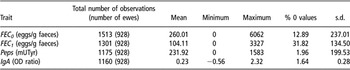
The mean, maximum and minimum values as well as the standard deviation for all the traits investigated are shown in Table 1. Note that in order to simplify the interpretation of data, the basic statistics shown for LFEC0 and LFEC1 are based on the raw untransformed data. These data refer to total egg counts in which the most prevalent genera encountered was Teladorsagia (65.5%), followed by Trichostrongylus spp. (30.5%), Nematodirus spp. (3.1%) and some less frequent genera (1% Chabertia spp. and Oesophagostomum spp.). The initial egg count, FEC0, showed higher faecal counts than LFEC1, with mean values of 260.01 and 104.11 epg, respectively.
Descriptive statistics of phenotypes related to parasite resistance analysed in this study

Peps = pepsinogen; OD = optical density.
The total number of observations analysed, mean, range, percentage of 0 values and s.d. are given for each studied trait.
Note: FEC0 and FEC1 are presented as untransformed values and refer to the total number of eggs (all genera of parasites).
Influence of environmental factors
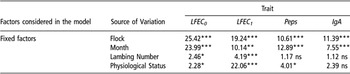
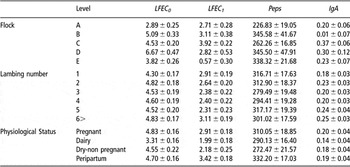
The results of the ANOVA are summarised in Table 2. Least square means calculated for three of the fixed factors included in the ANOVA analysis of the different traits (flock, physiological status and lambing number), are provided in Table 3. LFEC0 was mainly affected by month (P < 0.001) and flock (P < 0.001), with a lower influence of the lambing number (P < 0.05) and the physiological status of the ewe (P < 0.05).
Statistical significance results from the variance analysis performed for the four parasite resistance traits analysed in this study

Peps = pepsinogen; ns = non-significant.
Statistical significance of F-values: ***P < 0.001; **P < 0.01; *P < 0.05; ns P > 0.05.
The statistical significance (F-value) of the fixed effects included in the model are given for all variables studied.
Least square means obtained for the fixed effects included in the model of the variance component analysis performed for the parasite resistance traits examined in this study

Peps = pepsinogen.
LFEC1 was also affected by all the factors considered in the general model. The sampling interval (ID0−D+60), which was only included in the analysis of LFEC1, contributed significantly (P < 0.001) to the variation of this trait.
Peps and IgA were found to be significantly affected (P < 0.001) by flock and month, with the physiological status showing only a moderate influence on the Peps level (P < 0.05).
Lambing number had a significant influence on both the FECs but did not influence the Peps and IgA levels. The highest LFEC0 and LFEC1 were found in the older ewes (lambing number ⩾ 6) (Table 3). LFEC1 appeared to be the most influenced trait by the ewe’s physiological status, with the animals at the peripartum period showing the highest FEC for this trait. This physiological status showed also the highest Peps level, although the influence on this trait, and also on LFEC0, was less significant (P < 0.05).
Phenotypic and genetic parameters
The heritabilities and proportions of permanent environmental variance (c 2) estimated for the parasite resistance traits examined with the AG-REML analysis are given in the Table 4 (diagonal). The estimated heritabilities ranged from 0.09 to 0.21. The serum traits IgA and Peps had higher heritability estimates than the FEC traits. The heritabilities for LFEC0 and LFEC1 were low-to-moderate, displaying slightly higher values for LFEC0 than for LFEC1 (0.12 and 0.09, respectively). This might be explained by the higher percentage of 0 values for LFEC1 (31.8%) compared to those obtained for LFEC0 (12.9%). Peps and IgA appeared to be moderately heritable, with estimates of 0.21 and 0.19, respectively. The proportions of permanent environmental variance calculated ranged from 0.02 (for LFEC1) to 0.27 (for LFEC0). For the serum traits this parameter showed values of 0.04 for Peps and 0.09 for IgA.
Genetic and phenotypic parameters calculated for the parasite resistance traits examined in this study

Peps = pepsinogen.
Heritabilities (on the diagonal) and genotypic (above the diagonal) and phenotypic (below the diagonal) correlations between the parasite resistance traits studied in the present work. The proportions of permanent environmental variance (c 2) are also given in the diagonal (in italics and between brackets). The correlations found to be significantly different from 0, according their standard errors, are shown in bold.
The genetic and phenotypic correlations between the four parasite resistance traits are also provided in Table 4. The correlations that were significantly different from 0, according to their standard errors, are shown in bold. Both phenotypic and genetic correlations between LFEC0 and Peps and LFEC1 and IgA were not found to be significantly different from 0.
Considering the significance estimates, phenotypic correlations appeared to be weak, with values in the range of 0.07 to 0.10. Three out of the four significant phenotypic correlations showed positive signs, with only a negative environmental correlation, between LFEC1 and Peps (−0.11).
For all the cases, the genetic correlations were higher than the phenotypic counterparts, although they showed similar patterns and signs to those observed for the phenotypic traits. The significant estimates for the genetic correlations ranged from 0.43 between Peps and IgA to 0.82 between LFEC0 and LFEC1. A high negative genetic correlation was found between Peps and LFEC1 (−0.51), whereas IgA showed positive and moderately high genetic correlations with LFEC0 and Peps (0.45 and 0.43, respectively).
Discussion
In this study, we identified the environmental factors influencing parasite resistance in a commercial population of adult Churra sheep under natural infection and quantified the genetic component of this complex trait. As indicators of parasite resistance, we measured FECs, the plasma IgA concentration and the serum Peps level. These traits are likely to represent different aspects related to the host-parasite interactions during infection.
The phenotypic traits measured in this study are influenced by both environmental and genetic factors. The flock and sampling month were the external factors significantly influencing all the studied traits. This reflects the importance of the management given provided to the sheep, including management practices and protein content level in the diet (Martínez-Valladares et al., Reference Martínez-Valladares, Vara-del Río, Cruz-Rojo and Rojo-Vázquez2005b), and the influence of the season as a factor directly controlling parasite development, especially in continental climates where hypobiosis phenomena are frequent (Almería et al., Reference Almería, Llorente and Uriarte1996).
Other factors, such as age and the physiological status of the ewe, significantly influenced several of the traits studied. In our model, the age of the ewe is considered within the lambing number factor, which also takes into account the productivity stress accumulated during the animal’s lifetime. Our analysis indicated that older ewes had a tendency to have higher FECs (the highest for LFEC1 and the second highest one for LFEC0) indicating that, even without suffering obvious production loses, the animals may show a hypersensitivity reaction to the incoming larvae. The lack of a significant influence of lambing number on the IgA level suggests that the host’s ability to recognise parasite-specific antigens and develop an IgA response to control the infection appeared to be independent of the age of the animal. This observation seems reasonable considering that we only analysed adult ewes; therefore, all the animals became immunocompetent several months before the initiation of this experiment. According to Stear et al. (Reference Stear, Strain and Bishop1999c), the immunity of sheep against T. circumcincta develops in two stages. Young animals control worm growth and fecundity by producing parasite-specific antibodies. Subsequently, as the animals get older, they control worm numbers through the acquisition of effective immune responses that reduce the number of worms, possibly through immediate hypersensitivity reactions against incoming third-stage larvae (Stear et al., Reference Stear, Strain and Bishop1999c). Also the Peps levels appeared to be independent of the animal’s age.
In accordance with other studies, we have observed higher FECs in the periparturient (LFEC1) and pregnant ewes (LFEC0), which has been suggested to be the result of a periparturient breakdown of immunity because of prioritised nutrient allocation to reproductive functions rather than to immune functions (Houdijk et al., Reference Houdijk, Kyriazakis, Jackson, Huntley and Coop2003) and a failure of pregnant ewes to expel the resulting adult worms (Gibbs and Barger, Reference Gibbs and Barger1986). Jeffcoate et al. (Reference Jeffcoate, Fishwick, Bairden, Armour and Holmes1990) observed an increase in the plasma IgA level in periparturient ewes when IgA is transported from the gut to milk during early lactation, leading to a temporary reduction in the abomasal antibody level of ewes. This would permit the establishment and development of inhibited larvae, leading to a periparturient rise in the FEC. However, we did not observe a significant effect of the physiological status of the ewe on the serum Peps and IgA levels.
As expected, the FEC measured on day 60 of the experiment (LFEC1) was influenced by the sampling interval (ID0−D+60) and showed significantly positive correlation (phenotypic and genetic) with the initial egg count (LFEC0), which is an indicator of pasture contamination before LFEC1 sampling. It should be taken into account that at the beginning of the experiment, when FEC0 was measured, the experimental conditions (e.g. last anthelmintic treatment and correct administration of drugs) were not totally controlled. This may explain some of the differences regarding the significance level of the effects of some of the factors considered in the model, for example, the larger significance of the lambing number and the physiological status on the second egg count than on the initial egg count. The lack of control of the experimental conditions at the time of measuring LFEC0 is also evidenced by the much higher proportion of phenotypic variance because of the permanent environment observed for this trait than that estimated for the traits measured after the sampling interval (ID0−D+60) (Table 4). As expected, the anthelmintic treatment had a drastic effect on reducing the influence of the animal’s permanent environment on the parasite resistance traits measured at D+60.
Regarding the heritabilities estimated in this study, both FECs showed similar but lower values than those generally reported in lambs (Windon, Reference Windon1996; Stear et al., Reference Stear, Bairden, Bishop, Buitkamp, Duncan, Gettinby, McKellar, Park, Parkins, Reid, Strain and Murray1997; Morris et al., Reference Morris, Bisset, Vlassoff, West and Wheeler2004; Davies et al., Reference Davies, Stear, Benothman, Abuagob, Kerr, Mitchell and Bishop2006). Genetic parameters for parasite resistance in adult sheep are poorly described. Interesting results have been reported by Beraldi et al. (Reference Beraldi, McRae, Gratten, Pilkington, Slate, Visscher and Pemberton2007) in a free-living Soay sheep population in which no genetic variation for strongyle FECs and a very low heritability for coccidian faecal oocyst count were detected in adult sheep. The same authors reported moderate heritability estimates for the same traits measured in lambs (0.22 to 0.26), which are in the range of other authors’ estimates for the same trait in young animals. The lower heritabilities estimated for the FECs in adult Churra and Soay sheep when compared to lambs may be due to the differences in the immune mechanisms controlling the infection in young and adult animals, as we previously commented. Therefore, it is possible that the control of worm number by adult sheep, mediated through immediate hypersensitivity reactions, has genetic components that are not well represented by the classic indicator traits used to measure resistance in lambs, in which the major manifestation of resistance is the control of worm growth and worm fecundity through the production of antibodies (Stear et al., Reference Stear, Strain and Bishop1999b). In this regard, it seems interesting that the heritability estimates of FECs in lambs reported by Davies et al. (Reference Davies, Stear, Benothman, Abuagob, Kerr, Mitchell and Bishop2006) decreased slightly as animals grew, with heritability estimates for FEC at 4, 5 and 6 months, being 0.30, 0.21 and 0.19, respectively.
The relatively short interval between the initial anthelmintic treatment and the measurement of LFEC1 may not have been enough to guarantee an equal infection level in all the animals. This fact might explain the slightly higher heritability estimated for LFEC0 (0.12) v. that estimated for LFEC1 (0.09). As the animals were subjected to natural uncontrolled exposure to parasite infection after the initial anthelmintic treatment, it is likely that at the time of the LFEC1 measurement, several ewes had not been infected at all. Furthermore, for those that had been infected during the sampling interval, the parasites would still be in a pre-adult stage. Taking this into account, we believe that LFEC0 could be considered an indicator of general parasite resistance in this population, even when the experimental conditions were not completely controlled at the beginning of the experiment, whereas the traits measured on D+60 are likely to be better indicators of initial immune responses triggered by larvae at the beginning of the infection.
The serum traits (Peps and IgA) showed higher heritability than the FECs. The heritability of IgA reached a medium value, which is consistent with that reported in Scottish blackface lambs by Davies et al. (Reference Davies, Stear, Benothman, Abuagob, Kerr, Mitchell and Bishop2006). The highest heritability was that estimated for Peps (0.21), although it was markedly lower than that estimated by Davies (Reference Davies2004) for the same trait in Scottish blackface lambs (0.56). The higher heritability estimated for Peps and IgA compared to the FECs should be considered when selecting traits to be included in a breeding program. However, these results should be considered cautiously because of the limited control of the experimental conditions at the beginning of the study and the relatively short sampling interval between both FECs.
This study has allowed us to quantify the relationships between the parasitic, immunological and biopathological indicator traits studied at the genetic and phenotypic levels. The negative correlation observed between LFEC1 and Peps (rp = −10; rg = −0.51) supports the hypothesis that at D+60, most of the infestations were due to pre-adult, non-egg laying parasites. In a previous study carried out in adult Churra sheep, Martínez-Valladares et al. (Reference Martínez-Valladares, Vara-Del Río, Cruz-Rojo and Rojo-Vázquez2005a) observed a negative phenotypic correlation between the number of T. circumcincta eggs in the faeces and both the number of LIV and the concentration of plasma Peps, whereas a positive correlation was found between the number of LIV and the plasma Peps level. It seems, therefore, that in adult Churra sheep, the principal damage in GIN infections is due to the LIV stage. This is supported by the kinetics of the plasma Peps level observed in infections of Churra sheep, which reached their maximum around day 90 post-infection. In contrast, the maximum faecal egg excretion was observed approximately 150 to 160 days post-infection (J. Pérez, unpublished observations).
In lambs, several authors have reported negative genetic and environmental correlations between the FECs and the IgA level (Stear et al., Reference Stear, Bairden, Bishop, Buitkamp, Duncan, Gettinby, McKellar, Park, Parkins, Reid, Strain and Murray1997; Stear et al., Reference Stear, Bairden, McKeller, Scott, Strain and Bishop1999a and Reference Stear, Strain and Bishop1999b), which is in agreement with the role of IgA as a factor regulating the female parasite fecundity and inhibiting the adult parasite development. In our study, the plasma IgA level was not significantly correlated with the FEC measured on the same day (FEC1), which supports the hypothesis proposed by Stear et al. (Reference Stear, Strain and Bishop1999c).
It is also mentioning that Churra sheep is an autochthonous breed, well-adapted to the climatic and geographical conditions of the Castilla y León region. This breed is highly resistant to the effects of clinical infection and is able to maintain performance during GIN infection, which could be considered as resilience. In this regard, we calculated the genetic correlation between the parasite resistance traits studied here and milk yield (data not shown). The genetic correlations with milk traits were all negative and low (range: −0.08 to −0.18), but none were significant because of the large standard errors observed. The phenotypic correlations were even weaker, and only one, between Peps and milk yield, was negative. Therefore, our data suggest that adult Churra sheep show resilience against GIN parasite infection. If this is confirmed, further studies should be carried out in Churra sheep to better understand the immune and genetic mechanisms underlying this interesting feature. However, these results should be taken with caution, as this experiment was not specifically designed to evaluate the effect of parasite infection on milk production.
In summary, this study demonstrated the presence of heritable variation in parasite resistance indicator traits in the Churra population studied. This suggests that genetic improvement could be possible for this complex feature in this population. However, further studies in which the experimental variables are controlled as much as possible are needed to identify the best traits for routine measurement of adult sheep to use as an indicator of parasite resistance.