Introduction
Little is known about the effects of aging on the manifestations of bipolar disorder. Episodes typically accumulate with the passage of years and studies that were partly or wholly retrospective in their assessments have described decreases in inter-episode durations across successive episodes (Angst et al. Reference Angst, Baastrup, Grof, Hippius, Poldinger and Weis1973; Kukopulos et al. Reference Kukopulos, Reginaldi, Laddomada, Floris, Serra and Tondo1980; Zis et al. Reference Zis, Grof, Webster and Goodwin1980; Roy-Byrne et al. Reference Roy-Byrne, Post, Uhde, Porcu and Davis1985). Prospective studies, however, have found little evidence of this (Turvey et al. Reference Turvey, Coryell, Arndt, Solomon, Leon, Endicott, Mueller, Keller and Akiskal1999; Angst et al. Reference Angst, Gamma, Sellaro, Lavori and Zhang2003), suggesting that the apparent increases in episode frequency described in previous studies may have reflected the poorer recall of earlier episodes.
The symptoms of bipolar illness may also undergo qualitative changes with age. Either pole may grow more prominent, and such changes, if they occur, may differ in men and women. Moreover, studies have not as yet addressed the effects of age on overall symptom burden, the product of episode duration and frequency.
Nearly all efforts to study the possible effects of aging on bipolar disorders have compared cohorts grouped by current age. This, however, confounds age-of-onset effects with those of an individual's current age and many reports have associated earlier age at onset with poorer outcomes (Carlson et al. Reference Carlson, Bromet and Sievers2000, Reference Carlson, Bromet, Driessens, Mojtabai and Schwartz2002; Tohen et al. Reference Tohen, Hennen, Zarate, Baldessarini, Strakowski, Stoll, Faedda, Suppes, Gebre-Medhin and Cohen2000; McElroy et al. Reference McElroy, Altshuler, Suppes, Keck, Frye, Denicoff, Nolen, Kupka, Leverich, Rochussen, Rush and Post2001; Carter et al. Reference Carter, Mundo, Parikh and Kennedy2003; Ernst & Goldberg, Reference Ernst and Goldberg2004). Attempts to statistically control for age-of-onset effects are necessarily limited by the fact that youthful subjects with the illness have only early ages of onset.
Circumvention of this problem requires within-subject comparisons across age periods, and this, of course, requires a long period of observation. Frequent follow-up assessments are also necessary because bipolar disorder is typically episodic and widely spaced assessments are unlikely to capture symptom evolution adequately over time. Finally, transitions across several age periods should be examined to determine whether any observed changes in course apply only to a particular age period.
The National Institute of Mental Health (NIMH) Collaborative Depression Study (CDS) has followed a large cohort of individuals with mood disorders for over 20 years with assessments at semi-annual, and then annual, intervals. The observation period is now sufficient to address the above questions.
Method
Subjects
Between 1978 and 1981, inclusive, investigators at five academic centers recruited in-patients and out-patients who met research diagnostic criteria (RDC; Spitzer et al. Reference Spitzer, Endicott and Robins1978) for major depression, mania or schizo-affective disorder. Inclusion criteria specified that all participants were ⩾18 years of age, knowledgeable of their biological parents, English speaking, and Caucasian.
The following report is limited to subjects who completed at least 20 years of follow-up and who, before intake or at any time during follow-up, met RDC for mania, hypomania or schizo-affective disorder, manic type, other than the mainly schizophrenic subtype. In the RDC, the mainly schizophrenic subtype of schizo-affective disorder is equivalent to DSM-IV schizo-affective disorder but the remainder of RDC schizo-affective cases nearly all meet criteria for DSM-IV major depression or manic disorder with mood-incongruent psychotic features.
Procedures
After subjects had provided informed consent, carefully trained, professional raters used the Schedule for Affective Disorders and Schizophrenia (SADS; Endicott & Spitzer, Reference Endicott and Spitzer1978) to establish current and lifetime diagnoses. The SADS ratings on which these were based integrated information from subject interview, medical record review, and informants when available. The SADS included a Global Assessment Scale (GAS), a 100-point rating that integrates symptom severity with impairment in functioning.
Raters conducted follow-up assessments semi-annually for the first 5 years and then annually. The Longitudinal Instrument for Follow-up Evaluation (LIFE; Keller et al. Reference Keller, Lavori, Friedman, Nielsen, Endicott, McDonald-Scott and Andreasen1987) and later variants, the LIFE-II and Streamlined Longitudinal Interval Continuation Evaluation (SLICE), were used to record follow-up information from direct interviews and from medical record review. These instruments used psychiatric symptom ratings (PSRs) to track all RDC syndromes that had been active at intake or that developed during follow-up. Interviewers helped subjects to identify points at which symptom levels had changed and then quantified the levels present between those points. For major depression, manic disorder, schizo-affective depression and schizo-affective mania these levels were assigned scores of 1 to 6. A score of 1 indicated no symptoms, 2 indicated the presence or one to two symptoms to a mild degree, 5 indicated full syndrome and 6 a relatively severe, full syndrome. Scores of 3 and 4 indicated the continued presence of an episode with less than the number of symptoms necessary for an initial diagnosis. The end of an episode required 8 consecutive weeks of PSR ratings ⩽2 and a new episode required that the subject again met criteria for definite major depression, mania or schizo-affective disorder.
Data analytic procedures
Age at intake was used to assign subjects a priori into youngest (18–29 years), middle (30–44 years) and oldest (>44 years) groups. We used the proportion of weeks and episodes (symptom persistence) to quantify symptom activity over time and grouped the follow-up weeks into 5-year periods. To test for evidence that depressive and manic/hypomanic symptoms showed differing patterns of change over time, we conducted analyses separately for depression and manic/hypomanic poles. Subjects were deemed in an episode of depression if PSR ratings for major depression or schizo-affective depression exceeded 2 and were, likewise, considered to be in episodes of mania or hypomania if PSR ratings for mania, schizo-affective mania or hypomania exceeded 2.
An ANOVA was first used to determine whether the three age groups differed in symptom persistence across the entire 20 years of follow-up. An SPSS (version 16.0.2; SPSS Inc., USA) repeated-measures general linear model (GLM) procedure then tested for significant within-subject changes across the four follow-up periods, first with all age groups combined, and then for each age group separately.
Analyses next determined whether the age of onset, the age at which the subject first met criteria for a major depressive, schizo-affective or manic episode, predicted changes across follow-up periods in symptom persistence, first with the age groups combined and then in each group separately. The relative importance of age at intake and age at onset was assessed in a logistic regression on system persistence over the entire 20 years. Because the distribution of symptom persistence values varied over time and across groups, we also examined the proportion of subjects who had episodes for >50% of the weeks in each 5-year period. McNamar's tests were used to compare the first and last follow-up periods by the proportions of subjects with that level of symptom persistence. We then assessed the degree with which symptom persistence in each 5-year period predicted persistence in subsequent periods, and whether these relationships varied by age group. All of the above procedures were repeated for the percentage of time in manic or hypomanic episodes. Spearman tests were used for all correlations. All statistical tests used a two-tailed α and no correction was made for multiple testing.
Results
Baseline status
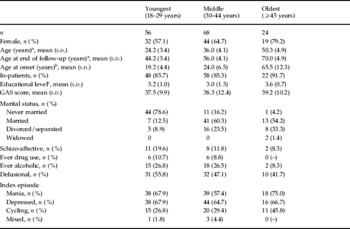
The three age groups did not differ by sex, severity as measured by the Global Assessment Scale (GAS) at intake, proportions with schizo-affective disorder, or the presence of co-morbid alcohol or drug dependence (Table 1). As expected, the three age groups differed significantly in having progressively later ages of onset.
Status at intake by age grouping

GAS, Global Assessment Scale; s.d., standard deviation.
a F=373.8, p=0.000.
b F=43.9, p=0.000.
c χ2=76.5, df=6, p=0.000.
Depressive symptoms
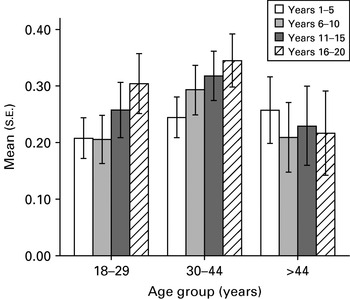
The youngest, middle and oldest groups were in depressive episodes for means (s.d.) of 24.4 (30.0), 30.0 (29.2) and 22.8% (29.2%) of weeks respectively over the entire 20 years of follow-up (F=0.812, df=2/145, p=0.446). With age groups combined, GLM analyses showed an increasing persistence of depressive symptoms across the four 5-year periods (F=7.1, p=0.008). This pattern appeared in the youngest (F=4.9, p=0.031) and middle (F=4.4, p=0.040) age groups but not in the oldest (F=0.24, p=0.626) (Fig. 1).
Proportion of weeks in depressive episodes (error bars±1.0 s.e.).

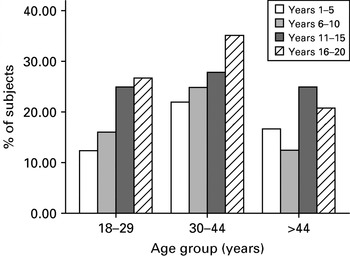
A depiction of the proportion of subjects in depressive episodes for >50% of the weeks in each 5-year period showed steady increases in the youngest and middle age groups (Fig. 2). The likelihood of being depressed for the majority of weeks increased from the first to the last follow-up period by 53.4, 37.4 and 19.7% in the youngest, middle and oldest groups respectively. McNamar's tests showed the increase to be significant for the overall sample (p=0.002) and for the youngest (p=0.039) and middle (p=0.049) age groups.
Percentage of subjects in depressive episodes for majority of weeks.

Sex did not predict symptom change with the age groups combined (F=0.006, p=0.939), nor in any of the three groups when these were tested separately. Likewise, sex was not significantly associated with persistence across the entire 10-year follow-up.
When added to the GLM model, neither age of onset nor age at intake predicted changes in depressive symptom persistence over the 20 years of follow-up. When baseline age and age of onset were entered as independent variables in a linear regression analysis on symptom persistence over 20 years, however, a positive trend was noted for baseline age (t=1.77, p=0.079) and a strong negative relationship emerged for age of onset (t=−2.68, p=0.008). Symptom persistence was negatively, though not significantly, related to age at onset in the youngest (t=−1.50, p=0.140), middle (t=−1.64, p=0.105) and oldest (t=−1.12, p=0.276) groups whereas the relationship with age at onset was consistently positive but not significant (t=0.164, p=0.87; t=0.90, p=3.72; t=0.129, p=0.899 respectively).
A receiver operating characteristics (ROC) analysis to indicate the age of onset that best identified subjects who would be in episodes for more than half of the follow-up period failed to reach significance (area under curve=0.426, s.e.=0.062, p=0.203).
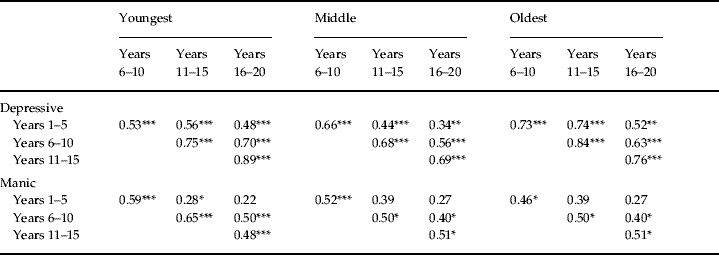
Within-subject correlations in depressive symptom persistence across follow-up periods were highly significant (Table 2) and were similar in the three age groups. The means (s.d.) of all interval correlations for the youngest, middle and oldest groups were 0.652 (0.156), 0.562 (0.144) and 0.703 (0.112) respectively (F=1.60, df=2/15, p=0.234). Correlations decreased across wider follow-up intervals: the mean (s.d.) correlation for contiguous 5-year periods was 0.726 (0.105), but only 0.605 (0.109) for intervals separated by 5 years and 0.447 (0.094) for intervals separated by 10 years (F=8.43, df=2/15, p=0.004).
Relationships between subsequent follow-up periods in percentage time in episodes

Spearman correlation:
* p<0.05, ** p<0.01, *** p<0.001.
Manic/hypomanic symptoms
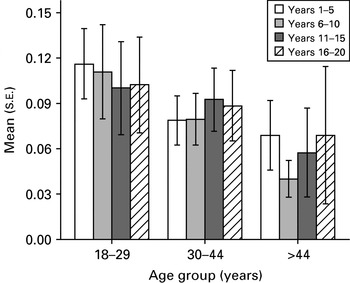
A trend was observed towards a decreasing persistence of manic/hypomanic symptoms across the three age groups, but inter-individual variation was high and group differences were not significant: mean (s.d.) values for the youngest, middle and oldest groups were 10.8 (18.1), 8.5 (10.5) and 5.9% (10.4%) respectively (F=0.805, df=2/227, p=0.448). There was no tendency for the proportion of weeks in manic/hypomanic episodes to increase or decrease across the four 5-year periods either for all age groups combined or within any of the three age groups (Fig. 3). Neither age at study entry (t=−0.701, p=0.484) nor age at onset (t=−0.487, p=0.627) was associated with total percentage time in manic or hypomanic episodes when both variables were entered in a logistic regression model.
Percentage of time in manic/hypomanic episodes (error bars±1.0 s.e.).

Within-subject correlations in manic/hypomanic symptoms remained significant across follow-up intervals and, as with depressive symptoms, decreased as interval length increased from contiguous periods (mean=0.61, s.d.=0.26), to intervals of 5 years (mean=0.29, s.d.=0.18) and to intervals of 10 years (mean=0.11, s.d.=0.13) (F=7.5, df=2/15, p=0.006). The means (s.d.) of all interval correlations did not differ significantly across age groups. For the youngest, middle and oldest group, they were 0.58 (0.26), 0.25 (0.18) and 0.43 (0.34) respectively (F=2.38, df=2/15, p=0.126).
The mean correlations and symptom persistence across follow-up periods was significantly higher for depressive symptoms (0.64, s.d.=0.14) than for manic/hypomanic symptoms (0.44, s.d.=0.12) (t=7.42, df=17.0, p=0.000). This was also true for each age group individually.
Discussion
Twenty years of annual assessments revealed substantial increases in the proportion of weeks spent in depressive episodes and corresponding increases in the likelihood of symptom chronicity, as follow-up progressed, patterns that held for the two age groups younger than 45 years at the study's beginning but not for the oldest group. Earlier age of onset was strongly associated with total time depressed through 20 years of follow-up and this relationship persisted across the three age groups. However, no clear age-of-onset threshold was apparent below which the likelihood of subsequent chronicity increased markedly. Manic and hypomanic symptom persistence showed no clear change over time and was not affected by age at onset.
These findings indicate that the poorer outcomes associated with early ages of onset in previous studies (Carlson et al. Reference Carlson, Bromet and Sievers2000, Reference Carlson, Bromet, Driessens, Mojtabai and Schwartz2002; Tohen et al. Reference Tohen, Hennen, Zarate, Baldessarini, Strakowski, Stoll, Faedda, Suppes, Gebre-Medhin and Cohen2000; McElroy et al. Reference McElroy, Altshuler, Suppes, Keck, Frye, Denicoff, Nolen, Kupka, Leverich, Rochussen, Rush and Post2001; Carter et al. Reference Carter, Mundo, Parikh and Kennedy2003; Ernst & Goldberg, Reference Ernst and Goldberg2004) were not due to the effects of current age. An early age at onset, rather than youth itself, seems to portend higher levels of depressive morbidity, an effect that does not lessen over several decades. Yet, age at onset did not predict a worsening in symptom persistence. Rather, increases in depressive morbidity occurred in the youngest and middle age groups regardless of age at onset. This suggests that either the passage of time or the cumulative effects of active illness, but not the process of growing old, leads to increased depressive morbidity.
The group that was ⩾45 years at the beginning of follow-up did not experience the increases in depressive morbidity seen in the two younger groups. We had no a priori prediction that changes in symptom persistence over time would apply to only some age groups. This group was also the smallest and had only begun to enter the age range typically considered geriatric. The follow-up of this sample is continuing and it is, of course, aging. Future analyses will determine whether the manifestations of bipolar disorder truly change as individuals enter this important period.
The higher symptom persistence associated with an early age of onset and also the tendency to worsen over time were seen with depressive symptoms but not with manic/hypomanic symptoms. Thus, the poorer prognosis experienced by individuals with early onset illness is driven by depressive morbidity and, regardless of age at onset, morbidity tends to be increasingly dominated by depressive symptoms as time passes.
The within-subject correlations between both depressive and manic/hypomanic symptom persistence remain significant over long periods and suggest that the proportion of time spent in either phase is a quality of an individual's lifelong illness that declares itself early. However, the observation that these correlations decrease with longer intervals suggests that individuals also pass through periods characterized by symptom persistence that is higher or lower than at other periods of their lives.
The significantly greater correlations in depressive symptom persistence across time periods that we noted in the oldest group of the CDS unipolar cohort (Coryell et al. Reference Coryell, Solomon, Leon, Fiedorowicz, Schettler, Judd and Kellerin press) were absent here. Total correlations for the middle and oldest unipolar groups were 0.51 (0.13) and 0.66 (0.10) respectively and were not dissimilar from the corresponding figures for depressive symptoms described here for the bipolar group, 0.56 (0.14) and 0.70 (0.11). Correlations for the youngest unipolar and bipolar groups were 0.44 (0.15) and 0.65 (0.16) respectively (t=2.38, df=10, p=0.99). We had no a priori hypothesis regarding these patterns and their implications are limited pending replication. A tentative interpretation is that the high rate of life events that characterizes early adulthood may shape the course of unipolar depression more than bipolar disorder.
In summary, these data provide evidence that, in adult bipolar illness, depressive symptoms become more persistent over decades in younger adults whereas manic and hypomanic symptoms do not, and that an early age of onset predicts higher long-term depressive morbidity but not a deteriorating course. The degree to which either manic or depressive symptoms persist in a 5-year period seems to be a stable characteristic of an individual, although this stability lessens over time.
Declaration of Interest
None.