Congenital tracheal stenosis (CTS) is a rare and potentially life-threatening disease that often leads to severe respiratory failure in children. It is characterised by narrowing the tracheal tract due to the presence of the complete tracheal cartilage rings and the absence of the membranous portion of the trachea. The population-based incidence of CTS is approximately 1 in 64,500 live births. Reference Herrera, Caldarone and Forte1 Recently, slide tracheoplasty has become the standard surgical procedure for long-segment CTS in children and infants. Advances in surgical techniques and perioperative management have improved the prognosis resulting in a survival rate of 88–95%. Reference Butler, Speggiorin and Rijnberg2–Reference Yokoi, Hasegawa and Oshima7
Vocal cord paralysis (VCP) following recurrent laryngeal nerve injury is a well-known complication in cardiovascular surgery. After congenital heart surgery, depending on the type of surgery performed, the reported incidence of VCP has varied between 5 and 59%. Reference Lee, Millar and Rose8–Reference Ambrose, Ongkasuwan and Dedhia12 This included a reversible VCP with a total recovery rate of 77–79% within 1 year after surgery. Reference Pourmoghadam, DeCampli and Ruzmetov10,Reference Raut, Maheshwari and Joshi13 However, aspiration and pneumonia have been closely related to VCP in children with incidences of 34–47% Reference Richter, Ongkasuwan and Ocampo14–Reference Raulston, Smood and Moellinger16 and 14%, Reference Tibbetts, Wu, Hsu, Burton, Nassar and Tan15 respectively. Swallowing difficulties increases the risk of more extended hospital stays in patients with VCP, Reference Richter, Ongkasuwan and Ocampo14 resulting in poor prognosis after surgery.
Although VCP can occur following slide tracheoplasty for CTS, Reference Hewitt, Butler, Maughan and Elliott3,Reference Hofferberth, Watters, Rahbar and Fynn-Thompson6 the incidence and risk factors of VCP following slide tracheoplasty remain unclear. The previous studies Reference Hewitt, Butler, Maughan and Elliott3,Reference Hofferberth, Watters, Rahbar and Fynn-Thompson6 included other surgical techniques in addition to slide tracheoplasty for CTS, which had not performed an assessment for VCP in all patients with symptoms of VCP. This study aimed to review our experience of slide tracheoplasty in CTS with a focus on post-operative VCP.
Materials and methods
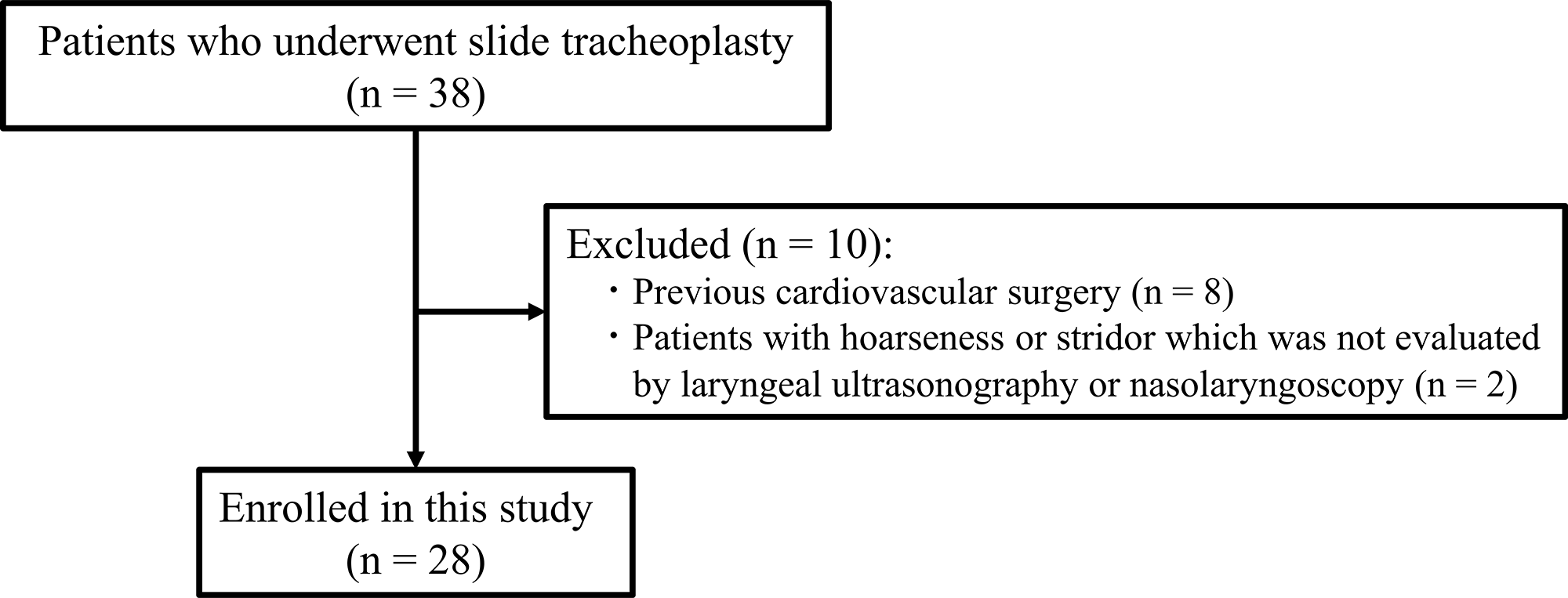
A total of 38 patients with CTS underwent the slide tracheoplasty at Kobe Children’s Hospital between June, 2016 and March, 2020. The exclusion criteria were as follows: history of cardiovascular surgery and lack of laryngeal ultrasonography or nasolaryngoscopy data for post-operative symptoms such as hoarseness or stridor. Thus, 28 patients were enrolled in the present study (Fig 1). We retrospectively reviewed the clinical medical records and databases that included the patients’ data from admission until their discharge or transfer to another hospital. This study was performed with the approval of the Institutional Review Board (registration No. R31-7). The need for individual consent was waived, and we provided an opportunity to opt out as described on the hospital homepage.
Flow chart of study participants.

Operative procedure
The slide tracheoplasty was performed through a standard median sternotomy with a transverse neck incision under extracorporeal cardiorespiratory support. Briefly, the stenotic segment was circumferentially dissected and transversely divided at the midpoint. The proximal and distal segments were incised at the posterior and anterior midlines, respectively. After both ends were trimmed to face each other and slide together to provide a large calibre lumen, an end-to-end anastomosis around the entire oblique circumference was achieved. Concomitant repairs for cardiovascular abnormalities were conducted before slide tracheoplasty.
Post-operative management
The patients were sedated and immobilised for 3 days using neuromuscular blockade, then weaned from mechanical ventilation with planned extubation on approximately post-operative day 7.
Assessment of vocal cord paralysis
Vocal cord movement was assessed by laryngeal ultrasonography, nasolaryngoscopy, or both when patients had clinical symptoms such as hoarseness or stridor after the extubation. Bedside laryngeal ultrasonography was performed using the LOGIQ e Premium Ultrasound System (GE Healthcare, Tokyo, Japan) by two paediatric intensivists. Nasolaryngoscopy was performed using a video nasopharyngeal scope system DEFINA, a nasopharyngeal scope VNL-90s, and a video processor EPK-3000 (PENTAX® Medical, Tokyo, Japan) by two otolaryngologists. VCP was diagnosed when the unilateral or bilateral vocal cord was fixed completely (complete VCP) or incompletely (partial VCP) during respiration for patients with symptoms.
Management of vocal cord paralysis
Dysphagia rehabilitation was performed, and nasogastric tube feeding was used to avoid aspiration until the vocal cord function recovered post-operatively.
Statistical analysis
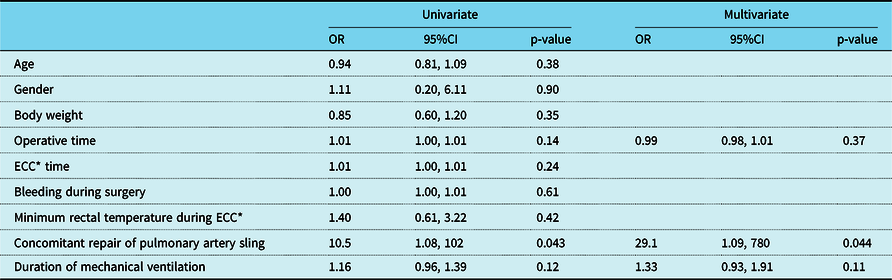
Data were presented as medians with interquartile ranges for continuous variables and as proportions for categorical variables. Continuous and categorical variables in the two groups were compared using the Fisher’s exact tests or the Mann–Whitney U-tests, as appropriate. Univariate and multivariate logistic regression analyses were performed to evaluate risk factors for VCP, in which odds ratios with 95% confidence intervals were reported. The multivariable logistic regression analyses were performed for the significant variables (p < 0.20) in the univariate analysis. Differences were considered statistically significant at p < 0.05. All the statistical analyses were performed using EZR, version 2.3-0 (Saitama Medical Center, Jichi Medical University, Saitama, Japan), a user interface for R (The R Foundation for Statistical Computing, Vienna, Austria).
Results
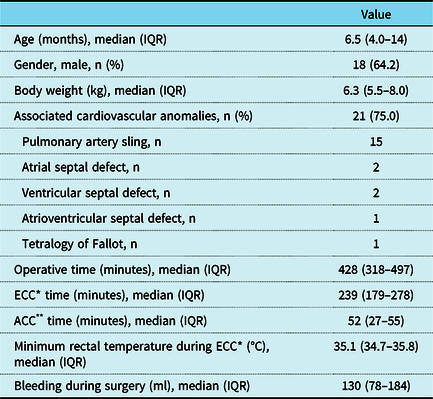
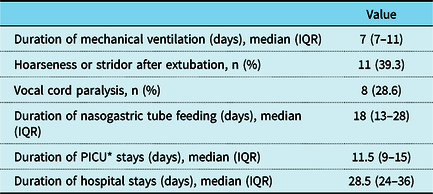
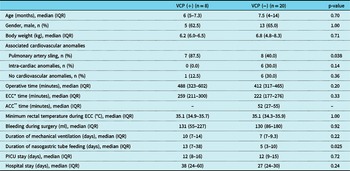
The patient characteristics and operative data are summarised in Table 1. The median patient age was 6.5 months, and the median body weight was 6.3 kg. None of the patients in this study had any clinical symptoms of VCP preoperatively. Of the 28 patients, 21 patients had associated with cardiovascular anomalies: pulmonary artery sling (PA sling) in 15, atrial septal defect (ASD) in 2, ventricular septal defect (VSD) in 2, Atrioventricular septal defect (AVSD) in 1, and tetralogy of Fallot (TOF) in 1. All of these 21 patients underwent a simultaneous repair of CTS and cardiovascular anomalies. The post-operative outcomes are summarised in Table 2. Eleven patients had clinical symptoms such as hoarseness or stridor after extubation. Of these patients, eight patients presented with VCP on laryngeal ultrasonography, nasolaryngoscopy, or both. All of them had left-sided VCP unilaterally (complete VCP in four and partial VCP in four). The overall incidence of VCP following the slide tracheoplasty was 28.6% (8 out of 28 patients). The causes of hoarseness or stridor in the remaining three patients who did not have VCP were subglottic oedema in one, laryngeal oedema in one, and laryngomalacia in one. Of those eight patients with VCP, seven patients underwent a concomitant repair of PA sling, and one patient had an isolated CTS repair without a concomitant repair of cardiovascular anomalies. No patients who underwent a concomitant repair of ASD, VSD, AVSD, or TOF had a post-operative VCP. In the 15 patients with CTS and PA sling, the incidence of VCP following the simultaneous repair was as high as 46.7% (7 out of 15 patients). In the seven patients without cardiovascular anomalies, the incidence of VCP following the simultaneous repair was 14.3% (one out of seven patients). We compared patient characteristics, operative data, and post-operative outcomes in patients with and without VCP after slide tracheoplasty (Table 3). Patients with VCP had a significantly greater associated PA sling than those without VCP (87.5 versus 40.0%, p = 0.0038). No patient with VCP underwent a simultaneous repair of CTS and the intracardiac anomalies such as ASD, VSD, AVSD, or TOF. The only risk factor for VCP following the slide tracheoplasty was the concomitant repair of PA sling in both the univariate and multivariate analyses (Table 4). There were no statistically significant differences in mechanical ventilation duration, PICU length of stay, and hospital length of stay. However, the nasogastric tube feeding duration in patients with VCP was significantly longer than in patients without VCP (p = 0.0248).
Patient characteristics and operative data

* ECC = extracorporeal cardiorespiratory
** ACC = aortic cross-clamping
Post-operative outcomes

* PICU = paediatrics intensive care unit
Comparison of patients with and without vocal cord paralysis after slide tracheoplasty

* ECC = extracorporeal cardiorespiratory
** ACC = aortic cross-clamping
Univariate and multivariate analyses of risk factors associated with vocal cord paralysis after slide tracheoplasty

* ECC: extracorporeal cardiorespiratory
Discussion
To the best of our knowledge, this study was the first to assess VCP following a slide tracheoplasty for CTS directly. In all the cases, the incidence of VCP following the slide tracheoplasty was 28.6%, including the concomitant repair for associated cardiovascular anomalies. The incidences of VCP were 46.7% in patients with CTS and PA sling, which were 14.3% in CTS patients without cardiovascular anomalies. The only risk factor associated with VCP following slide tracheoplasty was the concomitant repair for PA sling.
Vocal cord movement is controlled by recurrent laryngeal nerves, which pass under the aortic arch on the left side and around the subclavian artery on the right side before returning to the larynx. Reference Amer17 VCP is the immobilisation of the vocal fold caused by an impaired function of the recurrent laryngeal nerve. This is usually a consequence of an injury to the nerve fibres along their tract, which can be caused by various factors such as stretch, heat, electrocautery, compression, inadvertent transection, and compromise of the vascular supply. Reference Lawlor, Zendejas, Baird, Munoz-San Julian, Jennings and Choi18
VCP is reported to be one of the post-operative complications experienced after surgery for CTS. Hofferberth et al Reference Hofferberth, Watters, Rahbar and Fynn-Thompson6 showed that 3 out of 30 patients (10.0%) had a recurrent laryngeal nerve injury after CTS repair, while Hewitt’s and Stewart’s studies indicated only 3 out of 127 patients (2.4%) Reference Hewitt, Butler, Maughan and Elliott3 and 2 out of 43 patients (4.7%) Reference Stewart, Butler and Muthialu19 with post-operative recurrent laryngeal nerve palsy, respectively. However, Hewitt’s and Stewart’s research has not been fully assessed and described the incidence and risk factors of VCP following slide tracheoplasty for CTS. The former included other CTS repairs in addition to slide tracheoplasty, and the latter under-reported the prevalence of VCP because an assessment for VCP was not performed in all patients with symptoms of VCP. The present study demonstrated that the overall incidence of VCP following slide tracheoplasty was 28.6%, which depended on the PA sling. The incidence of VCP was 46.7% in patients with a concomitant repair of PA sling. The univariate and multivariate analyses in the present study demonstrated that following slide tracheoplasty, the concomitant repair of PA sling was the only risk factor of VCP.
PA sling is a vascular anomaly wherein the left PA originates from the posterior aspect of the right PA, which passes leftward around the right main bronchus and distal trachea. It is often associated with CTS (the so-called ring-sling complex), with an incidence reported of about 50–65% of CTS cases. Reference Harada, Shimojima and Shimotakahara20 In the present study, CTS was complicated by PA sling at a rate of 53.6%, which is similar to the results of previous reports. Patients with PA sling undergo reimplantation of the aberrant left PA to the main PA to relieve extrinsic airway compression. Reference Binsalamah, Thomason and Ibarra21 When performing a left PA reimplantation, extensive dissection and tissue mobilisation around the left PA and ligamentum arteriosum (ductus arteriosus) is required. Inevitably, retraction and compression are placed on the loop of the left recurrent laryngeal nerve for access to the left PA. The nerve is also in proximity and, when using electrocautery, can be injured from the associated heat during the tissue mobilisation. These left PA reimplantation processes may contribute to the recurrence of the recurrent laryngeal nerve palsy during the simultaneous repair of CTS and PA sling.
Feeding and swallowing difficulties have been closely related to VCP after paediatric cardiac surgery, Reference Sachdeva, Hussain and Moss22 contributing to an increased length of hospitalisation with high morbidity and poor prognosis after surgery due to tube feeding. Reference Richter, Ongkasuwan and Ocampo14,Reference Dewan, Cephus, Owczarzak and Ocampo23 In the present study, VCP was associated with a significantly longer duration of nasogastric tube feeding, although there was no statistically significant difference in hospital length of stay. To improve the post-operative outcome in patients with VCP following slide tracheoplasty, we emphasise the importance of conducting an early assessment of vocal cords after extubation to detect and characterise any vocal cord dysfunction in these patients. The gold standard for evaluating vocal cord function is a direct flexible laryngoscopy. Feeding and swallowing difficulties are evaluated by video-assisted swallow study and modified barium swallow study. Reference Raulston, Smood and Moellinger16 Recently, bedside laryngeal ultrasonography has been used as an initial assessment tool for post-operative vocal cord function in the paediatric ICU. Reference Hamadah and Kabbani24,Reference Hasegawa, Masui and Kurosawa25 It helps establish an early diagnosis, which can help us plan an appropriate management strategy. Furthermore, a speech–language pathologist should perform a formal feeding evaluation and rehabilitation once the diagnosis of VCP has been made. These can lead to positive post-operative effects such as decreased morbidity and a shortening of hospitalisation.
There are some limitations to this study. First, the study was a single-centre retrospective cohort study that included relatively small sample sizes that could have lacked the power to detect significant differences in the outcomes and comparisons between them. Second, not all patients performed a pre- and post-operative evaluation for VCP and swallowed difficulty using laryngeal ultrasonography or nasolaryngoscopy in this study. It remains a possibility of insufficient evaluation in patients with asymptomatic vocal cord paralysis. Third, exclusion criteria of the study population cause likely case ascertainment bias about risks for vocal cord dysfunction. Finally, intraoperative recurrent laryngeal nerve monitoring Reference Lawlor, Zendejas, Baird, Munoz-San Julian, Jennings and Choi18 was not performed during surgery. Paediatric recurrent laryngeal nerve monitoring may help decrease the rate of vocal cord paralysis following slide tracheoplasty.
Conclusions
The present study revealed that the incidence of VCP following slide tracheoplasty for CTS was high, especially in concomitant repair of PA sling, which was the only risk factor for VCP. Post-operatively, the duration of nasogastric tube feeding in patients with VCP was significantly longer than in patients without VCP. For the appropriate management, routine screening and evaluation of VCP should be encouraged soon after post-operative extubation, particularly in the presence of clinical symptoms of VCP. Additional multicentre data concerning VCP following tracheoplasty are required for further evaluation.
Acknowledgements
None.
Financial support
This research received no specific grant from any funding agency, commercial, or not-for-profit sectors.
Conflicts of interest
None.
Ethical standards
The authors assert that all procedures contributing to this work comply with the ethical standards required by Swedish laws on experimental research involving humans, and with the Helsinki Declaration of 1975, as revised in 2008. The present study has also been approved by the Institutional Review Board at Hyogo Prefectural Kobe Children’s Hospital.