I. INTRODUCTION
Titanium dioxide (TiO2) is widely recognized as an important ceramic material owing to its high chemical stability and ability as a white pigment, catalyst support, capacitor, and photocatalyst. Among titania polymorphs, anatase, rutile, and brookite exist in nature. In both industry and the laboratory, these three polymorphs have been paid attention as the main research targets, because they can be easily synthesized compared to other polymorphs such as hollandite and ramsdellite-type TiO2, which do not exist in nature. It has been well-known that each polymorph of titania shows different chemical and physical properties, e.g., band gaps of anatase and brookite are nearly equal each other to 3.2 eV and that of rutile is 3.0 eV. Reference Chen and Mao1 Therefore, establishment of a reliable method to enable the selective synthesis of TiO2 polymorphs is of vital importance.
At solution method, it has been argued that the selective synthesis of the three polymorphs of TiO2 can be performed in terms of control of titanium species' structures in a solution. Reference Cheng, Ma, Zhao and Qi2–Reference Yin, Hasegawa, Maeda, Ishitsuka and Sato12 Usually, titanium atom exists as a six-coordinated polyhedron in a solution, denoted as TiX6−n Y n . Reference Testino, Renato Bellobono, Buscaglia, Canevali, D’Arienzo, Polizzi, Scotti and Morazzoni10,Reference Henry, Jolivet and Livage13 When titanium atom is coordinated by many hydroxy groups in a given solution, the titanium octahedra, TiX6−n (OH) n , give rise to more frequent instances of edge sharing through oxolation between OH groups. This case may bring a result in the formation of TiO6 octahedra with a more edge-shared structure, i.e., the preferable formation of anatase Reference Yin, Hasegawa, Maeda, Ishitsuka and Sato12 ; because a TiO6 octahedron has a four-edge shared structure by another TiO6 in the anatase structure, rutile is consisted of a two-edge shared and two-corner shared polyhedra and brookite has three-edge shared and one-corner shared polyhedra. On the other hand, TiX6−n (OH) n with less OH groups leads to the formation of rutile. Considering the numbers of edge sharing (anatase: 4, rutile: 2, and brookite: 3) and of corner sharing (anatase: 0, rutile: 2, and brookite: 1), brookite-type TiO2 may be formed under a certain intermediated experimental condition between the established experimental conditions where anatase- and rutile-type TiO2 form. Nevertheless, in many cases, a mixture of anatase and rutile is the main product under such intermediate experimental conditions. Reference Reyes-Coronado, Rodrígues-Gattorno, Espinosa-Pesqueira, Cab, de Coss and Oskam11,Reference Gao, Luo, Mizusugi and Nagai14–Reference Li, Ishigaki and Sun16 Therefore, a further research for interpretation of the mechanism of the selective synthesis of the three TiO2 polymorphs is worthwhile to be performed.
The synthesis of brookite-type TiO2 was successfully accomplished by several limited research groups, and various mechanisms for formation of brookite as well as anatase and rutile in solutions have been proposed from author to author. Reference Kominami, Kohno and Kera17–Reference Gateshki, Yin, Ren and Petkovi19 However, among the various mechanisms, none of them was able to explain comprehensively how the three polymorphs form in a solution. One possible reason why no universal mechanism of formation was established may be responsible for the diversity of the synthesis procedures, which lead to the large ambiguity of chemical species of titanium present in solutions. To establish the formation mechanism, it is extremely valuable to develop a much simpler synthesis procedure. So far, we have found that a hydrothermal treatment of a series of water-soluble titanium complexes without any additives produced single-phase anatase, rutile, and brookite-type TiO2. Reference Morishima, Kobayashi, Petrykin, Yin, Sato, Kakihana and Tomita20–Reference Kakihana, Kobayashi, Tomita and Petrykin24 The procedure using titanium complexes is rather facile compared with other methods from a viewpoint of the fact that neither pH adjusters nor postheat-treatments are necessary to obtain a single-phase TiO2. The results have stimulated us to make further efforts toward elucidating the selective synthesis mechanism of the three polymorphs using water-soluble titanium complexes. Moreover, a precise examination of the experimental condition may lead to the discovery of the crucial factor controlling the formation of titanium polymorphs including other crystalline structures.
In this work, we have developed new water-soluble titanium complexes coordinated by hydroxycarboxylic acids or ethylenediaminetetraacetic acid (H4edta) derivatives and examined the effects of ligand on the selective formation of titania polymorphs by hydrothermal treatment of the complexes. We have found that the complex structure might be one of the important factors for the selective synthesis of TiO2 polymorphs.
II. EXPERIMENTAL
A. Materials
Titanium metal powder (98.0%, Wako Pure Chemical, Osaka, Japan), and aqueous solutions of H2O2 (30.0%, Santoku Chemical, Tokyo, Japan) and NH3 (28.0–30.0%, Kanto Chemical, Tokyo, Japan) were used as received. DL-2-hydroxybutxyric acid (95.0%, Tokyo Kasei Industry, Tokyo, Japan), DL-glyceric acid (40.0% in water, Tokyo Kasei Industry), DL-leucic acid (98.0%, Tokyo Kasei Industry), (±)-mandelic acid (99.0%, Wako Pure Chemistry), and quinic acid (98.0%, Tokyo Kasei Industry) were used as a possible ligand without further purification. Candidates for possible ligand in H4edta derivatives are as follows; 1,3-propylenediaminetertaacetic acid (1,3-H4pdta), 1,2-propylenediaminetertaacetic acid (1,2-H4pdta), and trans-1,2-cyclohexylenedinitrotetraacetic acid (H4Cydta), which have different alkyl groups between two nitrogen atoms (N–R–N) from H4edta were chosen. N-(2-hydroxyethyl)ethylenediaminetriacetic acid (EtOH-H3edta) in which one acetic acid group in H4edta substituted with an ethanol was used. Others were monoamine. Nitrilotriacetic acid (H3nta), N-(2-hydroxyethyl)iminodiacetic acid (EtOH-H2ida), N, N-bis(2-hydroxyethyl)glycine ((EtOH)2-gly), triethanolamine (TEA), and trimethylamine (TMA) were chosen as a possible ligand.
B. Preparation of a water-soluble titanium complex
Titanium metal powder (5 mmol) was dissolved in a mixture of 20 cm3 of hydrogen peroxide and 5 cm3 of ammonium solutions without stirring in a water bath. After a couple of hours, titanium was completely dissolved with the formation of a yellow peroxotitanate complex. Each ligand (5–50 mmol) was added and dissolved in the prepared aqueous solution. To eliminate an excess amount of hydrogen peroxide and ammonia, the solution was allowed to settle at room temperature overnight and then heated on a hotplate at 353 K until a gel-like substance was formed. To eliminate excess hydrogen peroxide and ammonia completely, distilled water was added and again heated at 353 K. Finally, an aqueous solution containing titanium was obtained after the formed solid was dissolved in water. The Fourier transform infrared (FTIR) spectra of the prepared solutions and aqueous solutions of corresponding ligands without titanium were recorded by the attenuated total reflection method (Jasco FT/IR-4200 equipped with an ATR PRO450-S having a diamond prism, Tokyo, Japan).
C. Synthesis of titanium dioxide
The prepared complex solution was set to 20 cm3 in a Teflon-lined stainless steel vessel [(Ti) = 0.25 mol/dm3] and held at 473 K in an electric oven to perform hydrothermal treatment of the titanium complex. After 24 h, the autoclave was cooled to room temperature, and the formed precipitate was collected by centrifuge. The powder obtained was washed with distilled water using ultrasonication and separated from the supernatant again. This washing was repeated three times and the final sample was obtained after drying at 353 K. X-ray diffraction measurements were performed using a powder diffractometer (Rigaku RINT-2200, Tokyo, Japan) operating with Cu Kα radiation at 40 kV/30 mA in a scanning mode with a step size of 0.02° and a speed of 4° min−1. The identification of the sample phase was carried out using XRD patterns simulated from ICSD#202242 anatase, ICSD#033838 rutile, and ICSD#036408 brookite.
III. RESULTS AND DISCUSSION
A. Preparation of water-soluble titanium complexes
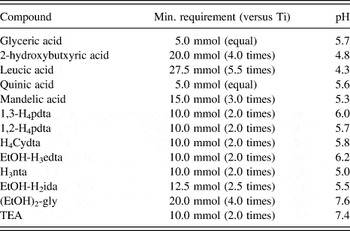
In this work, stable transparent solutions could be obtained using all candidates as ligands except for TMA. The minimum amount of ligands required for the preparation of the stable aqueous solutions, and their pH are summarized in Table I. At least, an equal amount of ligand (glyceric and quinic acids) to titanium was required, and at the maximum, the required amount of the ligand reached 5.5 times to titanium (in the case of leucic acid). Using ligands with appropriate quantities listed in Table I, the aqueous solutions of titanium were neither hydrolyzed nor did it become a colloidal solution for more than six months. Colors of the prepared solutions of titanium were yellow or brown, whereas aqueous solutions of ligands without titanium were colorless. The emergence of the color of titanium solutions may be attributed to the formation of bonding between titanium and the ligand. The pH of the prepared solutions ranged from 4 to 8 depending upon the ligand chosen. These results mean that aqueous solutions containing the titanium complex are preparable using a variety of organic compounds as ligands in a rather wide range of pH; i.e., from a weakly acidic to a weakly basic pH.
The minimum amount of ligands required for preparation of the stable aqueous solutions containing 5 mmol of titanium and their pH.

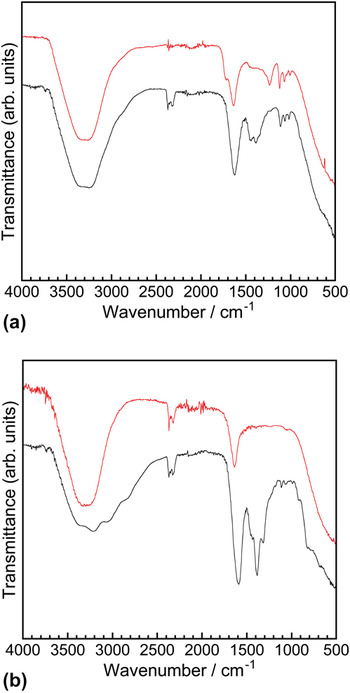
Figure 1 shows representative FTIR spectra of the titanium aqueous solutions prepared using the minimum required amount of ligands and of aqueous solutions of the corresponding ligands without titanium. The other FTIR spectra of the solutions are shown in Figs. S1 and S2. Broad peaks around 1400 cm−1 in spectra of complex solutions were assigned to vibrations involving N–H bonds in a free ammonium ion, Reference Ichinose, Taira, Furuta and Katsuki25 which existed as a counter ion. The presence of NH4 + in turn indicates that the complexes prepared are considered as anions. In the spectra of titanium solutions prepared using hydroxycarboxylic acids or amines having more than two carboxy groups [Figs. 1, S1, and S2(a)–S2(e)], peaks at 1700 cm−1 corresponding to the C=O stretch vibration of the carboxy group were clearly shifted to low wave number compared with those of the corresponding peaks in spectra of solutions containing only ligands. Broad peaks observed between 3000 and 3500 cm−1, which were ascribed to the O–H stretch vibration of the carboxy group, were split into several components [Figs. 1(b), S1(a), S1(d), and S1(e)]. Peaks at around 900 cm−1 were detected in hydroxycarboxylic acid complexes except for glyceric acid, H3nta, and 1,3-H4pdta-titanium complex solutions [Figs. 1(b), S1(a)–S1(d), and S2(d)]. The peaks may have arisen from a peroxo group, Reference Ichinose, Taira, Furuta and Katsuki25,Reference Gao, Masuda, Peng, Tonezawa and Koumoto26 and therefore, titanium is coordinated by at least one peroxo group in those aqueous solutions. The change of the spectra around 1100–1200 cm−1 assigned to the C–O stretch vibrational mode may be due to the change of the bonding strength of C–O in the hydroxyethyl group [Figs. 1(a), S1, S2(c), and S2(e)–S2(g)]. These differences between ligand solutions and the corresponding complex solutions can be caused by the coordination of the functional groups of the ligands to titanium. Though the structures of complexes have not been determined, it is speculated that deprotonated hydroxy and carboxy groups, and the peroxo group from hydrogen peroxide bind to the titanium atom. The color change as mentioned above supported the interaction with titanium and the ligand. The formation of a bond between nitrogen of amine and titanium is possible because the nitrogen has a lone pair. However, no clear evidence for the formation of Ti–N bond could be identified solely from FTIR spectra.
FTIR spectra of the prepared aqueous solutions of titanium complexes (below) and ligands (upper); (a) 1,3-H4pdta, (b) glyceric acid.

B. Synthesis of TiO2 by a hydrothermal treatment of aqueous solutions of titanium complexes coordinated by hydroxycarboxylic acids
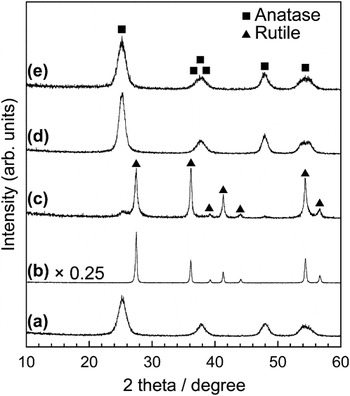
XRD patterns of the samples obtained by the hydrothermal treatment of aqueous solutions of titanium complexes coordinated by hydroxycarboxylic acids are shown in Fig. 2. A single phase of anatase was obtained using glyceric, quinic, and mandelic acids as a ligand [Figs. 2(a), 2(d), and 2(e)], whereas a single phase of rutile was formed from titanium–leucic acid complex. A mixture of anatase and rutile was produced from the aqueous solution of the titanium complex coordinated by 2-hydroxybutyric acid. The result indicates that the selective synthesis of anatase and rutile can be achieved by choosing an appropriate titanium complex. Broadening of peaks corresponding to anatase indicates that the crystallite size of the obtained anatase is smaller than that of rutile. The size difference can be explained in terms of the stability of TiO2 polymorphs as discussed elsewhere. Reference Zhang and Banfield27 In general, anatase is easily formed by hydrothermal treatment of titanium source including commercial reagents. Because rutile is a thermodynamically stable phase among the three polymorphs, it can be said that a heat treatment at a higher temperature is required for the synthesis of rutile when compared with temperatures needed for the synthesis of anatase and brookite. From this point of view, the fact that rutile was formed by the hydrothermal treatment of titanium complexes with leucic and 2-hydroxybutyric acids at the same condition, where a single phase of anatase can be synthesized using the other hydroxycarboxylic acid complexes, is of special interest.
XRD patterns of the powders obtained by the hydrothermal method at 473 K for 24 h using the aqueous solutions of water-soluble titanium complexes coordinated by (a) glyceric acid, (b) 2-hydroxybutyric acid, (c) leucic acid, (d) quinic acid, and (e) mandelic acid.

Rutile 110 and 101 reflections appeared at 2θ = 27.4° and 36.0°, respectively. Usually, the peak intensity ratio of 101 and 110 (I 101/I 110) for isotropic rutile particles is approximately 0.5. On the other hand, the ratio was around 1 at the XRD pattern of the sample obtained by the hydrothermal treatment of the titanium complex coordinated by leucic acid [Fig. 2(c)]. Rutile particles are generally obtained as a rod-like shape and the long side of the particles is parallel to the c-axis of rutile. Reference Chen and Mao1,Reference Lazzeri, Vittadini and Selloni28–Reference Huang and Pan31 If anisotropic growth of c-axis of rutile is proceeded, I 101/I 110 may become larger than 0.5. As shown in Fig. S3, bundles of straw-like particles with a high aspect ratio (80 nm × 3–10 μm) were observed in the sample obtained by the hydrothermal treatment of the titanium-leucic acid complex, whereas the particle shapes of anatase and rutile were typical, i.e., either nanosized or rod-like, for the sample obtained from other titanium complexes as is seen in Figs. S3(c)–S3(f). The particles prepared using the titanium–leucic acid complex seem to grow along the c-axis, and the shape is in good agreement with what is predicted from the XRD pattern. We suppose that the anisotropic growth of rutile is due to the preferential adsorption of leucic acid on certain specific rutile crystal facets, though precise measurements and additional experiments such as theoretical calculation and electron diffraction measurement from various angles are needed to clarify this issue.
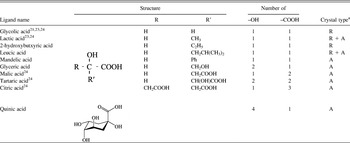
Relationships among ligand structures, the number of hydroxyl and carboxyl groups, and crystal structures of TiO2 obtained by the hydrothermal treatment of titanium complexes are summarized in Table II. Results previously reported in the literature Reference Tomita, Petrykin, Kobayashi, Shiro, Yoshimura and Kakihana21,Reference Kobayashi, Tomita, Petrykin, Yoshimura and Kakihana22,Reference Kakihana, Kobayashi, Tomita and Petrykin24 are also shown. From this table, it can be said that the rutile-type TiO2 is formed from the complexes coordinated by ligands having one hydroxyl and one carboxyl groups. When the hydrothermal treatment of a mandelic acid complex prepared using 4 times mandelic acid to titanium (the minimum required amount is 3 times) was performed, rutile could be obtained accompanied by the formation of anatase as a secondary phase. On the other hand, when aqueous solutions containing the complex coordinated by glyceric or quinic acids, which has more than two carboxy or hydroxy groups, were hydrothermally treated, rutile were not formed, even if the amount of ligands increased. Additionally, rutile was not formed by the hydrothermal treatment of commercially available anatase-type TiO2 (ST-01, Ishihara Sangyo, Osaka, Japan) in an aqueous solution of leucic or 2-hydroxybutxyric acids. This result indicates that the existence of the ligand itself does not directly affect rutile nucleation, but the formation of the titanium complex prepared using the ligand, which has one hydroxy and one carboxy groups, is indispensable to the formation of rutile.
Relationships between the ligand types and the crystal types obtained by the hydrothermal treatment of the corresponding titanium complexes at 473 K for 24 h.

a A: anatase, R: rutile.
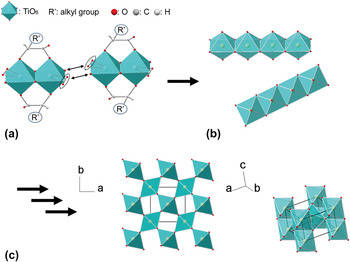
Based on the results mentioned above, we speculated a basic complex structure, which can be used as a starting material for obtaining the rutile-type TiO2, and a formation mechanism (Fig. 3). As shown in Fig. 3(c), rutile consists of a chain-like structure constructed by face-to-face edge sharing of TiO6 polyhedra. According to the partial charge model, Reference Henry, Jolivet and Livage13 rutile formation preferably takes place when a chain structure of polyhedra is formed. Now we suppose the structure of a complex having one edge shared TiO6 units and peroxo group at the opposite site to the shared edge [Fig. 3(a)]. Note that the peroxo group can be easily decomposed by heat treatment. Under a given hydrothermal condition, complexes lose peroxo groups at first. Then the empty site is filled by bonding of another Ti complex, resulting in the formation of a chain-like structure [Fig. 3(b)]. Finally, the chains are arranged into the rutile structure [Fig. 3(c)]. Thought the detailed structures of the complexes still remain unestablished, we believe it is the structure that determines the formation of the rutile phase. Reference Tomita, Petrykin, Kobayashi, Shiro, Yoshimura and Kakihana21,Reference Kakihana, Kobayashi, Tomita and Petrykin24,Reference Kinsinger, Wong, Li, Villalobos and Kisailus32
Possible rutile formation mechanism from the hydrothermal treatment of water-soluble titanium complex.

C. Synthesis of brookite-type TiO2 by a hydrothermal treatment of aqueous solutions of titanium complexes coordinated by amines
Figure 4 shows the XRD patterns of the samples obtained by a hydrothermal treatment of aqueous solutions of titanium–amine complexes at 473 K for 24 h. A mixture of anatase and brookite was obtained from the solutions of the complex prepared using 1,3-H4pdta, 1,2-H4pdta, H4Cydta, EtOH-H3edta, or EtOH-H2ida, although the ratios of anatase and brookite differ from sample to sample [Figs. 4(a)–(d) and 4(f)]. The hydrothermal treatment of the H3nta–titanium complex solution resulted in the formation of anatase with a trace amount of brookite and rutile [Fig. 4(e)]. It should be noticed that in a great majority of amines tested in this study, brookite was formed although the proportion of brookite to anatase/rutile greatly differs. On the other hand, single phase anatase was obtained by the hydrothermal treatment of aqueous solutions of the remaining two complexes prepared using (EtOH)2-gly and TEA [Figs. 4(g) and 4(h)].
XRD patterns of the powders obtained by the hydrothermal method at 473 K for 24 h using the aqueous solutions of water-soluble titanium complexes coordinated by (a) 1,3-H4pdta, (b) 1,2-H4pdta, (c) H4Cydta, (d) EtOH-H3edta, (e) H3nta, (f) EtOH-H2ida, (g) (EtOH)2-gly, or (h) TEA.

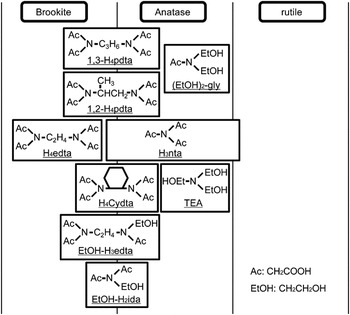
The empirical relationship between the amines used as a ligand and the crystal phases of titania formed by the hydrothermal treatment of the titanium complexes prepared using the corresponding amines at 473 K for 24 h is summarized in Fig. 5. It was confirmed that complexes, which led to the formation of brookite, had a common structure of two acetic acid groups binding to one nitrogen (–NAc2, Ac:CH2COOH). We have reported that single-phase rutile was obtained by the hydrothermal treatment of the peroxoglycolato complex without any additives at 473 K for 24 h. Reference Tomita, Petrykin, Kobayashi, Shiro, Yoshimura and Kakihana21,Reference Kakihana, Kobayashi, Tomita and Petrykin24 Even if the hydrothermal treatment of the aqueous solution of the peroxoglycolato complex in the presence of 1,3-H4pdta or EtOH-H3edta as an additive, which can act as a ligand of brookite formation, was carried out at 473 K for 24 h, brookite was not obtained. Therefore, the formation of the complex coordinated by amine is more important to tailor brookite rather than the existence of amine compounds having the structure of NAc2. Since the synthesis of TiO2 from a solution is achieved by the formation of Ti–O–Ti bonding through hydrolysis and the subsequent condensation between the titanium species, Reference Henry, Jolivet and Livage13,Reference Livage, Henry and Sanchez33 the ligand in a given titanium complex strongly affects the structure of the final product. FTIR measurements implied the interaction of a deprotonated carboxy group with titanium in the solutions. The formation of the complex and its structure might be affected by the lone pair of nitrogen, although there is no evidence of the interaction between titanium and nitrogen from FTIR spectra measurements (Figs. 1 and S2). The precise structures of complexes discussed in this paper have not been elucidated. However, when an amine having the structure of NAc2 is connected to titanium, the framework of brookite may be easily formed by reflecting the structure of the complex. Thus, the tendency for brookite formation is observed using the titanium complex, whose ligand has the –NAc2 group.
Relationship between the ligands and the crystal types obtained by the hydrothermal treatment of the corresponding titanium complexes at 473 K for 24 h.

IV. CONCLUSION
Knowledge about an effect of ligand and complex structure on a selective synthesis of titanium dioxide polymorphs by the hydrothermal method has been accumulated. Thirteen water-soluble titanium complexes coordinated by hydroxycarboxylic acids or amines have been developed. Each aqueous solution of titanium was stable for more than a half year under ambient conditions. Selective synthesis of anatase and rutile was achieved by the hydrothermal treatment of the titanium complexes coordinated by hydroxycarboxylic acids. The formation of complex prepared using hydroxycarboxylic acid having one hydroxy and one carboxy groups seems to be indispensable to the formation of rutile. Brookite could be obtained by the hydrothermal treatment of titanium complexes coordinated by amine having NAc2 group. The bonding of NAc2 to titanium may be attributable to the formation of brookite. Further study on the analysis of complex structures will give us more clear information about the mentioned mechanism.
Supplementary Material
Supplementary materials can be viewed in this issue of the Journal of Materials Research by visiting http://journals.cambridge.org/jmr.
ACKNOWLEDGMENTS
This work was supported in part by a Grant-in-Aid for Scientific Research (Grant No. 22107002) on Innovative Areas of “Fusion Materials: Creative Development of Materials and Exploration of Their Function through Molecular Control” (Grant No. 2206) from the Ministry of Education, Culture, Sports, Science and Technology, Japan (MEXT).