Introduction
Early in 1956, a group of indigenous farmers staged an armed revolt at El Teroque, a Mayo village on the Fuerte River in the Mexican state of Sinaloa. El Teroque was an ejido, one of many communal land parcels that the post-revolutionary Mexican state under President Lázaro Cárdenas granted to poor farmers. These ejidatarios (ejido farmers) enjoyed usufruct property rights so long as they kept the land in cultivation. In 1938, the same year that El Teroque became an ejido, the federal government created a state-backed sugarcane cooperative, the Sociedad de Interés Colectivo Agrícola Ejidal (Agricultural Society of the Collective Ejidal Interest, SICAE). Cárdenas expected to improve economic conditions for the majority of the ejidatarios in the Fuerte Valley by extending SICAE membership to them, but a limited water supply forced the SICAE to accept only about 5,000 members, known as ‘collectivists’. While 120 Mayo farmers from El Teroque joined the collective and gained control of 2,300 hectares of the ejido’s land, the remaining 104 members of the community (also Mayo) were left out, labelled pejoratively as ‘individualists’ and reduced to cultivating a mere 200 unirrigated hectares. Convinced that the government would never address their decades-long complaints, the individualists seized 607 hectares of the collectivist property at El Teroque by armed force.Footnote 1
At stake were not just the 30,000 tons of valuable sugarcane the contested property supported but also, more importantly, the fate of irrigation resources at the ejido. The individualists’ decision to reclaim access to water by force underscores how crucial hydraulic resource control was to indigenous autonomy.Footnote 2 In El Teroque, the SICAE convinced collectivists to annex individualists’ lands and block their irrigation rights, dividing the ejido into opposing camps. El Teroque individualists responded by claiming the SICAE collectivists were not Mayo but rather ‘white’, an indictment of SICAE officials’ initial attempts to help native people and their failure to follow through. Elsewhere in other Mayo ejidos, such as Los Goros, conflict over resources was less profound, but, wherever the SICAE gained control, the Mayo lost their connection to a river central to their subsistence, identity and religious ceremonies.
At El Teroque, Mayo individualists who revolted utilised what I call ‘hydraulic social mobilisation’ – a popular mobilisation to secure water rights – as a strategy to resist state control over communities and preserve local autonomy. This differed from other forms of mobilisation in its opposition to state-enforced irrigation restrictions and in its defence of river access. I draw on numerous archives and oral histories to explore Mayo hydraulic social mobilisation in two Fuerte Valley indigenous ejidos from 1944 to 1956. Attention to the use of water as a mechanism of native Mexican resistance provides a new framework that promises to recover peasant actions and voices. The Mayo oral histories highlighted in this article revise twentieth-century Mexican hydraulic and ethnic histories by demonstrating how indigenous tactics contested and then helped shape state development plans.Footnote 3
The struggle for water defined the history of the arid Fuerte Valley in the twentieth century. The massive Fuerte River runs through the historic homeland of the Mayo people, but, by the early twentieth century, large-scale landowners and corporations owned most of this property and had installed canals and pumps along the river. The valley's original milpa cultivation of maize, beans and squash depended upon annual floods. The new hydraulic technology regulated the river's flow and ended the flooding. After the 1910 Revolution, dozens of Mayo villages capitalised on opportunities to access this hydraulic infrastructure, but in the mid-1940s the government bestowed control over the irrigation resources on the SICAE, which proceeded to deny access to unaffiliated ejidatarios. This left individualist Mayo with two options: rely upon rainwater or struggle for irrigation rights – or both. Such conditions threatened indigenous claims over ejidal land, since the state retained authority to annex abandoned lots.Footnote 4
Post-revolutionary functionaries had hoped ejidatarios would support the populist organisation in exchange for gainful employment. However, by allowing only some ejidatarios to use the limited water from the Fuerte River to grow cash crops like sugarcane, the SICAE ensured a resource war. This story illustrates how a collective – allegedly created to mobilise ejidatarios – shifted from providing peasants with new economic opportunities to focusing on profit-driven commercial-export agriculture and repression during the 1940s state formation. The SICAE revealed itself as a clientelist organisation – by exchanging favours with a privileged elite – and, in so doing, created a rift in Mayo villages. This affirms recent scholarship which analyses the mounting corruption and authoritarianism of the Mexican federal government in the mid-twentieth century.Footnote 5
At the height of the SICAE's land annexation strategies, watering crops with rainfall was not viable, forcing individualists to struggle for water. When individualists reached out to purchase irrigation services from third parties who held water rights, the politically connected SICAE obstructed them. In response, individualist Mayo organised, first by joining peasant advocacy groups, then by petitioning the government and modifying the natural landscape, and – when those options failed – by joining together to invade the property of fellow ejidatarios. Recent Mexicanist scholarship focusing on peasant political and social movements in the post-Cárdenas mid-twentieth century has overlooked the importance of hydraulic social mobilisation.Footnote 6
Mayo responses to governmental water control reveal deep fractures within native communities under duress. There was an ethnic component behind this divisiveness, highlighted by a phenomenon in which mestizo administrators and privileged indigenous collaborators used their power as members of a state-backed organisation to encroach on other indigenous peoples’ natural resources.Footnote 7 SICAE officials propagated labels connoting selfishness, such as the term ‘individualists’, to create political cover for collectivist Mayo who supported the cooperative and to denigrate those who did not.Footnote 8 Collectivists maintained their advantage by honouring an implicit agreement: In return for access to irrigation and suitable wages to harvest sugarcane, cooperative members seized individualists’ properties at the behest of the SICAE.
This struggle created village disharmony and forced individualists to challenge both the SICAE and ejidal leaderships. But this was no simple matter. The ejidal leadership was connected to the SICAE and to the socio-ethnic structure of the larger Mayo community. By contesting their leadership, individualist Mayo raised two difficult questions: Who should have access to the Fuerte River and its fertile banks? And how should Mayo farmers define their connection and responsibility towards each other? As traditional environmental stewardship fractured, some Mexican indigenous villages found success in addressing the most important issue facing their communities’ economic and cultural cohesion: access to water.
Mayo Identity, Riverine Rituals and SICAE Membership
Understanding the symbolic relationship between the Mayo people and the Fuerte River helps to explain the water struggles arising from some indigenous ejidatarios becoming members of the SICAE. Mayo forged their identity over centuries, largely through their interaction with the local ecology of the Fuerte Valley. According to indigenous oral tradition, the term ‘Mayo’ derives from the Cáhita word ‘mayombo’, which means ‘the people of the riverbanks’.Footnote 9 Other indigenous groups of Mexico historically depended on river systems, but the Mayo ability to integrate canals and pumps into their practices in order to extend their symbolic connection to the Fuerte River in the early to mid-twentieth century also set them apart.
Mayo practices in direct opposition to dominant Mexican – or mestizo – society distinguished them as a cultural group. Mexican scholar Gabriel Uriarte argues that the Mayo language is the largest factor in their cultural cohesion and this is what created a distinction from Spanish-speaking mestizos.Footnote 10 Anthropologist N. Ross Crumrine points out that the Mayo view themselves as an integral part of the natural world, or ‘Juyya Annia’, as opposed to mestizos, who believe their mastery over nature entitles them to manipulate and hoard natural resources. Crumrine also points out the following differences: Mayo hold a past-present time orientation and mestizos a present-future one; the Mayo modality of relationship is lineal and collateral, while mestizos are individualistic; Mayo believe innate human nature is power-seeking, whereas mestizos view humans as good but corruptible. Yet probably the most noticeable difference is the fact that mestizos are generally submissive to Catholicism or lack interest in God, while Mayo believe they have a contractual obligation to enact ceremonies that appease their syncretic God and save humanity from catastrophic natural disaster.Footnote 11
The importance of riverine ceremonies in the maintenance of Mayo identity helps explain the predicament individualists encountered as the SICAE cut off river access. According to Mayo tradition, these ceremonies – which accompany traditional religious fiestas – not only prevent God from destroying humanity, but they are also a time of renewing communal ties both across and within Mayo villages.Footnote 12 The Catholic Church created the San Juan Bautista fiesta and it was appropriated largely by European and Latin American civilisations to fulfil their own religious and cultural purposes. Mayo San Juan participants of the Fuerte Valley carry out their ceremony by bathing in several areas of the Fuerte River to cure their ailments and clean and energise the soul. The ceremony thus exemplifies how Mayo protected their religion and identity by accepting Christian practices and fusing them with their own beliefs. For centuries the San Juan ceremony had expressed the critical link between the Fuerte River and indigenous peoples’ lives. The SICAE's control over the Fuerte River reduced riverine access and brought communal ties and Mayo identity into flux.
Mayo collectivists had little choice but to follow the SICAE's orders, even if it meant cutting off their indigenous, individualist brethren's access to the Fuerte River. As the minority in the Fuerte Valley − 10,000 of the total population of 130,000 − the Mayo were also statistically overwhelmed by mestizos in both the collectivist and individualist groups.Footnote 13 While some collectivists were Mayo, most were mestizos. SICAE leadership consisted of former local sugarcane-growing, mestizo foremen who became members of non-Mayo ejidos, but oversaw all collectivist sugarcane labour, including that of the Mayo. Within all-Mayo ejidos, such as El Teroque and Los Goros, membership within the cooperative was based on prior sugarcane-growing experience, as well as particular leadership and kinship dynamics. According to local SICAE expert Bernabé López, ‘because they had a guaranteed salary and benefits, ejidatarios wanted to be cooperative members. Those who were already sugarcane labourers, as well as ejido leaders and their families, became collectivists.’Footnote 14 Logically ejidatarios whose previous occupation qualified them to continue growing sugarcane became collectivists, but who were these ejidal leaders and their families who ostensibly became cooperative members?
As indigenous villages of the Fuerte Valley applied for and received a dotación (communal land grant) in the late 1930s, the power bestowed on their traditional governor, or cobanaro, was shifted into the hands of a six-person, member-elected executive ejidal committee.Footnote 15 Based on López's assertion, sugarcane growers, members of the ejidal committee and their family members were the most likely candidates to become collectivists, but this did not always turn out to be the case. For instance, in Los Goros most of the members of the first ejidal committee in 1937 − before the split between factions − were still individualist ejidal committee members in 1948, meaning they had not become collectivists.Footnote 16
Mayo ejidal leaders filling collectivist ranks could have also been fiesteros − those covering the costs of religious fiestas − as their economic devotion to indigenous identity earned them respect in their villages. Yet indigenous collectivists likely did not use their Mex$6 daily wages to fund fiestas, as these events declined at a dramatic rate from the mid-1940s to late 1950s.Footnote 17 What is known for sure is that SICAE members enjoyed some privilege, earning good wages as part of a state-backed cooperative. Sugarcane workers became collectivists, but beyond this, membership within the SICAE depended largely on personal relationships and those who could convince their ejidal councils that it was to their benefit to allow them to join the cooperative.Footnote 18
The Allegedly Idealistic Origins of Collective Ejidos
The SICAE-affiliated collective ejidos employed a new strategy of agricultural production that sprouted up throughout Mexico in the 1930s. Mexican economist Salomón Eckstein explains how the collective ejidos’ communal agricultural practices differed from those of other Mexican ejidos and describes collective ejidos as ejidal societies of cooperative production. Whereas Russian officials collectivised land, cooperative production in Mexico varied in practice.Footnote 19 Based on its experimental nature, this communal strategy of harvesting various high-value crops throughout Mexico garnered significant attention from the media, politicians and academics. Only a handful of countries in the western hemisphere practised cooperative agriculture in the twentieth century, and none on the same scale as Mexico.Footnote 20
Cárdenas, Mexico's most left-leaning president (1934–40), pushed for the growth of collective ejidos. Historian Alan Knight suggests that ‘both supporters and opponents saw the regime as attempting radical new initiatives that they loved or loathed according to taste’.Footnote 21 Collective ejidos perfectly exemplified a Cárdenas project whose level of support depended on how much Mexicans believed it harmed or helped their interests. Cárdenas ideally wanted to empower all peasants, yet he was not above retaining traditions of Mexican clientelism by granting economic opportunity to cooperative members in exchange for political patronage.Footnote 22
Cárdenas believed that collective ejidos would garner peasant political support, boost the economy and fulfil the 1917 Constitution's mandate to utilise lands and waters more efficiently. Environmental historians Emily Wakild and Christopher Boyer describe Cárdenas’ vision as ‘development-minded social landscaping, that is, a holistic political project intended to manage rural society and nature together to rationalize the countryside’.Footnote 23 With the help of development experts, Cárdenas established approximately 700 to 800 collective societies in the most fertile regions of Mexico to implement his grand project. Collective ejidos represented a Cárdenista experimental programme that accessed natural resources to support peasants, but with limits and requirements dictated by the state intended to minimise potential for economic failure − what Boyer describes as ‘regimented empowerment’.Footnote 24 Given that much opposition to Cárdenas’ left-leaning reforms focused on the massive federal expenditure involved, he was reluctant to grant cooperative members total control over agricultural regions like the Fuerte Valley, the output of which remained pivotal to the growth of the national economy.Footnote 25
In 1937, just prior to the birth of most Fuerte Valley ejidos, the Federal Agrarian Code drastically changed ejidal policy that, on the one hand, encouraged ejidatarios to produce cash crops, yet, on the other hand, revealed the state's priority to control cooperative members. Article 139 mandated that farmers had to harvest all capital-intensive crops collectively. Even the process of farming the land remained, indirectly, under state control, thus facilitating cooperative members’ subservience to administrators. Article 148 stated that the Departamento Agrario (Agrarian Department) and the Banco Nacional de Crédito Ejidal (National Bank of Ejidal Credit) were to direct and oversee ejidos and credit societies. These state agencies were to offer cooperative members loans and technical support, and also ensure that collective administrators paid members not only regular salaries, but also a portion of the profits.Footnote 26 While collective members received better economic opportunities than non-members, they were also subjected to the dictates of government bureaucrats and cooperative administrators who often prioritised profit over ejidatarios’ interests.
Mexican bureaucrats launched the largest and most productive collectives in the regions of La Laguna (north-central Mexico), the Yaqui Valley (Sonora), the Fuerte Valley, and in the states of Yucatán and Michoacán. Regardless of these organisations’ idealistic origins, the fact that their authoritarian administrations − usually infected by corruption − could not permanently change the structure of local politics in order to empower themselves resulted in abject failure by the 1940s and 1950s. The SICAE was one example of this failed authoritarianism. Indigenous ejidatarios of northern Sinaloa both contributed to and limited the SICAE's efforts, chiefly its attempts to grant its members irrigated land to increase sugarcane production. These hydraulic social mobilisation tactics distinguish the Fuerte Valley's mid-twentieth-century hydraulic politics and collective ejido history from the rest of Mexico.Footnote 27
The Birth and Growth of the SICAE
The SICAE did not start out with the explicit goal of splintering more than a half-dozen Mayo villages through manipulating access to irrigation and pressuring collectivists to annex individualists’ lands. Yet, as a product of the Cárdenas era, the government designed it, like other cooperatives of the 1930s, to support, organise and control some ejidatarios, while excluding others. The SICAE arose in 1938, with the confiscation and redistribution of thousands of hectares of United Sugar Companies’ (USCOS) land. The government empowered the cooperative with the responsibility to oversee the clearing, planting and irrigation of huge tracts of USCOS land and additional sugarcane property. Its architects intended it to be a benevolent organisation that would minimise the volatility of sugarcane prices and make life easier for the crop's growers. Yet, as a clientelistic association, it depended on a system of patronage which in fact encouraged authoritarianism and the persistence of village hierarchies.
By the 1940s and 1950s the cooperative had become more exclusionary and tyrannical. During this era, known as the ‘counter-revolution’, the Mexican state diverged from Cárdenas’ indigenous and peasant mobilisation efforts and moved towards capitalist development that opened the door to the proliferation of dishonest practices. The SICAE's descent into ejidatario repression in these years reflects this, as it increasingly focused on controlling peasants and their water sources in order to boost production and the sale of a profitable crop on the world market. When the state began emphasising industrialisation and corporatism in the 1940s, cooperatives like the SICAE did not have to drastically change in order to take a more authoritarian approach to local governance. Indeed, the SICAE was always prone to clientelism, and the most profound change was shifting its concern from rural producers to urban consumers.Footnote 28 While these cooperatives were flawed from their inception, we must understand the SICAE's exploitative land annexation strategies from the 1940s to 1950s, at least partially, as a consequence of an increasingly corrupt Mexican state. With minimal state oversight, government agencies began to concentrate more on their institutional empowerment and profit, even if this came at the expense of the citizens they were supposed to protect.
Current scholarship regarding the SICAE still focuses primarily on the major advances it made on behalf of peasants. For instance, Lorena Schobert celebrates the SICAE, arguing that its pace of labour and administrative tactics were unprecedented in the Fuerte Valley and created a sense of solidarity rarely seen in Mexico.Footnote 29 This idealised view is true if one privileges the viewpoint of the cooperative. The individualist Mayo who were victimised by the SICAE's actions had a dramatically different perspective on land and irrigation rights under the cooperative.
Partly, this rosy-tinted view of the SICAE is attributable to what came before it. Two factors defined life for the Mayo in the Fuerte Valley in the decades before the creation of the SICAE in the late 1930s: sugarcane and USCOS’ domination over the harvest. The sugar conglomerate cultivated nearly 100,000 hectares of some of the best land in the valley and had a virtual monopoly on access to the Fuerte River. But while land and control over irrigation figured prominently in USCOS’ power in the region, it was its domination over workers that truly rankled people living in the valley. According to Mexican scholar María Eugenia Romero-Ibarra, the USCOS workers ‘lived in caves like wild beasts, exposed to malaria and other diseases’.Footnote 30 As the largest employer, the conglomerate had a near monopsony and, consequently, paid meagre wages and mistreated employees.Footnote 31
Thousands of Fuerte Valley sugarcane labourers responded to this repression by unionising, joining the Confederación Regional Obrera Mexicana (Regional Confederation of Mexican Workers, CROM) in the 1920s and 1930s. In turn, USCOS hired thugs known as ‘white guards’, who, in coordination with state police forces, assaulted and terrorised unionists. Desperate at the lack of allies at the local level, labour leaders reached out to President Cárdenas for help and met with him in 1936. They informed the president of the violence USCOS had ordered, the mistreatment of workers, the illegal attempts to take land from small-scale farmers and how, in exchange for bribes and favours, the governor of Sinaloa, Manuel Páez (1933–7), planned to cede additional territory to USCOS.Footnote 32
As a result of his discussions with labour leaders, Cárdenas eventually facilitated the creation of the SICAE in December 1938 by assigning a dotación to 35 newly created Fuerte Valley ejidos and a land extension to four existing ones.Footnote 33 Some of the grant came from land the Mexican state expropriated from hacendados (owners of large estates), but the largest share − over 55,000 hectares − came at the expense of foreign corporations such as USCOS. The newly created SICAE-affiliated ejidos received 61,000 hectares of mostly non-irrigated land overgrown with natural vegetation, where they were required by law to harvest sugarcane under the direction of the cooperative's leaders.Footnote 34 Fuerte Valley peasants and unionised sugarcane workers, both Mayo and mestizo, joined forces as some members of 34 ejidos became collectivist sugarcane growers.Footnote 35 Cooperative leaders were tasked with seeing Cárdenas’ hopes for the organisation come to fruition, yet things did not go according to plan.
The Fuerte River provided only so much water for irrigation and the SICAE controlled almost all of it, resulting in a struggle over resources. Because sugarcane requires massive amounts of water, this meant that only some ejidatarios could join the collective, creating two ejidal factions: the included collectivists and the excluded individualists. Almost immediately after taking charge of the Fuerte Valley river development, the cooperative's officials began devising water distribution strategies that favoured their affiliated ejidatarios over other non-member, local villagers. In short, all along the Fuerte River the SICAE created two factions whose animosity towards each other would only grow over the next two decades.
As in other sugarcane-growing regions of Mexico, Cárdenas’ reforms − aimed at mobilising ejidatarios − alleviated exploitation but did not eliminate it.Footnote 36 This was particularly true in the Fuerte Valley where Cárdenas turned over USCOS lands to SICAE-affiliated ejidatarios, but left the sugar mill in the hands of the conglomerate. Additionally, ceding power to cooperative administrators invited corruption and ensured a hierarchy of managers over labourers. Mayo cooperative members appreciated the guaranteed wages and access to water they received, but the mandate to produce only sugarcane impinged on their farming options. The individualists, by contrast, did not have the freedom to choose sugarcane as a crop if they so desired. As they were facing water restrictions (as a result of their exclusion from the SICAE) and receiving little access to credit, they had no choice but to grow subsistence crops.Footnote 37 The two groups therefore differed not only in their membership status vis-à-vis the cooperative, but also in the approach to land and river usage they were each compelled to adopt.
Collectivists enjoyed an obvious advantage over their individualist counterparts, but a qualification is needed in order to understand the extent of this privilege. Via its control over irrigation, the SICAE essentially ensured that collectivist sugarcane crops would flourish while individualist farmers struggled to maintain yields. While SICAE members enjoyed several advantages, a dearth of collectivist voices in archival records makes it difficult to know if they were unanimously in favour of being members. It is also impossible to ascertain if collectivists initially understood that their affiliation with the cooperative meant they would eventually be required to cut off individualists’ access to the river.
Individualists not only suffered due to their exclusion from the SICAE in terms of planting, but they also resented the cooperative's manoeuvres into local ejido politics. Normatively, executive ejidal committees had the final say in the distribution of ejidal lots and important resources such as water. Although this system had always been hierarchical and imperfect, the SICAE began pushing its members to vote only for collectivists as committee officers in some ejidos. This way, the SICAE could deliver a block of votes that gave it political domination to match its economic and cultural power. Those left out of the SICAE began to openly question village leadership and the structure of the ejido system in general, further fracturing the community.
While ejidatarios took control over former USCOS land, the SICAE got something even more valuable: administration over the sugar company's former irrigation infrastructure.Footnote 38 So extensive was this one asset that it made cooperative leaders the de facto regulators of the Fuerte River. Ostensibly, ultimate hydraulic authority of the Fuerte Valley rested in the hands of the Secretaría de Agricultura y Fomento (Secretariat of Agriculture and Development, SAF), but in practice this was not the case. The cooperative's enormous allocation of irrigation water from the Fuerte River allowed SICAE administrators to decide the location of new hydraulic infrastructure, how it was constructed and who would draw water from it. In an attempt to assure the SICAE of an advantage in harvesting the profitable sugarcane crop, the Mexican state reinforced the cooperative's grip over the area in 1943 when it awarded it a four-month monopoly − during the dry months from March to late June − on the irrigation water of the Fuerte River.
Indigeneity and the Power of Water in Los Goros
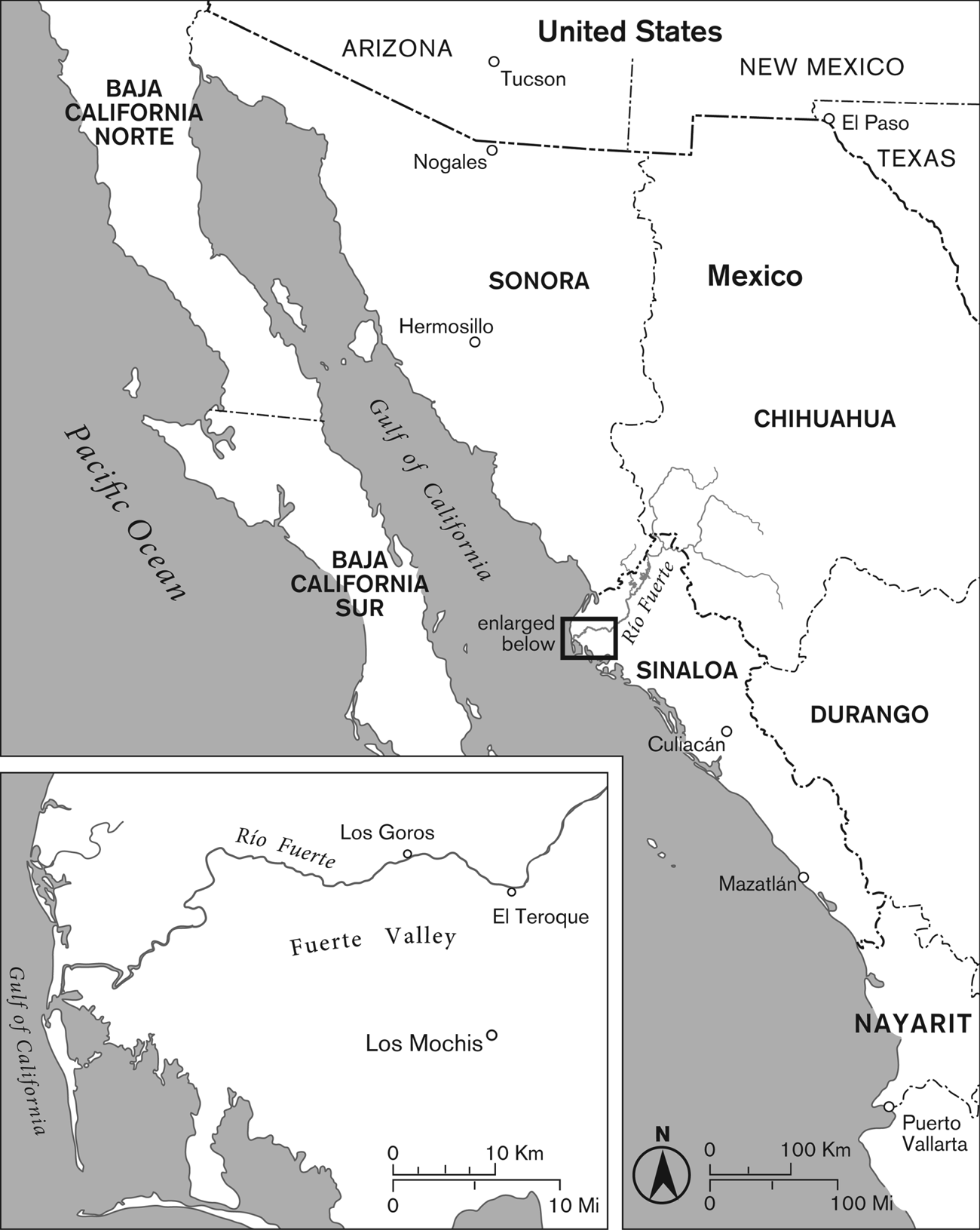
Situated along the Fuerte River, 15 kilometres north of the city of Los Mochis, the Los Goros ejido sits in the heart of the sugarcane-producing region (see Figure 1). Here, beginning in the 1940s, the SICAE's policies divided this Mayo community. The affiliated and non-affiliated ejidatarios shared no clear physical demarcation; there was no fence or canal that separated sides in this fight, as their plots of land were jumbled together. Instead, granting a number of ejidatarios membership in the cooperative and uneven access to irrigation resources created deep schisms. Both collectivist and individualist factions thus formed their own executive ejidal committees to defend their respective interests. The collectivists’ monopoly over hydraulic infrastructure threatened the entire community. The individualist leaders of Los Goros responded by attempting to confiscate irrigated land plots from some of their ejidatarios, who, in turn, questioned ejidal leadership.
Map of North-West Mexico and the Fuerte Valley, highlighting Los Goros and El Teroque Ejidos

By the mid-1940s the differences separating the two factions of Los Goros had forced leaders to attempt the formal division of their ejido. The first step was to demarcate the geographic boundaries separating the ejido’s collectivists and individualists, as these unclear borders had become an increasingly pivotal issue. After a few years of initial discussions, heads of both groups met with the SICAE, the National Bank of Ejidal Credit and the Agrarian Department on 16 March 1945 to settle on a territorial division.Footnote 39 The two sides could agree on virtually nothing, and only the influence of government officials wrung out the tepid concession that the collectivists would control enough land to produce the sugarcane they were legally required to grow. Yet, even here, there was no agreement as to how many hectares that would require or which lands they would receive.
For those outside the SICAE, the ambiguity of the division spoke volumes. What if cooperative members wanted an inordinate number of hectares? And would they grab the best, most productive land? A fear arose among individualists that the SICAE and collectivists would attempt to claim as many hectares as possible after solidifying an agreement, arguing that they needed more property to meet their sugarcane quota.Footnote 40 This uncertainty gave collectivists political leverage and left individualists at a disadvantage.
By 1944, and perhaps sooner, the ejidatarios of Los Goros viewed themselves as members of either the collectivist or individualist factions within the ejido and had begun to elect their own executive ejidal committees to administer their respective affairs. They had become, in de facto terms, two unequal communities. With support from the SICAE, the collectivists began to pressure their individualist neighbours into relinquishing their irrigated lots. With limited access to irrigation water and confronting possible SICAE land annexation, members of the individualist executive ejidal committee began to see the fight as a war of attrition. The key battle grounds were irrigated lots, and the SICAE's land annexations in the Fuerte Valley convinced individualists that they needed to consolidate these irrigated properties lest the collectivists draw them away one by one. This meant, however, coercing some individualist ejidatarios to part with their land. It is a backhanded compliment to the SICAE's power, but it made individualist Mayo leaders take action that harmed the interests of the very people who elected them to serve.
Take, for example, the plight of Ynocente Montiel, a Mayo farmer in Los Goros. On 18 November 1944, he wrote to President Manuel Ávila Camacho on behalf of himself and other ejidatario family members to complain of the actions of the individualist executive ejidal committee. According to the letter, after striking a deal with General Roberto Cruz to receive irrigation water from his pumping plant, the Montiel family had cleared their land for sowing, built irrigation canals and harvested crops over the five previous years.Footnote 41 Faced with a lack of water, Montiel had mobilised by finding a third party free of the SICAE influence, but his victory was short-lived. In July 1944, during a meeting of the individualist group, its leadership announced plans to restructure the entire faction's ejidal land holdings.Footnote 42 What that meant, in the case of the Montiel family, was that they would have to exchange their cultivated, irrigated plots for unirrigated ones. Individualist leaders wanted, as Montiel explained, to ‘re-fraction’ their lands, or, to put it plainly, confiscate their irrigated land.Footnote 43 For the Montiels, the struggles within the ejido felt like a war with two fronts: they had to worry about the machinations of the SICAE-affiliated collectivists as well as those of their own leaders.
Supporting documents do not divulge what the individualist executive ejidal committee planned to do with the Montiels’ irrigated plots, yet this land parcel was instrumental in the local political power struggles. In January 1945, the committee wrote to the Agrarian Department, informing it that the Montiels’ intransigence with the planned restructuring of the ejido was ‘an anomaly among their peers who all agreed with the 1944 re-parcelling plan, and the entire ejido signed the minutes of the meeting where the plan was proposed’.Footnote 44 Confronting the collectivists’ annexation strategies, the individualist committee expected its ejidatarios to act in the best interests of the entire faction. The irrigated land represented the culmination of the Montiels’ years of hard work and was, therefore, part of their patrimony. But in the midst of collectivist land seizures and ambiguous negotiations between both factions for the split of the ejido, this irrigated plot played a vital role in the individualist committee's plans.
But what were these plans, and what motivated the individualist ejidal committee's attempt to confiscate the Montiel properties? The committee could have intended to keep the valuable lots for itself, as the land possessed pumps and canals that allowed farmers to produce maize, sugarcane or other crops year-round. Transferring the Montiels’ irrigated property into the hands of the more politically connected ejidal committee might have dissuaded collectivists from annexing the land. The plot could also have been used as a bargaining chip offered up to the collectivists to push through the separation of the ejido. However, the evidence suggests the committee intended to use the Montiels’ irrigation infrastructure to disperse water to the entire ejido. During the 1944 meeting of the individualist faction, the ejidal committee convinced its ejidatarios to vote for the confiscation of the Montiel properties, and its best strategy was to argue that each farmer would receive water from their pumps and canals.Footnote 45
Montiel was not paranoid, and his claims are borne out by archival evidence − the executive ejidal committee did indeed attempt to formally confiscate his properties − yet, to equate the individualist committee's actions with the collectivists’ misses an important point: individualist leaders’ motives were defensive. Like a backfire intentionally set to arrest the approach of a wildfire, individualist leaders were willing to seize land from members of their own faction to get access to their all-important water rights – rights that could be used to irrigate other individualists’ farms and make them more productive. If the state declared their land fallow − that is, if there was not a well-watered, bumper crop grown − collectivists could annex their lands and argue that they would have no problem growing ample sugarcane crops.Footnote 46 While the Montiel family lamented their leaders’ actions, the individualist executive committee faced a difficult ethical dilemma: Was it fair to impinge on the rights of the few for the benefit of the many? In Los Goros’ case, the individualists’ leaders answered yes.
The SICAE-sponsored land seizures influenced every action taken by Los Goros’ individualist leaders, testing their faction's faith in them, and even the good news of more land and water did not alleviate their problems. Rather, once the pattern of seizing land by baldly immoral and frequently illegal methods infected Los Goros, it did not take long for it to infect the entire community. Even the individualists, seemingly victims of the collectivists’ machinations, could act in ways that the collectivist leadership might have appreciated.
On 7 November 1945, the Mexican state granted the individualists a small six-and-a-half-hectare ampliación (ejidal land extension) that was to receive irrigation from electric pumps.Footnote 47 Mayo elder Alejandro Inzunza of Los Goros recalls how, in 1946:
The ejidal committee let 12 Yoreme [Mayo] families clear out three of the seven hectares and awarded us this land for planting. Clearing the fields of large mesquite trees with machetes and axes was hard work. We planted cotton while clearing the fields and, with help from irrigation, received a good harvest that first year. Then they told us that we would receive the four hectares of non-cleared land, and not the three hectares as agreed on. We had put all of our resources into clearing and planting the original three hectares, and could not do the same with this new land. We had to abandon it. Our ejidal officers took the three hectares we had cleared, and continued to plant cotton. They should have helped us clear the remaining four hectares. The municipal president could not assist us because we never received land grant paperwork to verify our claims.Footnote 48
In the few short years between 1944 and 1946, the individualist committee transformed from undertaking unpleasant − and unfair − actions on behalf of all individualists to exploiting ejidatarios from its faction. Not officially transferring ownership to the labourers provided the committee with a fig leaf of legality, but it telegraphed its intentions clearly enough: The committee had used Inzunza and the other families to clear land that it intended to keep for itself.
While the actions of the individualists could be as undeniably ruthless as those of the collectivists, their motivations deserve further elaboration. The pressure the collectivists could summon − through water access, preferred credit terms and even political sway − meant that many individualists, especially leaders, could envision a day in the near future when all ejidatarios would be only SICAE-aligned and all individualists forced out. It led some to seeing the problem as a zero-sum game in which only large-scale, profit-making individualists stood any chance of stopping the collectivists. Regardless of individualist leaders’ intentions, their actions were indeed limited by the SICAE's control.
This situation was not unique to Los Goros. All along the Fuerte River, powerful individualist ejidal leaders used questionable tactics. Mayo individualist ejidatarios ended up unintentionally providing unpaid labour because their leaders promised them property in return for clearing it. Abandoned by their own leadership and lacking any other political connections, many individualists had no recourse. As the SICAE made irrigation water increasingly difficult for unaffiliated ejidatarios to acquire, new irrigation access generated conditions in which some individualist leaders made controversial decisions based not only on their personal ambitions, but also in reaction to the cooperative's local dominance.Footnote 49
In the 1940s and 1950s, while individualists scrambled and fought among themselves, collectivists, thanks to the SICAE's backing, acquired irrigation rights and annexed properties, creating havoc among individualists and pushing them onto less productive, overgrown lands. With a finite amount of water in the Fuerte River, the more collectivists took, the less was left for individualists. Consequently, individualists − relying on the poorest plots with only rainfall for water − were in jeopardy of collectivists claiming their land if the state declared it fallow.
In spite of a divided ejido and the recriminations thrown around, there is no record of the ejidatarios of Los Goros questioning a shared, Mayo identity. Individualists in the ejido still acknowledged collectivists as part of the ethnic community, engaged with them in most of their traditional religious rituals and conversed with them in their indigenous dialect. Mayo elder Carlos Moroyoqui of Los Goros Uno remembers the troubles haunting the ejido at the time but still recalls that ‘the collectivists were also Yoremes. They stopped performing some rituals with us, but they continued to attend the major ceremonies in San Miguel.’Footnote 50 Although the struggle over irrigation resources caused Los Goros to eventually split into two ejidos in 1962 – Los Goros Uno and Los Goros Dos − both sides continued to respect one another enough to identify their counterparts as Yoremes, or at least do so today.
El Teroque: Where Mayo Invaded Mayo Lands
Los Goros was not alone in its eruption of hostilities. The SICAE's aggressive targeting of irrigated land continued into the 1950s and created intense animosity between collectivists and individualists up and down the Fuerte Valley. In one Mayo ejido, El Teroque, individualists responded with appeals to government officials and through direct action. Here, in 1956, a group of individualists defied authorities and seized land from collectivists. The invasion highlights both the SICAE's increasingly bold tactics and individualists’ lack of political recourse in the 1950s. It was a dramatic move, made all the more so by its cultural implications.
Elsewhere, like in Los Goros in the 1940s, a shared native identity mitigated the harshest feelings provoked by battles over irrigated land – at least in comparison to El Teroque. No matter who was gaining land and who was losing it, both sides recognised their shared Mayo heritage, but the cooperative's aggressive land seizures in the 1950s led to more pronounced contention between collectivists and individualists in El Teroque. Unlike in Los Goros, the individualists of El Teroque unified in the face of repression by aligning with advocacy groups and collectively petitioning state agencies to defend their land and water rights. Here, there was no individualist turning on individualist. Rather, individualists nurtured solidarity and a collective response which allowed them to capture some influence over local hydraulic development decisions.
In the late 1940s, the sugarcane cooperative constructed a canal − named the SICAE canal − to expand El Teroque's irrigated lands from 190 hectares to 1,328 hectares, of which 506 hectares were already planted with sugarcane.Footnote 51 Given the SICAE's influence in El Teroque during the years after construction of the canal and its mandate to harvest sugarcane, the irrigated land and hydraulic infrastructure was intended solely for the collectivists. Indeed, complaints individualists filed seven years later claimed their faction had never controlled a single hectare of that massive chunk of irrigated land.Footnote 52 It is difficult to say if the individualist claim was correct, for the 1948 census omitted an exact number of hectares each side held. It is clear that by 1955, when the El Teroque ejidatarios attempted to cultivate as much as possible of their more than 2,500 hectares of land, individualists were the minority stakeholders − and were denied irrigation. Parched, they could only farm with rainfall while they watched their neighbours consume from the Fuerte River's bounty; over the next decade these individualists lost patience with their lack of resources.
Like many Mexicans since the Revolution, individualists of El Teroque appealed to the state, directly reaching out to the general secretary of the Comisión Agrícola (Agricultural Commission) in November 1954. Convinced by their argument, the general secretary then wrote a letter on behalf of the individualists to the Agrarian Department, stating that:
The individualists face a difficult situation because they do not have credits to obtain agricultural inputs necessary to grow crops, and also lack water for their harvests. Individualists seek the power to elect their own executive ejidal committee, and the separation of their ejido. In affiliated ejidos, the SICAE administration appoints the ejidal committee for the entire ejido, and these leaders only represent the interests of the collectivists.Footnote 53
Then, as now, farming was a business run on credit, so it is not surprising to read that the individualists needed and wanted more. What is striking is their complaint about irrigation. Farmers the world over complain of lack of access to water, but fewer do so when their farms are next to a large river.Footnote 54 This agonising anomaly in El Teroque can only be explained by the SICAE and its appointed officials turning off the individualists’ water supply.
The SICAE's influence, its official backing by the Mexican state and − most troubling − its efforts to influence the ejido’s executive committee, forced these non-affiliated ejidatarios to struggle for irrigation water, and created an uphill battle for those opposed to the cooperative. Because it enjoyed local domination and displayed a lack of respect for village democracy, the cooperative appointed an ejidal committee that governed both sectors of the ejido with only the collectivists’ interests in mind. But, like other ejidatarios in the region, individualists in El Teroque proposed to formally divide their ejido so they could elect their own ejidal commission and make group decisions independent from the SICAE.
Their campaign began by identifying specific issues, making demands and invoking existing legislation to seek political redress. In August 1955, individualists petitioned the Organización Agraria Ejidal (Ejidal Agrarian Organisation) for rights to formally divide the El Teroque ejido into two and hold elections for their own ejidal committee, stating: ‘We cannot obtain credit privately or officially because no institution or company will enter into an agreement under these conditions … With the completed Miguel Hidalgo Dam, we have undertaken an agreement to receive water from the Fuerte River Commission, but who has the power to endorse these contracts? The ejidal leadership will not do so.’Footnote 55 Water, free of the SICAE's influence, was tantalisingly close, yet individualists lacked the official power to make group decisions regarding their future in order to secure it. That power rested in an ejidal leadership that refused to take steps to favour the individualists. Individualist leaders revealed their precarious position and framed their argument by highlighting an inability to access irrigation water. Reliant only on rainfall, the individualists were virtually ensured underproduction and their lands were left vulnerable to collectivist annexation.
In September 1955, the Comisión del Río Fuerte (Fuerte River Commission, CRF) supplanted the Secretaría de Recursos Hidráulicos (Secretariat of Water Resources) as official regulator of all Fuerte Valley irrigation systems. The Mexican state had created the CRF in 1951 and placed it in charge of developing the Fuerte River's hydraulic technology to boost local agricultural output.Footnote 56 State officials, concerned over petitions from individualists and landowners and frustrated with the SICAE's refusal to address them, demanded that authority over the Fuerte River's flow be taken out of the collectivists’ hands. This should have been a pivotal moment, and there were some important changes. For example, private property owners received many new irrigation concessions, and paid fees in advance. Ostensibly, ejidatarios also had the opportunity to purchase irrigation rights from the CRF − and had even reached a preliminary agreement with the CRF before the agency was officially placed in charge of irrigation distribution − yet financial constraints and the rising price of water prevented this option.Footnote 57 Once again, their ejidal administration thwarted their hydraulic mobilisation efforts.
Despite their experience, as late as the mid-1950s, El Teroque individualists still employed the petition process to help them gain access to irrigation water. In October 1955, they wrote to President Adolfo Ruiz Cortines, elucidating their conflict with the collectivists. In their missive they explained that, ‘in order to conduct our work we request irrigation for our fields and construction of hydraulic distribution’.Footnote 58 At this point in El Teroque, hydraulic social mobilisation still fell safely within legal boundaries. The demand for hydraulic infrastructure, such as pumps, canals and dams, showed that these Mayo individualists had fully accepted its use in their practices. They needed water, wherever it came from, to grow crops that earned them a livelihood and, more than that, kept their fields cultivated and their properties safe, all of which secured them a place within the Mayo homeland along the Fuerte River.
The SICAE's hydraulic dominance interfered with individualist Mayo ejidatarios’ attempts to maintain a long-standing connection with the Fuerte River and grow subsistence crops without outsider interference. Felipe Buimena, a Mayo elder from El Teroque, recalls his parents’ mistrust of the SICAE, stating: ‘They did not want anyone telling them what they could grow. They also believed the river was for everyone and that nobody had the right to possess it completely.’Footnote 59 Although the SICAE never had total legal control over the river, Buimena remembered the collective's four-month water monopoly, from early March to late June, as effectively a bestowal of complete dominion. By controlling the four driest and most essential months of irrigation, the cooperative unofficially regulated the river throughout the year − there was no other entity with that amount of leverage in the valley. However, Buimena's conclusion may have also arisen from how collectivists, with crucial SICAE support, effectively blocked individualists’ efforts to establish irrigation deals with third parties. In this way, the SICAE ensured that there would be no other power along the Fuerte River and increased the collectivists’ chances to annex their neighbours’ land.
In both Mayo ejidos under analysis, struggles over irrigation access created two sectors, yet individualists of El Teroque were more explicit in expressing their separation from collectivists. In the late 1950s, the executive individualist ejidal committee of El Teroque wrote a letter to the Agrarian Department that shed light on the continued division in the ejido after 1956. The letter stated: ‘There are also antagonistic tendencies on the grounds that the first group [collectivists] are white farmers or “Yoris”, and the second group [individualists] are purely indigenous “Mayo” and speak our dialect.’Footnote 60 The message was not just an indictment of the collectivists’ actions, but even more a critique of the SICAE itself.
The SICAE's land annexations and the collectivists’ complicity apparently led these Mayo individualists to accuse indigenous collectivists of being ‘white’. Even as late as the mid-twentieth century, Mayo in El Teroque forged their identity based on their uses of and connection to the Fuerte River. Ejidatarios depended on river water to grow crops but, since Mayo farmers also used it to conduct traditional ceremonies such as that of San Juan, the communal use of the river was at the heart of their identity. In the eyes of the individualists, the collectivists violated this by following the SICAE's orders and denying them their connection. Yet, as much as individualists detested their adversaries’ actions, they also understood collectivists’ limited options.
What inspired these individualists to make this claim that collectivists were ‘white’? It appears that individualists openly questioned whether their collectivist brethren's attachment to the will of the SICAE took precedence over loyalty to the community. Yet they likely would have resolved these disputes by distancing themselves from collectivists and ceasing to perform some ceremonies with their adversaries, as was the case in Los Goros. The fact that they sent this letter to state functionaries with the intent of seeking political compensation suggests that individualists were pointing out the cooperative's shortcomings in that it was never able to sufficiently fulfil the promise to provide, even for their collectivist indigenous brethren. In order to pressure government functionaries to separate the ejido, the letter revealed how a state-backed agency wronged them by encroaching on their community's autonomy.
By the end of 1955, the dispute over irrigated land in El Teroque had become close to boiling over. In August, individualists demanded the return of a portion of valuable irrigated land that collectivists had seized from them and planted with sugarcane. On 31 August 1955, their leaders wrote to the National Bank of Ejidal Credit, claiming that they were entitled to this irrigated property and explaining:
We are willing to devote this land to sugarcane cultivation, as long as your institution provides us with necessary credit, but without ties to the administration of the aforementioned SICAE. Under the direction of this agency, all affiliated ejidos, except for rare exceptions, have been a resounding economic failure. We ask to stay unconnected to it, or otherwise devote ourselves to other crops.Footnote 61
The individualists were confident that, with credit from the National Bank of Ejidal Credit, they could make the land bountiful. The reason for their optimism? El Teroque had a source of water independent from the cooperative's authority. From the individualists’ perspective, if the pernicious influence of the SICAE could just be removed from their lands, their lives and livelihoods would improve.
The letter to the National Bank of Ejidal Credit highlights pertinent issues regarding the options available to the individualists of El Teroque. Here, they struggled to survive on their 200 hectares of unirrigated land because, compared to other crops, sugarcane was expensive to raise.Footnote 62 Even if they could recover some of their plots, they could not afford the tools, equipment, water and cane rods necessary to cultivate sugarcane. Yet, in spite of these obstacles, individualists were still willing to produce sugarcane because collectivists, as well as the crop's economic importance to the region, left them with few options.
Amid the rampant inequality and uneven access to land and water rights in El Teroque, the individualists turned to their ally, the Confederación Nacional Campesina (National Peasant Confederation, CNC). Although the CNC was an institution charged with representing all peasants, in reality not all farmers aligned with it, for those collectivists under the protective arm of the SICAE already had a powerful group that could capture the government's ear. Consequently, by 1955, the CNC found itself champion of the individualists. In September 1955 the CNC wrote a letter on behalf of individualists to the Agrarian Department to point out their land tenure and irrigation access disparity, as well as their lack of political representation. It argued that the collectivists had amassed over 1,000 hectares of sugarcane land over a decade by invading individualists’ plots and planting the cash crop, and that the inclusion of ejidatarios into the SICAE blurred the boundaries of the community and eventually led to individualists being left with only 200 hectares for 104 ejidatarios.Footnote 63
The petition emphasised the surface area each group possessed. By gobbling up ejidal plots, collectivists had won control over 2,300 hectares of land and left the individualists with roughly 200 hectares available to provide for their families. At nearly a dozen-to-one ratio, this allocation might have been arguably justified if there had also been the same ratio of collectivists to individualists, but that was not the case. Of the 224 ejidal plots, 104 were possessed by individualists; just under half the ejido had to scrape by on smaller plots of land with no access to hydraulic infrastructure. There was also the spectre haunting the individualists that, if they could not farm their unirrigated land, their slim holdings could be taken away.
The last months of 1955 had been a period of optimism followed by frustration for the El Teroque individualists. When, in the early months of 1956, they occupied 607 hectares of collectivist-controlled land it was a manifestation of their resentment − even anger − at the disenfranchisement and economic oppression they had suffered. After nearly two decades of encroachment, obstructed irrigation agreements, denial of land titles and, finally, being shoved into a mere 200 hectares, individualists had reached their tipping point. Individualists contended that the two groups had met and reached agreements for property reinstatement in the months leading up to the invasion but that collectivists broke their promise by withholding anticipated land transfers.Footnote 64 When they realised that their interests would not be satisfied through purely political methods, and with limited options at their disposal, they simply seized 607 irrigated sugarcane hectares.
Armed with unspecified weapons, the individualists occupied the disputed plot and prevented the collectivist farmers from tending to their sugarcane crops. The individualists’ original intent was to destroy the sugarcane plants and replace them with subsistence crops, but a commissioned engineer from the Agrarian Department intervened and convinced the individualists to hold off on obliterating the sugarcane until his agency could arbitrate a meeting between the two groups.Footnote 65 These individualists’ only option to ensure the productivity of milpa crops was to get rid of the existing sugarcane and use the irrigation infrastructure. This revealed that their interest was not the actual sugarcane crops planted on the land but, rather, the system of pumps and canals that fed the crops
While the seizure of land had obvious political significance, the individualists decided to annex this particular property because it was irrigated. They had tried through official channels to mobilise and lobby for access to water, but with the SICAE impeding their efforts they had no choice but this extreme form of hydraulic social mobilisation. Individualists informed state functionaries on several occasions leading up to the invasion that, though the collectivists’ encroachments rankled, their most pressing need was irrigation and the SICAE obstructed any deals they might have made with third parties for irrigation water.Footnote 66 Keeping with what they and their advocates had announced to the government before, it was access to irrigation water from the Fuerte River, more than access to land, that catalysed the individualists’ dramatic action.
The importance Mayo individualists attributed to irrigation infrastructure raises questions about the socio-cultural impacts of development. As late as the 1920s, indigenous farmers in the Fuerte Valley did not have access to irrigation infrastructure, but by the mid-1950s − one generation later − irrigation had become so essential to earning a livelihood that some were willing to risk their lives and freedom to gain control of it. For the Mayo who found themselves lumped into the ‘individualist’ camp, life had changed along the Fuerte River. By the 1950s, leaving land unexploited allowed collectivists to claim it, whereas farmers had previously been able to raise subsistence crops and leave portions fallow as necessity dictated. It was a vicious cycle created not by nature but by Mexican law.
In the end, the Agrarian Department awarded the individualists the section of the ejido they had invaded.Footnote 67 It seems fair that individualists received 607 of the more than 1,300 hectares of irrigated lands of El Teroque. Yet, the individualists of El Teroque were an exception in being granted so much irrigated land when compared to other non-affiliated ejidatarios of the Fuerte Valley. Individualists in other ejidos employed tactics of hydraulic social mobilisation and strategies to recover annexed properties, such as petitioning state functionaries. Although some individualists enjoyed varying degrees of success, none of their actions was as successful as El Teroque individualists’ risky tactic of invading their adversaries’ lands. The agreement to end the standoff had not only awarded the individualists land and water access, but also a voice in local hydraulic development decisions.
Perhaps the most consequential achievement for these individualists’ actions was that they also helped end the SICAE's stranglehold on power in the Fuerte Valley. After resolving the tensions in the El Teroque ejido, the state no longer supported the SICAE's strategy of annexing individualist properties. El Teroque individualists could not claim total credit for waning government support of the cooperative, as the state was in a transition period in which it began to give hydraulic priority to private landowners engaging in large-scale commercial agricultural operations. Yet the historical record does reveal that El Teroque's 1956 achievement eliminated any chances the SICAE had of reviving its political power, which helps to explain its demise a year later. Yet, like in Los Goros, the resource war within their ejido eventually led to a definitive separation. In 1963, individualists formed ‘El Teroque Viejo’ and the collectivist sector named their ejido ‘Cinco de Mayo’.
Conclusion
Being affiliated with the SICAE was a mixed blessing for some Mayo ejidatarios of the Fuerte Valley from the mid-1940s to mid-1950s. The cooperative paid indigenous collectivists a decent salary, invested in canals, dams and aqueducts, and granted them reliable irrigation access to cultivate sugarcane. But there was another side to the SICAE. Cooperative members also had to prove their loyalty by helping the SICAE annex individualists’ lands and cutting off their fellow ejidatarios’ access to irrigation water. These actions created tensions, and, while in this case they were more extreme in El Teroque than in Los Goros, they led to an eventual split of each ejido into two.
Ostensibly, land was at the heart of the battle between individualist and collectivist ejidatarios, but, in the arid Fuerte Valley, land meant little without water. From the late 1920s to early 1940s indigenous farmers either paid third parties for irrigation water or applied to the post-revolutionary Mexican state for water concessions, but that changed with the arrival of the SICAE. Its four-month-per-year water monopoly and virtual control of the Fuerte River politically marginalised unaffiliated Mayo and had severely restricted the availability of irrigation water by the mid-1940s. While the SICAE ordered the clearing and occupation of properties in the Fuerte Valley, the excluded individualist Mayo continued to seek irrigation rights. They had to, for collectivist land annexation pushed them onto less productive lands where, ironically, their only chance of producing crops required a deepening and expansion of irrigation infrastructure.
The history of water in the Fuerte Valley during the 1940s and 1950s demonstrates how Mexican indigenous people survived, culturally and physically, through hydraulic social mobilisation. Yet, despite this survival, the racial make-up of the Mayo ejidos discussed here transformed after more than a half-century, reflecting the growth of the mestizo population of the Fuerte Valley to nearly a million, while the Mayo population has remained at around 10,000. Although, at the close of the 1950s, both ejidos were still 100 per cent indigenous, today only 36 per cent of ejidatarios in El Teroque Viejo define themselves as Mayo, and only 31 per cent in Cinco de Mayo. The ejidos that split from Los Goros appear to have retained their traditions more fully, as 80 per cent in Los Goros Uno (Oro Pinto) claim to be Mayo, and 28 per cent in Los Goros Dos.Footnote 68 It appears that the acute divisiveness within El Teroque left a legacy of mistrust among Mayo ejidatarios that allowed mestizos to become members over time. Yet, for Mayo inhabitants in these particular ejidos, their culture has remained strong, becoming a source of local pride among even mestizo Fuerte Valley residents. This is only possible due to the Mayo ability to defend their identity so closely tied to the Fuerte River.
The post-revolutionary and post-war Mexican state intended to promote water distribution strategies to both mobilise peasants and generate a thriving agricultural economy. Instead, state-sponsored institutions like the SICAE sugarcane cooperative − founded with relatively idealistic aims − exacerbated irrigation disparities they were designed to fix. While analysing the state's hydraulic distribution plans in the Fuerte Valley exposes flaws in its strategy to empower peasants, it also reveals how some indigenous farmers used every resource available to resist their marginalisation. Only through a focus on water do the historical actions of these Mayo ejidatarios take on this vital significance. The SICAE and the corrupt ejidal leadership it cultivated forced Mayo individualists to mobilise, and, in so doing, they found a voice in local development decisions.
Acknowledgements
I would like to express my gratitude to Mayo interviewees for sharing their experiences, as well as to the archivists in Mexico City and my support network in Sinaloa, especially Henrique Felix and Loreto Coronado. Thank you to my former colleagues in the History Department at Claremont McKenna College, particularly Daniel Livesay and Sarah Sarzynski for reading drafts. Thanks also to Chris Boyer, Joaquín Chávez, Jeffrey Banister, Dave Wysocki, Michael Goode, Shayna Mehas and Ben Fallaw for offering feedback, and to all of my family, but especially Mom, Danny and Kristine for always being there.