





Schizophrenia is a severe mental disorder that follows a chronic course and is marked by regular relapse events following the first episode of schizophrenia (FES). Reference Robinson, Woerner, Alvir, Bilder, Goldman and Geisler1 These relapses have profound psychosocial consequences for both the affected individual and their family members, including disrupted interpersonal relationships, loss of employment and limited educational opportunities. Reference Kane2 Relapse events also impose a significant burden on constrained and often resource-limited healthcare systems in lower middle-income countries (LMICs) such as South Africa. Reference Correll, Galling, Pawar, Krivko, Bonetto and Ruggeri3,Reference Charlson, Ferrari, Santomauro, Diminic, Stockings and Scott4 Given that schizophrenia is ranked as the 12th most disabling disorder in terms of a chronic non-communicable disease globally, Reference Vos, Abajobir, Abate, Abbafati, Abbas and Abd-Allah5 the public health implications are substantial. Recurrent relapses are associated with illness progression, increased functional impairment and a greater likelihood of treatment resistance over time. Reference Wiersma, Nienhuis, Slooff and Giel6,Reference Emsley, Chiliza, Asmal and Harvey7
Investigating factors contributing to relapse other than treatment non-adherence, particularly among affected individuals with repeated episodes, presents considerable challenges. High-risk individuals with schizophrenia residing in LMICs often face a complex combination of social, economic and healthcare system barriers that impede consistent follow-up and limit research engagement. Reference Maart and Jelsma8,Reference Chauke, Nakwafila, Chibi, Sartorius and Mashamba-Thompson9 Frequent difficulties in maintaining regular contact with mental health services, including missed appointments and fragmented care, contribute to the underrepresentation of this vulnerable population in research and increase their risk of being excluded from or lost to the healthcare system. Reference Daniels, Loganathan, Wilson and Kasckow10
Underrepresentation of chronic schizophrenia in research in LMICs
As a result of deinstitutionalisation, the care of individuals with schizophrenia has largely shifted to family members and informal caregivers. Reference Stefan, Travis and Murray11,Reference Pakenham12 Family members therefore often face considerable emotional, physical and social burdens, Reference Ukpong13,Reference De Wet, Swartz and Chiliza14 while managing financial strain and competing responsibilities. Reference McFarlane, Dixon and Lukens15 Limited access to psychoeducation further exacerbates these challenges, straining family relationships. Reference Kane2 Without adequate support systems, and in the context of unemployment and pervasive community stigma, people with schizophrenia face heightened relapse risk and social exclusion. These conditions frequently fuel substance misuse and criminal behaviour, Reference Laudet, Magura, Vogel and Knight16 creating environments that substantially increase relapse risk. Reference Hjelm, Handa, de Hoop, Palermo, Zambia and Teams17 In LMIC settings, unemployed men, unmarried individuals and those who misuse substances are disproportionately underrepresented in healthcare services. Reference Fischer, Dornelas and Goethe18,Reference Homman, Smart, O’Neill and MacCabe19 These findings highlight the need to explore this underrepresented group in LMICs with frequent schizophrenia relapse, Reference Taipale, Schneider-Thoma, Pinzón-Espinosa, Radua, Efthimiou and Vinkers20 because the challenges that shape relapse risk, also contribute to their exclusion from research aimed at informing clinical practice.
Previous longitudinal studies investigating clinical risk factors for relapse
An earlier review of longitudinal studies identified significant psychosocial and treatment-related predictors of relapse in schizophrenia, including poor social relationships (n = 11), poor psychoeducation (n = 5), substance misuse (n = 10) and treatment discontinuation (n = 15). The findings suggest that sustained treatment adherence, absence of substance misuse, adequate social support, appropriate psychoeducational interventions to improve insight and a shorter duration of untreated psychosis (DUP) are all associated with reduced relapse risk. Reference Porcellia, Bianchini, De Girolamo, Aguglia, Crea and Serretti21 A more recent systematic review of 13 longitudinal studies further identified poor insight, substance misuse and younger age of illness onset as significant correlates of treatment non-adherence and subsequent relapse. Reference Ljungdalh22 Other psychosocial factors such as negative self-esteem, Reference Holding, Tarrier, Gregg and Barrowclough23 increased exposure to stressful life events, Reference Haque, Kamal, De Laila, Laila, Ahmed and Khan24 higher anxiety levels, Reference Hartley, Barrowclough and Haddock25 aberrant salience Reference Vaidya, Shenoy and Praharaj26 and low personal resilience, Reference Mitikhin, Kuzminova and Alieva27 also increase relapse risk in individuals with schizophrenia. Longitudinal evidence, however, is most often derived from selective samples, raising questions about its applicability to underrepresented LMIC populations.
Our previous research
Our previous research examined baseline predictors of relapse in individuals with FES who received assured long-acting injectable antipsychotic (LAIA) treatment over a 24-month period, focusing specifically on factors other than treatment non-adherence. Reference Smit, Luckhoff, Phahladira, Du Plessis, Emsley and Asmal28 The analysis identified more pronounced baseline neurological soft signs (NSS) and poor social relationships as significant predictors of the time to relapse. Subsequently, we compared symptom trajectories between participants in the same FES sample who relapsed versus those who did not. We further investigated putative moderators of group differences in psychopathology trajectories between the two groups. Notably, childhood physical abuse emerged as a significant moderator of time-dependent changes in psychopathology, insofar as being associated with worse positive symptom trajectories in the relapse group. Reference Smit, Luckhoff, Phahladira, Kilian, Emsley and Asmal29
To complement these quantitative findings, we conducted a qualitative focus group study with clinicians experienced in managing relapse among individuals with schizophrenia. This study provided additional insight into the complex, intersecting factors that contribute to both non-adherence and relapse, shifting the focus beyond individual factors. While treatment non-adherence was consistently highlighted as the primary cause of relapse, clinicians emphasised the impact of systemic, social and contextual challenges that compound the risk of both non-adherence and relapse.
Research aim
From converging lines of evidence, a crucial knowledge gap remains: relapse risk factors are well elucidated in controlled samples, but there is a lack of studies that have examined how systemic and psychosocial factors interact with clinical variables to shape relapse trajectories in real-world LMIC contexts. While we have looked at moderators of psychopathology trajectories in relapsers versus non-relapsers in FES, the present study extended this focus to psychosocial factors and interpersonal vulnerabilities in a chronic sample at high risk of relapse. The aim of this longitudinal study was to explore multidimensional factors moderating treatment trajectories in relapsers versus non-relapsers. We hypothesised that psychopathology trajectories would be moderated by premorbid (e.g., childhood trauma), clinical (e.g., NSS, aberrant salience, state-trait anxiety) and psychosocial (e.g., stressful life events, poor self-esteem, low personal resilience, quality of life (QOL)) factors.
Method
Research design
We conducted a prospective study to examine moderators of treatment trajectories compared between relapsers and non-relapsers over 12 months in a sample of participants with schizophrenia spectrum disorder, who were clinically stable at baseline but considered at high risk of relapse. All procedures contributing to this work comply with the ethical standards of the relevant national and institutional committees on human experimentation and with the Helsinki Declaration of 1975, as revised in 2013. All procedures involving human subjects were approved by the Health Research Ethics Committee of Stellenbosch University (HREC reference number: S22/02/021 (PhD)).
Participant selection
We recruited participants with schizophrenia or schizoaffective disorder, diagnosed according to the Diagnostic and Statistical Manual (DSM)-5 criteria. 30 We intentionally selected individuals who had previously responded to treatment but were considered at high risk of relapse, with a history of more than two documented relapses in the past 3 years. Participants were recruited from the participant cohort of Stikland Hospital’s Assertive Community Team (ACT) and New Beginnings, an intermediary care facility providing psychosocial rehabilitation in a step-up or step-down setting, also located at Stikland Hospital. Additionally, participants were recruited from in-patient and out-patient services at Stikland Hospital, after obtaining regulatory and institutional approvals. Participants were followed up over a 12-month period through monthly telephone check-ins and biannual follow-up visits. Written informed consent was obtained from all participants, with assurances of anonymity and confidentiality.
Inclusion criteria were: participants aged 18–60 years; meeting DSM-5 diagnostic criteria for schizophrenia or schizoaffective disorder, with or without comorbid substance misuse; a history of two or more documented relapses within the past 3 years; prior clinical response to antipsychotic treatment; clinical stability at study entry with Positive and Negative Syndrome Scale (PANSS) total score <60; Reference Kay, Fizbein and Opler31 and current treatment with an LAIA and/or demonstrated good adherence to oral antipsychotic medication. Exclusion criteria included a primary diagnosis other than schizophrenia or schizoaffective disorder, treatment-refractory (an ineffective therapeutic response to the sequential use of two or more antipsychotics on a recommended dose, for a period of 6–8 weeks or the failure of full remission of positive symptoms), Reference McGorry, Killackey, Lambert and Lambert32 current substance intoxication or withdrawal, clinically significant general medical conditions that would have impacted upon study participation and intellectual disability.
Pharmacotherapy
All participants were receiving LAIAs in combination with oral antipsychotics and were clinically stable at study entry. For the duration of the study, participants continued treatment as usual. Treating physicians maintained and adjusted treatment regimens as needed. In cases of treatment non-adherence, medication was reintroduced or modified in response to inefficacy or side effects. Monthly telephonic follow-ups were conducted with participants and their family members to monitor treatment adherence and any deterioration of psychopathology.
Assessment measures
Participants were assessed using the Structured Clinical Interview for DSM-5 (SCID) 30 to confirm diagnosis. Demographic information was obtained from hospital medical records and verified by participants. Psychopathology was measured with the PANSS; Reference Kay, Fizbein and Opler31 overall illness severity with the Clinical Global Impression (CGI) scale; Reference Guy and Rush33 QOL with the WHOQOL-BREF; 34 NSS with the Neurological Evaluation Scale (NES); Reference Buchanan and Heinrichs35 psychosis proneness with the Aberrant Salience Inventory (ASI); Reference Cicero, Kerns and McCarthy36 psychological resilience with the Connor–Davidson Resilience Scale (CD-RISC); Reference Velickovic, Axelsson, Borrebaeck, Ryden, Johnson and Månsson37 self-esteem with the Self-Esteem Rating Scale-Short Form (SERS-SF); Reference Lecomte, Corbiere and Laisne38 childhood trauma with the Maltreatment and Abuse Chronology of Exposure (MACE); Reference Teicher and Parigger39 trait and state anxiety with the Trait Scale of State Trait Anxiety Inventory (STAI-T) and State Scale of State Trait Anxiety Inventory (STAI-S); Reference Julian40 and adult stressful life events with the Perceived Chronic Social Adversity Questionnaire (PCSAQ). Reference Zhang, Ding, Tang, Zhang and Yang41 Substance use histories were obtained from participants, their primary carers and hospital records. Substance use was calculated as the number of positive urine toxicology tests for cannabis, methamphetamine and methaqualone over 12 months. Investigators underwent training, and inter-rater reliability testing exceeded >75% for all scales.
Assessment of medication adherence
Treatment adherence was assessed through regular monthly telephone follow-ups and 6-monthly study visits, and categorised as good, partial or poor. When participants and caregivers reported that participants were taking medication every day, or almost every day, adherence was classified as good. If participants were taking medication occasionally, adherence was classed as partial. If participants were not taking medication or taken very seldom, adherence was classed as poor. In instances where participants were re-hospitalised due to relapse, treatment adherence at the time of relapse was verified through hospital source notes and collateral reports from family members.
Relapse criteria
Participants were deemed to have relapsed when they were re-hospitalised due to a recurrence of psychosis. The clinical teams confirmed psychosis recurrence for each readmission.
Statistical analysis
Statistical analyses were conducted using SPSS version 29 for Windows with significance set at p < 0.05. Normally distributed continuous variables were summarised as means (s.d.), non-normally distributed variables as medians (IQR) and categorical variables as frequencies (%) (Table 1). Winsorisation (1st and 99th centiles) was used to address outliers. Group comparisons between relapse and non-relapse participants were performed using independent-samples t-tests for normally distributed variables, Wilcoxon rank-sum (Mann–Whitney U) tests for non-normal variables and chi-squared tests for categorical variables.
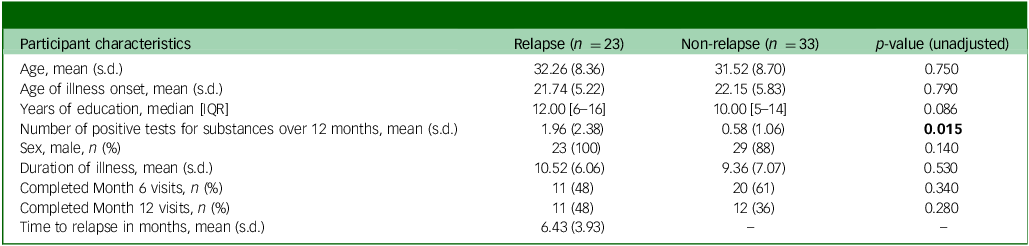
Descriptive statistics of demographic and clinical variables of participants (n = 56)

Table 1 Long description
The table presents a comparison of demographic and clinical variables between relapse (n = 23) and non-relapse (n = 33) participants. It includes participant characteristics such as age, age of illness onset, years of education, number of positive tests for substances over 12 months, sex, duration of illness, completed visits at month 6 and month 12, and time to relapse in months. The table also provides p-values for unadjusted statistical tests. Row 1: Age, mean (s.d.), Relapse: 32.26 (8.36), Non-relapse: 31.52 (8.70), p-value: 0.750. Row 2: Age of illness onset, mean (s.d.), Relapse: 21.74 (5.22), Non-relapse: 22.15 (5.83), p-value: 0.790. Row 3: Years of education, median [IQR], Relapse: 12.00 [6-16], Non-relapse: 10.00 [5-14], p-value: 0.086. Row 4: Number of positive tests for substances over 12 months, mean (s.d.), Relapse: 1.96 (2.38), Non-relapse: 0.58 (1.06), p-value: 0.015. Row 5: Sex, male, n (%), Relapse: 23 (100), Non-relapse: 29 (88), p-value: 0.140. Row 6: Duration of illness, mean (s.d.), Relapse: 10.52 (6.06), Non-relapse: 9.36 (7.07), p-value: 0.530. Row 7: Completed Month 6 visits, n (%), Relapse: 11 (48), Non-relapse: 20 (61), p-value: 0.340. Row 8: Completed Month 12 visits, n (%), Relapse: 11 (48), Non-relapse: 12 (36), p-value: 0.280. Row 9: Time to relapse in months, mean (s.d.), Relapse: 6.43 (3.93), Non-relapse: not applicable, p-value: not applicable.
IQR, interquartile range. Bold is used for p-values with a significance level < 0.05.
For the primary analysis, linear mixed-effects models for repeated measures (LMMRM) with covariance structure set as ‘compound symmetry’, were used to compare 12-month psychopathology trajectories between the relapse and non-relapse groups. Dependent variables included PANSS total score and PANSS factor-derived domains: positive (P1, P3, P6, G9), negative (N1, N2, N3, N4, N6, G7) and disorganised (P2, N5, G11). Reference Emsley, Rabinowitz and Torreman42 Relapse status was the between-subjects factor (group), visit was the within-subjects fixed effect (time) and the group*time interaction tested differential changes. Participant identity was modelled as a random effect. Covariates included duration of illness, age at illness onset, years of education, treatment adherence and substance misuse, as these have been identified as significant predictors of relapse and worse psychopathology outcomes in schizophrenia. Reference Verma, Poon, Subramaniam, Abdin and Chong43–Reference Emsley, Asmal, Rubio, Correll and Kane45 Post hoc group comparisons at each timepoint in the LMMRM models were performed using Fisher’s least significant difference (LSD) test.
For the secondary exploratory analysis, LMMRM models examined whether multidimensional psychological and clinical variables moderated psychopathology trajectories. Moderators included ASI, STAI-T, STAI-S, NES, PCSAQ, SERS-SF, CD-RISC, childhood trauma severity and QOL total scores. Dependent variables included PANSS total score and PANSS factor-derived domains (positive, negative, disorganised). Models included group and time as fixed effects, participant identity as a random effect and the group*time*moderator interaction, while controlling for age of illness onset, duration of illness, substance misuse, years of education and treatment adherence. To control for Type I error the Benjamini–Hochberg procedure was used by entering the p-values for all interaction terms, variables and covariates pertaining to each model, indicated as adjusted α in the result sections. Reference Benjamini and Hochberg46 To determine the direction and strength of associations, we examined the estimated marginal means derived from the LMMRM models. Positive estimates indicated that increases in the predictor variable were associated with increases in the outcome variable, whereas negative estimates indicated that increases in the predictor variable were associated with decreases in the outcome variable.
Results
Study flow diagram over 12 months
Over the recruitment period, 212 individuals were prescreened, 57 underwent full screening and 56 met eligibility criteria, and therefore enrolled. A total of 155 participants were excluded from the study for the following reasons: schizophrenia with a history of traumatic brain injury or epilepsy (n = 18); schizophrenia with significant general medical conditions that could have interfered with study participation (n = 8); clinical instability indicated by a total PANSS score >60 (n = 8); fewer than two relapses in the preceding 3 years (n = 49); presence of an index episode of schizophrenia (n = 15); refusal to participate (n = 14); or failure to meet diagnostic criteria for schizophrenia or schizoaffective disorder (n = 43). Over the 12-month follow-up, 23 participants (41%) relapsed and 33 (59%) discontinued the study before month 12 because of loss of contact (n = 27), absconding from home (n = 4) or consent withdrawal (n = 2). Of those who discontinued, 7 (21%) relapsed, reflecting substantial attrition in this high-risk cohort. Through ongoing contact with families, where possible, and utilisation of the Western Cape’s computer-based information system, we confirmed relapse status for 30 of the 33 participants lost to follow-up. Figure 1 shows the recruitment and follow-up flow.
Study recruitment, follow-up and attrition over 12 months. M, month.

Fig. 1 Long description
A flowchart illustrating the recruitment, follow-up, and attrition of participants in a study over 12 months. The flowchart begins with referrals from various sources: intermediary care facility (n = 180), assertive community team (n = 7), research database (n = 1), and in-patient referrals (n = 24). These referrals are prescreened, resulting in 212 prescreened participants. Out of these, 155 are excluded, leaving 57 participants who are screened. One participant fails the screen, resulting in 56 eligible and enrolled participants. These participants are divided into two groups: the relapse group (n = 23) and the non-relapse group (n = 33). In the relapse group, 11 participants complete month 6 (M6) and the same 11 participants complete month 12 (M12). In the non-relapse group, 20 participants complete M6 and 11 participants complete M12. Additionally, 33 participants are lost to follow-up.
Characteristics of participants and follow-up
Fifty-six participants with chronic schizophrenia, each with at least two documented relapses in the past 3 years, were enrolled. At baseline, all participants were treatment-adherent and tested negative for substances. The mean PANSS total score was 47.32 ± 9.55, mean illness duration was 9.84 ± 6.64 years, median duration of education was 11.00 years (range 5–16) and 52 participants (93%) were male. The hospital from which participants were recruited allocates approximately 60–70% of in-patient beds to males and 30–40% to females, reflecting national and international patterns in the care of severe mental disorders. The later onset of schizophrenia in women has been linked to better premorbid functioning and higher educational attainment, potentially reducing illness risk among females, Reference Luo, Guo, Zhang, Pang, Zhao and Zheng47,Reference Luo, Pang, Zhao, Guo, Zhang and Zheng48 whereas males with severe mental illness are more likely to engage in risk-taking behaviours and exhibit greater behavioural disturbance at illness onset and during relapse. Reference Sommer, Tiihonen, van Mourik, Tanskanen and Taipale49 Following discharge, participants may voluntarily enter a 2-month step-down programme with capacity for 30 males and 12 females because of structural constraints. Most participants were recruited from this programme. Of 33 female referrals, 25 were ineligible, 4 declined participation and 4 were enrolled, compared with 179 male referrals, of whom 52 were enrolled. Over the 12-month follow-up, 23 participants (41%) relapsed, with a mean time to relapse of 6.43 ± 3.93 months. In total, 33 participants (59%) discontinued the study prior to month 12, of whom 7 (21%) relapsed.
Sociodemographic and treatment characteristics were compared between the relapse and non-relapse groups (Table 1). Among participants who relapsed, 87% (n = 20), demonstrated both treatment non-adherence and substance misuse, while only two (9%) experienced breakthrough psychosis despite adherence to maintenance antipsychotic treatment and no history of substance misuse. Among participants with ongoing contact, 94% (n = 31) of the non-relapse group reported good treatment adherence. Comparisons of demographic characteristics between participants completing the month 12 assessment and those lost to follow-up showed significant differences between the groups for age and substance misuse histories (Table 2). Full baseline and month 12 descriptive statistics for all clinical and psychosocial measures, comparing the relapse and non-relapse groups, are summarised in Supplementary Table S1. No significant unadjusted differences in the primary outcomes were observed over time.
Descriptive statistics of demographic characteristics between participants completing M12 and those lost to follow-up (n = 56)

Table 2 Long description
A table comparing demographic characteristics between participants completing M12 and those lost to follow-up. The table has 7 rows and 4 columns. Column headers are Participant characteristics, Completed M12 (n = 23), Lost to follow-up (n = 33), and p-value (unadjusted). Row 1: Age, mean (s.d.), 34.65 (9.28), 29.85 (7.42), 0.036. Row 2: Age of illness onset, mean (s.d.), 22.78 (5.74), 21.42 (5.42), 0.372. Row 3: Years of education, median [IQR], 11.00 [6–16], 10.00 [5–14], 0.337. Row 4: Duration of illness, mean (s.d.), 11.87 (7.47), 8.42 (5.70), 0.060. Row 5: PANSS BL total, mean (s.d.), 47.48 (9.35), 47.21 (9.84), 0.919. Row 6: Substance use history, n (%), 18 (88), 33 (100), 0.005.
BL, baseline; IQR, interquartile range; M, month; PANSS, Positive and Negative Syndrome Scale. Bold is used for p-values with a significance level < 0.05.
Primary analysis: comparison of psychopathology trajectories between relapsers versus non-relapsers
No significant group-by-time interactions were found for PANSS total score (F(2, 58 = 0.04), p = 0.960), positive (F(2, 55 = 0.1), p = 0.910), negative (F(2, 54 = 0.2), p = 0.832) or disorganised symptom domains (F(2, 59 = 1.3), p = 0.273), while controlling for age of illness onset, duration of illness, substance misuse, years of education and treatment adherence.
Secondary analysis: moderating effects on psychopathology trajectories in relapse versus non-relapse groups
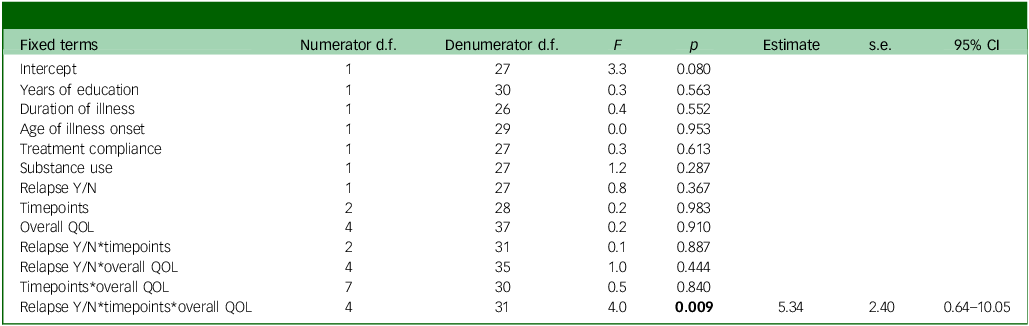
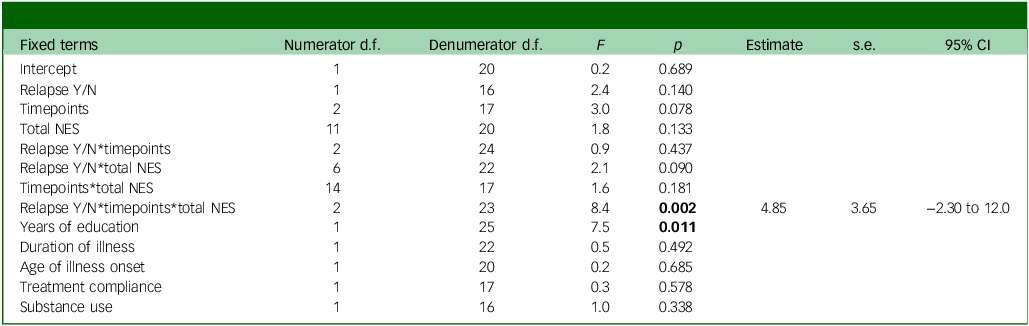
The results indicated that poorer QOL was a significant moderator of the negative symptom trajectory in the relapse group (group*time*QOL): (F(4, 31 = 4.0), p = 0.009; adjusted α = 0.025 (Table 3), and total NSS was a significant moderator of the positive symptom trajectory (group*time*NES total) (F(2, 23 = 8.4), p = 0.002) and the total psychopathology trajectory (F(2, 23 = 4.9), p = 0.017), while level of education stood out as a significant covariate (F(1, 25 = 7.5), p = 0.011); adjusted α = 0.025 (Table 4). Other potential moderators (ASI, STAI-S, STAI-T, PCSAQ, SERS-SF, Connor–Davidson Resilience Scale (CD-RISK), childhood trauma did not reach statistical significance while controlling for age at illness onset, duration of illness, substance misuse, years of education and treatment adherence.
Interaction effects of relapse status and time on negative symptom trajectory associated with overall QOL

Table 3 Long description
The table presents a statistical analysis of various factors affecting illness trajectories and quality of life. It includes columns for Numerator degrees of freedom, Denumerator degrees of freedom, F value, p value, Estimate, standard error, and 95% confidence interval. The rows list different variables such as Intercept, Years of education, Duration of illness, Age of illness onset, Treatment compliance, Substance use, Relapse Y/N, Timepoints, Overall QOL, and interactions between these variables. Each row provides specific values for the columns, indicating the statistical significance and impact of each variable on the outcomes studied. Notable trends include significant p values for the interaction of Relapse Y/N, timepoints, and overall QOL, suggesting a moderating effect of quality of life on symptom trajectories in the relapse group.
F, explained variance; N, no; QOL, quality of life; Y, yes.
‘Group status’ refers to whether participants relapsed (yes) or did not relapse (no) during the 12-month study period. The F value column reports the ratio of variance explained by the effect relative to the variance unexplained (the higher the F value, the greater the effect). Bold is used for p-values with a significance level < 0.05, indicating effects that remained significant after Benjamini–Hochberg correction for multiple comparisons.
Interaction effects of relapse status and time on positive symptom trajectory associated with total NSS

Table 4 Long description
A table with 12 rows and 8 columns. The columns are labeled as Numerator d.f., Denumerator d.f., F, p, Estimate, s.e., 95% CI. The rows are labeled as Intercept, Relapse Y/N, Timepoints, Total NES, Relapse Y/N*timepoints, Relapse Y/N*total NES, Timepoints*total NES, Relapse Y/N*timepoints*total NES, Years of education, Duration of illness, Age of illness onset, Treatment compliance, Substance use. The table presents statistical values for each factor, including degrees of freedom, F values, p values, estimates, standard errors, and 95% confidence intervals. Notable values include p = 0.002 for Relapse Y/N*timepoints*total NES and p = 0.011 for Years of education.
F, explained variance; NES, Neurological Evaluation Scale; N, no.
Directionality of LMMRM associations
In the relapse group, mean QOL scores decreased over time, whereas mean negative symptom scores increased, indicating an inverse association whereby poorer QOL was associated with worsening negative symptom psychopathology. In the non-relapse group, mean NSS and positive symptom scores both increased over time, indicating a positive association whereby more pronounced NSS was associated with worsening positive symptom psychopathology.
We also performed a post hoc Spearman correlation analysis between treatment adherence and NSS, which demonstrated a significant positive correlation (p = 0.016). In other words, better treatment adherence was significantly associated with more pronounced NSS.
Given the small sample size and high attrition rate, we examined the number of observations contributing to each LMMRM model. For the QOL interaction with negative psychopathology, the model included 31 parameters across 73 observations. The standard error of the compound symmetry covariance estimate (2.249) was approximately 45% of the estimate (5.023), indicating substantial uncertainty and probable overparameterisation for the available data. For the NES interaction with positive psychopathology, the model included 46 parameters across 120 observations. A large standard error (3.474) ∼ 81% relative to the estimate (4.313) indicated instability and overfitting of the model. To address concerns regarding model overparameterisation and the fact that relapse status was determined during follow-up, we conducted a complementary, more parsimonious LMMRM analysis together with an extended Cox regression survival analysis, which is presented in the next section.
Complementary LMMRM analysis: to identify time-varying interactions with global psychopathology trajectories between groups
In a complementary LMMRM analysis, we compared global psychopathology trajectories between the relapse and non-relapse groups over 12 months. The dependent variable was the PANSS total score. Relapse status was entered as the between-subjects factor (group), visit as the within-subjects fixed effect (time) and the group*time interaction was used to test differential changes over time. Participant identity was modelled as a random effect. Fixed factors included QOL and NES total scores. Covariates included duration of illness, age at illness onset, years of education, treatment adherence and substance misuse.
A significant group*time interaction was found between NES (F(11, 42 = 3.24), p = 0.003) and PANSS global psychopathology trajectory. The covariates age at illness onset, duration of illness, substance misuse, years of education and treatment adherence did not demonstrate clinically significant interactions. For this LMMRM model, the standard error of the compound symmetry diagonal offset (23.55) was approximately 33% of its estimated value (71.31), indicating acceptable precision of the variance estimate (Supplementary Table S2).
Extended Cox regression survival analysis: predictors of time to relapse
The predicted values from the complementary LMMRM analysis were saved as a time-dependent covariate (T_COV*PANSS total score) and entered into an extended Cox regression survival analysis. This approach allowed the survival model to account for changes in the predictor over time. The T_COV was calculated as (T_≥1)*PANSS total score and entered into the Cox regression model together with QOL total score, NES total score and the covariates duration of illness, age at illness onset, years of education, treatment adherence and substance misuse. To control for Type I error, the Benjamini–Hochberg procedure was applied. Reference Benjamini and Hochberg46
The extended Cox regression survival analysis identified the following significant predictors of time to relapse: fewer years of education (hazard ratio = 0.57, 95% CI = 0.40–0.83, p = 0.003), a shorter duration of illness (hazard ratio = 0.92, 95% CI = 0.86–0.99, p = 0.030) and greater substance misuse exposure (hazard ratio = 1.32, 95% CI = 1.07–1.61, p = 0.008), while controlling for duration of illness, age at illness onset, years of education, treatment adherence and substance misuse. After applying the Benjamini–Hochberg correction for multiple comparisons (QOL total score, NES total score, years of education, duration of illness, age at illness onset, substance misuse, treatment adherence and the time-varying predictor), with an adjusted α = 0.028, fewer years of education and greater substance misuse exposure remained significant predictors of a shorter time to relapse. The overall Cox regression model was statistically significant (p = 0.004). The proportional hazards assumption was satisfied, as the time-varying covariate (T_COV_PANSS total score) was not statistically significant (p = 0.639) (Supplementary Table S3).
Discussion
The present study investigated moderators of psychopathology trajectories over 12 months in individuals with chronic schizophrenia at high risk of relapse. Attrition was substantial (59%), reflecting both the methodological and clinical challenges of maintaining engagement and follow-up despite regular contact efforts. No significant differences were observed in overall symptom trajectories between the relapse and non-relapse groups, consistent with prior findings that, in chronic schizophrenia, global, negative and disorganised symptom patterns often remain relatively stable despite relapses. Reference Moncrieff, Pillai, Marston, Lewis, Barnes and Johnson50 Nevertheless, two exploratory moderating effects emerged: (a) in the relapse group, poorer overall QOL was associated with a worse negative symptom trajectory and (b) in the non-relapse group, more pronounced NSS were associated with a worse positive symptom trajectory. We aimed to examine moderators of psychopathology trajectories in a difficult-to-study chronic LMIC cohort. The exploratory analyses suggested that NSS and QOL may be potential moderators, but model instability and the inherent limitations of the group comparison constrain these findings. We therefore simplified the analytical approach and adopted a complementary joint longitudinal-survival framework, in which level of education and substance misuse emerged as robust predictors of time to relapse.
Despite monthly telephone contacts with participants and caregivers, attrition over 12 months was 59%, highlighting the difficulty of sustaining engagement in this population. For 30 of the 33 participants who discontinued the study, relapse status was confirmed from public-sector clinical records; for 3 participants, relapse status could not be ascertained. High loss to follow-up in real-world psychosis samples in South Africa and other LMICs has been linked to unstable contact details, fragmented services and substance misuse-related instability, which should be considered when interpreting these findings. Reference Daniels, Loganathan, Wilson and Kasckow10,Reference Homman, Smart, O’Neill and MacCabe19,Reference Bruwer, Sorsdahl, Harrison, Stein, Williams and Seedat51
We found some evidence that poorer overall QOL may be associated with a worse negative symptom trajectory in the relapse group, although these findings should be interpreted cautiously as exploratory and hypothesis-generating. Negative symptoms, a core feature of schizophrenia, present substantial therapeutic challenges and are strongly associated with impaired social functioning Reference Abel and Minor52 and diminished QOL. QOL reflects an individual’s perception of their position in life and their personal goals, expectations and concerns. 34 Negative symptoms, characterised by reduced emotional range, loss of interest, poverty of speech, blunted affect and diminished social drive, erode one’s sense of purpose and personal agency. Reference Kirkpatrick and Galderisi53 A lack of perceived personal control and the experience of stigma related to these symptoms often exacerbate these difficulties, contributing to social alienation, poor treatment adherence and subsequent relapse. Reference Singla, Avasthi and Grover54 While poorer QOL appeared to moderate negative symptom trajectories in the relapse group, a similar moderating effect was not observed in the non-relapse group. This may reflect greater clinical stability and protective factors operating among individuals who did not relapse. In the non-relapse group, sustained treatment engagement, relatively preserved coping capacity and more consistent access to care may have buffered the impact of QOL on negative symptom progression. Reference Yamashita, Yoshioka and Yajima55 Under these conditions, negative symptoms may follow a more stable course owing to better perceived QOL, greater resilience and ultimately more effective coping mechanisms. Taken together, these findings raise the possibility that QOL may have a greater influence on negative symptom trajectories in individuals with increased vulnerability to relapse, although this requires confirmation in larger prospective longitudinal studies.
A worse positive symptom trajectory in the non-relapse group appeared to be moderated by more pronounced NSS, although these findings should also be interpreted cautiously as exploratory and hypothesis-generating. However, the non-relapse group demonstrated good medication adherence, yet post hoc analyses indicated that better adherence was significantly associated with more pronounced NSS. The observed associations may reflect a clinical profile characterised by good adherence combined with higher antipsychotic exposure, resulting in more pronounced extrapyramidal side effects without improvement in positive symptoms. Sustained antipsychotic exposure can exacerbate NSS through parkinsonian motor effects, particularly impairments in coordination and sequencing of motor acts. Reference Emsley, Chiliza, Asmal, Kilian, Olivier and Phahladira56 In turn, the secondary analyses revealed that more pronounced NSS was associated with a worse trajectory of positive symptoms. Consequently, the findings may represent a clinical pattern of treatment resistance rather than a true link between adherence, NSS and positive symptom worsening. As extrapyramidal side effects were not formally assessed in this study, this interpretation cannot be confirmed.
Although NSS appeared to moderate the trajectory of positive symptoms in the non-relapse group, a comparable moderating effect was not observed in the relapse group. This discrepancy is likely attributable to fundamental differences in the clinical dynamics driving symptom change across groups. In the relapse group, acute symptom exacerbation and subsequent re-hospitalisation are typically precipitated by medication discontinuation, which may overshadow the influence of NSS. In contrast, the non-relapse group exhibited greater clinical stability and sustained antipsychotic exposure owing to good treatment adherence, creating conditions under which NSS, whether neurodevelopmental or medication-related, could meaningfully influence symptom trajectories. As such, the absence of a moderating effect in the relapse group should be interpreted cautiously and may reflect differing illness dynamics rather than the absence of a true relationship.
Additionally, level of education appeared to play a significant role in the relationship between NSS and extrapyramidal side effects. Lower educational attainment is often associated with reduced cognitive reserve and greater baseline neurodevelopmental burden, which may itself be reflected in more pronounced NSS. Reference Watson and Joyce57 In this context, NSS may partly index underlying cognitive vulnerability rather than solely medication-related extrapyramidal side effects. Indeed, NSS are regarded as neurodevelopmental markers reflecting aberrant neural maturation and connectivity in individuals with schizophrenia. Reference Bersani, Iannitelli, Massoni, Garavini, Grilli and Di Giannantonio58,Reference Viher, Stegmayer, Bracht, Federspiel, Bohlhalter and Strik59 They have also been associated with poor clinical response and a greater risk of extrapyramidal side effects with risperidone or typical antipsychotics. Reference Smith and Kadewary60–Reference Jahn, Hubmann, Karr, Mohr, Schlenker and Heidenreich62 Disentangling these trait and state contributions will require future studies incorporating formal extrapyramidal rating scales.
In a complementary, more simplified analysis, lower educational attainment was associated with a shorter time to relapse. Although exploratory, this finding is consistent with evidence linking lower education to reduced cognitive reserve, poorer social and occupational functioning, unemployment and socioeconomic disadvantage in schizophrenia. Reference Watson and Joyce57,Reference Tempelaar, Termorshuizen, MacCabe, Boks and Kahn63–Reference Thornicroft, Brohan, Rose, Sartorius and Leese66 These factors, together with structural barriers such as poverty, transport difficulties and limited access to care, may reduce sustained treatment engagement and increase vulnerability to relapse. Reference Lund, Brooke-Sumner, Baingana, Baron, Breuer and Chandra67–Reference Uhlmann, Kaehler, Harris, Unser, Arolt and Lencer70
The complementary simplified analysis also revealed that greater substance misuse exposure was associated with a shorter time to relapse in this chronic LMIC sample. Although exploratory, this finding is consistent with previous research linking substance misuse to poorer clinical outcomes and increased relapse risk in schizophrenia. Reference Swofford, Kasckow, Scheller-Gilkey and Inderbitzin71,Reference Menezes, Johnson, Thornicroft, Marshall, Prosser and Bebbington72 Substance misuse in schizophrenia is likely shaped by a combination of social and structural factors, including poverty, unemployment, limited educational opportunities, social isolation and exposure to high-risk environments. Reference Clark, Ricketts and McHugo73,Reference Charlson, Ferrari, Santomauro, Diminic, Stockings and Scott74 In addition, some individuals may use substances in an attempt to cope with distressing psychotic experiences or social difficulties. Reference Asher and Gask75 Consistent with previous reports, substance use was also associated with factors such as missed appointments and greater hospitalisation burden. Reference Swofford, Scheller-Gilkey, Miller, Woolwine and Mance76,Reference Cantor-Graae, Nordström and McNeil77
Compounding these vulnerabilities are substantial structural stressors, including community-level barriers, substance misuse, crime, exploitation, homelessness, unemployment and stigmatisation. Reference Laudet, Magura, Vogel and Knight16,Reference Burns and Esterhuizen69,Reference Corrigan78 Systemic barriers to care, such as fragmented services and poor continuity of follow-up, further diminish both functioning and perceived QOL. Reference Bruwer, Sorsdahl, Harrison, Stein, Williams and Seedat51 As noted by Hjelm et al, Reference Hjelm, Handa, de Hoop, Palermo, Zambia and Teams17 relapse is more likely to occur when environmental stressors exceed an individual’s capacity to cope. While the original aim of this study was to explore relapse risk factors beyond treatment non-adherence, the findings suggest that, in this context, relapse remains closely tied to non-adherence and substance misuse, highlighting the need for more sustained engagement and psychosocial support for this underserved group.
Strengths and limitations
This study has several limitations that should be acknowledged. First, the relatively small sample size may have resulted in insufficient statistical power to detect additional potential risk factors, particularly when accounting for multiple comparisons and the complex psychosocial pathology characterising this population. Given that the sample comprised individuals with chronic schizophrenia, potential confounding effects related to multiple medications, prior treatment histories and illness chronicity may also have influenced our findings.
Although missingness was modelled under a missing-atrandom assumption, with adjustment for observed baseline characteristics as accommodated by LMMRM, this assumption was likely only partially met. Participants who dropped out differed significantly from completers, particularly in being younger and having a history of substance misuse, and overall attrition was high (59%). Given the established influence of younger age and substance use on symptom course and relapse risk, the selective loss of these participants may have biased estimates and contributed to the absence of significant differences in psychopathology trajectories between the relapse and non-relapse groups.
In addition, the reduced sample size limited statistical power to detect group differences. Consequently, the absence of significant differences in psychopathology trajectories over 12 months between the relapse and non-relapse groups should be interpreted with caution and considered hypothesis-generating. The high attrition rate may also have had a pronounced impact on the secondary analyses, as moderation models are particularly sensitive to sample size. The LMMRM models were overparameterised, while comparisons between the relapse and non-relapse groups were inherently limited because group status was determined during follow-up.
The predominantly male composition of the sample (93%) further limits the generalisability of the findings to female participants with schizophrenia. Although males and females were comparable in socioeconomic background and psychopathology histories, sex-related differences in illness course, symptom expression and functional outcomes have been reported in the literature and may have influenced QOL and NSS. The observed results of the moderating effects on psychopathology trajectories may not equally apply to female participants because of their underrepresentation in the study. However, this attrition also reflects the inherent difficulty of maintaining contact and engagement in this population, which remains a key real-world challenge in longitudinal schizophrenia research in LMICs.
Nonetheless, this study also possesses several strengths. Participants were carefully selected at study entry and were clinically stable, treatment-adherent and free of substance use, enhancing internal validity. The study was labour-intensive, requiring sustained effort to retain participants over the 12-month follow-up period despite significant socioeconomic and psychosocial challenges, which contribute to the underrepresentation of such cohorts in research. Importantly, the longitudinal design enabled a comprehensive examination of several potential moderators of relapse beyond treatment non-adherence.
Implications for practice
Although exploratory and hypothesis-generating, these findings suggest that both NSS and QOL may offer clinically meaningful insights into the course of illness among individuals with chronic schizophrenia. More pronounced NSS was associated with a worse trajectory of positive symptoms in the non-relapse group, while poorer QOL was associated with worse trajectory of negative symptoms in the relapse group. In routine clinical practice, incorporating brief assessments of NSS and QOL could help clinicians identify individuals who may require closer monitoring. More broadly, the high attrition observed emphasises the importance of strengthening follow-up systems and addressing contextual barriers to sustained engagement in care.
Implications for research
This study highlights the persistent challenges of participant retention and follow-up in longitudinal research involving individuals with chronic schizophrenia at risk of relapse in real-world LMIC settings. These participants are frequently underserved, face unstable living conditions and are at high risk of disengagement from care, all of which contribute to high attrition. Future research should prioritise the development of feasible, context-sensitive follow-up strategies, such as community-based tracking, digital engagement tools or caregiver-supported contact systems, to improve retention. Larger longitudinal outcome studies are needed to clarify the mechanisms linking psychosocial adversity, treatment adherence and relapse trajectories, and to inform scalable interventions tailored to this high-risk group.
Supplementary material
The supplementary material is available online at https://doi.org/10.1192/bjo.2026.12061
Data availability
The data that support the findings of this study are available from the corresponding author (R.S.) upon reasonable request.
Acknowledgements
This study was funded by the Department of Psychiatry, Stellenbosch University.
Author contributions
R.S. contributed to data collection, extraction and coding, analysis and interpretation, design and writing of the manuscript. L.A. and R.E. conceived and designed the study. L.A., H.L. and L.P. collected, extracted and coded the study data. R.E., H.L. and L.A. contributed to data analysis and interpretation. L.A. and R.E. supervised the study. H.L., L.P., R.E., S.K. and L.A. reviewed and edited the manuscript and approved the final version.
Funding
The funding sources had no role in the study design, data collection, analysis or interpretation, writing of the report or the decision to submit the paper for publication.
Declaration of interest
R.E. has received honoraria from AstraZeneca, Bristol-Myers Squibb, Janssen, Eli Lilly, Lundbeck, Organon, Pfizer, Servier, Otsuka and Wyeth for participating in advisory boards and speaking at educational meetings. L.P., L.A., H.L., S.K. and R.S. declare that they have no conflicts of interest.
Transparency declaration
R.S. confirms that the manuscript is an honest, accurate and transparent account of the study being reported; that no important aspects of the study have been omitted; and that any discrepancies from the study as planned (and, if relevant, registered) have been explained. ChatGPT was utilised for grammatical errors, sentence construction and flow.




 Open access


eLetters
No eLetters have been published for this article.