


Introduction
Emotion regulation is one of the most studied domains in psychological literature due to its centrality to human experience and mental health. It can be described as the processes, actions and goals individuals use to influence emotions and emotional experiences. This definition implies that emotion regulation can be viewed as a set of intrapersonal sequential multi-stage processes that individuals apply to influence their emotions. Difficulties in emotion regulation have been associated with anxiety, mood disorders, post-traumatic stress disorders, schizophrenia and with the development of psychological problems.
Despite the valid theoretical framing and empirical data, research has focused mainly on the intrapersonal aspect of emotion regulation. Thus, researchers have only recently started exploring the interpersonal aspect of emotion regulation. Interpersonal emotion regulation (IER) can be seen as the individuals’ regulatory efforts to regulate another person’s emotions and can be divided into ‘intrinsic vs extrinsic’ and ‘response-dependent vs response-independent’ regulation (Zaki and Williams, Reference Zaki and Williams2013). Intrinsic interpersonal regulation describes a set of processes that the person does interpersonally to regulate his/her emotions, while extrinsic emotion regulation describes a set of processes in which a person regulates others’ emotions (Zaki and Williams, Reference Zaki and Williams2013). Response-dependent interpersonal regulation relies on specific responses from other people. Response-independent processes, on the other hand, do not need to have a specific response from others, where identifying, differentiating and symbolizing emotions in words may be sufficient to regulate emotions of the self (Sarısoy-Aksüt and Gençöz, Reference Sarısoy-Aksüt and Gençöz2020).
The IERQ (Hofmann et al., Reference Hofmann, Carpenter and Curtiss2016) was developed to assess how individuals use others to regulate their emotions (it can be viewed as intrinsic emotion regulation, according to Zaki and Williams, Reference Zaki and Williams2013). The development of the IERQ took several steps (studies). In the first, a pool of items was generated (105) in a qualitative study where participants responded to open-ended questions about how they usually regulate their emotions. In the second study, an EFA was conducted resulting in 60 items. In the third study, another EFA and CFA were conducted emerging four factors, namely, Enhancing Positive effect (tendency to ask others to enhance feelings of happiness); Soothing (asking others for comfort); Perspective Taking (use of others to be reminded not to worry and that others have it worse) and Social Modelling (modelling others about how they cope with similar difficult situations). IERQ subscales showed adequate internal consistency, re-test reliability, and expected associations with depression, anxiety and other emotion-focused measures. The IERQ has been translated and adapted into Turkish (Koç et al., Reference Koç, Aka, Doğruyol, Curtiss, Carpenter and Hofmann2019; Sarısoy-Aksüt and Gençöz, Reference Sarısoy-Aksüt and Gençöz2020), Iranian, Persian and Indian. The IERQ was psychometrically consistent with the original study in all studies. Despite the dissemination of the IERQ it has not been translated and adapted to European Portuguese.
The present paper aimed to conduct a preliminary psychometric analysis of the IERQ using confirmatory factor analysis (CFA) to establish its construct validity by replicating the four-factor model and to test convergent validity with the Emotion Regulation Questionnaire (ERQ; Gross and John, Reference Gross and John2003) subscales cognitive reappraisal and expressive suppression.
Method
Participants
The sample was composed of 165 women (62.0%), 100 men (37.6%) and one non-binary person (.4%), with a mean age of 35.02 (SD=12.8; min=18, max=73, amp=53). Most participants were Portuguese (245; 92.1%) and Brazilian (17; 7.3%). Relationship status were the following: dating (120; 54.1%), civil union (69; 25.9%), married (66; 24.8%) and other (6; 2.3%). In the supplementary material we present a more detailed description of the sample’s sociodemographic characteristics.
Measures
Socio-demographic questionnaire
The research team developed a socio-demographic questionnaire to characterize the sample on variables of interest such as age, gender, education, professional status and relationship status.
Interpersonal Emotion Regulation Questionnaire (IERQ)
The IERQ (Hofmann et al., Reference Hofmann, Carpenter and Curtiss2016) is a 20-item self-report questionnaire that assesses four interpersonal emotion regulation strategies: Positive Affect, Soothing, Perspective Taking, and Social Modelling. It has a 5-point Likert scale ranging from 1 (does not apply to me) to 5 (applies to me totally). See Table 1 for internal consistency.
Descriptive statistics and Pearson correlations between scales and subscales of the Interpersonal Emotion Regulation Questionnaire and the Emotion Regulation Questionnaire (N=266)
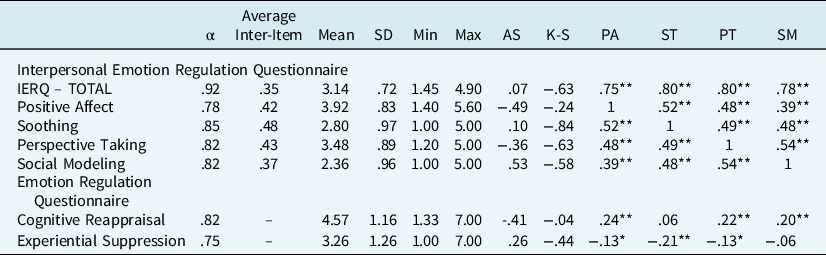
Note: α = Cronbach alpha; SD = Standard Deviation; Min = Minimum; Max = Maximum; AS= Asymmetry; K-S= Kurtosis; * = p< .05; ** = p < .01; PA = Positive Affect; ST = Soothing; PT = Perspective Taking; SM = Social Modeling.
Emotion Regulation Questionnaire (ERQ)
The ERQ (Gross and John, Reference Gross and John2003) is a self-report questionnaire that assesses two regulatory strategies: cognitive reappraisal and expressive suppression. It has a 7-point Likert-type scale ranging from 1 (strongly disagree) to 7 (strongly agree). Higher values indicate higher levels of cognitive reappraisal or expressive suppression. The present study considered the internal consistency adequate for cognitive reappraisal (α=.82) and experiential suppression (α=.75).
Procedures
After permission to adapt to European Portuguese, the recommended procedures for adapting psychological measures (e.g. translation and back-translation; cognitive interviewing-like procedures) were applied.
The survey received positive deontological appreciation by Ethical and Deontological Committee for Scientific Research of the Lusofona University- Lisbon, and after it was implemented in Qualtrics. The link was disseminated online from December 2019 to April 2020 following a snowball-like method: the second author disseminated the link through her social media accounts and different people participated and shared the URL through their networks.
Analytical strategy
Descriptive statistics were used for the sample basic description. The factor structure was examined with CFA with maximum likelihood estimation. Normality was explored with skewness and kurtosis, and all variables were normal. Goodness-of-fit for the CFA model was checked using the following criteria: chi-squaired (χ2) with a ratio <5 as an acceptable ratio, as well as Tucker–Lewis index (TLI), and comparative fit index (CFI) with a cut-off ≥.90 as acceptable. Root mean square error of approximation (RMSEA) with a value <.08 was also considered acceptable. The sample size was larger than 150 participants. Internal consistency was evaluated using Cronbach’s alpha; α≥60 was considered acceptable. The average inter-item correlation was considered acceptable within values between .15 and .50. Pearson moment-to-moment correlations were used to conduct a correlational analysis. Missing values of participants’ responses in the database were corrected with mode imputation procedures. All analyses were performed in the IBM SPSS Statistics (version 25) and IBM AMOS (version 27).
Results
In Table 1 we describe Cronbach’s alphas, average inter-item correlation, means, standard deviations, minimum, maximum, asymmetry, kurtosis and Pearson’s correlations for the Interpersonal Emotion Regulation Questionnaire and Emotion Regulation Questionnaire.
A CFA analysis was conducted to confirm the factorial structure. The sample was composed of 266 participants (M=35.02, SD=12.8). Results showed the following model fit: χ2=294,327, d.f.=148, TLI=.91, CFI=.94, RMSEA=.061 (.050–.070), which is an adequate fit to the data (see Fig. 1).
Confirmatory factor analysis of the Interpersonal Emotion Regulation Questionnaire (n=266).

Discussion
The present paper aimed to describe the psychometric properties of the IERQ in a community sample of a European Portuguese-speaking sample. This is the first attempt to explore the factor structure and convergent validity of the IERQ in European Portuguese. Results suggest that the IERQ may be a valid measure to assess interpersonal regulation strategies in the European Portuguese-speaking population.
The CFA showed clearly that the factorial structure of the IERQ has four factors, equal to the original study (Hofmann et al., Reference Hofmann, Carpenter and Curtiss2016), the Turkish adaptation (Koç et al., Reference Koç, Aka, Doğruyol, Curtiss, Carpenter and Hofmann2019), and the Iranian adaptation (Abasi et al., Reference Abasi, Hofmann, Kamjou, Moradveisi, Motlagh, Wolf, Sobhani and Saed2021). All items are loaded on theoretical factors, suggesting that the IERQ may have a robust factorial structure in different cultures. Factor loadings of items 1 and 7 were below .50, meaning they have a lower weight on the corresponding factor. However, according to overall CFA indexes, this does not compromise the factor structure. In this sense, it was decided to keep items 1 and 7 because they capture relevant aspects of social modelling and perspective-taking constructs.
Average inter-item correlations revealed satisfactory results, which suggest adequate reliability of the IERQ with the study sample. In this sense, these results suggest that individuals may regulate their emotions by relying on others in four different ways. Individuals may Enhance Positive affect by being and staying near others, as described in item 8, ‘I like being in the presence of others when I feel positive because it magnifies the good feeling’. Individuals may engage in Perspective Taking, where the situations of others can be used to put things such as described in item 2, ‘It helps me deal with my depressed mood when others point out that things aren’t as bad as they seem’. Individuals may also engage in Soothing by asking others for comfort, as described in item 4, ‘I look for other people to offer me compassion when I’m upset’. Finally, individuals may use Social Modelling by learning how others deal with distressful emotions, as described in item 1, ‘It makes me feel better to learn how others dealt with their emotions’. Moreover, these results, despite being produced from a non-clinical sample, add incremental validity that individuals use not only intrapersonal emotions regulation strategies to regulate their emotions but also use interpersonal strategies to regulate their emotions (Sarısoy-Aksüt and Gençöz, Reference Sarısoy-Aksüt and Gençöz2020).
The internal consistency of the IERQ was considered very good, and convergent validity was also satisfactory. These findings align with previous results where cognitive reappraisal and experiential suppression are positively and negatively associated with interpersonal regulation strategies. However, cognitive reappraisal did not correlate with soothing, and expressive suppression did not correlate with social modelling. These results can be interpreted from the sequential perspective model of emotion regulation, where individuals tend to follow a sequence of internal actions in emotion processing (Gross and John, Reference Gross and John2003).
On the one hand, cognitive reappraisal is an antecedent-focused strategy that means enhancing positive affect and perspective-taking. Social modelling can also be used as an antecedent strategy before emotion generation. On the other hand, experiential suppression is a consequent-focused strategy, meaning that individuals who rely on interpersonal strategies tend to rely less on intrapersonal consequent-focused strategies (after emotion generation). Other authors have divided emotion regulation strategies into two domains, cognitive and behavioural, which seem to match intrapersonal and interpersonal strategies of cognitive reappraisal, enhancing positive affect, perspective taking, and social modelling (cognition), and soothing and experiential suppression (emotional/behavioural). However, more research is required to explore these issues, especially if there is complete segregation between cognitive and behavioural emotion strategies on intrapersonal and interpersonal levels.
Furthermore, a consistent body of research suggests emotion regulation as a potential transdiagnostic factor (Cludius et al., Reference Cludius, Mennin and Ehring2020). However, most research has focused on intrapersonal emotion regulation strategies. In this sense, future studies should also consider both intrapersonal and interpersonal emotion regulation strategies as potential candidates to be transdiagnostic factors to be addressed in psychopathological disorders.
Limitations
The samples under study were composed of a community sample, and psychopathology or psychopathology indicators, were not assessed. Furthermore, only one instrument was used to explore convergent validity (ERQ), and no divergent or criterion validity was explored. Future studies should test IERQ psychometric properties in clinical samples and combine it with other measures to explore divergent and discriminant validities.
Supplementary material
The supplementary material for this article can be found at https://doi.org/10.1017/S1352465823000413
Data availability statement
Data are not shared, because they belong to an ongoing project.
Acknowledgements
The authors would like to thank all people who advertised and participated in this study.
Author contributions
Bruno Faustino: Conceptualization (equal), Data curation (equal), Methodology (equal), Writing – original draft (equal); Patricia Pascoal: Conceptualization (equal), Investigation (equal), Methodology (equal), Project administration (equal), Validation (equal), Writing – review & editing (equal).
Financial support
No funding was received for this work.
Competing interests
The authors declare that they have no competing interests.
Ethical standards
This study was approved by the Ethical and Deontological Committee for Scientific Research of the Lusofona University- Lisbon, and complied with the Ethical Principles of Declaration of Helsinki. This paper reflects an original unpublished scientific study. All participants gave consent to participate.




Comments
No Comments have been published for this article.