Introduction
The first of the species currently placed in the genus Trapelia was described (as Lichen coarctatus) by Smith (Reference Smith1798) who provided a colour illustration but no microscopic or chemical data. A number of additional species which are now regarded as belonging to the genus were described during the 19th century, mainly from Europe. These include Lecidea cotaria and Parmelia elacista (Acharius Reference Acharius1803), Lichen glebulosus (Smith Reference Smith1808), again with a good colour illustration clearly showing differences from Lichen coarctatus, Lecanora involuta (Taylor in Mackay Reference Mackay1836) and Lecidea pallidocervina (from Brazil, Krempelhuber Reference Krempelhuber1876). A sorediate taxon was described as Biatora coarctata subsp. obtegens (Fries Reference Fries1867). Choisy (Reference Choisy1929) described a new genus, Trapelia, with Trapelia coarctata (as Lecidea coarctata) as the type. It was distinguished from other taxa then placed in Lecanora by the cylindrical asci, uniseriate spores and the rose-coloured hymenium with little reaction in iodine. Since then, additional species have been described from all major regions of the world, including the Caribbean (Zahlbruckner Reference Zahlbruckner1930), North America (Brodo & Lendemer Reference Brodo and Lendemer2015), Madeira (Aptroot & Schum Reference Aptroot and Schumm2012), South Africa (Brusse Reference Brusse1987, Reference Brusse1991), South Korea (Kondratyuk et al. Reference Kondratyuk, Lőkös, Halda, Haji Moniri, Farkas, Park, Lee, Oh and Hur2016), Australasia (Fryday Reference Fryday2004; Kantvilas & Elix Reference Kantvilas and Elix2007; Kantvilas et al. Reference Kantvilas, Leavitt, Elix and Lumbsch2014) and Antarctica (Ertz et al. Reference Ertz, Aptroot, Van de Vijver, Sliwa, Moermans and Øvstedal2014).
Hertel (Reference Hertel1969) accepted the genus Trapelia and compared it to morphologically similar genera. The genus was said to be characterized by the subcylindrical asci with I− or weakly I+ walls and a weakly thickened apex, the slender, anastomosing paraphyses with unswollen tips, and the absence of cephalodia. Three species were accepted: T. coarctata (noted as a cosmopolitan collective species but not treated further), T. torellii (now Ainoa mooreana) and T. geochroa (now Ainoa geochroa).
Hertel (Reference Hertel1970) validly published the family Trapeliaceae for the genera Trapelia, Placopsis, Orceolina and four species placed under the provisional name ‘Trapeliopsis’ (later validated in Schneider Reference Schneider1979). The family was distinguished from other lecideoid lichens by characters including narrow paraphyses often forked near the tip but scarcely expanded, the inamyloid ascus wall, the frequent presence of gyrophoric acid and the filiform conidia. Seven species were listed in Trapelia: T. coarctata, T. geochroa (now in Ainoa), T. mayaguez, T. obtegens, T. ornata, T. pallidocervina and T. torellii (now Ainoa mooreana).
Hafellner (Reference Hafellner1984) retained the Trapeliaceae with a similar circumscription to that of Hertel (Reference Hertel1970), but Lumbsch (Reference Lumbsch1997) placed the family in synonymy with a broadly defined Agyriaceae, also including Rimulariaceae and Saccomorphaceae.
Schmitt et al. (Reference Schmitt, Mueller and Lumbsch2005) investigated the phylogeny of the genus Placopsis within the family Agyriaceae, using nuclear ITS, LSU and mitochondrial SSU rDNA. The genus as then understood was found to be non-monophyletic. The bulk of the species formed a sister clade to a clade containing Orceolina and P. macrophthalma (the latter consequently transferred to the resurrected genus Aspiciliopsis). Four species of Trapelia were included in the analysis and formed a monophyletic group basal to a Placopsis/Orceolina/Aspiciliopsis clade.
Lumbsch et al. (Reference Lumbsch, Schmitt, Mangold and Wedin2007), using a three-gene analysis, found that the family Agyriaceae as then circumscribed was non-monophyletic. The non-lichenized Agyrium was retained in the family and lichenized members were transferred to the resurrected family Trapeliaceae, comprising ten genera. Two species of Trapelia were used in the analysis. Genera used in the analysis and considered to belong in Trapeliaceae were Trapelia, Trapeliopsis, Orceolina, Placopsis and Placynthiella.
Resl et al. (Reference Resl, Schneider, Westberg, Printzen, Palice, Thor, Mayrhofer and Spribille2015) investigated the placement of trapelioid lichens within Lecanoromycetes, using a wide taxonomic sampling and eight gene loci. The analysis suggested a monophyletic Trapeliaceae sister to Xylographaceae and comprising (amongst the genera studied) Trapelia, Trapeliopsis, Rimularia p.p., Placynthiella and Placopsis. Rimularia was found to be non-monophyletic and some species were transferred to a newly described genus, Lambiella, in the Xylographaceae; Rimulariaceae was synonymized with Trapeliaceae. The genus Trapelia was recovered as non-monophyletic, with Placopsis nested within it. Specimens named as Trapelia coarctata and T. glebulosa were both recovered in different clades within Trapelia, indicating taxonomic problems at species level.
Schneider et al. (Reference Schneider, Resl and Spribille2016) examined the phylogeny of Placopsis and Trapelia in relation to the acquisition of cephalodia in the clade which corresponds to the former genus. They showed that the increased availability of nitrogen associated with the acquisition of the cyanobacterial symbiont allowed an increase in thallus thickness and apothecial volume, with a corresponding increase in morphological characters available to the taxonomist. Thus most of the Placopsis species recovered by the molecular analysis corresponded to species already described using morphology alone. In contrast, 13 species were delimited in the non-cephalodiate taxa corresponding to the genus Trapelia, for which only six published names were available. The authors attributed this to the small and simple thallus in Trapelia, which they termed a ‘small canvas’ for the exhibition of the phenotype, resulting in non-monophyletic and poorly understood species.
At the beginning of the present study, 20 species of Trapelia were accepted worldwide. Most regions contain only a small number of taxa, for instance five in Europe (Smith et al. Reference Smith, Aptroot, Coppins, Fletcher, Gilbert, James and Wolseley2009; Wirth et al. Reference Wirth, Hauck and Schultz2013; Roux et al. Reference Roux, Monnat, Gonnet, Gonnet, Poumarat, Esnault, Bertrand, Gardiennet, Masson and Bauvet2017), three in South Africa (Fryday Reference Fryday2015), three in North America (Brodo & Lendemer Reference Brodo and Lendemer2015), and nine in Australasia (Galloway Reference Galloway2007; McCarthy Reference McCarthy2016). A number of taxa have been considered to be very widespread: Trapelia coarctata is reported from regions including Europe, South Africa, North America, Australasia (preceding references), South America (Hafellner Reference Hafellner1984) and Antarctica (Hafellner Reference Hafellner1984). Most taxa are reported from rock (rarely also on soil), with two confined to soil (Trapelia rubra, Aptroot & Schum Reference Aptroot and Schumm2012; T. crystallifera, Kantvilas & Elix Reference Kantvilas and Elix2007) and one to bark (T. corticola, Coppins & James Reference Coppins and James1984). In Europe the saxicolous species are familiar as early colonizers of exposed rock surfaces, sometimes as a major component of a pioneer lichen community (Wirth Reference Wirth1972: 133), but also occurring at low frequency and low cover in numerous other lichen communities (Orange Reference Orange2009) where they are sometimes clearly associated with small-scale disturbance (Orange Reference Orange2009: 128).
In Great Britain, Trapelia coarctata has long been regarded as a variable species. Leighton (Reference Leighton1879) called Lecidea coarctata “a very variable lichen”, and listed eight formae; this variable taxon evidently covered all the British species accepted below. Smith (Reference Smith1921) described Lecidea coarctata as a “very protean species” and included a var. elacista, said to differ from the type in the “thinner, often subpulverulent thallus and the smaller apothecia”, and a var. glebulosa, described as “verrucose-glebulose or subsquamulose”. She noted that the latter was “looking when best developed as if it were even a distinct species”. In the British checklist of James (Reference James1965), Lecidea coarctata was considered to include all the previously treated infraspecific taxa, including var. obtegens. In the following checklist (Hawksworth et al. Reference Hawksworth, James and Coppins1980) the genus Trapelia was accepted, and T. coarctata, T. involuta, T. mooreana (now in Ainoa) and T. obtegens were listed. Later, two distinctive new species were described: Trapelia corticola and T. placodioides (Coppins & James Reference Coppins and James1984), bringing the total number of accepted species to five. Laundon (Reference Laundon2005) synonymized Trapelia involuta with T. glebulosa, but this was a purely nomenclatural change that did not seriously consider the possibility that they represented separate species. Following these changes to the taxonomy of the genus, the latest British lichen flora still described T. coarctata as “very variable” (Purvis et al. Reference Purvis, Coppins, Wolseley and Fletcher2009).
The writer has long experienced difficulty in assigning some specimens to the currently accepted species of Trapelia, and suspected that a new taxonomy was needed at species level. The recent studies quoted above confirm that there is considerable confusion regarding the limits of certain species. Consequently, an investigation using DNA sequencing, thin-layer chromatography and morphological study was initiated. As the investigation proceeded, and following examination of herbarium material in BM and NMW, it became clear that many herbarium specimens could not be confidently assigned to the newly delimited species. This was due to a number of factors: the natural variability of the species, the poor preservation of some specimens, and the presence of a proportion of poorly collected or inadequate material. It was decided to base the descriptions of the taxa, and data on their distribution, almost exclusively on sequenced specimens, in order to ensure that the new taxonomy was established on a firm basis. In recent years the writer has been able to make significant collections of fresh material in Great Britain and in the Falkland Islands, supplemented by a small number of specimens from Germany. Material from these disparate areas forms the basis of the present study.
Material and Methods
Thin-layer chromatography was carried out using solvent systems C and EA, following standard methods (Orange et al. Reference Orange, James and White2010). Micarea coppinsii and Parmelinopsis minarum were used as controls for 5-O-methylhiascic acid.
Approximately 110 specimens of Trapelia were collected specifically for the present study. In addition, 12 sequenced vouchers from GZU were examined together with type specimens from a number of herbaria. This material was used in the following investigations. All material of Trapelia in BM and NMW was examined but only a small number of specimens were studied in detail, as explained in the Introduction.
Thallus and apothecial sections were mounted in water and 5% KOH (K); the presence of crystals was investigated using crossed polarizing filters (POL). Asci were examined in water and c. 0·5% IKI, before and after treatment with K. Ascospores were measured in 5% KOH and the number of spores assessed is cited in brackets after the measurements for each species, followed by the number of specimens from which spores were measured (for example ‘[32/3]’).
Recently collected or frozen material of Trapelia, as currently circumscribed, was used to generate DNA sequences. A species of Trapeliopsis was used as outgroup in the ITS analysis, as suggested by the phylogenetic tree presented by Resl et al. (Reference Resl, Schneider, Westberg, Printzen, Palice, Thor, Mayrhofer and Spribille2015). Cladonia cervicornis was used as outgroup in the beta-tubulin analysis. Although Resl et al. showed that Placopsis is nested within Trapelia as currently circumscribed, Placopsis is a morphologically well-defined monophyletic group and outside the scope of the present study. All ITS and mtSSU sequences for Trapelia species on GenBank, downloaded on 27 March 2017, were used in the relevant analyses, with the exception of an ITS sequence (GenBank Accession number KR017056) attributed to Trapelia antarctica as a BLAST search suggested this sequence belonged to a non-lichenized contaminant.
DNA was extracted using the Qiagen DNeasy Plant Mini Kit; the manufacturer’s instructions were followed except that warm water was used for the final elution. PCR amplification was carried out using Bioneer AccuPower PCR Premix in 50 µl tubes. The two internal transcribed spacer regions and the 5.8S region (ITS1-5.8S-ITS2) of the nuclear ribosomal genes were amplified, using the primers ITS1F and ITS4. The PCR thermal cycling parameters were: initial denaturation for 5 min at 94°C, followed by 5 cycles of 30 s at 94°C, 30 s at 55°C and 1 min at 72°C, then 30 cycles of 30 s at 94°C, 30 s at 52°C and 1 min at 72°C. PCR products were visualized on agarose gels stained with ethidium bromide and purified using the Sigma GenElute PCR Clean-Up Kit. DNA sequencing was performed by DNA Sequencing & Services (MRC I PPU, College of Life Sciences, University of Dundee, Scotland, www.dnaseq.co.uk) using Applied Biosystems BigDye v3.1 chemistry on an Applied Biosystems 3730 automated capillary DNA sequencer. Sequences were assembled and edited using GeneStudio software (http://www.genestudio.com). Alignment was carried out using BioEdit (http://www.mbio.ncsu.edu/BioEdit/bioedit.html) and ClustalW was used to create an initial alignment, which was edited manually. Ambiguously aligned regions were deleted before further analysis.
Maximum likelihood (ML) analyses were used to investigate phylogenetic relationships and support values. Analysis was performed using RAxML v8.2.10 (Stamatakis Reference Stamatakis2014), as hosted on the CIPRES Science Gateway (Miller et al. Reference Miller, Pfeiffer and Schwartz2010). PartitionFinder v2.1.1 (Guindon et al. Reference Guindon, Dufayard, Lefort, Anisimova, Hordijk and Gascuel2010; Lanfear et al. Reference Lanfear, Calcott, Ho and Guindon2012, Reference Lanfear, Frandsen, Wright, Senfeld and Calcott2017) was used to optimize partitions and substitution models. Three regions of the ITS (ITS1, 5.8S, ITS2), and the codon positions in the beta-tubulin sequences, were used as input. No partitions were suggested for mtSSU. Parameters included linked branch lengths and greedy search, and the ‘--raxml’ command was used to limit the number of models to those used in RAxML. PartitionFinder returned GTR+G+I for each ITS region and for mtSSU, and GTR for each beta-tubulin codon position. Analyses with RAxML used rapid bootstrapping with 1000 iterations and the GTRGAMMAI substitution model; a search for the best-scoring ML tree was carried out with the bootstrap analysis in a single run. The resulting tree was visualized using MEGA v4 (Tamura et al. Reference Tamura, Dudley, Nei and Kumar2007). Support values of ≥70% maximum likelihood bootstrapping were regarded as significant.
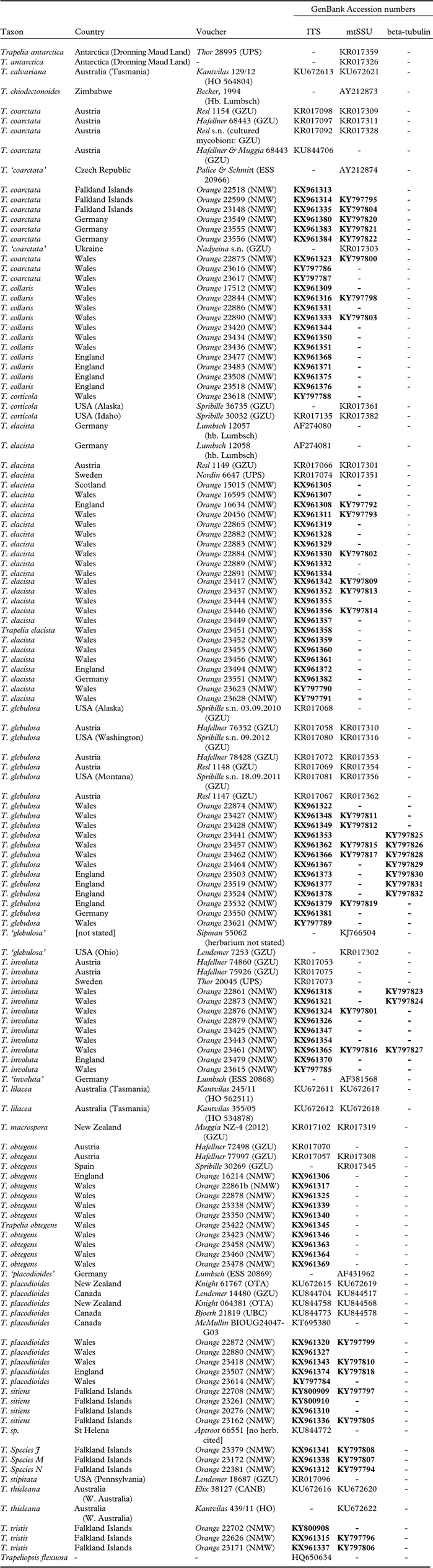
Sequences used in the analyses are shown in Table 1.
Sequences used in the phylogenetic analyses of Trapelia. New sequences are in bold. Where no ITS sequence was available, the original identification is placed in inverted commas if there is doubt about the correct name

Results
Thin-layer chromatography
All specimens examined contained one or both of gyrophoric acid and 5-O-methylhiascic acid. Where both were present, one compound was in greater quantity than the other, as estimated visually from the size and intensity of colour of the spot on the plate. The two substances were well separated by solvent system C: relative Rf values were 21 for gyrophoric acid and 30 for 5-O-methylhiascic acid. Under long-wave UV on the unheated plate 5-O-methylhiascic acid showed a faint fluorescence, whereas gyrophoric acid was UV−. Eleven samples from various species were run in solvent system EA to check for the presence of lecanoric acid but this was not found, except as a possible trace in some. In this solvent system, all three substances closely followed the solvent front but 5-O-methylhiascic acid had the lowest Rf value, followed by gyrophoric acid and then lecanoric acid (as a control).
ITS analysis
ITS sequences were newly prepared for 91 specimens and 33 additional sequences were available from GenBank. The ITS alignment was 525 bp in length. A total of 145 bp were excluded from the analysis as they could not be unambiguously aligned (ITS1: 7 regions with a total of 87 bp, ITS2: 6 regions with a total of 58 bp). After deletion of ambiguous regions, the alignment was 380 characters in length, of which 94 were parsimony-informative.
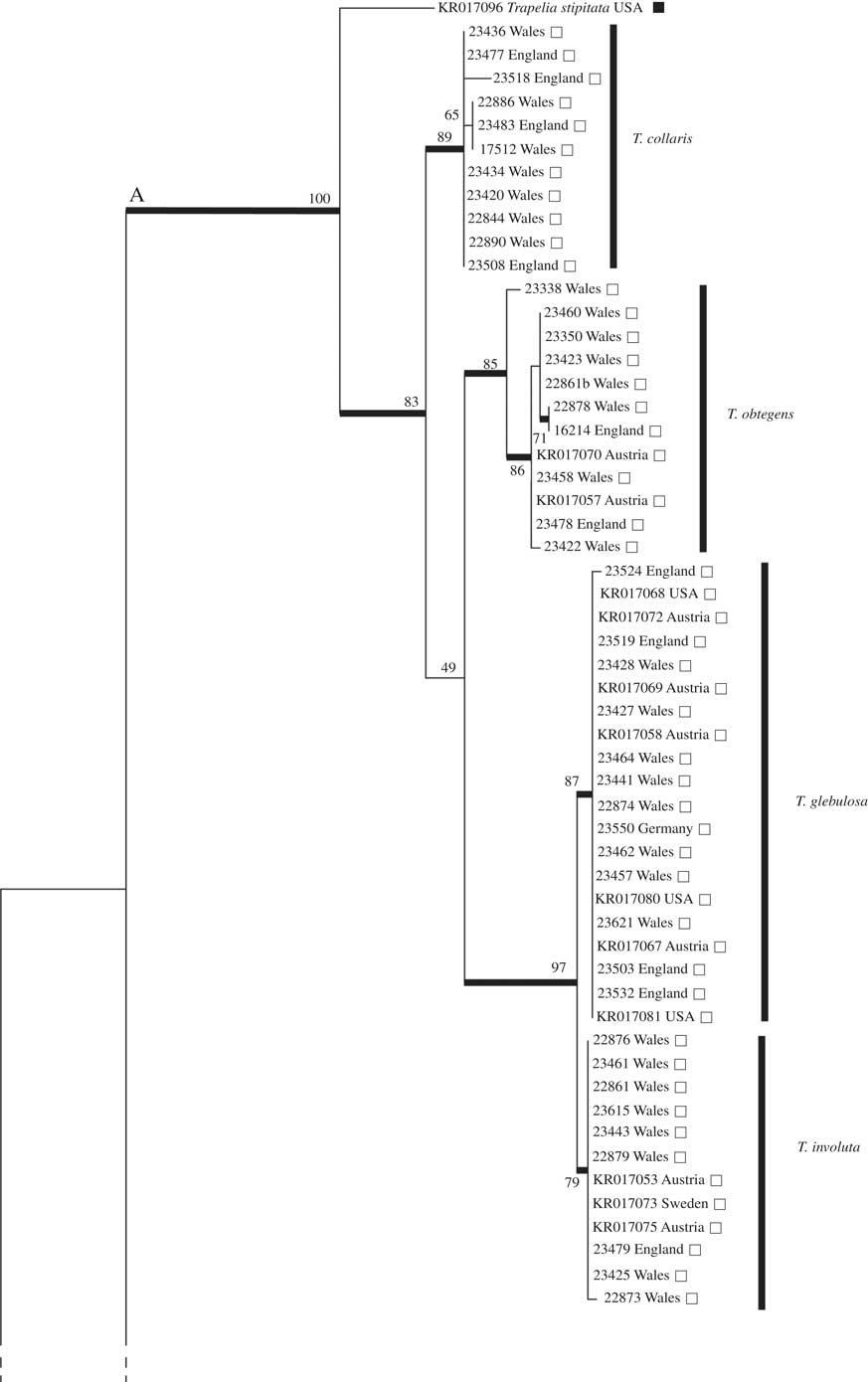
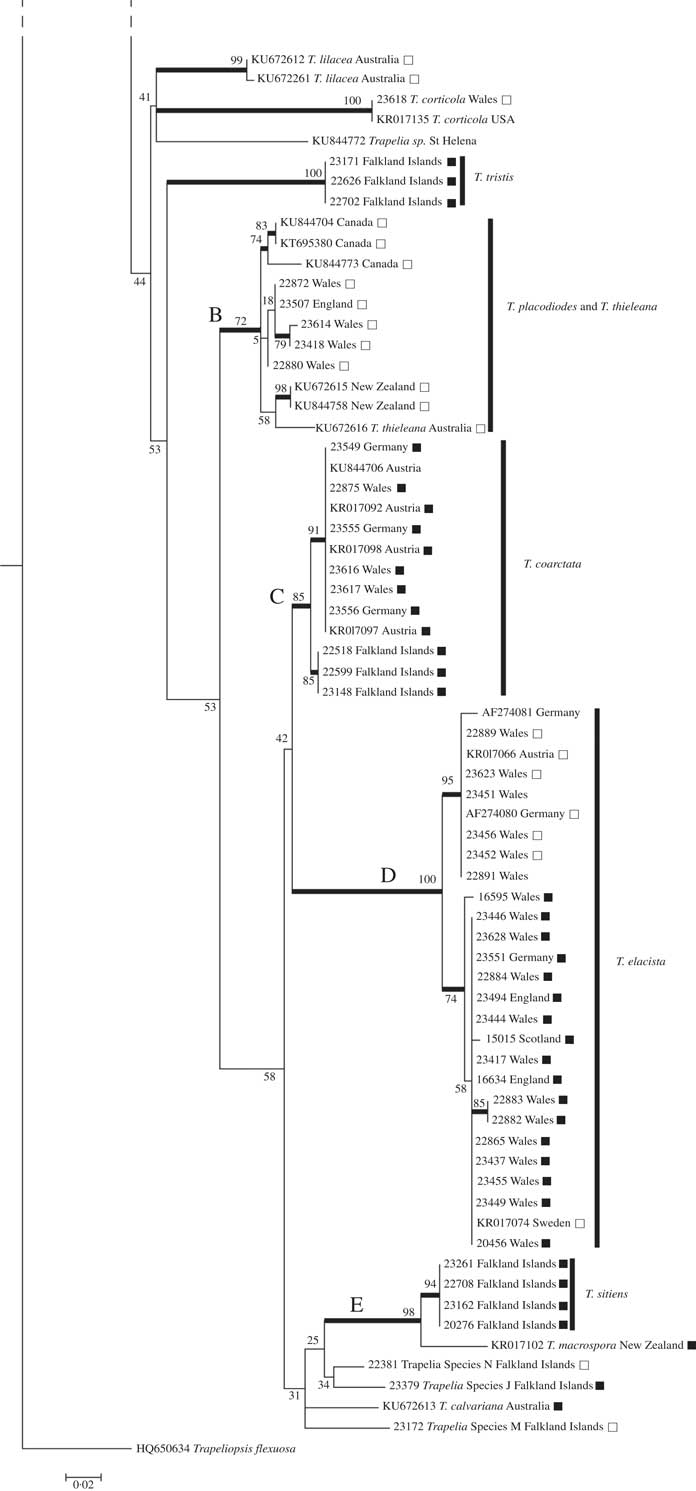
The tree resulting from analysis of the ITS1-5.8S-ITS2 region is shown in Fig. 1. The basal nodes are poorly supported and are consequently uninformative about the phylogenetic structure of the genus. There are a number of well-supported clades including the following.
Phylogenetic relationships amongst Trapelia species, based on a maximum likelihood analysis of the nuclear ribosomal ITS1-5.8S-ITS2 region. The tree was rooted using Trapeliopsis flexuosa. Branches in bold indicate a maximum likelihood bootstrap support of ≥70%. Closed squares indicate the presence of an indel in the 3ʹ end of the SSU; open squares indicate that there is no indel. Letters A to D indicate clades mentioned in the text.

Phylogenetic relationships amongst Trapelia species, based on a maximum likelihood analysis of the nuclear ribosomal ITS1-5.8S-ITS2 region. The tree was rooted using Trapeliopsis flexuosa. Branches in bold indicate a maximum likelihood bootstrap support of ≥70%. Closed squares indicate the presence of an indel in the 3ʹ end of the SSU; open squares indicate that there is no indel. Letters A to D indicate clades mentioned in the text.

Clade A. A clade with the single sequence of Trapelia stipitata basal to 3 main well-supported clusters, the most terminal of which is further divided into two well-supported but closely related clusters.
Clade B. A clade comprising Trapelia placodioides and the single sequence of T. thieleana.
Clade C. A clade comprising two well-supported (91% and 85%) but closely related clades.
Clade D. A clade comprising two well-supported (95% and 74%) clades which are nevertheless closely related. Where data on the 3ʹ end of the SSU are available, all but one of the sequences (KR017074) in the second subclade contained an indel c. 300 bp in length which was lacking in sequences in the first subclade.
Clade E. A clade comprising four identical sequences from the Falkland Islands, with a sequence of Trapelia macrospora from New Zealand basal to these.
Sequences named on GenBank as Trapelia coarctata are found in the most terminal clusters of Clade A, in Clade C and in Clade D, suggesting that this species as currently understood is non-monophyletic. Sequences named on GenBank as Trapelia glebulosa or T. involuta are mainly in Clade A, but with one in Clade D.
mtSSU analysis
Partial mtSSU sequences were newly prepared for 31 Trapelia specimens and 34 sequences were available from GenBank. The alignment was 765 bp in length. A total of 102 bp were excluded from the analysis as they could not be unambiguously aligned. After deletion of ambiguous regions the alignment was 663 bp in length, of which 85 characters were parsimony-informative.
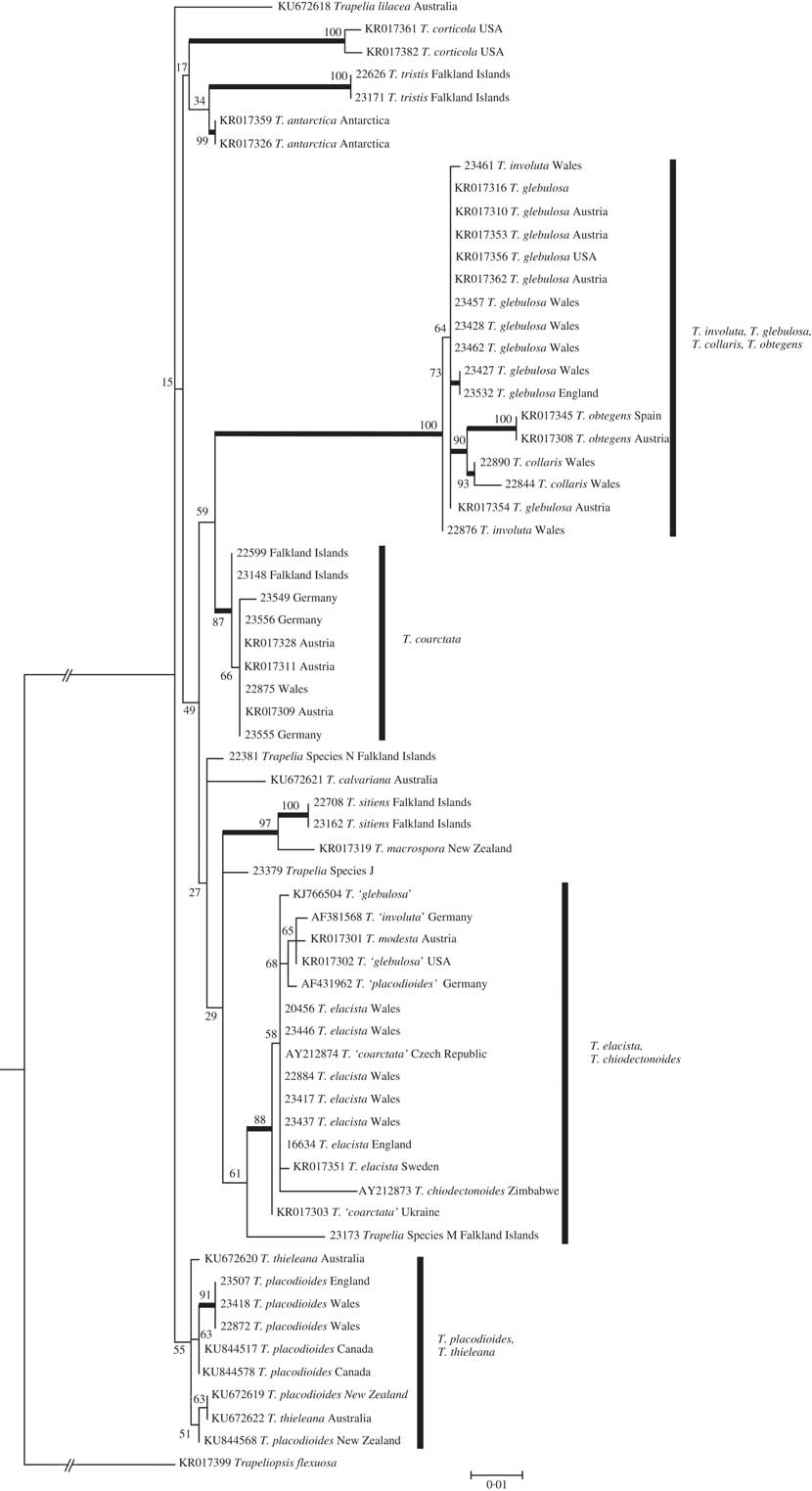
Clade A of the ITS was also recovered in the mtSSU tree with good support (100%) but the distinct subclades of the ITS tree were not recovered; instead the two more basal clades of the ITS tree are nested within the remaining sequences (Fig. 2). Clade B of the ITS tree is recovered but with poor support (59%). Clade C of the ITS tree is recovered with good support (87%) but with no differentiation into well-supported subclades. Clade D of the ITS tree is recovered with good support (88%) but with only poorly supported subclades. A single sequence of Trapelia chiodectonoides clusters in this clade (no ITS sequence for this species was available).
Phylogenetic relationships amongst Trapelia species, based on a maximum likelihood analysis of the partial mitochondrial SSU. The tree was rooted using Trapeliopsis flexuosa. Branches in bold indicate a maximum likelihood bootstrap support of ≥70%. Sequences are identified to species based on the ITS tree; where no ITS sequence is available, the original identification is generally placed in inverted commas.

Beta-tubulin analysis
Partial beta-tubulin sequences were prepared for 10 specimens belonging to the two most terminal, closely related clades in the ITS tree to investigate additional support for these clades. No beta-tubulin sequences from Trapelia were available from GenBank. The alignment was 638 bp long, including a putative intron 45 bp long which was identical in all sequences. After deletion of the putative intron, the alignment comprised 593 bp, of which 85 characters were informative.
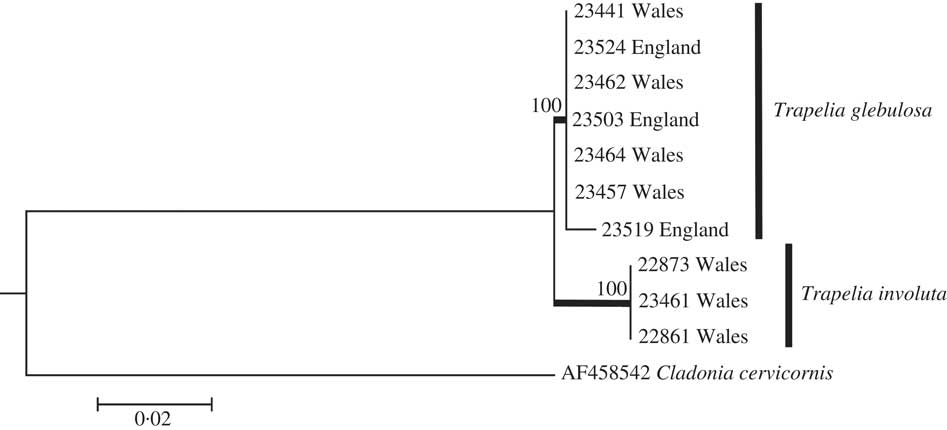
The analysis divides the sequences into two groups with high support (both 100%) giving additional support to the division in the ITS tree (Fig. 3).
Phylogenetic relationships in Trapelia glebulosa and T. involuta based on a maximum likelihood analysis of the partial beta-tubulin gene. The tree was rooted using Cladonia cervicornis. Branches in bold indicate a maximum likelihood bootstrap support of ≥70%.

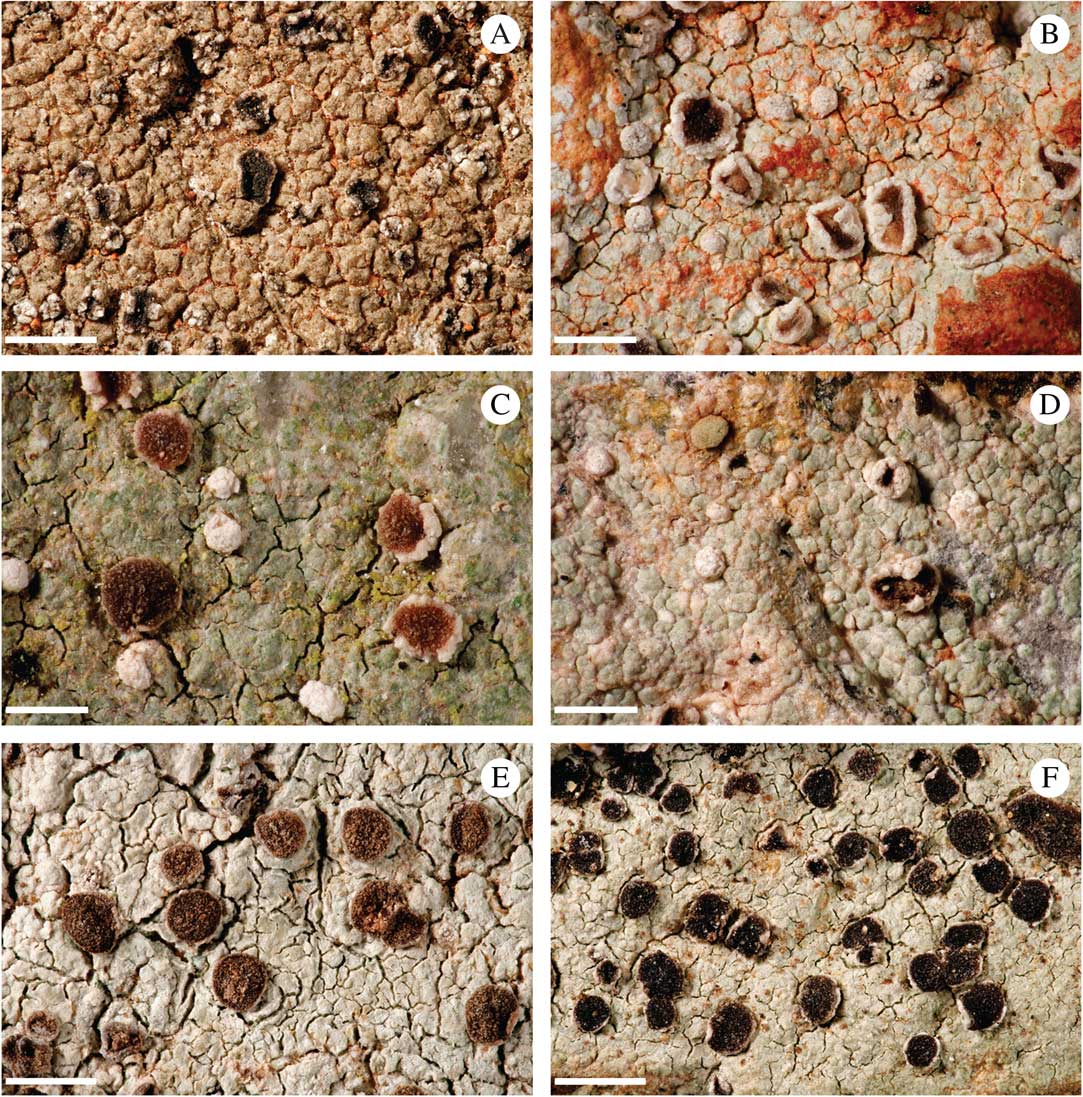
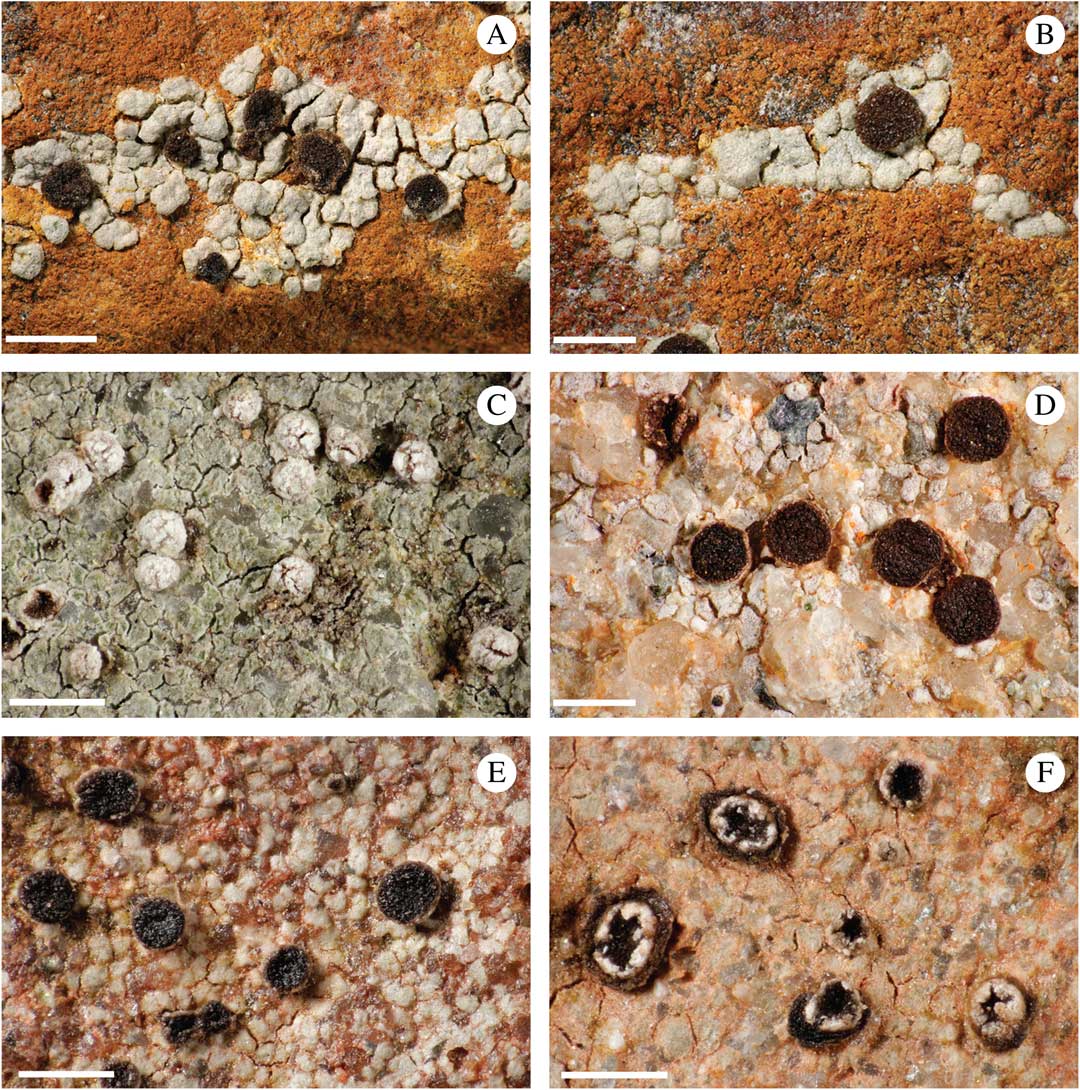
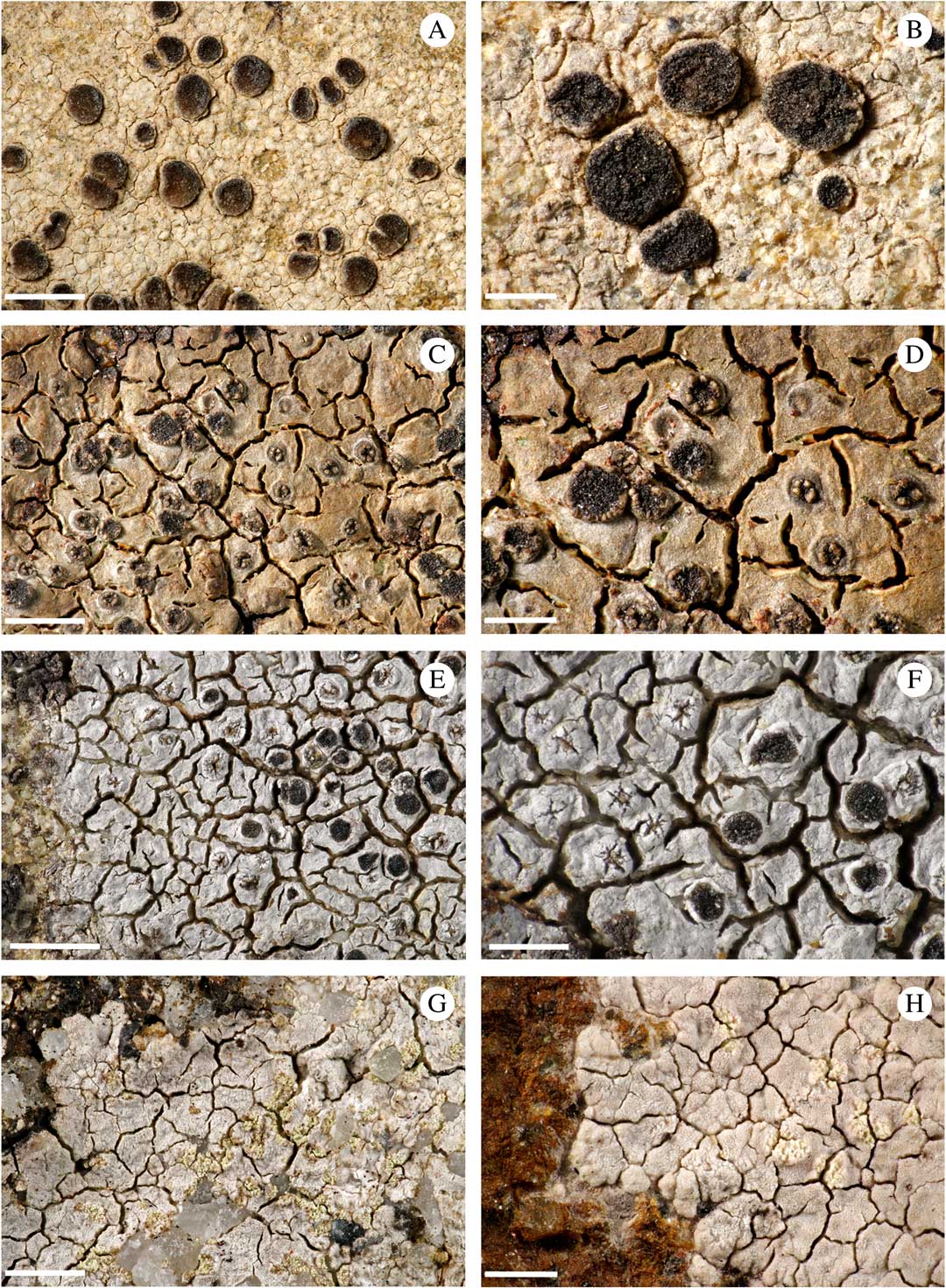
Trapelia coarctata. A, holotype; B, Orange 22875; C, Orange 23549; D, Orange 23555; E, Orange 22599; F, Orange 23148. Scales: A, E & F=1 mm; B–D=0·5 mm.

Indels in the nuclear ribosomal SSU
Several clades recovered in the ITS tree comprise specimens which show an indel near the 3ʹ of the nuclear ribosomal SSU. Comparison with the secondary structure diagram of Lecanora dispersa in Gargas et al. (Reference Gargas, DePriest and Taylor1995) suggests that all the indels are at a position equivalent to 1506 in the SSU of Escherichia coli (Gutell Reference Gutell1993). It is possible that the ‘indels’ are in fact introns.
Morphological and chemical assessment of putative species
The ITS tree places sequences from Europe in nine well-supported subclades (four in Clade A, Clade B, Clade C, two in Clade D, and a clade comprising one sequence of Trapelia corticola from Great Britain and one from North America), whereas there are currently only five species of Trapelia accepted in Europe. When the morphologically or ecologically distinctive species T. corticola and T. placodioides are discounted, this still leaves seven subclades to accommodate the taxa currently known as T. coarctata, T. glebulosa and T. obtegens. The morphology and chemistry of the nine subclades were compared to seek support or otherwise for their recognition as putative species. For clarity, the names and species circumscriptions used in the taxonomic treatment below (and in Fig. 1) are used from this point on, except where stated.
In Clade A of the ITS tree, the lowest cluster of European samples (Trapelia collaris) comprises specimens which frequently have a well-developed thallus cracked into distinct secondary areoles and the apothecia are consistently small (up to 300 µm diam.) compared with other species in the genus and often regenerate from old apothecia, apparently leaving the old apothecial tissue as a brown collar around the young apothecium. The major secondary substance is 5-O-methylhiascic acid. The cluster differs from the three more terminal clusters in Clade A by the presence of a prothallus (not visible in every specimen). The specimens in this cluster mostly have a distinctive appearance, and specimens would be difficult to assign to the traditional species (T. coarctata versus T. glebulosa) as the thallus is neither smooth and subcontinuous nor distinctly subsquamulose.
Another cluster in Clade A comprises two morphologically differing types. Specimens with the areoles almost completely dissolved into brown soralia are consistent with the current concept of Trapelia obtegens in Smith et al. (Reference Smith, Aptroot, Coppins, Fletcher, Gilbert, James and Wolseley2009). The cluster also contains non-sorediate specimens with scattered or loosely clustered areoles which are typically strongly convex, and typically more strongly browned than the other species of Trapelia. Both sorediate and non-sorediate morphs can be fertile. This cluster is interpreted here as a single species, Trapelia obtegens, due to the lack of strongly supported subclades within it, but further studies are recommended. Gyrophoric acid is the major secondary substance.
The more terminal clade within Clade A comprises two closely related subclades differing only in four transitions in the ITS region. Nevertheless, the two subclades are distinguished by chemistry and morphology: the first (Trapelia glebulosa) has gyrophoric acid as the major secondary substance, and the areoles are typically small and often fertile, even when very small; the second (T. involuta) has 5-O-methylhiascic acid, the areoles are typically larger and apothecia are frequently absent. Additional support for the distinctness of the two species is given by beta-tubulin sequences for seven specimens of T. glebulosa and three specimens of T. involuta; the species differ consistently in a number of third-codon positions. These two species have been recently regarded as synonymous but are reinstated here.
Clade B of the ITS tree comprises Trapelia placodioides, including material from Europe, North America and New Zealand. A sequence of T. thieleana, a species described from Tasmania, also clusters here. This suggests that T. thieleana may be merely a fertile, non-sorediate morph of the sorediate T. placodioides, first described from Europe, but a much wider sampling is needed to resolve this.
Clade C of the ITS tree comprises two closely related subclades, corresponding to specimens from Europe (10 sequences) and the Falkland Islands (3 sequences) respectively. No consistent morphological differences have been noted between the two subclusters and they are provisionally treated as the same species. This cluster is referred to T. coarctata, which is thus defined here in a much more restricted sense than in current treatments.
Clade D of the ITS tree comprises specimens which tend to show a relatively smooth thallus which often becomes secondarily cracked, and does not comprise distinct areoles from early on as in T. obtegens, T. glebulosa and T. involuta; a prothallus is visible in some specimens. In well-developed thalli there is often a fissure separating the apothecium from the thallus. The two subclades are closely related, differing in five transitions and one transversion in the ITS region. Specimens in one cluster have a c. 300 bp indel near the 3ʹ end of the SSU. In the other cluster there is no indel. Both contain gyrophoric acid as the major secondary substance. Specimens in Clade D would very likely be identified as T. coarctata using current treatments, but are not closely related in the ITS tree, and differ from T. coarctata in subtle morphological features. The whole clade is interpreted here as a single species, for which the name T. elacista is resurrected from synonymy.
Clade E of the ITS tree comprises a well-supported (100%) cluster of four sequences from the Falkland Islands, with T. macrospora basal to the cluster. The four Falklands specimens are morphologically uniform and differ from T. macrospora in the sessile apothecia (immersed in T. macrospora). They are treated here as a distinct new species, T. sitiens.
Three sequences from the Falkland Islands are basal to Clades B, C, D, and the T. sitiens clade, but with low support (53%). Although the specimens are lacking in diagnostic morphological features, they are widely divergent in ITS sequence to related species and are described as a new species, T. tristis. Three additional Trapelia sequences from the Falkland Islands (named as Species J, Species M and Species N in the ITS tree) may represent further undescribed species, but they occur in clades with very poor support and more material is needed before their status can be assessed.
It should be noted that the genus lacks very clearly defined morphological characters and morphological variation in response to environmental conditions appears to be high. Some of the species accepted here show an overlap in morphological features which may make individual specimens difficult to identify without sequencing, and which makes meaningful descriptions difficult to compile. Despite this, examination of sequenced specimens strongly suggests that each species has a characteristic appearance when growing in optimal conditions. Mixed collections of morphologically differing taxa have been detected and more combinations of mixed taxa will doubtless be found in the future.
Morphological overview of the taxa treated here
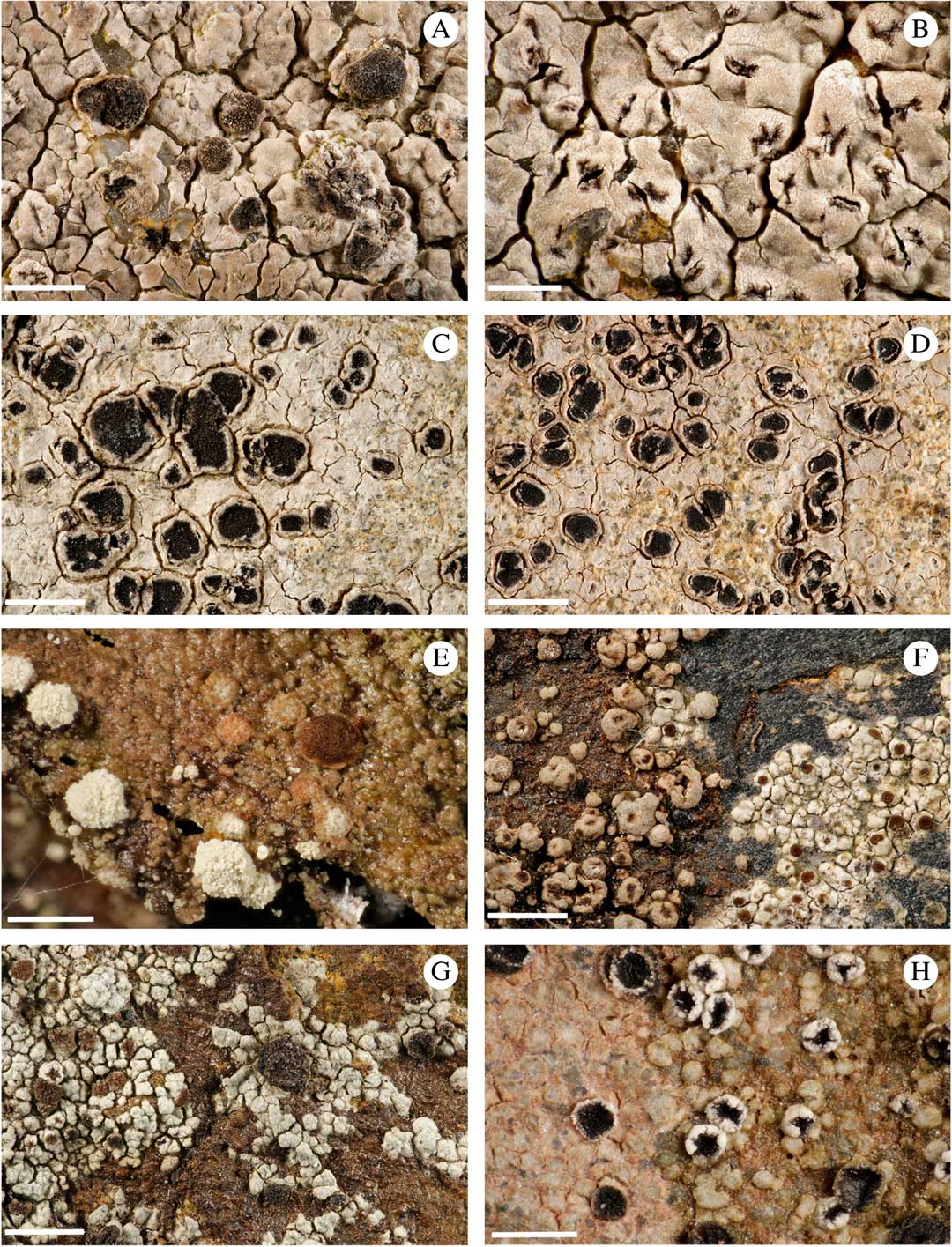
A whitish or brownish prothallus is sometimes seen in Trapelia coarctata, T. collaris, T. corticola, T. elacista and T. placodioides, but only on unimpeded margins where other lichens are absent (Figs 5E & 11H). Trapelia glebulosa, T. involuta and T. obtegens seem never to exhibit a visible prothallus, and these species have distinct primary areoles with abruptly thickened margins (Figs 8C & 9E). In Trapelia coarctata, T. elacista, T. placodioides, T. sitiens and T. tristis, the thallus edge is more or less continuous, with at most indistinct primary areoles, and the thallus may form a more or less extensive cracked crust, giving the impression of a single, coherent thallus (Figs 6A & F, 11E). The thalli of Trapelia glebulosa, T. involuta and T. obtegens are composed of distinct areoles from the start which either remain scattered or become loosely aggregated to form a more extensive thallus, which, however, does not give the impression of a single, coherent unit (Fig. 10A). Areoles may be roughly circular in outline (Fig. 10C), at least when young, or distinctly crenate, giving an effigurate appearance to a small thallus (Fig. 8B). In T. involuta the areoles may appear large and subsquamulose, with the edge slightly lifted from the substratum. Primary and secondary areoles can vary from more or less plane in T. coarctata, T. elacista and T. involuta, to strongly convex in T. obtegens. However, there is a great deal of variation in the form of the thallus within each species, probably largely related to environmental conditions. Species that have extensive thalli in moister conditions may have a discontinuous thallus in drier conditions; areoles can be convex and rather isolated, or flatter and more aggregated.
The thallus cortex is rather undifferentiated, of rounded cells which may have brown walls in well-lit habitats. There may be slight differences between species in the degree of browning of the cortex; T. obtegens often has distinctly brown areoles. In some specimens of a number of species (Trapelia collaris, T. elacista, T. involuta, T. obtegens and T. placodioides) the cortex is bright under crossed polars (POL+), suggesting the presence of crystalline material, although crystals were not seen; in N the cortex remains POL+ but in K it is POL−, and it is POL− in water after dry sections have been washed in acetone. However, POL− specimens have been seen in Trapelia elacista so the taxonomic value of this character is doubtful. The cortex is often overlain by a thin epinecral layer of poorly-preserved cell remnants which are POL−. This layer gives a slight pruinose appearance to many species, especially where the cortex is pigmented.
Apothecia are erumpent from within the thallus, and the expanding apothecial margin may show pale thallus-remnants as a thin web of tissue, as a mealy-pruinose covering, or as irregular teeth or flecks (Figs 6H & 8F). The precise type of covering is variable and does not seem to have much taxonomic significance. Where there is a pale margin to the apothecium this does not contain algal cells, and it has been called a pseudothalline margin; this is often excluded when the apothecium is mature. In Trapelia elacista the apothecium can sometimes be separated from the adjacent thallus or a contiguous apothecium by a fissure with white-pruinose sides (Fig. 6B & E). This does not seem to occur in other European species and is probably created during expansion of the apothecium rather than by the apparently simple mechanical cracking found in the thallus. The mature apothecia are sessile and the disc is more or less roughened and can vary from pink-grey to black, mainly depending on light intensity. Apothecial diameter does not appear to be an important taxonomic character, except that in T. collaris and T. tristis the apothecia mostly remain rather small. In Trapelia collaris young apothecia have frequently been observed regenerating within the remains of an old one. When this occurs the older apothecial discs often have a light brown rim which appears to represent the remains of a previous apothecium (Fig. 5B); in section, a trace of the older exciple can be seen. Regeneration has also been noted in T. elacista (Fig. 7F) and in T. coarctata. Some species, especially Trapelia glebulosa, are capable of fruiting very early, on very small isolated areoles (Fig. 8F), whereas others mainly fruit on a more extensive thallus (T. collaris, Fig. 5A & C). Trapelia involuta is often found without apothecia, although it has no vegetative propagules (Fig. 9A). In all species the exciple and epithecium are brown (except in shade). Paraphysis apices are unthickened except in T. corticola and T. tristis. Ascospores tend to be similar in size between the species studied, except for T. corticola where they are distinctly smaller. Soralia are found in T. corticola (Fig. 12E), T. obtegens (Fig. 10E & F) and T. placodioides (Fig. 11G & H), although they are absent in many specimens of T. obtegens.
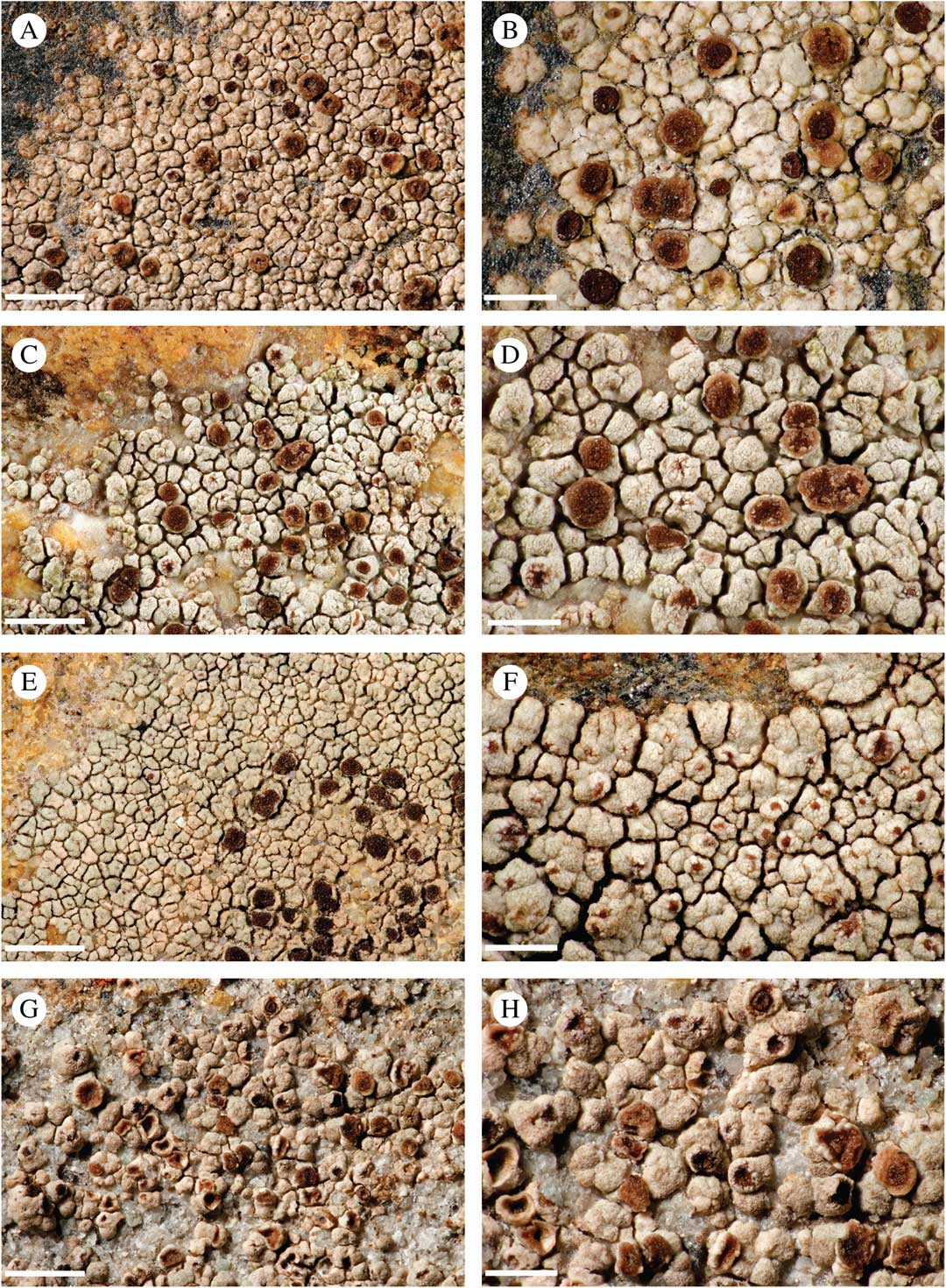
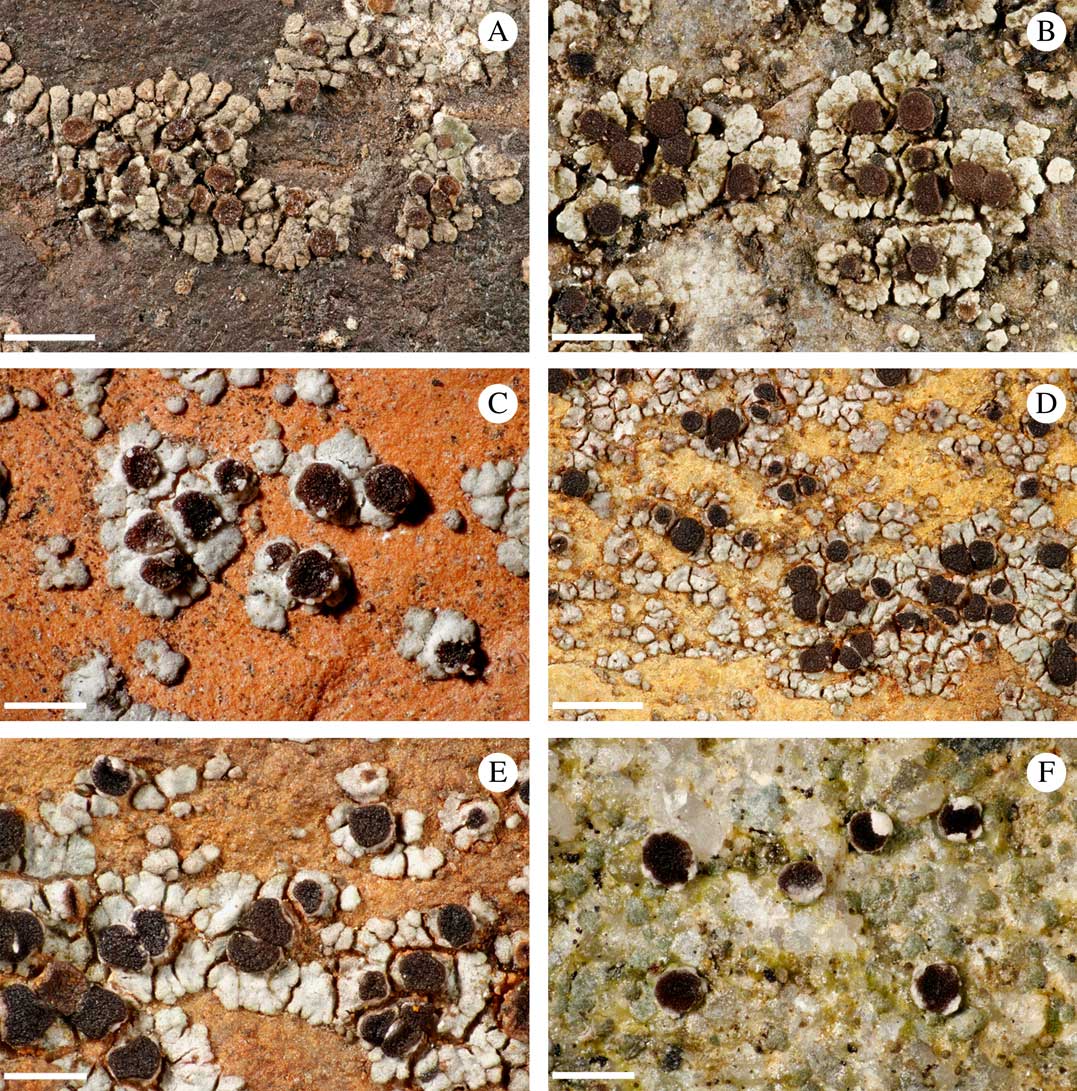
Trapelia collaris. A & B, holotype; C & D, Orange 23508; E, Orange 22886; F, Orange 22890; G & H, Orange 23420. Scales: A, C, E & G=1 mm; B, D, F & H=0·5 mm.

Trapelia elacista. A & B, Orange 15015; C, Orange 23494; D, Orange 23551; E, Orange 16634; F, Orange 23444; G, Orange 22884; H, Orange 23455. Scales: A, F & H=1 mm; B–E & G=0·5 mm.

Trapelia elacista. A & B, holotype; C, Orange 23671; D, Orange 23456; E & F, Orange 23623. Scales: A=1 mm; B–F=0·5 mm.

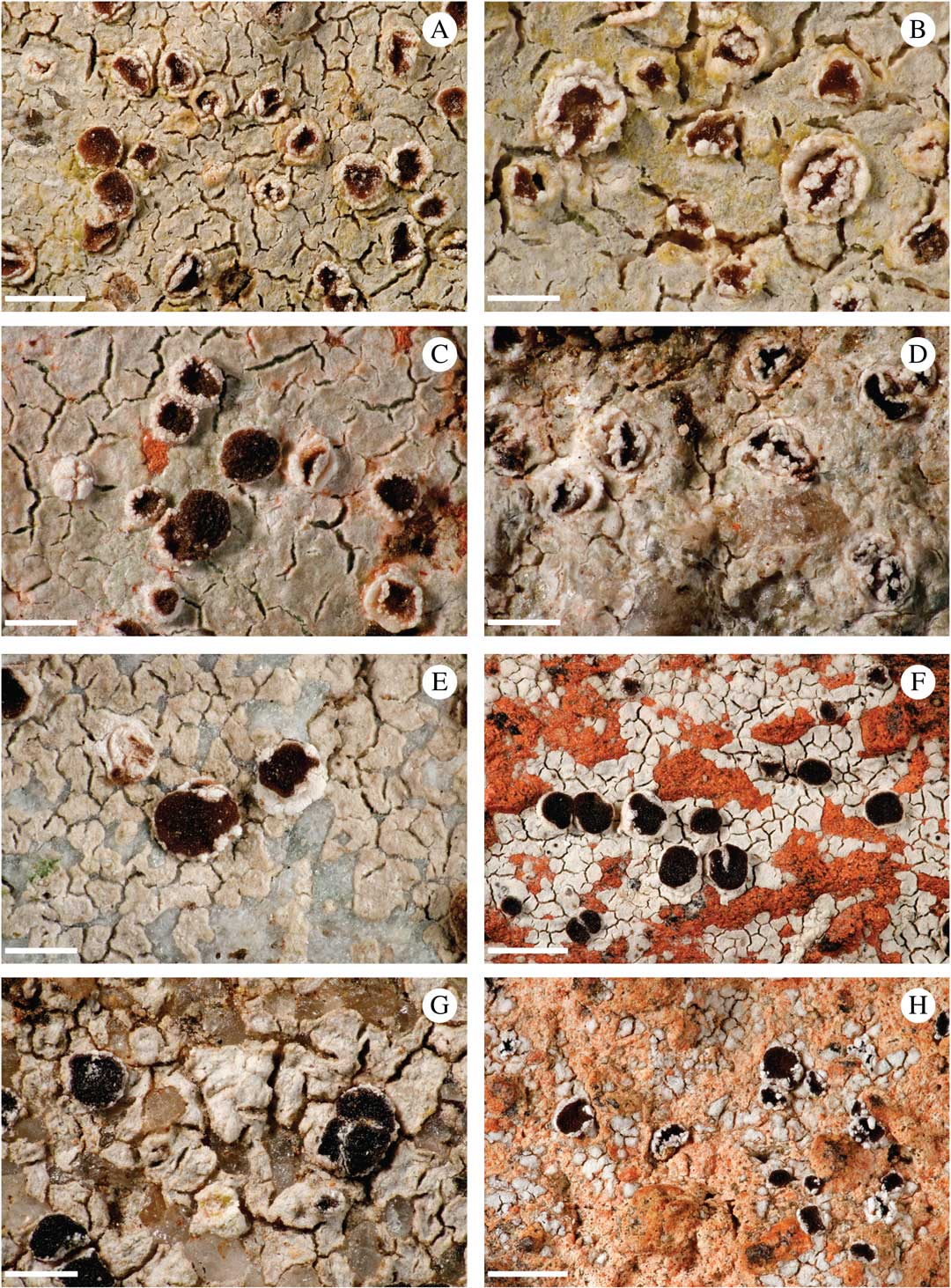
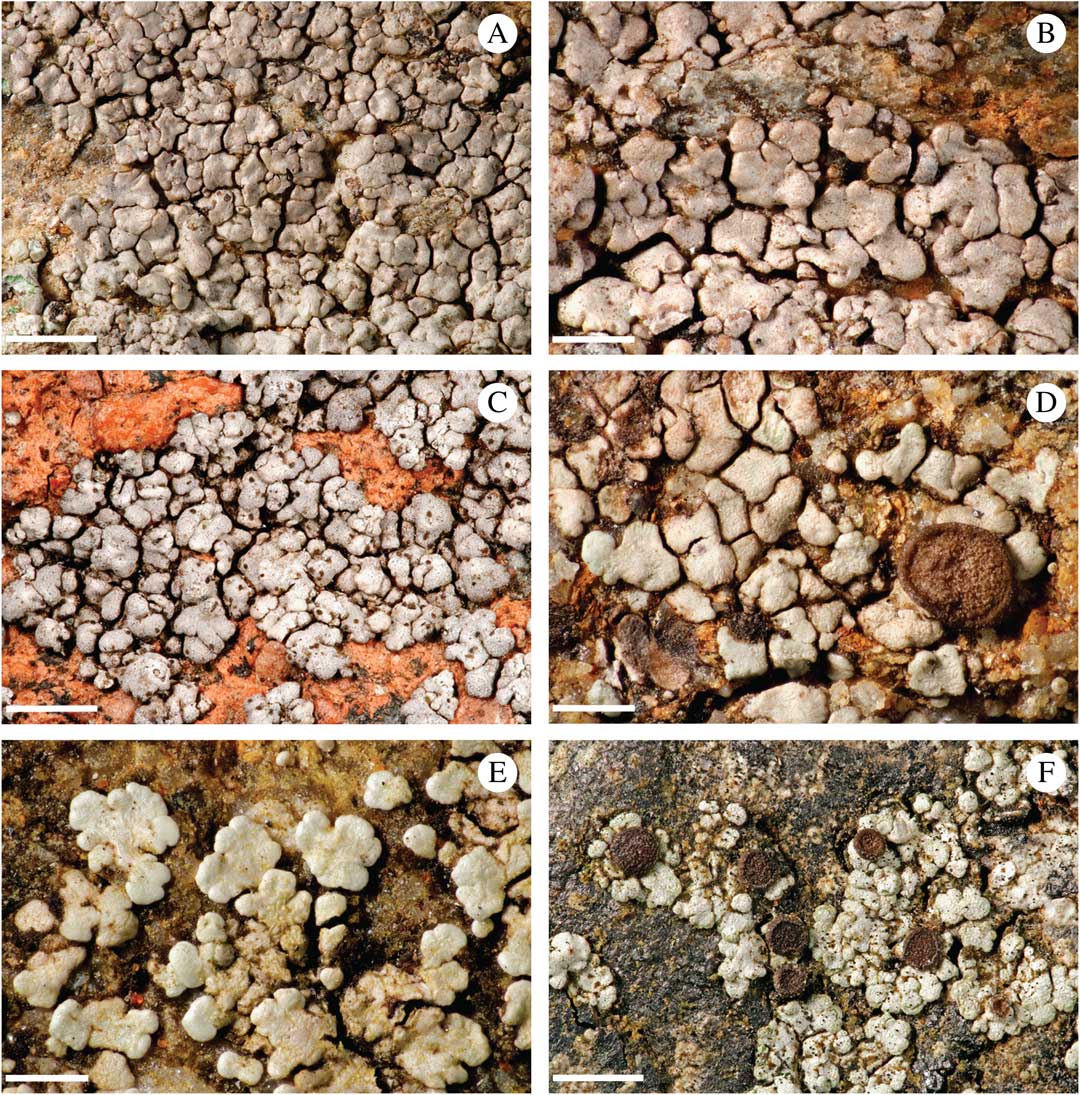
Trapelia glebulosa. A, lectotype (BM 000975977); B, Orange 23550; C, Orange 23464; D & E, Orange 23532; F, Orange 23428. Scales: A, B & D=1 mm; C, E & F=0·5 mm. In colour online.

Trapelia involuta. A & B, Orange 23479; C, Orange 23443; D, Orange 22879; E, Orange 22873; F, Orange 22876. Scales: A, C & F=1 mm; B, D & E=0·5 mm.

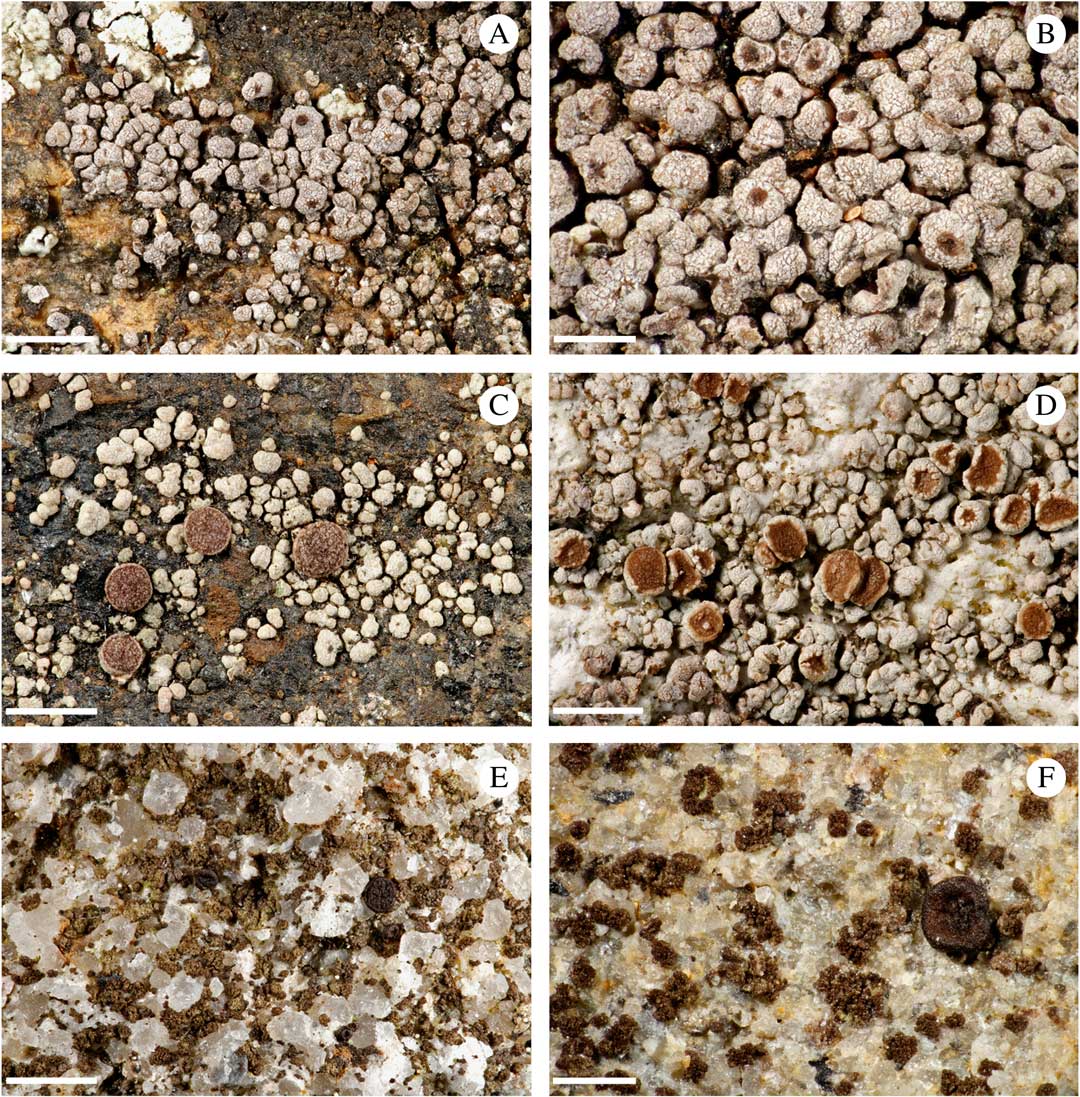
Trapelia obtegens. A & B, Orange 23478; C, Orange 22878; D, Orange 16214; E, Orange 23458; F, Orange 23422. Scales: A & C–E=1 mm; B & F=0·5 mm.

A & B, Trapelia sitiens; A, Orange 20276; B, holotype. C–F, T. tristis; C & D, holotype; E & F, Orange 22702. G & H, T. placodioides; G, Orange 22872; H, Orange 22880. Scales: A, C, E & G=1 mm; B, D, F & H=0·5 mm.

Undescribed Trapelia species, T. corticola and mixed collections. A & B, Trapelia Species N (Orange 22381); C, Trapelia Species J (Orange 23379); D, Trapelia Species M (Orange 23172); E, T. corticola (Orange 14995); F, T. collaris (Orange 17512, right) with T. obtegens (left); G, T. elacista (Orange 22891, right) with T. collaris (left); H, T. elacista (Orange 23623, left) with T. glebulosa (right). Scales: A, C, D, F & G=1 mm; B, E & H=0·5 mm.

Taxonomic Treatment
Trapelia M. Choisy
Bull. Soc. Bot. Fr. 76: 521–527 (1929); type: Trapelia coarctata (Sm.) M. Choisy in Werner (holotype).
Choisy (Reference Choisy1929) discussed the relationships of a number of species previously placed in Lecanora and described new genera for some of them. In a paragraph treating Lecanora coarctata, he cites Zahlbruckner (Reference Zahlbruckner1928) p. 419, entry no 10240 as a reference for the name, and goes on to state “Lecidea coarctata Nyl. sera le type d’un nouveau genre: Trapelia Choisy (= Lecanora trapelia Ach.)”. Both ‘Lecanora coarctata Ach.’ and ‘Lecidea coarctata Nyl.’ are based on Lichen coarctatus Sm. The entry in Zahlbruckner treats Lecanora trapelia as a synonym of Lecanora coarctata but in the present work this species is considered to be a synonym of Trapelia glebulosa. However, Choisy’s sentence is understood here to mean that Lecidea coarctata is the type of the new genus, and not Lecanora trapelia. Choisy did not dispute that the latter was a synonym of Lecidea coarctata, and his mention of the name Lecanora trapelia was probably to indicate the derivation of the new generic name.
Trapelia coarctata (Sm.) M. Choisy in Werner
Bulletin de la Société des Sciences Naturelles du Maroc 12: 160 (1932).—Lichen coarctatus Sm., English Botany 8, plate 534 (1798); type: England, [Isle of Wight], brick walls, Yarmouth, 1799, D. Turner (BM 000975980—holotype!); epitype (selected here): Great Britain, Wales, Glamorgan (V.C. 41), Rhondda Fach, Ynyshir, Mynydd Troed-y-rhiw, 31/0160.9311, alt. 300 m, on brick fragment amongst stones from ruined building, unshaded, 9 October 2015, A. Orange 22875 (NMW.C.2015.005.128).
Lecidea cotaria Ach., Methodus, Supplementum: 11 (1803); type: no locality or collector [?Habitat in saxis arenariis][?Westring] (H-ACH 1009, Fragment E!).
?Lecidea tenagea Ach., Syn. Lich.: 27 (1814): type: Svecia. Ad terram argillac. Agardh (H-ACH 284 p.p.—holotype!).
Prothallus white, very thin, non-fimbriate, or inapparent. Thallus often forming more or less extensive patches, pale greenish grey, matt, weakly to fairly strongly cracked, rarely uncracked, surface usually slightly to moderately uneven, though may be plane in shade, up to 160 µm thick; thallus margin with small, gently convex, poorly delimited areole-like units, these sometimes appearing separate on prothallus but mostly coalescing from the start.
Apothecia first appearing as white, slightly rough or pruinose, convex mounds; expanding margin with the outer surface white, faintly roughened, or coarsely pruinose with a ‘mealy’ appearance (granules c. 20 µm diam.); mature apothecia sessile, up to 600 µm diam., margin often becoming excluded; disc dark brown to black, slightly rough. Paraphyses c. 1·2–1·6 µm diam., branched and anastomosing above, apices scarcely thickened. Ascospores 14–21×7·5–10·5 µm, 1·7–2·4 times as long as wide [43/6].
Conidiomata not detected.
Chemistry. Gyrophoric acid (major), 5-O-methylhiascic acid (trace).
Ecology and distribution. In Europe, found on stones and brick fragments on rocky slopes, beside tracks and on spoil heaps. There are confirmed (sequenced) records for Great Britain, Austria and Germany. In the Falkland Islands it is rare, collected on seasonally moist stones and bedrock, beside streams and in a rock crevice.
Typification and nomenclature. The specimen BM 000975980 is dated 1799, whereas plate 534 in English Botany is dated 1 December 1798. The dates on the plates in English Botany were for copyright purposes and, while they are a good guide to the date of publication, they do not provide conclusive proof (Wiltshear Reference Wiltshear1915, quoted by Laundon Reference Laundon2005). The discrepancy might be evidence that the plate was not issued until 1799, or it might be that the specimen is a later collection. The discrepancy cannot be resolved here; the specimen agrees with the protologue to a reasonable extent in its features and is regarded as the type until evidence is found to the contrary. The protologue emphasizes the mouth of the apothecium ‘pursed up’ when young so that the apothecium appears as a convex white speck; this is more or less the case in the BM type. An epitype is selected here as not every specimen of this species and T. elacista can be distinguished, so that there is a small element of doubt in the attribution of the holotype of Lichen coarctatus.
The holotype of Lecidea tenagea is impossible to identify with certainty; it is likely to be Trapelia coarctata but could possibly be T. elacista.
Notes. This species has a thallus which is thin at the margin, with at most poorly defined and soon-coalescing areoles, and which forms a cracked crust of indefinite extent; it is often conspicuously pale in the field. Trapelia elacista is very similar and not all specimens of the two species can be distinguished; both are variable in appearance, associated with the degree of available moisture and degree of shade of the microhabitat. Trapelia elacista appears to differ in the following features, which are not always well displayed: the emerging apothecia may be visible as a white-pruinose disc or mound but are typically less conspicuous at this stage than in T. coarctata; possibly the apex splits to reveal the brown disc earlier than in the latter species so that a convex white mound is usually less developed. However, a convex white mound is displayed in Orange 23671 (Fig. 7C) and this specimen seems impossible to distinguish from T. coarctata by morphology. A proportion of the apothecia in T. elacista may be separated from the thallus by a fissure with white-pruinose sides; this may be inconspicuous or may form a conspicuous crater-like depression, and is often best seen in young apothecia. The thallus in T. elacista is often smoother than in T. coarctata but this feature is variable. The specimens Orange 23551 (T. elacista, Fig. 6D) and 23555 (T. coarctata, Fig. 4D) occurred in the same habitat at the same locality and were recognized as differing in appearance before sequencing.
Sequenced specimens from Europe and from the Falkland Islands form two closely related and well-supported clades. Without a much wider geographical sampling it is not possible to assess whether these represent separate taxa or infraspecific variation. No consistent morphological differences have been found.
Additional specimens examined. Great Britain: Wales: V.C. 42, Breconshire, west of Talybont Reservoir, by Caerfanell, 51·844775°N, 3·363665°W, 2017, Orange 23616 (NMW.C.2017.003.3); same locality and date, Orange 23617 (NMW.C.2017.003.4).—Austria: Kärnten: Nockberge, Hochrindl, Gemeinde Albeck, 46°52'52·55''N, 13°59'33·43''E, 2013, Resl 1149 (GZU). Steiermark: Grazer Bergland, St. Radegund bei Graz, 47°12'14·67''N, 15°29'1·67''E, 2012, Resl 1154 (GZU).—Germany: Baden-Württemberg: Hinterzarten, Löffeltal, 47·91142°N, 8·09110°E, 2016, Orange 23549 (NMW.C.2015.005.129); ibid., 47·91236°N, 8·08138°E, 2016, Orange 23555 (NMW.C.2015.005.130).—Falkland Islands: West Falkland: near Fox Bay, Arroyo Malo, 51·96474°S, 60·12050°W, on stones in stream (tipped in to make a ford), 2015, Orange 22518 (NMW.C.2015.005.177); north of Fox Bay, Chartres Farm, ‘Patricia Luxton Nature Reserve’, 51·72682°S, 59·98476°W, alt. 5 m, on rock in river, 2015, Orange 22599 (NMW.C.2015.004.122). East Falkland: Goose Green Farm, Darwin, S of settlement, 51·81786°S, 58·96596°W, 2015, Orange 23148 (NMW.C.2015.005.179).
Trapelia collaris Orange sp. nov.
MycoBank No.: MB 821704
Differing from other Trapelia species in the combination of a typically extensive, cracked thallus with abruptly thickening marginal areoles arising on an inconspicuous prothallus, also the relatively small apothecia (rarely exceeding 300 µm diam.) and presence of 5-O-methylhiascic acid as the major substance.
Type: Great Britain, Wales, Caernarvonshire (V.C. 49), Capel Curig, east of Carnedd Moel Siabod, Clogwyn Llwyd, 23/7261.5432, on stones beside track in conifer plantation, with Rhizocarpon reductum, Porpidia macrocarpa, Trapelia obtegens, 12 June 2008, A. Orange 17512 (NMW C.2007.001.264).
Prothallus present, very thin, appearing as a whitish or brown stain, or inapparent, but sometimes possibly present but immersed, visible as a lichen-free zone near areoles. Thallus areoles irregularly convex, margins abrupt; thallus often a coherent, cracked-areolate crust, growing at the margin, but sometimes areoles in smaller, more scattered groups and forming a larger thallus by growing in diameter and becoming mutually compressed; marginal areoles sometimes slightly elongated or crenate, giving an effigurate effect to the thallus; mature areoles very variable in size, mostly 160–500 (–1000) µm diam., convex, or with several convex areas due to coalescence of smaller areoles; rarely thallus much thickened locally. Thallus pale grey to greenish grey, or young areoles brownish grey, often faintly pruinose. Cortex up to 14 µm thick, of rounded cells to c. 5–6 µm wide, these sometimes with brown walls. Epinecral layer present, thin, colourless, of cell fragments or amorphous tissue.
Apothecia relatively small, up to 300 µm diam., occasionally more; when emerging the margin has some whitish thalline tissue, but never conspicuous white flecks; apothecium sometimes surrounded by a low collar of thallus; apothecia often appear to degenerate, and frequently a new one is initiated in the centre of the old one, so that the apothecium has a collar of pale brown material of somewhat cartilaginous appearance. Ascospores 16–22×9·0–12·5 µm [14/3].
Conidiomata not detected.
Chemistry. 5-O-methylhiascic acid (major), gyrophoric acid (trace).
Etymology. From the Latin word ‘collaris’ (collared), referring to the ring of tissue surrounding regenerating apothecia.
Ecology and distribution. On siliceous stones beside tracks and on spoil heaps of coal, metal and slate mines, usually where moist from contact with soil. Also confirmed from natural stony ground at 830 m altitude. Probably frequent in Great Britain. Sometimes on stones apparently rich in heavy metals, at least iron, growing with Placopsis lambii, Porpidia macrocarpa, Rhizocarpon furfurosum, R. oederi and Trapelia obtegens.
Notes. This species often forms rather extensive, strongly cracked thalli of convex areoles. Sometimes the thallus is apparently a coherent whole, growing at the margin by extension and cracking of the marginal areoles, these often preceded by a prothallus, and such forms have a characteristic appearance (Fig. 5E & F). In some specimens, probably experiencing drier or otherwise suboptimal conditions, strongly convex and isolated areoles appear to arise on an immersed prothallus and form a discontinuous thallus (Fig. 5G & H). Even in ‘coherent’ thalli the areoles have an abruptly thickening margin (Fig. 5D), unlike the thin edge or very gently convex ‘areoles’ of Trapelia coarctata and T. elacista, but sometimes the marginal areoles are very small (Fig. 5B). The apothecia often remain small and frequently regenerate from the centre (Fig. 5B). The white-pruinose fissures sometimes present in T. elacista are never seen.
The more extensive thalli in particular have a distinctive appearance, but some morphs with rather dispersed areoles could be confused with other species. Trapelia glebulosa has thalli that are typically small and very early fruiting, and a prothallus is not apparent. Trapelia elacista can have larger apothecia. Non-sorediate morphs of Trapelia obtegens differ in the more strongly convex areoles which can become crowded but which do not form a coherent thallus; in addition, the apothecia can become larger.
Additional specimens examined. Great Britain: Wales: V.C. 35, Monmouthshire, Blaenavon, 32/2522.1039, 2015, Orange 22886 (NMW.C.2015.005.152); ibid., 32/2520.1044, Orange 22890 (NMW.C.2015.005.153); W of Pontypool, Llanhilleth, Blaen y Cwm, 32/2388.0136, 2016, Orange 23420 (NMW.C.2015.005.154); NW of Blaenavon, 32/2267.1046, 2016, Orange 23434 (NMW.C.2015.005.155); ibid., 32/2269.1042, 2016, Orange 23436 (NMW.C.2015.005.156). V.C. 42, Breconshire, west of Talybont Reservoir, by Caerfanell, 51·844775°N, 3·363665°W, 2017, Orange 23616 (NMW.C.2017.003.3). V.C. 46, Cardiganshire, Doethie Valley, near Craig Ddu, 22/76.48, 1958, Wade (NMW.59.5.269). V.C. 48, Merioneth, Ganllwyd, Gwynfynydd, 23/73547.28193, 2015, Orange 22844 (NMW.C.2015.005.69); Tanygrisiau, W of Llyn Cwmorthin, 2017, Orange 23647 (NMW). England: V.C. 69, Westmorland, Coniston Copper Mines, 35/2886.9901, 2016, Orange 23477 (NMW.C.2015.005.157); ibid., 34/2894.9897, 2016, Orange 23483 (NMW.C.2015.005.158); ibid., 34/2812.9901, 2016, Orange 23508 (NMW.C.2015.005.159); ibid., 34/2873.9905, 2016, Orange 23518 (NMW.C.2015.005.160). V.C. 70, Cumberland, Grasmoor, near summit, 35/1781.2039, 2004, Orange 15491 (NMW.C.2015.005.150).
Trapelia corticola Coppins & P. James
Lichenologist 16: 254 (1984); type: Wales, Breconshire, Cwm Dyfnant, B. J. Coppins 4078 & R. G. Woods (E—holotype [not seen]).
Prothallus occasionally visible as a very thin, pale film. Thallus with young areoles arising on the prothallus, with thin margins, early becoming uneven, coalescing into a thin, verrucose-uneven crust with very poorly-delimited subunits c. 30–80 µm diam.; thallus light brown in good light, brownish green in shade, occasionally lightly cracked. Soralia always present, mostly discrete, usually convex, up to 500 µm diam., rarely confluent, pale green with a brownish tinge; soredia very fine, c. 20 µm diam.
Apothecia rare (but easily overlooked in the field), sessile, 220–380 µm diam., margin pale brown, smooth, thin; disc pale brown to dull mid brown, more or less plane, without a pseudothalline margin. Exciple thin, c. 20–30 µm thick, brown; hymenium 80–100 µm high. Paraphyses with the apical cells brown, irregularly swollen, to 3·5 µm wide. Ascospores 9·0–15·5×5–9 µm [15/2].
Ecology and distribution. On acidic bark and wood of phorophytes including Quercus petraea, Alnus glutinosa, Larix decidua and Picea sitchensis, usually in humid woodland. Locally frequent in north and west Britain.
Notes. This species differs from the other species studied here by the substratum of bark or wood, the smaller ascospores and the swollen paraphysis apices.
Selected specimens examined. Great Britain: Wales: V.C. 42, Breconshire, west of Talybont Reservoir, by Caerfanell, 51·844775°N, 3·363665°W, 2017, Orange 23618 (NMW.C.2017.003.5). V.C. 46, Cardiganshire, near Cardigan, Coedmor National Nature Reserve, 22/195.444, 1996, Orange 10949 (NMW.C97.35.636); Devil’s Bridge, Coed-Cyd, 22/740.771, 1998, Orange 11703 (NMW.C.1999.011.59). V.C. 48, Merioneth, 6 km S of Trawsfynydd, Caeau-cochion, 23/713.294, 2002, Orange 13579 (NMW.C.2001.024.502). Scotland: V.C. 87, West Perthshire, near Callander, Strathyre, 27/5645.1849, 2004, Orange 14995 (NMW.C.2004.002.237).
Trapelia elacista (Ach.) Orange comb. nov.
MycoBank No.: MB 823243
Parmelia elacista Ach., Methodus: 159, tab. IV, fig. 4 (1803); type: [Habitat in saxis, Swartz], ‘Dr Acharius Reference Acharius1803’ (LINN [J. E. Smith Miscellaneous Lichen Collection] 47-2!); epitype (selected here): Great Britain, England, Westmorland (V.C. 69), north-east of Ambleside, Troutbeck Park, Trout Beck, on siliceous rock by stream, unshaded, with Trapelia placodioides, Sporodictyon cruentum, 35/418.069, 28 August 2006, A. Orange 16634 (NMW.C.2005.001.653).
Lecanora ocrinaeta Ach., Lichenogr. Univ.: 380 (1810); type: [Switzerland] Helvetia [Habitat in saxis et rupibus Helvetiae. Schleicher] (H-ACH 1098 - two upper fragments!).
?Lecidea arridens Nyl. Flora 59: 573 (1876); type: [Ireland, West Mayo V.C. H27] Delphi, Connemara, 1876, C. Larbalestier (BM 000975983—syntype!); Delphi, Connemara, ‘only one specimen gathered’, Aug. 1876, Larbalestier (BM 000975981—syntype!).
Prothallus sometimes visible at unimpeded margins, very thin, pale; sometimes absent or at least inapparent. Thallus margin thin, growing outwards, sometimes uneven with low convex areas, but (at least usually) without new areoles arising on the prothallus; rapidly becoming cracked, mature thallus surface plane to slightly uneven, cracks usually numerous, sometimes delimiting discrete ‘islands’; thallus pale grey or pale pinkish grey, at most faintly brownish when young; thallus discontinuous in drier habitats.
Apothecia often first visible as a pale pruinose disc, sometimes becoming convex, but often beginning to split at apex before becoming convex; developing margins often white, slightly roughened or pruinose, sometimes margin irregularly crenulate or with white flecks, margin often excluded when mature; a proportion of apothecia sometimes surrounded with a more or less circular fissure with a white-pruinose surface, especially when young, the crack sometimes wide and crater-like; adjacent apothecia sometimes separated by white-pruinose fissures; apothecia variable in size but up to 560 µm (thus relatively large); young apothecia sometimes arising on the degenerating remains of a previous one. Ascospores 14·0–24·5×8·0–12·5 µm [52/10].
Conidiomata not detected.
Chemistry. Gyrophoric acid (major), 5-O-methylhiascic acid (trace).
Ecology and distribution. A colonizer of exposed surfaces; on natural rocks often in moist habitats including regularly inundated stream margins, and then associated with typical riparian lichens and bryophytes. Also on stones and brick fragments lying on the ground, beside tracks, on spoil heaps and on low, ruined walls. Probably widespread and frequent in Great Britain. ITS sequences from GenBank which conform to this species are based on vouchers from Austria and Germany.
Typification and nomenclature. The single fragment of Parmelia elacista in LINN is annotated ‘Dr. Acharius Reference Acharius1803’, which is interpreted here to mean that the specimen was supplied by Acharius, not collected by him. There is no material of Parmelia elacista in H (L. Myllys, pers. comm.). P. O. Swartz, cited as the collector in the protologue, was a Swedish botanist and the specimen is most likely from Sweden, although he also travelled to North America and the West Indies. The type of Parmelia elacista is a single small fragment. The type is interpreted here as the taxon described above, largely due to the presence of a shallow circular crack separating some of the apothecia from the adjacent thallus. The fragment of rock illustrated in the protologue does not match the type specimen but is similar in size; either there were other fragments, or quite possibly the artist did not attempt to reproduce the fragment faithfully. Since the holotype is difficult to interpret, an epitype is designated.
The two syntypes of Lecidea arridens in BM show apothecia with pale discs (‘carneo-rosea’ in protologue, now pinkish orange); these appear to be due to deeply shaded conditions, as noted in an annotation by Peter James. One specimen is growing with the hepatic Marsupella emarginata, suggesting moist or regularly inundated rock. This is consistent with the habitat of many specimens of T. elacista, but it is doubtful whether the material is identifiable with certainty.
The two fragments of Lecanora ocrinaeta in H-ACH 1098 labelled ‘Helvetia’ both have a well-developed, uneven or fairly smooth thallus; they seem most likely to be T. elacista.
Notes. The species has a thallus of indefinite growth, often with a prothallus; the thallus is pale, with little or no dark pigment. Apothecia are variable depending on habitat, but can be relatively large. White-pruinose fissures between the apothecia and adjacent thallus are often seen but may be absent, especially in thinner specimens from more exposed habitats. These fissures have not been observed in Trapelia coarctata, where the emerging apothecia tend to form white mounds which are more conspicuous than in T. elacista, but the two may sometimes be impossible to distinguish. Specimens with a thick extensive thallus from moist microhabitats are easily identified but discontinuous thalli from drier microhabitats are less distinctive.
Trapelia elacista comprises two clades differing in five transitions and one transversion in the ITS region. All but one of the sequences in one clade contain an indel c. 305 bp long at the 1506 position at the 3ʹ end of the SSU; the other clade lacks an indel. The two clades are treated here as a single species due to the very similar ITS sequence and the lack of morphological distinguishing features.
Additional selected specimens examined. Great Britain: Wales: V.C. 35, Monmouthshire, Blaenavon, Varteg, 32/2581.0573, 2015, Orange 22882 (NMW.C.2015.005.167); ibid., 32/2581.0573, 2015, Orange 22883 (NMW.C.2015.005.165); same locality, 2015, Orange 22884 (NMW.C.2015.005.166); Blaenavon, 32/2520.1044, 2015, Orange 22891 (NMW.C.2015.005.186); W of Pontypool, Llanhilleth, Blaen y Cwm, 32/2388.0129, 2016, Orange 23417 (NMW.C.2015.005.168); Sirhowy Valley, Markham, 32/1654.0210, 2016, Orange 23437 (NMW.C.2015.005.169); ibid., 32/1693.0185, 2016, Orange 23444 (NMW.C.2015.005.170); ibid., 32/1693.0185, 2016, Orange 23446 (NMW.C.2015.005.171); Aberbargoed, 32/1638.0029, 2016, Orange 23449 (NMW.C.2015.005.172). V.C. 41, Glamorgan, Rhondda Fach, Ynyshir, Mynydd Troed-y-rhiw, 31/0162.9312, 2006, Orange 16595 (NMW.C.2005.001.535); ibid., 31/0149.9352, 2015, Orange 22865 (NMW.C.2015.005.164); Rhondda Fawr, Llwynypia, Gelli, 21/9842.9429, 2016, Orange 23452 (NMW.C.2015.005.188); ibid., 21/9836.9425, 2016, Orange 23455 (NMW.C.2015.005.173); ibid., 21/9819.9463, Orange 23456 (NMW.C.2015.005.189); Merthyr Tydfil, Merthyr Common, 51·73983°N, 3·33426°W, 2017, Orange 23628 (NMW.C.2017.003.10). V.C. 42, Breconshire, north of Pontsticil, 51·841130°N, 3·380170°W, 2017, Orange 23623 (NMW.C.2017.003.9). V.C. 48, Merioneth, 10 km NE of Dolgellau, Afon Harnog, 23/820.222, 1998, Orange 11995 (NMW.C98.9.39); east of Beddgelert, stream below Llyn Llagi, 23/6396.4886, 2011, Orange 20456 (NMW.C.2015.005.68). England: V.C. 40, Shropshire, Abdon, near Nordy Bank, [32/57.84], Leighton [Leighton, Lich. Brit. exs. 177] (NMW.14.353.154). V.C. 50, Denbighshire, Chirk Castle, 33/265.386, 2017, Orange 23671 (NMW.C.2017.003.11). V.C. 69, Westmorland, Coniston Copper Mines, 34/2889.9865, 2016, Orange 23494 (NMW.C.2015.005.174). Scotland: V.C. 88, Mid Perthshire, south side of Loch Tay, near Shenlarich, 27/706.409, 2001, Orange 13172 (NMW C.2001.024.200). V.C. 97, Westerness, near Fort William, Loch Linnhe, north-west of Corrychurrachan, 27/0510.6730, 2004, Orange 15015 (NMW.C.2005.001.503). V.C. 104, North Ebudes, Isle of Skye, Bla Bheinn, Coire Uaigneich, 18/542.215, alt. 250 m, 2005, Orange 16067 (NMW.C.2005.001.592).—Ireland: V.C. H34, East Donegal, 1·5 km WSW of Barnesmore Village, River Lowerymore, 1998, Orange 12498 (NMW.C98.9.71).—Austria: Kärnten: Nockberge, Hochrindl, Gemeinde Albeck, 46°52'52·55''N, 13°59'33·43''E, 2013, Resl 1149 (GZU).—Germany: Baden-Württemberg: Hinterzarten, Löffeltal, 47·91236°N, 8·08138°E, 2016, Orange 23551 (NMW.C.2015.005.175).
Trapelia glebulosa (Sm.) J. R. Laundon
Bot. J. Linn. Soc. 147: 492 (2005).—Lichen glebulosus Sm., English Botany 28: plate 1955 (1808); type: England, Knitsley, Durham, Mr Winch [N. J. Winch] (BM 000975977—lectotype [selected by Laundon, Bot. J. Linn. Soc. 147: 492 (2005)]!).
Lecanora trapelia Ach., Lichenogr. Univ.: 387 (1810); type: Lusatia [Habitat ad saxa Lusatiae. Mosig] (H-ACH 1043 0150—holotype!).
Prothallus inapparent. Thallus of areoles, these arising singly, more or less plane or slightly convex, 200–400(–700) µm diam., the largest areoles sometimes only 200 µm in small specimens; greenish grey to brownish grey, matt, entire or crenulate, when old sometimes cracking into secondary areoles and sometimes aggregated to form a small, more or less effigurate, thallus up to 2 mm diam.
Apothecia always present, appearing very early, sometimes on areoles no larger than 200 µm, erumpent, margin with stretched pale thalline material, or with few irregular teeth of material; mature apothecia to 460(–600) µm diam., sessile and without thalline material visible from above, or retaining a rim of thalline material (sometimes the only visible remains of the whole areole); disc light pinkish brown (in shade) to brown or black. Ascospores 17·0–24·5×8·5–10·5 µm [22/4].
Conidiomata not detected.
Chemistry. Gyrophoric acid (major), 5-O-methylhiascic acid (minor or trace).
Ecology and distribution. On siliceous rock and brick; a colonist of small stones and other recently exposed surfaces, often restricted to stones lying on soil and thus experiencing prolonged moisture. Probably widespread in Great Britain.
Typification and nomenclature. Laundon (Reference Laundon2005) lectotypified the name Lichen glebulosus on a specimen from Knitsley, apparently because two localities were mentioned in the protologue (Knitsley and Lanchester). However, no competing specimens have been seen. The protologue emphasized the notched or lobed character of the areoles. It seems likely that the protologue was based on heterogenous material: unfortunately the attractive painting suggests that the species referred in the present paper to Trapelia involuta, although it is difficult to be certain of the identity. It is shown growing on a pale crystalline rock, unlike the substratum of the lectotype.
Notes. Similar to Trapelia involuta in the scattered to loosely aggregated, flattened areoles that scarcely form an extensive thallus but the areoles are usually smaller and begin fruiting very early. The two species overlap in size and some thalli may be difficult to assign by morphology (compare Figs 8B and 9F). Weakly grown specimens can have very small, entire areoles. The species was illustrated by Wirth et al. (Reference Wirth, Hauck and Schultz2013, p. 1112) and Brodo & Lendemer (Reference Brodo and Lendemer2015, Fig. 3B).
Additional selected specimens examined. Great Britain: Wales: V.C. 35, Monmouthshire, W of Pontypool, Llanhilleth, Blaen y Cwm, 32/2406.0141, 2016, Orange 23427 (NMW.C.2015.005.133); ibid., 2016, Orange 23428 (NMW.C.2015.005.134); Sirhowy Valley, Markham, 32/1693.0214, 2016, Orange 23441 (NMW.C.2015.005.135). V.C. 41, Glamorgan, Rhondda Fach, Ynyshir, Mynydd Troed-y-rhiw, 31/0143.9340, 2015, Orange 22874 (NMW.C.2015.005.132); Rhondda Fawr, Llwynypia, Gelli, 21/9819.9463, 2016, Orange 23457 (NMW.C.2015.005.136). V.C. 42, Breconshire, north of Pontsticill, Coetgae-llwyn, 51·84171°N, 3·38007°W, 2017, Orange 23621 (NMW.C.2017.003.8). V.C. 48, Merioneth, Blaenau Ffestiniog, 23/6939.4827, 2016, Orange 23462 (NMW.C.2015.005.137). England: V.C. 69, Westmorland, Coniston Copper Mines, 34/2844.9872, 2016, Orange 23503 (NMW.C.2015.005.139); ibid., 34/2873.9905, 2016, Orange 23519 (NMW.C.2015.005.140); ibid., 34/2899.9840, 2016, Orange 23524 (NMW.C.2015.005.141); ibid., 34/28872.98673, 2016, Orange 23532 (NMW.C.2015.005.142). Scotland: V.C. 89, East Perthshire, Glen Tilt, 1912, Wilson & Wheldon (NMW.25.146.4331).—Austria: Kärnten: Zentralalpen, Saualpe W von Wolfsberg, 46°50'55''N, 14°42'15''E, 2010, Hafellner 76352 (GZU); Nockberge, Hochrindl, Gemeinde Albeck, 46°52'52·55''N, 13°59'33·43''E, 2013, Resl 1148 (GZU). Thüringen: bei Masserberg, Weg nach Oelze, 1928, Schneider [Migula, W., Cryptogamae Germaniae, Austriae et Helvetiae exsiccatae: 203] (NMW.C95.2.366).—Germany: Baden-Württemberg: Hinterzarten, Löffeltal, 47·91236°N, 8·08138°E, 2016, Orange 23550 (NMW.C.2015.005.143).—USA: Alaska: Hoonah-Angoon Census Area, Skagway, 59°28·332'N, 135°18·371'W, 3 ix 2010, Spribille (GZU).
Trapelia involuta (Taylor) Hertel
Herzogia 2(4): 508 (1973).—Lecanora involuta Taylor in Mackay, Flora Hibernica 2: 134 (1836); type: Ireland, South Kerry, Dunkerron, Taylor (BM 000975974 – the two smaller of the three fragments—lectotype, selected here!).
Lecanora coarctata var. ornata Sommerf., Supplementum Florae Lapponicae: 92 (1826); type: Norway, [Nordland] [Bodø] Bodöe 10/22 [October 1822], Sommerfelt (O L-381—holotype!).—Trapelia ornata (Sommerf.) Hertel, Vorträge aus dem Gesamtgebiet der Botanik, neue Folge 4: 181 (1970).
Prothallus inapparent. Thallus of areoles which arise singly; when unimpeded these growing radially, or later mainly in one direction, becoming lobed and later usually developing cracks; singly-growing areoles retaining their individuality until 700 (–1600) µm diam., thereafter difficult to distinguish from possible aggregations of areoles; areoles more or less plane, not much thickening with age (if anything, slightly thicker near margins), pale grey (especially in shade) to brownish grey, slightly glossy to matt, margin sometimes slightly raised from substratum; crowded areoles often remaining small and forming aggregations of mutually impeded, gently convex areoles c. 200–600 µm diam.; some thalli eventually forming a thick crust of overlapping areoles to 600 µm thick, the primary areoles indistinguishable, and the crust cracked into secondary areoles.
Apothecia often sparse or absent; at first apparent as a convex pruinose-scurfy mound, soon sessile, expanding margin with white scurfy-pruinose covering; when mature up to 900 µm diam., margin brown or grey-brown or white-pruninose, with no or with only sparse fine granules of paler tissue (never with distinct larger flecks, never with any splitting to produce a white area between apothecium and thallus); disc light pinkish brown to black, more or less rough. Ascospores 19·0–24·5×9·0–12·5 µm [12/1].
Conidiomata not detected.
Chemistry. 5-O-methylhiascic acid (major), gyrophoric acid (trace).
Ecology and distribution. On siliceous rock or on brick in a wide variety of habitats, including small stones on colliery spoil heaps, and boulders and outcrops in woodland or in unshaded upland situations; tolerant of some shade and found in open woodland. The species is a colonist of recently exposed surfaces such as small stones, or areas where bryophyte or macrolichen colonies have recently been lost on larger rocks. Widespread in Great Britain.
Typification and nomenclature. There are three syntypes of Lecanora involuta in BM: Dunkerron, Taylor (BM 000975974); Dunkerron, Taylor (BM 000975975); Carig Mountain, Co. Kerry, Taylor (BM 000975976). Two species are present, one with pale, subsquamulose areoles and apothecia up to 800 µm diameter, and another with small, strongly convex, light brown, often scattered areoles, with apothecia up to 300 µm diameter. The protologue is a mixture of features belonging to both species; the first species is suggested by the phrases “somewhat lobed or crenate warts”, “lobed or crenate scales”, “rose colour in the disc”, and the second species is suggested by “scattered, tumid, minute, scarcely lobed warts”. The name is lectotypified here on the two smaller of the three fragments in BM 000975974, which have the first species. This preserves recent usage of the name Trapelia involuta for a subsquamulose taxon (for instance Purvis et al. Reference Purvis, Coppins, Hawksworth, James and Moore1992). The second species is Trapelia obtegens (non-sorediate material).
Notes. This species is distinguished by the large, more or less plane, crenate, subsquamulose areoles which are sometimes slightly glossy, especially in shade. The species has not been distinguished from Trapelia glebulosa by recent authors and T. involuta was synonymized with that species by Laundon (Reference Laundon2005). Trapelia glebulosa differs in the smaller thallus and areoles, which rapidly become fertile, and in the different chemistry. Small, fertile morphs of T. involuta could be confused with T. glebulosa, especially as it is difficult to find a meaningful way of measuring areole ‘size’. The two species are closely related, the ITS region differing consistently only in four transitions in the ITS region.
Additional specimens examined. Great Britain: Wales: V.C. 35, Monmouthshire, Sirhowy Valley, Markham, 32/1693.0185, 2016, Orange 23443 (NMW.C.2015.005.125). V.C. 41, Glamorgan, Rhondda Fach, Ynyshir, Mynydd Troed-y-rhiw, 31/0130.9341, 2015, Orange 22873 (NMW.C.2015.005.121); ibid., 31/0169.9333, 2015, Orange 22876 (NMW.C.2015.005.122); Treherbert, Blaenrhondda, 22/9270.0152, 2015, Orange 22879 (NMW.C.2015.005.123); W of Pontypool, Llanhilleth, Blaen y Cwm, 32/2388.0129, 2016, Orange 23425 (NMW.C.2015.005.124). V.C. 42, Breconshire, west of Talybont Reservoir, by Caerfanell, 51·844775°N, 3·363665°W, 2017, Orange 23615 (NMW.C.2017.003.2). V.C. 44, Carmarthenshire, near Rhandirmwyn, Dinas, 22/7791.4646, 2015, Orange 22861a (NMW.C.2015.005.120). V.C. 48, Merioneth, Blaenau Ffestiniog, 23/6937.48237, 2016, Orange 23461 (NMW.C.2015.005.126); Nantmor, south of Llwynyrhwch, 23/63720.348813, 2017, Orange 23640 (NMW). England: V.C. 69, Westmorland, Coniston Copper Mines, 34/2886.9901, 2016, Orange 23479 (NMW.C.2015.005.127). V.C. 70, Cumberland, on walls, Egremont, Asby, and Harris-Moor [Johnson’s Lichen Herbarium 334] (NMW.27.76.752).
Trapelia obtegens (Th. Fr.) Hertel
Vorträge aus dem Gesamtgebiet der Botanik, N.F. [Deutsch. Bot. Ges.] 4: 181 (1970).—Biatora coarctata ssp. obtegens Th. Fr., Bot. Notiser 1867: 152 (1867); types: [Norway]: Christiania, Ekeberg, 1 January 1866, N. G. Moe 345 (UPS [L-93369] 163518—syntype!); Christiania, Bryn, 1 January 1866, N. G. Moe 345 (UPS [L-93363] 163512—syntype!).
Prothallus inapparent. Thallus of areoles with abrupt margin, often scattered, strongly convex, sometimes more flattened later, with more or less round outline or becoming slightly lobed, green-grey to normally pale brownish grey to dull grey-brown, pruinose, up to 720 µm diam. but often much smaller; soralia either absent, or sparse, or abundant; when soralia are abundant, the areoles are dissolved into soralia early on, and corticate areoles are inconspicuous. Cortex c. 10 µm thick, with brown pigment; thin epinecral layer (c. 4 µm) of cell remains.
Apothecia frequent, even in sorediate morphs, up to 700 µm diam.; young thalline margin often with pale stretched thalline remains; disc pinkish brown to brown-black, rough. Ascospores 17–23×8·5–12·5 µm [16/3].
Conidiomata not detected.
Chemistry. Gyrophoric acid (major), 5-O-methylhiascic acid (trace).
Ecology and distribution. On rock in a wide variety of habitats, the non-sorediate morph frequent in upland situations on bedrock and boulders where there is recently exposed rock. Both sorediate and non-sorediate morphs also on stones in scree and on spoil heaps; frequent.
Typification and nomenclature. There are two specimens in UPS labelled as types of Biatora coarctata ssp. obtegens; UPS 163518 is labelled as being from ‘Ekeberg’, and thus agrees with the protologue (‘På mossa (och jord) vid Christiania på Egebjerget’). UPS 163512 is from Bryn and was annotated as a lectotype by P. M. Jørgensen in 1983, although no published record of this lectotypification has been found by the author. Bryn and Ekeberg are indicated as only c. 2·5 km apart on modern maps and before suburban sprawl may well have been regarded as parts of the same locality. Both have the same collection (?) number and both can be considered as syntypes. Both contain the same sorediate species but the Bryn specimen is better developed. The type specimens are unusual in substratum and appearance compared to most British specimens named as this species. The lichen grows on soil mixed with dead moss; soralia are large (up to 900 µm), abundant and pale, corticate areoles are very rare and inconspicuous, and apothecia are sparsely present but certainly belong to Trapelia. There are said to be more specimens collected by Moe on the same date in O, TROM and S (Martin Westberg, in litt.).
Notes. There are two main morphs in Great Britain. One is abundantly sorediate and is often inconspicuous with the areoles dissolving early into small, dark brown soralia. Another morph has conspicuous, scattered or loosely aggregated convex areoles, and soralia are absent or rarely present and then not obscuring the areoles. Recent taxonomic treatments have not mentioned a non-sorediate morph, and this morph has surely been widely misidentified as other species. These non-sorediate morphs can usually be distinguished from other species by the scattered or loosely aggregated, often strongly convex, often brownish areoles. Variation in the species needs more study based on specimens from a wider geographical area and preferably using more gene regions. The syntypes deviate from most material named as Trapelia obtegens in the different substratum, and the possibility should be considered that they are not conspecific with material on rock.
Additional selected specimens examined. Great Britain: Wales: V.C. 35, Monmouthshire, W of Pontypool, Llanhilleth, Blaen y Cwm, 32/2388.0136, 2016, Orange 23422 (NMW.C.2015.005.147); ibid., 2016, Orange 23423 (NMW.C.2015.005.146). V.C. 41, Glamorgan, Treherbert, Blaenrhondda., 22/9270.0152, 2015, Orange 22878 (NMW.C.2015.005.144); Rhondda Fawr, Llwynypia, Gelli, 21/9819.9463, 2016, Orange 23458 (NMW.C.2015.005.148). V.C. 50, Denbighshire, Llangollen, Dinas Bran, 33/22331.43092, 2015, Orange 23338 (NMW.C.2015.005.161); ibid., 33/22158.42889, 2015, Orange 23350 (NMW.C.2015.005.145). V.C. 44, Carmarthenshire, near Rhandirmwyn, Dinas, 22/7791.4646, 2015, Orange 22861b (NMW.C.2015.005.131). V.C. 48, Merioneth, Blaenau Ffestiniog, 23/6937.4823, 2016, Orange 23460 (NMW.C.2015.005.149). V.C. 49, Caernarvonshire, Nantgwynant, Afon Cwm-llan, 23/623.515, 1998, Orange 12043 (NMW.C98.9.90). England: V.C. 69, Westmorland, Coniston Copper Mines, 34/2886.9901, 2016, Orange 23478 (NMW.C.2015.005.162). V.C. 70, Cumberland, Scafell Pike, near Mickledore, 35/2112.0696, 2004, Orange 15492 (NMW.C.2005.001.151); near Eskdale, Moasdale, 35/2395.0309, 2005, Orange 16214 (NMW.C.2005.001.298). Scotland: V.C. 88, Mid Perthshire, Glen Lyon, near Fortingall, River Lyon, Macgregor’s Leap, 27/642.421, 2001, Orange 13218 (NMW.C.2001.024.216).
Trapelia placodioides Coppins & P. James
Lichenologist 16: 257 (1984); type: England, Yorkshire, Hebden Bridge, 1978, P. M. Earland-Bennett (E—holotype [not seen]).
Prothallus sometimes visible, whitish. Thallus thin or somewhat abruptly thickened at margin, margin entire or divided by cracks, no primary areoles visible, thallus forming a cracked crust, well developed, 50–400 µm thick, pale pinkish grey, surface plane, matt, slightly pruinose. Cortex c. 20 µm thick, with thin epinecral layer. Soralia present on upper surface of secondary areoles, usually originating at margin of areole, plane, pale green to pale greenish brown, irregular in shape, remaining limited in size and not obscuring the thallus.
Apothecia not seen (reported as very rare by Coppins & James (Reference Coppins and James1984)).
Conidiomata not seen.
Chemistry. Gyrophoric acid.
Ecology and distribution. In Great Britain frequent on stones and on flushed or poorly drained bedrock. The only record from the Falkland Islands is of a small quantity on two stones in sparse short turf in a long-eroded shallow gully, growing with Trapelia sitiens, Acarospora smaragdula and Lecanora xantholeuca.
Notes. Easily recognized by the pale, cracked, widely-spreading thallus with finely farinose soralia. In the ITS tree Trapelia thieleana is nested within sequences of T. placodioides. This could indicate that T. thieleana represents a fertile morph of T. placodioides but a wide geographical sampling and study of additional gene regions is needed to investigate this.
Selected specimens examined. Great Britain: Wales: V.C. 35, Monmouthshire, W of Pontypool, Llanhilleth, Blaen y Cwm, 32/2388.0129, 2016, Orange 23418 (NMW C.2016.005.117). V.C. 41, Glamorgan, Rhondda Fach, Ynyshir, Mynydd Troed-y-rhiw, 31/0137.9345, 2015, Orange 22872 (NMW C.2016.005.119); Treherbert, Blaenrhondda, 22/9270.0152, 2015, Orange 22880 (NMW.C.2015.005.163); NW of Treherbert, south of Craig y Llyn, 51·71733°N, 3·59154°W, 2017, Orange 23614 (NMW.C.2017.003.1). England: V.C. 69, Westmorland, Coniston Copper Mines, 34/2816.9898, 2016, Orange 23507 (NMW C.2016.005.118).—Canada: Ontario: Bruce County, Bruce Peninsula National Park, 45°11'24''N, 81°35'29''W, 2008, Lendemer 14480 (GZU).—Falkland Islands: East Falkland: north-east of Port Louis, Northern Stream, 51·5010°S, 58·1221°W, 2011, Orange 20282 (NMW.C.2015.005.184).
Trapelia sitiens Orange sp. nov.
MycoBank No.: MB 821705
Differing from Trapelia coarctata in the widely diverging ITS sequence, the presence of conidiomata and having 5-O-methylhiascic acid as the major secondary substance.
Type: Falkland Islands, East Falkland, Walker Creek Farm, 51·97722°S, 58·82197°W, on stones on bare stony soil, probably seasonally moist, 12 November 2015, Orange 23162 (NMW.C.2015.005.180—holotype).
Prothallus not seen. Thallus diffuse, continuous or discontinuous, thin at margin; thin to locally well developed, cracked, sometimes into discrete secondary areoles, very pale pinkish grey, matt, faintly pruinose in places.
Apothecia when emerging with the margin covered by thallus material, becoming very irregularly toothed, disc appearing early; sessile when mature, to 600 µm diam., pseudothalline margin often forming a ring around the disc, concolorous with thallus, often excluded later; disc more or less plane or slightly concave, brown to black, rough. Hypothecium colourless; hymenium c. 160 µm high. Ascospores 16·5–19·5×8–14 µm, 1·3–2·2 times as long as wide [20/2].
Pycnidia immersed, appearing as grey dots or short lines 60–100×60–80 µm; conidia 12·5–20·5×0·8 µm, strongly curved.
Chemistry. 5-O-methylhiascic acid (major), gyrophoric acid (minor).
Etymology. From the Latin word ‘sitiens’ (thirsty, dry, parched), referring to the habitat on rocks and stones which are only occasionally moist.
Ecology and distribution. On seasonally moist rocks and stones, with Acarospora smaragdula, Lecanora polytropa, Trapelia Species J, Trapelia Species M, T. placodioides and Xenolecia spadicomma; rare, Falkland Islands.
Notes. This species differs from Trapelia coarctata in the thinner thallus, the presence of pycnidia, and the presence of 5-O-methylhiascic acid as a major substance. Trapelia Species J and Trapelia Species M differ in the immersed or semi-immersed apothecia. Trapelia macrospora is resolved as a sister taxon to T. sitiens in Fig. 1, but it differs very distinctly in the immersed apothecia and in the larger ascospores.
Additional specimens examined. Falkland Islands: East Falkland: north-east of Port Louis, Northern Stream, 51°30·06'S, 58°07·33'W, on stones in sparse short turf in long-eroded area in broad gully, 2011, Orange 20276 (NMW.C.2015.005.176); Lafonia, North Arm Farm, 51·99019°S, 59·27942°W, on rocks by stream, 2015, Orange 22708 (NMW.C.2015.004.268). West Falkland: Port Howard, N of settlement, 51·60695°S, 59·51751°W, on crumbling stone in grassland by road, 2015, Orange 23261 (NMW.C.2015.004.269).
Trapelia tristis Orange sp. nov.
MycoBank No.: MB 821706
Differing from Trapelia coarctata in the smaller apothecia, up to 460 µm diam., and from all other sequenced species by the strongly deviating ITS sequence.
Type: Falkland Islands, West Falkland, North of Fox Bay, Chartres Farm, ‘Patricia Luxton Nature Reserve’, 51·72459°S, 59·98522°W, alt. 10 m, on rocks in stream, shortly above water, 30 January 2015, Orange 22626 (NMW.C.2015.005.178—holotype).
Prothallus whitish, sometimes visible. Thallus well developed, extensive, with a more or less entire margin, soon becoming cracked, the cracks sometimes delimiting discrete secondary areoles, pale grey to dull greenish grey to dull greenish brown, matt; cortex thin, poorly differentiated, of rounded cells c. 4–5 µm with dilute brown walls; epinecral layer absent or up to 8 µm thick, of colourless, amorphous cell remains.
Apothecia semi-immersed to sessile when mature, to 460 µm diam., margin dark grey-brown, when young with irregular teeth the same colour as thallus, or more or less white-pruinose; sometimes surrounded by a low, thin collar the same colour as the thallus; disc brown-black, rough. Exciple thin to relatively well developed, c. 20–40 µm thick, brown at the surface; hypothecium colourless; epithecium dull brown. Hymenium c. 110–140 µm high; paraphyses branched above, c. 1·5–2·5 µm thick at middle of hymenium, weakly thickened to 3 µm wide at apices, but occasionally distinctly thickened to 6·5 µm wide. Asci c. 95–100×20–24 µm, with apical thickening when young, ascus wall and surrounding gel uniformly K/I+ dilute blue. Ascospores 17–27×8–12 µm, 1·8–2·5 times as long as wide [39/2].
Conidiomata not detected.
Chemistry. Gyrophoric acid.
Etymology. From the Latin word ‘tristis’ (dull coloured), referring to the colour of the thallus of some specimens.
Ecology and distribution. On rocks beside streams, in the intermittently inundated zone, with Hydropunctaria sp., Xenolecia spadicomma and the moss Racomitrium lamprocarpum, rare; Falkland Islands.
Notes. This species resembles others including Trapelia coarctata, T. elacista and T. sitiens in having a thallus which is thin at the margin and which becomes cracked, and is not composed of discrete primary areoles as in T. glebulosa and T. obtegens. Only four specimens are known, from three localities. Three specimens of this species have a distinctive dull-coloured thallus but the fourth (Orange 22702) is pale grey and thus resembles T. coarctata. This may be related to the absence of an epinecral layer in the first three, which in turn could be a result of the occasionally inundated habitat. The species is not morphologically distinctive but the available specimens differ from T. coarctata in the apothecia which remain small, no larger than 460 µm diameter, in contrast to the apothecia in T. coarctata which are often larger (up to 600 µm). The paraphyses in T. tristis are sometimes distinctly thickened at the apex, in contrast to the other species treated here except for T. corticola where the paraphyses are also thickened, but this feature needs to be confirmed when more material is available.
Additional specimens examined. Falkland Islands: West Falkland: North of Fox Bay, Chartres Farm, ‘Patricia Luxton Nature Reserve’, 51·72513°S, 59·98504°W, alt. 10 m, on rocks in stream, shortly above water, 2015, Orange 22601 (FINH). East Falkland: Lafonia, North Arm Farm, 51·99019°S, 59·27942°W, on rock by stream, 2015, Orange 22702 (NMW.C.2014.004.267); Port Sussex, Shepherd’s Brook, 51·67245°S, 58·97540°W, on rock in stream near sea, 2015, Orange 23171 (NMW.C.2015.005.181).
Trapelia Species M
(Fig. 12D)
Prothallus not seen. Thallus moderately developed, pale pinkish grey, cracked, but scarcely into discrete secondary areoles; no free margin seen; matt.
Apothecia numerous, to 500 µm diam., partly immersed, surrounded by a deep circular crack between the pale pseudothalline margin and the thallus; often a second crack develops, separating the pseudothalline margin from the very thin proper margin. Disc brown-black, plane or slightly concave, rough. Hypothecium and thin exciple brown; epithecium brown. Ascospores 16·5–18·0×10·5–13·0 µm, 1·3–1·8 times as long as wide [15/1].
Conidiomata pycnidia, numerous, immersed, visible as pale grey dots up to 60 µm diam.; conidia 10–14×0·8 µm, gently curved.
Chemistry. 5-O-methylhiascic acid (major), gyrophoric acid (minor).
Ecology and distribution. Known only from one locality, on small stones lying on mineral soil in eroded patch of grazed grassy heathland dominated by Cortaderia pilosa, probably seasonally moist, with Trapelia sitiens, Trapelia Species J and Acarospora smaragdula.
Notes. Very similar in appearance to Trapelia J; see notes under that species.
Specimen examined. Falkland Islands: East Falkland: Walker Creek Farm, 51·97722°S, 58·82197°W, on stones on patch of bare mineral soil in grassy heathland, probably seasonally moist, 2015, Orange 23172 (NMW.C.2015.005.182).
Trapelia Species N
Prothallus not seen. Thallus extensive, thick, to 400 µm, pale pinkish grey, cracked. Cortex 44 µm, little more than an alga-free layer, cells 4·0–5·5×3·5–4·0 µm; epinecral layer c. 4–8 µm.
Apothecia when emerging with whitish-pruinose punctiform disc, and margin with whitish thallus remnants; mature apothecia to 1 mm, sessile, often with excluded margin and brown, lightly convex disc. Hymenium c. 120 µm; hypothecium, exciple and epithecium brown. Asci 86–104×22·0–24·5 µm, ascus wall and surrounding gel K/I+ uniform dilute blue. Ascospores 20–23×10·5–12·5 µm, 1·7–2·2 times as long as wide [11/1].
Conidiomata pycnidia, in black, irregularly stellate groups up to 500 µm long. Conidia 10·5–15·5×c. 0·5 µm, curved.
Chemistry. 5-O-methylhiascic acid.
Ecology and distribution. Known from a single specimen on a stone by a stream, with Xenolecia spadicomma; Falkland Islands.
Notes. Differs from the other Falkland species in the thick thallus and particularly the stellate groups of pycnidia which are readily seen on the thallus surface. However, these features may need to be revised when more material is available.
Specimen examined. Falkland Islands: Weddell Island: near Weddell Settlement, Waterfall Valley, 51·89955°S, 60·94554°W, alt. 123 m, on stone by stream, with Xenolecia spadicomma, 2015, Orange 22381 (NMW.C.2015.005.190).
Trapelia Species J
(Fig. 12C)
Prothallus not seen. Thallus diffuse, margin thin, very pale pinkish grey (whitish), cracked, but not into discrete islands, matt; cortex 30 µm thick, poorly differentiated, of rounded cells 5–6 µm wide, slightly longer than wide, colourless; epinecral layer very thin, to c. 3 µm.
Apothecia when emerging with margin covered by thalline material; disc appearing early; mature apothecia semi-immersed, up to 1 mm diam., round or somewhat angular, pseudothalline margin concolorous with thallus, separated from thallus by a crack, pseudothalline margin and proper margin only rarely and locally separated by a crack; disc black, more or less plane, slightly rough. Hypothecium brown (or maybe just poorly delimited from exciple); hymenium c. 120 µm high; epithecium dull brown. Paraphyses branched and anastomosing. Ascospores 16–22×10·5–13·0 µm [14/1].
Conidiomata pycnidia, visible as immersed grey dots; conidia 11·5–15·5×c. 0·5 µm, curved.
Chemistry. 5-O-methylhiascic acid (major), gyrophoric acid (minor).
Ecology and distribution. Known only from one locality, on small stones lying on mineral soil in eroded patch within grazed grassy heathland dominated by Cortaderia pilosa, probably occasionally moist due to poor drainage, with Trapelia sitiens, Trapelia Species M and Acarospora smaragdula.
Notes. Similar to T. sitiens but the apothecia are semi-immersed and surrounded by a crack. Trapelia Species M is very similar, differing only in the slightly more immersed, smaller apothecia and frequent presence of a crack not only between the pseudothalline margin and the thallus, but also between the pseudothalline margin and the disc. The sequence of Trapelia Species M also lacked an indel at the 3ʹ end of the SSU. However, these apparent differences may not hold when more specimens are available. Both species need to be compared with Trapelia herteliana, described from New Zealand, but a meaningful comparison would probably require the preparation of ITS sequences from the type region. For this reason, neither Species J nor Species M is formally described here.
Specimen examined. Falkland Islands: East Falkland: Walker Creek Farm, 51·97722°S, 58·82197°W, on stones on patch of bare mineral soil in grassy heathland, probably seasonally moist, 2015, Orange 23379 (NMW.C.2015.005.183).
Discussion
The new treatment of Trapelia in Europe presented above differs markedly from recent concepts of the species-level taxonomy of the genus. Trapelia coarctata has been regarded as a species with a thin, pale, extensively-spreading thallus, but many specimens conforming to this concept are placed here in T. elacista, a taxon which is very well separated from T. coarctata in ITS and mtSSU sequences, and which differs in subtle morphological characters. The T. glebulosa of recent authors has referred to specimens with a thallus comprising distinct, sometimes lobed, areoles. This taxon is treated here as two distinct species based on differences in ITS and beta-tubulin sequences, chemistry and morphology; the name T. involuta is reinstated from synonymy to apply to one of them. In addition, it is shown that Trapelia obtegens, previously defined largely by the possession of soralia, often occurs without soralia. It is likely that these non-sorediate specimens have been named as T. glebulosa by field lichenologists due to their discrete, convex areoles. Trapelia collaris is a species of distinctive appearance which is described here as new. It is likely that this species has contributed to difficulties in the correct identification of Trapelia species since its features may be taken to span the distinctions made by recent authors between T. coarctata and T. glebulosa, having a typically extensive thallus which is nevertheless strongly cracked, uneven and sometimes effigurate.
Study of material from the Falkland Islands suggests that there is diversity in the Southern Hemisphere which has not yet been adequately treated. Trapelia coarctata, which has been regarded by recent authors as a geographically very widespread species, is confirmed as occurring in both the Northern and Southern Hemispheres. However, two new species are described and there are an additional three specimens that might represent additional taxa but which are not described due to the lack of sufficient material.
The phylogenetic analysis of Resl et al. (Reference Resl, Schneider, Westberg, Printzen, Palice, Thor, Mayrhofer and Spribille2015) resulted in a tree with well-supported basal nodes, giving a robust overview of the main clades in the genus, although based on a rather narrow taxon sampling. The ITS tree in the present study showed only weak support for the more basal clades but some of the major clades in the multigene tree of Resl et al. were nevertheless recovered. Clade A in the ITS tree corresponds to the major clade in the multigene tree that comprises samples KS24 to P201 (Fig. 4 in Resl et al. Reference Resl, Schneider, Westberg, Printzen, Palice, Thor, Mayrhofer and Spribille2015). According to the taxonomy adopted in the present paper, this clade comprises Trapelia stipitata (basal to the others), T. obtegens, T. glebulosa and T. involuta (all present in Fig. 4 of Resl et al. though sometimes under other names) together with T. collaris (not sampled by Resl et al.). Clade B of the ITS tree is not recovered in Resl et al. since T. placodioides and T. thieleana were not included in that study. Clade C of the ITS tree (T. coarctata) is represented by three sequences of T. coarctata in Resl. et al.; T. macrospora was recovered as basal to these, forming a well-supported clade whereas T. macrospora did not form a clade with T. coarctata in the ITS tree. Clade D of the ITS tree is equivalent to a clade in Resl et al. represented by sequences KS18 to KS23. According to the taxonomy adopted in the present paper, this clade comprises Trapelia chiodectonoides (not present in the ITS tree but recovered in an equivalent clade in the mtSSU tree) and T. elacista. A number of the samples in the multigene tree appear under other names; the identity of some of these is not certain as no ITS sequence is available.
Since Resl et al. (Reference Resl, Schneider, Westberg, Printzen, Palice, Thor, Mayrhofer and Spribille2015) found that the genus Placopsis was nested within Trapelia as currently understood, it is likely that some rearrangement at generic level will be necessary to maintain monophyletic genera. For any such revision it is necessary to know the correct identity of the type of the genus, T. coarctata. Figure 4 of Resl et al. recovers samples named as T. coarctata in three well-supported clades within the genus. The present study has confirmed the identity of T. coarctata, which belongs in the subclade of samples KS64 to P141 in Resl et al. Any rearrangement of the genus should, if possible, be based on an analysis with a broad taxon sampling, including species from the Southern Hemisphere.
Schneider et al. (Reference Schneider, Resl and Spribille2016) used up to eight gene regions to explore the relationship between Trapelia and Placopsis. Again, some of the clades recovered in the present study were recovered with good support by Schneider et al. Clade A of the ITS tree in the present paper corresponds to samples KS81 to KS24 in Fig. 2 of Schneider et al. The distinction between Trapelia glebulosa (samples KS81 to KS21) and T. involuta (samples P201 to KS47) is also supported (although many sequences are given other names). Clade B of the ITS tree corresponds to the three sequences of T. placodioides. Clade C of the ITS tree corresponds to the three sequences KS61 to KS64 of T. coarctata. Clade D of the ITS tree corresponds to four samples: KS18 and P202 (T. elacista), and two other samples for which no ITS was generated.
The clarification of the taxonomy at species level offered in the present paper should also assist species-level studies in other regions of the world. The paper by Kantvilas et al. (Reference Kantvilas, Leavitt, Elix and Lumbsch2014) described two new species and presented a three-locus tree which recovered them as clades distinct to samples named on GenBank as Trapelia placodioides, T. glebulosa and T. coarctata (indicated by the authors as the type of the genus). However, these three samples are considered in the present paper to belong to T. elacista. Thus the close relationship between T. thieleana and the true T. placodioides was not apparent to the authors of the paper.
There are two main limitations to the present study. The first is the narrow geographical sampling. The second is the reliance on the ITS region as the main arbiter of species status. These two limitations become most acute when closely related species are being considered. There may be additional, unsuspected variation in other geographical regions that might blur discontinuities between taxa that are apparent when only few specimens from a small region are being considered. As importantly, recently evolved species may show incomplete lineage sorting such that the ITS tree might not be congruent with the (undiscovered) species tree. There are several instances in the present study where additional investigation is needed, using a wider geographical sampling, and sequencing of additional gene regions. Trapelia glebulosa and T. involuta are regarded here as a pair of closely related sister species. This distinction, suggested by ITS and beta-tubulin sequences, is supported also by morphology and chemistry but confirmation from a wider region would be welcome. Trapelia obtegens is regarded here as a single species but the relationship between sorediate and non-sorediate morphs deserves further study. Trapelia coarctata specimens from the Falklands Islands differ consistently in a few bases in the ITS region from European material and a very wide geographical sampling is needed to put these differences in context. Finally, the sorediate species T. placodioides is recovered as a geographically widespread species showing variation in the ITS region. A sequence of the non-sorediate Australian species T. thieleana is nested within T. placodioides and the status of these species needs to be investigated when sufficient Southern Hemisphere material can be sequenced.
Almost all the species of Trapelia accepted in this study show consistent, though slight, morphological differences and well-developed material of most of them can be identified on sight. However, the differences can be partly obscured by variation induced by environmental conditions or age of the colony. It is possible that careful morphological study, and observation of mixed collections, could have led to similar conclusions to the present study but DNA sequencing has provided strong evidence for the taxonomic significance of observed morphological differences. Without this, the apparent overlaps in morphology between morphs might have been interpreted as evidence for a small number of variable species rather than more numerous, narrowly defined species. As in some other studies (Orange Reference Orange2012, Reference Orange2014), DNA sequencing was undertaken not at random, but to elucidate morphological variation noted in the field. Thus although the species present difficulties in identification, they are not ‘cryptic’. In the words of Schneider et al. (Reference Schneider, Resl and Spribille2016), the crustose thallus of Trapelia provides a ‘small canvas’ on which to express phenotypic variation. However, it is expected that most of the species described here will soon be familiar to lichenologists working in the field.
Provisional keys are provided below to assist identification of material from Europe and the Falkland Islands.


I would like to thank the curators of BM, GZU, H, O and UPS for the loan of material. Fieldwork in the Falkland Islands was financially supported by the United Kingdom Government through DEFRA and the Darwin Initiative; funding was allocated to the project ‘Lower Plants Inventory and Conservation in the Falkland Islands’, reference number DPLUS017. Support for fieldwork and advice regarding landowners was provided by Falklands Conservation, charity number 1073859. Many thanks also to all the landowners in the Falkland Islands who generously granted access and permission to collect.