
Introduction
MnO2 has gained significant interest as a supercapacitor (SCap) material due to its high gravimetric capacitance (C g, F/g), large and stable voltage window in Na2SO4 aqueous electrolyte, low toxicity, and low cost.[Reference Devaraj and Munichandraiah1–Reference Athouël, Arcidiacono, Ramirez-Castro, Crosnier, Hamel, Dandeville, Gillemet, Scudeller, Guay, Belanger and Brousse6] The charging process is described by the below equation:
 $${\rm MnO}_2 + {\rm R}^ + + {\rm e}^ - \leftrightarrow {\rm MnO}_2{\rm R}$$
Small size of MnO2 particles and porous electrode microstructure enable good ion access (R+ = H+, Na+, and K+) to the particle surface.[Reference Coustan, Le Comte, Brousse and Favier7] Carbon nanotube (NT) additives allow for improved electronic conductivity of MnO2–NT composites.[Reference Demarconnay, Raymundo-Pinero and Béguin8–Reference Grote, Kühnel, Balducci and Lei10] Despite the impressive progress[Reference Chodankar, Dubal, Gund and Lokhande4, Reference Demarconnay, Raymundo-Pinero and Béguin8, Reference Goubard-Bretesché, Crosnier, Buvat, Favier and Brousse11–Reference Gund, Dubal, Chodankar, Cho, Gomez-Romero, Park and Lokhande14] achieved in the design of MnO2-based composites, there is a need for the manufacturing of advanced SCap electrodes with high active mass (AM) for practical applications. It is known that C g decreases significantly with increasing AM.[Reference Chen, Poon, Sahu, Puri and Zhitomirsky15] Moreover,[Reference Chen, Poon, Sahu, Puri and Zhitomirsky15] limited electrolyte access to AM can result in reduction of areal capacitance (C S, F/cm2) with increasing AM. In this scenario, the bulk material exhibits low capacitance whereas surface region is highly capacitive, and the overall capacitance is reduced since total capacitance is governed by the capacitor with lower capacitance. A high C S must be achieved at low electrode resistance. Another important characteristic of the SCap electrodes is the ratio (δ m) of AM to current collector mass. It should be noted that δ m values are often about 0.5–2% for films with AM of 0.5–1.0 mg/cm2 on metal foils. Substantially higher δ m values are required for advanced lightweight SCap.
The objective of this study was the development of MnO2–NT electrodes with high AM and enhanced performance. Our conceptually novel manufacturing method is based on the synthesis of surfactant–MnO4 complex compound for the MnO2 fabrication. The surfactant inhibited MnO2 particle growth, enabled liquid–liquid extraction of MnO2, and formation of composites with improved morphology. This method eliminated the problems related to the MnO2 particle agglomeration during filtration and drying and their re-dispersion in the electrode processing medium. Moreover, the method facilitated improved co-dispersion and nanoscale mixing of non-agglomerated MnO2 and NT, which enabled enhanced performance of the composite electrodes at high AM. We fabricated electrodes with AM of 42–61 mg/cm2 and δ m values of 0.63–0.91. The C S of 8.95 F/cm2 was achieved.
Experimental procedures
Commercial cetylpyridinium chloride (CPC), KMnO4, Na2SO4, poly(vinyl butyral) (PVB), n-butanol, multiwalled NTs (ID of 4 nm, OD of 13 nm, length in the range of 1–2 µm, Bayer Company, Germany), and Ni foam (porosity of 95%, Vale, Canada) were used.
Solutions of 3.45 mM CPC in 150 mL of deionized (DI) water and 3.45 mM KMnO4 in 50 mL of DI water were prepared and stirred for 15 min. Mixing of the solutions resulted in the synthesis of cetylpyridinium permanganate precipitate. The addition of 50 mL of n-butanol as a reducing agent and stirring for 1 h allowed for the synthesis of MnO2 particles. The particles were spontaneously transferred to the n-butanol phase, whereas the aqueous phase became clear. The suspension of MnO2 particles was filtered, then washed and dried particles were studied by x-ray diffraction (XRD). The results of XRD studies presented below confirmed the formation of MnO2. The drying of the particles resulted in their agglomeration.
NT were added to water and ultrasonicated. It was found that the addition of n-butanol resulted in the transfer of NT to the n-butanol phase, whereas the aqueous phase became clear (Supplementary Fig. S1). This observation paved the way for the phase transfer of the as-prepared MnO2 and NT from water to the n-butanol phase. Therefore, the procedure for the synthesis of MnO2 was modified by adding NT to the synthesis medium. In the modified procedure, NTs were dispersed in water in the presence of CPC surfactant, which facilitated NT dispersion. Then, KMnO4 solution was added to form cetylpyridinium permanganate. The addition of n-butanol to the mixture, containing cetylpyridinium permanganate and NTs, resulted in the MnO2 synthesis and co-dispersion of MnO2 and NT in the n-butanol phase (Supplementary Fig. S2). The mass ratio of MnO2 and NT was 4:1. The slurry, containing MnO2 and NT in a solvent, containing dissolved PVB binder, was used for the impregnation of Ni foam current collectors. The AM loading of MnO2 and NT of the electrodes was in the range of 42–61 mg/cm2. The mass of the PVB binder was in the range of 0.5–1% of the total AM. The electrodes were dried at 60 °C for 48 h.
XRD analysis was performed using a powder diffractometer equipped with a Bruker SMART6000 CCD area detector and a Rigaku Cu Kα rotating anode. Scanning electron microscopy (SEM) and electrochemical characterization methods were described in Ref. Reference Chen, Poon, Sahu, Puri and Zhitomirsky15.
Results and discussion
Previous investigations showed that interactions of cationic surfactants and other long chain organic cations with permanganates resulted in the formation of complex compounds, such as cetyltrimethylammonium permanganate,[Reference Dash and Mishra16] triphenylphosphonium permanganate,[Reference Uppugalla, Boddula and Srinivasan17] tetrabutylammonium permanganate,[Reference Ching, Welch, Hughes, Bahadoor and Suib18] and other compounds,[Reference Dash, Patel and Mishra19, Reference Karaman, Barton, Robertson and Lee20] which were used as oxidants for many applications.[Reference Dash, Patel and Mishra19] In this investigation, we prepared cetylpyridinium permanganate by reaction of CPC and KMnO4 in water. The addition of n-butanol allowed synthesis of MnO2 in the n-butanol phase. The synthesis of MnO2 was confirmed by the XRD analysis (Fig. 1). The XRD pattern showed reflections of the birnessite phase. However, the mechanism of MnO2 formation is not well understood. Previous investigations[Reference Wallar, Zhang, Shi and Zhitomirsky21] showed that the reduction of Mn7+ species at the interface of aqueous KMnO4 solutions and n-butanol resulted in the precipitation of MnO2 in water. In contrast, in this investigation we prepared cetylpyridinium permanganate in water and the addition of n-butanol led to the formation of MnO2 in the n-butanol phase. The analysis of the literature indicated that cationic surfactants facilitate[Reference Malik and Khan22] phase transfer of MnO4− species from water to an organic phase. The organic phase, containing transferred MnO4− species has been separated and the addition of a reducing agent to the organic phase allowed the fabrication of MnO2 particles.[Reference Malik and Khan22]
XRD pattern of MnO2 powder.

We suggested that stirring of the mixture, containing cetylpyridinium permanganate and n-butanol, resulted in the phase transfer of cetylpyridinium permanganate from water to n-butanol and its dissociation in the n-butanol phase. The redox reaction of MnO4− species with n-butanol resulted in the precipitation of MnO2, which remained in the n-butanol phase. We suggested that surfactant was adsorbed on the MnO2 particles during synthesis and surfactant modified particles were dispersed in n-butanol. In the previous studies performed without surfactant,[Reference Wallar, Zhang, Shi and Zhitomirsky21] the MnO2 prepared by the reduction of MnO4− species with n-butanol, precipitated in an aqueous phase.
The ability to synthesize and disperse MnO2 particles in the organic phase offers benefits for SCap applications. In previous investigations,[Reference Wang, Liu and Zhitomirsky23] MnO2 particles were synthesized from aqueous KMnO4 solutions, then dried and dispersed again in an organic phase, containing water-insoluble binder for the fabrication of SCap electrodes. However, the drying procedure resulted in particle agglomeration, which hindered their mixing with NT. The major reasons of the agglomeration are the reduction of surface energy of MnO2 nanoparticles and surface condensation reactions. In contrast, in this investigation we found that drying and re-dispersion steps can be avoided and MnO2 particles can be prepared and mixed with NT in the n-butanol phase. As mentioned above, NTs can be transferred from water to n-butanol spontaneously without the use of a surfactant. However, the use of CPC facilitated dispersion of NTs and their transfer to n-butanol.
The addition of n-butanol to the aqueous phase, containing cetylpyridinium permanganate and NT led to the formation of a suspension of MnO2 and NT (Supplementary Fig. S2). We suggest that CPC facilitated co-dispersion MnO2 and NT as well as and their mixing. Moreover, we found that good dispersion facilitated the impregnation of Ni foam current collectors and allowed the fabrication of electrodes with high AM.
Figure 2 shows an SEM image of a MnO2–NT composite formed by filtering and drying of the suspension of MnO2 and NT in n-butanol. The SEM studies indicated that phase segregation of MnO2 and NT was avoided. The microstructure showed many elongated particles, the formation of such particles is probably governed by the shape of NT encapsulated in the MnO2 matrix. The SEM images at higher magnifications and transmission electron microscopy images revealed many MnO2 coated NTs (Supplementary Figs. S3 and S4). The analysis of the electron microscopy data showed improved mixing of MnO2 and NT. As a result, we achieved improved electrode performance at high AM.
SEM image of MnO2–NT composite; arrows show examples of elongated particles.

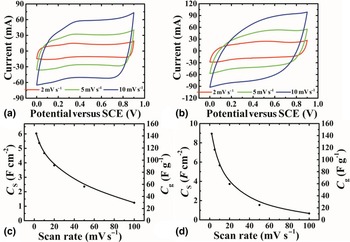
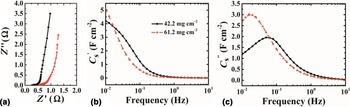
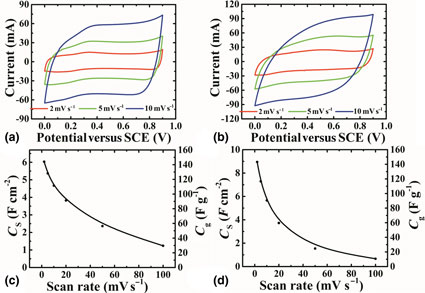
The capacitive performance of the electrodes was analyzed by different methods (Figs. 3 and 4, Supplementary Figs. S5–S7, Table S1). Figures 3(a) and 3(b), S5(a) show cyclic voltammetry (CVs) for MnO2–NT composites with AM loadings in the range of 42–61 mg/cm2. The nearly ideal box shape CVs represent good capacitive behavior, which was achieved at high AM. The capacitances of 6.03, 7.22, and 8.95 F/cm2 were achieved for mass loadings of 42, 51, and 61 mg/cm2, respectively, at a scan rate of 2 mV/s1. However, C S decreased with scan rate increase due to limited diffusion of electrolyte in pores [Figures 3(c) and 3(d), S5(b)]. The δ m values were in the range of 0.63–0.91 for AM of 42–61 mg/cm2. The relatively high δ m values offer benefits for the fabrication of devices with reduced mass. The high capacitance was achieved at relatively low electrode resistance. Figures 4(a) and S5(c) show complex impedance data in the Nyquist diagram. For the electrode with AM of 42 mg/cm2 the slope of the graph was close to 90°, indicating good capacitive properties. The electrode with AM of 61 mg/cm2 showed slightly higher resistance and reduced Nyquist diagram slope. The equivalent series resistance value increased from 0.97 to 1.27 Ohms with AM increase in the range of 42–61 mg/cm2. The complex capacitance, derived from the AC impedance data [Figs. (4b) and 4(c), S5(d)] showed a frequency dispersion of the relaxation type,[Reference Shi and Zhitomirsky24, Reference Su and Zhitomirsky25] due to the decrease of the real part (C S′) with frequency increase and relaxation maxima in the imaginary part (C S″). The frequency of the relaxation maximum decreased with increasing AM due to limited diffusion in pores. The constant current charge–discharge graphs (Supplementary Fig. S7) were of nearly ideal symmetric triangular shape, which indicated good capacitive properties.
(a, b) CVs at different scan rates and (c, d) C g and C S versus scan rate for MnO2–NT electrodes with AM of (a, c) 42 mg/cm2 and (b, d) 61 mg/cm2.

(a) Nyquist plots of complex impedance and (b, c) frequency dependences of components of complex capacitance for MnO2–NT electrodes with AM of 42 and 61 mg/cm2.

Conclusions
A conceptually new method has been developed for the manufacturing of MnO2–NT electrodes for SCaps. CPC was used as a complexing and capping agent for synthesis and a phase transfer agent for liquid–liquid particle extraction. We suggested a mechanism of synthesis, which involved the formation of cetylpyridinium permanganate in an aqueous phase, phase transfer to n-butanol phase and reduction of MnO4− species by n-butanol. In this method, the problem of particle agglomeration in the drying process was eliminated. The co-dispersion of MnO2 and NT in n-butanol facilitated their improved mixing, which allowed the fabrication of advanced electrodes with high AM. We demonstrated the formation of SCap electrodes with AM loading in the range of 42–61 mg/cm2. The high AM loading allowed for high δ m, which was beneficial for the fabrication of SCap with reduced total mass. The electrodes showed enhanced capacitive behavior and low resistance. The highest C S of 8.95 F/cm2 was obtained.
Supplementary material
The supplementary material for this article can be found at https://doi.org/10.1557/mrc.2018.165.
Acknowledgment
This investigation was supported by NSERC Canada.