












1. Introduction
Let  $H^{\infty}(\mathbb{D},\mathbb{C})$ be the space of bounded analytic functions from the unit disk
 $\mathbb{D}:=\{z \in \mathbb{C}:|z| \lt 1\}$ into the complex plane
 $\mathbb{C}$, and we denote
 $\left\lVert f\right\rVert_{\infty}:=\sup_{|z| \lt 1} |f(z)|$. The remarkable theorem of Harald Bohr of a universal constant
 $r=1/3$ for functions in
 $H^{\infty}(\mathbb{D},\mathbb{C})$ is as follows.
Theorem A. Let  $f \in H^{\infty}(\mathbb{D},\mathbb{C})$ with the power series
 $f(z)=\sum_{n=0}^{\infty} a_{n}z^{n}$. If
 $\left\lVert f\right\rVert_{\infty} \leq 1$, then
 \begin{equation}
\sum_{n=0}^{\infty} |a_{n}|r^{n} \leq 1
\end{equation}
for  $|z|=r \leq 1/3$, and the constant
 $1/3$, referred to as the classical Bohr radius, is the best possible.
The Bohr’s theorem has become popular when Dixon [Reference Dixon19] has used it to disprove a long-standing conjecture that if the non-unital von Neumann’s inequality holds for a Banach algebra, then it is necessarily an operator algebra. It is important to note that Equation (1.1) can be written in the following equivalent form:
 \begin{equation}
|a_{0}|\phi_{0}(r) + \sum_{n=1}^{\infty} |a_{n}| \phi_{n}(r) \leq \phi_{0}(r)
\end{equation}
for  $r \leq R:= 1/3$, where
 $\phi_{n}(r)=r^n$ and R is the smallest root of the equation
 $\phi_{0}(r)=2\sum_{n=1}^{\infty} \phi_{n}(r)$ in
 $(0,1)$. We observe that
 $\{\phi_{n}(r)\}_{n=0}^{\infty}$ is a sequence of non-negative continuous functions in
 $[0,1)$ such that the series
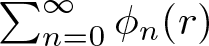
 $\sum_{n=0}^{\infty} \phi_{n}(r)$ converges locally uniformly with respect to
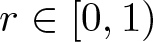
 $r \in [0,1)$. This fact leads to the following question.
Question 1.3.
Can we establish the inequality (1.2) for any sequence  $\{\psi_{n}(r)\}_{n=0}^{\infty}$ of non-negative continuous functions in
 $[0,1)$ such that the series
 $\sum_{n=0}^{\infty} \psi_{n}(r)$ converges locally uniformly with respect to
 $r \in [0,1)$.
We give the affirmative answer to this question in Theorem 1.3. In order to generalize the inequality (1.2), we first need to introduce some basic notations. Let  $\mathcal{G}$ denote the set of all sequences
 $\phi= \{\phi_{n}(r)\}_{n=0}^{\infty}$ of non-negative continuous functions in
 $[0,1)$ such that the series
 $\sum_{n=0}^{\infty} \phi_{n}(r)$ converges locally uniformly with respect to
 $r \in [0,1)$. Now we want to define a modified Bohr radius associated with
 $\phi \in \mathcal{G}$.
Definition 1.1. Let  $f \in H^{\infty}(\mathbb{D},\mathbb{C})$ with
 $f(z)=\sum_{n=0}^{\infty} a_{n}z^{n}$ such that
 $\left\lVert f\right\rVert_{\infty} \leq 1$ in
 $\mathbb{D}$. For
 $\phi \in \mathcal{G}$, we denote
 \begin{equation}
R_{\phi}(f,\mathbb{C})= \sup \left\{r \geq 0: \sum_{n=0}^{\infty} |a_{n}|\phi_{n}(r) \leq \phi_{0}(r)\right\}.
\end{equation}
Define Bohr radius associated with ϕ by
 \begin{equation}
R_{\phi}(\mathbb{C})=\inf \left\{R_{\phi}(f,\mathbb{C}): \left\lVert f\right\rVert_{\infty} \leq 1\right\}.
\end{equation}
Clearly,  $R_{\phi}(\mathbb{C})$ coincides with the classical Bohr radius
 $1/3$ for
 $\phi_{n}(r)=r^n$ for
 $r \in [0,1)$. In this article, we are interested in studying the operator-valued analogue of the Bohr radius
 $R_{\phi}(\mathbb{C})$, which we discuss in Definition 1.2.
Over the past two decades, there has been significant interest on several variations of Bohr inequality (1.1) (see [Reference Ahamed, Allu and Halder1-Reference Aizenberg, Aytuna and Djakov4, Reference Alkhaleefah, Kayumov and Ponnusamy6-Reference Allu and Halder8, Reference Aytuna and Djakov10, Reference Bayart, Pellegrino and Seoane-Sepúlveda12, Reference Bhowmik and Das13, Reference Blasco15-Reference Defant, Frerick, Ortega-Cerdà, Ounaïes and Seip18, Reference Evdoridis, Ponnusamy and Rasila23, Reference Liu and Ponnusamy30, Reference Popescu33]). In 2000, Djkaov and Ramanujan [Reference Djakov and Ramanujan20] extensively studied the best possible constant rp, for  $1 \leq p \lt \infty $, such that
 \begin{equation}
\left(\sum_{n=0}^{\infty} |a_{n}|^p (r_{p})^{np}\right)^{1/p} \leq \left\lVert f\right\rVert_{\infty},
\end{equation}
where  $f(z)=\sum_{n=0}^{\infty} a_{n}z^n$. For p = 1, rp coincides with the classical Bohr radius
 $1/3$. Using Haussdorf–Young’s inequality, it is easy to see that
 $r_{p}=1$ for
 $p \in [2,\infty)$. Computing the precise value of rp for
 $1 \lt p \lt 2$ is difficult in general. This fact leads to estimate the value of rp. The following best known estimate has been obtained in [Reference Djakov and Ramanujan20]
 \begin{equation}
\left(1+ \left(\frac{2}{p}\right)^{\frac{1}{2-p}}\right)^{\frac{p-2}{p}} \leq r_{p} \leq \inf \limits_{0 \leq a \lt 1} \frac{(1-a^p)^{1/p}}{\left((1-a^2)^p + a^p (1-a^p)\right)^{1/p}}.
\end{equation}
For further generalization of Equation (1.1), replacing  $H^{\infty}$-norm by the Hp-norm, we refer to [Reference Bénéteau, Dahlner and Khavinson11]. Paulsen et al. [Reference Paulsen, Popescu and Singh32] have considered the another modification of Equation (1.1) and have shown that
 \begin{equation}
|a_{0}|^2 + \sum_{n=1}^{\infty} |a_{n}| \left(\frac{1}{2}\right)^n \leq 1,
\end{equation}
where  $f(z)=\sum_{n=0}^{\infty} a_{n}z^n$ and
 $\left\lVert f\right\rVert_{\infty} \leq 1$. Moreover, the constant
 $1/2$ is sharp. Several authors have extended the inequality (1.8) to harmonic mappings in the unit disk and obtained several interesting results. For more intriguing aspects of Equation (1.8) for harmonic mappings, we refer to [Reference Evdoridis, Ponnusamy and Rasila22, Reference Kayumov and Ponnusamy28, Reference Kayumov, Ponnusamy and Shakirov29] and references therein. Using the same approach in [Reference Paulsen, Popescu and Singh32], Blasco [Reference Blasco14] has extended Equation (1.8) for the range of
 $p \in [1,2]$ and has shown that
 \begin{equation}
|a_{0}|^p + \sum_{n=1}^{\infty} |a_{n}| \left(\frac{p}{p+2}\right)^n \leq 1.
\end{equation}
The constant  $p/(p+2)$ is sharp.
The study of Bohr radius has also been extended for functions defined on a proper simply connected domain of the complex plain. Throughout this paper, Ω stands for a simply connected domain containing the unit disk  $\mathbb{D}$. Let
 $\mathcal{H}(\Omega)$ denote the class of analytic functions in Ω, and let
 $\mathcal{B}(\Omega)$ be the class of functions
 $f \in \mathcal{H}(\Omega) $ such that
 $f(\Omega) \subseteq \overline{\mathbb{D}}$. The Bohr radius
 $B_{\Omega}$ for the class
 $\mathcal{B}(\Omega)$ is defined by (see [Reference Fournier and Ruscheweyh24])
 \begin{equation*}
B_{\Omega}:=\sup\bigg\{r\in (0,1) : M_{f}(r)\leq 1\; {\rm for} \ {\rm all}\; f(z)=\sum_{n=0}^{\infty}a_nz^n\in\mathcal{B}(\Omega),\; z\in\mathbb{D}\bigg\},
\end{equation*}
where  $M_{f}(r):=\sum_{n=0}^{\infty}|a_n|r^n$ is the associated majorant series of
 $f \in \mathcal{B}(\Omega)$ in
 $\mathbb{D}$. It is easy to see that when
 $\Omega=\mathbb{D}$,
 $B_{\mathbb{D}}=1/3$, which is the classical Bohr radius for the class
 $\mathcal{B}(\mathbb{D})$.
For  $0\leq \gamma \lt 1$, we consider the following disk defined by
 \begin{equation*}
\Omega_{\gamma}:=\left\{z\in\mathbb{C} : \left|z+\frac{\gamma}{1-\gamma}\right| \lt \frac{1}{1-\gamma}\right\}.
\end{equation*}
Clearly,  $\Omega_{\gamma}$ contains
 $\mathbb{D}$ and
 $\Omega_{\gamma}$ reduces to
 $\mathbb{D}$ for γ = 0. In 2010, Fournier and Ruscheweyh [Reference Fournier and Ruscheweyh24] studied Bohr inequality (1.1) for the class
 $\mathcal{B}(\Omega_{\gamma})$.
Theorem 1.1. ([Reference Fournier and Ruscheweyh24])
For  $ 0\leq \gamma \lt 1 $, let
 $ f\in\mathcal{B}(\Omega_{\gamma}) $, with
 $ f(z)=\sum_{n=0}^{\infty}a_nz^n $ in
 $ \mathbb{D} $. Then,
 \begin{equation*}
\sum_{n=0}^{\infty}|a_n|r^n\leq 1\quad {\rm for}\; r\leq\rho _{\gamma}:=\frac{1+\gamma}{3+\gamma}.
\end{equation*}
Moreover,  $ \sum_{n=0}^{\infty}|a_n|\rho _{\gamma}^n=1 $ holds for a function
 $ f(z)=\sum_{n=0}^{\infty}a_nz^n $ in
 $ \mathcal{B}(\Omega_{\gamma}) $ if, and only if,
 $ f(z)=c $ with
 $ |c|=1 $.
The main aim of this paper is to study the vector-valued analogue of Equations (1.4), (1.5) and (1.9) on simply connected domains and its connection with Banach space and Hilbert space theories. For discussing this, we first need to introduce some basic notation and give some definitions. Let  $H^{\infty}(\mathbb{D},X)$ be the space of bounded analytic functions from
 $\mathbb{D}$ into a complex Banach space X, and we write
 $\left\lVert f\right\rVert_{H^{\infty}(\mathbb{D},X)}= \sup_{|z| \lt 1} \left\lVert f(z)\right\rVert$. For
 $p \in [1, \infty)$,
 $H^{p}(\mathbb{D},X)$ denotes the space of analytic functions from
 $\mathbb{D}$ into X such that
 \begin{equation}
\left\lVert f\right\rVert_{H^{p}(\mathbb{D},X)}= \sup \limits _{0 \lt r \lt 1} \left(\int_{0}^{2\pi} \left\lVert f(r\,{\rm e}^{it})\right\rVert^p \frac{{\rm d}t}{2\pi}\right)^{1/p} \lt \infty.
\end{equation}
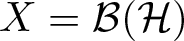
Throughout this paper,  $\mathcal{B}(\mathcal{H})$ stands for the space of bounded linear operators on a complex Hilbert space
 $\mathcal{H}$. For any
 $T \in \mathcal{B}(\mathcal{H})$,
 $\left\lVert T\right\rVert$ denotes the operator norm of T. Let
 $T \in \mathcal{B}(\mathcal{H})$. Then the adjoint operator
 $T^{*}:\mathcal{H} \rightarrow \mathcal{H}$ of T defined by
 $\left\langle Tx,y\right\rangle=\left\langle x,T^{*}y\right\rangle$ for all
 $x, y \in \mathcal{H}$. T is said to be normal if
 $T^{*}T=TT^{*}$, self-adjoint if
 $T^{*}=T$, and positive if
 $\left\langle Tx,x\right\rangle \geq 0$ for all
 $x \in \mathcal{H}$. The absolute value of T is defined by
 $\left\lvert T\right\rvert:=\left(T^{*}T\right)^{1/2}$, while
 $S^{1/2}$ denotes the unique positive square root of a positive operator S. Let I be the identity operator on
 $\mathcal{H}$.
Now we define the vector-valued analogue of Definition 1.1 on arbitrary simply connected domain containing the unit disk  $\mathbb{D}$. Let
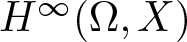
 $H^{\infty}(\Omega,X)$ be the space of bounded analytic functions from Ω into a complex Banach space X and
 $\left\lVert f\right\rVert_{H^{\infty}(\Omega,X)}= \sup_{z \in \Omega} \left\lVert f(z)\right\rVert$.
Definition 1.2. Let  $f \in H^{\infty}(\Omega,X)$ be given by
 $f(z)=\sum_{n=0}^{\infty} x_{n}z^{n}$ in
 $\mathbb{D}$ with
 $\left\lVert f\right\rVert_{H^{\infty}(\Omega,X)} \leq 1$. For
 $\phi \in \mathcal{G}$, we denote
 \begin{equation}
R_{\phi}(f,\Omega,X)= \sup \left\{r \geq 0: \sum_{n=0}^{\infty} \left\lVert x_{n}\right\rVert\phi_{n}(r) \leq \phi_{0}(r)\right\}.
\end{equation}
Define Bohr radius associated with ϕ by
 \begin{equation}
R_{\phi}(\Omega,X)=\inf \left\{R_{\phi}(f,\Omega,X): \left\lVert f\right\rVert_{H^{\infty}(\Omega,X)} \leq 1\right\}.
\end{equation}
It is important to note that for  $\Omega=\Omega_{\gamma}$ and
 $\phi_{n}(r)=r^n$, by embedding
 $\mathbb{C}$ into X, from Theorem 1.1,
 $R_{\phi}(\Omega_{\gamma},X) \leq (1+\gamma)/(3+\gamma)$ for every complex Banach space X. Clearly,
 $R_{\phi}(\mathbb{D},X)\leq 1/3$. However, this notion is not much significant in the finite-dimensional case for dimension greater than one. As usual, for
 $1 \leq p \lt \infty$,
 $\mathbb{C}^{m}_{p}$ stands for the space
 $\mathbb{C}^m$ endowed with the norm
 $\left\lVert w\right\rVert_{p}=\left(\sum_{i=1}^{m} |w_{i}|^p\right)^{1/p}$ and
 $\left\lVert w\right\rVert_{\infty}=\sup_{1\leq i \leq m} |w_{i}|$, where
 $w=(w_{1}, w_{2},\ldots,w_{m}) \in \mathbb{C}^m$. In [Reference Blasco14], Blasco has shown that
 $R_{\phi}(\mathbb{D},\mathbb{C}^{m}_{p})=0$ for
 $\phi_{n}=r^n$ in
 $[0,1)$ when
 $1\leq p\leq \infty$. By considering the same functions as in [Reference Blasco14], we show that, for
 $m \geq 2$,
 $R_{\phi}(\mathbb{D},\mathbb{C}^{m}_{p})$ need not be always non-zero for all
 $\phi \in \mathcal{G}$. In particular, we see that
 $R_{\phi}(\mathbb{D},\mathbb{C}^{m}_{p})$ becomes zero for some particular choices of ϕ. For m = 1, we observe that
 $\left\lVert w\right\rVert_{p}=\left\lVert w\right\rVert_{\infty}$ for
 $1\leq p \lt \infty$ for any
 $w \in \mathbb{C}$. Thus,
 $R_{\phi}(\mathbb{D},\mathbb{C}^{m}_{p})=R_{\phi}(\mathbb{D},\mathbb{C}^{m}_{\infty})$. In the following proposition, we show that
 $R_{\phi}(\mathbb{D},\mathbb{C}^{m}) \gt 0$ for m = 1 under some suitable conditions on
 $\phi_{n}(r)$.
Proposition 1.13. Let  $\phi=\{\phi_{n}(r)\}^{\infty}_{n=0} \in \mathcal{G}$.
(1) For
 $m \geq 2$, $R_{\phi}(\mathbb{D},\mathbb{C}^{m}_{\infty})=0$ when r = 0 is the only zero of $\phi_{1}(r)$ in $[0,1)$.
(2) For
$1\leq p \lt \infty$ and $m \geq 2$, $R_{\phi}(\mathbb{D},\mathbb{C}^{m}_{p})=0$ when $\phi_{0}(r)=1$ and $\phi_{1}(r)=\alpha \, r^{\beta}$ for $r \in [0,1)$ and $\alpha, \beta \in (0,\infty)$.(3) For m = 1, let
$f \in H^{\infty}(\mathbb{D},\mathbb{C})$ be given by $f(z)= \sum_{n=0}^{\infty} x_{n}z^n$ in $\mathbb{D}$ with $\left\lVert f(z)\right\rVert_{H^{\infty}(\mathbb{D},\mathbb{C})} \leq 1$. Also let $\phi=\{\phi_{n}(r)\}_{n=0}^{\infty} \in \mathcal{G}$ satisfy the inequality(1.14)\begin{equation}
\phi_{0}(r) \gt 2 \sum_{n=1}^{\infty} \phi_{n}(r) \quad\mbox{for} \; r\in [0,R),
\end{equation}where R is the smallest root in
$(0,1)$ of the equation
(1.15)\begin{equation}
\phi_{0}(x)=2 \sum_{n=1}^{\infty} \phi_{n}(x).
\end{equation}Then, we have
$R_{\phi}(\mathbb{D},\mathbb{C})\geq R$. That is, $R_{\phi}(\mathbb{D}, \mathbb{C}) \gt 0$.


Proof. It is sufficient to prove for the case m = 2.
(1) We consider the function  $f(z)= (1,z)= e_{1} + e_{2}z$,
 $z \in \mathbb{D}$, where
 $e_{1}=(1,0)$ and
 $e_{2}=(0,1)$. Clearly,
 $\left\lVert f\right\rVert_{H^{\infty}(\mathbb{D},\mathbb{C}^{2}_{\infty})}= \sup _{|z| \lt 1}\left\lVert f(z)\right\rVert_{\infty}=1$. Then from Equation (1.11), we have
 \begin{equation*}
R_{\phi}(f,\mathbb{D},\mathbb{C}^{2}_{\infty}) = \sup \left\{r \geq 0: \left\lVert x_{0}\right\rVert_{\infty} \phi_{0}(r) + \left\lVert x_{1}\right\rVert_{\infty}\phi_{1}(r) \leq \phi_{0}(r)\right\},
\end{equation*}
where  $x_{0}=e_{1}$ and
 $x_{1}=e_{2}$. Clearly,
 $\left\lVert x_{0}\right\rVert_{\infty}=\left\lVert x_{1}\right\rVert_{\infty}=1$. Then
 \begin{equation}
\left\lVert x_{0}\right\rVert_{\infty} \phi_{0}(r) + \left\lVert x_{1}\right\rVert_{\infty}\phi_{1}(r) = \phi_{0}(r) + \phi_{1}(r) \leq \phi_{0}(r)
\end{equation}
only when  $\phi_{1}(r) \leq 0$ for
 $r \in [0,1)$. Thus, to obtain
 $R_{\phi}(f,\mathbb{D},\mathbb{C}^{2}_{\infty})$, we need to find the supremum of all such r such that
 $\phi_{1}(r) \leq 0$ for
 $r \in [0,1)$. Since
 $\phi \in \mathcal{G}$, each
 $\phi_{n}(r)$ is non-negative for all
 $r \in [0,1)$. Therefore, Equation (1.16) holds only when
 $\phi_{1}(r)=0$ for
 $r \in [0,1)$. By the hypothesis, we have
 $\phi_{1}(r)=0$ if, and only if, r = 0, which yields that Equation (1.16) holds only for r = 0. Thus,
 $R_{\phi}(f,\mathbb{D},\mathbb{C}^{2}_{\infty})=0$ and so
 $R_{\phi}(\mathbb{D},\mathbb{C}^{2}_{\infty})=0$. This shows that
 $R_{\phi}(\mathbb{D},\mathbb{C}^{m}_{\infty})=0$. (2) For
 $1 \lt p \lt \infty$, using the fact
 $\lim _{s \rightarrow \infty} s^{1/p} - (s-1)^{1/p}=0$, for each ϵ > 0, one can easily find a value
 $\delta \in (0,1)$ such that
 \begin{equation}
1-(1-\delta)^{1/p} \lt \alpha \epsilon^{\beta}\, \delta^{1/p}.
\end{equation}
We now consider the function
 \begin{equation*}
f(z)=\left((1-\delta)^{1/p}, \delta^{1/p}\,z\right)= (1-\delta)^{1/p} e_{1} + \delta^{1/p}\, e_{2} z.
\end{equation*}
It is easy to see that
 \begin{equation*}\left\lVert f\right\rVert _{H^{\infty}(\mathbb{D},\mathbb{C}^{2}_{p})}=\sup_{|z| \lt 1} \left\lVert f(z)\right\rVert_{p}=\sup_{0 \lt r \lt 1} \left(((1-\delta)+ \delta r^{p})^{1/p}\right) =1,\end{equation*}
and hence Equation (1.11) becomes
 \begin{equation}
R_{\phi}(f,\mathbb{D},\mathbb{C}^{2}_{p})= \sup \left\{r \geq 0: \left\lVert x_{0}\right\rVert_{p} \phi_{0}(r) + \left\lVert x_{1}\right\rVert_{p} \phi_{1}(r) \leq \phi_{0}(r)\right\}.
\end{equation}
In view of the assumptions  $\phi_{0}(r)=1$ and
 $\phi_{1}(r)=\alpha r^{\beta}$, we have
 \begin{equation}
\left\lVert x_{0}\right\rVert_{p} \phi_{0}(r) + \left\lVert x_{1}\right\rVert_{p} \phi_{1}(r)= (1-\delta)^{1/p} + \delta^{1/p} \alpha r^{\beta}.
\end{equation}
Using Equation (1.19) in Equation (1.18), we obtain
 \begin{equation}
R_{\phi}(f,\mathbb{D},\mathbb{C}^{2}_{p})= \sup \{r \geq 0: (1-\delta)^{1/p} + \delta^{1/p} \alpha r^{\beta} \leq 1\}.
\end{equation}
Therefore, Equations (1.17) and (1.20) show that  $R_{\phi}(f,\mathbb{D},\mathbb{C}^{2}_{p}) \leq \epsilon$. Hence,
 $R_{\phi}(\mathbb{D},\mathbb{C}^{2}_{p}) =0$ for
 $1 \lt p \lt \infty$. Thus,
 $R_{\phi}(\mathbb{D},\mathbb{C}^{m}_{p}) =0$.
Now for p = 1, using the fact  $\lim _{s \rightarrow \infty} \sqrt{s} - \sqrt{s-1}=0$, for each ϵ > 0, one can easily find a value
 $\delta \in (0,1)$ such that
 \begin{equation}
1-\sqrt{1-\delta} \lt \alpha \epsilon^{\beta} \sqrt{\delta}.
\end{equation}
We consider the following function
 \begin{equation*}
f(z)=\frac{\sqrt{1-\delta}}{2} (1,1) + \frac{\sqrt{\delta}}{2}(1,-1)z = \frac{1}{2} \left(\sqrt{1-\delta} + \sqrt{\delta}z, \sqrt{1-\delta} - \sqrt{\delta}z\right).
\end{equation*}
A simple computation shows that
 \begin{align*}
\left\lVert f(z)\right\rVert_{1}
&= \frac{1}{2} \left(\left\lvert\sqrt{1-\delta} + \sqrt{\delta}z\right\rvert + \left\lvert\sqrt{1-\delta} - \sqrt{\delta}z\right\rvert\right)\\
& \leq \frac{1}{\sqrt{2}} \left(\left\lvert\sqrt{1-\delta} + \sqrt{\delta}z\right\rvert^2 + \left\lvert\sqrt{1-\delta} - \sqrt{\delta}z\right\rvert^2 \right)^{1/2}=1.
\end{align*}
By the similar lines of argument as above for the case  $1 \lt p \lt \infty$, we obtain
 $R_{\phi}(f,\mathbb{D},\mathbb{C}^{2}_{1}) \leq \epsilon$, and hence
 $R_{\phi}(\mathbb{D},\mathbb{C}^{2}_{1}) =0$. Thus,
 $R_{\phi}(\mathbb{D},\mathbb{C}^{m}_{1}) =0$. (3) Let
 $H^{\infty}(\mathbb{D},\mathbb{C})$ with
 $\left\lVert f(z)\right\rVert_{H^{\infty}(\mathbb{D},\mathbb{C})}=\sup_{z \in \mathbb{D}}|f(z)| \leq 1$. Then, by Weiner’s inequality, we have
 $|x_{n}|\leq 1-|x_{0}|^2$ for
 $n \geq 1$. Using this inequality, we obtain
 \begin{align}
|x_{0}| \phi_{0}(r) + \sum_{n=1}^{\infty} |x_{n}|\phi_{n}(r) & \leq |x_{0}| \phi_{0}(r) + \left(1-|x_{0}|^2\right) \left(\sum_{n=1}^{\infty} \phi_{n} (r)\right)\\
& \leq |x_{0}| \phi_{0}(r) + 2(1-|x_{0}|) \sum_{n=1}^{\infty} \phi_{n} (r) \leq \phi_{0}(r),
\end{align}
provided
 \begin{equation}
2 \sum_{n=1}^{\infty} \phi_{n}(r) \lt \phi_{0}(r).
\end{equation}
Now, by the given assumption (1.14), the inequality (1.23) holds for  $r \in [0,R)$, where R is the smallest root in
 $(0,1)$ of
 $\phi_{0}(r)=2 \sum_{n=1}^{\infty} \phi_{n}(r)$. Thus, we obtain that Equation (1.22) holds for
 $r \in [0,R)$. Hence,
 $R_{\phi}(f,\mathbb{D},\mathbb{C})\geq R$ and so
 $R_{\phi}(\mathbb{D},\mathbb{C})\geq R$. Since
 $R \in (0,1)$, we have
 $R_{\phi}(\mathbb{D},\mathbb{C}) \gt 0$.
(1) If
$\phi=\{\phi_{n}(r)\}_{n=0}^{\infty}$ with $\phi_{n}(r)=r^n$, then each ϕn is non-negative in $[0,1)$ and so $\phi \in \mathcal{G}$. Clearly, $\phi_{1}(r)=r$ has only zero at r = 0 in $[0,1)$. In view of Proposition 1.13(1), the corresponding Bohr radius associated with ϕ is $R_{\phi}(\mathbb{D},\mathbb{C}^{m}_{\infty}) =0$. Furthermore, it is easy to see that $\phi_{0}(r)=1$ and $\phi_{1}(r)=\alpha\, r^{\beta}$ with $\alpha=\beta=1$, and hence by Proposition 1.13(2), we have $R_{\phi}(\mathbb{D},\mathbb{C}^{m}_{p}) =0$ for $1\leq p \lt \infty$ and $m \geq 2$.(2) Similarly, when
$\phi=\{\phi_{n}(r)\}_{n=0}^{\infty}$ with $\phi_{n}(r)=(n+1)r^n$, nrn, $n^2r^n$, Proposition 1.13 gives the corresponding Bohr radius associated with ϕ, $R_{\phi}(\mathbb{D},\mathbb{C}^{m}_{\infty}) =0$ and $R_{\phi}(\mathbb{D},\mathbb{C}^{m}_{p}) =0$ for $1\leq p \lt \infty$ and $m \geq 2$.


The above fact leads us to consider the vector-valued analogue of Equation (1.8) in a simply connected domain for a given Banach space X and parameters  $0 \lt p,q \lt \infty$. We define a modified Bohr radius, which need not be zero for all
 $\phi \in \mathcal{G}$ even for infinite-dimensional Banach spaces.
Definition 1.3. Let  $f \in H^{\infty}(\Omega,X)$ be given by
 $f(z)=\sum_{n=0}^{\infty} x_{n}z^{n}$ in
 $\mathbb{D}$ with
 $\left\lVert f\right\rVert_{H^{\infty}(\Omega,X)} \leq 1$. For
 $\phi=\{\phi_{n}(r)\}_{n=0}^{\infty} \in \mathcal{G}$ with
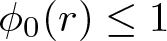
 $\phi_{0}(r)\leq 1$,
 $1\leq p,q \lt \infty$, we denote
 \begin{equation}
R_{p,q,\phi}(f,\Omega,X)= \sup \left\{r \geq 0: \left\lVert x_{0}\right\rVert^p \phi_{0}(r) + \left(\sum_{n=1}^{\infty} \left\lVert x_{n}\right\rVert\phi_{n}(r)\right)^q \leq 2\phi_{0}(r)\right\}.
\end{equation}
Define Bohr radius associated with ϕ by
 \begin{equation}
R_{p,q,\phi}(\Omega,X)=\inf \left\{R_{p,q,\phi}(f,\Omega,X): \left\lVert f\right\rVert_{H^{\infty}(\Omega,X)} \leq 1\right\}.
\end{equation}
Clearly,  $R_{1,1,\phi}(\Omega,X)=R_{\phi}(\Omega,X)$. For
 $p_{1} \leq p_{2}$ and
 $q_{1} \leq q_{2}$, we have the following inclusion relation:
 \begin{equation}
R_{p_{1},q_{1},\phi}(\Omega,X) \leq R_{p_{2},q_{2},\phi}(\Omega,X).
\end{equation}
Finding the exact value of  $R_{p,q,\phi}(\Omega,X)$ is very difficult in general, even for
 $\Omega=\mathbb{D}$ and
 $X= \mathbb{C}^{1}_{2}$. In 2002, Paulsen et al. [Reference Paulsen, Popescu and Singh32] proved that
 $R_{2,1,\phi}(\mathbb{D},\mathbb{C})=1/2$ for
 $\phi=\{\phi_{n}(r)\}^{\infty}_{n=0}$ with
 $\phi_{n}(r)=r^n$. Later, for the same ϕ, Blasco [Reference Blasco14] has shown that
 $R_{2,1,\phi}(\mathbb{D},\mathbb{C})=p/(p+2)$ for
 $1 \leq p \leq 2$. By considering the same example as in Proposition 1.13, we have the following interesting result.
Proposition 1.27. Let  $\phi=\{\phi_{n}(r)\}^{\infty}_{n=0} \in \mathcal{G}$. For
 $m \geq 2$ and
 $1\leq p,q \lt \infty$,
 $R_{p,q,\phi}(\mathbb{D},\mathbb{C}^{m}_{\infty})=0$ when r = 0 is the only zero of
 $\phi_{1}(r)$ in
 $[0,1)$.
It is important to note that  $\mathbb{C}^m_{\infty}$ is not a Hilbert space. Indeed, let
 $x=(1,0,\ldots,0)$ and
 $y=(0,1,\ldots,0)$ be in
 $\mathbb{C}^m_{\infty}$. Then
 $\left\lVert x\right\rVert_{\infty}=\left\lVert y\right\rVert_{\infty}=\left\lVert x+y\right\rVert_{\infty}= \left\lVert x-y\right\rVert_{\infty}=1$ and
 $\left\lVert x+y\right\rVert^2_{\infty} + \left\lVert x-y\right\rVert^2_{\infty}=2 \neq 4=2\left\lVert x\right\rVert^2_{\infty}+2\left\lVert y\right\rVert^2_{\infty}$. Hence, Parallelogram law is violated. Blasco [Reference Blasco14] has shown that for
 $m \geq 2$,
 $R_{p,p,\phi}(\mathbb{D},\mathbb{C}^m_{2}) \gt 0$ if, and only if,
 $p\geq 2$ when
 $\phi_{n}(r)=r^n$. It is worth mentioning that
 $X=\mathbb{C}^m_{2}$ is a Hilbert space with the inner product
 $\left\langle.\right\rangle$, where
 $\left\lVert x\right\rVert_{2}=\sqrt{\left\langle x,x\right\rangle}$. This fact leads us to the following question.
Question 1.28.
Does the radius  $R_{p,q,\phi}(\mathbb{D},\mathcal{B}(\mathcal{H}))$ have to be always positive for
 $2 \leq p \leq q$?
We give an affirmative answer to the Question 1.28 in the following form. In the following theorem, we show that  $R_{p,p,\phi}(\Omega,\mathcal{B}(\mathcal{H}))$ is strictly positive for
 $p \geq 2$. Then by the inclusion relation (1.26), we obtain that
 $R_{p,q,\phi}(\mathbb{D},\mathcal{B}(\mathcal{H}))$ is strictly positive for
 $2\leq p \leq q$.
Theorem 1.2. Let  $\mathcal{B}(\mathcal{H}))$ be complex Hilbert space with
 $\mathcal{H}$ being one-dimensional and
 $f \in H^{\infty}(\mathbb{D},\mathcal{B}(\mathcal{H}))$ be given by
 $f(z)= \sum_{n=0}^{\infty} A_{n}z^n$ in
 $\mathbb{D}$ with
 $A_{n} \in \mathcal{B}(\mathcal{H})$ for
 $n \in \mathbb{N} \cup \{0\}$ and
 $\left\lVert f(z)\right\rVert_{H^{\infty}(\mathbb{D},\mathcal{B}(\mathcal{H}))} \leq 1$. Also let, for
 $p\geq 2$,
 $\phi=\{\phi_{n}(r)\}_{n=0}^{\infty} \in \mathcal{G}$ with
 $\sum_{n=1}^{\infty} \phi_{n}^2(r)$ converges locally uniformly in
 $[0,1)$ and satisfies the inequality
 \begin{equation}
\phi_{0}(r) \gt 2 \sum_{n=1}^{\infty} \phi_{n}^2(r) \quad \mbox{for} \; r\in [0,R(p)),
\end{equation}
where R(p) is the smallest root in  $(0,1)$ of the equation
 \begin{equation}
\phi_{0}(x)=2 \sum_{n=1}^{\infty} \phi_{n}^2(x).
\end{equation}
Then, for  $p \geq 2$, we have
 $R_{p,p,\phi}(\mathbb{D},\mathcal{B}(\mathcal{H}))\geq R(p)$. That is,
 $R_{p,p,\phi}(\mathbb{D},\mathcal{B}(\mathcal{H})) \gt 0$ for
 $p \geq 2$.
Proof. In view of the inclusion relation (1.26), it is enough to show that  $R_{1,2,\phi}(\mathbb{D},\mathcal{B}(\mathcal{H})) \gt 0$. By the given assumption, f is in the unit ball of
 $H^{\infty}(\mathbb{D},\mathcal{B}(\mathcal{H}))$, i.e.,
 $\left\lVert f\right\rVert_{H^{\infty}(\mathbb{D},\mathcal{B}(\mathcal{H}))} \leq 1$. In particular, we have
 $\left\lVert f\right\rVert^2_{H^{2}(\mathbb{D},\mathcal{B}(\mathcal{H}))} =\sum_{n=0}^{\infty} \left\lVert A_{n}\right\rVert^2\leq 1$. Using Cauchy–Schwarz inequality, we obtain
 \begin{align}
\left\lVert A_{0}\right\rVert \phi_{0}(r) + \left(\sum_{n=1}^{\infty} \left\lVert A_{n}\right\rVert\phi_{n}(r)\right)^2
& \leq \left\lVert A_{0}\right\rVert \phi_{0}(r) + \left(\sum_{n=1}^{\infty} \left\lVert A_{n}\right\rVert^2\right) \left(\sum_{n=1}^{\infty} \phi_{n}^2 (r)\right)\\
& \leq \left\lVert A_{0}\right\rVert \phi_{0}(r) + (1-\left\lVert A_{0}\right\rVert^2) \sum_{n=1}^{\infty} \phi_{n}^2 (r) \leq \phi_{0}(r)\\
& \leq \left\lVert A_{0}\right\rVert \phi_{0}(r) + 2(1-\left\lVert A_{0}\right\rVert) \sum_{n=1}^{\infty} \phi_{n}^2 (r) \leq \phi_{0}(r),
\end{align}
provided
 \begin{equation}
2 \sum_{n=1}^{\infty} \phi_{n}^2(r) \lt \phi_{0}(r).
\end{equation}
Now, by the given assumption (1.29), the inequality (1.32) holds for  $r \in [0,R(p))$, where R(p) is the smallest root in
 $(0,1)$ of
 $\phi_{0}(r)=2 \sum_{n=1}^{\infty} \phi_{n}^2(r)$. Thus, we obtain that Equation (1.31) holds for
 $r \in [0,R(p))$. Hence,
 $R_{1,2,\phi}(f,\mathbb{D},\mathcal{B}(\mathcal{H}))\geq R(p)$ and so
 $R_{1,2,\phi}(\mathbb{D},\mathcal{B}(\mathcal{H}))\geq R(p)$. Since
 $R(p) \in (0,1)$, we have
 $R_{1,2,\phi}(\mathbb{D},\mathcal{B}(\mathcal{H})) \gt 0$. Therefore, by the inclusion relation (1.26), for
 $p \geq 2$, we obtain
 $R_{p,p,\phi}(\mathbb{D},\mathcal{B}(\mathcal{H})) \gt 0$. This completes the proof.
Remark 1.2. By the virtue of the inclusion relation (1.26) and Theorem 1.2, we conclude that  $R_{p,q,\phi}(\mathbb{D},\mathcal{B}(\mathcal{H})) \gt 0$ for
 $2\leq p \leq q$ under the same assumption on ϕ as in Theorem 1.2.
As we have discussed, the existence of the ‘strictly’ positive radius  $R_{p,q,\phi}(\mathbb{D},\mathcal{B}(\mathcal{H}))$ for
 $2\leq p \leq q$, it is natural to ask the following question.
Question 1.33.
Does the radius  $R_{p,q,\phi}(\mathbb{D},\mathcal{B}(\mathcal{H}))$ have to be always positive for
 $1\leq p,q \lt 2$?
We give the affirmative answer to the Question 1.33. We prove that  $R_{p,q,\phi}(\mathbb{D},\mathcal{B}(\mathcal{H}))$ is strictly positive for
 $1\leq p,q \lt 2$. Although finding the exact value of
 $R_{p,q,\phi}(\mathbb{D},\mathcal{B}(\mathcal{H}))$ for
 $1\leq p,q \lt 2$ is very much complicated, we can find a good estimate of the Bohr radius
 $R_{p,q,\phi}(\Omega,\mathcal{B}(\mathcal{H}))$ on simply connected domain Ω containing
 $\mathbb{D}$. In the following theorem, we show that
 $R_{p,1,\phi}(\Omega,\mathcal{B}(\mathcal{H}))$ is strictly positive for
 $1\leq p \leq 2$. Then by the inclusion relation (1.26), we obtain that
 $R_{p,q,\phi}(\mathbb{D},\mathcal{B}(\mathcal{H}))$ is strictly positive for
 $1\leq p,q \lt 2$. Let
 $f : \Omega \rightarrow \mathcal{B}(\mathcal{H})$ be a bounded analytic function, i.e.,
 $f \in H^{\infty}(\Omega,\mathcal{B}(\mathcal{H}))$ with
 $f(z)=\sum_{n=0}^{\infty} A_{n}z^n$ in
 $\mathbb{D}$ such that
 $A_{n} \in \mathcal{B}(\mathcal{H})$ for all
 $n \in \mathbb{N} \cup \{0\}$. We denote
 \begin{equation}
\lambda_{\mathcal{H}}:=\lambda_{\mathcal{H}}(\Omega):= \sup \limits _{\substack{f \in H^{\infty}(\Omega,\mathcal{B}(\mathcal{H}))\\{\left\lVert f(z)\right\rVert\leq1}}} \left\{\frac{\left\lVert A_{n}\right\rVert}{\left\lVert I- |A_{0}|^2\right\rVert} : A_{0} \not \equiv f(z)= \sum \limits_{n=0}^{\infty} A_{n} z^n, \; z \in \mathbb{D}\right\}.
\end{equation}
Theorem 1.3. For fixed  $p \in [1,2]$. Let
 $f \in H^{\infty}(\Omega,\mathcal{B}(\mathcal{H}))$ be given by
 $f(z)= \sum_{n=0}^{\infty} A_{n}z^n$ in
 $\mathbb{D}$, where
 $A_{0}=\alpha_{0}I$ for
 $|\alpha_{0}| \lt 1$ and
 $A_{n} \in \mathcal{B}(\mathcal{H})$ for all
 $n \in \mathbb{N} \cup \{0\}$ with
 $\left\lVert f\right\rVert_{H^{\infty}(\Omega,\mathcal{B}(\mathcal{H}))} \leq 1$. If
 $\phi=\{\phi_{n}(r)\}_{n=0}^{\infty} \in \mathcal{G}$ satisfies the inequality,
 \begin{equation}
p \phi_{0}(r) \gt 2 \lambda_{\mathcal{H}} \sum_{n=1}^{\infty} \phi_{n}(r)\quad \mbox{for} \; r \in [0, R_{\Omega}(p)),
\end{equation}
then the following inequality
 \begin{equation}
M_{f}(\phi, p, r):= \left\lVert A_{0}\right\rVert^p \phi_{0}(r) + \sum_{n=1}^{\infty} \left\lVert A_{n}\right\rVert \phi_{n}(r) \leq \phi_{0}(r)
\end{equation}
holds for  $|z|=r \leq R_{\Omega}(p)$, where
 $R_{\Omega}(p)$ is the smallest root in
 $(0,1)$ of the equation
 \begin{equation}
p \phi_{0}(r)= 2 \lambda_{\mathcal{H}} \sum_{n=1}^{\infty} \phi_{n}(r).
\end{equation}
Then,  $R_{\Omega}(p) \leq R_{p,1,\phi}(\Omega,\mathcal{B}(\mathcal{H}))$. That is,
 $R_{p,1,\phi}(\Omega,\mathcal{B}(\mathcal{H})) \gt 0$ for
 $1 \leq p \leq 2$.
Proof. Let  $f \in H^{\infty}(\Omega,\mathcal{B}(\mathcal{H}))$ be given by
 $f(z)= \sum_{n=0}^{\infty} A_{n}z^n$ in
 $\mathbb{D}$ with
 $\left\lVert f(z)\right\rVert_{H^{\infty}(\Omega,\mathcal{B}(\mathcal{H}))} \leq 1$. We note that
 $A_{0}=\alpha_{0}I$. Then, by Equation (1.34), we have
 \begin{equation}
\left\lVert A_{n}\right\rVert \leq \lambda_{\mathcal{H}}\left\lVert I- \left\lvert A_{0}^2\right\rvert\right\rVert= \lambda_{\mathcal{H}}\left\lVert I- \left\lvert\alpha_{0}\right\rvert^2 I\right\rVert=\lambda_{\mathcal{H}} (1- \left\lvert\alpha_{0}\right\rvert^2)\quad \mbox{for} \; n\geq 1.
\end{equation}
Using Equation (1.38), we obtain
 \begin{align*}
M_{f}(\phi, p, r)
& \leq \left\lvert\alpha_{0}\right\rvert^p \phi_{0}(r) + \lambda_{\mathcal{H}} (1- \left\lvert\alpha_{0}\right\rvert^2) \sum_{n=1}^{\infty} \phi_{n}(r) \\[2mm]
&= \phi_{0}(r) + \lambda_{\mathcal{H}} (1- \left\lvert\alpha_{0}\right\rvert^2) \left(\sum_{n=1}^{\infty} \phi_{n}(r) - \frac{(1-|\alpha_{0}|^p)}{\lambda_{\mathcal{H}}(1-|\alpha_{0}|^2)} \phi_{0}(r)\right).
\end{align*}
To obtain the inequality (1.36), we now estimate the lower bound of  $(1-|\alpha_{0}|^p)/\lambda_{\mathcal{H}} (1-|\alpha_{0}|^2)$. Let
 \begin{equation*}
B(x)=\frac{(1-x^p)}{\lambda_{\mathcal{H}}(1-x^2)} \quad \mbox{for} \; x\in [0,1).
\end{equation*}
For p = 2, we have  $B(x)=1/\lambda_{\mathcal{H}}$. For
 $p \in [1,2)$, let
 $\eta(x)=(2-p)x^p + px^{p-2} -2$. Then
 $B^{\prime}(x)= - (1/\lambda_{\mathcal{H}})\, x \,\eta(x)/ (1-x^2)^2$ for
 $x \in (0,1)$. We note that
 $\eta^{\prime}(x)= -p(2-p) x^{p-3} (1-x^2) \lt 0$ for
 $x \in (0,1)$ and
 $p \in [1,2)$, which shows that η is decreasing function in
 $(0,1)$ and thus
 $\eta(x) \gt \eta(1)=0$ for
 $x \in (0,1)$. Therefore,
 $B^{\prime}(x) \lt 0$ in
 $(0,1)$, i.e., B is decreasing in
 $[0,1)$ and hence
 \begin{equation*}
B(x) \geq \lim_{x \rightarrow 1^{-}} B(x)= \frac{p}{2\lambda_{\mathcal{H}}}\quad \mbox{for} \; p\in [1,2).
\end{equation*}
Thus,  $B(x) \geq p/2\lambda_{\mathcal{H}}$ for
 $p \in [1,2]$, which leads to
 \begin{equation*}
M_{f}(\phi,p, r) \leq \phi_{0}(r) + \lambda_{\mathcal{H}} \left(1-\left\lvert\alpha_{0}\right\rvert^2\right) \left(\sum_{n=1}^{\infty} \phi_{n}(r) - \frac{p}{2\lambda_{\mathcal{H}}} \phi_{0}(r)\right),
\end{equation*}
and hence by Equation (1.35), we obtain  $M_{f}(\phi,p, r) \leq \phi_{0}(r)$ for
 $|z|=r \leq R_{\Omega}(p)$. Thus,
 $R_{\Omega}(p) \leq R_{p,1,\phi}(\Omega,\mathcal{B}(\mathcal{H}))$.
Remark 1.3. By the virtue of the inclusion relation (1.26) and Theorem 1.3, we conclude that  $R_{p,q,\phi}(\mathbb{D},\mathcal{B}(\mathcal{H})) \gt 0$ for
 $1\leq p,q \leq2$ under the same assumption on ϕ as in Theorem 1.3.
When p = 1 and  $\phi_{n}(r)=r^n$, Theorem 1.3 gives the following result, which is an analogue of classical Bohr inequality for operator-valued analytic functions in a simply connected domain.
Corollary 1.39. Let  $f \in H^{\infty}(\Omega,\mathcal{B}(\mathcal{H}))$ be given by
 $f(z)= \sum_{n=0}^{\infty} A_{n}z^n$ in
 $\mathbb{D}$, where
 $A_{0}=\alpha_{0}I$ for
 $|\alpha_{0}| \lt 1$ and
 $A_{n} \in \mathcal{B}(\mathcal{H})$ for all
 $n \in \mathbb{N} \cup \{0\}$ with
 $\left\lVert f\right\rVert_{H^{\infty}(\Omega,\mathcal{B}(\mathcal{H}))} \leq 1$. Then
 \begin{equation}
\sum_{n=0}^{\infty} \left\lVert A_{n}\right\rVert r^n \leq 1 \quad \mbox{for} \; r \leq \frac{1}{1+2\lambda_{\mathcal{H}}}.
\end{equation}
As a consequence of Theorem 1.3, we wish to find the Bohr radius  $R_{p,1,\phi}(\Omega_{\gamma},\mathcal{B}(\mathcal{H}))$ for the shifted disk
 $\Omega_{\gamma}$. For this, we need to compute the precise value of
 $\lambda_{\mathcal{H}}$, which in turn is equivalent to study the coefficient estimates for the functions
 $f \in H^{\infty}(\Omega,\mathcal{B}(\mathcal{H}))$ of the form
 $f(z)= \sum_{n=0}^{\infty} A_{n}z^n$ in
 $\mathbb{D}$ with
 $\left\lVert f\right\rVert_{H^{\infty}(\Omega,\mathcal{B}(\mathcal{H}))} \leq 1$. To obtain the coefficient estimates, we shall make use of the following lemma from [Reference Anderson and Rovnyak9].
Lemma 1.41. ([Reference Anderson and Rovnyak9])
Let B(z) be an analytic function with values in  $\mathcal{B}(\mathcal{H})$ and satisfying
 $\left\lVert B(z)\right\rVert \leq 1$ on
 $\mathbb{D}$. Then
 \begin{equation*}
(1-|a|)^{n-1} \left\lVert\frac{B^{(n)}(a)}{n!}\right\rVert \leq \frac{\left\lVert I-B(a)^{*}B(a)\right\rVert^{1/2} \left\lVert I-B(a)B(a)^{*}\right\rVert^{1/2}}{1-|a|^2}
\end{equation*}
for each  $a \in \mathbb{D}$ and
 $n=1,2,\ldots$.
Using Lemma 1.41, we obtain the following coefficient estimates.
Lemma 1.42. Let  $f : \Omega_{\gamma} \rightarrow \mathcal{B}(\mathcal{H})$ be analytic function with an expansion
 $f(z)= \sum_{n=0}^{\infty} A_{n}z^n$ in
 $\mathbb{D}$ such that
 $A_{n} \in \mathcal{B}(\mathcal{H})$ for all
 $n \in \mathbb{N} \cup \{0\}$ and A 0 is normal. Then
 \begin{equation*}
\left\lVert A_{n}\right\rVert \leq \frac{\left\lVert I- |A_{0}|^2\right\rVert}{1+\gamma} \quad \mbox{for} \;n\geq 1.
\end{equation*}
Proof. Let  $\psi: \mathbb{D} \rightarrow \Omega_{\gamma}$ be analytic function defined by
 $\psi(z)= (z-\gamma)/(1-\gamma)$. Then, we see that the composition
 $g= f \circ \psi: \mathbb{D} \rightarrow \mathcal{B}(\mathcal{H})$ is analytic and
 \begin{equation*}
g(z)=f(\psi(z))= \sum \limits_{n=0}^{\infty} \frac{A_{n}}{(1-\gamma)^n} (z-\gamma)^n \quad \mbox{for} \; |z-\gamma| \lt 1-\gamma.
\end{equation*}
We note that  $g(\gamma)=f(0)=A_{0}$ is normal and
 \begin{equation}
\frac{g^{(n)}(z)}{n!}= f^{(n)}\left(\frac{z-\gamma}{1-\gamma}\right) \frac{1}{(1-\gamma)^n}.
\end{equation}
For  $z=\gamma$, from Equation (1.43), we obtain
 \begin{equation}
(1-\gamma)^n \frac{g^{(n)}(\gamma)}{(n!)^2}= \frac{f^{(n)}(0)}{n!}=A_{n} \quad \mbox{for} \; n \geq 1.
\end{equation}
As  $g(\gamma)=A_{0}$ is normal, using Equation (1.44), Lemma 1.41 gives
 \begin{equation*}
\left\lVert A_{n}\right\rVert \leq (1-\gamma)^n \left\lVert\frac{g^{(n)}(\gamma)}{n!}\right\rVert \leq \frac{\left\lVert I-|g(\gamma)|^2\right\rVert}{1+\gamma}= \frac{\left\lVert I-|A_{0}|^2\right\rVert}{1+\gamma} \quad \mbox{for} \; n \geq 1.
\end{equation*}
This completes the proof.
For  $\Omega=\Omega_{\gamma}$, by making use of Lemma 1.42 and Equation (1.34), we obtain
 \begin{equation}
\lambda_{\mathcal{H}}=\lambda_{\mathcal{H}}(\Omega_{\gamma})\leq\frac{1}{1+\gamma}.
\end{equation}
Now, we are in a position to find the Bohr radius  $R_{p,1,\phi}(\Omega_{\gamma},\mathcal{B}(\mathcal{H}))$ for the shifted disk
 $\Omega_{\gamma}$.
Theorem 1.4. Fix  $p \in [1,2]$. Let
 $f \in H^{\infty}(\Omega_{\gamma},\mathcal{B}(\mathcal{H}))$ be given by
 $f(z)= \sum_{n=0}^{\infty} A_{n}z^n$ in
 $\mathbb{D}$ with
 $\left\lVert f\right\rVert_{H^{\infty}(\Omega_{\gamma},\mathcal{B}(\mathcal{H}))} \leq 1$, where
 $A_{0}=\alpha_{0}I$ for
 $|\alpha_{0}| \lt 1$ and
 $A_{n} \in \mathcal{B}(\mathcal{H})$ for all
 $n \in \mathbb{N} \cup \{0\}$. If
 $\phi=\{\phi_{n}(r)\}_{n=0}^{\infty} \in \mathcal{G}$ satisfies the inequality
 \begin{equation}
\phi_{0}(r) \gt \frac{2}{p(1+\gamma)} \sum_{n=1}^{\infty} \phi_{n}(r) \quad \mbox{for} \; r\in [0,R(p,\gamma)),
\end{equation}
then the inequality (1.36) holds for  $|z|=r \leq R(p,\gamma)$, where
 $R(p,\gamma)$ is the smallest root in
 $(0,1)$ of the equation
 \begin{equation}
\phi_{0}(x)=\frac{2}{p(1+\gamma)} \sum_{n=1}^{\infty} \phi_{n}(x).
\end{equation}
Moreover, when  $\phi_{0}(x) \lt (2/(p(1+\gamma))) \sum_{n=1}^{\infty} \phi_{n}(x)$ in some interval
 $\left(R(p,\gamma), R(p,\gamma)+ \epsilon\right)$ for ϵ > 0, then the constant
 $R(p,\gamma)$ cannot be improved further. That is,
 $R_{p,1,\phi}(\Omega_{\gamma},\mathcal{H}) = R(p,\gamma)$.
Proof. For  $\Omega=\Omega_{\gamma}$,
 $\lambda_{\mathcal{H}}=1/(1+\gamma)$, the condition (1.35) becomes
 \begin{equation*}
\phi_{0}(r) \gt \frac{2}{p(1+\gamma)} \sum_{n=1}^{\infty} \phi_{n}(r) \quad \mbox{for} \; r\in [0,R(p,\gamma)),
\end{equation*}
where  $R(p,\gamma)$ is the smallest root in
 $(0,1)$ of the equation
 \begin{equation*}
\phi_{0}(x)=\frac{2}{p(1+\gamma)} \sum_{n=1}^{\infty} \phi_{n}(x).
\end{equation*}
By the virtue of Theorem 1.3, the required inequality (1.36) holds for  $r \in [0,R(p,\gamma))$. This gives that
 $R_{p,1,\phi}(\Omega_{\gamma},\mathcal{H})\geq R(p,\gamma)$. Our next aim is to show that
 $R_{p,1,\phi}(\Omega_{\gamma},\mathcal{H})= R(p,\gamma)$. For this, it is enough to show that the radius
 $R(p,\gamma)$ cannot be improved further. That is,
 $\left\lVert A_{0}\right\rVert^p \phi_{0}(r) + \sum_{n=1}^{\infty} \left\lVert A_{n}\right\rVert \phi_{n}(r) \gt \phi_{0}(r)$ holds for any
 $r \gt R(p,\gamma)$, i.e., for any
 $r \in \left(R(p,\gamma), R(p,\gamma)+ \epsilon\right)$. To show this, we consider the following function
 \begin{align}
F_a(z)=\left(\frac{a-\gamma-(1-\gamma)z}{1-a\gamma-a(1-\gamma)} \right)I\quad{\rm for}\; z\in \Omega_{\gamma}\; {\rm and}\; a\in (0,1).
\end{align}
Define  $ \psi_1 : \mathbb{D}\rightarrow\mathbb{D} $ by
 $ \psi_1(z)=(a-z)/(1-az) $ and
 $ \psi_2(z) :\Omega_{\gamma}\rightarrow\mathbb{D} $ by
 $ \psi_2(z)=(1-\gamma)z+\gamma $. Then, the function
 $ f_a=\psi_1\circ \psi_2 $ maps
 $ \Omega_{\gamma} $ univalently onto
 $ \mathbb{D}$. Thus, we note that
 $F_{a}(z)=f_{a}(z)I$ is analytic in
 $\Omega_{\gamma}$ and
 $\left\lVert F_{a}(z)\right\rVert \leq \left\lvert f_{a}(z)\right\rvert \leq 1$. A simple computation shows that
 \begin{equation*}
F_a(z)=\left(\frac{a-\gamma-(1-\gamma)z}{1-a\gamma-a(1-\gamma)}\right) I=A_0-\sum_{n=1}^{\infty}A_nz^n\quad \mbox{for}\; z\in\mathbb{D},
\end{equation*}
where  $ a\in (0,1) $ and
 \begin{equation}
A_0=\frac{a-\gamma}{1-a\gamma} I\quad {\rm and}\quad A_n=\left(\frac{1-a^2}{a(1-a\gamma)}\left(\frac{a(1-\gamma)}{1-a\gamma}\right)^n \right)I \quad \mbox{for} \; n\geq 1.
\end{equation}
For the function Fa, we have
 \begin{align} &
\left\lVert A_{0}\right\rVert^p \phi_{0}(r) + \sum_{n=1}^{\infty} \left\lVert A_{n}\right\rVert \phi_{n}(r)\\
&= \left(\frac{a-\gamma}{1-a\gamma}\right)^p \phi_{0}(r) + (1-a^2) \sum_{n=1}^{\infty} \frac{a^{n-1} (1-\gamma)^n}{(1-a\gamma)^{n+1}} \phi_{n}(r) \\
&= \phi_{0}(r) + (1-a) \left(2\sum_{n=1}^{\infty} \phi_{n}(r) - p(1+\gamma) \phi_{0}(r)\right) \\
& + (1-a) \left(\sum_{n=1}^{\infty}\frac{a^{n-1} (1+a) (1-\gamma)^n}{(1-a\gamma)^{n+1}} \phi_{n}(r) - 2 \sum_{n=1}^{\infty} \phi_{n}(r)\right) \\
& + \left(p(1+\gamma)(1-a) + \left(\frac{a-\gamma}{1-a\gamma}\right)^p -1\right) \phi_{0}(r) \\
&= \phi_{0}(r) + (1-a) \left(2\sum_{n=1}^{\infty} \phi_{n}(r) - p(1+\gamma) \phi_{0}(r)\right) + O((1-a)^2)
\end{align}
as  $a \rightarrow 1^{-}$. Also, we have that
 $2\sum_{n=1}^{\infty} \phi_{n}(r) \gt p(1+\gamma) \phi_{0}(r)$ for
 $r \in (R(p,\gamma), R(p,\gamma)+\epsilon)$. Then it is easy to see that the last expression of Equation (1.50) is strictly greater than
 $\phi_{0}(r)$ when a is very close to 1, i.e.,
 $a \rightarrow 1^{-}$ and
 $r \in (R(p,\gamma), R(p,\gamma)+\epsilon)$, which shows that the constant
 $R(p,\gamma)$ cannot be improved further. This completes the proof.
The following are the consequences of Theorem 1.4.
Corollary 1.51. For  $\psi_{n}(r)=r^n$ for
 $n \in \mathbb{N} \cup \{0\}$. Let f be as in Theorem 1.4, then
 \begin{equation}
\left\lVert A_{0}\right\rVert^p + \sum_{n=1}^{\infty} \left\lVert A_{n}\right\rVert r^n \leq 1 \quad \mbox{for} \; |z|=r \leq R_{1}(p,\gamma):=\frac{p(1+\gamma)}{p(1+\gamma) +2}
\end{equation}
and the constant  $R_{1}(p,\gamma)$ cannot be improved. Furthermore, if we consider complex valued analytic function
 $f \in \mathcal{B}(\Omega_{\gamma})$ such that
 $f(z)=\sum_{n=0}^{\infty} a_{n}z^n$ in
 $\mathbb{D}$, then from Equation (1.52), we deduce that
 \begin{equation}
|a_{0}|^p + \sum_{n=1}^{\infty} |a_{n}| r^n \leq 1 \quad \mbox{for} \; |z|=r \leq R_{1}(p,\gamma):=\frac{p(1+\gamma)}{p(1+\gamma) +2}.
\end{equation}
We note that when  $\Omega_{\gamma}=\mathbb{D}$, i.e., γ = 0, Equation (1.53) holds for
 $R_{1}(p):=p/(p+2)$, which has been independently obtained in [Reference Blasco14].
Corollary 1.54. Let  $\psi_{n}(r)=(n+1)r^n$ for
 $n \in \mathbb{N} \cup \{0\}$. Let f be as in Theorem 1.4. Then we have the following sharp inequality
 \begin{equation*}
\left\lVert A_{0}\right\rVert^p + \sum_{n=1}^{\infty} (n+1)\left\lVert A_{n}\right\rVert r^n \leq 1 \quad \mbox{for} \; |z|=r \leq R_{2}(p,\gamma):=1- \sqrt{\frac{2}{p(1+\gamma) +2}}.
\end{equation*}
An observation shows that
 \begin{equation}
\sum_{n=1}^{\infty} nr^n= \frac{r}{(1-r)^2} \quad \mbox{and} \quad \sum_{n=1}^{\infty} n^2 r^n= \frac{r(1+r)}{(1-r)^3}.
\end{equation}
Using Equation (1.55) and Theorem 1.4, we obtain the following corollary.
Corollary 1.56. Let  $\psi_{0}(r)=1$ and
 $\psi_{n}(r)=n^k r^n$ for
 $n \geq 1$ and
 $k=1,2$. Then the following sharp inequalities hold
 \begin{equation*}
\left\lVert A_{0}\right\rVert^p + \sum_{n=1}^{\infty} n\left\lVert A_{n}\right\rVert r^n \leq 1 \quad \mbox{for} \; |z|=r \leq R_{3}(p,\gamma):= \frac{p(1+\gamma) + 1 - \sqrt{2p(1+\gamma)+ 1}}{p(1+\gamma) }
\end{equation*}
and
 \begin{equation*}
\left\lVert A_{0}\right\rVert^p + \sum_{n=1}^{\infty} n^2 \left\lVert A_{n}\right\rVert r^n \leq 1 \quad \mbox{for} \; |z|=r \leq R_{4}(p,\gamma),
\end{equation*}
where  $R_{4}(p,\gamma)$ is the smallest positive root of the equation
 $G_{p,\gamma}(r):=p(1+\gamma)(1-r)^3 -2r(1+r)=0$ in
 $(0,1)$.
From Tables 1–4, for fixed values of p, we observe that Bohr radius  $R_{1}(p,\gamma), R_{2}(p,\gamma), R_{3}(p,\gamma)$, and
 $R_{4}(p,\gamma)$ are monotonic increasing in
 $\gamma \in [0,1)$. In these tables, the notation
 $(R_{i}(p,\gamma_{1}) \nearrow R_{i}(p,\gamma_{2})]$ means that the value of
 $R_{i}(p,\gamma)$ is monotonically increasing from
 $\lim _{\gamma \rightarrow \gamma ^{+}_{1}}= R_{i}(\gamma_{1})$ to
 $ R_{i}(\gamma_{2})$ when
 $\gamma_{1} \lt \gamma \leq \gamma_{2}$, where i = 1, 2, 3 and 4. Figures 1 and 2 are devoted to the graphs of
 $G_{p,\gamma}(r)$ for different values of p and γ.
Values of  $R_{1}(1,\gamma)$,
 $R_{1}(1.5,\gamma)$,
 $R_{1}(1.7,\gamma)$ and
 $R_{1}(2,\gamma)$ for various values of
 $\gamma \in [0,1)$.

Values of  $R_{2}(1,\gamma)$,
 $R_{2}(1.4,\gamma)$,
 $R_{2}(1.8,\gamma)$ and
 $R_{2}(2,\gamma)$ for various values of
 $\gamma \in [0,1)$.

Values of  $R_{3}(1,\gamma)$,
 $R_{3}(1.5,\gamma)$,
 $R_{3}(1.8,\gamma)$ and
 $R_{3}(2,\gamma)$ for various values of
 $\gamma \in [0,1)$.

Values of  $R_{4}(1,\gamma)$,
 $R_{4}(1.3,\gamma)$,
 $R_{4}(1.6,\gamma)$ and
 $R_{4}(2,\gamma)$ for various values of
 $\gamma \in [0,1)$.

The graph of  $G_{1,\gamma}(r) $ and
 $G_{1.3,\gamma}( r)$ in
 $ (0,1) $ when
 $\gamma=0,0.2,0.4,0.6,0.8,1$.

The graph of  $G_{1.6,\gamma}(r) $ and
 $G_{2,\gamma}( r)$ in
 $ (0,1) $ when
 $\gamma=0,0.2,0.4,0.6,0.8,1$.

2. Bohr inequality for Cesáro operator
In this section, we study the Bohr inequality for the operator-valued Cesáro operator. For  $\alpha \in \mathbb{C}$ with
 ${\operatorname{Re}} \alpha \gt -1$, we have
 \begin{equation*}
\frac{1}{(1-z)^{\alpha + 1}}= \sum_{k=0}^{\infty} C^{\alpha}_{k} z^k \quad \mbox{where} \; C^{\alpha}_{k}= \frac{(\alpha +1) \cdots (\alpha + k)}{k!}.
\end{equation*}
Comparing the coefficient of zn on both sides of the following identity
 \begin{equation*}
\frac{1}{(1-z)^{\alpha + 1}} . \frac{1}{1-z}= \frac{1}{(1-z)^{\alpha + 2}},
\end{equation*}
we obtain
 \begin{equation}
C^{\alpha + 1}_{n} = \sum_{k=0}^{n} C^{\alpha}_{k} \quad {{\rm i.e.}},\; \frac{1}{C^{\alpha + 1}_{n}} \sum_{k=0}^{n} C^{\alpha}_{k}=1.
\end{equation}
This property leads to consider the Cesáro operator of order α or α-Cesáro operator (see [Reference Stempak34]) on the space  $\mathcal{H}(\mathbb{D})$ of analytic functions
 $f(z)= \sum_{n=0}^{\infty} a_{n} z^n$ in
 $\mathbb{D}$, which is defined by
 \begin{equation}
\mathcal{C}^{\alpha} f (z):= \sum_{n=0}^{\infty} \left(\frac{1}{C^{\alpha + 1}_{n}} \sum_{k=0}^{n} C^{\alpha}_{k}\, a_{k}\right) z^n.
\end{equation}
A simple computation with power series gives the following integral form (see [Reference Stempak34])
 \begin{equation}
\mathcal{C}^{\alpha} f (z):= (\alpha + 1)\int\limits_{0}^{1} f(tz) \frac{(1-t)^{\alpha}}{(1-tz)^{\alpha +1}}\, {\rm d}t
\end{equation}
with  ${\operatorname{Re}\,} \alpha \gt -1$. For α = 0, Equations (2.2) and (2.3) give the classical Cesáro operator
 \begin{equation}
\mathcal{C}f(z):= \mathcal{C}^{0} f (z)=\sum_{n=0}^{\infty} \left(\frac{1}{n+1} \sum_{k=0}^{n} a_{k}\right)z^n= \int\limits_{0}^{1} \frac{f(tz)}{1-tz} \, {\rm d}t, \; z \in \mathbb{D}.
\end{equation}
In 1932, Hardy and Littlehood [Reference Hardy and Littlewood25] considered the classical Cesáro operator, and later, several authors have studied the boundedness of this operator on various function spaces (see [Reference Albanese, Bonet and Ricker5]). In 2020, Bermúdez et al. [Reference udez, Bonilla, Müller and Peris35] extensively studied the Cesáro mean and boundedness of Cesáro operators on Banach spaces and Hilbert spaces.
In the same spirit of the definitions (2.2) and (2.3), we define the Cesáro operator on the space of analytic functions  $f : \mathbb{D} \rightarrow \mathcal{B}(\mathcal{H})$ by
 \begin{equation}
\mathcal{C}^{\alpha}_{\mathcal{H}} f (z):= \sum_{n=0}^{\infty} \left(\frac{1}{C^{\alpha + 1}_{n}} \sum_{k=0}^{n} C^{\alpha}_{k}\, A_{k}\right) z^n = (\alpha + 1)\int\limits_{0}^{1} f(tz) \frac{(1-t)^{\alpha}}{(1-tz)^{\alpha +1}}\, {\rm d}t,
\end{equation}
where  $f(z)=\sum_{n=0}^{\infty} A_{n}z^n$ in
 $\mathbb{D}$ and
 $A_{n},\, B_{n} \in \mathcal{B}(\mathcal{H})$ for all
 $n \in \mathbb{N} \cup \{0\}$. In [Reference Kayumov, Khammatova and Ponnusamy26] and [Reference Kayumov, Khammatova and Ponnusamy27], Kayumov et al. have established an analogue of the Bohr theorem for the classical Cesáro operator
 $\mathcal{C}f(z)$ and α-Cesáro operator
 $\mathcal{C}^{\alpha}_{\mathcal{H}}f(z)$, respectively. For an analytic function
 $f : \mathbb{D} \rightarrow \mathcal{B}(\mathcal{H})$ with
 $f(z)=\sum_{n=0}^{\infty} A_{n}z^n$ in
 $\mathbb{D}$, where
 $A_{n},\, B_{n} \in \mathcal{B}(\mathcal{H})$ for all
 $n \in \mathbb{N} \cup \{0\}$, we define the Bohr’s sum by
 \begin{equation}
\mathcal{C}^{\alpha}_{f}(r):= \sum_{n=0}^{\infty} \left(\frac{1}{C^{\alpha + 1}_{n}} \sum_{k=0}^{n} C^{\alpha}_{k} \left\lVert A_{k}\right\rVert\right)r^n \quad \mbox{for} \; |z|=r.
\end{equation}
Now we establish the counterpart of the Bohr theorem for  $\mathcal{C}^{\alpha}_{\mathcal{H}} f (z)$.
Theorem 2.1. Let  $f : \Omega_{\gamma} \rightarrow \mathcal{B}(\mathcal{H})$ be an analytic function with
 $\left\lVert f(z)\right\rVert \leq 1$ in
 $\Omega_{\gamma}$ such that
 $f(z)= \sum_{n=0}^{\infty} A_{n}z^n$ in
 $\mathbb{D}$, where
 $A_{0}=\alpha_{0}I$ for
 $|\alpha_{0}| \lt 1$ and
 $A_{n} \in \mathcal{B}(\mathcal{H})$ for all
 $n \in \mathbb{N} \cup \{0\}$. Then for
 $\alpha \gt -1$, we have
 \begin{equation}
\mathcal{C}^{\alpha}_{f}(r) \leq (\alpha + 1) \sum_{n=0}^{\infty} \frac{r^n}{\alpha + n +1}= \frac{(\alpha + 1)}{r^{\alpha +1}} \int\limits_{0}^{r} \frac{t^{\alpha}}{1-t} \, {\rm d}t
\end{equation}
for  $|z|=r \leq R(\gamma,\alpha)$, where
 $R(\gamma,\alpha)$ is the smallest root in
 $(0,1)$ of
 $C_{\gamma,\alpha}(r)=0$, where
 \begin{equation*}
C_{\gamma,\alpha}(r)=(3+\gamma)(1+\alpha)\sum_{n=0}^{\infty} \frac{r^n}{\alpha + n +1} -\frac{2}{1-r}.
\end{equation*}
The constant  $R(\gamma,\alpha)$ cannot be improved further.
Proof. Let α-Cesáro operator  $\mathcal{C}^{\alpha}_{\mathcal{H}}f(z)$ be expressed in the following equivalent form
 \begin{equation}
\mathcal{C}^{\alpha}_{\mathcal{H}}f(z)= \sum_{n=0}^{\infty} A_{n} \phi_{n}(z),
\end{equation}
where  $\phi_{n}(z)$ can be obtained by collecting the terms involving only An in the right hand side of Equation (2.5). Then it is easy to see that
 \begin{equation}
\phi_{n}(z)= \sum_{k=n}^{\infty} \frac{C^{\alpha}_{k-n}}{C^{\alpha +1}_{k}} z^k
\end{equation}
and hence by using the definition of  $C^{\alpha}_{k}$, for α-Cesáro operator
 $\mathcal{C}^{\alpha}_{\mathcal{H}}f(z)$, we obtain
 \begin{equation}
\phi_{0}(z)= \sum_{k=0}^{\infty} \frac{C^{\alpha}_{k}}{C^{\alpha +1}_{k}} z^k = (\alpha + 1) \sum_{k=0}^{\infty} \frac{z^k}{k+\alpha+1}, \; z \in \mathbb{D}.
\end{equation}
It is easy to see that
 \begin{equation}
\mathcal{C}^{\alpha}_{f}(r)= \sum_{n=0}^{\infty} \left\lVert A_{n}\right\rVert \phi_{n}(r).
\end{equation}
By setting  $f(z)=f_{1}(z):=(1/(1-z))I$ in Equation (2.8), using Equations (2.1) and (2.5), we obtain
 \begin{equation}
\sum_{n=0}^{\infty} I \phi_{n}(z) = \mathcal{C}^{\alpha}_{\mathcal{H}}f_{1}(z)= \left(\frac{1}{1-z}\right)I.
\end{equation}
By using Equations (2.11) and (2.12), we obtain
 \begin{equation}
\mathcal{C}^{\alpha}_{f}(r)=\sum_{n=0}^{\infty} I \phi_{n}(r) = \frac{1}{1-r}.
\end{equation}
Thus, Equation (1.47) with p = 1 takes the following form
 \begin{equation*}
(\alpha+1)\sum_{k=0}^{\infty} \frac{x^k}{k+\alpha+1}= \frac{2}{1+\gamma} \left(\frac{1}{1-x} - (\alpha+1)\sum_{k=0}^{\infty} \frac{x^k}{k+\alpha+1}\right),
\end{equation*}
which is equivalently
 \begin{equation*}
(3+\gamma)(\alpha+1)\sum_{k=0}^{\infty} \frac{x^k}{k+\alpha+1}= \frac{2}{1-x}.
\end{equation*}
Now the inequality (2.7) follows from Theorem 1.4. Sharpness part follows from Theorem 1.4. This completes the proof.
From Table 5, for fixed values of α, we observe that Bohr radius  $R(\gamma,\alpha)$ is monotonic increasing in
 $\gamma \in [0,1)$. In Table 5, the notation
 $(R(\gamma_{1},\alpha) \nearrow R(\gamma_{2},\alpha)]$ means that the value of
 $R(\gamma,\alpha)$ is monotonically increasing from
 $\lim _{\gamma \rightarrow \gamma ^{+}_{1}}= R(\gamma_{1},\alpha)$ to
 $ R(\gamma_{2},\alpha)$ when
 $\gamma_{1} \lt \gamma \leq \gamma_{2}$. Figures 3 and 4 are devoted to the graphs of
 $C_{\gamma,\alpha}(r)$ for various values of γ and α.
Corollary 2.14. Let  $f : \Omega_{\gamma} \rightarrow \mathbb{D}$ be an analytic function with
 $f(z)= \sum_{n=0}^{\infty} a_{n}z^n$ in
 $\mathbb{D}$. Then for
 $\alpha \gt -1$, the inequality (2.7) holds for
 $|z|=r \leq R(\gamma,\alpha)$, where
 $R(\gamma,\alpha)$ is as in Theorem 2.1. In particular, for α = 0, we have
 \begin{equation}
\mathcal{C}^{0}_{f}(r) \leq \frac{1}{r}\, \ln \left(\frac{1}{1-r}\right)
\end{equation}
for  $|z|=r \leq R_{0}(\gamma)$, where
 $R_{0}(\gamma)$ is the smallest root in
 $(0,1)$ of
 $C_{\gamma}(r)=0$, where
 \begin{equation*}
C_{\gamma}(r)=(3+\gamma)(1-r)\ln\left(\frac{1}{1-r}\right) -2r.
\end{equation*}
The constant  $R_{0}(\gamma)$ cannot be improved further.
Values of  $R(\gamma,0)$,
 $R(\gamma,10)$,
 $R(\gamma,20)$ and
 $R(\gamma,30)$ for various values of
 $\gamma \in [0,1)$.

The graph of  $C_{\gamma,0}(r) $ and
 $C_{\gamma,10}( r)$ in
 $ (0,1) $ when
 $\gamma=0,0.3,0.5,0.7,0.9,1$.

The graph of  $C_{\gamma,20}(r) $ and
 $C_{\gamma,30}( r)$ in
 $ (0,1) $ when
 $\gamma=0,0.3,0.5,0.7,0.9,1$.

For  $\Omega_{\gamma}=\mathbb{D}$, i.e., γ = 0, using Corollary 2.14, we obtain the Bohr inequality for the Cesáro operator for analytic functions
 $f:\mathbb{D} \rightarrow \mathbb{D}$.
Corollary 2.16. Let  $f : \mathbb{D} \rightarrow \mathbb{D}$ be an analytic function with
 $f(z)= \sum_{n=0}^{\infty} a_{n}z^n$ in
 $\mathbb{D}$. Then for
 $\alpha \gt -1$, the inequality (2.7) holds for
 $|z|=r \leq R(0,\alpha)$, where
 $R(0,\alpha)$ is as in Theorem 2.1. In particular, for α = 0, we have
 \begin{equation}
\mathcal{C}^{0}_{f}(r) \leq \frac{1}{r}\, \ln \left(\frac{1}{1-r}\right)
\end{equation}
for  $|z|=r \leq R_{0}(0)$, where
 $R_{0}(0)$ is the smallest root in
 $(0,1)$ of
 $C_{0}(r)=0$, where
 \begin{equation*}
C_{0}(r)=3(1-r)\ln\left(\frac{1}{1-r}\right) -2r.
\end{equation*}
The constant  $R_{0}(0)$ cannot be improved further.
3. Bohr inequality for Bernardi operator
In similar fashion to the Bohr-type radius problem for the operator-valued α-Cesáro operator, we also study the Bohr-type radius problem for the operator-valued Bernardi operator. For  $f:\mathbb{D} \rightarrow \mathcal{B}(\mathcal{H})$ analytic function with
 $f(z)= \sum_{n=m}^{\infty} A_{n}z^n$ in
 $\mathbb{D}$, where
 $A_{n} \in \mathcal{B}(\mathcal{H})$ for all
 $n \geq m$ and
 $m\geq 0$ is an integer with
 $\beta \gt -m$, we define Bernardi operator by
 \begin{equation*}
L_{\beta,\mathcal{H}}[f](z):= (1+\beta) \sum\limits_{n=m}^{\infty} \frac{A_{n}}{n+\beta} z^n=(1+\beta) \int\limits_{0}^{1}f(zt)\,t^{\beta-1}\,{\rm d}t \quad \mbox{for}\; z \in \mathbb{D}.
\end{equation*}
For  $f(z)= \sum_{n=m}^{\infty} a_{n}z^n$ is complex-valued analytic function in
 $\mathbb{D}$,
 $L_{\beta,\mathcal{H}}$ reduces to complex-valued Bernardi operator Lβ (see [Reference Miller and Mocanu31]). For β = 1 and m = 0, we obtain the well-known Libera operator (see [Reference Miller and Mocanu31]) defined by
 \begin{equation*}
L[f](z):= 2\sum\limits_{n=0}^{\infty} \frac{a_{n}}{n+1} z^n=2\int\limits_{0}^{1}f(tz)\,{\rm d}t \quad \mbox{for}\; z \in \mathbb{D}.
\end{equation*}
For β = 0, m = 1 and  $g(z)=\sum_{n=1}^{\infty} b_{n}z^n$, we obtain the well-known Alexander operator (see [Reference Duren21]) defined by
 \begin{equation*}
J[g](z):=\int\limits_{0}^{1} \frac{g(tz)}{t}\,{\rm d}t =\sum\limits_{n=1}^{\infty} \frac{b_{n}}{n} z^n \quad \mbox{for}\; z \in \mathbb{D},
\end{equation*}
which has been extensively studied in the univalent function theory. In this section, we study Bohr inequality for Barnardi operator  $L_{\beta, \mathcal{H}}[f]$ when analytic functions
 $f :\Omega \rightarrow \mathcal{B}(\mathcal{H})$ for
 $f(z)=\sum_{n=m}^{\infty}A_{n}z^n$ in
 $\mathbb{D}$. Before going to establish Bohr inequality for the operator
 $L_{\beta, \mathcal{H}}$, we prove the following results, which are more general versions of Theorem 1.3 and Theorem 1.4.
Theorem 3.1. Fix  $m \in \mathbb{N} \cup \{0\}$. Let
 $f \in H^{\infty}(\Omega,\mathcal{B}(\mathcal{H}))$ be given by
 $f(z)= \sum_{n=m}^{\infty} A_{n}z^n$ in
 $\mathbb{D}$ with
 $\left\lVert f(z)\right\rVert_{H^{\infty}(\Omega,\mathcal{B}(\mathcal{H}))} \leq 1$, where
 $A_{m}=\alpha_{m}I$ for
 $|\alpha_{m}| \lt 1$ and
 $A_{n} \in \mathcal{B}(\mathcal{H})$ for all
 $n \geq m$. If
 $\phi=\{\phi_{n}(r)\}_{n=m}^{\infty} \in \mathcal{G}$ satisfies the inequality
 \begin{equation}
p \phi_{m}(r) \gt 2 \lambda_{\mathcal{H}} \sum_{n=m+1}^{\infty} \phi_{n}(r)\quad \mbox{for} \; r \in [0, R_{\Omega}(p)),
\end{equation}
then the following inequality
 \begin{equation}
M_{f}(\phi, p,m, r):= \left\lVert A_{m}\right\rVert^p \phi_{m}(r) + \sum_{n=m+1}^{\infty} \left\lVert A_{n}\right\rVert \, \phi_{n}(r) \leq \phi_{m}(r)
\end{equation}
holds for  $|z|=r \leq R_{\Omega}(p,m)$, where
 $R_{\Omega}(p,m)$ is the smallest root in
 $(0,1)$ of the equation
 \begin{equation}
p \phi_{m}(r)= 2 \lambda_{\mathcal{H}} \sum_{n=m+1}^{\infty} \phi_{n}(r).
\end{equation}
Proof. Let  $f \in H^{\infty}(\Omega,\mathcal{B}(\mathcal{H}))$ be of the form
 $f(z)= \sum_{n=m}^{\infty} A_{n}z^n$ in
 $\mathbb{D}$ with
 $\left\lVert f(z)\right\rVert_{H^{\infty}(\Omega,\mathcal{H})} \leq 1$. Then we have
 $A_{m}=\alpha_{m}I$. We observe that
 $f(z)=z^m h(z)$, where
 $h:\Omega \rightarrow \mathcal{B}(\mathcal{H})$ is analytic function of the form
 $h(z)= \sum_{n=m}^{\infty} A_{n} z^{n-m}$ in
 $\mathbb{D}$ with
 $\left\lVert h(z)\right\rVert_{H^{\infty}(\Omega,\mathcal{H})} \leq 1$. Then, in view of Definition (1.34), we have
 \begin{equation}
\left\lVert A_{n}\right\rVert \leq \lambda_{\mathcal{H}}\left\lVert I- \left\lvert A_{m}\right\rvert^2\right\rVert= \lambda_{\mathcal{H}}\left\lVert I- \left\lvert\alpha_{m}\right\rvert^2 I\right\rVert=\lambda_{\mathcal{H}} (1- \left\lvert\alpha_{m}\right\rvert^2)\quad \mbox{for} \; n\geq m+1.
\end{equation}
Using Equation (1.38), we obtain
 \begin{align*}
M_{f}(\psi, p,m, r)
& \leq \left\lvert\alpha_{m}\right\rvert^p \psi_{m}(r) + \lambda_{\mathcal{H}} (1- \left\lvert\alpha_{m}\right\rvert^2) \sum_{n=m+1}^{\infty} \psi_{n}(r) \\[2mm]
&= \psi_{m}(r) + \lambda_{\mathcal{H}} (1- \left\lvert\alpha_{m}\right\rvert^2) \left(\sum_{n=m+1}^{\infty} \psi_{n}(r) - \frac{(1-|\alpha_{m}|^p)}{\lambda_{\mathcal{H}}(1-|\alpha_{m}|^2)} \psi_{m}(r)\right).
\end{align*}
Since  $|\alpha_{m}| \lt 1$, from the proof of Theorem 1.3, we have
 $(1-|\alpha_{m}|^p)/\lambda_{(\mathcal{H}}(1-|\alpha_{m}|^2)) \geq p/2\lambda_{\mathcal{H}}$ for
 $p \in (0,2]$, which leads to
 \begin{equation*}
M_{f}(\psi,p,m, r) \leq \psi_{m}(r) + \lambda_{\mathcal{H}} \left(1-\left\lvert\alpha_{m}\right\rvert^2\right) \left(\sum_{n=1}^{\infty} \psi_{n}(r) - \frac{p}{2\lambda_{\mathcal{H}}} \psi_{m}(r)\right)
\end{equation*}
and hence by Equation (3.1), we obtain  $M_{f}(\psi,p,m, r) \leq \psi_{m}(r)$ for
 $|z|=r \leq R_{\Omega}(p,m)$.
Theorem 3.2. Let  $f \in H^{\infty}(\Omega_{\gamma},\mathcal{B}(\mathcal{H}))$ be of the form
 $f(z)= \sum_{n=m}^{\infty} A_{n}z^n$ in
 $\mathbb{D}$ with
 $\left\lVert f\right\rVert_{H^{\infty}(\Omega_{\gamma},\mathcal{B}(\mathcal{H}))} \leq 1$, where
 $A_{m}=\alpha_{m}I$ for
 $|\alpha_{m}| \lt 1$ and
 $A_{n} \in \mathcal{B}(\mathcal{H})$ for all
 $n \geq m+1$. If
 $\phi=\{\phi_{n}(r)\}_{n=m}^{\infty} \in \mathcal{G}$ satisfies the following inequality
 \begin{equation}
\phi_{m}(r) \gt \frac{2}{p(1+\gamma)} \sum_{n=m+1}^{\infty} \phi_{n}(r) \quad \mbox{for} \; r\in [0,R(p,m,\gamma)),
\end{equation}
then the inequality (3.2) holds for  $|z|=r \leq R(p,m,\gamma)$, where
 $R(p,m,\gamma)$ is the smallest root in
 $(0,1)$ of the equation
 \begin{equation}
\phi_{m}(x)=\frac{2}{p(1+\gamma)} \sum_{n=m+1}^{\infty} \phi_{n}(x).
\end{equation}
Moreover, when  $\phi_{m}(x) \lt (2/p(1+\gamma)) \sum_{n=m+1}^{\infty} \phi_{n}(x)$ in some interval
 $\left(R(p,m,\gamma), R(p,m,\gamma)+ \epsilon\right)$ for ϵ > 0, then the constant
 $R(p,m,\gamma)$ cannot be improved further.
Proof. For  $\Omega=\Omega_{\gamma}$,
 $\lambda_{\mathcal{H}}=1/(1+\gamma)$, the condition (3.1) becomes
 \begin{equation*}
\phi_{m}(r) \gt \frac{2}{p(1+\gamma)} \sum_{n=m+1}^{\infty} \phi_{n}(r) \quad \mbox{for} \; r\in [0,R(p,m,\gamma)),
\end{equation*}
where  $R(p,m,\gamma)$ is the smallest root in
 $(0,1)$ of the equation
 \begin{equation*}
\phi_{m}(x)=\frac{2}{p(1+\gamma)} \sum_{n=m+1}^{\infty} \phi_{n}(x).
\end{equation*}
Then, by the virtue of Theorem 1.3, the required inequality (3.2) holds for  $r \in [0,R(p,m,\gamma))$. Our aim is to show that the radius
 $R(p,m,\gamma)$ cannot be improved further. That is,
 $\left\lVert A_{m}\right\rVert^p \, \phi_{m}(r) + \sum_{n=m+1}^{\infty} \left\lVert A_{n}\right\rVert \phi_{n}(r) \gt \phi_{m}(r)$ holds for any
 $r \gt R(p,m,\gamma)$, i.e., for any
 $r \in \left(R(p,\gamma), R(p,\gamma)+ \epsilon\right)$. To show this, we consider the function
 $F_{a,m}: \Omega_{\gamma} \rightarrow \mathcal{B}(\mathcal{H})$ defined by
 $F_{a,m}(z)=z^m F_{a}(z)$, where Fa is defined by Equation (1.48). From the proof of Theorem 1.3,
 $\left\lVert F_{a}(z)\right\rVert\leq 1$, and hence
 $\left\lVert F_{a,m}(z)\right\rVert\leq 1$. Since
 $F_a(z)=A_0-\sum_{n=1}^{\infty}A_nz^n$ in
 $\mathbb{D}$, where
 $A_{0}, A_{n}$ are as in Equation (1.49), then
 \begin{equation*}
F_{a,m}(z)=\left(\frac{a-\gamma}{1-a\gamma}\right)I z^m - (1-a^2) \sum_{n=m+1}^{\infty} \left(\frac{a^{n-m-1}(1-\gamma)^{n-m}}{(1-a\gamma)^{n-m+1}} \right)Iz^n\quad \mbox{for}\; z\in\mathbb{D}.
\end{equation*}
For the function  $F_{a,m}$, we have
 \begin{align} &
\left\lVert A_{m}\right\rVert^p \phi_{m}(r) + \sum_{n=m+1}^{\infty} \left\lVert A_{n}\right\rVert \phi_{n}(r)\\
&= \left(\frac{a-\gamma}{1-a\gamma}\right)^p \phi_{m}(r) + (1-a^2) \sum_{n=m+1}^{\infty} \frac{a^{n-1} (1-\gamma)^n}{(1-a\gamma)^{n+1}} \phi_{n}(r) \\
&= \phi_{m}(r) + (1-a) \left(2\sum_{n=m+1}^{\infty} \phi_{n}(r) - p(1+\gamma) \phi_{m}(r)\right) \\
& + (1-a) \left(\sum_{n=m+1}^{\infty}\frac{a^{n-m-1} (1+a) (1-\gamma)^{n-m}}{(1-a\gamma)^{n-m+1}} \phi_{n}(r) - 2 \sum_{n=m+1}^{\infty} \phi_{n}(r)\right) \\
& +\left(p(1+\gamma)(1-a) + \left(\frac{a-\gamma}{1-a\gamma}\right)^p -1\right) \phi_{m}(r) \\
&= \phi_{m}(r) + (1-a) \left(2\sum_{n=m+1}^{\infty} \phi_{n}(r) - p(1+\gamma) \phi_{m}(r)\right) + O((1-a)^2)
\end{align}
as  $a \rightarrow 1^{-}$. Also, we have that
 \begin{equation*}2\sum_{n=m+1}^{\infty} \phi_{n}(r) \gt p(1+\gamma) \phi_{m}(r)\end{equation*}
for  $r \in (R(p,m,\gamma), R(p,m,\gamma)+\epsilon)$. It is easy to see that the last expression of Equation (3.7) is strictly greater than
 $\phi_{m}(r)$ when a is very close to 1, i.e.,
 $a \rightarrow 1^{-}$ and
 $r \in (R(p,m,\gamma), R(p,m,\gamma)+\epsilon)$. This shows that the constant
 $R(p,m,\gamma)$ cannot be improved further. This completes the proof.
Now we are in a position to establish Bohr inequality for Barnardi operator  $L_{\beta, \mathcal{H}}[f]$ for analytic functions
 $f :\Omega_{\gamma} \rightarrow \mathcal{B}(\mathcal{H})$ of the form
 $f(z)=\sum_{n=m}^{\infty}A_{n}z^n$ in
 $\mathbb{D}$.
Theorem 3.3. Let  $\beta \gt -m$ and
 $f : \Omega_{\gamma} \rightarrow \mathcal{B}(\mathcal{H})$ be an analytic function with
 $\left\lVert f(z)\right\rVert \leq 1$ in
 $\Omega_{\gamma}$ such that
 $f(z)= \sum_{n=m}^{\infty} A_{n}z^n$ in
 $\mathbb{D}$, where
 $A_{m}=\alpha_{m}I$ for
 $|\alpha_{0}| \lt 1$ and
 $A_{n} \in \mathcal{B}(\mathcal{H})$ for all
 $n \in m$, then
 \begin{equation}
M_{\beta,\mathcal{H}}(r):=\sum_{n=m}^{\infty} \frac{\left\lVert A_{n}\right\rVert}{n+\beta}\, r^n \leq \frac{1}{m+\beta} r^m
\end{equation}
for  $|z|=r \leq R(m,\beta,\gamma)$, where
 $R(m,\beta,\gamma)$ is the smallest root in
 $(0,1)$ of
 $B_{m,\beta,\gamma}(r)=0$, where
 \begin{equation}
B_{m,\beta,\gamma}(r)=\frac{2}{1+\gamma} \sum_{n=m+1}^{\infty} \frac{r^n}{n+\beta} - \frac{r^m}{m+\beta}.
\end{equation}
The constant  $R(m,\beta,\gamma)$ is the best possible.
Proof. We note that  $M_{\beta,\mathcal{H}}(r)$ can be expressed in the following form
 \begin{equation*}
M_{\beta,\mathcal{H}}(r):=\sum_{n=m}^{\infty} \frac{\left\lVert A_{n}\right\rVert}{n+\beta}\, r^n= \sum_{n=m}^{\infty} \left\lVert A_{n}\right\rVert \phi_{n}(r)\quad \mbox{with} \; \phi_{n}(r)=\frac{r^n}{n+\beta}
\end{equation*}
and hence the condition (3.5) becomes
 \begin{equation*}
\frac{r^m}{m+\beta} \gt \frac{2}{1+\gamma} \sum_{n=m+1}^{\infty} \frac{r^n}{n+\beta} \quad \mbox{for} \; r\in [0,R(m,\beta,\gamma)),
\end{equation*}
where  $R(m,\beta,\gamma)$ is the smallest root of the Equation (3.9). Now the inequality (3.8) follows from Theorem 3.2. The sharpness of the constant
 $R(m,\beta,\gamma)$ follows from Theorem 3.2. This completes the proof.
Remark 3.1. We observe that Equation (3.9) can also be written in the following form
 \begin{equation*}
B_{m,\beta,\gamma}(r)=\frac{2}{1+\gamma} \sum_{n=1}^{\infty} \frac{r^{n+m}}{n+m+\beta} - \frac{r^m}{m+\beta}.
\end{equation*}
Thus, the root  $R(m,\beta,\gamma)$ of
 $B_{m,\beta,\gamma}(r)=0$ is same as that of
 $L_{m,\beta,\gamma}(r)=0$, where
 \begin{equation}
L_{m,\beta,\gamma}(r)=\frac{2}{1+\gamma} \sum_{n=1}^{\infty} \frac{r^{n}}{n+m+\beta} - \frac{1}{m+\beta}.
\end{equation}
Therefore, Equation (3.10) yields that the roots of  $L_{m,\beta,\gamma}(r)=0$ are same when the corresponding sums
 $m+\beta$ of m and β are the same. That is, for each fixed
 $i \in \mathbb{N}$, if
 $R(m_{i},\beta_{i},\gamma)$ is the root of
 $L_{m_{i},\beta_{i},\gamma}(r)=0$, then
 $R(m_{i},\beta_{i},\gamma)=R(m_{j},\beta_{j},\gamma)$ when
 $m_{i}+\beta_{i}=m_{j}+\beta_{j}$. For instance,
 $R(0,1,\gamma)=R(1,0,\gamma)=R(2,-1,\gamma)$,
 $R(0,2,\gamma)=R(1,1,\gamma)$.
From Table 6, for fixed values of m and β, we observe that Bohr radius  $R(m,\beta, \gamma)$ is monotonic increasing in
 $\gamma \in [0,1)$. In Table 6, the notation
 $(R(m,\beta, \gamma_{1}) \nearrow R(m,\beta, \gamma_{2})]$ means that the value of
 $R(m,\beta, \gamma)$ is monotonically increasing from
 $\lim _{\gamma \rightarrow \gamma ^{+}_{1}} R(m,\beta, \gamma)= R(m,\beta, \gamma_{1})$ to
 $ R(m,\beta, \gamma_{2})$ when
 $\gamma_{1} \lt \gamma \leq \gamma_{2}$. Figures 5 and 6 are devoted to the graphs of
 $B_{m,\beta,\gamma}(r)$ for various values of
 $m, \beta$ and γ.
Corollary 3.11. Let f be as in Theorem 3.3 with m = 0 and β = 1. Then
 \begin{equation*}
\sum_{n=0}^{\infty} \frac{\left\lVert A_{n}\right\rVert}{n+1}\, r^n \leq 1
\end{equation*}
Values of  $R(0,1,\gamma)$,
 $R(0,2,\gamma)$,
 $R(1,2,\gamma)$ and
 $R(4,0,\gamma)$ for various values of
 $\gamma \in [0,1)$.

for  $|z|=r \leq R(0,1,\gamma)$, where
 $R(0,1,\gamma)$ is the smallest root in
 $(0,1)$ of
 \begin{equation}
\frac{2}{1+\gamma} \sum_{n=1}^{\infty} \frac{r^n}{n+1} = 1.
\end{equation}
The constant  $R(0,1,\gamma)$ is the best possible.
Corollary 3.13. Let f be as in Theorem 3.3 with m = 1 and β = 0. Then
 \begin{equation*}
\sum_{n=1}^{\infty} \frac{\left\lVert A_{n}\right\rVert}{n}\, r^n \leq r
\end{equation*}
The graph of  $B_{0,1,\gamma}(r) $ and
 $B_{0,2,\gamma}( r)$ in
 $ (0,1) $ when
 $\gamma=0,0.2,0.4,0.6,0.8,0.9,1$.

The graph of  $B_{1,2,\gamma}(r) $ and
 $B_{4,0,\gamma}( r)$ in
 $ (0,1) $ when
 $\gamma=0,0.2,0.4,0.6,0.8,0.9,1$.

for  $|z|=r \leq R(1,0,\gamma)$, where
 $R(1,0,\gamma)$ is the smallest root in
 $(0,1)$ of
 \begin{equation}
\frac{2}{1+\gamma} \sum_{n=2}^{\infty} \frac{r^n}{n} =r.
\end{equation}
The constant  $R(1,0,\gamma)$ is the best possible.
Funding Statement
The first author is supported by SERB-CRG and the second author is supported by CSIR (File No: 09/1059(0020)/2018-EMR-I), New Delhi, India.
Competing Interests
The authors declare none.



