INTRODUCTION
In 1914, Robert Leiper, one of the Glasgow scientists whose work is commemorated in this volume, together with the Antarctic explorer, Edward Atkinson, took part in an expedition to China the primary objective of which was to ‘a certain the mode of spread of the trematode diseases of man’ particularly Schistosoma japonicum (Leiper and Atkinson, Reference Leiper and Atkinson1915). Unable to find villages where the inhabitants were infected, they borrowed a dog that was teeming with schistosomes and methodically began to infect potential snail hosts with very little success. Leiper then went to Japan to find suitable snails, and while he was there that the Japanese helminthologist Fujiro Katsurada informed him that Keinosuke Miyairi and Minoru Suzuki had already worked out the life cycle much to Leiper's disappointment (see Stothard et al. Reference Stothard, Kabatereine, Archer, Al-Shehri, Tchuem-Tchuenté, Gyapong and Bustinduy2017 in this volume). One of the significant outcomes of this expedition was the realization of the importance of dogs and other animals as hosts of S. japonicum, a finding that is now, nearly a century later, the subject of this paper. Schistosomiasis japonica is an intravascular parasitic disease caused by the blood fluke S. japonicum and is endemic in the People's Republic of China (PRC), the Philippines and small pockets of Indonesia. In the PRC, there are ~286 000 people currently infected, with more than 60 million people considered to be at risk (Gray et al. Reference Gray, Li, Williams, Zhao, Harn, Li, Ren, Feng, Guo, Guo, Zhou, Dong, Li, Ross and McManus2014). Major endemic foci occur in the lakes (Dongting and Poyang) and marshland regions along the Yangtze River basin, where elimination has proven difficult to achieve.
Unlike the other main human schistosome species (S. mansoni, S. haematobium, S. intercalatum), S. japonicum is zoonotic infecting 46 species of wild and domestic animals, spanning 28 genera and 7 orders (Ho and He, Reference Ho and He1963; He et al. Reference He, Salafsky and Ramaswamy2001; Wang et al. Reference Wang, Wang and Zhang2013). This wide host specificity significantly complicates control efforts as infections in animal hosts lead to environmental contamination with schistosome eggs. Animal hosts determined to be of public health importance include domesticated animals (water buffalo, cattle, sheep, dogs, goats, horses, pigs, cats) and rodents (Ho and He, Reference Ho and He1963; He et al. Reference He, Salafsky and Ramaswamy2001; Zou et al. Reference Zou, Dong, Yang, Xie, Zhang, Duan and Zhu2010; Li et al. Reference Li, Dong, Liu, Gao, Shi, Zhang, Jin, Lu, Cheng and Lin2015). In the PRC, there is now irrefutable evidence indicating that bovines, particularly water buffaloes (Bubalus bubalis), play a major role in the transmission of S. japonicum to humans (Guo et al. Reference Guo, Li, Gray, Hu, Chen, Davis, Sleigh, Feng, McManus and Williams2006; Gray et al. Reference Gray, Williams, Li, Chen, Li, Forsyth, Barnett, Guo, Feng and McManus2007, Reference Gray, Williams, Li and McManus2008, Reference Gray, Williams, Li, Chen, Forsyth, Li, Barnett, Guo, Ross, Feng and McManus2009a , Reference Gray, Williams, Li, Chen, Forsyth, Li, Barnett, Guo, Ross, Feng and McManus b , Reference Gray, Thrift, Williams, Zheng, Li, Guo, Chen, Wang, Xu, Zhu, Zhu, Cao, Lin, Zhao, Li, Davis and McManus2012, Reference Gray, Li, Williams, Zhao, Harn, Li, Ren, Feng, Guo, Guo, Zhou, Dong, Li, Ross and McManus2014). The daily fecal output from a water buffalo (~25 kg) has been estimated to be at least 100 times greater than that produced by a human individual (0·25 kg), leading to much higher egg excretion rates (Guo et al. Reference Guo, Ross, Lin, Williams, Chen, Li, Davis, Feng, McManus and Sleigh2001; Encylopedia Britannica, 2013). The environmental contamination of S. japonicum eggs from a previous study was calculated at 28·7 million eggs per day for 238 infected bovines (225/13; water buffaloes/cattle), emphasising their considerable contribution to the release of S. japonicum eggs into the external environment (Gray et al. Reference Gray, Williams, Li, Chen, Li, Forsyth, Barnett, Guo, Feng and McManus2007; Li et al. Reference Li, McManus, Lin, Williams, Harn, Ross, Feng and Gray2014). As a result, bovines are targeted in the national schistosomiasis control programme for China, which is recognized as one of the most successful control programmes worldwide (Engels et al. Reference Engels, Chitsulo, Montresor and Savioli2002; Zhou et al. Reference Zhou, Guo, Wu, Jiang, Zheng, Dang, Wang, Xu, Zhu, Wu, Li, Xu, Chen, Wang, Zhu, Qiu, Dong, Zhao, Zhang, Zhao, Xia, Wang, Zhang, Lin, Chen and Hao2007).
The current national control strategy employs a multi-component integrated approach with human and bovine mass praziquantel (PZQ) chemotherapy as its cornerstone – combined with snail control; environmental modification; improved sanitation through the supply of safe water; and the building of latrines, health education, barrier farming, and removal of bovines and their replacement with mechanized tractors (Wang et al. Reference Wang, Chen, Guo, Zeng, Hong, Xiong, Wu, Wang, Wang, Xia, Hao, Chin and Zhou2009). Research is also ongoing for the development and deployment of a transmission-blocking veterinary vaccine in livestock animals, particularly bovines to augment and accelerate elimination efforts and to achieve the Chinese government's goal of eliminating schistosomiasis by 2025 (Wang et al. Reference Wang, Dai and Liang2014; Zhou, Reference Zhou2016).
As schistosomiasis in China approaches elimination, it is important to investigate whether other animal hosts, such as rodents, goats and dogs, may act as additional reservoirs of infection, maintaining low levels of transmission. If so they should therefore be targeted in the national programme to prevent rebound infections after elimination is deemed to have been achieved and control interventions are discontinued (Liang et al. Reference Liang, Yang, Zhong and Qiu2006).
In this study we describe, for the first time, the use of both molecular and coproparasitological methods to examine the role of rodents, goats, and dogs in the transmission of S. japonicum in the Dongting Lake region, Hunan Province, PRC.
METHODS
Ethics
The study procedures were performed with approvals from the Animal Ethics Committees of QIMR Berghofer Medical Research Institute (project number: P288), Hunan Institute of Parasitic Diseases (HIPD), Yueyang, PRC and the School of Biomedical Sciences, the University of Queensland. The project was undertaken in accordance with the Australian Code for Care and Use of Animals for Scientific Purposes (8th Edition, 2013).
Study design
This cross-sectional, epidemiological study was carried out in the Dongting Lake area of Hunan Province, PRC, and aimed to determine the prevalence and infection intensity of S. japonicum in rodents (Rattus norvegicus; the brown field rat, Microtus fortis; the common lake vole), dogs (Canis familiaris) and goats (Capra aegagrus hircus). Stool samples were collected from 83 rodents, 145 goats and 52 dogs. Stool collection and microscopy took place over a 1-month period from April 2014 to May 2014 at the HIPD. Stool samples fixed in 80% ethanol (v/v) were transported to QIMRB (QIMR Berghofer Medical Research Institute), Australia, for molecular analysis.
Ten cattle (Bos taurus domestica) and 10 water buffalo (B. bubalis) were examined to confirm ongoing S. japonicum transmission in the area.
Study area
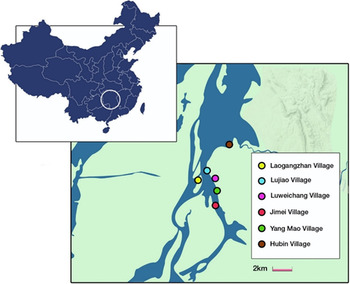
The study was undertaken in six villages (Jimei, Lujiao, Luweichang, Laogangzhan, Yang Mao and Hubin) surrounding the Dongting Lake (Fig. 1). Goat stool samples were collected from two goat farms in Jimei and Yang Mao. Stool samples from dogs were collected by the owners from Jimei, Lujiao, Luweichang and Hubin. Rodent traps were set in Hubin and Laogangzhan villages and bovine samples were collected from Yang Mao and Lujiao.
The six villages in the Dongting Lake region, PRC, involved in the study.

STUDY PROCEDURES
Sample collection
Fecal samples were collected from individual goats and dogs immediately after defecation. The ages of the goats and dogs were reported by the owners. Rodents were collected as part of the national rodent control programme and were kept in individual cages for 2 days. Stool samples were collected each day from the bottom of the cages. Rodents were then necropsied and examined for the presence of adult S. japonicum worms. Stool samples from cattle and water buffalo were collected directly from the rectum. Approximately 1–3 g of stool from each animal was fixed and stored in 80% (v/v) ethanol for DNA extraction and molecular analysis.
Diagnostics
For accuracy in the estimation of prevalence and intensity of infection, a combination of three diagnostic methods was used: the Kato-Katz thick smear technique (KK), the miracidial hatching technique (MHT) and quantitative real-time PCR (qPCR). All three techniques were used to examine fecal samples from dogs, goats and bovines, while the MHT and qPCR were used in fecal examination in conjunction with necropsy on the specimens from rodents. Droplet digital PCR (ddPCR) was also performed on DNA extracted from the goat stool samples.
Kato-Katz thick smear technique
All goat, dog and bovine stool samples were evaluated using the KK technique, as previously described (Katz et al. Reference Katz, Chaves and Pellegrino1972). Three slides were prepared from each stool sample and examined for the presence of S. japonicum eggs.
Miracidial hatching technique
All fecal samples were subjected to examination for the presence of live miracidia using the MHT, as previously described (Yu et al. Reference Yu, de Vlas, Jiang and Gryseels2007), with minor modifications. Briefly, the stool sample was homogenized, forced through a fine sieve, the resulting sample was placed into an Erlenmeyer flask filled with water (pH 6·8–7·2) and subjected to a strong artificial or natural light source for 1 h at room temperature (25–30 °C). The neck of the flask was then examined for the presence of live miracidia.
Necropsy
All rodents were dissected and inspected for adult S. japonicum worms and evidence of pathology caused by eggs in the host liver. The dissected internal organs of necropsied rodents were collected along with ~1 g of stools taken directly from the gastrointestinal tract that was subjected immediately to the MHT, as described above.
Quantitative real-time PCR
The primers used in the qPCR assay amplify the NADH dehydrogenase 1 (nad1) mitochondrial gene and their sequences have been described (Lier et al. Reference Lier, Simonsen, Haaheim, Hjelmevoll, Vennervald and Johansen2006; Gordon et al. Reference Gordon, Acosta, Gray, Olveda, Jarilla, Gobert, Ross and McManus2012, Reference Gordon, Acosta, Gobert, Jiz, Olveda, Ross, Gray, Williams, Harn, Yuesheng and McManus2015a , Reference Gordon, Acosta, Gobert, Olveda, Ross, Williams, Gray, Harn, Yuesheng and McManus b ). The 18 µL qPCR reaction contained: 10 µL SYBR Green MasterMix (Invitrogen), 4 µL H2O, 1 µL each of the forward and reverse primer mixtures (200 nM final concentration) and 2 µL DNA template. DNA was extracted using QIAamp Stool DNA mini prep following the manufacturer's instructions (Qiagen). The qPCR cycling conditions were: initial hold at 50 °C for 2 min, a second hold at 95 °C for 10 min, followed by 45 cycles of 95 °C denaturation for 15 s, 60 °C annealing for 60 s, 72 °C extension for 90 s and a final melt of 65 and 90 °C. The assay was run on a Corbett RotorGene 6000 thermocycler (Qiagen). Each sample was run in triplicate, and positive and negative controls were used concurrently in each assay. Distilled H2O was used as the template in negative controls and template DNA extracted from S. japonicum eggs isolated from the livers of laboratory infected mice was used as a positive control (Dalton et al. Reference Dalton, Day, Drew and Brindley1997). Melt curve analysis was performed for each sample.
Using the cycle threshold (Ct) score results, positive stool samples were quantified as eggs per gram of feces (EPG). To determine the corresponding egg numbers to Ct scores, seeding and dilution experiments were performed as previously described (Gordon et al. Reference Gordon, Acosta, Gray, Olveda, Jarilla, Gobert, Ross and McManus2012, Reference Gordon, Acosta, Gobert, Jiz, Olveda, Ross, Gray, Williams, Harn, Yuesheng and McManus2015a , Reference Gordon, Acosta, Gobert, Olveda, Ross, Williams, Gray, Harn, Yuesheng and McManus b ). Briefly, a standard curve was generated from the results of the serial dilutions, and seeding experiments were used to determine known number of eggs corresponding to a range of Ct scores. The standard curve was then used to compare the unknown animal samples from our study and to determine egg numbers. From this, a Ct score of 35 was set as the cut-off for a positive result.
Droplet digital PCR
ddPCR was performed on 125 goat stool samples only. Using the same nad1 primers as described above for the qPCR, reaction mixtures for ddPCR were prepared containing 10 µL of ddPCR EvaGreen (Bio-Rad, Hercules, California, USA), forward and reverse primers (200 nM final concentration), 2 µL of DNA (50 ng μL−1) and distilled H2O to a final volume of 20 µL. The assay was setup as previously described (Weerakoon et al. Reference Weerakoon, Gordon, Gobert, Cai and McManus2016, Reference Weerakoon, Gordon, Cai, Gobert, Duke, Williams and McManus2017). The following cycling conditions were used; initialization of 5 min at 95 °C, followed by 40 cycles of 95 °C for 30 s and 55·8 °C for 1 min, followed by a final stabilization step of 95 °C for 5 min. After amplification, the plate was placed on a QX200 Droplet Reader (Bio-Rad) for analysis and quantification of positive and negative droplets. Negative and positive controls were the same as used for the qPCR assay.
Data analysis
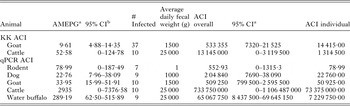
All data were analysed using Microsoft Excel and SAS Software (SAS Institute, Cary, North Carolina, USA). An animal was considered infected if at least one S. japonicum egg was found by KK, one adult worm was found during necropsy, one live miracidium was observed by the MHT or if a positive Ct score (<35) was obtained by qPCR. With the ddPCR, a goat was considered infected if >3 positive droplets were evident. Egg counts from the KK slides and estimated egg counts from qPCR Ct scores were log transformed from average EPG to geometric mean EPG (GMEPG) to give infection intensity. The 95% confidence intervals (CI) were calculated using standard formulae based on the binomial distribution (prevalence) and the lognormal distribution (intensity). When there was no variability in the data (e.g. 100% prevalence), CIs could not be calculated. The χ 2 tests were used to compare infection prevalence and mean EPG. The Animal Contamination Index (ACI) was derived from a formula originally designed for bovines, called the Bovine Contamination Index (Gray et al. Reference Gray, Williams, Li, Chen, Li, Forsyth, Barnett, Guo, Feng and McManus2007) calculated as follows:
 $$\eqalign{{\rm ACI} =\,\, & [\hbox{arithmetic mean EPG}\, ({\rm infected\, animals}){\rm ]}\, \cr &\times \, [\hbox{number of infected animals}]\, \cr & \times \, [\hbox{average daily faecal weight of animal}].} $$
The average stool output per day for the goats (1000–1500 g), dogs (1000 g) and rodents (1 g) was determined by our research team and recorded. The conservative average stool output of 25 kg per bovine per day was taken from the previous literature, as the average daily fecal output of water buffalo and cattle in China has been found to be between 25 and 60 kg (Guo et al. Reference Guo, Ross, Lin, Williams, Chen, Li, Davis, Feng, McManus and Sleigh2001).
RESULTS
Sample collection
Eighty-three rodents were collected and their S. japonicum infection status was determined by necropsy and MHT; DNA was successfully extracted from 79 fecal samples for qPCR. Stools were collected from 52 dogs and analysed by KK and MHT; DNA was successfully extracted from 49 samples for qPCR. A total of 145 goats, 10 cattle and 10 water buffalo stool samples were analysed by KK, MHT and qPCR. Stool samples from 125 goats were also analysed by ddPCR.
Prevalence and intensity of infection
Rodents
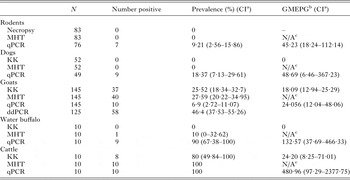
A total of 37 black field rats (R. norvegicus) and 46 lake voles (M. fortis) were necropsied and their stools examined for S. japonicum infection using the MHT. None of the rodents were parasite-positive by MHT or necroscopy; however, both species had a prevalence of 9·21% (95% CI 2·56–15·86%) determined by qPCR (Table 1). No significant (P > 0·05) differences were found in infection prevalence between the two rodent species, nor between age, village or gender. The GMEPG determined by qPCR (qGMEPG) estimated from S. japonicum-positive rodents (n = 7) was 45·23 (95% CI 18·24–112·14).
Prevalence and intensity of Schistosoma japonicum infections in animals sampled from the Dongting Lake region, PRC

a 95% Confidence interval.
b Geometric mean eggs per gram.
c MHT does not give an estimation of intensity.
Dogs
None of the dogs were positive for S. japonicum infection using the KK and MHT procedures, whereas a prevalence of 18·37% (95% CI 7·13–29·61%) was obtained by qPCR (Table 1). No significant differences (P > 0·05) were found between prevalence and age, gender or village location. The qGMEPG for positive dog samples (n = 9) was 48·69 (95% CI 6·46–367·23).
Goats
One hundred forty-five goats were examined; 75 black goats (Capra spp.) from Jimei village and 70 Boer goats (Capra spp.) from Yang Mao village. The S. japonicum prevalence of all 145 goats was 27·59% (95% CI 20·22–34·95%) by both KK and MHT. The GMEPG was 18·09 (95% CI 12·94–25·29) using the KK data.
There was a significant difference (OR 23·85, 95% CI 7·71–73·8, P < 0·001) in prevalence between black goats (50·67%, 95% CI 39·09–62·25%) and Boer goats (2·86%, 95% CI 0–6·86%) determined using the MHT and KK (46·67%, CI 35·11–58·22%; 2·86%, CI 0–6·86%) (Table 2). No significant differences (P > 0·05) were evident between gender or age groups. Of the 145 goat stools examined by qPCR – where the prevalence was determined to be 6·9% (95% CI 2·72–11·07%) – 125 were examined by ddPCR. The prevalence in goats by ddPCR was 46·40% (95% CI 37·53–55·26%) (Table 1).
Prevalence and intensity of Schistosoma japonicum infection in goats by KK, MHT, qPCR and ddPCR

a 95% Confidence intervals.
Bovines
A total of 10 cattle and 10 water buffalo were sampled from Hubin and Laogangzhan villages and all animals were S. japonicum-positive by at least one diagnostic test. Water buffalo had a prevalence of 10% (95% CI 0–32·62%), 0% and 90% (95% CI 67·38–100%) by MHT, KK and qPCR, respectively (Table 1), while cattle had a prevalence of 100%, 80% (95% CI 49·84–100%) and 100%, respectively. No significant differences (P > 0·05) in prevalence were seen between the bovines (cattle, water buffalo), age or gender. The cattle had a high GMEPG determined by the KK (24·20, 95% CI 8·25–71·01). Water buffalo had an estimated qGMEPG of 132·57 (37·69–466·33) and cattle a qGMEPG of 480·96 (97·29–2377·75) (Table 1).
Animal Contamination Index
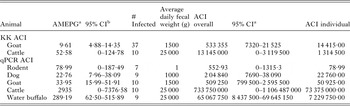
The total daily fecal output of the goats, rodents and dogs was estimated to be 1500, 1 and 1000 g, respectively. The ACI was calculated using both the KK and qPCR data for goats and cattle, but using only the qPCR data for dogs, water buffalo, cattle, goats and rodents. The ACI for goats, calculated on KK-positive samples, was 533 355 eggs per day for all positive goats and an average of 14 415 eggs for individual goats, while with the qPCR, the calculated individual ACI was 169 750 eggs per day (Table 3). A conservative estimate of 25 kg fecal weight per day for bovines was used (Guo et al. Reference Guo, Ross, Lin, Williams, Chen, Li, Davis, Feng, McManus and Sleigh2001) to calculate the ACI for cattle and water buffalo. Cattle were calculated to be excreting between 788 700 and 1 314 500 eggs per day, per animal by KK and 44 025 000–73 375 000 by qPCR. Water buffalo had an individual ACI of between 4 337 859 and 7 229 750 eggs per day using qPCR data (Table 3). Rodents had a much smaller ACI of 78·99 per animal using the qPCR data, an estimate considerably less than dogs with an ACI of 22 760 per animal (Table 3).
ACI calculated for each animal species using the KK and qPCR arithmetic mean EPG
a Arithmetic mean eggs per gram.
b 95% Confidence intervals.
DISCUSSION
This is the first study of its kind to estimate prevalence and intensity of schistosomiasis japonica in rodents, goats and dogs using a combination of diagnostic methods, including qPCR. Evaluating the contribution of individual animal hosts is important in understanding the transmission dynamics of S. japonicum in China and whether a particular species should be considered in the future for potential treatment in the national control programme. Bovines are already included in the control programme for China as it is well established that they are important reservoir hosts in the transmission of schistosomiasis to humans (Gray et al. Reference Gray, Williams, Li, Chen, Li, Forsyth, Barnett, Guo, Feng and McManus2007, Reference Gray, Williams, Li and McManus2008, Reference Gray, Williams, Li, Chen, Forsyth, Li, Barnett, Guo, Ross, Feng and McManus2009a , Reference Gray, Williams, Li, Chen, Forsyth, Li, Barnett, Guo, Ross, Feng and McManus b ).
Ongoing extensive and concerted programmes in China resulted in a substantial decreased prevalence and intensity of S. japonicum infection in humans and bovines since control first commenced in 1949. Then, an estimated 12 million humans were infected, whereas currently, it is estimated that there are 184 943 human infections (WHO, 2013; Lei et al. Reference Lei, Zheng, Zhang, Zhu, Xu, Xu, Fu, Wang, Li and Zhou2014; Yang et al. Reference Yang, Liu, Zhu, Griffiths, Tanner, Bergquist, Utzinger and Zhou2014). To determine whether there was active transmission in the Dongting Lake study area, we examined 20 bovines (10 cattle, 10 water buffalo) and showed all were infected, confirming ongoing transmission. We examined bovine stools using KK, MHT and qPCR, with the latter found to be by far the most sensitive diagnostic method. None of the water buffalo were shown infected by KK, whereas the MHT identified only one infected animal. Cattle had a prevalence of 80% by KK, while 100% prevalence was recorded by both MHT and qPCR. KK and the MHT are known to lack sensitivity, particularly in low-intensity infection areas, a feature confirmed here (Ebrahim et al. Reference Ebrahim, El-Morshedy, Omer, El-Daly and Barakat1997; Glinz et al. Reference Glinz, Silué, Knopp, Lohouringnon, Yao, Steinmann, Rinaldi, Cringoli, N'Goran and Utzinger2010; Habtamu et al. Reference Habtamu, Degarege, Ye-Ebiyo and Erko2011; Gordon et al. Reference Gordon, Acosta, Gray, Olveda, Jarilla, Gobert, Ross and McManus2012, Reference Gordon, Acosta, Gobert, Olveda, Ross, Williams, Gray, Harn, Yuesheng and McManus2015b ).
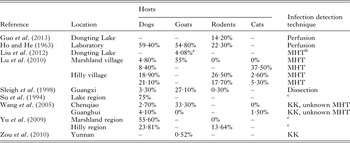
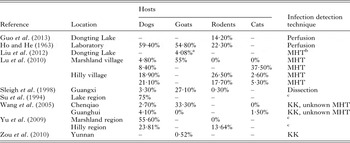
The results from previous studies on S. japonicum infections in rodents, goats and dogs in China are conflicting with a large variation in infection prevalence reported and limited data on infection intensity (Table 4). The majority of these studies used microscopy [such as KK and the Danish Bilharziasis Laboratory (DBL) technique] and egg hatching procedures, which are known to have low sensitivity, leading to under-reporting of S. japonicum infection (Gordon et al. Reference Gordon, Acosta, Gray, Olveda, Jarilla, Gobert, Ross and McManus2012, Reference Gordon, Acosta, Gobert, Jiz, Olveda, Ross, Gray, Williams, Harn, Yuesheng and McManus2015a , Reference Gordon, Acosta, Gobert, Olveda, Ross, Williams, Gray, Harn, Yuesheng and McManus b ; Xu et al. Reference Xu, Gordon, Hu, McManus, Chen, Gray, Ju, Zeng, Gobert, Ge, Lan, Xie, Jiang, Ross, Acosta, Olveda and Feng2012; Zhu et al. Reference Zhu, Xu, Zhu, Cao, Bao, Yu, Zhang, Xu, Feng and Guo2014). Processing of stool samples using the MHT effectively requires a specific pH, temperature and good water quality, which can be challenging under field conditions (Katz et al. Reference Katz, Chaves and Pellegrino1972; Yu et al. Reference Yu, de Vlas, Jiang and Gryseels2007; Jurberg et al. Reference Jurberg, de Oliveira, Lenzi and Coelho2008; Xu et al. Reference Xu, Feng, Xu and Hu2011). Immunodiagnostic procedures have been used but these lack specificity and do not distinguish between past and current infections (Carabin et al. Reference Carabin, Balolong, Joseph, McGarvey, Johansen, Fernandez, Willingham and Olveda2005; Lier et al. Reference Lier, Simonsen, Haaheim, Hjelmevoll, Vennervald and Johansen2006; Yu et al. Reference Yu, de Vlas, Jiang and Gryseels2007).
Reports of infection prevalence of Schistosoma japonicum among different mammalian hosts in PRC
a 4·08% in 2010.
b Miracidial hatching technique.
c Technique not described.
Schistosoma japonicum infection prevalence reported for rodents in China ranges from 0 to 26·50% determined by perfusion and dissection, MHT and KK (Table 4). In this study, no rodents were found infected by MHT or necropsy, while qPCR showed a prevalence of 9·21% (Table 1). This reflects the prevalence from previous studies in the area (Table 4), and coupled with the relatively low ACI found in the current study would indicate that rodents have a limited impact on environmental transmission unless present in plague numbers, particularly when compared with bovines. In this study, bovines had an individual ACI of between 44 025 000 and 73 375 000 for cattle, between 4 337 850 and 7 229 750 for water buffalo and 22 760 for dogs (Table 2).
While there are sensitivity issues with MHT, it is the only diagnostic method which also tests egg viability. Rodents are generally considered to be non-permissive hosts (He et al. Reference He, Salafsky and Ramaswamy2001; Jiang et al. Reference Jiang, Hong, Peng, Fu, Feng, Liu, Shi and Lin2010). A recent epidemiological survey from the Dongting Lake reported a rodent infection prevalence of 14·2% (Guo et al. Reference Guo, Jiang, Gu, Qiao and Li2013) (Table 4). The authors suggested that rodents are an important disease reservoir owing to their large population densities and extensive migratory patterns, which vary seasonally and during flooding (Kamiya et al. Reference Kamiya, Tada, Matsuda, Tanaka, Blas, Nosenas and Santos1980). However, egg viability was not determined in that investigation (Guo et al. Reference Guo, Jiang, Gu, Qiao and Li2013) (Table 4). Rodents have also previously been identified as driving transmission in the hilly area of Anhui (Rudge et al. Reference Rudge, Webster, Lu, Wang, Fang and Basáñez2013).
Experimental laboratory infections demonstrated that M. fortis produces natural antibodies against schistosome antigens (He et al. Reference He, Li, Liu, Luo, Yu, Lin, Zhang, Yu and McManus1999). Protective monoclonal antischistosome antibodies produced by Wistar rats after re-infection were found to induce resistance to schistosomes in other rats (Verwaerde et al. Reference Verwaerde, Joseph, Capron, Pierce, Damonneville, Velge, Auriault and Capron1987; Ross et al. Reference Ross, Sleigh, Li, Davis, Williams, Jiang, Feng and McManus2001; Peng et al. Reference Peng, Han, Gobert, Hong, Jiang, Wang, Fu, Liu, Shi and Lin2011; Han et al. Reference Han, Peng, Hong, Zhang, Han, Fu, Shi, Xu, Tao and Lin2013). These data, along with the results reported here again suggest that rodents are poor hosts for S. japonicum infection, and are likely to be minor contributors to human transmission. While the S. japonicum prevalence in rodents determined by qPCR was 9·21%, all of the fecal samples tested by MHT were negative, which supports the suggestion that these wild rodents are not permissive hosts; they pass non-viable eggs and, therefore, are not important as transmission reservoirs. Similarly, none of the stool samples from dogs were positive by MHT.
Previous reports of the S. japonicum prevalence in goats from China, determined using MHT and KK, ranged from 2·70% to 75%, with the highest rates of infection occurring in the lake regions (Table 4). In the current study, the prevalence in goats ranged from 6·90% by qPCR, 27·59% by MHT and 46·4% by ddPCR (Table 1). The low prevalence by the qPCR method was unexpected as qPCR is a much more sensitive diagnostic than either KK or MHT. After testing the qPCR assay, we determined that there were inhibitors present in goat stools that were not found in the dog, bovine or human stool samples. This was determined by spiking extracted goat fecal DNA with DNA extracted from S. japonicum eggs and using the mix as template in the qPCR. Goat DNA samples spiked in this way did not amplify, indicating the presence of inhibitors. ddPCR has proven to have a similar or, in some cases, even higher sensitivity than qPCR, and the assay procedure is less sensitive to potential inhibitors in test samples (Sze et al. Reference Sze, Abbasi, Hogg and Sin2014; Weerakoon et al. Reference Weerakoon, Gordon, Gobert, Cai and McManus2016). Through the partitioning of the template DNA and MasterMix into ~20 000 droplets prior to PCR amplification, the ddPCR method effectively dilutes any inhibitors present. Accordingly, 125 goat samples were subjected to the ddPCR and the increased prevalence value (46·4%) was recorded. This prevalence is significantly higher than a previous report from the Dongting Lake (4·08%, Table 4) (Liu et al. Reference Liu, Zhu, Shi, Li, Wang, Qin, Kang, Huang, Jin and Lin2012), suggesting that goats may play an important role in the transmission of schistosomiasis japonica.
It was previously considered that goats are unimportant reservoirs for S. japonicum in China unless present in high numbers (Sleigh et al. Reference Sleigh, Li, Jackson and Huang1998). A recent longitudinal study in the Dongting Lake region, however, reported high infection rates in goats (4·08–13·60%) compared with bovines (2·83–3·62%); the authors concluded that both species are major sources of S. japonicum infection and recommended that control measures should include two annual and equally comprehensive mass PZQ treatments of both goats and bovines (Liu et al. Reference Liu, Zhu, Shi, Li, Wang, Qin, Kang, Huang, Jin and Lin2012) (Table 4). That particular study used MHT to investigate S. japonicum infections in these domestic ruminants, and may have under-reported the true prevalence, particularly when compared with the current investigation, which found 27·59% of goats positive by MHT and 46·4% by ddPCR (Table 1).
Two breeds of goat were examined in the current study: the common black goat and the Boer goat, which are used as livestock animals (Li et al. Reference Li, Li and Zhao2004). The black goat is an indigenous Chinese breed which, along with several other goat populations, is reported to have been bred to be relatively disease-resistant (Jiang et al. Reference Jiang, Liu, Ding, Yang, Cao and Cheng2003). Black goats are used in farming and our observations indicated they had constant access to infectious water sources, whereas the Boer goats have far more restricted contact with water, specifically to prevent infection. Using both KK and MHT, we found a highly significant difference in S. japonicum infection prevalence between the black (46·67%; 50·67%) and Boer goats (2·86%; 2·86%) (Table 3). If the current restricted access to water by Boer goats were to be applied also to native black Chinese goats, this would have potentially positive implications for the future control of schistosomiasis japonica in China.
Bovines have been shown to drive S. japonicum transmission in the PRC and mathematical modelling has predicted that they are responsible for up to 75% of human infections (Williams et al. Reference Williams, Sleigh, Li, Feng, Davis, Chen, Ross, Bergquist and McManus2002; Gray et al. Reference Gray, Williams, Li and McManus2008). As such, one of the main aims of the Chinese national control programme is to reduce the bovine infection prevalence to below 1% by 2015 and beyond (WHO, 2013; Lei et al. Reference Lei, Zheng, Zhang, Zhu, Xu, Xu, Fu, Wang, Li and Zhou2014; Yang et al. Reference Yang, Liu, Zhu, Griffiths, Tanner, Bergquist, Utzinger and Zhou2014). The current study sampled water buffalo and cattle from the endemic Dongting Lake region and found by at least one diagnostic method, that all bovines were infected, indicating that transmission in the area is ongoing. An earlier study, which used MHT to assess ruminant (cattle, water buffalo, goats) infections in the same locality, found little difference (P = 0·28) in prevalence over the period 2005 (4·93%) to 2010 (3·64%), despite ongoing control efforts.
As China proceeds towards its goal to eliminate schistosomiasis, it will be important to examine all animal hosts with the potential to act as reservoir hosts contributing to contamination of the environment with schistosome eggs leading to human infection, and, if appropriate, introduce interventions for their control. Rebound infections have previously occurred in China in villages in hilly and mountainous areas of Sichuan province that had previously participated in a mass drug administration (MDA) programme with PZQ where it was thought schistosomiasis had been controlled (Liang et al. Reference Liang, Yang, Zhong and Qiu2006). In these villages the re-emergence of the disease occurred between 2 and 15 years after the suspension of control (Liang et al. Reference Liang, Yang, Zhong and Qiu2006). The re-emergence of the disease may have been due to: (a) poor surveillance with the low human prevalence and infection intensity of S. japonicum being missed by the insensitive diagnostic tests used when the parasite was considered to be eliminated, and/or (b) continued contamination of the environment by schistosome eggs released from animals that had not been included in the control programme.
CONCLUDING REMARKS
This study examined the role, played by rodents, goats and dogs as disease reservoirs of schistosomiasis japonica in the Dongting Lake area of China. The low ACI of dogs and rodents, the low average daily fecal output of rodents and the apparent lack of viability, as evidenced by 0% prevalence by MHT, of S. japonicum eggs in these two small mammalian species suggests these hosts play a limited role as disease reservoirs. The fact that all bovines were infected indicates that the Dongting Lake region remains an active area of schistosomiasis transmission. The high infection prevalence and ACI for goats suggests they have an important role in human transmission. We recommend that additional surveys comprising more mammalian species in larger numbers from other endemic areas in China be undertaken. Molecular methods should be advocated for use in surveillance to diagnose S. japonicum in infected hosts to determine their potential as reservoirs. We recommend that consideration should be given to restricting access of all indigenous Chinese goats to potential transmission spots as is now applied to Boer goats. A transmission blocking vaccine for bovines has been advocated as a component of an integrated control package for schistosomiasis control in China (McManus et al. Reference McManus, Li, Gray and Ross2009; Gray et al. Reference Gray, Li, Williams, Zhao, Harn, Li, Ren, Feng, Guo, Guo, Zhou, Dong, Li, Ross and McManus2014). As a result of our current observations, we suggest that goat populations might also be targeted for vaccination (Xu et al. Reference Xu, Gordon, Hu, McManus, Chen, Gray, Ju, Zeng, Gobert, Ge, Lan, Xie, Jiang, Ross, Acosta, Olveda and Feng2012).
FINANCIAL SUPPORT
This work was funded by the following grants awarded to Darren Gray: ARC DECRA (DE120101529), NHMRC CDF (ID: APP1090221); and Don McManus: NHMRC Project Grant (ID: APP1098244), NHMRC Project Grant (ID: APP1002245), and NHMRC Program Grant (ID: APP1037304).