Introduction
Advanced airway management forms a key component of emergency care both in and outside of the emergency department. Despite technological advances in airway management, placement of a cuffed endotracheal tube by direct laryngoscopy is still the procedural standard for securing an airway.Reference Kovacs and Law 1 , Reference Brown and Walls 2 Direct laryngoscopy is not an easy technique to learn, requiring a substantial number of clinical patient encounters to achieve an acceptable success rate.Reference Konrad, Schupfer, Wietlisbach and Gerber 3 - Reference Toda, Toda and Arakawa 6
The principle of “best look” laryngoscopy is advocated in emergency care, meaning that all possible measures should be directed towards an optimal laryngoscopic view on the first intubation attempt. Several preparatory factors may optimize the first laryngoscopy attempt, including positioning of the patient, positioning of the intubator, and adequate provision of hypnotic and neuromuscular blocking agents. A number of simple adjunctive maneuvers may also be utilized during laryngoscopy in order to improve the glottic view.Reference Kovacs and Law 1
Head elevation (HE) with the intubator’s right hand, together with varying degrees of atlanto-occipital extension, may aid in aligning airway axes under direct vision and thus improve the laryngoscopic view.Reference Kovacs and Law 1 , Reference El-Orbany, Getachew, Joseph and Salem 7 - Reference Schmitt and Mang 9 Forward traction (FT), which involves the use of the intubator’s left and right hands in applying longitudinal traction on the laryngoscope handle, is also purported to bring about greater displacement of soft tissue and thus facilitate exposure of the glottic opening.Reference Kovacs and Law 1 , Reference Botha and Wells 10 External laryngeal manipulation (ELM) during laryngoscopy generally produces posterior and rightward movement of the glottic opening, thus making it more visible.Reference Kovacs and Law 1 , Reference Levitan, Kinkle, Levin and Everett 11 - Reference Benumof and Cooper 13 All of these maneuvers involve an assistant: in HE and ELM, to maintain the ideal position of the occiput or larynx achieved by the intubator, and in FT, to assist with longitudinal traction or to take over from the intubator whose right hand must place the endotracheal tube.
These three adjunctive maneuvers are attractive because they are quick and easy to implement, requiring little to no additional skill. Although their use is widely recommended at all levels of proficiency, they may be especially helpful for novice intubators who are likely to not have mastered the technique of direct laryngoscopy and who may more frequently be faced with a poor glottic view on a first attempt. Some data exist establishing the effectiveness of HEReference El-Orbany, Getachew, Joseph and Salem 7 - Reference Schmitt and Mang 9 and ELM;Reference Levitan, Kinkle, Levin and Everett 11 - Reference Benumof and Cooper 13 however, the effectiveness of LT has not been quantified in a real or simulated airway and the relative effectiveness of these three maneuvers has not been compared when performed by the same sample of novice intubators. This study aimed to investigate and compare the effect of HE, FT, and ELM performed by novice intubators on glottic view, time to intubation, and intubation success in a simulated airway.
Methods
Design
A non-randomized, self-controlled, experimental design was used with each participant attempting endotracheal intubation (ETI) four times in each of two different groups. The first four ETI attempts utilized an adult airway simulator (SimMan 3G; Laerdal Medical; Stavanger, Norway) configured to have a normal airway. Of these four attempts, one was without any adjunctive maneuver, while each of the other three attempts utilized one of the three adjunctive maneuvers. The second four ETI attempts followed a similar pattern, but the airway simulator was configured to have a difficult airway by activating the tongue edema setting from the electronic simulator interface.
Data for the normal and difficult airway ETI attempts were collected on different days and participants were blinded to the simulated airway settings. On each day, each participant performed the four ETI attempts in random order.
Sample
The sample was non-randomly drawn from a group of second year paramedic students in the Department of Emergency Medical Care at the University of Johannesburg, South Africa. These students were enrolled in a four-year professional degree program in Emergency Medical Care. Second year students had learned the theory of laryngoscopy and ETI (including the three adjunctive maneuvers used in this study), had demonstrated competence in an ETI practical skills assessment, and had attempted between five and 10 ETIs under direct supervision in an operating room environment. This cohort of prospective participants was chosen because they had limited ETI experience and could therefore be considered to be novice intubators.
This study was approved by the Faculty of Health Sciences Research Ethics Committee at the University of Johannesburg. Students were invited to participate in the study and provided with both verbal and written information about all procedures, risks, and benefits. Each participant was required to sign a consent form. A total of 33 students were invited to participate. Of these, 24 consented and 22 were present on both days of data collection and thus constituted the sample.
Interventions
On all data collection days, another student was present to act as an assistant (the same student assisted on both days). The assistant was briefed on the HE, FT, and ELM maneuvers and what to expect when assisting participants. Head elevation was performed by participants placing their right hand under the simulator’s occiput during laryngoscopy and elevating the head, while exerting varying degrees of atlanto-occipital extension in order to optimize the laryngeal view. Once the best HE position had been achieved, the participant’s hand was replaced by that of the assistant while the participant placed the endotracheal tube with their right hand.
Forward traction was performed by the participants placing their right hand on the distal end of the laryngoscope handle and exerting longitudinal traction in order to displace the simulator’s tongue. Once the best FT position had been achieved, as indicated verbally by the participant, the assistant (who was facing the participant) took over traction on the distal end of the laryngoscope handle and the participant placed the endotracheal tube with their right hand.
External laryngeal manipulation was performed by the participants displacing the thyroid cartilage with their right hand while performing laryngoscopy with the left hand, in such a way as to optimize the laryngeal view. Once the best ELM position had been achieved, the assistant took over thyroid manipulation while the participant placed the endotracheal tube with their right hand.
Data Collection
All ETI attempts by study participants used the same equipment and simulated airway. A standard laryngoscope handle and a Size 4 Macintosh blade was provided, together with an 8mm internal diameter cuffed endotracheal tube and tracheal tube introducer. Use of the tracheal tube introducer was mandatory; however, participants were allowed to configure the introducer as they wanted.
For each ETI attempt, participants were instructed to follow the technique that they had been taught for direct laryngoscopy and to attempt to place the endotracheal tube between the vocal cords under direct vision. The experimental procedure was limited to laryngoscopy and placement of the endotracheal tube only without preoxygenation, verification of tube placement (other than by direct vision), securing of the endotracheal tube, or positive pressure ventilation. The airway simulator was placed on the ground for all data collection procedures; however, participants were allowed to choose any position on the ground for laryngoscopy.
Participants were asked to verbally indicate the best percentage of glottic opening (POGO) score for each attempt prior to placement of the endotracheal tube. A diagrammatic representation of the POGO score, identical to that used by Levitan et al.,Reference Levitan, Hollander and Ochroch 14 was placed in an easily visible position next to the simulator for reference.
Time to intubate was assessed in real time using a stopwatch from the time the laryngoscope blade passed the simulators teeth to the time each participant reported that they had finally placed the endotracheal tube. Endotracheal intubation attempts exceeding a maximum time limit of 60 seconds without participants reporting placement of the endotracheal tube were recorded as failed attempts.
Endotracheal tube position was verified by one researcher with a video laryngoscope (King Vision; King Systems; Noblesville, Indiana USA) after participants had reported placement of the endotracheal tube. Each ETI attempt was recorded as a success if video laryngoscopy indicated that the endotracheal tube tip and cuff were in the trachea distal to the vocal cords or failure if the endotracheal tube was in any other position.
Data Analysis
Intubation times and POGO scores were compared within the normal and difficult airway groups using single factor repeated measures analysis of variance with four factor levels: no maneuver (control), HE, ELM, and FT. Intubation outcome (success or failure) was compared between groups using Cochran’s Q test. A P<.05 was considered significant for all tests and IBM SPSS (version 22; IBM Corporation; Armonk, New York USA) was used for data analysis.
Results
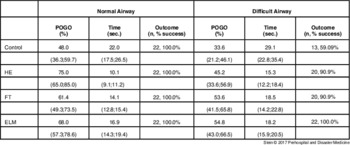
Descriptive data (means and 95% confidence intervals) over the four factor levels for intubation times, POGO scores, and intubation outcome are shown in Table 1.
Descriptive Data for All Variables

Note: Time=intubation time; Control=no maneuver.
Abbreviations: ELM, external laryngeal manipulation; FT, forward traction; HE, head elevation; POGO, percentage of glottic opening.
With no adjunctive maneuvers, participants reported being able to view almost one-half of the glottis in the normal airway. This decreased to approximately one-third of the glottis in the difficult airway. Participants took roughly nine seconds longer to intubate the difficult airway compared to the normal airway, and had an intubation success rate slightly more than one-half of that observed in the normal airway.
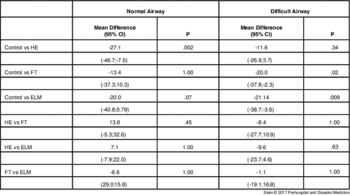
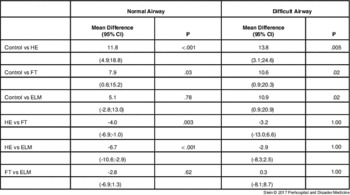
Ranking of adjunctive maneuvers for effectiveness, as measured by POGO scores, differed between the normal and difficult airway groups. Head elevation was the most effective maneuver under normal airway conditions while ELM proved to be the most effective maneuver in the difficult airway, with both of these producing significant improvements in POGO compared to control (Table 2). In the normal airway, intubation times decreased with all maneuvers, but most markedly and significantly with HE (Table 2). The use of HE in the difficult airway resulted in the shortest intubation time compared to control (Table 1).
Pairwise Comparisons: Percentage of Glottic Opening Score

Note: Control=no maneuver.
Abbreviations: ELM, external laryngeal manipulation; FT, forward traction; HE, head elevation.
No pairwise differences between maneuvers for POGO scores were significant (Table 2), and only pairwise differences for intubation time between HE and FT, and between HE and ELM were significant with the use of HE producing shorter intubation times (Table 3). Differences in intubation success proportions amongst all groups in the difficult airway were significant [χ2 (2)=18.097; P<.001].
Pairwise Comparisons: Intubation Times

Note: Control=no maneuver.
Abbreviations: ELM, external laryngeal manipulation; FT, forward traction; HE, head elevation.
Discussion
This study aimed to compare three adjunctive maneuvers used during laryngoscopy in simulated normal and difficult airways using a sample of novice intubators. Head elevation was found to be the most effective maneuver in the normal airway, resulting in the greatest improvement in mean POGO score compared to control. In the difficult airway, ELM resulted in the biggest improvement in mean POGO score and also in intubation success. All maneuvers had beneficial effects by decreasing intubation time, with HE and ELM having among the greatest effects in the normal and difficult airways, respectively.
The benefits of HE in improving laryngoscopic view have been identified from several studies using cadavers and patients undergoing anaesthesia.Reference El-Orbany, Getachew, Joseph and Salem 7 - Reference Schmitt and Mang 9 Only one of these measured laryngoscopic view using the POGO score and found a POGO score increase of 56% with full elevation of the head.Reference Levitan, Mechem, Ochroch, Shofer and Hollander 8 The POGO score improvement with HE of 27% was not as marked, but it is unlikely that the participants were applying exactly the same maneuver as that described by Levitan et al. Although these authors do mention atlanto-occiptal extension in their technique, the participants used an HE approach with something closer to the mid-position described by Levitan et al., combined with mild to moderate atlanto-occipital extension. The difference in laryngoscope blades, as well as the difference in airways (simulator vs cadaver), between the two studies may also have contributed to the widely divergent POGO scores.
The improvement in POGO scores with ELM was similar to that found in a cadaver study by Levitan et al.,Reference Levitan, Kinkle, Levin and Everett 11 which found an improvement in mean POGO scores of 25% in cases where the initial POGO score was less than 100%. However, this was less than the increase in mean POGO score of 47% documented in another study by Levitan et al. involving the intubation of anesthetized patients by novice intubators.Reference Levitan, Mickler and Hollander 12 Data from the study by Benumof and Cooper also supports the efficacy of ELM; however, a different scoring system prevents direct comparison with these data.Reference Benumof and Cooper 13
Very little has been published about FT, apart from textbook and other descriptions of how to apply the maneuver.Reference Kovacs and Law 1 , Reference Botha and Wells 10 The current data are the first reporting the use of this maneuver, and thus no comparisons with other studies are possible. Forward traction appears to be the least effective maneuver of the three studied in the normal airway, but may have greater utility in the difficult airway where it was more effective than HE but less effective than ELM.
These data support the notion, already established in other studies of HE and ELM, that using any of these maneuvers is better than using none as they all improve POGO scores compared to control in both normal and difficult airways. The effectiveness ranking apparent in Table 1 suggests that it may be possible, with further corroborating evidence from studies on cadavers or anaesthetized patients, to recommend preferred first choice maneuvers for normal and difficult airway situations that optimize efforts to achieve “best look” laryngoscopy.
Limitations
This study had two main strengths – standardization of the airway for each attempted intubation by participants, and the ability to use participants as self-controls across different factor-level comparisons. However, several important limitations also apply. External validity is influenced by the obvious limitation that an airway simulator was used. It was not possible to control the exact degree of airway difficulty that resulted from activating the simulator’s tongue edema setting. Results in Table 1 for the difficult airway suggest that this produced at most only a moderate degree of difficulty.
The population of paramedic students from which the sample was derived was chosen on the basis of their ETI-related skill competence but lack of real intubating experience. A similar approach has been used in one study by other authors who have aimed to investigate the capabilities of a novice group.Reference Levitan, Kinkle, Levin and Everett 11 This sample may not, however, be directly comparable to any other due to local variations in training and other factors affecting skill uptake.
The POGO scores were self-reported by each participant. This may not have been as accurate or consistent as scoring carried out by more experienced clinicians; however, self-reporting of POGO scores was implicit in the research design which utilized a sample of novice intubators. Researcher confirmation of POGO scores during the data collection procedure would not have been feasible, neither would confirmation using video laryngoscopy, which is not comparable to conventional laryngoscopy in terms of glottic view. Finally, the participant’s POGO scoring ability may have improved over time, with each scoring attempt. Random ordering of ETI attempts and POGO scoring will most likely have offset this effect.
Conclusion
This study identified HE as the most effective maneuver for improving laryngoscopic view in a normal airway, and ELM as the most effective in a difficult airway, in a group of novice intubators. The relative effect of FT on glottic view in a simulated normal and difficult airway was also quantified for the first time.