Introduction
Many modern concepts of health which rely on a bio-psycho-social paradigm of health stress the importance of demands and resources an individual is exposed to. These demands and resources are located at three levels: the macro environment, the micro environment (external demands and resources) and the personal (internal demands and resources) (Freidl, Rásky and Stronegger Reference Freidl, Rásky and Stronegger1999; Freidl et al. Reference Freidl, Fazekas, Raml, Pretis and Feistritzer2007).
Research shows social inequality, and especially low income, to be an important factor in maintaining health (Brunner et al. Reference Brunner, Shipley, Spencer, Kivimaki, Chandola, Gimeno, Singh-Manoux, Guralnik and Marmot2009; Crimmins, Kim and Seeman Reference Crimmins, Kim and Seeman2009; Marmot et al. Reference Marmot, Atkinson, Bell, Black, Broadf, Cumberleg, Diamond, Gilmore, Ham, Meacher and Mulgan2010; Rognerud and Zahl Reference Rognerud and Zahl2006; Zajacova, Dowd and Allison Reference Zajacova, Dowd and Allison2009). In order to understand the effects of social inequality on health it seems useful not just to analyse economic inequality but also other forms of social inequality. Social capital is such a dimension of social inequality.
There are several different definitions of social capital (Bourdieu Reference Bourdieu2005; Lin Reference Lin2001; Putnam Reference Putnam2000). Numerous studies about social capital and health refer to Putman and operationalise social capital by measures of trust and participation (Giordano and Lindstrom Reference Giordano and Lindstrom2010; Lindström Reference Lindström2005; Snelgrove, Pikhart and Stafford Reference Snelgrove, Pikhart and Stafford2009). Harpham (Reference Harpham, Kawachi, Subramanian and Kim2008) distinguishes between structural and cognitive social capital. Other researchers rely on Bourdieu's theory of social capital (Carpiano Reference Carpiano, Kawachi, Subramanian and Kim2008). Bourdieu defines social capital as the entirety of actual or potential resources an individual has access to. These resources depend on belonging to certain groups. They can be based on material or symbolic exchange relationships and can be more or less institutionalised. In other words, the resources can be based on institutionalised guarantees such as legal claims or on subjective feelings like recognition, respect and friendship (Bourdieu Reference Bourdieu2005: 63ff). These subjective feelings belong to the cognitive dimension of social capital. Following Bourdieu, belonging to a certain group can be characterized by geographic neighbourhood, by the quality of the neighbourhood or by economic and social closeness (Bourdieu Reference Bourdieu2005: 64ff). One possibility to operationalise the quality of neighbourhood is to measure the satisfaction of individuals with their social bonds. Thus this satisfaction is a possible measure for the cognitive dimension of social capital, whether institutional or informal.
Research has shown social capital to be important for older people in general (Gray Reference Gray2009) and to be a resource for maintaining health (D'Hombres et al. Reference D'Hombres, Rocco, Suhrcke and McKee2010; Ichida et al. Reference Ichida, Kondo, Hirai, Hanibuchi, Yoshikawa and Murata2009; Kawachi, Kennedy and Glass Reference Kawachi, Kennedy and Glass1999; Kawachi, Subramanian and Kim Reference Carpiano, Kawachi, Subramanian and Kim2008; Nummela et al. Reference Nummela, Sulander, Karisto and Uutela2009; Snelgrove, Pikhart and Stafford Reference Snelgrove, Pikhart and Stafford2009; Theurer and Wister Reference Theurer and Wister2009). Recent studies on social capital and health have started to investigate the associations between different dimensions of social capital and health. Results, however, remain inconsistent (Berry and Welsh Reference Berry and Welsh2010; D'Hombres et al. Reference D'Hombres, Rocco, Suhrcke and McKee2010; Sagpag et al. Reference Sagpag, Aracena, Villarroel, Poblete, Berrocal, Hoyos, Martínez and Kawachi2008; Snelgrove, Pikhart and Stafford Reference Snelgrove, Pikhart and Stafford2009). Some research shows a particular association between social capital and the health of older people, suggesting that social capital is an important health resource for older people (Boneham and Sixsmith Reference Boneham and Sixsmith2006). Others found social participation and access to help as two dimensions of social capital that are strong indicators for older people's health (Nummela et al. Reference Nummela, Sulander, Karisto and Uutela2009).
Purpose
To our knowledge it has not yet been investigated systematically whether the strength of the association between social capital and health differs between age groups. The aim of our study was therefore to find out whether social capital is associated more strongly with the health of older people than of younger individuals and if such an effect can be observed even when controlling for socio-economic status. Previous studies (D'Hombres et al. Reference D'Hombres, Rocco, Suhrcke and McKee2010; Ichida et al. Reference Ichida, Kondo, Hirai, Hanibuchi, Yoshikawa and Murata2009; Nummela et al. Reference Nummela, Sulander, Karisto and Uutela2009; Snelgrove, Pikhart and Stafford Reference Snelgrove, Pikhart and Stafford2009) did not investigate the relationship between the cognitive aspects of social capital and health. Hence, in contrast to previous studies, we refer to Bourdieu's theory in order to analyse this association.
In addition, there is a need for research on more complex measures of social capital and its associations with health (Ziersch et al. Reference Ziersch, Baum, MacDougall and Putland2005). In order to compile more detailed information about the effect of social capital on health in different age groups we investigated the association of the two dimensions of social capital (institutional and informal social capital) on two forms of health (physical and psychological health). We analysed institutional and informal social capital on the cognitive dimension, defined as follows:
• Institutional social capital corresponds to an individual's satisfaction with and perception of his/her access to different institutionalised resources.
• Informal social capital, on the cognitive level, corresponds to resources based on subjective feelings as well as on emotional and geographic closeness to other known people.
Therefore we operationalise informal social capital by the quality of and satisfaction with social contacts rather than by their frequency.
Methods
Data
The data for the analysis were taken from the Austrian Health Interview Survey (ATHIS) 2006–07 (Klimont, Kytir and Leitner Reference Klimont, Kytir and Leitner2007). The ATHIS forms part of the European Health Interview Survey (EHIS) (European Comission 2010), carried out by Statistik Austria.
In the period between March 2006 and February 2007 a total of 15,474 individuals were interviewed by way of computer-assisted face-to-face interviews (CAPI). The random sample was drawn from the central population register; it is representative for the Austrian population. The response rate was 61.58 per cent (N=15,474; 7,005 men and 8,469 women) out of a gross sample of 25,130 people).
Measures
The constructs investigated in this study were drawn from the quality of life inventory of the World Health Organization (WHO), the WHOQOL-Brief, Dependent Variables: Indices of Health.
Status
We measured health on two dimensions: physical and psychological health. The two dimensions of health were confirmed by a confirmatory factor analysis for the variables from the physical and psychological domains of the WHOQOL-Brief and calculated in accordance with the WHO specification (WHO 1998: 106).
Physical health was measured by the physical domain of health of the WHOQOL-Brief. The index reaches a Cronbach alpha of 0.90 (mean=78.76, standard deviation (SD)=19.70). The scale ranges from 0 (very poor health) to 100 (excellent health).
The second index (psychological health) was measured by the psychological domain of the WHOQOL-Brief. The index reaches a Cronbach alpha of 0.82 (mean=76.38, SD=15.21) and ranges from 0 (very poor health) to 100 (excellent health).
Independent variables
Social capital
Social capital was operationalised following Bourdieu's theory as explained in the introduction. All variables of the indices were taken from the WHOQOL-Brief social and environmental domains. The index of institutional social capital ranges from 5 to 25. The index of informal social capital has a range from 3 to 15. As both are sum-indices, they are not categorical but can be assumed to be metric. A value of 5 (institutional) or 3 (informal) indicates very low social capital, a value of 25 or respectively 15 indicates very high social capital.
Institutional social capital
The index ‘institutional social capital’ corresponds to the perception of and satisfaction with the access of individuals to different institutionalised resources. The index with a reliability of Cronbach alpha=0.70 (mean=20.36, SD=2.91) is composed as the sum of the following five variables: ‘How available to you is the information that you need in your day-to-day life?’; ‘To what extent do you have the opportunity for leisure activities?’; ‘How safe do you feel in your daily life?’; ‘How satisfied are you with your transport?’; ‘How satisfied are you with your access to health services?.’
Informal social capital
The dimension of informal social capital corresponds to resources based on subjective feelings as well as on emotional and geographic closeness to other known persons. The sum-index reaches a reliability of Cronbach alpha=0.62 (mean=12.71, SD=1.72) and is composed of the following three items: ‘How satisfied are you with your personal relationships?’; ‘How satisfied are you with the support you get from your friends?’; ‘How satisfied are you with the conditions of your living place?’ The question on satisfaction with the conditions at the living place has been integrated in the index of informal social capital, based on the result of the factor analysis. As neighbourhood is one important aspect of conditions at the living place, it is likely that those interviewed interpreted the question in that way, so the variable refers to the factor of informal social capital.
Socio-economic status
In order to control for the impact of social capital on health, the following variables concerning the socio-economic position of the individuals were included in the model: equivalent income, level of education, job characteristics/position and the question on self-perceived quality of livelihood.
Equivalent income
We used the Organization for Economic Cooperation and Development (OECD) equivalence scale (OECD Social Policy Division 2009) to calculate the equivalent income per capita, irrespective of the sources of household income (mean=1103.06, SD=640.48).
Level of education
This was measured by an ordinal variable which distinguishes between five levels of education, including the years of schooling.
Job characteristics
These were measured by an ordinal index variable ranging from 0 to 3, ranging from unemployed (0) to persons in higher non-manual occupations (3).
Self-perceived quality of livelihood
Self-perception of livelihood was measured with the item: ‘How do you get by with your money?’ The range of the item lies between 1 – not at all and 5 – very well.
Age
In order to analyse the difference between younger and older persons, age was classified in four groups: 15–29 years (N=3,111), 30–44 years (N=3,979), 45–59 years (N=3,759) and 60 years or older (N=4,625). The age of 60 is an important cut-off point in Austria since many persons retire from gainful occupation at that age. For this reason the older age group is defined as 60 years or older.
Statistical analyses
The indices of health and social capital were confirmed by factor analyses. As extraction method, principal axis factoring was used. Orthogonal rotation (varimax) was also adopted.
The associations between health status and social capital were analysed by calculating multiple linear regression models using the SPSS (version 17.0) procedure for general linear modelling. In total, four different multiple regression models with two different dependent variables (measures of health status) were calculated. In order to stratify by gender, each model was calculated two times, separately for men and women. The youngest age group was chosen as group of reference. In total six interaction terms (see Table 2) were calculated and integrated in the multiple regression model. Models with significant interaction terms were calculated for the total sample in addition to the gender-stratified analysis and are presented in figures. The values of the B coefficients were calculated with a confidence interval of 95 per cent.
When uncentred variables are used, correlations between dependent variables, in particular between dependent variables and interaction terms, can occur. This problem of multicollinearity can be avoided using centred variables for the interaction term (Aiken and West Reference Aiken and West1991: 35). To centre variables the following formula is used: X i − mean score of X. Tolerance statistics showed no problems with multicollinearity. None of the models has a tolerance value lower than 0.70.
Results
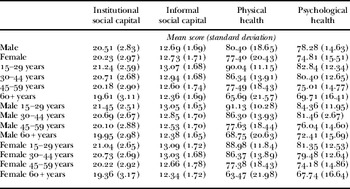
Table 1 presents descriptives for institutional social capital, informal social capital, physical health and psychological health stratified by gender and age groups.
Mean scores and standard deviations for measures of social capital and health, stratified by gender and age

Associations between social capital and health adjusted by age and socio-economic status
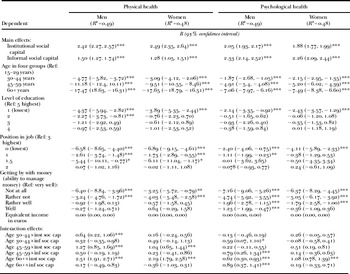
All models calculated include institutional and informal social capital as independent variables. The described variables for socio-economic status and age were integrated as covariates. Interaction effects between age and social capital were calculated, in order to analyse age differences in the effect of social capital on health. The measures of health (physical health and psychological health) were varied over the different models (see Table 2). All other variables were kept stable for all models. All values are presented in Table 2; the most important results are described below.
Regression model for physical health and psychological health as dependent variables: coefficient B with a 95% confidence interval adjusted for institutional and informal social capital, and interaction terms

Notes: Ref: category of reference. inf soc cap: informal social capital. inst soc cap: institutional social capital.
Significance levels:
* p<0.05,
** p<0.01,
*** p<0.001.
Both institutional and informal social capital is strongly and statistically significantly associated with physical and psychological health. The more institutional social capital a person has, the better is his or her physical (males: B=2.42***, females: B=2.49***; significance level: *** p<0.001) and psychological health (males: B=2.05***, females: B=1.88); and the more informal social capital a person has, the better his or her physical (males: B=1.50***, females: B=1.28) and psychological health (males: B=2.33***, females: B=2.26***).
Both dimensions of health are associated more strongly with institutional and informal social capital than with indicators of socio-economic status. Institutional social capital and age are the strongest factors influencing physical health. Institutional social capital and informal social capital are the strongest factors influencing psychological health. Institutional social capital has a stronger influence than informal social capital on physical health and psychological health. There are no significant gender differences in the general results described above.
Interaction effects between age and social capital concerning health
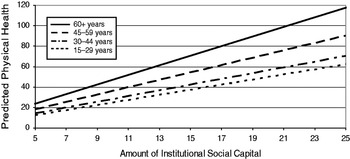
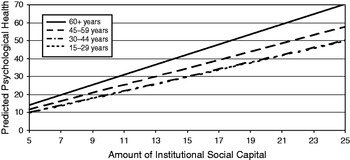
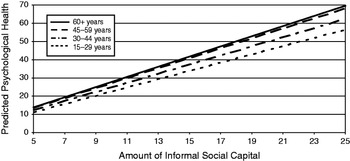
Institutional social capital is significantly more important for physical health (males: B=2.31***, females: B=2.19***) and psychological health (males: B=0.62***, females: B=1.08***) of older people (60 years or older) than for younger people. Figures 1–3 show the associations between institutional social capital and physical/psychological health, as well as the association of informal social capital with psychological health for the unstratified sample (men and women together).
Predicted physical health by institutional social capital in age groups.

Predicted psychological health by institutional social capital in age groups.

Predicted psychological health by informal social capital in age groups.

The figures show the association between the amount of social capital and health predicted by social capital and interaction terms. Predicted values were calculated as functions of the B-values of the respective dimension of social capital and of the B-value of the interaction term of the respective age group. In doing so, the following formula was applied:
 $$\eqalign{Y = & [B({\rm institutional}\,{\rm social}\,{\rm capital}) + B({\rm age}\,{\rm group} \times {\rm institutional}\,{\rm social}\,{\rm capital})] \cr \times & {\rm institutional}\,{\rm social}\,{\rm capital}.{\rm}} $
Figure 1 demonstrates a steeper ascent of the regression line for the older than for younger individuals. This goes to show that institutional social capital is more strongly related to older people's physical health than to that of younger ones. Figure 2 shows similar differences for the association of institutional social capital with psychological health. Figure 3 shows that informal social capital is more strongly related to the psychological health of older individuals and of 45–59-year-olds than to that of younger persons.
Although men's and women's health are related to social capital in a similar way, there is a gender difference in the interaction between informal social capital and age regarding their association with psychological health. There is no significant interaction to be found between age and informal social capital in the association with psychological health of women; for men, however, a significant interaction could be found. Older men's psychological health is more strongly affected by a lack of informal social capital than that of younger ones (B=0.89***).
Discussion/limitations
To our knowledge this is the first study which, as a result of a systematic comparison, has revealed that the association between social capital and health is significantly stronger among older people than among younger ones. Both institutional and informal social capital are significantly positively related to physical as well as to psychological health in all age groups. Consistent with previous research (Grundy and Sloggett Reference Grundy and Sloggett2003) we found social capital to be important for the health of older people. In addition to previous research we showed that there is a significant interaction between institutional social capital and physical as well as psychological health. Social capital is more important for health of older than of younger men and women.
As institutional social capital comprises inter alia access to information, to transportation, to health services and to opportunity for leisure activities, one explanation for the higher importance of institutional social capital on the health of older people could be that younger individuals have better opportunities to compensate for lacking institutional social capital than do older men and women. This result is consistent with research showing that environmental characteristics like mobility barriers and transportation facilitators are associated with the daily activities, performed by older people with functional limitations (Keysor et al. Reference Keysor, Jette, LaValley, Lewis, Torner, Nevitt and Felson2009).
Another explanation could be that social capital might add up to cumulative effects over the years. So, difficulties in compensating for low social capital in younger years could also have negative effects on health in later years.
A high level of informal social capital is significantly related to good physical health, but there is no significant age difference in this association. This could be due to the fact that younger people are less able to develop good coping and compensatory strategies for a lack of informal social capital than older ones. A lack of satisfying personal relationships might even cause more stress for younger individuals than for older ones, as they are more commonly expected to have satisfying relationships. Thus a lack of informal social capital cannot be compensated by younger individuals in the same way as this is possible for institutional social capital.
There is a gender difference in the interaction effect regarding the association of informal social capital with psychological health. Whereas institutional social capital is more strongly related to older men's and to older women's health than to the health of younger individuals, there is a significant interaction between informal social capital and psychological health in men but not in women. There is a stronger association between informal social capital and psychological health in older than in younger men.
For women, there are probably no age effects in this association because younger women do not have better coping strategies for compensating for a lack of informal social capital than older women do.
But what would cause older men's psychological health to be more seriously affected by a lack of informal social capital than that of younger men? According to previous studies, the decline in social capital with advancing age can be due to the fact, that older people have fewer good friends (Gray Reference Gray2009). In addition, managing life in retirement seems to be particularly important for men (Yeh and Lo 2004). Therefore an explanation for the gender differences described could be that informal social capital, such as satisfaction with friendships, is important for women during their whole lifespan. For men, in contrast, the importance of informal social capital increases upon retiring from paid work. Therefore older men might need to develop coping strategies for the lack of informal capital which women may have already developed in earlier years of life. Another explanation could be that the item measuring satisfaction with the living place (which includes the relationship with neighbours) is an important factor influencing the psychological health of women during their whole lifecourse given that many Austrian women spend a considerable part of their time at home. For the men on the other hand, it can be presumed that they do not spend much time at home before retirement. When retiring they are suddenly much more exposed to their neighbourhood and influenced in their psychological health by the quality of their vicinity. That could indeed explain the age effect in the association of informal social capital with male psychological health.
As the relationship of cognitive institutional social capital with physical health is stronger than with psychological health, we argue that the cognitive dimension of institutional social capital is a very important health resource for physical health. This is also consistent with the World Bank social capital assessment tool (SOCAT) (World Bank 2010), which includes questions about institutional resources for individuals.
Limitations and strengths
A limitation of our study is that directionality of the associations is not entirely clear. As the study is based on cross-sectional data it might be the fact that not only social capital is affecting health but also health status could affect aspects of institutional social capital as well as of informal social capital. Some previous studies showed longitudinally that the amount of social capital in the first point in time had no significant effect on psychological health to a later point in time (Choi and Kim Reference Choi and Kim2011).
Research has shown that health is related to the capacity to reciprocate (Gray Reference Gray2009; Wenger et al. Reference Wenger, Davies, Shahtahmasebi and Scott1996). As poor health can diminish the possibility to give help, poor health can be a condition which leads to a reduction of social capital (Gray Reference Gray2009). As informal social capital includes aspects of receiving help from others it is possible that not only a lack of social capital is affecting health but also that bad health leads to poor informal social capital.
Another limitation of the study could be that by taking nearly all variables from the WHOQOL-Brief we stayed within the measurement of quality of life. But on the other hand, the domains are measuring different constructs. The physical and the psychological domain of the WHOQOL-Brief are high-quality measures of physical and psychological health which have been widely tested and extensively validated (World Health Organization 1998). Therefore it seemed to be worth staying within the items of one instrument in order to use a well-tested and validated instrument.
In addition, a limitation of the study is the relatively high level of non-response (36.9%) in the data set. In order to deal with this problem, missing values were systematised and an imputation procedure was applied by the Austrian federal statistical agency (Statistik Austria). Nevertheless some bias might arise because of missing data. As Statistik Austria uses an advanced system of several contacts for their survey, bias mostly could arise due to people not willing to respond more than due to a problem of reaching people. We therefore controlled the analysis for differences in socio-economic status with variables like age, education, position in job and income.
One strength of our study is the high quality of the database. With a representative sample of more than 15,000 individuals, valid statements on the Austrian population can be made.
A second important strength of our study is that we used scales and indices for both health and social capital. Whereas many studies on social capital take single variables as measures, the measurement with composite scales is more valid for these complex constructs.
Conclusions
We conclude that even if the direction of causation between social capital and health is not entirely clear and might be bi-directional, it can be argued that both institutional and informal social capital could be improved in particular for older individuals with bad health.
As social capital seems to be important for the health of older people, we agree with previous research in demanding that different forms of social capital should be strengthened with risk0prevention and health0promotion activities (Bergh, Hagquist and Starrin Reference Bergh, Hagquist and Starrin2010; Boneham and Sixsmith Reference Boneham and Sixsmith2006). Such activities should aim, in particular, to strengthen aspects of cognitive institutional social capital and should include health promotion as well as risk prevention. As health is influenced by satisfaction with aspects of social capital it is essential that all activities follow participatory approaches. Older men and women should therefore be engaged in the whole process of planning and realization of such activities.
As an example for a health-promotion activity, it would be important to analyse what information is most important for older people and the ways they access the information they need. Health-promotion activities should then aim to improve the access to information according to the expressed needs of the target population. Another example of the importance of participatory activities could be the improvement of public transport with the focus on health promotion as well as on risk prevention. Satisfaction with transport is an important aspect of institutional social capital, and depends on numerous characteristics of public and individual transport, on the one hand, and of the individuals accessing different means of transport, on the other hand. For health promotion in the context of public transport it would be important to know exactly what older people need in order to be able to use transport and to stay mobile. Needs for infrastructural changes should be reviewed for each regional context, and possible improvements should then be developed together with the target population. But infrastructural changes in public transport should also be carried out following guidelines for risk prevention, in particular in the prevention of falls which can occur, for example, when entering a tram or bus or in case of sudden braking.
Concerning the improvement of informal social capital, previous research called for increasing social support and facilitating of friendships for elderly people (Yeh and Lo 2004). Participatory health-promotion activities should focus on age and in particular on gender, as there are gender differences in the age-effects in the association of informal social capital with health. Participation in the development of such a health-promotion activity itself could represent an amelioration of informal social capital.
As our results show the importance of institutional as well as of informal social capital for health, it would be advised to improve preventive activities aiming at both dimensions. Prevention therefore should be planned in an intersectoral context, including as many different aspects of social capital as possible. We argue, to base our study on Bourdieu's theory of social capital helped to gain new insights in the field of research on social capital and health.
For future research we conclude that the processes of social capital affecting health and the ways in which different dimensions of social capital affect health should be studied in more detail. This could include studies on the interplay of structural and cognitive social capital in their associations with health.