Research on the development of criminal behavior has long recognized the great heterogeneity within youth who show serious aggressive and antisocial behaviors (Moffitt, Reference Moffitt1993). That is, within youth diagnosed with conduct disorder or within youth who show serious criminal behavior, there appears to be distinct groups that differ on the life course of their antisocial behavior, the severity of their antisocial behavior, the likely causal process leading to their antisocial behavior, and the most effective treatment for their antisocial behavior (Frick & Viding, Reference Frick and Viding2009). As a result, there has been great interest in defining methods for distinguishing among the different subgroups of antisocial individuals. One particularly promising method that is being considered for inclusion in the upcoming fifth edition of the Diagnostic and Statistical Manual of Mental Disorders is distinguishing between those who do and do not show significant callous–unemotional (CU) traits (Frick & Moffitt, Reference Frick and Moffitt2010).
CU traits are characterized by a lack of empathy or guilt and callous use of others (Frick, Reference Frick2009). These traits have often been considered key features to the broader construct of psychopathy (Cleckley, Reference Cleckley1941; Cooke & Michie, Reference Cooke and Michie2001; Hare, Reference Hare2003). Youth high on CU traits represent only a minority of antisocial youths in community, clinic-referred, or forensic samples (Frick & Moffitt, Reference Frick and Moffitt2010; Kahn, Frick, Youngstrom, Findling, & Youngstrom, in press; Kruh, Frick, & Clements, Reference Kruh, Frick and Clements2005; Rowe et al., Reference Rowe, Maughan, Moran, Ford, Briskman and Goodman2010). Yet, this group appears to be significantly different from other antisocial youths in a number of ways that cut across multiple levels of analyses.
Specifically, youths with CU traits differ behaviorally by showing a more stable pattern of behavior that is characterized by more conduct problems and aggression, especially instrumental aggression (Frick et al., Reference Frick, Cornell, Bodin, Dane, Barry and Loney2003; Frick, Stickle, Dandreaux, Farrell, & Kimonis, Reference Frick, Stickle, Dandreaux, Farrell and Kimonis2005). They also differ on the relative strength of genetic and environmental influences on their behavior (Fontaine, Rijsdijk, McCrory, & Viding, Reference Fontaine, Rijsdijk, McCrory and Viding2010; Viding, Blair, Moffitt, & Plomin, Reference Viding, Blair, Moffitt and Plomin2005; Viding, Jones, Frick, Moffitt, & Plomin, Reference Viding, Jones, Frick, Moffitt and Plomin2008). For example, Viding et al. (Reference Viding, Blair, Moffitt and Plomin2005) demonstrated that the heritability of antisocial behavior at age 7 for those high on CU traits was considerably greater (h = 0.81) than for those low on CU traits (h = 0.30). Further, several studies have shown that the antisocial behavior of youths with CU traits are less strongly related to problematic parenting factors (Edens, Skopp, & Cahill, Reference Edens, Skopp and Cahill2008; Hipwell et al., Reference Hipwell, Pardini, Loeber, Sembower, Keenan and Stouthamer-Loeber2007; Oxford, Cavell, & Hughes, Reference Oxford, Cavell and Hughes2003; Wootton, Frick, Shelton, & Silverthorn, Reference Wootton, Frick, Shelton and Silverthorn1997).
In addition to these differences in the genetic and environmental influences, youths scoring high on measures of CU traits differ from other youths with conduct problems on various physiological measures as well, including evincing lower resting salivary cortisol (i.e., stress hormone) levels (Loney, Butler, Lima, Counts, & Eckel, Reference Loney, Butler, Lima, Counts and Eckel2006) and reduced amygdala activation while processing fearful expressions (Jones, Laurens, Herba, Barker, & Viding, Reference Jones, Laurens, Herba, Barker and Viding2009; Marsh et al., Reference Marsh, Finger, Mitchell, Reid, Sims and Kosson2008). They also show cognitive differences, such as decreased sensitivity to punishment and threat cues and a tendency to overestimate the potential positive consequences of acting aggressively compared to those with lower levels of CU traits (Blair, Peschardt, Budhani, Mitchell, & Pine, Reference Blair, Peschardt, Budhani, Mitchell and Pine2006; Fisher & Blair, Reference Fisher and Blair1998; Pardini, Lochman, & Frick, Reference Pardini, Lochman and Frick2003). Finally, youths high on CU traits show differences in emotional processing compared to other antisocial youth. For example, these youths are more likely to show impaired recognition of and reduced sensitivity to negative emotional stimuli, especially stimuli that typically evoke the experience of empathy (e.g., pictures, words, or sounds depicting others' distress; Blair, Reference Blair1999; Blair, Colledge, Murray, & Mitchell, Reference Blair, Colledge, Murray and Mitchell2001; Dadds, El Masry, Wimalaweera, & Guastella, Reference Dadds, El Masry, Wimalaweera and Guastella2008; Kimonis, Frick, Fazekas, & Loney, Reference Kimonis, Frick, Fazekas and Loney2006; Kimonis, Frick, Muñoz, & Aucoin, Reference Kimonis, Frick, Muñoz and Aucoin2008).
Thus, antisocial youths with and without CU traits seem to show very different behavioral, genetic, contextual, cognitive, and emotional characteristics. As a result of these differences, any comprehensive causal theory of antisocial behavior must explain these differences in youths with and without CU traits (Frick, Blair, & Castellanos, in press; Frick & Viding, Reference Frick and Viding2009). Further, it is also important to derive theories for how children may develop these traits. Many theories have linked CU traits to a fearless temperament (Frick, Reference Frick2006; Lykken, Reference Lykken1995; Patrick, Fowles, & Krueger, Reference Patrick, Fowles and Krueger2009). This temperament is thought to leave a child insensitive to emotional cues (e.g., angry parent signaling punishment, crying peer signaling distress) that normally contribute to the development of empathy, guilt, and other aspects of the affective components of conscience (Fowles & Kochanska, Reference Fowles and Kochanska2000; Kochanska, Reference Kochanska1993).
As noted above, CU traits are a critical dimension included in most definitions of psychopathy. However, CU traits are only one facet of psychopathy, often termed the “affective discomfort” component (Hare & Neumann, Reference Hare and Neumann2010). It is more important that some authors have suggested that the CU traits component of psychopathy may designate an etiologically distinct subtype of psychopathy. For example, Lykken (Reference Lykken1957, Reference Lykken1995) contrasts what has come to be called the primary psychopath, which Cleckley (Reference Cleckley1955) described as having a core deficit in emotional responding, against the impulsive secondary psychopath who is prone to negative emotionality and neuroticism. This theoretical model would suggest that persons with primary psychopathy manifest marked CU traits, whereas those with the secondary variant would manifest greater impulsivity, hostility, and behavioral deviance. There has been only mixed support for this distinction. That is, secondary variants often show higher rates of impulsivity and negative emotionality; however, both variants tend to show higher rates of CU traits (Hicks, Markon, Patrick, Krueger, & Newman, Reference Hicks, Markon, Patrick, Krueger and Newman2004; Vassileva, Kosson, Abramowitz, & Conrod, Reference Vassileva, Kosson, Abramowitz and Conrod2005; cf. Poythress et al., Reference Poythress, Edens, Skeem, Lilienfeld, Douglas and Frick2010; Skeem, Johansson, Andershed, Kerr, & Louden, Reference Skeem, Johansson, Andershed, Kerr and Louden2007).
As a result of these findings, other theories to distinguish between the two variants have focused more on the presence of anxiety (Karpman, Reference Karpman1941). Although major theories of psychopathy often feature emotional deficits like fearlessness or a lack of anxiety (Cleckley, Reference Cleckley1941), such traits are not included in leading psychopathy measures (Forth, Kosson, & Hare, Reference Forth, Kosson and Hare2003; Hare, Reference Hare2003; Hart, Cox, & Hare, Reference Hart, Cox and Hare1995) and individuals labeled as psychopathic can vary substantially in their levels of anxiety. It is more important that those individuals with psychopathic traits who are high and low on measures of anxiety seem to show differences in their emotional and cognitive processing. For example, Newman and colleagues (Newman, Patterson, Howland, & Nichols, Reference Newman, Patterson, Howland and Nichols1990; Newman & Schmitt, Reference Newman and Schmitt1998; Newman, Schmitt, & Voss, Reference Newman, Schmitt and Voss1997) reported that adult psychopathic offenders with high scores on measures of anxiety failed to show the same deficits in passive avoidance learning, modulation of responses to emotional and neutral stimuli, and fear-potentiated startle response as their psychopathic counterparts with low anxiety.
These findings by Newman and colleagues are consistent with early research that distinguished variants of psychopathy by focusing largely on the presence of anxiety.Footnote 1 For example, Karpman's description of a person with secondary psychopathy focused largely on the presence of high levels of anxiety (Karpman, Reference Karpman1948b, p. 523). Further, Karpman viewed secondary psychopathy as an acquired disturbance in emotional functioning stemming chiefly from abusive parenting or other childhood trauma (Karpman, Reference Karpman1941, Reference Karpman1948a, Reference Karpman1948b; Skeem, Poythress, Edens, Lilienfeld, & Cale, Reference Skeem, Poythress, Edens, Lilienfeld and Cale2003). Significant research has provided support for Karpman's distinction. That is, there appears to be a variant of psychopathy associated with higher levels of anxiety, as well as greater histories of childhood abuse and trauma in both studies of youths with high scores on measures of psychopathy (Kimonis, Skeem, Cauffman, & Dmitrieva, Reference Kimonis, Skeem, Cauffman and Dmitrieva2011; Tatar, Cauffman, Kimonis, & Skeem, in press; Vaughn, Edens, Howard, & Smith, Reference Vaughn, Edens, Howard and Smith2009) and adults with high scores on measures of psychopathy (Hicks et al., Reference Hicks, Markon, Patrick, Krueger and Newman2004; Hicks, Vaidyanathan, & Patrick, Reference Hicks, Vaidyanathan and Patrick2010; Skeem et al., Reference Skeem, Johansson, Andershed, Kerr and Louden2007). In addition, consistent with Karpman's conceptualization of secondary psychopathy as an acquired emotional disturbance, studies have shown that those with secondary psychopathy also manifest greater depression, attentional problems, and anger (Kimonis et al., Reference Kimonis, Skeem, Cauffman and Dmitrieva2011; Lee, Salekin, & Iselin, Reference Lee, Salekin and Iselin2010; Vaughn et al., Reference Vaughn, Edens, Howard and Smith2009).
Thus, research has largely supported the presence of two variants of psychopathy in samples of adults and adolescents, both of which tend to be high on CU traits. One significant limitation to this research is a failure to compare these different groups on their emotional processing. As noted earlier, deficits in the processing of distress cues in others have played a key role in theories trying to explain the development of CU traits. Further, theories to explain the development of primary psychopathy have often focused on a dispositional deficit in the person's emotional responsiveness to others, with persons with primary psychopathy showing less responsiveness to negative emotional cues that makes them less sensitive to distress cues in others and to cues for punishment (Cleckley, Reference Cleckley1976).
In contrast, the experience of maltreatment and related trauma that is characteristic of secondary psychopathy has been linked with heightened emotional sensitivity to negative emotional stimuli. For example, physically abused children show heightened emotional reactivity and hypervigilance to threat-related cues (Dodge & Pettit, Reference Dodge and Pettit2003). Similarly, Pollak and colleagues (Pollak & Kistler, Reference Pollak and Kistler2002; Pollak, Klorman, Thatcher, & Cicchetti, Reference Pollak, Klorman, Thatcher and Cicchetti2001; Pollak & Sinha, Reference Pollak and Sinha2002; Pollak & Tolley-Schell, Reference Pollak and Tolley-Schell2003) reported that maltreated children showed abnormalities in their processing of angry faces and their regulation of emotional states. For example, children who were physically abused tended to overattend to angry expressions and experienced difficulty disengaging from such cues, even when they were task irrelevant. Pollak and colleagues suggest that this pattern of emotional processing is likely an adaptive mechanism for maltreated youth who must rapidly filter out and identify anger cues that signal impending threat.
Thus, persons with primary and secondary psychopathy may have very different patterns of responses to emotional stimuli, both of which could contribute to their problems in conscience development. That is, theories of moral development suggest that patterns of emotional underarousal and overarousal may both interfere with the normative development of conscience (Frick & Morris, Reference Frick and Morris2004; Hoffman, Reference Hoffman and Eisenberg1982; Young, Fox, & Zahn-Waxler, Reference Young, Fox and Zahn-Waxler1999). Unfortunately, very little research has tested this possibility. In one notable exception, Bagley, Abramowitz, and Kosson (Reference Bagley, Abramowitz and Kosson2009) found that adult males with primary psychopathy made significantly more errors in recognizing emotional tones conveyed in sentences spoken in a foreign language (i.e., prosodic condition) relative to nonpsychopaths, whereas those with secondary psychopathy did not differ significantly from either group. However, they also found that the primary and secondary variants both made significantly more errors than nonpsychopaths in recognizing affective cues conveyed in sentences spoken in a neutral and flat tone of voice (i.e., semantic condition: content of language) but did not differ significantly from each other. It is important, although not significant, that the primary group made 13% more errors relative to nonpsychopaths whereas the secondary group made 9% more errors. This difference was most pronounced for sadness cues where the group difference between primary and secondary variants yielded a moderate effect size (d = 0.41). These findings suggest that primary and secondary psychopathy variants may show at least some differences in their processing of emotional stimuli. It is possible that emotion tasks that rely less on effortful processing of emotional information (i.e., encoding sentences) and more on automatic processing, such as the dot-probe task described below, might be more sensitive to differences among psychopathy variants.
The Present Study
In summary, the presence of CU traits has been important for designating a distinct group of antisocial youths who differ behaviorally, neurologically, socially, cognitively, and emotionally from antisocial youths without these traits. It is important that CU traits are key features to most conceptualizations of psychopathy. Thus, the decades of research on psychopathic traits could inform theories on the development of CU traits. In particular, research suggests that there may be primary and secondary variants of psychopathy. Some authors have suggested that CU traits may be more specific to the primary variant, but this research has not been conclusive. What has been shown more consistently in past research is that the secondary variant shows higher rates of anxiety, has more extensive histories of abuse, and shows higher rates of emotional and attentional problems. However, a key limitation to this literature is the lack of research testing whether the primary group is more likely to display deficits in the automatic processing of distress cues in others.
Thus, to advance this research, we tested whether distinct groups of juvenile offenders with high rates of psychopathic traits could be identified using levels of anxiety to form this typology. Based on past research, we predicted that two groups of youths high on psychopathy would emerge, with one group showing high rates of anxiety (i.e., a secondary group) and the other (i.e., a primary group) showing low to average levels of anxiety. In addition, based on past research, we predicted that the group high on anxiety would be more likely to have histories of abuse and would show higher rates of emotional and attentional problems. We further tested whether the two groups would differ in their level of CU traits; but, based on past research, we did not predict differences on this variable. This test was still important, however, because if both groups were high on CU traits, then the primary and secondary distinction would be critical for understanding youths high on these traits. However, our biggest advance from past work is that we tested the hypothesis that the group low on anxiety, but not the group high on anxiety, would show deficits in the processing of emotional stimuli depicting distress in others.
Method
Participants
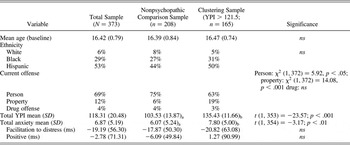
The data for the present study come from assessments of 373 male juvenile offenders housed in a secure confinement facility in Southern California. All youths between the ages of 14 and 17 years who were newly admitted to the facility or returning on a new offense were eligible to enroll in the study. The majority (94%; n = 350) of youths (M age = 16.42, SD = 0.79; see Table 1) were from ethnic minority backgrounds (53% Hispanic, 29% African American, 12% biracial or multiracial, 6% Caucasian), an ethnic composition that is representative of youth incarcerated in this region of the United States (Snyder & Sickmund, Reference Snyder and Sickmund2006). The majority of study participants were sentenced for violent (e.g., murder, rape, robbery, aggravated assault) committing offenses (69%, n = 258).
Characteristics of the total sample, the nonpsychopathic comparison sample, and the clustering sample (YPI > 121.5)

Note: YPI, Youth Psychopathic Traits Inventory. Facilitation scores are based on performance on the emotional pictures dot-probe task. Subscript letters indicate a significant difference between the comparison and clustering subsamples.
Procedure
All study procedures were approved by a university institutional review board and a Certificate of Confidentiality was secured from the Department of Health and Human Services to ensure that the information disclosed by the youths remained confidential. Ninety-seven percent of parents/guardians contacted consented to their child's participation in the study; the youth assent rate was 96%. Youth completed a 2-hr baseline interview within 48 hr of arrival to the facility as well as weekly and monthly follow-up interviews (i.e., Weeks 2, 3, 4, and Month 2). Each interview consisted of a battery of developmental, behavioral, emotional, and attitudinal measures.
Measures
Participants self-reported their age, ethnicity, and whether they had been to the facility before. The measures described below are categorized into clustering measures used in model-based cluster analysis (MBC) to identify primary and secondary psychopathy variants and measures used to support the external validity of the resultant clusters based on theoretical conceptualizations of psychopathy variants.
Clustering measures
Psychopathy
The Youth Psychopathic Traits Inventory (YPI; Andershed, Kerr, Stattin, & Levander, Reference Andershed, Kerr, Stattin, Levander, Blauuw and Sheridan2002) is a 50-item self-report measure of psychopathic traits that was administered at the Week 3 assessment. The YPI was developed in a community-based sample of youths with an aim to capture core affective and interpersonal personality features of psychopathy to the exclusion of the “more behavioral consequences of psychopathic personality traits” (Andershed et al., Reference Andershed, Kerr, Stattin, Levander, Blauuw and Sheridan2002, p. 135) or antisocial deviance and criminal behavior that some believe develop as a result of such traits (Skeem & Cooke, Reference Skeem and Cooke2010a, Reference Skeem and Cooke2010b; cf. Hare & Neumann, Reference Hare and Neumann2010). The items of the YPI were written to assess 10 target traits/scales in a relatively comprehensive (five items/trait) and indirect, nontransparent manner (e.g., “I usually feel calm when other people are scared”). Prior factor analytic research supports a three-factor structure in which each higher-order factor is composed of several lower-order scales (in parentheses): Grandiose–Manipulative (i.e., interpersonal traits: dishonest charm, grandiosity, lying, manipulation), CU (affective traits: remorselessness, callousness, unemotionality), and Impulsive–Irresponsible (lifestyle traits: impulsiveness, irresponsibility, thrill seeking; Andershed et al., Reference Andershed, Kerr, Stattin, Levander, Blauuw and Sheridan2002). The YPI correlates moderately with the Psychopathy Checklist: Youth Version (r = .35, Forth et al., Reference Forth, Kosson and Hare2003), with low to moderate correlations with a variety of self-report conduct problem indices, supporting its convergent validity (Cauffman, Kimonis, Dmitrieva, & Monahan, Reference Cauffman, Kimonis, Dmitrieva and Monahan2009). In the current sample, the YPI total (α = 0.90) and factor scores (0.71 for affective to 0.89 for interpersonal) demonstrated adequate internal consistency.
Anxiety
The Revised Children's Manifest Anxiety Scale (RCMAS; Reynolds & Richmond, Reference Reynolds and Richmond1985; Reference Reynolds and Richmond2000) is a standardized measure designed to assess anxiety in youths between the ages of 6 and 19. The RCMAS has 37 items divided into four scales: physiological anxiety (10 items; e.g., “Often I feel sick in my stomach,” α = 0.64), worry/oversensitivity (11 items; e.g., “I worry about what is going to happen,” α = 0.76), social concerns/concentration (7 items; “A lot of people are against me,” α = 0.68), and lying (9 items; e.g., “I never get angry,” not included in the analyses). The child responds to each question with a “Yes” or “No” answer. The RCMAS possesses moderate test–retest reliability over a 9-month period (r = .63; Reynolds, 1981), and its construct validity is supported by past research (e.g., Muris, Merckelbach, Ollendick, King, & Bogie, Reference Muris, Merckelbach, Ollendick, King and Bogie2002).
External criteria variables
Maltreatment history
The Life Events Scale (Gil-Rivas, Reference Gil-Rivas2003) consists of a list of 32 stressful life events. The youth is asked to endorse which of these events he has ever experienced in his lifetime. Maltreatment history was computed by totaling the seven items tapping parental absence; domestic violence exposure; parental neglect; and physical, emotional, and sexual (two items) abuse (α = 0.64).
Depression
The Center for Epidemiologic Studies Depression Scale (Radloff, Reference Radloff1977) is a 20-item self-report measure of depressed mood, lack of positive affect, somatic symptoms, and interpersonal difficulties. A total score was computed by summing all 20 items rated at baseline, with higher scores indicative of more depressive symptomatology (α = 0.82).
Psychopathology
The 112-item Child Behavior Checklist Youth Self-Report (Achenbach, Reference Achenbach1991) was used to assess negative emotionality/internalizing psychopathology. The withdrawn/depressed (7 items), anxious/depressed (16 items), and attention problems (9 items) subscales rated at baseline were used.
Anger
The Novaco Anger Scale (Novaco, Reference Novaco2003) is a 48-item self-report measure of various dimensions of anger. The total score rated at baseline (α = 0.90) was used in the current study. The Novaco Anger Scale is highly correlated with several other measures of anger, such as the STAXI Trait Anger Scale (r = .84; Novaco, Reference Novaco2003).
Emotional processing
The emotional pictures dot-probe task (Kimonis, Frick, et al., Reference Kimonis, Frick, Fazekas and Loney2006) is a variant of the traditional word version of the task that has been used extensively in the anxiety literature (MacLeod, Mathews, & Tata, Reference MacLeod, Mathews and Tata1986). It is a spatially oriented selective attention task that is administered via computer to capture automatic attentional bias toward emotional cues, providing an indirect index of emotional reactivity (see Schippell, Vasey, Cravens-Brown, & Bretveld, Reference Schippell, Vasey, Cravens-Brown and Bretveld2003). The version used in the current study was developed using primarily slides taken from the International Affective Picture System (IAPS; Lang, Bradley, & Cuthbert, Reference Lang, Bradley and Cuthbert1997) that were carefully selected to tap distressing (e.g., crying child), positive (e.g., puppies), and neutral emotional content (e.g., fork). Because the number of neutral and distressing images was not sufficient for dividing the slides into neutral, distress, and positive categories, additional slides (distress, n = 19; neutral, n = 42) were added that directly matched the IAPS slide content. For example, additional slides of a crying child were added to the existing IAPS slides of crying children (see Kimonis et al., Reference Kimonis, Frick, Muñoz and Aucoin2008). A recent meta-analysis suggests that selective attention is similarly robust for both pictorial and verbal stimuli (Bar-Haim, Lamy, Pergamin, Bakermans-Kranenberg, & van IJzendoorn, Reference Bar-Haim, Lamy, Pergamin, Bakermans-Kranenberg and van IJzendoorn2007).
The dot-probe task consists of one block of practice stimuli (16 picture pairs) followed by four test blocks of picture pairs, each containing 24 picture pairs. Each picture pair presentation consists of three sequential and nonoverlapping components: (a) a 500-ms fixation cross appearing in the center of the screen, (b) a 250-ms simultaneous presentation of two picture stimuli that are centered and located immediately above and below the location of the fixation cross, and (c) an asterisk (i.e., dot probe) appearing in either the top or bottom picture location immediately after the offset of the picture. The objective of the task is to select as quickly as possible a key on the keyboard that corresponds to the location on the screen (top or bottom) where the dot probe appears. The time between when the probe appears and when the youth presses the corresponding key to its location is recorded in milliseconds and used for the calculation of facilitation indices (MacLeod & Mathews, Reference MacLeod and Mathews1988): facilitation = 1/2 × [(neutral only/probe top – distress up/probe top) + (neutral only/probe bottom – distress down/probe bottom)]. The assumption is that if the spatial location of the probe corresponds to where the participant's attention is allocated, then their response to the probes' location will be faster than if their attention was allocated elsewhere. If no key is pressed within 5000 ms, the response is recorded as incorrect. Consistent with past uses of the task (Vasey, Daleidon, Williams, & Brown, Reference Vasey, Daleidon, Williams and Brown1995; Vasey, El-Hag, & Daleidon, Reference Vasey, El-Hag and Daleidon1996), incorrect responses were not included in the calculation of facilitation indices because they reflect that the participant was not paying attention to a specific stimulus pair. Higher scores reflect greater attentional orienting to emotional stimuli (see Kimonis, Cauffman, & Goldweber, Reference Kimonis, Cauffman and Goldweber2009; Kimonis et al., Reference Kimonis, Frick, Muñoz and Aucoin2008; Kimonis, Frick, et al., Reference Kimonis, Frick, Fazekas and Loney2006). The facilitation index to distress demonstrated adequate internal consistency in the current study (α = 0.81). A subsample of youths in the psychopathic group (n = 127) completed the emotional pictures dot-probe task. This subsample did not differ significantly from those who did not complete the task (n = 38) on any of the study variables.
Results
Data analyses
Descriptive statistics are provided in Table 1 on the clustering variables, anxiety and psychopathy. YPI and anxiety scores were uncorrelated with facilitation indices from the dot-probe task. The mean facilitation to distress pictures was negative (M = –19.19, SD = 56.30 ms), in keeping with Kimonis et al. (Reference Kimonis, Frick, Muñoz and Aucoin2008; see also Legerstee et al., Reference Legerstee, Tulen, Kallen, Dieleman, Treffers and Verhulst2009). In incarcerated samples of youths, there may be no general facilitation effect for images of distress.
Consistent with prior research (Hicks et al., Reference Hicks, Markon, Patrick, Krueger and Newman2004, Reference Hicks, Vaidyanathan and Patrick2010; Kimonis, Skeem, & Cauffman, Reference Kimonis, Skeem and Cauffman2006; Skeem et al., Reference Skeem, Johansson, Andershed, Kerr and Louden2007; Tatar et al., in press), we first used the MBC (Banfield & Raftery, Reference Banfield and Raftery1993) to determine whether primary and secondary variants of juvenile psychopathy can be identified in a subsample (n = 165) of male juvenile offenders scoring high on the measure of psychopathy. To validate the resultant clusters, we used multivariate analyses of variance and analyses of variance to compare them on theoretically relevant factors not used to derive them. The nonpsychopathic comparison group was included in these analyses along with primary and secondary psychopathy variants.
Cluster derivation
Although we recognize that the most compelling data suggest that psychopathy is a dimensional trait rather than categorical (Edens, Marcus, Lilienfeld, & Poythress, Reference Edens, Marcus, Lilienfeld and Poythress2006; Lilienfeld, Reference Lilienfeld1994; Reference Lilienfeld1998; Marcus, Lilienfeld, Edens, & Poythress, Reference Marcus, Lilienfeld, Edens and Poythress2006; cf. Harris, Rice, & Quinsey, Reference Harris, Rice and Quinsey1994; Vasey, Kotov, Frick, & Loney, Reference Vasey, Kotov, Frick and Loney2005), we used a threshold score to select youths because our interest was in identifying subgroups within those with substantial psychopathic traits. Thus, to derive clusters of primary and secondary variants of psychopathy, those scoring greater than 121.5 on the YPI (n = 165) were selected for analyses. Although the YPI does not have an established cut score for classifying youth as psychopathic, a score of 121.5 was found to correspond to a Psychopathy Checklist: Youth Version score of 30 in a large sample (N = 1,171) of adolescent male offenders (Cauffman et al., Reference Cauffman, Kimonis, Dmitrieva and Monahan2009). We also focused on youths with high scores on the YPI (rather than all youthful offenders) for the cluster analyses to permit comparison of the results with prior studies of adult (Hicks et al., Reference Hicks, Markon, Patrick, Krueger and Newman2004; Skeem et al., Reference Skeem, Johansson, Andershed, Kerr and Louden2007) and juvenile variants of psychopathy (Kimonis et al., Reference Kimonis, Skeem, Cauffman and Dmitrieva2011; Vaughn et al., Reference Vaughn, Edens, Howard and Smith2009) that used this methodology. The remaining youths (n = 208) with YPI total scores of 121.5 and below were used as a comparison group. The characteristics of the general sample (N = 373), clustering subsample (n = 165), and comparison subsample (n = 208) are provided in Table 1. Relative to the comparison group, the group scoring high on the YPI (i.e., clustering group) obtained significantly higher scores on the RCMAS and was more likely to have a property-related committing offense.
MBC was performed using SPLUS 7.0 (Insightful Corporation, 1988–2005), the mclust library (Fraley & Raftery, Reference Fraley and Raftery2002a, Reference Fraley and Raftery2002b, Reference Fraley and Raftery2008), and the expectation maximization algorithm. MBC reduces some of the uncertainties inherent in common clustering methods by testing the relative fit of 10 models that vary in their assumptions about the structure of the data. More detailed discussions of MBC are provided by Hicks et al. (Reference Hicks, Markon, Patrick, Krueger and Newman2004) and Skeem et al. (Reference Skeem, Johansson, Andershed, Kerr and Louden2007). Youths' Z scores (based on the psychopathic subsample) on the three higher-order factors of the YPI and the three anxiety scales of the RCMAS were used as clustering variables. According to Bayesian information criterion (BIC) values generated by MBC, models that specified one cluster fit relatively poorly, indicating there were subgroups of youths scoring high on psychopathy with distinctive trait patterns. The best fitting model was a two-cluster solution (Cluster 1, n = 122; Cluster 2, n = 43) with equal shape, equal volume, and diagonal orientation (BIC = –5236). The average classification certainty, or posterior probability that an individual was correctly assigned to a cluster, was high at 99.9%. Three-quarters of the sample had a fairly high (≥97.5%) probability of correct assignment to a cluster, suggesting confidence in this clustering solution.Footnote 2
Description of clusters
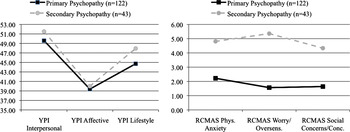
Using t tests, the two clusters (Cluster 1, n = 122; Cluster 2, n = 43) were compared on total, factor, and subscale scores of the YPI and the RCMAS for descriptive purposes (see Figure 1). The second cluster (n = 43), which was labeled “secondary,” reported significantly greater anxiety, physiological, t (163) = –8.59, d = 1.35; worry, t (163) = –13.61, d = 2.13; and social concerns/concentration, t (163) = –11.92, d = 1.87; all ps < .001; higher total YPI, t (163) = –3.31, d = 0.52, p < .001; and Impulsive–Irresponsible lifestyle factor scores, t (163) = –3.70, d = 0.58, p < .001; but not CU or Grandiose–Manipulative factor scores compared to the first cluster (n = 122), which was labeled “primary.” Comparison youths were slightly more anxious than primary variants but significantly less anxious than secondary variants.
The mean scores for psychopathy variants on clustering variables from the Youth Psychopathic Traits Inventory (YPI) and the Revised Child Manifest Anxiety Scale (RCMAS). Secondary variants scored significantly higher across anxiety factor scores and on the impulsive–irresponsible lifestyle factor of the Youth Psychopathic Traits Inventory (YPI), but not grandiose–manipulative and affective factors, compared with primary variants. YPI interpersonal, range = 34–73, SEM = 0.68 (primary)/range = 32–72, SEM = 1.31 (secondary); affective, range = 24–55, SEM = 0.44 (primary)/range = 26–51, SEM = 0.81 (secondary); lifestyle, range = 31–56, SEM = 0.47 (primary)/range = 39–60, SEM = 0.78 (secondary). RCMAS physiological anxiety, range = 0–7, SEM = 0.15 (primary)/range = 1–10, SEM = 0.31 (secondary); worry/oversensitivity, range = 0–6, SEM = 0.14 (primary)/range = 2–10, SEM = 0.26 (secondary); social concerns/concentration, range = 0–4, SEM = 0.11 (primary)/range = 2–7, SEM = 0.21 (secondary).

Validating clusters: Maltreatment and negative emotionality/symptomatology
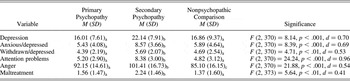
By definition, clusters will differ on the variables used to cluster them. Thus, clusters were validated by comparing them via multivariate analyses of variance on theoretically relevant dimensions not used to derive them and found in prior empirical research to distinguish psychopathy variants. Consistent with expectations, the secondary variant group reported significantly more maltreatment, F (2, 371) = 5.64, p < .01, d = 0.41, compared to primary variants and comparison youths (see Table 2).Footnote 3 Secondary variants also scored significantly higher on each measure of negative emotionality/symptoms compared to primary variants and comparison youth, Wilks λ = 0.82, F (10, 732) = 7.68, p < .001, d = 0.65. As depicted in Table 2, secondary variants endorsed significantly greater symptoms of depression/social withdrawal and attention problems compared to primary variants and nonpsychopathic comparison youths. In addition, relative to other groups, secondary variants endorsed significantly greater anger problems; primary variants also reported significantly more anger than nonpsychopathic comparison youths.
Comparisons between primary and secondary variants and nonpsychopathic comparison youth

Note: Different subscript letters denote significant differences between groups in post hoc pairwise comparisons using the Tukey honestly significant difference procedure. The constructs were assessed using the Center for Epidemiologic Studies Depression Scale for depression (Radloff, Reference Radloff1977); Child Behavior Checklist Youth Self-Report (Achenbach, Reference Achenbach1991) for anxious/depressed, withdrawn/depressed, and attention problems; the Novaco Anger Scale for anger (Novaco, Reference Novaco2003); and the Life Events Scale for maltreatment (Gil-Rivas, Reference Gil-Rivas2003). The Cohen d statistics are for comparisons of primary versus secondary variants.
Validating clusters: Processing of distressing emotional stimuli
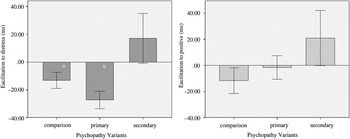
The two psychopathy clusters and comparison youth were also compared on their processing of distressing and positive emotional stimuli. The results of one-way analyses of variance revealed a significant but modest difference among the three groups in attentional orienting to distressing, F (2, 282) = 4.61, p < .05, d = 0.36, but not positive stimuli. Given a priori hypotheses, planned comparisons between primary and secondary variants were conducted. The analyses revealed that primary and secondary variants differed significantly from each other, unequal variances, t (43) = –2.34, p < .05, Cohen d = 0.71, but not from comparison youths, primary versus comparison, unequal variances, t (220) = –1.65, ns, Cohen d = 0.22; secondary versus comparison, unequal variances, t (41) = 1.61, ns, Cohen d = 0.50 (see Figure 2). That is, primary variants were not attentionally engaged by distressing stimuli, whereas secondary variants were more attentive to stimuli depicting distressing emotional content.
The mean scores on facilitation to (left) distress and (right) positive pictures (ms) for primary and secondary variants of juvenile psychopathy and comparison youth. Lower scores indicate reduced attention to emotional stimuli. Errors bars = ±1 SE. Facilitation to distress, range = –251.75 to 113.96 (primary)/range = –100.75 to 361.33 (secondary); facilitation to positive, range = –375.58 to 299.21 (primary)/range = –166.96 to 421.82 (secondary).

Discussion
The results of this study are consistent with past research indicating that the construct of psychopathy is heterogeneous (Poythress & Skeem, Reference Poythress, Skeem and Patrick2005; Skeem et al., Reference Skeem, Poythress, Edens, Lilienfeld and Cale2003) and that high-anxious secondary variants endorse more negative emotionality and childhood abuse than low-anxious primary variants (Hicks et al., Reference Hicks, Markon, Patrick, Krueger and Newman2004, Reference Hicks, Vaidyanathan and Patrick2010; Skeem et al., Reference Skeem, Johansson, Andershed, Kerr and Louden2007; Tatar et al., in press; Vaughn et al., Reference Vaughn, Edens, Howard and Smith2009). The primary contribution of these results, however, is demonstrating that the variants of juvenile psychopathy, which were identified via cluster analysis, differed in their processing of emotional stimuli. As hypothesized, we found that secondary psychopaths were more engaged by distressing emotional stimuli than primary psychopaths (Cohen d = 0.71).
Consistent with our findings, Bagley et al. (Reference Bagley, Abramowitz and Kosson2009) also found that adult secondary psychopathy variants made fewer errors in recognizing emotional tone and in recognizing sad emotional content (d = 0.41) of spoken sentences relative to primary variants, albeit nonsignificantly. Our findings are also consistent with a body of research generated by Newman and colleagues (Newman et al., Reference Newman, Patterson, Howland and Nichols1990, Reference Newman, Schmitt and Voss1997; Newman & Schmitt, Reference Newman and Schmitt1998) that found that high-anxious adult psychopathic offenders, which most closely resemble secondary variants, do not show deficits in passive avoidance learning, modulation of responses to emotional and neutral stimuli, and fear-potentiated startle response that are found to differentiate low-anxious psychopathic individuals. Together, these studies provide some support for our hypothesis that low-anxious primary variants, but not high-anxious secondary variants, will show emotional deficits believed by some to be core to the psychopathic personality (Cleckley, Reference Cleckley1941).
It is important that our findings are consistent with past research suggesting that the two groups are not distinguished by differences in their level of CU traits (Hicks et al., Reference Hicks, Markon, Patrick, Krueger and Newman2004; Vassileva et al., Reference Vassileva, Kosson, Abramowitz and Conrod2005). This finding is important because, as noted previously, CU traits have been increasingly used to designate an important subgroup of antisocial youths. These findings suggest that those high on CU traits could fall into either the primary or secondary groups. Thus, causal theories of CU traits need to account for this heterogeneity.
Although this cross-sectional study cannot conclusively address etiological issues, we use our results to offer two speculative hypotheses that could be addressed in future research. One possibility is that these differences in emotional processing signal differences in temperament. Theories of moral development suggest that both “too high” and “too low” levels of emotional reactivity can impair conscience development and related complex social emotions of guilt and empathy (Kochanska, Reference Kochanska1993, Reference Kochanska1995, Reference Kochanska1997). Whereas children with a fearless temperament (i.e., primary variants) may be insufficiently engaged by important socializing cues, highly emotionally reactive/dysregulated children (i.e., secondary variants) might miss them because they are easily overwhelmed in negatively charged situations where such cues tend to be elicited (e.g., parental anger, peer distress; see Frick & Morris, Reference Frick and Morris2004; Hoffman, Reference Hoffman and Eisenberg1982; Young et al., Reference Young, Fox and Zahn-Waxler1999). In short, our results would be consistent with the possibility that the two variants have different temperaments that are linked to CU traits and subsequent antisocial behavior via different emotional mechanisms.
Another possibility that would be consistent with our findings is that these differences in emotional processing signal differences in experience. Specifically, childhood maltreatment may relate to emotional sensitivity among those with secondary psychopathy. There is evidence that maltreatment adversely affects the development of the hypothalamus–pituitary–adrenocortical system, which regulates emotional and particularly fearful responding (see Nelson & Carver, Reference Nelson and Carver1998). In turn, maltreated children are less likely to offer help to or show sadness or concern toward a distressed peer and are more likely to withdraw from or aggress against that peer (Klimes-Dougan & Kistner, Reference Klimes-Dougan and Kistner1990; Main & George, Reference Main and George1985). Genetically sensitive, longitudinal research is needed to explore how differences in emotional processing among primary and secondary variants of psychopathy may relate to temperamental and environmental factors.
It is remarkable that neither variant processed distress significantly differently from nonpsychopathic offenders; comparison offenders fell midway between primary and secondary variants in their responsiveness to distressing stimuli. As previously mentioned, similar findings were reported by Bagley et al. (Reference Bagley, Abramowitz and Kosson2009). This finding may reflect the considerable heterogeneity of offenders as a group. The spread of scores on the dot-probe task was greater for general (nonpsychopathic) offenders (–310.67 to 382.37 ms) than for primary (–251.75 to 113.96 ms) and secondary psychopathy variants (–100.75 to 361.33 ms), reflecting greater variability in the comparison group. There are at least two possible explanations for this. One explanation is that measures of psychopathy may lack precision in adolescent samples because of normative variations in the level of these traits across adolescents (Edens, Skeem, Cruise, & Cauffman, Reference Edens, Skeem, Cruise and Cauffman2001). Alternatively, this heterogeneity in the general offending group may be tied to more divergent dispositional characteristics and contextual experiences across youths who enter the juvenile justice system. For example, youths high on anxiety (Vasey et al., Reference Vasey, Daleidon, Williams and Brown1995; Watts & Weems, Reference Watts and Weems2006) and narcissism (Munoz, Kimonis, Strickleton, Frick, & Aucoin, Reference Munoz, Kimonis, Strickleton, Frick and Aucoin2010) and those with conduct problems/aggression without psychopathic traits (Kimonis, Frick, et al., Reference Kimonis, Frick, Fazekas and Loney2006) tend to show heightened attention to negative emotional cues. Thus, the high prevalence of aggression, narcissism, and anxiety disorders in incarcerated youths (Baumeister, Smart, & Boden, Reference Baumeister, Smart and Boden1996; Karnik et al., Reference Karnik, Soller, Redlich, Silverman, Kraemer and Haapanen2009) may account for the failure to find a significant difference from secondary variants. In sum, although primary variants did not display an emotional deficit and secondary variants did not display an enhancement in attention to others' distress cues relative to the comparison group, our results do suggest that secondary variants were still more attentively engaged by images of others in distress than were primary variants.
The results of this study must be considered within the context of several study limitations. First, whereas prior research found that anxiety is associated with hypervigilance toward threatening stimuli on the dot-probe task (e.g., Vasey et al., Reference Vasey, El-Hag and Daleidon1996), we were able to rule out the possibility that differences between psychopathy variants in emotional processing of distressing stimuli were entirely accounted for by differences in anxiety, because these two variables were not significantly correlated (r = .10). Second, the current study is limited to serious male juvenile offenders and findings may not generalize to girls, community samples, or juvenile offenders with less serious histories of offending. That is, this study employed an adolescent offender sample housed in a secure facility, the majority of whom were sentenced for a violent committing offense. The average YPI scores were fairly high in this sample, and our use of a cut score extrapolated from a more heterogeneous sample of delinquent boys with a greater composition of drug offenders (capped at 15% in Schubert et al., Reference Schubert, Mulvey, Steinberg, Cauffman, Losoya and Hecker2004, vs. 4% in the present study) likely resulted in a large proportion of youth falling in the “psychopathic” range for inclusion in the cluster analysis. In addition, the sample consisted of predominately ethnic minority youths (72%), particularly those of Hispanic descent (47%), a population for which validation studies of the YPI have yet to be conducted. Although this is an important strength, given the relative lack of research on CU traits and psychopathy in minority populations, it also limits the generalizability of findings to less ethnically heterogeneous populations. However, chi-square difference tests from multiple group analysis supported the covariance equivalence of the YPI and RCMAS measures across the two primary racial/ethnic groups (Black and Hispanic) included in this study. Third, as noted previously, etiological inferences cannot be drawn from this cross-sectional study. That is, emotional processing deficits may reflect temperamental differences in emotionality or may result from exposure to violent home and neighborhood environments that cause desensitization (see Kimonis et al., Reference Kimonis, Frick, Muñoz and Aucoin2008). For example, infants raised in severely impoverished social and emotional environments show a blunted pattern of emotional (i.e., cortisol) reactivity (Carlson & Earls, Reference Carlson and Earls1997; Gilles et al., Reference Gilles, Bernston, Zipf and Gunnar2000), which may persist into adulthood (van der Vegt, van der Ende, Kirschbaum, Verhulst, & Tiemeier, Reference van der Vegt, van der Ende, Kirschbaum, Verhulst and Tiemeier2009).
Implications for future research and practice
Models to explain antisocial behavior need to explain the many differences between antisocial youths with and without high levels of CU traits. Our results further suggest that youths high on these traits can also be disaggregated into important subgroups that differ in their emotional stability and emotional processing. As suggested earlier, these results help shape etiologic hypotheses to address in future research. For example, our results suggest that future prospective studies could follow two groups of children: those with a fearless temperament and deficits in processing distressing emotional stimuli (i.e., primary psychopathy) and those with a disinhibited temperament who are exposed to high rates of trauma and abuse (i.e., secondary psychopathy). Fortunately, there are methods for assessing fearlessness and related temperamental dimensions in very young children (Fowles & Kochanska, Reference Fowles and Kochanska2000; Kagan, Reznik, & Snidman, Reference Kagan, Reznik and Snidman1988).
Such prospective studies could be very important for developing effective prevention programs for CU traits by identifying factors that may reduce the risk for problems in conscience development in youths with a fearful temperament. For example, Kochanska (Reference Kochanska1997; Kochanska & Murray, Reference Kochanska and Murray2000) proposed that the parent–child relationship, especially the responsiveness toward each other, may be critical in the socialization of children with a fearless temperament. This aspect of parenting does not rely on punishment-related arousal for internalization and instead focuses on the positive qualities of the parent–child relationship (Kochanska & Murray, Reference Kochanska and Murray2000). In support of this proposal, attachment security predicted conscience development in temperamentally fearless children (Kochanska, Reference Kochanska1995, Reference Kochanska1997). In addition, Cornell and Frick (Reference Cornell and Frick2007) specifically tested several interactions between a fearless temperament and different dimensions of parenting in predicting scores on measures of guilt and empathy in young children (age 3–5 years). They reported two interactions, such that fearless children showed higher levels of guilt when parental consistency was high and when parents used authoritarian parenting (i.e., strong rule-oriented and obedience-oriented parenting). The authors interpreted these findings to suggest that fearless children require stronger and more consistent parenting to develop appropriate levels of guilt.
More immediately, our findings can shape hypotheses about targeted intervention for psychopathic juvenile offenders to evaluate in future research. At the outset, it is important to recognize that a growing body of research indicates that intensive treatment meaningfully reduces the risk of violence and other criminal behavior for youths with psychopathic traits (for a review, see Skeem, Polaschek, & Manchak, Reference Skeem, Polaschek, Manchak, Skeem, Douglas and Lilienfeld2009). However, it is possible that even greater gains may be made if treatment is targeted to the psychopathic variants identified in this study. For example, research suggests that cognitive–behavioral interventions may be most effective at treating internalizing problems (e.g., anger, anxiety, and depression) and related trauma histories (see Chaffin & Friedrich, Reference Chaffin and Friedrich2004; Kaslow & Thompson, Reference Kaslow and Thompson1998; Ollendick & King, Reference Ollendick and King1998) that distinguish secondary variants. For the low-anxious primary variant, recent research suggests that deficits in attention to others' distress cues can at least be corrected temporarily by focusing youths' attention on the eye region (Dadds et al., Reference Dadds, Perry, Hawes, Merz, Riddell and Haines2006; see also Baskin-Sommers, Curtin, & Newman, Reference Baskin-Sommers, Curtin and Newman2011). In addition, increasing the salience of others' distress cues has been found to attenuate laboratory-based aggression for youths scoring high on psychopathic traits (van Baardewijk, Stegge, Bushman, & Vermeiren, Reference van Baardewijk, Stegge, Bushman and Vermeiren2009). This group has also been shown to respond positively to rewards, and this also can be capitalized on in treatment. For example, Hawes and Dadds (Reference Hawes and Dadds2005) reported that clinic-referred boys (ages 4 to 9) with conduct problems and CU traits were less responsive to a parenting intervention than were boys with conduct problems who were low on CU traits. However, children with and without CU traits seemed to respond equally well to the first part of the intervention that focused on teaching parents methods of using positive reinforcement to encourage prosocial behavior. In contrast, only the group without CU traits showed added improvement with the second part of the intervention that focused on teaching parents more effective discipline strategies. In summary, several promising interventions have emerged for youths with CU traits. These efforts are likely to be enhanced if they consider the heterogeneity among high CU youths and appropriately tailor treatment to their individual needs.