Publicised as the Horseless Carriage Show, the brief display of motor vehicles on the Tunbridge Wells Agricultural Show Ground on the afternoon of the 15th October 1895 was a symbolic introduction to Britain's motoring revolution. Followed by other exhibitions and demonstrations, and another twelve months of lobbying to replace the restrictive legislation that was identified with the man carrying a red-flag in front of a vehicle, success was realised with the passing of the Light Locomotives on Highways Act marked by the so-called emancipation run from London to Brighton of 14th November 1896.Footnote 1 Reported as a new age of freedom, motoring was increasingly identified with the British countryside. Central to the construction of the pleasures of motoring was an imagined relationship that established the idea that the motorcar was reliable, able to deal with every eventuality; offered freedom, with the road to yourself, and the ability to discover the hidden beautiful Britain. It also showed how the service industries would take care of you wherever you went. It was a relationship that not only defined the pleasures of ‘Being British’ but of owning a British car, cars for example that were identified as being as endurable as the ‘oak’, and as strong as a ‘shire’ horse. Seen to be reopening a countryside that had been isolated and neglected with the coming and expansion of the railway, rural motoring was packaged as a consumable. Monumental and picturesque, it offered the motorist an opportunity to engage with the aesthetic of the countryside and enjoy a healthy open-air life.Footnote 2
In the first decades of the twentieth century motoring changed the character of country-house life, revitalised the country inn, and brought a new garage trade to the country towns and villages. It generated opposition to its roadside advertising and signage, and, through the motor trials and rallies, exposed the country lanes and hills to the noise and speed of the new machines. In the form of tours, weekend jaunts and commercial traffic, whether it was the charabancs, the motor lorries delivering beer to the village inn, or the carrier bringing goods to the door and taking produce to the market, rural motoring was an ad hoc yet profitable development. The restrictions of the war years were to show how much rural Britain had come to rely on the motor-trade, and the essential part it would play in the post-war regeneration of the countryside economy.
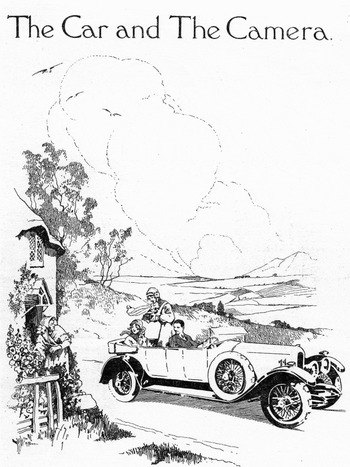
Commuting took on an added significance as did the rebuilding of the tourist industry with the motorists being encouraged to see their own country first, before venturing abroad for their holidays. As the idea of ‘Motoring for the Millions’ took shape, so the campaign was widened but with it came the dilemma as to how and to what extent a new age of motoring could bring about a revival of rural life while preserving the countryside of a pre-industrial landscape. What is clear, and what this essay sets out, is the manner in which the motoring press, notably The Motor and Autocar, with their increased use of artist-illustrators, and the innovative advertising campaigns of motor manufacturers and petrol companies, promoted the mutual benefits of the harmony between modern motoring and the countryside. It identified motoring and the motor trade with Britain's heritage and the ‘beauty spot’, and sought to bring together urban and countryside interests and values. The preservation movement was far from being convinced by this pattern of representation, but it reassured the working rural communities, and convinced the professional planners and architects of the need to respond to the demands of motor traffic as part of the control of commercial and speculative developments that threatened the countryside.Footnote 3 The Dunlop Motorists Guide, Counsellor and Friend, 1920, provides a suitable starting point to examine what was to become known as modern motoring. Packed with details, maps and drawings, it set out all the possibilities of journeying in ‘a comfortable car through our beautiful British by-ways’. Providing information on routes, architecture, sports, including a list of golf courses and the pleasures of a day's fishing, it ended as ‘gently the car glides with us to evening meal and rest’. Since the launch of the Kodak Brownie camera in 1900 had introduced the age of the snapshot, all of this was to be recorded for the family album. Setting the high-powered touring car against the thatched cottage, rustic old-English garden and bonneted lady, the open plain with distant hills, illustrated the underlying passion for a journey through an idyllic landscape that was undisturbed by work or rural poverty (Figure 1). A picturesque tableau, yet it leaves a sense of unease as the aristocratic travellers are portrayed on a countryside safari capturing images of the quaint peasant life. It was a juxtaposition of rustic and modern life, a myth but nevertheless a plausible and enduring one, and one that was to be reinforced and repositioned over the next twenty years.
Dunlop, Motorists Guide, Counsellor and Friend, London, 1920.

Trouble-free motoring, providing the freedom to drive anywhere and whenever, door to door, unrestricted by timetables, was central to the dream of becoming a motor-owner. So was the notion of the widening circle of trade and communication. The weekend took on new meanings, as the new models offered greater safety, speed and comfort, and small cars offered an increased possibility of economic motoring. With the arrival of the petrol-pump the country roads acquired new architecture as garages, road-houses and filling-stations marked the popular routes. Country inns were renovated and new ones built to provide suburban comforts in the rural setting. It was a new trade that not only did much to stem the rural decline but also promoted the idea of the suburban countryside, accessible for an evening run.
Parading rural Britain as the place for the recreation, rest and enjoyment of busy town dwellers, and offering new opportunities to live in the country and work in the town, motoring was to accelerate the changes to the working life of the village and countryside. At a time when towns and cities in response to the 1919 Housing and Town Planning Act were redrawing their boundaries, the potential impact of the motorcar was recognised as a major factor in defining the new plans. The arterial road and by-pass, the widening and straightening of existing country roads, the problems of parking and even the need for the provision of parking to enable the motorist to enjoy the beautiful view were part of the discourse and a cause of disquiet to the preservationist. The possibility of motorways cutting through the countryside was a topic of much debate, but much more significant to the changing landscape was the government decision at the beginning of 1921 to classify roads, with six trunk-roads radiating out of London, and three from Edinburgh. The remaining road system was to be classified into A and B categories, leaving the rural hinterland unclassified. The immediate effect was to realign the relationship of places by suggesting that Britain had acquired a modernised road system. It was to stimulate the speculative and much-maligned ribbon development while leaving large areas of rural Britain outside this modernisation process, not so much forgotten, but waiting to be explored.
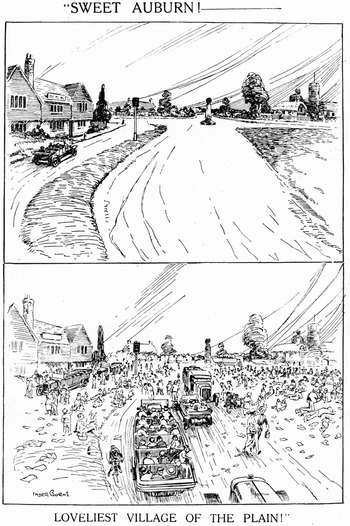
With this remapping of Britain, a landscape that had been the preserve of the enthusiast, the rich and the middle-class motorist, had to face the prospect of sharing it with the working-class hordes arriving on the new charabancs. The cyclists and walkers had bemoaned the arrival of the motorist, now attention was to turn to the impact of a new invasion. As Inder Burns’ drawing ‘Sweet Auburn’, reproduced in The Motor, August 1920, clearly portrayed, the perfection of the mid-week visit of the middle-class tourists became the horror story of the weekend overwhelmed by traffic, litter and the trippers sprawled across the village green (Figure 2). Uncivilised, the village had been transformed into a pleasure ground more readily identified with the seaside excursion. It may have been far-fetched but it was indicative of a wider concern to protect Rural England while making it possible to accommodate the motorist and the anticipated increase of commercial traffic. Far from destroying the countryside, the motoring lobby was determined to protect it, realising that, while wanting a modernisation of its facilities and new services, it still needed a beautiful countryside to enjoy, the raison d'etre of the drive or tour. For this reason Autocar, 22nd December 1922, fantasised about a future in which the motoring lobby had taken control of Parliament and was working to put all commercial transport underground, construct new roads, and appoint a landscape expert to every county responsible for the reconstruction of the picturesque. Even the Black Country had been restored, with Dutch artists coming over in crowds to paint it. England had become a vast show place with the ‘Yanks and the Huns’ coming over in thousands ‘just to soak themselves in our scenery’.Footnote 4
‘Sweet Auburn’, The Motor, 4th August 1920.

The most discussed piece of industrial design was the petrol-pump, icon of the modern age of motoring.Footnote 5 Positioned by the roadside, at the end of country lanes and giving rise to the filling station, it was a symbol of efficiency and the dangers of uncontrolled commercial development. One of the greatest needs of the early motorist had been for a ready supply of petrol, and since 1900 it had been available in sealed two-gallon cans stocked by bicycle shops, hotels and the new garages, with the petrol companies claiming to be able to provide it anywhere, at any time. This brought no physical change to the built landscape, but that was to change when the American-designed petrol pump was first erected on the British roadside outside of the premises of Legge and Chamier in Shrewsbury in 1915. Further expansion was halted by the First World War and it was 1919 before there was an indication of things to come as the Automobile Association decided to open ten filling-stations for its members in countryside locations, the first of which was opened on the 2nd March 1920 at Aldermaston on the Reading-Newbury Road. A prefabricated wooden hut with a canopy to protect the motorist whilst filling-up from the pump hidden inside, it marked the beginning of an extended debate on the appropriate architectural style for these road-side developments.
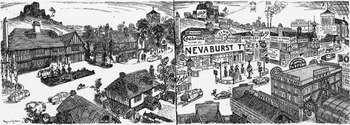
It was now evident that while there was no way of halting the tide of roadside services, including workshops to deal with maintenance and breakdowns, an aesthetic had been established to ensure that these were domestic rather than industrial in character.Footnote 6 Adding its voice to the rising tide of unease as to its impact on the villages, Cuningham's drawing ‘England's Beauty Spots’, in The Motor, 1923, offered a picture of ‘the English Village as it might be – and as it is likely to be’ (Figure 3). With futuristic streamlined cars purposefully rushing through the village, the good and bad models of commerce were distinguished. On the one hand there was the discreet advertising and petrol pumps secured in the rose garden with plants growing up and around them, adjacent to the sundial, cyclists arriving at the tea garden, pedestrians chatting and children playing untroubled by the motor-cars. The future was altogether more aggressive and uncaring, a commercialised electrified village in which advertising had been attached to every building including the hill-top castle and village church on which the vicar's flag was flying from the mast and a billboard announced that the Reverend Showtah would be preaching on the topic ‘Is Humility Possible?’ The tea-garden was replaced by a three-storey tea palace, the thatch-cottages were hidden behind bill-boards, all of the trees had been removed, and the solitary pedestrian was shown leaping out of the way of a speeding car. It was more than a destruction of the village landscape; it was a breakdown of social order. A horror story that came to be described as the ‘Uglification’ of England, it was as much a concern to the motor trade as it was to architects and planners, for ‘motoring, without the attraction of rural charms and historical associations, will be mere aimless meandering, or soulless speeding without objective or interest’.Footnote 7
‘Save England's Beauty Spots!’ The Motor's Campaign against Spoliation, 24th July 1923, pp. 1080–81.

Since the early 1920s the pleasures of motoring were being targeted at the lower middle-class with the new breed of small cars, heralded by the arrival of the Austin 7 in 1923. Portrayed in every imaginable situation, it was the car that made it possible to ‘revel in the beauties of the country while enjoying the conveniences of the town’. It brought the town into the heart of the countryside and the brightness of the town closer to the country dweller. It even included what seemed to be off-road motoring. Marking the beginning of an escalating expansion, over the next four years the number of cars licensed more than doubled to 727,443 private cars and the future of motoring was to be increasingly shaped by those of ‘moderate means’ and ‘slender purse’.
In 1923 The Motor revived its series of ‘Wayside Features’, distinguishing the through routes from the picturesque, marking a map with areas of special interest and beauty intent on informing the motorist of the quaint and historical England, an England that had ‘the most beautiful and varied scenery in the world’.Footnote 8 Much more significant for its visual impact and wider audience was the 1925 Shell campaign ‘See Britain First – on Shell’. With Charles Fouqueray's landscapes of upper-class tourists, the campaign gave a new dimension to the concept of the ‘beauty spot’. Railway posters had taken the tourist to the seaside and cathedral cities; now motorists were being introduced to the Britain of the heroic landscape, with Ullswater, Cheddar Gorge, High Tor Matlock, Lulworth Cove and Loch Lomond among the places visited. A modern romanticism, these images held out the possibility that, with the aid of Shell, they were places that could be reached by any motorist, a reminder that across Britain beautiful countryside was just waiting to be explored. The scenic charm, folklore and historic connection of the beauty spot were being made available to the motorist, courtesy of Shell petrol.Footnote 9
The annual motor show at Olympia was identified with touring through Britain, its mountains, rivers, villages and highways. Always the motorist had the road to himself; pleasures that were magnified when driving on a summer night:
No crowd, no dust before you; calmness, beauty and serene peace; . . . in the long clear rays ahead foliage has a grandeur – as well as an unusual colour – the great, dark blue shadows, sharply cut, bringing individual masses of leaves into greater prominence . . . Moreover, the driver soon falls into a natural pace to fit the rhythm of the engine as though he, too, were part of some definite machine.Footnote 10
1926 was a year that brought everyone's attention to the manner and extent to which modernisation and preservation could coexist. It was a year in which the national well-being had seemed threatened by the ‘Great Strike’. Although it only lasted for ten days, this shutdown challenged the idea of Englishness and prompted the Prime Minister, Stanley Baldwin, to parade a dream of England defined by its countryside:
The tinkle of the hammer on the anvil in the country smithy, the corncrake on a dewy morning, the sound of the scythe against the whetstone, and the sight of a plough team coming over the brow of a hill.Footnote 11
Devon passed a bye-law directed at the excursionists enjoying the pleasures of the charabanc, prohibiting the playing of noisy instruments and loud singing when passing through a town, village or hamlet, and attaching streamers and balloons that could be a danger to others. The Motor asked whether the countryside would be doomed by the speculative builder, the advertising hoardings and weekend shacks calling on motorists to give their support to an aesthetic for the motor trade that would harmonise with the countryside. It was Abercrombie's The Preservation of Rural England that best summarised these concerns and the way forward:
Bluntly speaking, we want to see if it is possible to put a great many more buildings, new roads, subdivisions of property, etc., into the countryside, and yet preserve its beauty either substantially as it is or in a changed form.Footnote 12
The identification of a new dynamic between town and country brought about by motor transport gave weight to the formation, at one extreme, of the Council for the Preservation of Rural EnglandFootnote 13 in February 1927, and, at the other, of the 1932 Town and Country Planning Act. Abercrombie understood the importance of support for a new scientific and machine age for agriculture,Footnote 14 and the coming of electricity to the countryside, but then there was the appeal of the countryside to the charabanc and the economic importance of villages retaining their charm. Such ideals were to divide opinions at a time when attention was being directed at the substandard condition of housing for the rural workers and moves were being made to stimulate interest in the preservation of ancient cottages,Footnote 15 which Ellen Wilkinson MP was reported to have dismissed as being to make dwellings ‘look pretty for the motor-car folk as they pass by’.Footnote 16 The overwhelming view of the activists both from architecture and the motor associations was summarised in E. Guy Dawber's Presidential address to the Royal Institute of British Architects, which concluded with remarks on the necessity and convenience of motor traffic, and the dangers of the beautiful byways of England being over-run by the interests of the well-to-do class, with the villages vulgarised with hoardings, garages and pumps.Footnote 17
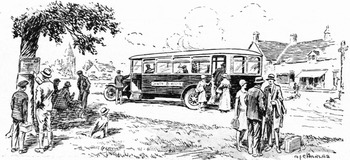
Despite the fear of the uncivilised day-trippers, the charabanc and the municipal motor-bus service was a key part of the opening up of the countryside. By the mid-1920s motoring in its public and private forms had been identified as a process of ‘deruralising’ Britain. Relieving the rural inhabitants from a monotonous existence, the motor bus made it possible for those who could not afford a car to get to work and socialise in a way that had been previously impossible. The picture was now altogether different from what it had once been (Figure 4). With pre-booked tickets available at the local grocer's, the village green had become the new centre of life with its waiting bus offering the same comforts as the latest saloon. Pictured conveying young and old, farmers and housewives, it was a revolution that linked the village and the town, and brought markets and simple pleasures within reach. This was the ideal, but in practice there was a severely restricted service. When the working class were moved out of the cities, into such well-known municipal housing developments as Becontree and Wythenshawe, and followed the new industrial settlements into the countryside, such as Crittals at Silver End, Pilkington Glass at Kirk Sandall, and the new mining villages in Yorkshire, Derbyshire, Nottinghamshire and Kent, it was soon apparent that the limitations of the municipal transport system had left the housewives and children isolated.
The Village Green, with waiting bus, has eclipsed the railway station as the centre of life. Commercial Motor, 11th August 1925, p. 806.

Advertisements suggested that motor-owners had no such problems. Going beyond the suburbs, with the ‘All-British Standard’ car of 1925 a man of moderate means could find an ideal home in the country. This was the house ‘off the beaten track . . . in the fresh health-giving air of the country side’. The wife was identified with the task of driving the husband to the station, being able to use the car during the day for socialising and shopping, before collecting him at the end of the working day. This was a trend that was to escalate as yet more country house estates came up for sale, and agricultural land was being sold with the potential for housing development. The use of the car was a key part in selling the qualities of middle-class life in the country as well as the undeveloped coastal sites.Footnote 18 Any number of examples can be referenced, but one that locates itself between coast and countryside, and was already established as a beauty spot and a tourist destination as a typical old Devon village, was Cockington, sandwiched between Torquay and Paignton. In the hands of Sir Edwin Lutyens it was to have a new ‘high-class shopping area’, thatched and in keeping with the ‘old-world village’. This was never built, although areas of new housing were started and the Drum Inn for the middle-class motorist stands as a reminder of the aesthetic of Lutyens’ plan.
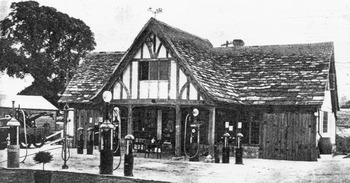
Arguments circulated around the merits of using Tudor revival, neo-Georgian, Rustic Thatch, or Modernist styles for garages and filling-stations. Attention was given to hanging-baskets and gardens and although it now seems extraordinary, new developments, notably in Devon, even extended to the thatched-roof of the canopy over the petrol-pumps. A popular outcome was an architecture of Old England, shown in the house and service station at Farningham from 1926, conceived as a sixteenth-century timber-framed Tudor gate house, but fitted with all of the latest garage equipment including a ramp for inspecting the cars (Figure 5). Petrol, air, water, and oil were lined up ready for service, while the breakdown lorry was parked ready to go to rescue the stranded motorist. Constructed of solid oak that had been treated to give the appearance of grey bleached weathering, old stone and brick had been used in the plinth and old Sussex stone slates for the roof. Finished off with a weathervane and rain-barrel it was old-world for modern life. Beautiful garages became the focus of attention, and Owen John, writing in Autocar, 17th August 1928, suggested that there should be a national campaign with individual motorists taking it upon themselves to produce placards urging ‘Will all motorists who appreciate natural beauty please patronise only garages, etc., that do not spoil the countryside?’Footnote 19 The following year the Design and Industries Association ‘Save-the-Countryside’ travelling exhibition (subsequently published as ‘The Face of the Land’) articulated its campaign against the uncontrolled commercial developments, embracing planning as it affected towns, roads, countryside and industry. Setting good against bad speculative developments, advertising and the motor trade were identified as the villains, particularly in the 1930 booklet ‘The Village Pump: A Guide to Better Garages’.Footnote 20
House and Service Station, Farningham, Kent, 1926, from Building, September 1926, p. 265.

The inter-war period brought about a major development of new hotels, country inns, tearooms and the much-denigrated roadside refreshment shacks, as well as the wholly new concept of the road-house. Through the late 1920s and into the 1930s the network of over 200 Trust Houses Ltd provided hotels with a modern standardised service. At 15s. a night, 2s. 6d. for lunch, and 3s. 6d. for dinner, it was not inexpensive, but the quality was perceived to be reliable. Constructed in villages, on new roads, by-passes and road intersections, some were refurbished, some were demolished and rebuilt, and others were newly built.
The Lygon Arms, Broadway, a sixteenth-century inn that by the end of nineteenth century had declined into a semi-dereliction, had been steadily restored since being bought in 1903 by S. B. Russell for his antique business and as a hotel for the new motor trade. Catering for the rich and aristocratic, driving cars costing from £500 to £1000, and who appreciated good wine, it had by the early 1930s extended its garage provision to provide heated accommodation and a workshop for twenty-four cars. The Bear Inn, at Oxshott, Surrey, which was reconstructed in 1924, used many of the materials from the original inn, in a scale and style that sought to replicate the qualities of the domestic neighbourhood. The bars were balanced by a tea-room and tea-garden. In a similar manner two years later the Montagu Arms Hotel, Beaulieu, was rebuilt as a residential hotel using the bricks from the old building and tiles from pulling down various old buildings on the estate, harmonising with the village and the natural surroundings. On an altogether different scale was the reconstructed Black Horse, Northfield, near Birmingham (1930). Northfield had been the subject of an intense civic society campaign in the early 1920s to save it from the planned new arterial road leading from Birmingham to the West Country, but by the end of the decade ideas of Olde England had reached a monumental scale. With its bars and ladies and gentlemen's smoke-rooms, a hall for dinners, concerts and dances, a garden complete with a thatched pavilion and a bowling green with committee room facilities, this was no longer a wayside or village inn but a medieval revival of country-house proportions for suburban middle-England. Like the Berkeley Arms Hotel, on the Bath Road at Cranford, Middlesex, it was ‘for the city dweller who can jump into his car in the evening, and take his dinner and refreshments in the more pleasant air of the suburban countryside. It is a sort of public country club.’Footnote 21
Neo-Georgian was a popular style for new inns and hotels but when it came to the design of the new Road Houses in the 1930s, modernism was the preferred choice. Providing urban pleasures in a country setting, these establishments offered dance and dinner facilities and open-air swimming pools that, dressed in a modernist architectural style, brought a continental life-style to the by-pass and new arterial roads. The Showboat, Maidenhead, 1933, was one of the more spectacular developments. Designed by Wadhwa and Bailey, it was built of reinforced concrete in less than three months in early summer, equipped with an open-air swimming-pool sixty-eight feet by forty-three feet, tea and sun-bathing terraces, restaurant, ballroom and bar. It was readily identified with the pleasures of the continental Riviera and the pleasures of the ‘Gay Young Things’.
For the motorist the car was described as a living thing ‘a companion which carries him out of the rush and turmoil of the city to the green countryside and quiet village, and discloses to him beauties and glories which he has read or heard about but never seen’.Footnote 22 A much used image of the union of man, machine and nature in 1928 Motor made sure that nothing was left to chance, publishing three maps covering the Lake District, North Wales and the Highlands on which the picturesque roads were marked in green and the best views with red arrows. Taken home as a snapshot, beauty was a collectable, with the ‘beauty spot’ defining place and national identity. But with such popularity came fears for its survival.
Rudyard Kipling's short story ‘Beauty Spots’, 1931, described the destruction of the natural beauty of a ‘ravishing little dell’ through the ignorance of the new land-owning industrialist, his son's experiments, and, worst of all, the charabancs:
Their drivers pulled up by the broken wall, which the publican at the White Hart, a little further up the road, recommended as a good pitch between drinks. So people used it more and more for picnics and pleasure, and after a Southern Counties Private Tour had removed as a trophy the pitiful little ‘Trespassers will be prosecuted’ which was Mr Gravell's one protest, the gaps in the wall widened by feet in a week; the rhododendron clumps shrank like water drops on a hot iron, and the dell became dotted with coloured streamers, burst balloons, tins, corks, food-bags, old paper, tyre-wrappers, bottles – intact or broken – rags of the foulest, cigarette-cartons, and copious filth.Footnote 23
This reworking of earlier concerns was matched by similar fears over the demand for improved roads and new roads designed for the exclusive use of motor-cars and commercial vehicles. There were numerous proposals, the most contentious of which was the plan for the construction of a road through the spectacular isolation of the Sty Head Pass from Wasdale to Borrowdale in the heart of the Lake District. Almost certain to have been built but for the interruption of the First World War, the growing conservationist lobby of the 1920s successfully intervened to halt the development. Less controversial and a significant example of the importance of new roads was the construction of the Great Western Highway from Glasgow to Inverness via Glencoe and Loch Ness, begun in October 1928 and officially opened in November 1932.
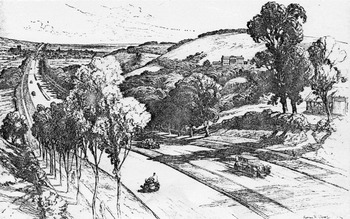
The dilemma with these plans and proposals was understanding and representing the ‘Ideal Road’. Many roads were inadequate for the increasing volume of traffic and through the 1930s the public were faced with reports of traffic jams and the facts and folklore of the chaos of holiday weekends. It was little wonder that dual carriageways were seen as a solution, avoiding towns and villages, yet retaining the harmony between the traffic and the countryside. Sydney R. Jones, prolific artist-illustrator for Autocar, drew such a road, showing how the new arterial road would blend into the countryside (Figure 6). It would leave the classical country house undisturbed in its parkland, with the thatched barn and the country town in the far distance. While pedestrians are accommodated, there are no commercial services to spoil the landscape, but, as the preservationists understood, such features would soon follow. The image suggested perfection, but closer scrutiny raised questions about the impact of the arterial road on the footpath leading to the barn, and whether the road was really cutting through the town, separating the church from the town-centre. The reality was far more complex, with access, road-surfaces, speed and noise being just some of the issues needing to be resolved.
‘Ideal Road’, Autocar, 21st August 1936, p. 321.

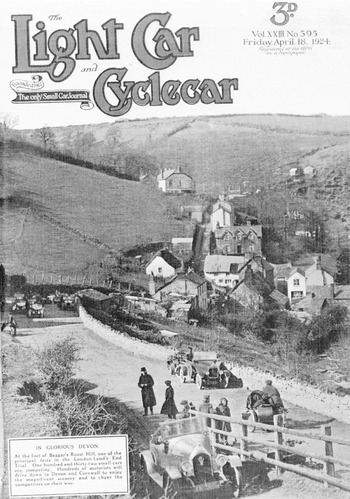
Despite the dream of the fast through road, with the ever-popular car rallies and the hill-tests, the maintenance of the picturesque represented a challenge to the motoring lobby. Motor sports often involved large numbers of competitors and attracted crowds of spectators that brought additional commercial benefits. The Beggars Roost Hill, Barbrook, Nr Lynton, on the MCC London-Lands End Trial was a particular favourite, as the light cars battled it out ‘In Glorious Devon’, 1924 (Figure 7).
Small Car Trials in Glorious Devon, 1924.

At the same time as the seclusion and peace of the countryside were being set out for the new motoring public, so was the idea that this did not necessarily mean isolation from modern civilisation. In the heart of the countryside, in March 1924, you were no longer cut off from the world of news or entertainment with the Vauxhall tourer, just as long as you could rig up an aerial for your wireless. Ten years later the radio was installed as standard in the Hillman ‘Melody Minx’, the same year in which Gilbert Rumbold's introduction to ‘The Wayside Book’ described how:
We shall set out to enjoy the England of our own day: an England that can still show ancient hostelries and cottages, quaint and delightful as ever, but an England also of fast transport, telephones and bathroom luxury.Footnote 24
These pleasures had been matched by a steady expansion of the number of campsites. The formation of the Caravan Club in 1927 brought a new level of organisation and comfort to the freedom of the countryside, matched by a rise in the number of campsites listed by the Automobile Association to over 1500 by 1933. Suburban life on wheels, the domesticity of the camping trip, was to extend beyond the picnic case to the soda dispenser and the sun-shade.
However, while motoring wanted to be identified with freedom, the idea of just being able to park anywhere was increasingly being challenged as the numbers steadily increased, and in a pamphlet ‘The Roadside Halt’ published by the Automobile Association and the Roads Beautifying Association in 1935, the issue of parking in the countryside was identified as being as important as parking in the town. Considering that ‘tourism’ was then recognised as a national asset, it was argued that communities that had tourism to sell should make every effort to cater for the comfort and convenience of the visitor, and for the motorist this included the availability of parking at local beauty spots.
As for the working countryside, it was, as the 1931 Chevrolet press advertisements and brochures illustrated, a case of the new commercial vehicles helping the farmer to find and develop new markets. No longer would he be restricted to the distance of horse-drawn transport, with the new trucks now offering the opportunity to reach a range of new settlements and their industries. At the same time the coach-builders were developing a range of new designs for the mobile shop, while the light van increasingly used by local businesses and the post-office was promoted as expanding the home-delivery service of the in-town store to the suburbs and beyond.
Throughout the inter-war years the idea of a motoring season that began at Easter was common, as for practical and safety reasons the cars were stored away for the winter months. However by the late 1920s, with the enclosed car, heaters, new fuels and lubricants, the idea of all-weather motoring began to take root. Safety and reliability were consistently positioned by the drive through the countryside. Motoring not only enabled women to drive as well as men, but, with the improved mechanics of the car, also allowed them to enjoy the countryside with the utmost freedom. With the latest Lockheed brakes, for example, a large tourer was shown to be able to stop comfortably and safely on a hill allowing the shepherd to cross the country lane with complete safety. This was the imagined union of leisure and the working countryside; modernity colluded with the traditional way of doing things. It also meant that a three-week winter tour of Cornwall was a possibility:
As a result of the economic crisis, wintering abroad has become taboo for the patriotic Briton, and this gives him the opportunity of seeing more of his native country in its wintry garb. In Devon and Cornwall the winters are genial and sunny, and the pleasures of the road are enhanced by the diminished traffic compared with the summer months.Footnote 25
With all cars now capable of much greater speeds, it was possible to go ‘From Birmingham to Beauty’ over a weekend:
In these days of modern cars – if one has a good car – the weekend tour may be of a much more extensive nature than a decade ago. There is certainly something very exciting, even to the hardened motorist, in getting out one's car on a Saturday morning or afternoon, and setting forth to some unknown or only partly known district which has a promise of beauty . . . One naturally wants to get out of the area of industries and smoky chimneys which surrounds Birmingham, so as speedily as possible we ran through Bromsgrove, and were almost at once at the gate of the Valley of Evesham.Footnote 26
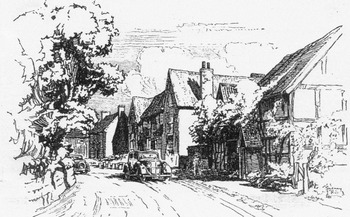
The text was illustrated with drawings of King John's Bridge Tewkesbury and the ‘beautiful village of Wyre Piddle’ by Sydney Jones, with the car always unintrusive, and with a mixture of images of historic Britain, orchards, good food and a tankard of real ale (Figure 8).
‘Birmingham to Beauty’ – ‘The beautiful village of Wyre Piddle’. Autocar, 23rd November 1934, p. 969.

The landscape was used to fix the status and character of the car, as the ‘Buy British’ campaign gained momentum in the late 1920s and early 1930s. But it was not only British-made cars that exploited this association. Increasingly, the foreign imports positioned themselves against British landmarks and pastimes to emphasise a naturalisation process. The Chrysler Six was depicted next to Anne Hathaway's Cottage, blending ancient and modern, and the Buick 8, 1936, was presented as the car for the country gentleman and member of the local hunt.
It was an imagined world that attracted its critics, for while such inroads into rural Britain had brought new trade towards the end of the 1930s the motorists were being blamed for increasing the problems of rural poverty and housing by putting accommodation beyond the reach of the farm labourer, not only by commuting but also through renting weekend cottages at up to three or four times the previous rent.Footnote 27 Evidence of the widening of the social class divide, the relationship between the car and the countryside signified both the good and the bad of Modern Britain. It also marked the construction of the culture of a tidy countryside.
H. Packington's English Villages and Hamlets (1934) encapsulated the culture of the modernised preserved village free of commercial blight. Having considered 13,000 villages, on the basis of their setting, dark woods, moving water, trim parklands and shining meadows, perfection was identified as the well-kept and tidy village. Three years later, through the influence of Lord Bledisloe, the Gloucester branch of the Council for the Protection of Rural England began England's first Best Kept Village Competition. The competition has flourished and retains nationwide popularity, and confirms the inter-war period as the defining moment in the modernisation-preservation cultural phenomenon. Baldwin's dream of the smells and sights of a working countryside had been replaced by the rustic charm of the cottage garden, a landscape of reassurance, an expression of national identity created for the motorist that established the foundations of a themed heritage Britain.Footnote 28
In December 1939 the countryside was ready for war and a Morris advertisement depicted the officer coming home for Christmas being met by his wife at the country station. The porter carries the luggage, confirming that the old social order is intact, and the advertisement suggests that even in the depths of winter, the latest family car has made it possible for the middle-classes not only to cope with the demands of war but also to continue to enjoy the pleasures of living in the country. The motor trade was underlining its commitment to the values of Britain, and there was no greater representation of these values and identity than the British countryside.
Post Second World War Britain has shown that the countryside has not been overwhelmed by the charabanc, while the trips out of the seaside resort into the neighbouring countryside are as popular as they were in the inter-war years. The campsites and caravan parks have not only remained but have expanded, many offering the same facilities that were previously associated with the now defunct roadhouses. The weekend break in the country house hotel is no longer the preserve of the upper middle-class, and continues to make an important contribution to the rural economy. The arguments over the preservation of the countryside remain the same, as do the concerns over the civic countryside interface. I suggest that this brief summary of motoring and the British countryside has identified a relationship that contributed to the reconstruction of the rural economy in ways that have survived to the present, and is as important to the tourist industry of today as it was to that of the past.