


1. T-glottalling in sociolinguistics
Sociolinguistic research has established that glottal realisations of the voiceless alveolar stop /t/ have become increasingly common in accents of British English. The phenomenon, known as T-glottalling, encompasses the production of word-final and word-medial /t/ using glottal articulations, including creaky voice, pre-glottalisation [ʔt] and glottal replacement [ʔ] (Straw & Patrick, Reference Straw and Patrick2007), so that words such as but [bʌt] and butter [bʌtə] may become [bʌʔ] and [bʌʔə] respectively. The change has been documented for some time in Scotland (Macafee, Reference Macafee and Jones1997) and Norfolk (Trudgill, Reference Trudgill, Foulkes and Docherty1999) but has since been reported in numerous locations across the UK (see Smith & Holmes–Elliott, Reference Smith and Holmes–Elliott2018 for a recent review). Studies of regional dialect levelling (Kerswill, Reference Kerswill, Britain and Cheshire2003) have argued that T-glottalling has spread from working-class London speech into neighbouring varieties of South East England and beyond as a form of geographical diffusion (Altendorf & Watt, Reference Altendorf, Watt, Kortmann and Schneider2004). Together with other variables showing similar sociolinguistic patterns, such as TH-fronting and L vocalisation, it has been identified as part of a set of ‘youth norms’ used by young people in many urban centres to index a trendy, youthful identity (Williams & Kerswill, Reference Williams, Kerswill, Foulkes and Docherty1999; Milroy, Reference Milroy, Cain and Russom2007; though see Watson, Reference Watson2006 for an exception in Liverpool), which have elsewhere been referred to as ‘Estuary English’ (Rosewarne, Reference Rosewarne1984; Altendorf, Reference Altendorf, Bergs and Brinton2017). In terms of perception, T-glottalling is described as highly salient and stigmatised, frequently attracting comments from lay speakers to the effect that it should be avoided (Wells, Reference Wells1982; Bennett, Reference Bennett2012), to the extent that mainstream journalistic publications can identify and criticise its use by ‘educated’ speakers such as politicians (e.g. Littlejohn, Reference Littlejohn2011).
Despite the traditional view of T-glottalling as a low-prestige variable, recent research has uncovered a more nuanced understanding of the social meanings of this feature. Fabricius (Reference Fabricius2000, Reference Fabricius2002) shows that the stigma associated with glottal variants of /t/ may be diminishing, even among speakers of England's most traditionally prestigious variety, Received Pronunciation (RP). Kirkham and Moore's (Reference Kirkham and Moore2016) analysis of the speech of one high-profile RP speaker, the former UK Labour Party leader Ed Miliband, shows that he uses different rates of T-glottalling to evoke various social meanings, such as solidarity and friendliness, in speeches to two audiences with different political ideologies. This demonstrates that the social meanings of T-glottalling cannot be reduced to merely a vague notion of ‘stigma’. Rather, they may vary depending on the speaker, the audience and the nature of the interaction, potentially indexing a range of social characteristics.
The notion that phonetic variation can be used for indexical work is supported by research in the ‘third wave’ of sociolinguistics (Eckert, Reference Eckert2012), which argues that linguistic features are not necessarily used as a reflection of a speaker's membership of a particular social group, but can be used to evoke social meanings and identities that are relevant and meaningful within a particular interaction. In this way, phonetic features can index a multitude of inter-related social meanings, forming an ‘indexical field’ of stances and personae that may be activated in the minds of listeners depending on the (perceived) identity of the speaker, the hearer and other contextual factors (Eckert, Reference Eckert2008). This is important when considering the perceptions of T-glottalling, since it enables us to consider the social associations of this variable as diverse, context-dependent, and meaningful within particular interactions, rather than as a deterministic binary distinction between ‘stigma’ and ‘prestige’.
In this article, I report a case study of the social meanings of T-glottalling in South East England by presenting survey and conversation data from 16 adolescent listeners attending a private school in Hampshire. This community is ideal for addressing this issue because T-glottalling is a socially stratified sound change in the region (Altendorf & Watt, Reference Altendorf, Watt, Kortmann and Schneider2004), together with other variables that are collectively regarded as ‘youth norms’ (Williams & Kerswill, Reference Williams, Kerswill, Foulkes and Docherty1999) or ‘Estuary English’ (Altendorf, Reference Altendorf, Bergs and Brinton2017). The change is increasing in usage and prestige in South East England, even among those from higher social class backgrounds such as private school students (Fabricius, Reference Fabricius2000; Badia Barrera, Reference Badia Barrera2015), which raises the question of how this is reflected in the perceptions of listeners from such backgrounds. In doing so, the study contributes to our understanding of sociolinguistic meaning by testing whether one linguistic variant can elicit different indexical meanings using a novel combination of survey and conversation techniques. It is hoped that this small-scale investigation may prove a useful point of departure for scholars interested in accessing listener perceptions of phonetic variables using multiple methods. It also offers an insight into the stylistic possibilities of T-glottalling (Coupland, Reference Coupland2007) as well as how adolescents from high socio-economic class backgrounds process and discuss sociolinguistic variation.
2. Methods
The present study is part of a broader project described in Alderton (Reference Alderton2019). Perception data were elicited using the verbal-guise technique, which involves listeners responding to recordings of different speakers (e.g. Nesdale & Rooney, Reference Nesdale and Rooney1996; Bayard et al., Reference Bayard, Weatherall, Gallois and Pittam2001), via both forced-choice and free-choice responses. The forced-choice data were obtained by having listeners rate four auditory stimuli according to various social dimensions via an attitude judgement survey. The free-choice data took the form of conversations in which participants discussed their impressions of the stimuli in small groups. The participants in the perception study were 16 native English-speaking adolescents (eight girls, eight boys) aged 16–18, who attended the sixth form of a private school in Hampshire.
The auditory stimuli were 30-second extracts of recordings of four teenagers from Hampshire reading aloud the short story ‘The Boy Who Cried Wolf’ (Deterding, Reference Deterding2006). This text was chosen as it contains all the phonemes of English, including many instances of /t/ in different phonological environments.Footnote 1 The four stimulus speakers were selected from a pool of 26 participants who were recorded at another school in the same town, as they displayed differing rates of various ‘youth norm’ (Williams & Kerswill, Reference Williams, Kerswill, Foulkes and Docherty1999; Milroy, Reference Milroy, Cain and Russom2007) or ‘Estuary English’ (Altendorf, Reference Altendorf, Bergs and Brinton2017) features, which included T-glottalling. Two boys and two girls were selected, with one participant of each gender representing relatively high and relatively low rates of glottalling, in order to assess whether speaker gender played a role in mediating listener perceptions. This included the speakers with the highest (nine out of ten glottal tokens in the 30-second extract) and lowest (two out of ten) rates of T-glottalling out of the sample of 26. Tokens of /t/ in the stimuli were coded auditorily as either alveolar or glottal, with the latter category encompassing productions with different phonetic characteristics, but which are all regarded perceptually as types of T-glottalling (Straw & Patrick, Reference Straw and Patrick2007; Smith & Holmes–Elliott, Reference Smith and Holmes–Elliott2018). These include:
• Total glottal replacement (typically preceding vowels and syllabic /l/, e.g. hot afternoon [hɒʔ ɑːftə˜nʉ˜ːn], little [lɪʔɫ̩]).
• Creaky voice (typically preceding pauses and sonorant consonants, e.g. short while [ʃɔ̰ː waɪɫ])
• Unreleased /t/ (typically preceding obstruents, e.g. get some [ɡɛt¬ sə˜m]).
The social characteristics included in the survey were informed by the results of a pilot study conducted in another school in the same town, through which I was able to identify the traits that were socially relevant to young people in the area and were associated with linguistic variation. While some of these social characteristics were specific to the school, echoing other studies of sociolinguistic variation in secondary schools (e.g. Eckert, Reference Eckert2000; Drager, Reference Drager2015), many were generalisable within the context of adolescent life in the town and were locally relevant for teenagers at other schools in the same locality (see Alderton, Reference Alderton2019, for further examination of school-specific factors). The data analysed in this article are listeners’ responses to two of the survey questions, which concern the speaker's personality traits and their stereotypical social group at school. Listeners heard each stimulus three times in a consistent order and were instructed to select as many traits as they wished from a list of 42 personality traits and five stereotypical social groups (the arty group, the chavs, the geeks, the popular group and the sporty group) by circling them on an answer sheet while listening to the stimuli.
Many studies of sociolinguistic perception use a similar method to that employed in the present study, the matched-guise technique (e.g. Giles, Reference Giles1970; Campbell–Kibler, Reference Campbell–Kibler2007), whereby different ‘guises’ are produced by the same speaker. This has the advantage of eliminating the influence of characteristics of individual variation beyond those under investigation. However, matched-guise studies require either speakers who can accurately perform various guises, or digital manipulation of the stimuli to splice variants from one recording into another, which can produce unnatural-sounding stimuli (Garrett, Coupland & Williams, Reference Garrett, Coupland and Williams2003). The verbal-guise technique used here avoids these problems, while the risk that listeners respond to properties of the stimuli beyond those under investigation is addressed by the free-choice part of the study, in which listeners discussed which specific phonetic features of the stimuli prompted their survey responses. In this way, listeners’ holistic perceptions of unmodified, ecologically valid recordings of speech could be investigated, while their reactions to T-glottalling specifically could be accessed via the free-choice conversation task.
3. Survey results
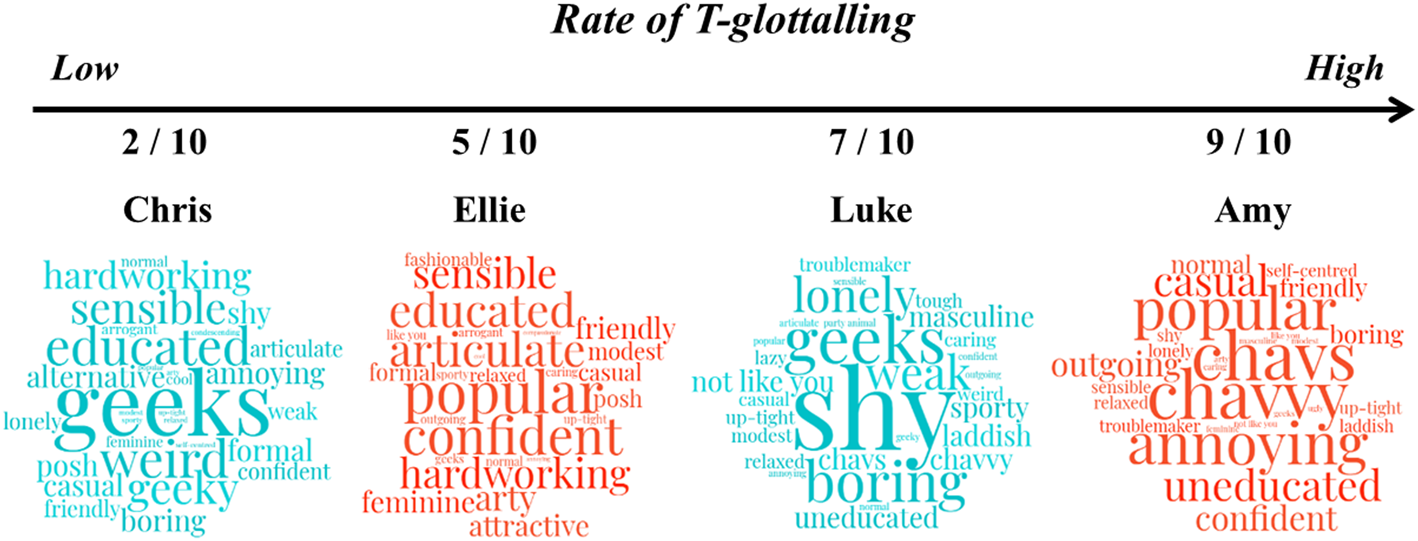
Figure 1 shows the responses attributed to each of the four stimuli in the form of word clouds, where words in larger text represent answers selected more frequently. All names are pseudonyms.
Survey results for the four stimuli, including the number of tokens of /t/ that were produced with a glottal realisation out of 10 possible tokens (Chris and Luke are boys; Ellie and Amy are girls)

For the two stimuli with the fewest glottal tokens – Chris and Ellie – the traits ‘educated’, ‘hardworking’ and ‘sensible’ are frequently selected. In contrast, Amy, who uses the most glottal tokens, is described as ‘annoying’, ‘uneducated’ and ‘chavvy / chavs’. The word chav refers to the stereotype of a brash, loutish, sportswear-clad young person of low social status (OED Online, 2018a), and was frequently mentioned by participants in the pilot study, motivating its inclusion as an option in the survey. This reflects previous findings that frequent use of T-glottalling in particular contexts is deemed less acceptable by some people in formal, educated speech (Wells, Reference Wells1982; Fabricius, Reference Fabricius2000), whereas the stimuli with more alveolar tokens are linked to qualities that show academic success.
Luke also uses a relatively high number of glottal stops, but the most frequent words selected for him do not reflect those for Amy. ‘Shy’ is selected by 75% of listeners when evaluating his speech, while ‘geeks’, ‘boring’, ‘weak’ and ‘lonely’ also appear frequently. This is slightly unexpected given the results for the other speakers and the literature on T-glottalling. The conversation data, however (see Section 4), suggest that the reason for these evaluations is the presence of some disfluency features (e.g. stuttering and slow pace) in his speech. This points to the main limitation of the verbal-guise technique referred to in Section 2: that using non-manipulated stimuli from different speakers may cause listeners to focus on aspects of speech that are not of theoretical interest or that may inhibit them from behaving in an expected direction. Yet the alternatives, which involve presenting listeners with digitally manipulated stimuli (e.g. Campbell–Kibler, Reference Campbell–Kibler2007) or several recordings from the same speaker (e.g. Giles, Reference Giles1970), also have disadvantages such as the risks of producing unnatural-sounding stimuli or listeners paying no attention (or too much) to very small differences between otherwise identical recordings.
Closer observation of the other frequently selected traits for Luke reveals some more expected results based on a high rate of T-glottalling: ‘uneducated’, ‘masculine’, ‘sporty’, ‘chavvy’ and ‘laddish’.Footnote 2 These suggest that frequent T-glottalling in his speech may be linked to a lack of education and loutishness in a similar way to Amy, but that these indexical links may be partially blocked or are weaker than the ‘shy’ and ‘boring’ characteristics prompted by his disfluency. This reflects previous research suggesting that the indexical meanings of linguistic features may in certain contexts be blocked in perception by the presence of other social and linguistic variables (Campbell–Kibler, Reference Campbell–Kibler2009; Levon, Reference Levon2014; Pharao et al., Reference Pharao, Maegaard, Møller and Kristiansen2014).
Comparing the gender of the speakers also yields interesting findings. While Ellie is attributed with characteristics such as ‘popular’, ‘confident’, ‘feminine’ and ‘attractive’, Chris's most frequent traits include ‘geeks / geeky’ and ‘weird’. This indicates that high rates of alveolar /t/ production may index positive traits for girls – mainstream popularity and aesthetic appeal – but that this works conversely for boys, making them sound too intellectual or unconventional for mainstream acceptance. This is similar to work which has found strongly released alveolar /t/ to index a ‘nerd’ persona among teenagers in California (Bucholtz, Reference Bucholtz2010). Similarly, Amy's speech is more strongly associated with negative characteristics such as the ‘chav’ persona and the ‘uneducated’ and ‘annoying’ traits compared to Luke's, even both speakers use relatively high rates of T-glottalling. This may echo established societal gender norms surrounding appropriate behaviour for boys and girls, here indexed through /t/ realisation. Alternatively, it may reflect the sociolinguistic distribution of T-glottalling in speech production, as research suggests that men tend to use glottal stops more frequently than women (Kerswill, Reference Kerswill, Britain and Cheshire2003).
Gender-based patterns of sociolinguistic variation and meaning have been shown to be particularly profound at secondary school, in which students are negotiating their identity within the ‘heterosexual market’ as a key element of the school social order through their gendered behaviour (Eckert, Reference Eckert2000). These gender differences imply that the social meanings of variants of /t/ may differ depending on the social characteristics (e.g. gender) of the speaker, rather than forming a static, universally applicable association between form and indexical meaning (Eckert, Reference Eckert2008; Levon, Reference Levon2014; Pharao et al., Reference Pharao, Maegaard, Møller and Kristiansen2014; Schleef, Reference Schleef2017). Caution should be applied when interpreting results based on the perception of only four speakers, however, especially when listeners could be responding to a wider range of characteristics that may vary between the speakers.
4. Conversation results
A limitation of the findings in the previous section is that listeners’ survey responses may not be based solely on the variation in T-glottalling. For instance, they could be a reaction to other phonetic, prosodic or voice-quality features, or a combination of these. The conversation data help address this issue by enabling participants to state which specific characteristics of the stimuli contributed to their impressions. The task of commenting on linguistic phenomena is challenging for many non-linguists because they may not have the knowledge or meta-linguistic discourse needed to articulate the subtle differences in pronunciation that they hear (Kristiansen, Reference Kristiansen, Wodak, Johnstone and Kerswill2011). As a result, it is unreasonable to expect to find direct and unequivocal comments from participants on the socio-indexical properties of phonetic features, so it is necessary to infer these perceptions from more general discussion of language use. It becomes clear from the conversations, however, that T-glottalling is a highly salient variable for the participants, which colours their impressions of the stimuli to a substantial degree, and which elicits strong reactions based on its social associations. Transcript 1 is typical of the discussions, demonstrating the importance of T-glottalling to listener perceptions. For the sake of brevity and clarity, some fillers, disfluencies and irrelevant utterances are removed from the transcripts in this article.
Transcript 1
Roy What made you think [Amy's] voice was annoying?
Vanessa She didn't pronounce her Ts at all. I'm not saying that's annoying, it's just . . . that doesn't annoy me, it's just . . .
Jake You pick up on it, don't you?
Vanessa Yeah.
Jake There was one word in particular . . . I can't remember it but as soon as I heard it, it sort of made me think . . .
Vanessa I don't find that annoying, it's just I think it says something . . . maybe more about her.
Roy What does it say about her?
Vanessa Oh no, I'm digging myself a hole! I don't know. She sounded quite uneducated, which isn't annoying but that, kind of coupled with how loud she was, just kind of made me feel how in a lesson she'd be really not focused and kind of the one that's chatting at the back with all her friends and that.
The participants here are discussing Amy, the speaker who uses the most glottal stops, and have decided that she sounds annoying. When asked what prompted this evaluation, Vanessa immediately responds with ‘she didn't pronounce her Ts at all’. She then backtracks somewhat before clarifying that this realisation of /t/ makes her think of Amy as a loud, uneducated and disruptive student. The salience of T-glottalling in listener perceptions as one of the major contributors towards participants’ impressions is also shown in Jake's comment that ‘you pick up on it, don't you?’ and that his thoughts were piqued as soon as he heard a particular word (later on, this is identified to be little, which Amy pronounces with a glottal stop). The association between Amy's T-glottalling and her supposed lack of education and disruptive behaviour reflects the ‘uneducated’ and ‘annoying’ responses from the survey. These traits are linked to the ‘chav’ and ‘lad’ personae, which is demonstrated in Transcript 2, featuring the same participants discussing Luke's speech.
Transcript 2
Vanessa He seemed really nervous. I feel like if he was talking normally, not under, like, that pressure, he wouldn't speak like that. He'd be a lot more kind of outgoing and not stuttery.
Jake He sounded quite masculine as well and I think, like, the same as Vanessa, that if he wasn't in that environment, quite laddish.
Cath Yeah, I agree, but at first I thought he was nervous, but then I just feel . . . I don't mean to be mean but he'd be, like, one of the people . . . like . . . chavs.
Roy Why did you think he sounded like one of the chavs?
Cath I dunno, he was a bit, like . . . he wasn't . . . very articulate. [laughs] I sound so posh. [laughs]
This discussion shows that some of the survey responses for Luke concerning shyness are a result of disfluency features such as stuttering. Moreover, it makes clear that these listeners are able to account for this while attributing additional social factors to the stimulus, such as the ‘lad’ and ‘chav’ personae, in response to the speaker being ‘not very articulate’, which is defined elsewhere by these participants as including T-glottalling.
So far, we have seen that some listeners in this study are highly sensitive to the realisation of /t/ in the stimuli and are able to perceive and, to a certain degree, articulate the social meanings that they associate with glottal variants of /t/. Their comments indicate that glottal production of /t/ indexes disengagement from education and being a ‘chav’ or a ‘lad’. This reflects public discourse on T-glottalling that identifies it as inappropriate for educated speech and as negatively associated with working-class people (Littlejohn, Reference Littlejohn2011; Bennett, Reference Bennett2012), reproducing traditional class-related anxieties in British culture which are often manifested through attitudes to language (Milroy, Reference Milroy, Coupland, Sarangi and Candlin2001). The participants’ responses so far thus suggest a somewhat deterministic relationship between phonetic and social information – that speakers’ pronunciation reflects their background, upbringing or group membership. As discussed in Section 1, however, research has argued that linguistic variables may index various social meanings that may only be relevant or accessible by certain speakers or within particular contexts (Eckert, Reference Eckert2008). Studies have found that the complex, contextually-bound nature of social meaning in speech production can be accounted for by listeners in speech perception experiments (Campbell–Kibler, Reference Campbell–Kibler2009; Levon, Reference Levon2014; Pharao et al., Reference Pharao, Maegaard, Møller and Kristiansen2014), so the question is whether these perceptions can be manifested in listeners’ metalinguistic commentary here.
In the conversation data, there is some evidence that listeners may be aware of how T-glottalling can be used to index social meanings beyond working-class stereotypes and that it can be used stylistically for identity construction. This is shown in Transcript 3, in which two boys are talking about a mutual friend who is from a highly privileged background, but who often uses ‘chavvy’ speech.
Transcript 3
Jim But Theo is hugely different because he's such an extraordinary person. He's so . . . upper-class but his dialect is so . . .
Lee Chavvy.
Jim . . . Not upper-class, so yeah.
Lee He's a contradiction . . . there are quite a few people like that, though, who I think are very upper-class – they have basically everything you could want – and yet are still quite . . . I don't wanna say working-class, but less educated.
Jim But I've known Theo for about eight years and I've seen the transition between him talking like me and him sort of over the last, like, three or four years changing into this. I dunno, I don't really understand why but yeah, I see what you're saying.
Roy OK, so do you think those people put it on a little bit?
Lee Yes, most certainly. I wouldn't say they'd go home and talk like that.
Roy OK, so this ‘upper-class group’ who ‘put on chavviness’ if you like, they put on the T-dropping and H-dropping and TH [pronounced as F]?
Lee Yeah. They do it to act cool. I dunno why.
In this conversation, Jim and Lee identify a fellow student from their school whose pronunciation sounds ‘chavvy’, ‘less educated’ and ‘working-class’, despite ‘hav[ing] basically everything you could want’. This ‘chavvy’ pronunciation was earlier identified as encompassing T-glottalling, H-dropping and TH-fronting, which I clarify with the participants at the end of the transcript. The boys acknowledge that their friend's language use is a recent development that he only does at school in order to ‘act cool’. The student's use of ‘chavvy’ speech to evoke ‘coolness’ is not tied to his social class background – in fact, in this regard it is a ‘contradiction’, as he is ‘upper-class’. Rather, T-glottalling has a specific indexical meaning within a particular context (i.e. in their school). It is not entirely clear whether the participants are claiming that the speaker consciously adopts this style as a type of performance or if he supposedly does it sub-consciously in everyday conversation, but in either case, it shows that they perceive T-glottalling to be part of a style, together with other ‘youth norm’ (Williams & Kerswill, Reference Williams, Kerswill, Foulkes and Docherty1999; Milroy, Reference Milroy, Cain and Russom2007) or ‘Estuary English’ (Rosewarne, Reference Rosewarne1984; Altendorf, Reference Altendorf, Bergs and Brinton2017) features such as TH-fronting, that can be used to construct a ‘cool’ identity within the institution of the school, and not simply as a marker of a speaker's background.
5. Conclusion
The results suggest that, at a surface level, T-glottalling is perceived to be a feature of a stigmatised ‘chavvy’ style, reflecting previous research (Bennett, Reference Bennett2012). However, the social meanings associated with glottal /t/ appear to vary according to the social and linguistic characteristics of the speaker, particularly their gender. This supports the idea that T-glottalling, as with other linguistic variables, can be used to index multiple social meanings. The conversation results also show that T-glottalling is salient in listener perceptions and can be recognised by listeners as a resource for identity construction and style formation. This may be particularly noticeable in the context of a private school in South East England, where the use of T-glottalling can evoke a ‘cool’ stance based on its associations with working-class stereotypes that may be regarded as incongruous when produced by young people from high socio-economic class backgrounds. The social meanings of T-glottalling reported in this case study are not intended to be claimed as generalisable to all adolescents in the South East, but they can act as a demonstration of what is ‘stylistically possible’ (Coupland, Reference Coupland2007: 28). Further work in sociolinguistic perception would benefit from combining indirect experimental methods with more direct methods, such as the survey and interviews reported here, to deepen our understanding of how people process sociolinguistic variation.
 ROY ALDERTON is a University Teacher in Linguistics at the University of Sheffield, UK. He recently completed his doctoral thesis at Lancaster University, UK, entitled ‘Salience and social meaning in speech production and perception’. He is interested in various topics in phonetics and sociolinguistics, including sociophonetic variation in English, the language of adolescents, and the relationship between speech production and speech perception. Email: r.alderton@sheffield.ac.uk