Introduction
Microhodotermes viator, the southern harvester termite of the family Hodotermitidae, is an ecologically important species in its endemic home range in the south-western parts of South Africa (Coaton & Sheasby, Reference Coaton and Sheasby1974; Inward et al., Reference Inward, Beccaloni and Eggleton2007). M. viator has many well-developed associations with other species (Dean, Reference Dean1989: Kok & Hewitt, Reference Kok and Hewitt1990; Nel & Mackie, Reference Nel and Mackie1990; Moore & Picker, Reference Moore and Picker1991; Kok & Nel, Reference Kok and Nel1992; Kuntzsch & Nel, Reference Kuntzsch and Nel1992; Ashe & Maus, Reference Ashe and Maus1998; Shuttleworth et al., Reference Shuttleworth, Mouton and van Wyk2008). However, it is M. viator's foraging activities in particular, which have been found to significantly improve soil fertility within the local area around their nests, facilitating the development of distinctive plant communities and contributing to habitat differentiation (Midgley & Musil, Reference Midgley and Musil1990; Moore & Picker Reference Moore and Picker1991). Furthermore, the effects of their foraging activities are amplified due to their large distribution range and mature nest size, coupled with the potentially extreme longevity of their colonies. M. viator has been estimated to occupy between 14 and 25% of the land surface area of the Western Cape (Lovegrove & Siegfried, Reference Lovegrove and Siegfried1989; Picker et al., Reference Picker, Hoffman and Leverton2007), with an average mature nest diameter of 25 m (Lovegrove & Siegfried, Reference Lovegrove and Siegfried1986; Midgley & Hoffman, Reference Midgley and Hoffman1991; Moore & Picker, Reference Moore and Picker1991), and a potential mature-termitaria age in excess of 4000 years BP (Moore & Picker Reference Moore and Picker1991; Potts et al., Reference Potts, Midgley and Harris2009).
Despite their position as a keystone species, very little research has been conducted on M. viator. Over the past 40 years, there have been several studies, which focussed on descriptions of castes and observations of foraging behaviour (Watson, Reference Watson1973, Coaton & Sheasby, Reference Coaton and Sheasby1974; Dean, Reference Dean1993), and several more studies relating to the ecology and potential longevity of colonies and termitaria (Lovegrove & Siegfried, Reference Lovegrove and Siegfried1986; Lovegrove & Siegfried, Reference Lovegrove and Siegfried1989; Midgley & Musil, Reference Midgley and Musil1990; Midgley & Hoffman, Reference Midgley and Hoffman1991; Moore & Picker Reference Moore and Picker1991; Picker et al., Reference Picker, Hoffman and Leverton2007; Potts et al., Reference Potts, Midgley and Harris2009; Cramer et al., Reference Cramer, Innes and Midgley2012). However, there are no published reports that have investigated the genetic structure of colonies, and this study is the first to begin to address this gap. Understanding the genetic structure of M. viator is valuable, as insight into the genetic mechanisms facilitating colony turnover would be the first step in determining whether the biological processes exist within this species that could facilitate such extreme colony longevity.
The absence of genetic studies is at least partially attributable to a lack of optimized microsatellites primers, which could be used to investigate the intra- and intercolonial genetic structure. Microsatellite loci are particularly useful for studies of insect populations, which have relatively short generation times (Caterino et al., Reference Caterino, Cho and Sperling2000). Within populations, microsatellites can be used to assign workers to specific colonies, establish pedigree and detect the presence of multiple unrelated reproductives within a colony (Vargo, Reference Vargo2003). They are also invaluable in elucidating colony structure and have been shown to be applicable in studies of fine-scale differentiation and local gene flow, via spatial distribution of alleles (Queller et al., Reference Queller, Strassmann and Hughes1993; Macaranas et al., Reference Macaranas, Colgan, Major, Cassis and Gray2001). Additionally, microsatellite loci can be used to investigate relationships between colonies such as kinship and levels of inbreeding.
Unfortunately, there are relatively few published microsatellite loci for termite species (Vargo & Husseneder, Reference Vargo, Husseneder, Bignel, Roisin and Lo2011). However, primers developed for one species will often work for other species within the same genus (Pamilo et al., Reference Pamilo, Gertsch, Thoren and Seppa1997; Vargo & Husseneder, Reference Vargo, Husseneder, Bignel, Roisin and Lo2011). For example, microsatellites identified in Zootermopsis nevadensis, were successfully amplified in both Zootermopsis augusticolis and Zootermopsis nuttingi nuttingi (Aldrich & Kambhampati, Reference Aldrich and Kambhampati2004; Booth et al., Reference Booth, Brent, Calleri, Rosengaus, Traniello and Vargo2012). It has even been noted that occasionally amplification is possible across different families. Goodisman et al. (Reference Goodisman, Evans, Ewen and Crozier2001) was able to successfully amplify loci developed for Macrotermes darwinensis, in Coptotermes lacteus, Cryptotermes dudleyi, Neotermes insolaris, Porotermes adamsoni and Hodotermes mossambicus. However, despite numerous attempts, we were unable to successfully amplify microsatellite loci using primers that were isolated from Zootermopsis nevadensis or Macrotermes darwinensis in M. viator. Therefore, here we describe the development and characterization of seven novel polymorphic microsatellite loci in M. viator, using the enriched library approach of Glenn & Schable (Reference Glenn, Schable, Zimmer and Roalson2005).
Materials and methods
Sample collection
M. viator individuals foraging outside their nests were collected from May to July 2011 in the Western Cape province of South Africa. A total of 369 individuals were sampled from 29 colonies across four geographical areas (fig. 1). These regions were Tygerberg (ten colonies), Malmesbury (two colonies), Darling (nine colonies) and Worcester (eight colonies).
Map of the Western Cape of South Africa showing the location of the four populations of M. viator.

Isolation and characterization of microsatellite loci
Total genomic DNA was extracted from the legs and thorax of eight individuals, using a universal salt-extraction (Aljanabi & Martinez, Reference Aljanabi and Martinez1997), with the inclusion of a chloroform/isoamyl alcohol step prior to the first centrifugation. The crude DNA extraction was purified, using the Promega Wizard® SV Gel and polymerase chain reaction (PCR) Clean-Up System, following the manufacturer's instructions. The DNA yield for the combined sample was 732.9 ng µl−1, measured using a NanoDrop® ND-1000 Spectrophotometer and the associated software, NanoDrop Version 3.1.0.
Microsatellite library construction followed the protocol of Glenn & Schable (Reference Glenn, Schable, Zimmer and Roalson2005) with the following modifications. Total genomic DNA (~14.5 ng) was digested using 30 units of the restriction enzyme, Rsa I. The digest product was ligated to double-stranded SuperSNX24 linkers in triplicate. The linker-ligated DNA was then enriched using Mix 2 of 3’ labelled Biotinylated oligonucleotide probes. The Biotinylated labelled DNA fragments of interest were captured using Streptavidin M-280 Dynabeads (Invirtogen™) and a Magnetic Particle Concentrator (Invirtogen™). The DNA released from the Dynabeads was captured and precipitated using 70% ethanol. The pellet was re-suspended in Tris low-Ethylenediaminetetraacetic acid buffer. The complete enrichment process was then repeated, using the final product from the first enrichment as the starting product for the second enrichment. The final product from the second enrichment process is referred to as ‘pure Gold’. In order to increase the amount of ‘pure Gold’, a PCR was performed using the SuperSNX-24 primer.
The product from the ‘Gold-enrichment’ PCR was ligated into a plasmid, using the Promega pGEM®–T Easy Vector System, following the manufacturer's instructions. Using a standard heat-shock method, the plasmid was then transformed into Escherichia coli JM109 competent cells, which were spread on Liquid Broth Ampicillin + agar plates, spread with X-gal and Isopropyl β-D-1-thiogalactopyranoside (Promega, 2010). The plates were incubated at 37°C for 24 h. Positive white colonies were picked and grown separately in a medium of Liquid Broth + Amp at 37°C for 24 h, with vigorous shaking. A colony PCR was performed using M13 primers, following the protocol of Glenn & Schable (Reference Glenn, Schable, Zimmer and Roalson2005). The PCR product was visualized on an ethidium bromide (EtBr) stained agarose gel and bands in the appropriate size range (300–1000 bp) were excised and purified using the Promega Wizard® SV Gel and PCR Clean-Up System, following the manufacturer's instructions.
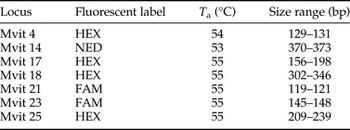
One hundred and two purified colony PCR products were sequenced using standard automated capillary sequencing at the Central Analytical Facility at Stellenbosch University, and edited using Chromas Lite 2.1.1 by Technelysium Pty Ltd. In total, 27 unique microsatellite loci were identified using WebSat (Martins et al., Reference Martins, Lucas, de Souza Neves and Bertioli2009). Appropriate primer sequences were identified using WebSat (Martins et al., Reference Martins, Lucas, de Souza Neves and Bertioli2009). Initially non-fluorescently labelled primer pairs were used to test for positive and correct amplification. Of the 27 primer pairs, 21 successfully amplified M. viator microsatellite loci. The forward primer of each of the 21 pairs was then remade with either a HEX, FAM or NED fluorescent label. Using 17 individuals – each from a discrete colony (Worcester n = 5, Tygerberg n = 6 and Darling n = 6) – the amplification reactions were repeated with the fluorescently labelled primers. The PCR products were genotyped to identify polymorphisms on an ABI PRISM® 3100 Genetic Analyser and the results were visualized using ABI Peak Scanner™ v1.0 Software. Of the 21 loci tested, seven were found to be polymorphic (Table 1).
Characteristics of seven polymorphic microsatellite loci and their primer sequences, for Microhodotermes viator.

Amplification and genotyping of microsatellite loci across populations
Total genomic DNA was extracted from 369 individuals using the ‘Dilution Protocol’, from the Phire® Animal Tissue Direct PCR Kit, as per the manufacturer's instructions. Two modifications were made to the Dilution Protocol. Firstly, the extraction was performed using one macerated leg from each individual. Secondly, the sample was incubated at the elevated temperature of 65°C for 5 min, before continuing to the standard denaturation step of 98°C for 2 min. It was not possible to accurately quantify the DNA concentrations yielded by the extraction procedure, as particular reagents in kit's extraction buffer interfered with the NanoDrop® ND-1000 Spectrophotometer readings. Individuals were screened for microsatellite amplification at seven loci: Mvit 4, Mvit 14, Mvit 17, Mvit 18, Mvit 21, Mvit 23 and Mvit 25 (Table 2).
Characteristics of microsatellite loci amplified in Microhodotermes viator. Allelic size range based on the genotypes of 369 individuals.

DNA amplification was performed in 0.2 ml PCR tubes in 20 µl reaction volumes containing the following reagents: 0.4 µl Phire® Hot Start ll DNA Polymerase, 10 µl 2X Phire® Animal Tissue PCR Buffer (which includes dNTPs and MgCl2), 0.12 µl each of fluorescently labelled forward primer and reverse primer (to a final concentration of 0.3 ρmol µl−1), 8.36 µl Millipore water and approximately 20 ng of template DNA. Thermal cycling was performed on an ABI GeneAmp® PCR System 2700. The cycling profile consisted of an initial denaturizing step for 5 min at 98°C followed by 40 cycles composed of 98°C for 5 s, T a for 5 s (Table 2) and extension at 72°C for 20 s, followed by a final extension step at 72°C for 1 min. Each PCR reaction was stopped with a rapid cool-down to 4°C. Products were maintained at 4°C prior to electrophoresis on 1.5% agarose gels stained with EtBr, against a 100 bp DNA standard.
Genotyping was performed on an ABI PRISM® 3100 Genetic Analyzer, using 1–3 µl of PCR product, 8 µl Hi-Di™ Formamide (ABI) and 0.25 µl of GeneScan™ 500 ROX™ Size Standard (ABI) per sample. The results were visualized using ABI Peak Scanner™ v1.0 Software.
Data analysis
Allele and genotype frequencies, Hardy–Weinberg equilibrium, linkage disequilibrium, observed and expected heterozygosity and genetic differentiation were all calculated using the web implementation of GENEPOP (version 4.2) (Raymond & Rousset, Reference Raymond and Rousset1995). Each geographical region was treated as a distinct population (Malmesbury, Tygerberg, Darling and Worcester) for the population-level analysis. As a single individual was used from each of the 29 colonies, sample sizes differed among these four populations, particularly for the Malmesbury population, thus interpretation of the analyses is appropriately conservative.
Results and discussion
In total, seven polymorphic microsatellite loci were identified and optimized for use in M. viator. Across the loci, allele numbers ranged from 2 to 14, with an average of 5.8 alleles per locus.
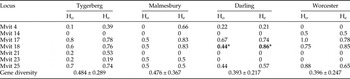
Within each population or geographical region, all loci were found to be in Hardy–Weinberg equilibrium, after applying a Bonferroni correction (P = 0.0039), with the exception of locus Mvit18 in the Darling population. Furthermore, no significant linkage disequilibrium was observed in any population, nor was any linkage found when pairwise combinations of loci were considered over all populations. As such, all loci are assumed to assort independently.
Genetic variation, as measured by observed- and expected heterozygosity (Ho and He respectively), was determined at each locus within each population (Table 3). There was no significant heterozygote excess or deficiency at any of the loci in any of the populations, with the exception of Mvit 4 in the Tygerberg population (P = 0.047) and Mvit18 in the Darling population (P = 0.001). Both of these instances are examples of heterozygote deficiency, although in the Tygerberg population the deficiency was no longer significant after the application of a Bonferroni correction (adjusted significance level P = 0.008). While the most likely cause for heterozygote deficiency at an individual locus is the presence of null alleles (Husseneder et al., Reference Husseneder, Messenger, Su, Grace and Vargo2005), this is unlikely as the genotype scoring was specifically checked for the presence of null alleles, using MICRO-CHECKER (version 2.2.3) (Van Oosterhout et al., Reference Van Oosterhout, Hutchinson, Wills and Shipley2004), and none were identified. In this instance, the significant deficit at Mvit18 in the Darling population corresponds to the only locus not in Hardy–Weinberg equilibrium. There are two likely explanations for this; either it may simply be an artefact of a small sample size or it could be attributable to the Wahlund effect – a reduction in Ho due to the pooling of individuals from discrete colonies, or subpopulations, into a single population, which may not actually represent a randomly interbreeding unit. As mentioned, due to the limited number of colonies we were able to sample in this study, individuals from discrete colonies were pooled within geographic areas, lending weight to this explanation. While it was originally thought that the Wahlund effect should register concordantly across all loci (Dakin & Avise, Reference Dakin and Avise2004), Dharmarajan et al. (Reference Dharmarajan, Beatty and Rhodes2013) has since convincingly argued that such effects can be observed in isolated loci as a result of inter-locus variance in F ST .
Observed- and expected heterozygosity (Ho and He) and average gene diversity within each population.

Bold values are significant at P = 0.05, while values marked with an asterisk (*) indicate those differences, which remained significant after a Bonferroni correction.
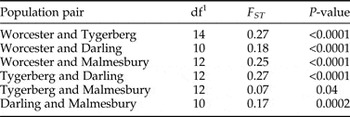
Across all loci, the variation and distribution of allele frequencies indicated distinctive geographic clustering within populations. This trend, which was evident at all loci, is clearly exemplified here at locus Mvit 25 (fig. 2a) and locus Mvit 4 (fig. 2b). Accordingly, all four populations were found to be significantly differentiated from one another (Table 4).
Distribution of allele frequencies at each of the four populations (Tygerberg, Malmesbury, Darling and Worcester) at (a) locus Mvit 25, with alleles 209, 212, 218, 221, 230, 236 and 239 and at (b) locus Mvit 4, with alleles 129 and 131.

Population pairwise F ST values, across all loci.

1 degrees of freedom.
Conclusions
The primary aim of this study was to identify a set of polymorphic microsatellite loci in M. viator, and develop corresponding optimized primers to provide researchers with a tool that can be used to elucidate the population genetic structure of this fascinating species. From the results of the basic descriptive statistics performed on four small populations, the novel set of loci characterized and described here is sufficiently polymorphic for studies of fine-scale population genetic structure. Due to time and budget constraints, it was not possible to test for cross-amplification in other Hodotermitid species, which is a worthwhile avenue for future research. Should these microsatellites prove to be mutable across the Hodotermitids, they will be extremely valuable in aiding our understanding of this poorly studied, primitive family of harvester termites.
Acknowledgements
We would like to sincerely thank Associate Professor Mike Picker for his intellectual guidance with this work and Ross Cowlin for his invaluable support in the field. We also offer sincere gratitude to the various funders who have made this research possible; the National Research Foundation (NRF), the Ernst & Ethel Eriksen Trust, the South African Association of Woman Graduates (SAAWG), the Cape Tercentenary Foundation, the Bob Blundell Memorial Scholarship, the University of Cape Town (UCT) and the Harry Crossley Foundation.