


Introduction
Control theories assert that psychological distress occurs due to unresolved conflict between personal goals (Powers, Reference Powers1973, 2005; Mansell, Reference Mansell2005). According to control theory all living organisms are made up of a hierarchy of control systems. Within this hierarchy, each control system operates according to identical principles. The function of a control system is to keep current perception as near to a predefined goal standard as possible. Conflict is the specific situation where a predefined goal standard is not met because another predefined goal standard is in opposition and attempts are being made to achieve both of these standards simultaneously (Powers, Reference Powers1973, 2005). Goal standards, also known as reference values, are either innate predispositions, e.g. hunger, and/or formed from past perceptual experiences, e.g. a desired body shape, which has been influenced by cultural norms. In his integrative account of control theory Mansell (Reference Mansell2005) advises that conflict is a normal consequence of pursuing a variety of goals. In other words, it is normal for individuals to experience a lack of control. Control theories are supported by a wide body of research which converges on the idea that goal attainment is closely linked to affect (e.g. Carver & Scheier, Reference Carver and Scheier1998; Carver et al. Reference Carver, Lawrence and Scheier1999; Dickson & MacLeod, Reference Dickson and MacLeod2004) and that successful pursuit of personally meaningful goals is related to measures of subjective well-being (e.g. Emmons, Reference Emmons, Gollwitzer and Bargh1996).
The basic unit of a control system is a feedback loop. Whereas negative feedback loops act to makes the discrepancy between perceived and ideal states smaller, positive feedback loops act to increase such discrepancies. Control, or goal attainment, is achieved by acting to oppose disturbances from the environment that would otherwise move perceptions away from their goal standards. The input function of a control system senses the present environment and the comparator detects environmental discrepancies deviating from the internal goal standard. The output function or behavioural response is performed to reduce sensed discrepancies. Thus, outputs or actions occur to maintain a specified perception of the environment (Powers, Reference Powers1973, 2005).
Perceptual Control Theory (PCT) proposes that in living organisms’ control systems are arranged hierarchically and in parallel. Control processes occurring at each level are identical, the only difference being that perceptions at one level are more complex than perceptions at a lower level. Within the hierarchy, a control system at one level controls its perceptual input by manipulating the reference values of feedback loops from control systems at lower levels. In human cognition, ideal-self representations, e.g. a kind person, or a hard worker are situated in the highest level of the hierarchy known as the system concept. The lowest level in the hierarchy, known as the intensity level, controls sensations, e.g. body temperature (Powers, Reference Powers1973, 2005; Mansell, Reference Mansell2005). Thus, individuals, at any one time, can hold multiple goals at various levels within a goal hierarchy.
Discrepancy reduction for the most part takes place through the normal functioning of a negative feedback loop. An inability to reduce discrepancy leads to intrinsic error and a process called reorganization. Reorganization is a random process, guided solely by error reduction. As intrinsic error is sensed and reorganization makes random changes within the hierarchy. If a change reduces the sensed discrepancy then that change strategy persists. If on the other hand the discrepancy is not reduced, another random change strategy is initiated (Powers, 2005). Conflict is thought to involve at least three levels within the hierarchy, and in order for conflict to be resolved it is proposed that the highest level involved in the conflict needs to be reorganized, as reorganizing lower levels will have no lasting effect on conflict (Carey, Reference Carey2006). From a PCT perspective reorganization occurs when an individual shifts their awareness to a higher level within the hierarchy (Mansell, Reference Mansell2005).
Research has demonstrated that intrusive imagery is a common phenomenom which occurs across psychological disorders as well as in psychologically healthy individuals (e.g. Hackmann & Holmes, Reference Hackmann and Holmes2004; Harvey et al. Reference Harvey, Watkins, Mansell and Shafran2004). When it is recurrent, intrusive imagery can capture attention and impel individuals to respond in a manner that is intended to regulate or control its occurrence and associated distress (Wells & Matthews, Reference Wells and Matthews1994; Hackmann & Holmes, Reference Hackmann and Holmes2004; Mansell, Reference Mansell2005).
Within control theories intrusive imagery is considered a symptom of goal conflict (Mansell, Reference Mansell2005). Leading autobiographical memory theorists propose that one important function of intrusive imagery is to convey important information about personal goals that cannot be directly or consciously accessed. Furthermore, they argue that images are viewed as representations of goal standards and are highly associated with goals because they are close to actions (Conway et al. Reference Conway, Meares and Standart2004a). Austin & Vancouver (Reference Austin and Vancouver1996) define goals as ‘internal representations of desired states, where states are broadly construed as outcomes, events or processes’ (p. 338). Dickson & MacLeod (Reference Dickson and MacLeod2004) differentiate between attempts to move from a present state towards a desired state (approach goals) and attempts to move away from some undesired state (avoidance goals). Within the Self-Memory System autobiographical memory model (Conway & Pleydell-Pearce, Reference Conway and Pleydell-Pearce2000) images derived from experience or otherwise are all thought to correspond to goals. More specifically, they correspond to the ideal, standard or referent in negative and positive feedback loops (Carver & Scheier, Reference Carver and Scheier1982, Reference Carver and Scheier1998).
Research over the past decade into the phenomenology of intrusive imagery across psychological disorders lends support to the claims that imagery contains important information about goals. In a number of studies the salient concerns of the particular disorder in question are often prominent in the content of intrusive imagery. For example, in body dysmorphic disorder, imagery tends to depict past situations involving criticism about appearance (Osman et al. Reference Osman, Cooper, Hackmann and Veale2004). In social phobia, imagery tends to depict the self looking or sounding anxious (Hackmann et al. Reference Hackmann, Clark and McManus2000). In bipolar affective disorder specific memories which involved images were found to depict personal failures (Mansell & Lam, Reference Mansell and Lam2004). Somerville et al. (Reference Somerville, Cooper and Hackmann2007) report the content of imagery in an eating-disorder sample typically related to shape and weight. Although these findings concur with the notion that imagery contains important information about goals, none of these studies have actually asked participants directly about their personal goals when looking at intrusive imagery.
This study examined personal goals (approach and avoidance), the content of intrusive imagery and any associated memories in a clinical and non-clinical group. The primary aim was to explore thematic links between self-reported personal goals (approach and avoidance) and intrusive imagery.
Method
Participants
Forty-six individuals participated in the study. Participants were allocated to the clinical group if they scored above the clinical cut-off on the Clinical Outcomes in Routine Evaluation – Outcome Measure (CORE-OM; Evans et al. Reference Evans, Mellor-Clark, Margison, Barkham, Audin, Connell and McGrath2000) (1.19 males, 1.29 females) or had a current diagnosis of a mental health problem given by a health professional. Participants were allocated to the non-clinical group if they scored below the clinical cut-off on the CORE-OM and did not have a current diagnosis of a mental health problem. To be included in the study individuals had to be aged 18 or over. General exclusion criteria for the study included: a learning disability, pervasive developmental disorder or dementia, history of traumatic brain injury, and active psychosis or mania. There were 22 participants in the clinical group and 24 in the non-clinical group. The mean age of the clinical group was 33.7 years (s.d. = 9.38, range 18–50) and 15 (68.2%) were female. The control group was on average 35.25 years old (s.d. = 15.31, range 19–75), and 18 (75%) were female. The mean age did not differ significantly between groups [t(44) = –0.414, p = 0.681]. There were no significant differences between groups in terms of sex [χ2(2) = 0.263, p = 0.608], martial status [χ2(2) = 1.559, p = 0.459], employment status [χ2(3) = 5.512, p = 0.138], or ethnic background [χ2(2) = 3.375, p = 0.115].
All participants were reimbursed for their travel. Participants were recruited through a variety of means including: a university volunteer webpage, national mental health websites, local press articles, a BBC evening radio show, from general adult psychology services, and community mental health teams.
Measures
The following measures were used.
CORE-OM (Evans et al. Reference Evans, Mellor-Clark, Margison, Barkham, Audin, Connell and McGrath2000). Global psychological functioning was assessed using the CORE-OM. This measure is now widely used in clinical practice as a routine outcome measure by psychological therapists. It comprises 34 items addressing domains of subjective well-being (4 items), symptoms (12 items), functioning (12 items) and risk (6 items). Items are scored on a five-point scale from 0 (‘not at all’) to 4 (‘most or all the time’). Psychometric properties of the CORE-OM have been calculated using an extremely large sample involving 890 clinical and 1106 non-clinical individuals (Evans et al. Reference Evans, Connell, Barkham, Mellor-Clark, McGrath and Audin2002) and demonstrated exceptional reliability and validity.
Goals Task (Dickson & MacLeod, Reference Dickson and MacLeod2004). This test was used to measure idiographic approach and avoidance goals. Goals refer to future experiences that individuals think they will typically be trying to accomplish or avoid. Participants were read the following prompts ‘In the future it will be important for me to try to . . .’ [approach goals], and ‘In the future it will be important for me to try to avoid . . .’ [avoidance goals]. Participants were given 75 seconds to describe verbally as many goals that came to mind within each goal condition. They were also asked to indicate on a scale of 0–10 (‘not at all’ to ‘completely’) the degree to which they felt they were attaining their goals. Goals were coded as approach or avoidance to check that responses were consistent with the instructions. The present author coded all responses.
Imagery Interview (based on Day et al. Reference Day, Holmes and Hackmann2004). This interview schedule was devised to enable to the phenomenological nature of intrusive imagery to be examined. Participants were told:
as well as thinking in words, some people think in mental imagery. Instead of words imagery contains aspects of our different senses. The majority of imagery is experienced in picture form. It can be ‘still’ (like a photograph) or ‘moving’ (like a video). Sometimes images are in black and white and sometimes they are in colour. Other senses that are involved in imagery include hearing, smell, taste and touch.
Each participant was asked to close their eyes and imagine a pleasant situation of their choice. Participants were then asked to describe the sensory characteristics of their chosen image in order to become familiar with the process of answering questions about mental imagery. Before proceeding to the next stage of the imagery interview, all participants had confirmed that they understood what was meant by the term mental imagery. Then participants were read the following:
For the next part of the interview I am interested in imagery that pops into your mind without you having intended to think it, or imagery that pops into your mind against your will. It is not about imagery that you have deliberately thought about.
Participants were then asked if they had experienced any recurrent intrusive imagery in the past 2 weeks. Participants who endorsed the experience of intrusive imagery recently were asked to indicate if they experienced intrusive imagery several or more times a day, once a day, every few days, about once a week, or less than once a week. Those who confirmed a recent experience of intrusive imagery were then asked to close their eyes and re-create their chosen intrusive image, making it as vivid as possible so that a film director might be able to re-create the scene. Participants were then asked to describe their imagery, including all sensory modalities. Following this they were asked if there was a particular memory that was associated with their imagery.
Procedure
Participants were invited to take part in the study and had made either email or telephone contact with the researcher before the interview to check they met the inclusion criteria. The data reported here comes from a larger study which was undertaken as a ClinPsyD thesis. Therefore, in addition to the measures reported here participants completed a larger battery of measures, with the other measures being used to test several other hypotheses which are not reported here. Interviews were conducted at university premises, health service premises or in participants’ own homes. Written informed consent was obtained prior to participation. Participants completed the CORE first, and then Goals Task and Imagery Interview were administered randomly, interspersed with other study measures. At the end of the interview, the researcher checked with participants that they were happy to finish. Questions and feedback on the interview were invited. At the end of participation, participants were debriefed, and given an opportunity to ask any questions. Interviews were recorded on a digital audio device. All interviews were transcribed verbatim. Recordings were deleted once data had been transcribed.
Analyses
All data were analysed by the author and matches between goals and imagery were also independently rated by a clinical psychologist to enable inter-rater agreement to be calculated using the kappa statistic. Ethical approval for the study was obtained from Salford, Bolton and Trafford Research Ethics Committee and the School of Psychological Sciences at the University of Manchester. All data were kept confidential, stored securely and anonymized.
Results
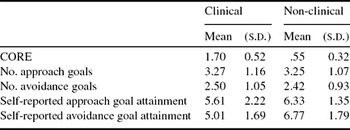
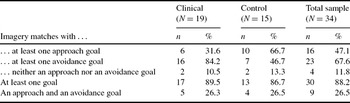
Nineteen (86.3%) clinical participants and 15 (62.5%) control participants completed the Imagery Interview (n = 34). It should be noted that five control participants who reported not currently experiencing intrusive imagery described imagery they had experienced spontaneously in the recent past. Data from these participants were included in the analyses. Table 1 shows descriptive data for the CORE-OM and Goals Task. Table 2 displays the frequency of matches between goals and imagery in both groups. Of the 19 clinical participants who reported intrusive imagery all identified a memory or collection of memories closely associated with their imagery. Of the 15 non-clinical participants who described imagery, 14 (93.3%) identified an associated memory. These findings substantiate that intrusive imagery is related to past experiences. Of this reported imagery, all clinical participants (n = 19) and 10 non-clinical (66.7%) reported negative or unpleasant imagery. Four (26.7%) non-clinical participants reported imagery they considered positive or pleasant and one considered their imagery as neutral.
Descriptive data for both groups for the CORE, and the goals task

CORE, Clinical Outcomes in Routine Evaluation – Outcome Measure.
Matches between imagery and goal types

As shown in Table 1 the majority of imagery reported matched at least one reported goal in both study groups. Cohen's kappa was calculated for imagery that matched onto at least one goal and emerged as 0.91, indicating a high level of agreement between raters. The clinical group had a higher percentage of imagery matching avoidance goals than the control group, and the control group had a higher percentage of imagery matching approach goals than the clinical group. The difference was statistically significant for avoidance goals (Fisher's exact test, p = 0.030), but not for approach goals (Fisher's exact test, p = 0.082). Nonetheless, these findings are consistent with the hypothesis that imagery contains information about personal goals. Qualitative examples of imagery and associated goals are given in Table 3.
Examples of reported imagery and matching goals

Discussion
In a number of studies the salient concerns of the particular disorder in question are often prominent in the content of intrusive imagery (Wells & Hackmann, Reference Wells and Hackmann1993; Day et al. Reference Day, Holmes and Hackmann2004; Stopa & Bryant, Reference Stopa and Bryant2004; Somerville et al. Reference Somerville, Cooper and Hackmann2007), therefore implying that imagery contains information about goals. This is the first study to ask participants about their current goal pursuits as well as intrusive imagery. A key original finding was a strong association between reported goals and imagery. In the total sample almost 90% of individuals reported imagery that matched onto either an approach or an avoidance goal. Furthermore, significant group-wise differences were found for the percentage of images matching avoidance goals. Eighty-five percent of clinical participants reported imagery which matched at least one avoidance goal, whereas this was the case for only half of control participants. For a quarter of all participants imagery matched with both an approach and an avoidance goal. Participants in the present study were only asked to describe one image they had experienced intrusively, thus it is still possible that a match between goals and imagery existed for the 10% of participants where no match was found, but imagery that matched was not reported. Future studies may wish to consider asking participants to describe all intrusive imagery they experience.
These findings qualify claims made by Conway and his colleagues, who argue that imagery contains important information about goals in particular states of the world to be avoided (Conway et al. Reference Conway, Meares and Standart2004a). However, they extend these claims and suggest that imagery can be both approach and avoidance goal-oriented, but in a clinical sample imagery is more often associated with avoidance goals. The finding that almost all reported imagery was negative and associated with a particular memory lends support to the notion that the referents or goal standards in feedback loops are formed from significant past experiences (Powers, Reference Powers1973, 2005; Conway et al. Reference Conway, Meares and Standart2004a; Mansell, Reference Mansell2005).
Clinical implications
This study demonstrated a relatively high prevalence of intrusive imagery in a clinical sample and that intrusive imagery is highly associated with avoidance goals. On this basis it is argued that both goals and intrusive imagery should be investigated routinely in a clinical assessment. Enquiring about imagery may prove a fruitful way of eliciting clients’ goals or assisting clients to articulate their goals which can be otherwise difficult to access. Intrusive imagery within control theories is considered a symptom of conflict between goals and its recurrence is conceptualized as repeated attempts to reorganize conflict which has no lasting effect. It should be noted that PCT hypothesizes that in order for conflict to be resolved permanently information from higher levels within the control hierarchy must be accessed. Discussing intrusive imagery with clients may therefore help to identify potential sources of conflict within the hierarchy of control systems which are manifested as psychological distress, and may also enable them to access information from higher levels in the control hierarchy required to enable the conflict to be resolved permanently. The Method of Levels (MOL), an innovative form of cognitive therapy based on PCT (Powers, Reference Powers1973, 2005) advises that shifting awareness to a higher level is necessary to resolve conflict. Helping individuals to shift their thought processes about imagery to a higher level using techniques outlined by Carey (Reference Carey2006, Reference Carey2008) may be a helpful way of assisting individuals to resolve their conflicts and reduce the distress experienced by this common symptom of psychological distress. Alternatively, meta-cognitive approaches, such as enquiring about appraisals of the occurrence of imagery may enable awareness to be shifted to a higher level.
The fact that intrusive imagery was found to occur in psychological distress and in a non-clinical sample suggests it is an aspect of cognition that is trans-diagnostic. Other studies corroborate this (see Harvey et al. Reference Harvey, Watkins, Mansell and Shafran2004 for a review). In clinical practice where comorbidity and complexity are becoming commonplace, using disorder-specific CBT protocols, e.g. social phobia (Clark & Wells, Reference Clark, Wells, Heimburg, Liebowitz, Hope and Schneier1995) becomes more difficult. The findings of the present study provide preliminary evidence and a rationale for using goal-based information to inform interventions. Using goal-based information and imagery to obtain this information, then focusing on conceptualizing the sources of conflict which maintain distress is a possible alternative way of working that may prove more powerful than inferring themes or concerns associated with diagnoses. Of course, more research is required in this area to quantify these claims.
Limitations and future research
A weakness of this study was that it did not ask participants if they considered any of their reported goals as conflictual. Future research may wish to ask participants if they consider any of their goals conflictual. However, goals in PCT are not defined by their observable behaviour but by the perceptual variable under control. For example, one might have a goal to avoid coming into contact with spiders, but may approach a spider in order to have a smaller perception of it, e.g. squashing it. In this way, what we consider unhelpful avoidance is really arbitrary control generating internal conflict within the individual, so it can be argued that conflict can be inferred within the existing design.
The method through which associations between goals and imagery was tested is open to criticism. Future research may wish to consider asking participants if they consider there are associations between intrusive imagery and reported goals. Moreover, separating participants’ goal data and reported imagery and having an independent rater attempt to combine imagery data with goal data may be a more robust way of analysing the data. Finally, the study's design did not incorporate a diagnostic tool such as the structured clinical interview for DSM-IV, and relied on self-reported diagnosis made by mental health professionals. Future research may wish to use such a tool to partial out any effects of diagnosis.
Acknowledgements
Thanks are due to Warren Mansell who kindly provided comments on earlier versions of this paper, and also to Natalie Lane who assisted with data analyses.
Declaration of Interest
None.
Learning objectives
(1) To have an understanding of the basic principles of control theories and how these relate to psychological difficulties.
(2) To become aware of available research in relation to the content of intrusive imagery across psychological disorders and how these may relate to personal goals.
(3) To become familiar with the clinical implications of the findings.
(4) To critique to the research methodology utilized and consider improvements for future research.




Comments
No Comments have been published for this article.