Haplolepids are small basal actinopterygian fishes of the Carboniferous period and common in equatorial coal-forming swamp areas. The geographical distribution of these fish stretched from New Mexico in the west of North America to as far as the Czech Republic in eastern Europe, in areas which were positioned in equatorial regions during this period. During the Upper Carboniferous, haplolepids ranged stratigraphically from the Namurian A (Serpukhovian) at Loanhead in Scotland until the Stephanian B (late Kasimovian) in the Blanzy-Montceau Basin of France.
Newberry (Reference Newberry1856, Reference Newberry1857) proposed the new genus Mecolepis, including several species, for haplolepid fishes from the Carboniferous strata at Linton, Ohio. He noted that the most noticeable diagnostic characters were the small size of these fish, the posterior position of the dorsal fin and, in particular, the high lateral scales. Since then, several additional species have been named solely on the diagnostic form and ornamentation of the skull roof. In 1857, Newberry realised that Mecolepis was preoccupied and proposed the new name Eurylepis (Newberry Reference Newberry1857), and he went on to describe several further species (Newberry Reference Newbery1873). However, Miller (1892) pointed out that Eurylepis was also preoccupied and proposed the new genus Haplolepis, with Mecolepis corrugata Newberry as the genotype, as it was the first to be described. Furthermore, Newberry (Reference Newberry1889) proposed that Eurylepis lineatus should be removed from the genus and later it was placed in the genus Pyritocephalus Fritsch. However, it was not until Westoll (Reference Westoll1944) provided a thorough revision of the Haplolepidae that a better understanding of the taxa and their relationships developed.
Recent studies of the Haplolepidae have increased the stratigraphical and palaeogeographical distributions of the family in general. Baird (Reference Baird1962) described two new species of haplolepids from the Lower Pennsylvanian (Bashkirian) near Parrsboro, Nova Scotia; the specimen material consisted entirely of an incomplete, macerated individual fish which he designated Haplolepis cf. corrugata; and a partial skull which he compared with Haplolepis aff. anglica from Newsham and later (Baird Reference Baird1978) placed in a new species, Haplolepis (Parahaplolepis) canadensis. Štamberg (Reference Štamberg and Pokorny1978), with the aid of new material, revised the haplolepid Pyritocephalus sculptus Frisch from the Nýřany locality in the Plzeň basin of the Czech Republic, and presented a more detailed description of the skull roof and other dermal bones of the species.
Furthermore, on the basis of new faunal material obtained from Linton, Ohio, Lowney (Reference Lowney1980) revised the family Haplolepidae; the genus Microhaplolepis was erected to include Haplolepis ovoidea (Newberry) and Mecolepis serratus Newberry; and Parahaplolepis was raised from the subgeneric to the generic level to include Parahaplolepis tuberculata from Linton. Later, Lowney (Reference Lowney1983) described two new genera and species of haplolepids (Protohaplolepis scotica and Blairolepis loanheadensis) from the ironstones of Loanhead, Midlothian, in which the only material available of Blairolepis loanheadensis was a single skull roof. Also described was a new species, Parahaplolepis westolli, from Newsham, Northumberland, which very closely resembled Parahaplolepis tuberculata from Linton. Two subfamilies were also recognised to reflect the distinct phylogeny within the family: the Haplolepinae and the Parahaplolepinae; the Haplolepinae to include Protohaplolepis, Haplolepis and Microhaplolepis; and the Parahaplolepinae to include Blairolepis, Parahaplolepis and Pyritocephalus.
More recently, Huber (Reference Huber1992) described a new species, Pyritocephalus lowneyae, from the early Stephanian (Kasimovian) of central New Mexico, thus representing the most westerly component of the palaeographical distribution of the Haplolepidae; and Poplin (Reference Poplin1997) described a new species of haplolepid, Blanzyhaplolepis beckaryae (Late Kasimovian), from the Blanzy–Montceau basin, France; specimen material consisted of two small fish lacking most parts of the head, dorsal, pectoral and pelvic fins. Despite the lack of skull roof detail which is characteristic of the Haplolepidae, Poplin warranted assignment of the specimens to a new genus and species based on other details, which included the distinctive wide, fan-shaped cleithrum and the characteristic structure of the fin rays. To date, 25 species of haplolepids have been found: 13 in North America; three in Canada; seven in Great Britain; and two in continental Europe.
The present study aims to give a detailed description of the different skull roof morphologies of the seven new taxa, including an account of some of the larger dermal bones; and, as a result of these differences in skull roof detail, compute phylogenic trees to show inferred relationships which may exist between the Haplolepidae and other closely related genera; and in addition, to include a study of the Haplolepidae in general in order to investigate previous hypotheses within the family.
1. Material and methods
1.1. Specimen preparation and study
Although the Lower Coal Measures of Scotland are rich in fish remains, no articulated specimen of haplolepid has been collected so far. Unfortunately, complete coal measure specimens are not as frequently found in the Lanarkshire area as they are in the Scottish Midlothian location and in the North Staffordshire area of England. Nevertheless, a large collection of dermal remains of at least seven different species of haplolepid have been found; these include skull roofs, maxillae, dentaries, cleithra, clavicles, opercula, preopercula, dermosphenotics and scales, including many of the smaller bones. Most specimens were found well preserved throughout the fossil beds and, in some cases, remains formed the bulk of the faunal material.
All specimens referred to in this study are now stored at the Hunterian Museum, University of Glasgow, abbreviated GLAHM throughout the text.
The haplolepid material examined for this study was found in, or close to, anthracitic shale beds of 1–10 mm thickness. Specimens were also obtained from a dark carbonaceous material lying adjacent to the thin bands of anthracite and proximal to a bed of compressed, minute bivalve molluscs of the family Aviculopectinidae. Most specimens, however, were found in the thin bands of anthracite and in many cases much of constituent bony material was replaced with anthracite; in this same band, the remains of juvenile fish are also to be found. Other haplolepid fossils were associated with a mass of mixed fish remains in a fossil bed of about one millimetre thickness and of indeterminate lateral extension. Other vertebrate material to be found in this fossil bed includes the bones and scales of small coelacanths, spines of the acanthodian Acanthodes wardi and various elements of actinopterygians including the rhadinichthyids Rhadinichthys grossarti, R. monensis, R. wardi, R. hancocki, the platysomid Platysomus parvulus, the eurynotiforms Amphicentrum granulosum and Mesolepis wardi, and several still unidentified species.
By virtue of the small size of the specimens, an Olympus BM620B stereomicroscope with WFX10 eyepieces, with or without X2 objective lenses, was used extensively throughout this study. In addition, a Swann-Morton scalpel with a No. 25 blade was essential for this work, especially to aid in the separation of the finely laminated layers of material containing the fossils. However, due to the high carbon content of the specimens, dilute hydrochloric acid could not be used to prepare the fossils for study. As an alternative, a solution of H2O2 (100 vol.) was used and, although slower in removing the matrix which enveloped the specimens, was found to be very effective and safe. The hydrogen peroxide solution was used on all specimens except those found in a black carbonaceous band as the solution tended to lift and separate the different layers of bone; these specimens could only be prepared mechanically with the Swann-Morton scalpel. Much of the bone material obtained is well preserved and exhibits fine morphological detail. In addition, the bone and scale layers of ganoine, dentine-like cosmine and the laminate isopedine are found more or less intact. Although not necessary for this study, with care these layers could easily be separated if a better view of the pit lines and the skull roof sutures were required.
Photographic images of all specimens were produced using a Kodak Z740 digital zoom camera with two X10 macro close-up lenses connected in tandem. Camera sensitivity was set at ISO 80 with f-number=f/8 and exposure time=1to1/4 seconds. Line drawings were first produced by hand and then refined using Microsoft Paint or Paint.NET.
By using Westoll's (Reference Westoll1944) illustrations from his monograph on haplolepids as a guide, and by taking a measurement of the distance from the anterior margin of the skull roof to its posterior border, an estimation of the possible length of each fish was deduced. This assumption was based on the fact that the estimated length of a typical fish could be calculated from the ratio of the average skull roof measurement relative to its overall length.
Concerning the parietal–dermopterotic region of the skull roof in the genera Pyritocephalus and Parahaplolepis (also including Millerolepis in this study), Westoll (Reference Westoll1944) postulated that the loss of the parietals of the skull roof had caused the dermopterotics to expand medially until they met midline. It is also most unlikely that natural development resulted in the fusion of the parietal and dermopterotic regions into a single unit, since this configuration was present in some of the oldest known taxa. I have preferred to follow an alternative interpretation, that of Baird (Reference Baird1978), in that the parietals had simply developed lappets to compensate for the loss of the dermopterotics. Thus, the single bone formed will be named the parietal throughout this study.
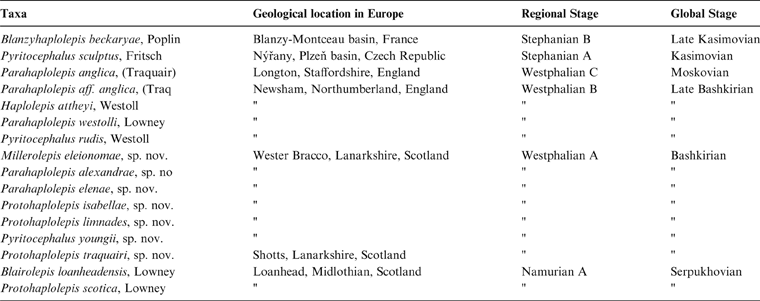
Other species of haplolepids (Table 1) were used for a comparison. Also shown are the geographical locations where these fossils were found.
Other haplolepids studied for comparison including their geological location.

1.2. Systematic palaeontology
Class Actinopterygii Woodward, Reference Woodward1891
Subclass Actinopteri E. D. Cope, Reference Cope1871
Family Haplolepidae Westoll, Reference Westoll1944
Subfamily Haplolepinae Lowney, Reference Lowney1983
Genus Protohaplolepis Lowney, Reference Lowney1983
Diagnosis. A haplolepid with a short, broad skull roof; dermopterotics and parietals separate; posterolateral lappets absent; extrascapulars and posttemporals meeting at midline; maxilla with a tall, triangular expansion and quadratojugal possibly present; ventral lateral line absent.
Protohaplolepis isabellae sp. nov.
(Figs 1, 8a, 9b (i), 10a(i))
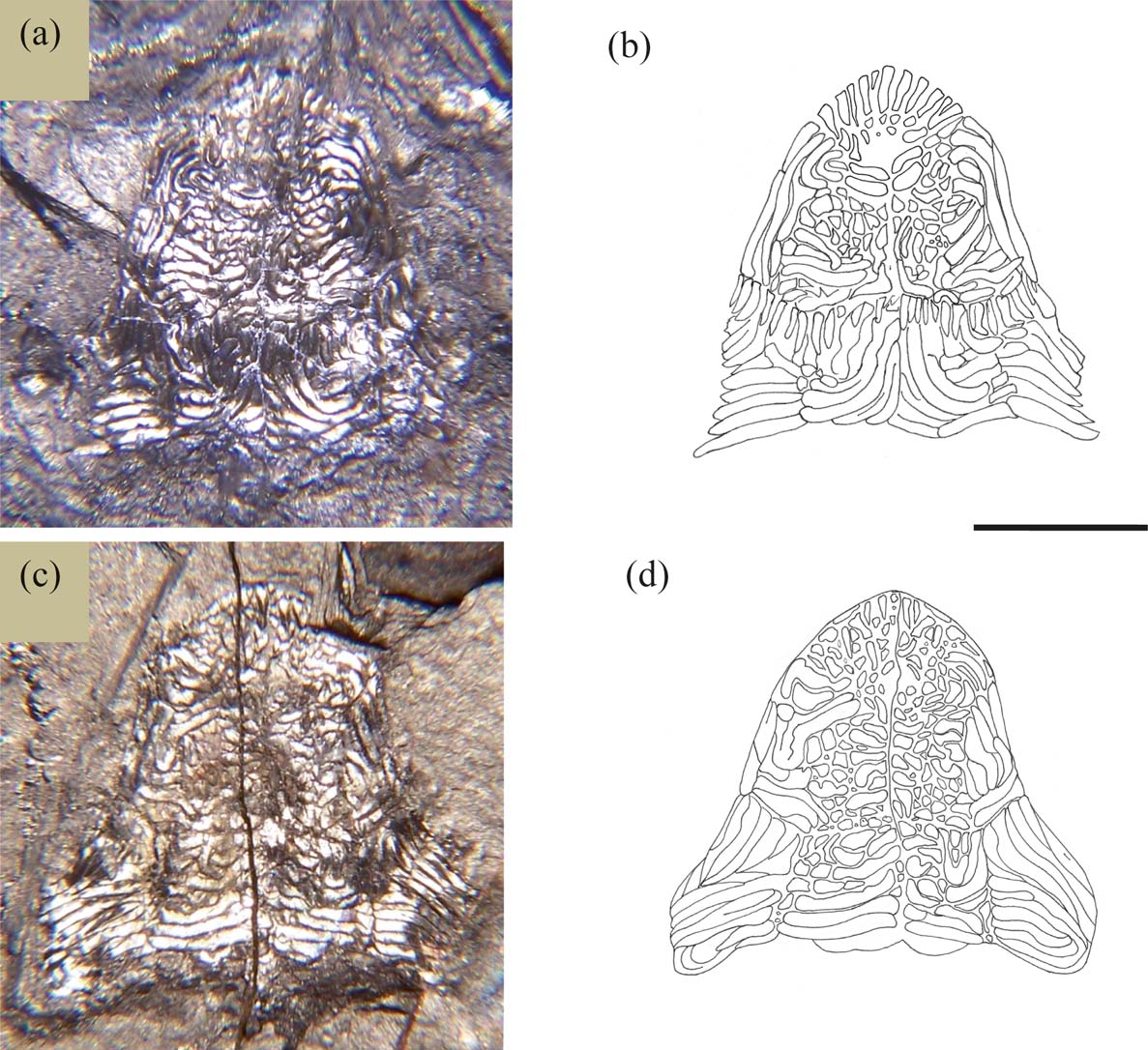
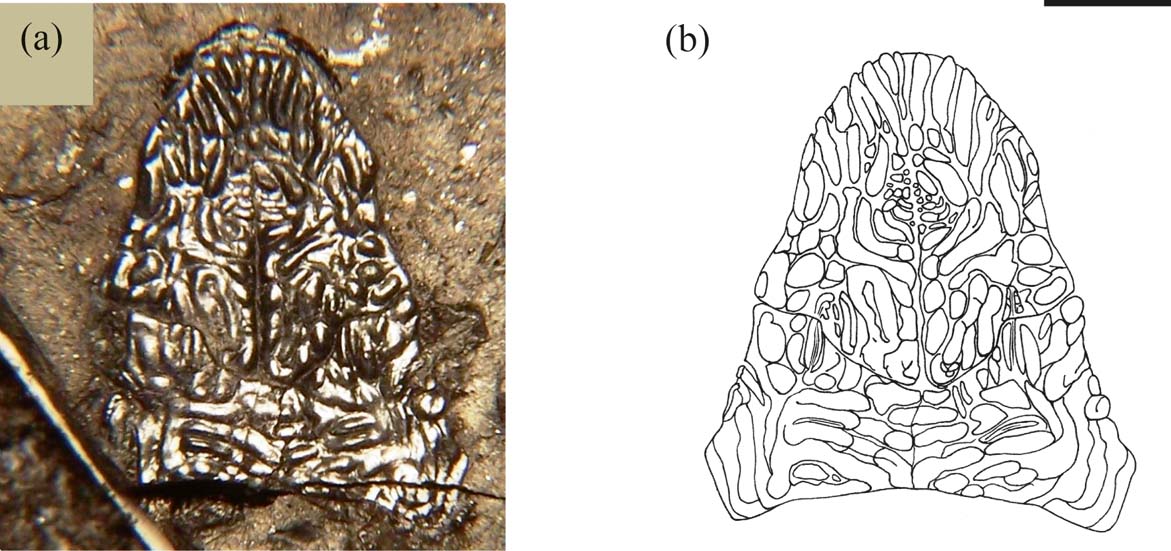
(a) Paratype specimen of Protohaplolepis isabellae, skull roof, GLAHM 152368; (b) line drawing of same skull roof showing ornamentation. (c) Holotype specimen of Protohaplolepis isabellae, skull roof, GLAHM 152369, showing variation in ornamentation; (d) line drawing of same skull roof showing ornamentation. Scale bar=2 mm.

Holotype. GLAHM 152369. Part and counterpart (Fig. 1b).
Paratype. GLAHM 152368. Part and counterpart (Fig. 1a).
Locality and horizon. Anthracitic bands in shale from the Drumgray coal, Ardenrigg No.6 Mine, Wester Bracco, North Lanarkshire [NS 8265 6566].
Etymology. After Isabella, the first Spanish queen regnant and a key character in the Reconquista, the Spanish Inquisition.
Diagnosis. Skull roof in the form of an equilateral triangle; dermopterotics and parietals separate, no posterolateral lappets; parietals small and square; posterior margin not embayed; anterior margin of frontals tapered, lateral margin convex; pineal macula strongly marked; transverse suture V-shaped; anterior pit lines confined to the parietals; skull roof ornamentation of flat ridges. Maxilla with tall, triangular postorbital expansion, notched area at optic margin; suborbital process the same length as expansion; maxillary dentary with row of small, close-set, conical and sharp teeth along the whole margin; ornamentation as skull roof. Cleithrum ventral pit line absent. Dentary deep, teeth identical to those of the maxilla; ornamentation of longitudinal rugae and troughs; articular present.
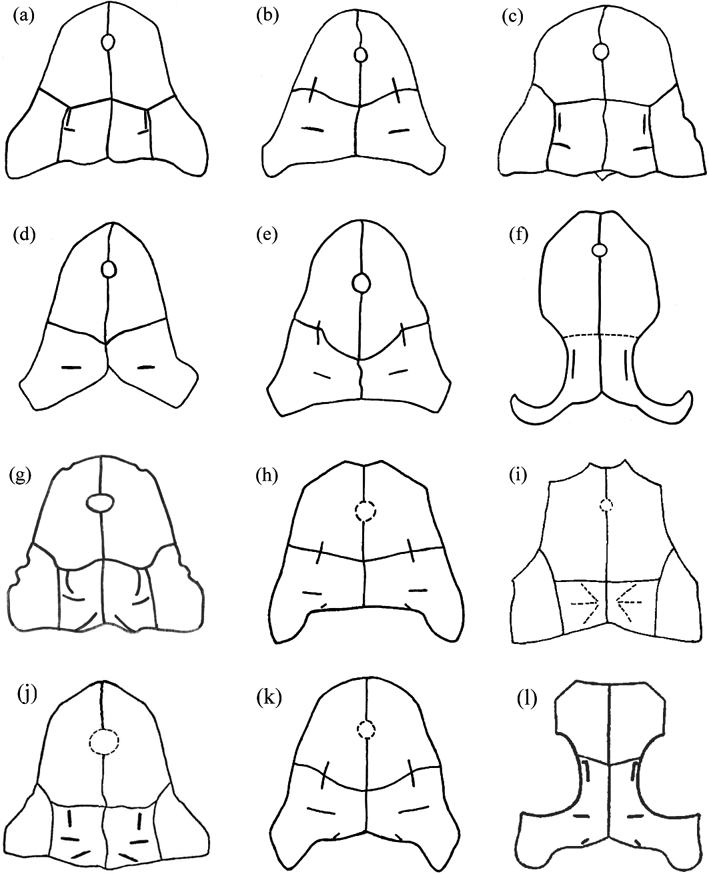
Discussion. The skull roof outline resembles very closely that of Protohaplolepis scotica from Loanhead, but the anterior margin has no embayment for the reception of the postrostral and there is no embayment at the posterior margin. The extrascapulars and posttemporals do not meet midline. The frontals are slightly larger than the parietals and more or less quadrilateral in form; they are longer than wide, and taper from about level with the clearly marked pineal macula to their most anterior extremity; the pineal macula being situated somewhat closer to the anterior margin than midpoint. The small parietals are almost square and about half the length and width of the frontals. The dermopterotics are trapezoid in form and separated laterally from the parietals. The anterior pit line and the middle pit line are clearly visible and resemble those of Microhaplolepis from Linton; however, a posterior pit line has not been observed on any specimens. The transverse suture separating the frontal from the parietal and dermopterotic is V-shaped and not arched at the dermopterotic as in P. scotica (compare Figs 8a and 8i).
The ornamentation over most of the skull roof is a pattern of terraced areas of smooth, flat, lustrous ridges separated by sharp grooves as in H. corrugata and P. scotica. This ornamentation runs more or less parallel with the lateral and posterior margins, occasionally forming a swirling pattern, especially near the posterior margin of the parietals. Anteriorly and medially encircling the pineal macula, the ornamentation tends to small irregular-shaped tubercles; these tubercules may extend as far back as the posterior margin of the parietals (Fig. 1c, d).
The most frequently found remains of haplolepids at Wester Bracco are of this small fish; several maxillae and dentaries have been found in slates containing skull roofs and other material of this species.
The maxilla of Protohaplolepis isabellae (Fig. 9b (i)) has a tall, triangular postorbital expansion, similar to that of H. corrugata from Linton and P. scotica from Loanhead. The suborbital process is approximately the same length as the postorbital expansion, the width of the process remaining more or less constant along its length, except at the ramus where it is clavate distally. The dentary margin of the maxilla has a row of small, close-set, conical and sharp teeth located along the whole margin. Ornamentation is of flat ridges and sharp grooves; a quadratojugal, however, has not been observed on any maxillae. Maxillae from Wester Bracco have a small notched area at the optic margin of the postorbital expansion, a characteristic which may possibly separate Wester Bracco haplolepids from Loanhead and Linton material. The cleithrum is similar to that shown in Figure 9 (Fig. 9a (v)), in which the ornamentation is of strong, flat ridges with the ventral pit line absent. The dentary (Fig. 10a (i)) is deep and armed with teeth, which are identical to those of the maxilla, along the whole margin. The surface is ornamented with strong longitudinal rugae and troughs, except in the area of the articular, where the ornamentation is of flat rugae.
The approximate total length of the adult fish is 45 mm.
Protohaplolepis limnades sp. nov.
(Figs 2, 8c)
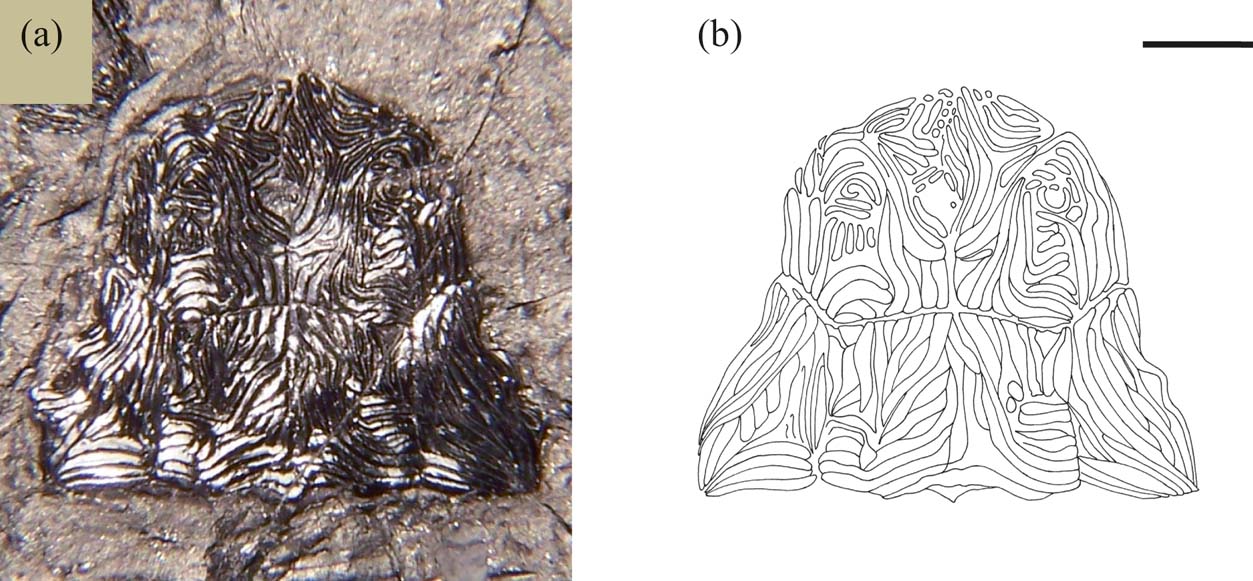
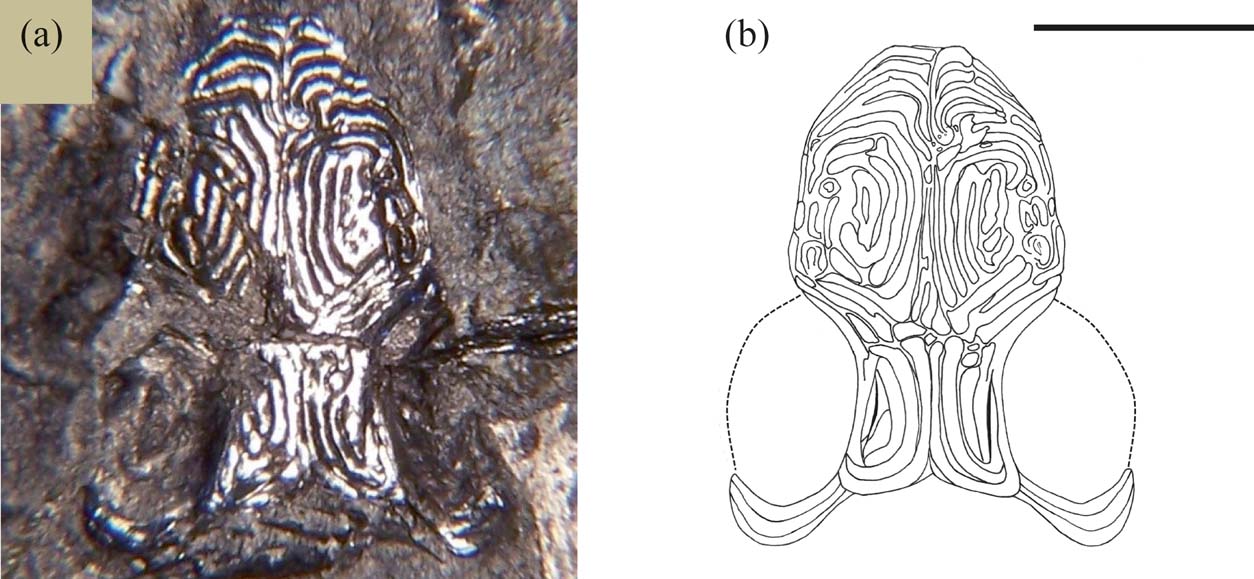
(a) Holotype specimen of Protohaplolepis limnades, skull roof, GLAHM 152371; (b) line drawing of same skull roof showing ornamentation. Scale bar=2 mm.

Holotype. GLAHM 152371 (Fig. 2a).
Locality and horizon. Anthracitic shale from the Drumgray coal, Ardenrigg No. 6 Mine, Wester Bracco, North Lanarkshire [NS 8265 6566].
Etymology. In Greek mythology, the Limnades or Limnatides were a type of naiad who lived in lakes.
Diagnosis. Skull roof trapezoid in form; dermopterotics and parietals separate, posterolateral lappets absent; parietals square slightly less than length of frontals; anterior margin of frontal rounded, lateral margin convex; posterior margin of skull roof not embayed; transverse suture V-shaped; anterior pit lines confined to the parietals; pineal macula strongly marked, located midpoint of frontals; skull roof ornamented with flat ridges.
Discussion. Complete skull roofs are frequently found of this relatively large haplolepid. In outline, the skull roof of P. limnades resembles that of P. scotica. In P. limnades, however, the skull roof is much wider and the anterior margin has no embayment for the reception of the postrostral. The broad anterior border of the frontals gives the specimen a very robust, near quadrate appearance.
Frontals are bulky and more or less quadrilateral in form, the parietals are square-shaped and about half the overall size of the frontals. The dermopterotics, which are separated laterally from the parietals, are slightly larger and trapezoid in form. The pineal macula is clearly seen in all specimens and located in the centre of the frontals. The posterior margin of the skull roof is rectilinear and not embayed, and the extrascapulars and posttemporals do not meet midline. The anterior pit line and the middle pit line are clearly visible and resemble those of Microhaplolepis, however, a posterior pit line has not been observed in any specimens. The transverse suture separating the frontal from the parietal and dermopterotic is V-shaped and similar to that found in P. scotica.
The ornamentation over the whole skull roof is a very strong combination of deep, sharp trenches and flat, lustrous ridges. This pattern runs more or less parallel with the lateral and posterior margins, but tending to localised swirls anteriorly.
The approximate total length of the fish is 68 mm.
Protohaplolepis traquairi sp. nov.
(Figs 3, 8g)
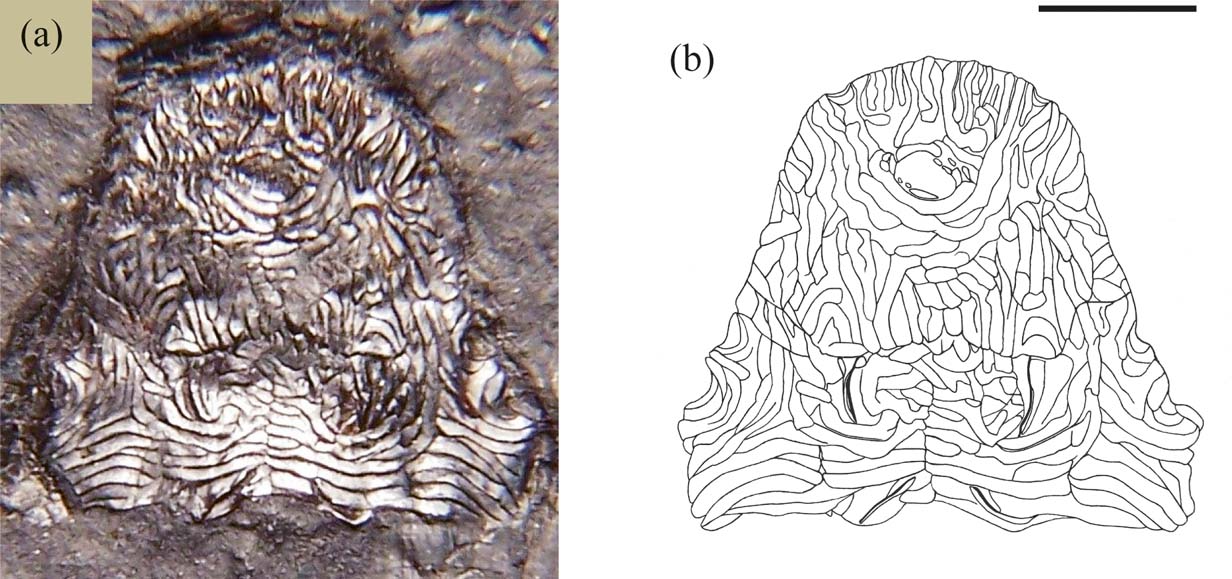
(a) Holotype specimen of Protohaplolepis traquairi, skull roof, GLAHM 152375; (b) line drawing of same skull roof showing ornamentation. Scale bar=2 mm.

Holotype. GLAHM 152375 (Fig. 3a).
Locality and horizon. Shale from the Drumgray Coal, Calderhead No.3 Mine, Shotts, North Lanarkshire [NS 8775 6139]. To date, a single skull roof and a few dermal elements and scales are the only haplolepid remains found at this site.
Etymology. In honour of the Scottish naturalist and palaeontologist, Ramsay Heatley Traquair (1840–1912) for his contribution to palaeoichthyology.
Diagnosis. Skull roof shape of an isosceles trapezoid; dermopterotics and parietals separate, posterolateral lappets absent; parietals square; anterior margin of frontals rounded with two knurled areas, lateral margin rectilinear; posterior margin not embayed; transverse suture sinusoidal; anterior pit lines confined to parietals; pineal macula strongly marked, located midpoint of frontals; skull roof ornament of flat ridges.
Discussion. In outline, the skull roof of P. traquairi resembles that of Haplolepis attheyi, but is somewhat wider, the anterior margin more round than tapered. The frontals are bulky and more or less quadrilateral in form. The parietals are almost square and a little more than half the length and width of the frontals. The dermopterotics are separated laterally from the parietals; they are trapezoid in form, with two knurled areas along each anterolateral margin. The posterior margin is not embayed but rectilinear, and the scapulars and posttemporals do not meet midline. The pineal macula is very clearly defined, as in P. canadensis. The transverse suture which separates the frontal from the parietal and dermopterotic, is sinusoidal in shape. The anterior pit line and the posterior pit line are clearly visible and resemble those of H. attheyi; the middle pit line is present, but is almost obscured by the strong overlapping ornamentation of the skull roof.
The ornamentation over the whole skull roof is a combination of deep sharp trenches and flat, lustrous ridges running in a more or less anteroposterior direction on the frontals, except where they encircle the pineal macula. These flat ridges also encircle two knurled areas which are located along the anterior margin and two located along the anterolateral borders of each dermopterotic. The posterior margin of the skull roof is, however, somewhat straight along its whole length and the general trend in pattern of the ornamentation is to run parallel with this margin across the parietals and dermopterotics.
The approximate total length of the fish is 70 mm.
Subfamily Parahaplolepinae Lowney, Reference Lowney1983
Genus Parahaplolepis Westoll, Reference Westoll1944
Diagnosis. A haplolepid in which the dermopterotics and parietals are not separate; the anterior pit line extends onto the frontal from the parietal; posterior margin of skull roof deeply embayed for the reception of the extrascapulars and posttemporals, the latter two pairs of bones meeting in midline; skull roof ornament of broad raised rugae or low tubercles; maxilla (in the one species where it is known) with tall posterior expansion and a quadratojugal present; ventral lateral line present.
Parahaplolepis alexandrae sp. nov.
(Figs 4, 8b, 9b (ii), 10b (i))
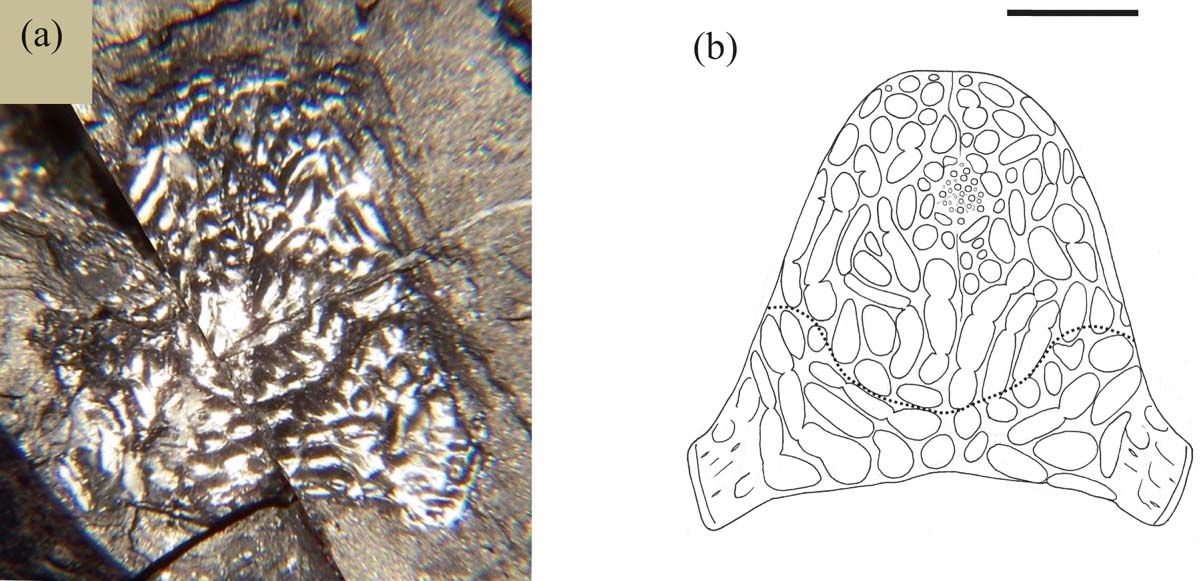
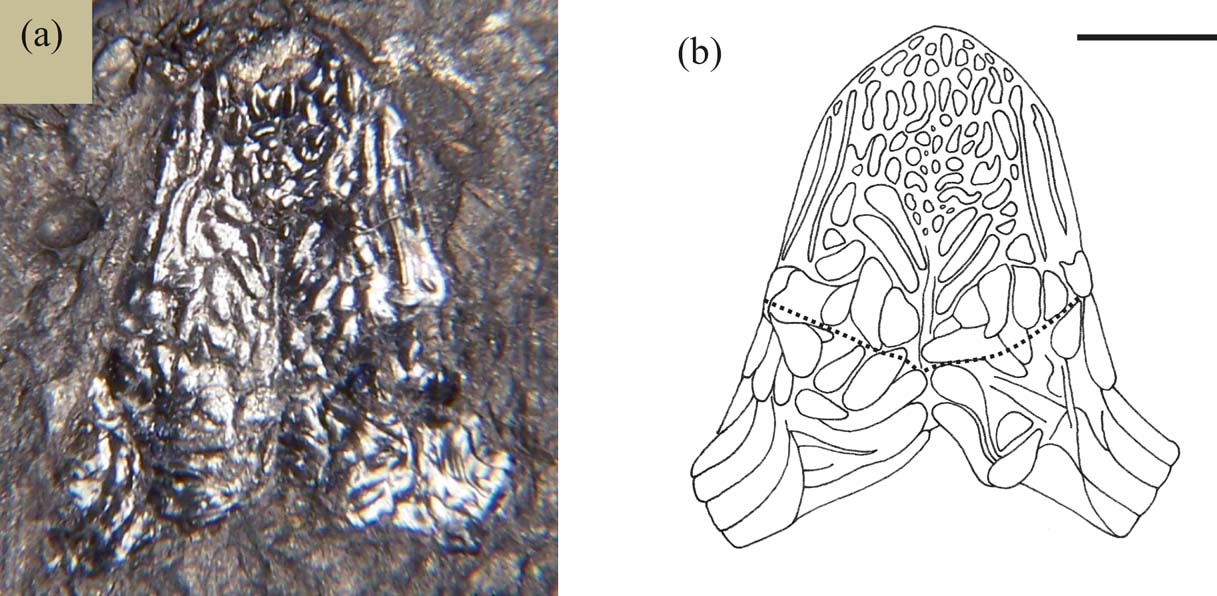
(a) Holotype specimen of Parahaplolepis alexandrae, skull roof, GLAHM 152370; (b) line drawing of same skull roof showing ornamentation. Dotted line indicates path of frontoparietal sutures. Scale bar=2 mm.

Holotype. GLAHM 152370 (Fig. 4a).
Locality and horizon. Carbonaceous shale from the Drumgray coal, Ardenrigg No.6 Mine, Wester Bracco, North Lanarkshire [NS 8265 6566].
Etymology. The species is named after Alexandra, a title or epithet given to the Greek goddess Hera.
Diagnosis. Skull roof triangular in form; dermopterotics and parietals not separate; posterolateral lappets present; anterior margin of frontals rounded, lateral margin convex; posterior margin of skull roof deeply embayed; transverse suture sinusoid; anterior pit line crosses into frontal; pineal macula faint, located midpoint of frontals; skull roof ornamented with large, round tubercles. Dermosphenotic tetrahedral in form, ornamented with round and elongate tubercles. Maxilla with large, rounded posterior expansion; suborbital ramus longer than posterior expansion; ornamentation of large tubercles; dentary margin with small, sharp conical teeth occupying posterior two-thirds of the margin only.
Discussion. The skull roof is in the form of an equilateral triangle, its anterior margin rounded and the posterior margin deeply embayed to receive the extrascapulars and posttemporals, which meet midline. In outline, it resembles that of P. canadensis and P. anglica with the rounded anterior margin. However, the outline of P. alexandrae is much wider and in P. tuberculata and P. westolli the anterior margins are shouldered.
The frontals are somewhat triangular in form, their length being almost twice the width; along the anterior margin they are rounded and the lateral margins are convex, similar to those shown in P. canadensis. The pineal macula, which is faintly marked, as in P. anglica and P. tuberculata, is positioned midpoint of the frontals. The parietals are quadrilateral in shape and approximately the same size as the frontals.
The sculpture of the skull roof is strongly developed and consists of rounded tubercles on each of the frontals and transverse rows of merged tubercles on the parietals, similar to those in P. canadensis and P. tuberculata. The posterolateral lappets are angular at their margins and ornamented with only a few tiny grooves and pores. Normally, the positions of the mid-sagittal suture, transverse suture and pit lines are not clearly discernible in this species (Fig. 2a, b). This detail, however, is clearly shown in material which has been subject to some form of erosion, which has resulted in the reduction or complete removal the ganoine layer. A diagram (Fig. 8b) was produced from the study of this material which indicates that the transverse suture is sinusoidal in form and passes diagonally forward and outward from the mid-sagittal suture in a manner similar to that in P. canadensis. The anterior pit line can be clearly seen to cross the transverse suture, the middle pit line is present; however, a posterior pit line has not been observed in any specimens.
Other dermal remains found in the same piece of material as the skull roof of Parahaplolepis alexandrae include a dermosphenotic (Fig. 10b (i)), which is a large bone, tetrahedral in form and ornamented with round and elongate tubercles. Several maxillae of this species have also been found; the example in (Fig. 9b (ii)) is shown to be ornamented with large tubercles, the suborbital ramus is almost two and a half times longer than the rounded posterior expansion. The dentary margin has a row of small, sharp conical teeth which are set a short distance apart and which occupy only the first two-thirds of the margin, with the remaining length edentulate. A quadratojugal has not been observed on any specimens.
The approximate total length of the fish is 63 mm.
Parahaplolepis elenae sp. nov.
(Figs 5, 8e)
(a) Holotype specimen of Parahaplolepis elenae, skull roof, GLAHM 152373; (b) line drawing of same skull roof showing ornamentation. Left parietal repositioned with lappet reconstruction. Scale bar=2 mm.

Holotype. GLAHM 152373 (Fig. 5a). The holotype is at present the only known specimen. Part and counterpart.
Locality and horizon. Fossil ostracod-rich shale from the Drumgray coal, Ardenrigg No.6 Mine, Wester Bracco, North Lanarkshire [NS 8265 6566].
Etymology. A Spanish variant of the Greek name Helena meaning ‘shining light’ or ‘bright one’, referring to the lustrous nature of the skull ornamentation.
Diagnosis. Skull roof triangular in form; parietals without dermopterotics, posterior lappets present; anterior margin of frontals rounded, lateral margin concave; posterior margin of skull roof deeply embayed; transverse suture sinusoidal; anterior pit line crosses into frontal; pineal macula strongly marked, positioned midpoint of frontals; skull roof ornamentation of rugae and tubercles.
Discussion. The general outline of the skull roof of Parahaplolepis elenae is in the form of an isosceles triangle, with the posterior margin slightly embayed to receive the extrascapulars and posttemporals, which do not meet midline. The long, narrow skull roof resembles that of P. canadensis and P. anglica, with its rounded anterior margin and concave lateral borders of the frontals, but differs from P. westolli which has a distinctly shouldered anterior margin.
The lengths of the frontals are almost twice their width, with the lateral margins concave and similar to those found in P. canadensis; the clearly defined pineal macula is also similar to that found in P. canadensis and is located midpoint of the frontals. The parietals are more or less triangular in form and about two-thirds the size of the frontals. The transverse suture passes forward and outward in a gentle curve from the mid-sagittal suture to about half its distance, then abruptly alters direction at the point where the anterior pit line crosses into the frontal from the parietal, to almost 90 degrees relative to the mid-sagittal suture. The anterior pit line is clearly seen and crosses the transverse suture, as previously mentioned; the middle pit line is present but difficult to see, and a posterior pit line has not been observed.
The sculpture of the skull roof is very strongly developed, the direction of which is remarkably similar to that of P. canadensis and consists of long rugae and rounded tubercles on each of the frontals and long, less strongly marked rugae running more or less axially on the parietals. On the frontals, the ornamentation consists of strong, elongate tubercles running anteroposteriorly; not transversely as in P. anglica. The posterolateral lappets are angular at their margins and ornamented with broad, flat rugae.
The approximate total length of the fish is 63 mm.
Genus Pyritocephalus Fritsch, Reference Fritsch1893
Diagnosis. A haplolepid with paired skull roof fenestrations, mostly surrounded by frontals, parietals and dermosphenotics; dermopterotics not present and parietals meeting midline; ornament of head bones of fairly regularly arranged terraced rugae; scales smooth, except for a few linear grooves near the anterior margin, without denticulations on the posterior border, peg-and-socket articulations probably absent; ventral lateral line present, represented by grooves on cleithrum and scales of venter; pit line grooves completely developed.
Pyritocephalus youngii sp. nov.
(Figs 6, 8f, 9a (iv), 10a(ii))
(a) Holotype specimen of Pyritocephalus youngii, skull roof, GLAHM 152374; (b) line drawing of same skull roof showing ornamentation and area of “tympani”. Scale bar=2 mm.

Holotype. GLAHM 152374 (Fig. 6a). Part and counterpart.
Locality and horizon. Anthracitic shale in from the Drumgray coal, Ardenrigg No.6 Mine, Wester Bracco, North Lanarkshire [NS 8265 6566].
Etymology. Named after the geologist John Young (1823–1900), in recognition of his services to palaeontology by his researches into the Carboniferous fossils of the west of Scotland.
Diagnosis. Skull roof approximates the shape of an isosceles triangle; anterior margin of frontals with small indentation at the extremity, lateral margin slightly convex and tapering towards the anterior margin; posterior margin deeply embayed; transverse suture not present; pineal macula faintly marked, located close to anterior margin of frontals; orbital fenestrae present; skull ornamentation of fine ridges. Dentary moderately deep; teeth large, conical, slightly incurved; ornamentation of flat ridges, tubercles and longitudinal grooves. Cleithrum small, almost square-shaped; anterior margin nearly straight; ventral pit line present; ornamentation of flat ridges. Scales small, much taller than wide, without anterodorsal process; ornamentation smooth.
Discussion. The frontals are very much larger and the parietals much smaller than in other Pyritocephalus species; however, the pattern of ornamentation on the frontals is remarkably similar to that found in the type species, Pyritocephalus sculptus Fritsch (Reference Fritsch1893) from Nýřany. In Pyritocephalus youngii, the frontals are large and expanded and taper from a point roughly level with the pineal macula to the anterior margin, and the anterior margin is slightly indented where it contacts the postrostral. The parietals are reduced to narrow, curved extensions bordering the posterior margins of the temporal fenestrae, which are rounded as in P. sculptus (compare Figs 8f and 8l). The posterior margin of the parietals are very deeply embayed for the reception of the posttemporals; the extrascapulars are most likely very small paired elements, each completely surrounded by the parietals and posttemporals and, as a consequence of their small size, the posttemporals only would meet in the midline. The supraorbital vacuities are large and ovate, with a smooth tympanic-like membrane, as in P. sculptus. The mid-sagittal suture is visible; the frontoparietal suture is not apparent, although the ornamentation has a natural break where a suture line would be positioned. The middle pit lines are present, but difficult to determine; anterior and posterior pit lines were not observed. The ornamentation of the skull roof consists of long, fine ridges separated by deep troughs of roughly the same width; the ridges are arranged in a concentric or semiconcentric pattern on the frontals and in the region between the fenestrations.
Other dermal remains found in the same piece of material as the skull roof of Pyritocephalus youngii include a cleithrum, a dentary and some scales. The cleithrum is small and almost square-shaped (Fig. 9a (iv)) compared with that of other haplolepids; the anterior margin is almost straight and not curved where it connects with the clavicle; the ornamentation is of flat ridges running more or less parallel with the ventral and posterior borders; and a ventral pit line is observed mid-way along ventral margin. The dentary is moderately deep; the ornamentation consists of strong, flat ridges separated by four or five longitudinal grooves, the pattern breaking into broad, flat tubercles near the dentary border. The form of the dentary is similar to that shown on Figure 10 (Fig. 10a (ii)), but the teeth are large, conical and slightly incurved forwards, with each tooth very close to the next one. The scales are small, much taller than wide, and without an anterodorsal process; the ornamentation is smooth, with peg-and-socket articulation.
The approximate total length of the fish is 40 mm.
Genus Millerolepis gen. nov.
Diagnosis. A haplolepid with skull roof in the form of an isosceles triangle; parietals without dermopterotics; parietals extending outwards and backwards; posterolateral lappets absent; anterior margin of frontals tapered, lateral margin planate, posterior margin deeply embayed; extrascapulars and posttemporals meeting at midline: transverse suture nearly straight and oblique; anterior and posterior pit lines absent; pineal macula faintly marked, positioned close to anterior margin; longitudinal rugae on frontals; skull roof ornamented with rugae and large tubercles.
Holotype. Millerolepis eleionomae, sp. nov.
Etymology. The genus is named after Hugh Miller (1802–1856) the self-taught Scottish geologist and writer.
Millerolepis eleionomae sp. nov.
(Figs 7, 8d)
(a) Holotype specimen of Millerolepis eleionomae skull roof, GLAHM 152372; (b) line drawing of same skull roof showing ornamentation. Dotted lines indicates path of frontoparietal sutures. Scale bar=2 mm.

Diagrams of centre part of skull roofs of Haplolepidae showing pineal macula, pit lines, mid-sagittal suture and oblique/transverse sutures (not to scale): (a) Protohaplolepis isabellae sp. nov.; (b) Parahaplolepis alexandrae sp. nov.; (c) Protohaplolepis limnades sp. nov.; (d) Millerolepis eleionomae sp. nov., gen. nov.; (e) Parahaplolepis elenae sp. nov.; (f) Pyritocephalus youngii sp. nov.; (g) Protohaplolepis traquairi sp. nov.; (h) Parahaplolepis tuberculata (after Westoll 1944); (i) Parahaplolepis scotica (after Lowney Reference Lowney1983); (j) Haplolepis attheyi (after Westoll 1944); (k) Parahaplolepis canadensis (after Baird Reference Baird1978); (l) Pyritocephalus sculptus (after Westoll 1944).

Holotype. GLAHM 152372 (Fig. 7a). The holotype is at present the only known specimen. Part and counterpart.
Locality and horizon. Fossil ostracod-rich shale from the Drumgray coal, Ardenrigg No.6 Mine, Wester Bracco, North Lanarkshire [NS 8265 6566].
Etymology. The species is named after the Eleionomae, marsh and wetland naiads from Greek mythology.
Diagnosis. As for genus, and can be identified immediately by the almost straight, longitudinal rugae which run half the length of the frontals.
Discussion. Millerolepis eleionomae has a Parahaplolepis-type skull roof; that is, the presence of parietals without dermopterotics, but also without the posterolateral lappets. However, further association with the genus Parahaplolepis cannot be established, due to the fact that the anterior pit lines, which may cross from the parietals into the frontals, are not observed. Removal of the dermal ganoine may reveal pit lines and thus help determine any possible relationship with that genus; however, to undertake such an action would cause undesirable damage to the specimen. Nonetheless, in Millerolepis, the ornamentation at the posterolateral corner does not run parallel with the margin of the bone as in some species of Parahaplolepis, but terminates at the margin in a similar manner to that of Protohaplolepis in general. Millerolepis differs also from the other Scottish haplolepids Protohaplolepis and Blairolepis, as both these genera have separate dermopterotics and parietals.
The outline of the skull roof of Millerolepis eleionomae is similar to that of Haplolepis corrugata, although the shape of the former species is longer and narrower and tapers at the anterior border, rather than being shouldered. The frontals are almost twice as long as broad, with the lateral borders nearly straight for much of their length, and the anterior border tapers to a point; the pineal macula is faintly marked, as in P. anglica and P. tuberculata, and lies slightly closer to the anterior margin of these bones than midpoint. The parietals are almost the same size as the frontals, quadrilateral in shape and extend outwards and backwards, and are deeply embayed for the reception of the extrascapulars and posttemporals, which probably meet midline in much the same way as in Protohaplolepis scotica (see Lowney Reference Lowney1983, p.71, fig. 4b). The shape and direction of the transverse suture is not particularly pronounced or clear; it can, however, be traced from the lateral margin of the skull roof to the mid-sagittal suture, where it is seen to be steeply inclined and to follow a more or less linear path as it separates the frontals from the parietals. The anterior and posterior pit lines are not observed, and the existence of the middle pit lines is also not very clear, but there are markings in one area which seem to suggest they may possibly be present.
The sculpture of the skull roof is strongly developed and consists anteriorly of short rugae and small tubercles, which are also found in the area of the pineal macula. Two or three strong, longitudinal rugae commence proximal to the anterior margin and continue for half the length of the frontals without diverging. The frontals are, however, ornamented with short rugae and large, irregular-shaped and slightly raised tubercles, mostly originating from about level with the terminations of the longitudinal rugae and continuing to as far as the posterior margin.
The approximate length of the fish is 58 mm.
2. Remainder of material
Due to the rather unique morphology and osteology of the haplolepid elements, identification of their dermal bones and scales was not difficult to determine. For that reason, and regardless of the fragmented nature of the specimens, these elements could not be confused with those of other actinopterygians from the Lower Coal Measures of Scotland. Brief descriptions and interpretations of some of the remains are given below.
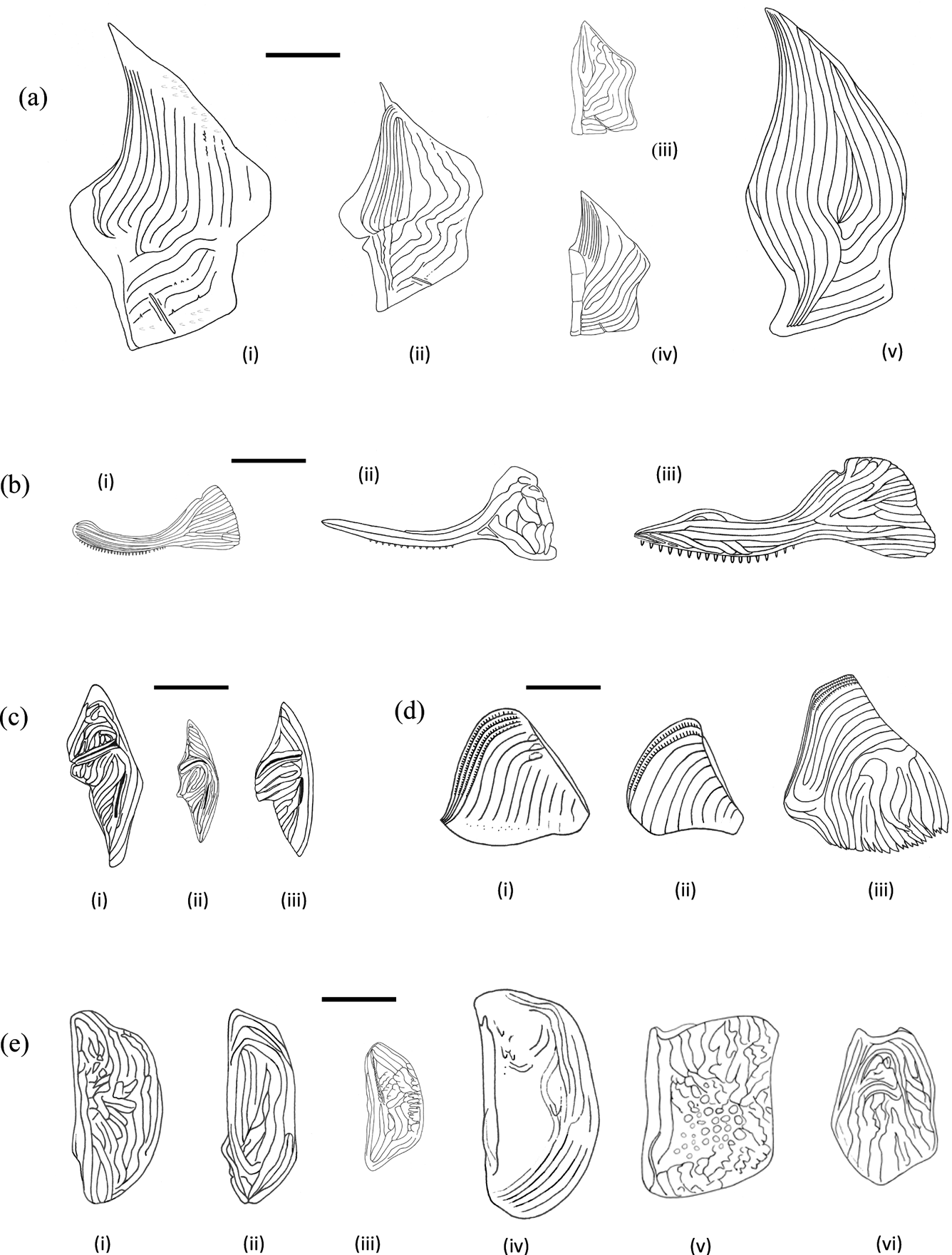
The cleithra (Fig. 9a) are typically haplolepid in ornamentation and form. That is, compared with the cleithra of other basal actinopterygians, they are large for the size of the fish, broader ventrally and, without exception, strongly ornamented with flat ridges and grooves along the anterior, posterior and ventral borders. In addition, the existence of a ventral lateral line is evident by the presence of a pit line close to the ventral margin of the bone. These pit lines are not found on all cleithra and the angle which they occupy on these bones can vary considerably in different species. The cleithrum (Fig. 9a (i)) indicating the presence of a ventral lateral line is similar to that of P. tuberculata from Linton and is usually associated with the remains of P. alexandrae. There are several similar cleithra to that shown in Figure 9 (Fig. 9a (v)) in which the ventral pit line is absent, the only difference being the size of the bone and the direction in ornamentation which can vary. The small square-shaped cleithra (Fig. 9a (iii), (iv)) also exhibiting ventral pit lines are from Pyritocephalus; the smaller one belongs to Pyritocephalus youngii.
Line drawings of various dermal elements of Haplolepidae from Wester Bracco: (a) cleithra; (b) maxillaries; (c) preopercula; (d) clavicles; (e) opercula/subopercula. Scale bars=2 mm.

All maxillae (Fig. 9b) encountered so far have a greatly modified postorbital expansion similar to that found in P. tuberculata and H. corrugata from Linton and in P. scotica from Loanhead. The teeth along the dentary margin are strong, conical and sharp; the size of which can vary quite considerably within species. Ornamentation on the maxillae is usually of broad terraced rugae running parallel with the dorsal and ventral margins. A quadratojugal has not been observed on any specimen.
The small maxilla with the triangular-shaped postorbital expansion (Fig. 9b (i)) is usually associated with P. isabellae; also to be found are much larger, almost identical maxillae with a similar triangular-shaped expansion; the teeth are large and conical and the notched area may be located close to the apex of the expansion, or further along the optic margin. The tuberculated maxilla (Fig. 9b (ii)) is usually associated with remains of P. alexandrae.
The preopercula (Fig. 9c) are of the typical haplolepid type in which the expanded anterodorsal part does not continue over the orbit as in other actinopterygians, but remains posterior to it. All specimens found are very similar in shape to the preoperculum found in H. corrugata from Linton and in P. scotica from Loanhead: a lunate posterior margin; the anterior margin notched anterodorsally at the point of contact with the suborbital and anteroventrally for the maxilla; and ornamentation of a rather complex pattern in which both horizontal and vertical pit lines can be clearly observed.
The clavicles (Fig. 9d) are large for the size of the fish, triangular in form and ornamented with strong flat rugae. The direction of this ornamentation, which is a continuation of the same pattern from the cleithrum, runs mostly parallel with the anterior margin of the bone. The ventral margin, however, may be smooth or strongly denticulated, as in Figure 9d (iii).
The opercula and subopercula (Fig. 9e) are large plates which can be ovoid, square or irregular in outline. The ovoid operculum (Fig. 9e (i)) is very similar to that found in Parahaplolepis scotica from Loanhead and the irregular shaped suboperculum (Fig. 9e (vi)) is similar to the bone found in Microhaplolepis ovoidea from Linton. The ornamentation of most opercula is of a strong flat rugae running more or less parallel with the plate margins, but it can be almost smooth with a few concentric grooves, as in Figure 9e (iv). The flat rugae of the subopercula on the other hand, tend to run dorsoventrally and form small tubercles or striations at the centre of the plate.
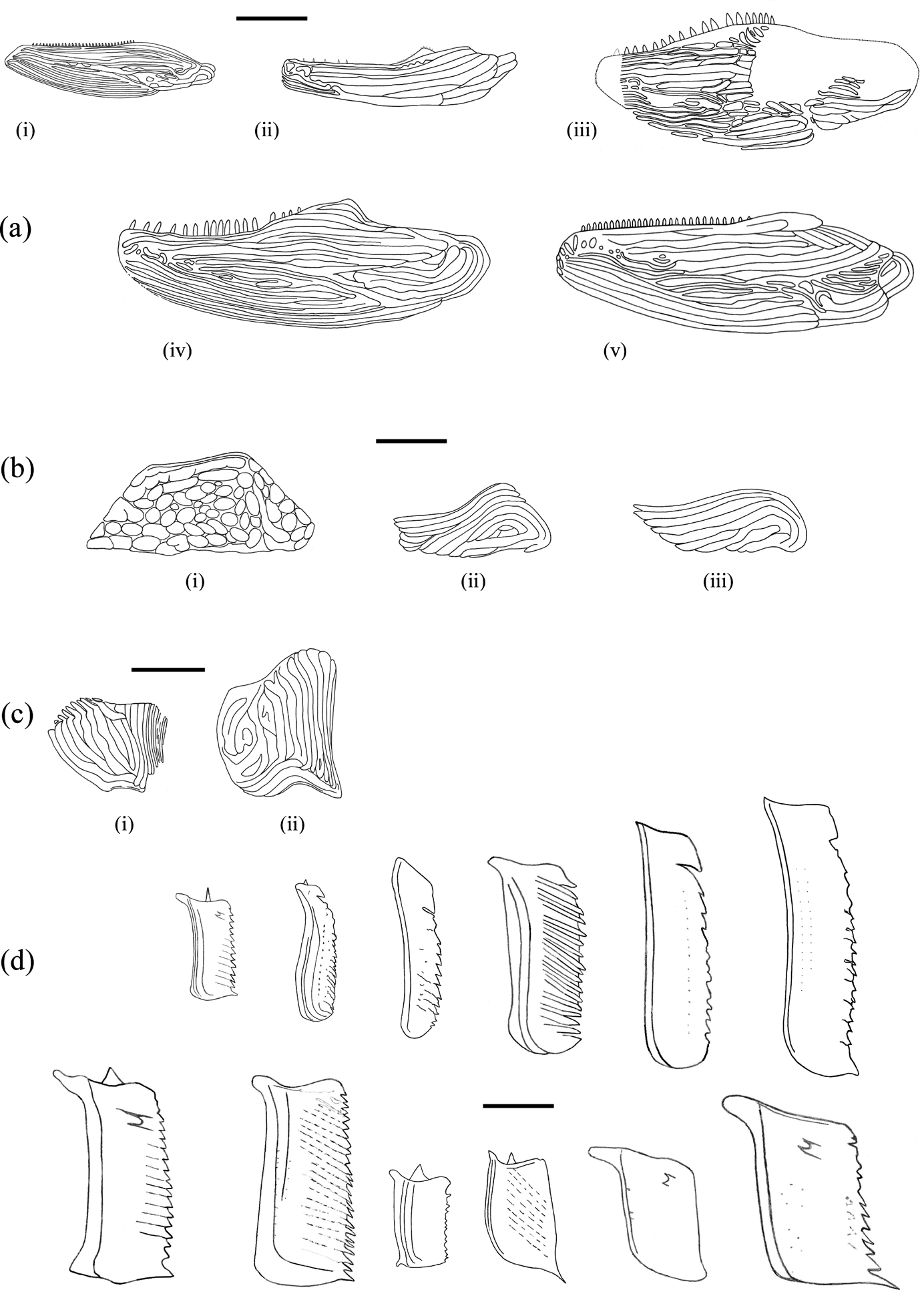
The dentaries are extremely deep in some specimens and usually have a very strong ornamentation of well-marked, longitudinal rugae; occasionally they exhibit an ornamentation with flat ridges and grooves, as found in Pyritocephalus youngii (Fig. 10a (ii)). The articular is clearly observed in most specimens; in some instances detached and missing. The teeth, irrespective of size, are strong, conical and sharp and vary considerably in arrangement, from being very close together to having a short space between each tooth. The dentary (Fig. 10a (i)) is often associated with the remains of P. isabellae, and the large dentaries (Fig. 10a (iii), (iv)) show different aspects of a dentary most likely to belong to P. limnades.
Line drawings of various dermal elements and scales of Haplolepidae from Wester Bracco: (a) dentaries; (b) dermosphenotics; (c) nasals; (d) scales. Scale bars=2 mm.

The dermosphenotics of these haplolepids (Fig.10b) are stout and usually ornamented with a pattern similar to that found on the skull roof. This may be an ornamentation of strong terraced rugae running parallel with the medial and distal borders of the bone, or with low rounded tubercles, similar to that of P. tuberculata from Linton or as in P. alexandrae (Fig. 10b (i)).
Very little information concerning the morphological detail of the nasals of these fish is known, due to the fact that they are not commonly found; although this may be due to their small size or to the fact that they do not preserve very well. The two specimens shown in Figure 10 (Fig. 10c) appear to exhibit an arched contour at their lower margins, which may correspond to the anteromesial openings found in the nasals of haplolepids.
The supracleithra and postcleithra are commonly met with and are ovoid in form and ornamented with strong, concentric, flat ridges and grooves. The posterior margin is strongly denticulated in some specimens.
The scales (Fig. 10d) of these fish, especially the high diagnostic lateral scales, are features which can vary quite considerably in their specific osteology: the anterior lateral scales may be four or five times as high as wide; usually lustrous and completely smooth or with diagonal grooves, punctuations or ridges, the ridges often indicating wear on the otherwise smooth surface; posteriorly with or without fine, coarse or blunt denticulations; ‘peg-and-socket’ articulation on some types of scale, absent from others, the peg being narrow or broad, depending on species; anterodorsal corner of scales for most species is curiously drawn out and extended, on certain scales this characteristic may be absent; lateral line and accessory lateral line evident by deep, near horizontally orientated pits and grooves high up on the scale. The osteological and histological detail of the scales of this family is in fact very complex, not quite what the English translation of their Latin name suggests (haplo and lepis, or ‘simple scale’).
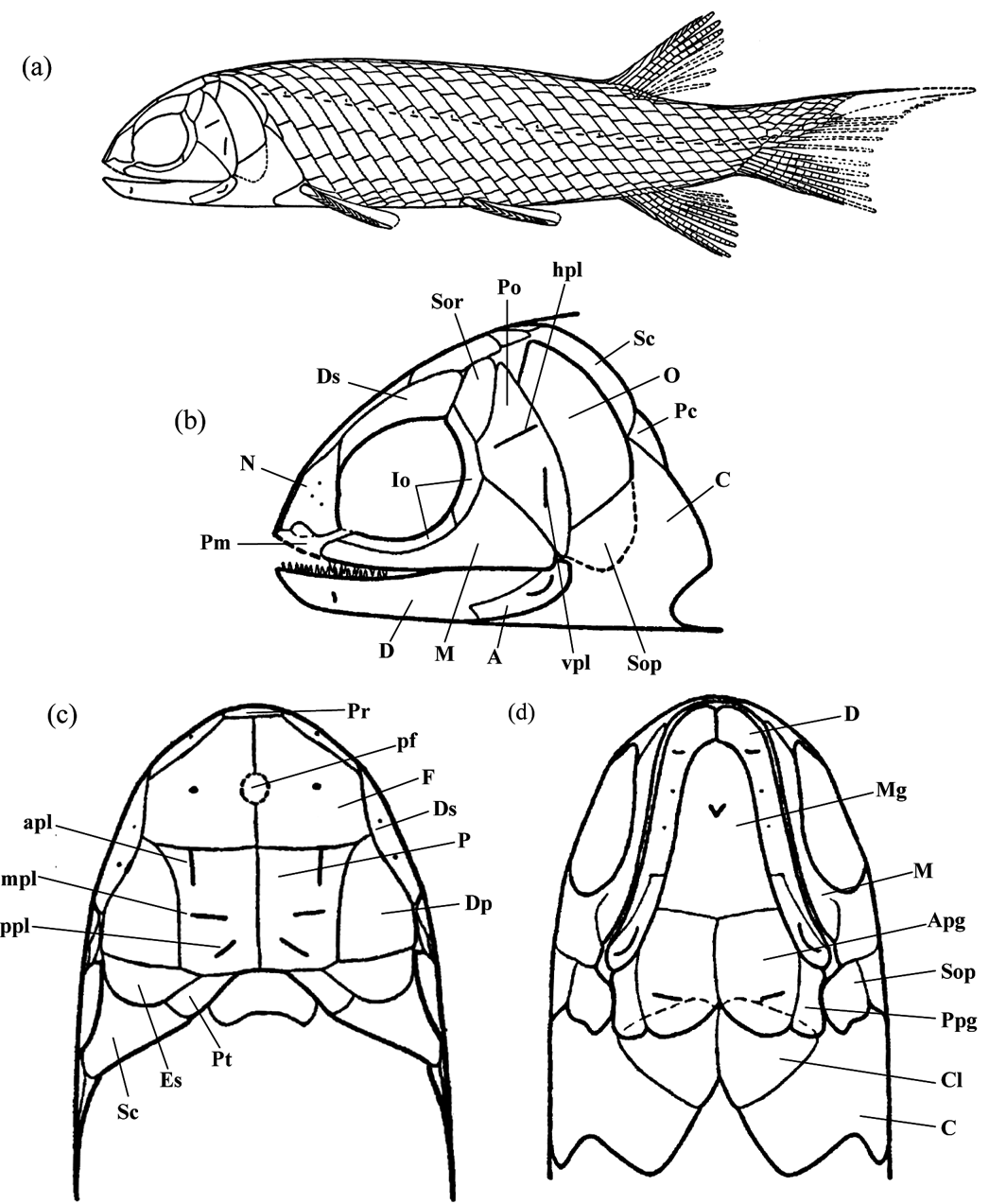
Infraorbitals, posttemporals and suborbitals of haplolepids are also commonly found; however, identification of many smaller elements could not be given with complete certainty. Furthermore, the gulars from these fish have not been identified so far; it may be that this type of fossilisation does not favour their preservation. The illustrations shown in Figure 11 may be referred to as a guide in the nomenclature of the dermal elements discussed throughout the study.
(a) Haplolepis corrugata (Newberry), reconstruction of whole fish in lateral view. (b) H. corrugate, reconstruction of dermal skull and shoulder girdle in lateral view. (c) Microhaplolepis ovoidea (Newberry), reconstruction of dermal skull in dorsal view. (d) M. ovoidea, reconstruction of dermal skull in ventral view. All figures modified after Westoll (Reference Westoll1944). Abbreviations: A=angular; Apg=anterior paired gular; apl=anterior pit line of parietal; C=cleithrum; Cl=clavicle; D=dentary; Dp=dermopterotic; Ds=dermosphenotic; Es=extrascapular; F=frontal; hpl=horizontal pit line of preoperculum; Io=infraorbital; M=maxilla; Mg=median gular; mpl=middle pit line of parietal; N=nasal; O=operculum; P=parietal; Pc=postcleithrum; pf=pineal foramen or macula; Pm=premaxilla; Po=preoperculum; Ppg=posterior paired gular; ppl=posterior pit line of parietal; Pr=postrostral; Pt=posttemporal; Sc=supracleithrum; Sor=suborbital; Sop=suboperculum; vpl=vertical pit line of preoperculum. Dashed lines indicate areas of free reconstruction.

3. Cladistic analysis
The variation in skull roof morphologies in the Haplolepidae has for many years been used as an aid in the determination of taxonomic classification within the family. A phylogenetic analysis was thus conducted in order to establish hypothetical relationships which may have existed between the haplolepids and different, though closely related, lower actinopterygians. The information was then used to ascertain the possible taxonomic placements for the new genus Millerolepis eleionome and the problematic Haplolepis attheyi from Newsham.
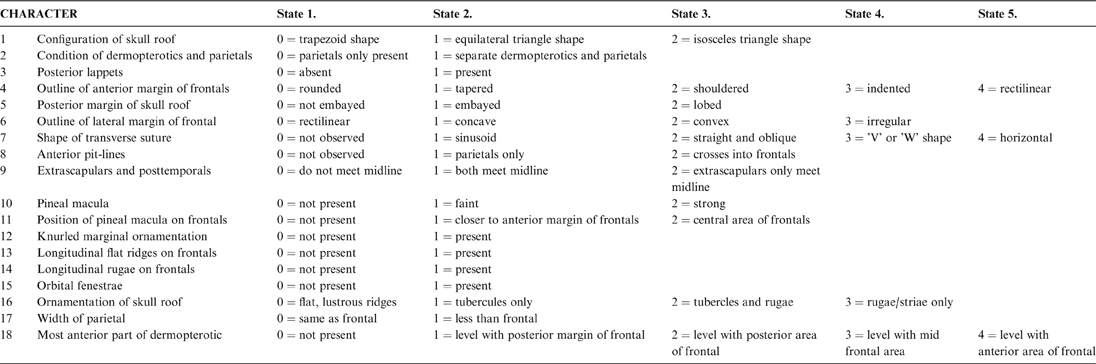
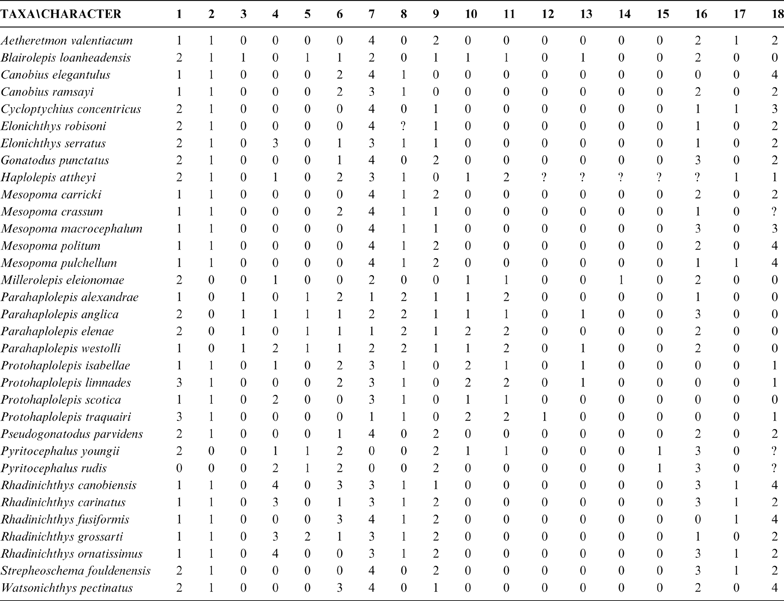
Morphological data were obtained from detailed illustrations in Traquair (Reference Traquair1914), Moy-Thomas & Bradley Dyne (Reference Moy-Thomas and Bradley Dyne1938), Gardiner & Schaeffer (Reference Gardiner and Schaeffer1989) and from personal material. A list of 18 characters with a maximum of five states was created (Table 2) and, with the assumption that all characters are valid for all taxa, the information was used to construct a data matrix (Table 3). All analyses were conducted using the phylogenic package Mesquite Version 3.0 and applying a heuristic search to create the most parsimonious trees, and with all characters unordered and given equal weight. The hypothesis was also tested using TNT Version 1.1, which generated similar results.
List of character and character states for cladograms A and B

Data matrix for generation of cladograms A and B

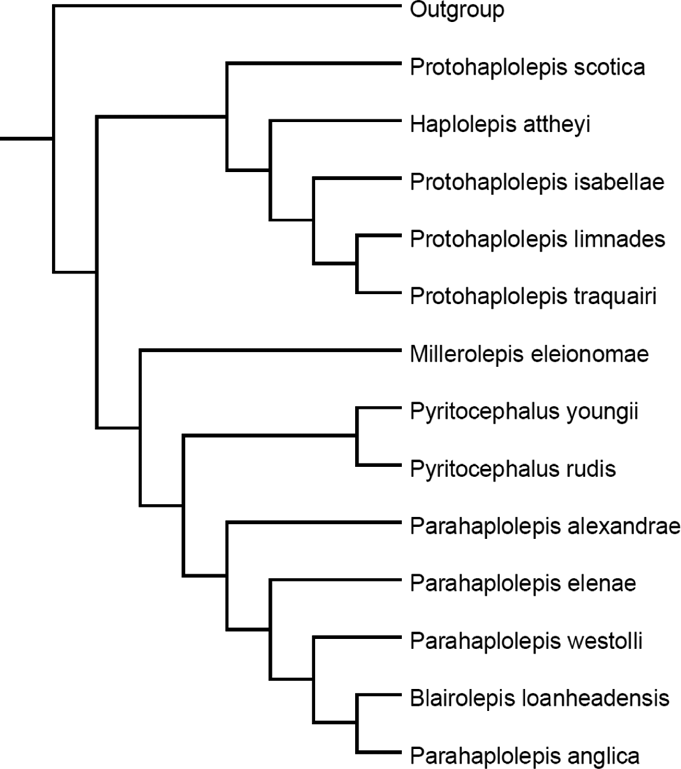
In order to establish relationships within the Haplolepidae and Canobius–Mesopoma–Rhadinichthys complex, a homologous hypothesis was produced using 32 taxa from fossil localities in Scotland and England. This tree was rooted to the genus Canobius, since Westoll (Reference Westoll1944) hypothesised that Canobius, due to the close resemblance in its skull roof to the most generalised species of Haplolepis, could have an ancestral lineage with the Haplolepidae. This analysis excluded Haplolepis attheyi due to missing detail from the original specimen. However, a second cladogram using 13 haplolepid taxa, including Haplolepis attheyi, was generated with the phylogenic tree rooted to a hypothetical outgroup.
Figure 12 clearly illustrates a common relationship within the Haplolepidae and other lower actinopterygians. This can also be shown by examination of the skull roof of Canobius ramsey; which reveals several features which in form and structure are remarkably similar to those of a haplolepid, an observation which was also noted by Westoll (Reference Westoll1944). This is especially true as regards the resemblance of the skull roof to that of the genus Protohaplolepis, albeit without the pineal macula. On the other hand, concerning the skull roof of Canobius elegantulus, although the morphological detail is basically similar to that of Canobius ramsey; the dermopterotics extend in a forward direction and terminate close to the anterior margin of the frontals. This is also a feature prevalent in the genus Mesopoma, the nearest known relative of Canobius, and by virtue of the mode of jaw suspensorium in Mesopoma, is also known to be closely related to the Rhadinichthyids. Thus, and in agreement with the cladistics results, the Canobius elegantulus line does not appear to produce a distinct haplolepid phylogeny. However, the results do indicate there is a possible lineage with Canobius ramseyi to the Haplolepidae, and as such present the Haplolepidae as paraphyletic with two monophyletic groups:
(1) The clade representing the subfamily Haplolepinae (Lowney Reference Lowney1983) is composed of the haplolepids Protohaplolepis scotica and P. isabellae, with P. limnades and P. traquairi forming closely related sister taxa;
(2) The clade representing the subfamily Parahaplolepinae (Lowney Reference Lowney1983) contains the haplolepids Parahaplolepis anglica; P. westolli, the sister taxa P. elenae and P. alexandrae; Millerolepis eleionome; Blairolepis loanheadensis; and sister taxa Pyritocephalus youngii and P. rudis.
Cladogram A. The most parsimonious tree showing the relationship between the main groups of lower actinopterygians introduced in this paper (tree length=90; consistency index=0.4222; retention index=0.6730).

Figure 13 shows a possible relationship with haplolepids from the UK which are all referred to in this study and, bearing in mind the missing character data, includes the position of Haplolepis attheyi within the Haplolepinae. Again, two monophyletic groups are depicted within the Haplolepidae:
(1) The Haplolepinae, in which all taxa are as in Figure 12;
(2) The Parahaplolepinae, which, in this case, has a slightly different arrangement from that in Figure 12 and contains: Millerolepis eleionome; sister taxa Pyritocephalus youngii and P. rudis; Parahaplolepis elenae; P. alexandrae; P. westolli; with sister taxa Blairolepis loanheadensis and Parahaplolepis anglica.
Cladogram B. The most parsimonious tree showing the relationship of Haplolepis attheyi with other Haplolepidae mentioned in this study (tree length=54; consistency index=0.5556; retention index=0.6757).

In effect, the analyses clearly show that the subfamilies Haplolepinae and Parahaplolepinae most likely evolved in parallel with each another and that the genus Millerolepis eleionome should be placed within the latter subfamily. Also indicated in the analyses is that Haplolepis attheyi should be positioned within the Haplolepinae, and possibly renamed Protohaplolepis attheyi. And, furthermore, the study also implies that the separate parietals and dermopterotics found in many genera are a homologous trait, with the loss of the dermopterotics being a derived synapomorphyic character state.
Using meristic data alone as a method of defining the classification of taxa introduces a higher degree of variability into the data set than by using morphological information. This is due to the fact that certain conditions, such as fin position and scale count, may vary depending on individual factors such as the size and sex of the fish in question. Whereas, concerning the structure of skull roofs, the general pattern in layout of the bones remains more or less constant, with any variation occurring solely in the strength of the ornamentation. Thus, the analytical study of skull roof morphologies may be used as an additional aid in the taxonomic classification for many taxa, besides that of the Haplolepidae.
4. Biostratigraphical and geographical distribution
The discovery of a number of new species of haplolepid in association with other freshwater fish fauna in the Westphalian A (Bashkirian) of the Midland Valley of Scotland has helped to fill a gap in the continuity of the chronological history of the Haplolepidae in Europe. Although these new taxa are stratigraphically younger than the previously known specimens from the Scottish Namurian (Lowney Reference Lowney1983), they are also to be found in a stratigraphic horizon equivalent to the earliest haplolepid recorded from the North American continent, Parahaplolepis canadensis from Parrsboro, Nova Scotia.
The distribution of the Haplolepidae in western Europe (Table 4) demonstrates the possibility of the lateral distribution of the taxon through Europe, which possibly began in the vicinity of the Midland Valley of Scotland, spreading in the direction of Northumberland and the English Midlands and then into continental Europe. This dispersal would coincide with a migration of haplolepid fauna from Europe and westwards through the vast equatorial coal swamps into the areas of Canada and the rest of North America (Lowney Reference Lowney1983).
Stratigraphic history of the Haplolepidae in Europe

5. Associated fauna
As regards the strata where haplolepid fossils are to be found, it is interesting to note that the ostracod Beyrichia arcuata is always present in large numbers. For that reason, it is possible that these crustaceans served as a food source for these fish and, most likely, for other small actinopterygians. Very little is known of the diet of haplolepids, although the large, sharp, conical teeth found on most haplolepid dentaries and maxillae do suggest a diet of small fish and invertebrates. Also worth noting is the association of haplolepid remains with the brachiopod Lingula mytiloides and the serpulid worm Spirorbis carbonarius; the fossils of these invertebrates, although abundant at times, are not always present. Haplolepid fossils are also found close to, but have never been found within, the Anthracomya or Carbonicola mussel beds. These bivalves are commonly met with in bands of several centimetres in thickness, and where an assortment of fish remains are frequently found trapped between the closely-spaced mussels.
There is, however, a noticeable near complete absence of large predator fishes in the haplolepid-bearing strata. Fossils of the larger coelacanths, rhizodonts and elasmobranchs, which may be found in quantity a few centimetres above and below the thin haplolepid beds, are very rare in these rocks. Westoll (Reference Westoll1944, p. 106), however, mentioned that large baphetids were often associated with haplolepids, and that these tetrapods were practically confined to known haplolepid-yielding localities. In fact, the remains of a large tetrapod, most probably Loxomma rankini, are found in close proximity to the haplolepid stratum in the shales at Wester Bracco; the very nature of the shale tips makes the exact distance from the haplolepid stratum difficult to measure.
Unlike most other actinopterygians encountered in the Lower Coal Measures of Scotland, the skull roofs of haplolepids are normally found with the cranial dermal plates still articulated; this occurrence is most likely the result of ankylosis along the suture lines, although occasionally specimens are found which have separated along the mid-sagittal or other suture, but this is not a very common occurrence. In many instances, however, skull roofs are found in a state in which the complete assemblage has folded over on itself before fossilisation. This condition, and the fragmentary nature of the material in general, suggests that these fish could not have been buried rapidly after death but were subjected to a moderate form of water movement which carried the remains a relatively short distance. It is also possible that the dead fish floated for a length of time in a fine, briny silt in a low energy environment and, as decay gradually set in, this would allow the various dermal elements to become disarticulated, but not scattered. Eventually, and due to the large density gradient, the suspension and its contents settled to form a very thin band of material, typical of that found in the Lanarkshire coalfield shale beds. This is evidenced by the fact that disarticulated scales are found en masse and it is not uncommon to find these scales accompanied by head bones, apparently from the same individual. It is, of course, also possible that scavengers may have fed on the decaying fish and left the bones and scales slightly disturbed but undamaged before burial.
6. The taxonomic position of Haplolepis attheyi from Newsham
Westoll (Reference Westoll1944) based his conclusions on the taxonomic position of Haplolepis attheyi on a single skull roof and with the ornamentation and strong dentition of a single dentary. He also mentioned that the fin rays of the caudal fin were widely separated, segmented and with the basal segments expanded, and that the scales were entirely smooth with the anterior ones denticulated: details which could be found in other haplolepid genera. However, Lowney (Reference Lowney1983) described a complete operculum in which the bone is shaped and ornamented as in Protohaplolepis scotica. This description is remarkably similar to that of several operculae found in the Lanarkshire coalfield, and which are usually associated with Protohaplolepis material. Furthermore, Westoll did not include H. attheyi within the genus Parahaplolepis, due to the absence of a marked concavity of the posterior margin of the skull roof. Nonetheless, it can be deduced from this study that the shape of the posterior margin of the skull roof can be quite variable, even within a range of skull roofs of similar species; for example, compare the posterior of the skull roof margins of Protohaplolepis isabellae and Protohaplolepis limnades (Figs 8a and 8c respectively).
The original specimen of H. attheyi lacked ornamentation and, consequently, no proper description was given of this feature. Nonetheless, regarding the genus Protohaplolepis, the ornamentation of the skull roof can be either terraced with deep grooves, tuberculated or a mixture of both of these, or with longitudinal rugae, and not limited to a terraced pattern: for instance, compare the skull roof ornamentation of P. isabellae (Fig. 1a–d) and P. limnades (Fig. 2a, b). It is fair to say that although the facial dermal elements of H. attheyi resemble very closely those of Haplolepis corrugata from Linton, the structure of the skull roof, in particular the separate dermosphenotics and parietals in H. attheyi, seems to exclude it from any taxonomic connection with the genus Haplolepis. Haplolepis attheyi does, however, possess several of the diagnostic characteristics given to both Microhaplolepis and Protohaplolepis: the short, broad skull roof; the separate dermopterotics and parietals; and the absence of posterolateral lappets.
The dentaries of haplolepids from the Lanarkshire coalfield seem to be exclusively a fairly deep bone with longitudinal rugae and a well-marked angular; with the exception of Pyritocephalus, all the teeth have been strong, conical and sharp, irrespective of size. The size of the teeth on the dentary (but not their form) has also been shown to be a very variable character; this most likely also applies to the maxilla. With this information regarding the teeth, we can look at the illustration of H. attheyi in Westoll's (Reference Westoll1944) monograph. At the top part of the illustration and close to the specimen, a small plate with tiny hemispherical teeth can be seen. This tiny tooth plate has been identified as possibly belonging to the illustrated specimen. The assumption that these hemispherical teeth belong to of H. attheyi is certainly incorrect, as this element is most likely part of the tooth palate of another common Carboniferous fish, the eurinotiform Amphicentrum.
The diversity of faunal material incorporated in the fossils found at the Lanarkshire coal shale tips has presented a clearer picture into an understanding and the distribution of British Haplolepidae, of which so little material is available; an assumption which most likely applies to material concerning continental European haplolepids. Thus, after careful study of these fossils and using information regarding the skull roof of H. attheyi given by Westoll (Reference Westoll1944) and the description of other material from Newsham presented by Lowney (Reference Lowney1983), it can be deduced that this skull roof is not of the Microhaplolepis–Haplolepis type (Lowney Reference Lowney1983, p.75), but rather the Microhaplolepis–Protohaplolepis type, as explained above.
Finally, considering the detail of the skull roof, the comparatively deep mandible with a strong longitudinal ornament of rugae and the shape and ornamentation of the operculum, Haplolepis attheyi should most likely be assigned to the generic level of Protohaplolepis Lowney.
7. Further notes on the Haplolepidae
At least two species of Pyritocephalus are to be found at Wester Bracco and, to date, Pyritocephalus youngii is the oldest member of the genus; this was previously attributed to Pyritocephalus rudis (Westoll Reference Westoll1944) from upper Westphalian B (late Bashkirian) material from Newsham, Northumberland, and was described from a single skull roof.
The peculiar shape of the skull roof of P. youngii (Figs 6a, b, 8f) is the result of the enlarged frontals, reduced parietals and the large, rounded temporal fenestrae, which in all probability are primitive characteristics of the genus. If these attributes are autapomorphic, then it is most unlikely that Pyritocephalus evolved from Parahaplolepis (Westoll Reference Westoll1944), or indeed from any haplolepid ancestry.
Furthermore, the form of the temporal fenestrae in P. youngii and the extent of the skull roof challenge a previous hypothesis. That theory is based on the assumption that the progressive development of the fenestrae and reduction of the skull roof was due to the enlargement of the supraorbital vacuities which happened over a period of time (Huber Reference Huber1992, p.186). However, careful examination of the osteological detail of the new material quite clearly illustrates that when a comparison is made of different species, the increase in the area of the vacuities and the reduction in the skull roof area did not happen over a period of time as proposed.
It is interesting to note that several other indeterminate fish remains are found in the Lanarkshire shale tips, which exhibit some of the morphological and osteological characteristics of haplolepids and other actinopterygians. For example, in one unknown taxon the dermopterotics are absent and the parietals exhibit small fenestrae at their lateral margins; in another, the dermal bones, including the tall scales, are strikingly similar to those found in haplolepids; albeit some diagnostic features are absent from the skull roofs. These fish lived in swamp areas in association with the haplolepids and may represent their close relatives, but it is not known whether they possess such features as the ventrally placed nostrils, reduced branchiostegals or the reduction of fin rays, which are characteristic of the Haplolepidae.
8. Conclusion
Seven new species of haplolepids from the Lanarkshire coal shale tips are used as an aid to the stratigraphic correlation and geological distribution of the Haplolepidae in Europe; and are in agreement that the family possibly arose in Great Britain and dispersed west to North America and east to the Czech Republic in continental Europe in a more or less simultaneous movement.
This work also supports the supposition that the fossilised remains of these fish are more common in Great Britain and continental Europe than previously estimated. This assumption is based on the fact that although haplolepids were small, minnow-sized fish and could quite easily be overlooked, there is a definite discrepancy in their fossil remains. This discrepancy is possibly due to the preference of haplolepids to inhabit quiet, shallow waters, as these areas would be relatively free from the larger predators which frequented the deeper parts. The result, therefore, of living in this type of environment was to limit the distribution of their fossilised remains to a few localised bands of material, which in most instances is only a millimetre or so in thickness, as found in the Lanarkshire coalfield. This presupposition may not only apply to the coal measures of Scotland but also to the large coal fields of England, where these small fish may have possibly been overlooked in the past.
Additionally, and as a result of the examination of this new material, it is shown that the area of the supraorbital vacuities and the reduction of the skull roof in the genus Pyritocephalus did not happen gradually over a period of time as previously thought; the new findings suggest that these features are most likely the result of apomorphic homology of the genus.
The study also indicates that the new genus Millerolepis eleionome should be placed with the Parahaplolepinae, and that the problematic Haplolepis attheyi from Newsham should (tentatively) be assigned to the generic level of Protohaplolepis within the subfamily Haplolepinae.
9. Acknowledgements
I am extremely grateful to Ramsey and William Kerr, owners of Wester Bracco Farm, for allowing me unlimited access to the shale tips. Many thanks to Tony Fallick, Josanne Newton and Jason Newton for their helpful comments and grammatical corrections to this paper; and special thanks to Neil Clark for his valuable suggestions during its preparation. Finally, I thank Mike Benton, Lauren C. Sallan and Adriana Lopez-Arbarello for their helpful and constructive criticisms of a previous draft of this manuscript. Please note that this study is of a personal nature and is not funded in any way by SUERC.