

The notion that we are in the midst of a “Second Gilded Age” has really taken off since the publication of Thomas Piketty's Capital in the Twenty-First Century in 2014. Yet while one might think that the expression has been broadly employed to focus on a wide-ranging list of issues that would include government corruption, corporate concentration, business ineptitude, or the crass superficiality for which Mark Twain first gave the era its gold-coated veneer—this has rarely been the case. In most of the instances of the term's being wielded in recent years, it has been narrowly construed to reference the sharp escalation in American income and wealth inequality since the 1980s—an era that, for lack of a better term, I refer to as the neoliberal period. For example, BBC Chief Business Correspondent Linda Yueh opened her 2014 article “Are We Living in the Second Gilded Age?” by citing Piketty, noting in the very first sentence that “the share of income going to the top 1 percent has grown to the point [that] the richest Americans now hold one-fifth of the country's overall income.” That same year, the Los Angeles Review of Books declared that “Piketty has shown that we are living in a Second Gilded Age.”Footnote 1
In this brief article, I will address this historical analogy as it has usually been framed—through the rather narrow lens of income and wealth inequality. To be more statistically specific, the temporal comparison at the core of the idea of a “Second Gilded Age” has been tightly linked to the famous “u-shaped” inequality graphs popularized by Piketty (first in his seminal article with Emmanuel Saez in 2003Footnote 2) that show a steep decline in inequality in the mid-twentieth century followed by a sharp uptick since the neoliberal turn in the 1980s. Yet when we take a closer look at Piketty's charts, an odd yet revealing discrepancy between the Second Gilded Age narrative and actual inequality trends becomes visible. Capital in the Twenty First Century's central graph on income inequality in the United States (figure 1 in the introduction) is far and away the book's most widely circulated chart. It has appeared in countless newspaper articles, Occupy Wall Street signs, and bestselling books. One could go so far as to say it is iconic—perhaps the first truly iconic economic graph in American history.Footnote 3
“The Productivity-Pay Gap,” updated July 2019. Reprinted with permission from the Economic Policy Institute. Data are for compensation (wages and benefits) of production/nonsupervisory workers in the private sector and net productivity of the total economy. “Net productivity” is the growth of output of goods and services less depreciation per hour worked. Source: EPI analysis of unpublished total economy productivity data from the Bureau of Labor Statistics (BLS) Labor Productivity and Costs program, and wage data from the BLS Current Employment Statistics, BLS Employment Cost Trends, BLS Consumer Price Index, and the Bureau of Economic Analysis National Income and Product Accounts.

As the graph makes plain, the most observable and obvious comparison to today's high rates of inequality appears not to be to the Gilded Age era—which does not even appear on the chart—but rather the 1920s. It was in 1929—not 1889—when, according to Piketty, American society reached the same peak levels of high inequality as today. The time frame of this specific graph, moreover, is no outlier. Since Piketty's great empirical intervention was to base his analysis on income tax returns, and since income taxes only began to be collected in the United States in the 1910s, most of Piketty's inequality charts on the United States begin well after the Gilded Age had already ended in the mid-1890s.Footnote 4
Why then have so many people, inspired by Piketty's graphs, chosen to label our own highly unequal period the “Second Gilded Age”? I will end this piece by briefly addressing this riddle. Along with the general catchiness of the framing, I believe it stems from modern American liberalism's refusal to fully grapple with the uncomfortable fact that many of the structural foundations of the highly unequal corporate capitalist society we live in today were realized, legitimized, and solidified not in the Gilded Age—an era still open to various political and socioeconomic paths and possibilities—but in the Progressive Era.
We must undertake a closer empirical examination of economic inequality in the Gilded Age and Progressive Era to gain a better understanding of the discrepancy between the Second Gilded Age narrative and the actual history of income and wealth distribution in the United States. In so doing, I will suggest that both detailed empirical data and the broader historical record leads to an alternative, and more apt, temporal analogy: perhaps we are actually living in a Second Progressive Era.
A Brief History of Inequality in the Gilded Age and Progressive Era
Due to the lack of income tax returns, the data before the 1910s is not nearly as exact as what came after. Nevertheless, economic historians have painstakingly collected data on national income, wealth, cost-of-living, and wages in this period, so a very general picture can be constructed regarding the era's class dynamics.
When it comes to the Gilded Age, the first economic phenomena we must take note of is “The Great Deflation.” Prices dropped precipitously between 1873 and 1896, both because of the (controversial) return to the gold standard in 1879, but also because of the second industrial revolution, which greatly increased productivity gains, thus making many mass-produced goods far cheaper.Footnote 5
Yet while most prices dropped, some did so far more than others. In the Gilded Age, the value of consumer goods tended to fall significantly more than wages. Try as industrialists might to lower wages at the same pace of overall prices, they mostly failed, in large part due to an increase in class power and solidarity among industrial workers and their middle-class neighbors. This means that for most American earners who were not farmers in this era (more on them below), real wages were on the rise.Footnote 6
To be sure, we must not conflate rising real wages with social progress; my recent book, The Pricing of Progress: Economic Indicators and the Capitalization of American Life, explains why. Nevertheless, this is a key aspect of the Gilded Age economy that often gets overlooked by noneconomic historians. While many Americans in this era worked harder, had more dangerous and insecure jobs, experienced diminishing social mobility, and led more stressful, lonely, and less fulfilling or dignified lives than before, their material well-being was likely improving. Evidence of this improvement can be found in nonmonetary measures such as height and life expectancy.Footnote 7
Here we see the first major discrepancy between the first and second Gilded Age: numerous studies have shown that, save for the top deciles, real wages in the past forty years have stagnated—and for those in the bottom deciles even dropped. For wide swaths of the American working population in the final decades of the nineteenth century, this does not seem to have been the case. At first glance, the framing of our current era as a Second Gilded Age does not seem to make much statistical sense.Footnote 8
What this all means for income inequality in the Gilded Age is not immediately clear. While historian James Livingston has argued that the material gains of Gilded Age workers are evidence of diminishing inequality, this assumes a zero-sum-game economy, which is not necessarily accurate. Trying to make any argument about income distribution in this era is tricky due to the reliance on very partial data. In Unequal Gains, the latest and most detailed book on income inequality before the twentieth century, economists Peter Lindert and Jeffrey Williamson argue that the Gilded Age witnessed a clear decrease in the “steep” inequality rate of antebellum America, yet continued to see a “mixed and modest” increase in income gaps between the rich and everyone else. Their estimates from 1870 and 1910, for instance, show an increase in the income of the top 1 percent from 9.8 percent in 1870 to 17.8 percent in 1910. But since these estimates were not made for 1880, 1890, or 1900 we remain uncertain as to whether this rise in inequality was mostly a product of the Gilded Age or the Progressive Era. Piketty's own U.S. wealth inequality estimates (not income—recall that those begin only in 1910) also jump from 1870 to 1910, and thus likewise do not allow us to compare inequality in the Gilded Age and Progressive Era.Footnote 9
Luckily, there are some broad patterns that we can creatively glean from historical data that may allow us, albeit rather crudely, to fill in some of these empirical blanks. One of the most striking signs of rising inequality since the mid-1970s has been the fact that while productivity growth per capita has continued to rise, wages have flatlined. This means that while workers are producing more value than ever before, since the mid-1970s they are no longer receiving the fruits of this increased productivity in the form of higher wages. Rather, much of the economic growth and productivity gains since the mid-1970s have ended up in the hands of capital—not labor. As a result, it is not surprising that we have seen a sharp rise in the income share of the 1 percent during this era: they have gobbled up nearly 60 percent of all productivity growth since 1977.Footnote 10
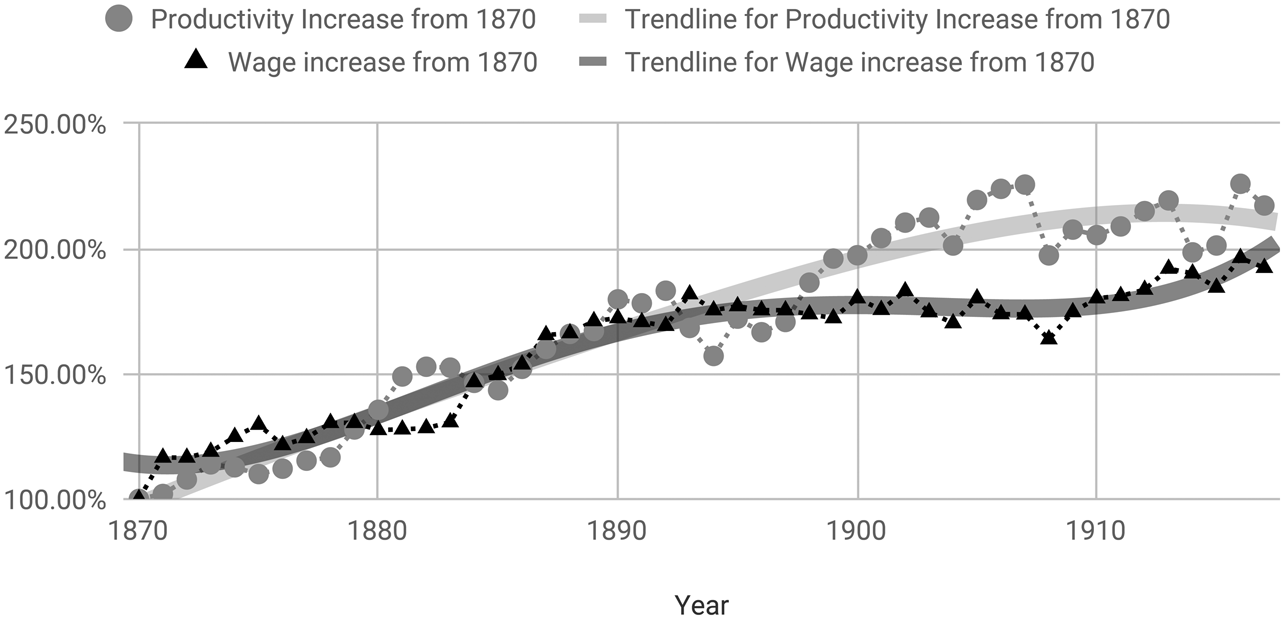
Using the MeasuringWorth.com historical database, I have attempted to reproduce this productivity versus pay chart for the Gilded Age and Progressive Era in order to gain a sense of the changing capital-labor power relations in this period. The data is partial and examines only the wages of blue-collar, industrial laborers—which means this graph can tell us little regarding the situation of African American sharecroppers, yeoman farmers, or agricultural, domestic, or white-collar office wage workers. Yet despite these important caveats, the data for the Gilded Age and Progressive Era is nevertheless revealing, as blue-collar workers were clearly a central part of the workforce in this industrializing era and at the heart of much of the class conflict between labor and capital.
Here are my findings:Footnote 11
Productivity versus pay chart for the Gilded Age and Progressive Era. Data are from MeasuringWorth.com. Chart by author, who would like to thank Robert Margo, Benjy Cook, and Gilad Bar Levav for their advice and assistance.

Before we delve into the nitty-gritty details, the map's overall trend is quite clear. It appears that the Gilded Age (1873–96) was quite similar to the 1950s and 1960s of the twentieth century, in that productivity and wages rose more or less in tandem over the long run, suggesting that industrial workers were receiving much of the gains of economic growth. On the other hand, around the start of the Progressive Era in the mid-1890s, we see a clear divergence between wages and productivity—a divergence that continues for much of the period and looks eerily similar to the pattern we have witnessed in the United States since the mid-1970s, as seen in the above Economic Policy Institute (EPI) graph.Footnote 12
In accordance to the graph, we can divide the Gilded Age into a number of shorter periods. Between 1873 and 1879, it appears that both wages and the overall economy grew at roughly the same rate, which means inequality levels likely held steady. Between 1879 and 1882, on the other hand, we see significant gains for capital over labor. While overall productivity growth rose, wages hardly budged. This was likely an era in which industrial inequality rose. Then came the mid-1880s, roughly 1883–86. Thanks in all likelihood to the dramatic rise of the Knights of Labor and a more powerful working class more generally, these years witnessed major gains for labor, as rates of growth actually dropped while rates of wages increased steadily. This was almost surely an era of decreasing inequality. After the Haymarket Affair in 1886, it appears as though labor lost some of its class power, as many historians (who probably never looked at this data) have already gathered from the historical record. Nevertheless, between 1886 and 1892, wages continued to grow—but this time the economy did so at roughly the same pace. Inequality levels probably remained stable. The final years of the Gilded Age appear once again to have proved good for labor over capital. Much like the early 1880s, growth rates dropped while wage growth rose. Labor's share of the pie likely increased. No wonder capitalists like Andrew Carnegie and George Pullman were so aggressive in their attempts to stamp out the Homestead and Pullman strikes in the early 1890s—capital was, more times than not, losing the class war in these years. On the other hand, this might also explain why urban industrial workers did not join political forces with the agrarian populists: things were going relatively well for them from a strictly materialist point of view.Footnote 13
To summarize, while there were ups and downs for American industrial workers in the Gilded Age, the trend lines in this graph make plain that from 1873 to 1896, industrial wages and the overall economy were growing at more or less the same rate. This means that, much like in the post–World War II years, much of the productivity gains brought about by the industrial revolution found their way into the pockets of the American industrial worker. If we add to this important statistical dynamic the unquantifiable rise of agrarian populists, bimetallists, the cooperative movement, urban ward politics, Georgist single tax leagues, Bellamy-inspired “nationalists,” the Sherman Antitrust Act (a thoroughly Gilded Age creation), big business’ struggle with “ruinous” competition, and the rejection of permanent wage labor by the likes of the Knights of Labor, it appears that the Gilded Age should be framed as an unstable, conflict-ridden era in which labor often had the upper hand, and thus countless futures were still on the proverbial table for American society. This seems very different from the past forty years of U.S. history, when neoliberal hegemony has reigned largely unchallenged.Footnote 14
Let us now turn to the Progressive Era. If we view 1896, as many historians do, as the end of the Gilded Age and beginning of the Progressive Era, it appears as if this moment was not only a transition from one historical period to another but also a crucial turning point in the history of American inequality and the power relations between workers and capitalists. From 1896 to around 1912—a period that spans most of the Progressive Era—wages remained almost completely flat while labor productivity and the overall economy continued to grow at much the same rate as in the Gilded Age. A real, significant improvement in labor power only took place during World War I. Even this jump, however, appears to be an anomaly of war, since the overall trend of the 1920s (as can be seen from Piketty's famous chart) continued that of the pre-war Progressive Era as inequality continued its upward climb.
In sum, much of the Progressive Era was a period of stagnating wages yet rising levels of productivity. We have seen charts like this before: this is the same pattern of inequality the United States has witnessed since the mid-1970s. In short, if we frame the last forty years through the narrow prism of income inequality—as most users of the term “The Second Gilded Age” have done—it appears that it is the Progressive Era, not the Gilded Age, that best matches our own times.
What of those who did not work in factories? Here, the data does not appear to be so readily available. One clue that suggests that rising inequality in this era was not only part and parcel of the industrial sector can be found in the fact that while 1890 census data reveals that the top 1 percent owned 25.8 percent of the wealth, economist Edward Wolff's 1922 data pegs that same number at a whopping 40.1 percent. Interestingly, this is almost precisely the same rate of wealth inequality that exists in America today.Footnote 15
While 1890 to 1922 is not exactly the time frame of the Progressive Era, the rise in wealth inequality during this period fits into the broader history of the period. Although rising inflation in the Progressive Era (mostly caused from an increase in the gold supply and not real policy change) may have eased some farmers’ pain, it seems more than likely that the bitter defeat of debtor populists in the latter half of the 1890s to creditor elites exacerbated the existing power asymmetries and wealth inequality between farmers and capitalists (even if farmers’ material condition improved temporarily). What is more, rising racism, violence, and discrimination in the Progressive Era suggests that the highly unequal condition of debt-ridden, poverty-stricken African Americans did not improve in this period, and possibly even got worse. In short, it would seem that perhaps the only “winners” of the Progressive Era from an inequality standpoint—besides the consolidating class of corporate bourgeoisie—were the very middle-class experts and professionals who gave this period its glowing reputation.Footnote 16
Comparing the First and Second Progressive Era
This suggested reframing of our own times as a Second Progressive Era does not, however, emerge only from a close reading of economic data. Rather, a deeper look at the reasons for the parallel rise in economic inequality in both of these periods allows us to see some of the key similarities that exist between these two eras. In comparing the two periods, I would argue that both eras of rising inequality share the following four broad structural and historical trends: increased globalization, depoliticization, financialization, and labor disempowerment. Combined, these four elements solidified corporate capitalism's grasp on the American polity during both eras, while weakening alternative forms of social organization that do not rely as heavily on large private sums of elite-owned, for-profit capital to run a society. If the Gilded Age and New Deal eras were rife with egalitarian, noncapitalist possibility, the Progressive and neoliberal eras foreclosed many of these options. In this article, I will only briefly address each of these four developments by tracking a very broad historical outline.Footnote 17
It is a well-established fact that globalization has played a central role in the upsurge of inequality since the 1970s, as capital usually gains from playing one nation off another. On the contrary, the Progressive Era has not always been framed as an age of increased globalization—although it clearly was. The years between 1886 and 1917 saw a sizeable reduction in American protectionary tariffs (the percentage of the budget collected from tariffs dropped from 57 percent in 1890 to 20 percent in 1917) and a significant rise in international trade and global investments. American corporations, investment banks, and the federal government aggressively turned their focus onto the world stage during these years, in part due to the second industrial revolution's problem of overproduction, pushing for an “open door” imperialism—especially in the Global South—which would enable them to sell their surplus goods in global markets as well as purchase raw materials at reduced costs. As Lance Davis and Robert Cull have shown, 1897 marked a key turning point in the American economy, as the United States went from being a net importer of capital to a net exporter. American capital was going global in the Progressive Era, a development that increased U.S. profit margins and bargaining power vis-à-vis labor, while also solving the nagging deflationary problems brought on by overproduction.Footnote 18
Both eras also experienced a rise in depoliticization. Sociologists of the past few decades have focused a great deal on how the neoliberal state has not necessarily shrunk, yet has become less democratic, with the bulk of policy-making power shifting from elected officials to unelected technocrats or bureaucratic organizations like the World Trade Organization or the European Union. A similar pattern took place in the expert-obsessed Progressive Era, with perhaps the most dramatic example (along with the rise of philanthropic organizations like the Carnegie and Rockefeller Foundations) being the founding of the Federal Reserve and the depoliticization of monetary policy. This was a striking shift from the Gilded Age era, when the question of money and who controls it was perhaps the most burning political issue of the period. Such depoliticization likely played a role in declining voting rates—yet another striking similarity between the Progressive Era and the neoliberal epoch (but not the Gilded Age.) A stunning 79.3 percent of voters took part in the 1896 election—the final election of the Gilded Age—which was centered on monetary policy. This continued a trend that had existed throughout the Gilded Age. (In 1888, for instance, turnout was also 79.3 percent). On the other hand, the Progressive Era saw a consistent decline in turn out, usually hovering around 50–55 percent and reaching a low of 49.1 percent in 1920. These are roughly the same turnout figures we see since the 1980s.Footnote 19 (Of course we must add that in both of these eras, women and African Americans were disenfranchised).
Both eras also witnessed a great leap in financialization. In 1890, the aggregated amount of capital in publicly traded manufactured companies was a paltry $33 million. By 1898, it would hit the $1 billion mark. Five years later, following a period historians have referred to as the “Great Merger Movement,” it ballooned to almost $5 billion. It was, in short, during the early Progressive Era—not the Gilded Age—that the United States really “went corporate,” and that the fruits of American industry were consolidated, securitized, financialized, and divvied up into an array of interest-bearing bonds and dividend-bearing stocks. According to economist Thomas Philippon's data, the financial sector's share in the economy rose significantly from 1905 to 1917. This meeting of Main Street and Wall Street had enormous ramifications in the American economy and in everyday life, as investment banks such as J. P. Morgan became arguably the most powerful forces not only in domestic economic policy (as in the Panic of 1907) but also in foreign diplomatic policy (such as in the Caribbean). After a regulatory clampdown in the New Deal era, such a financialized society once again became a key driver of the American economy (and American inequality) in the neoliberal era.Footnote 20
Finally, the “incorporation” of the American economy in the wake of the great merger movement dramatically changed the power relations between labor and capital. By the end of the Progressive Era in 1919, 86 percent of wage laborers worked for publicly traded corporations. As factories became bigger, less personal, and more hierarchical, and the pressure for stock dividends pushed down on them, workers lost a great deal of day-to-day power in the workplace to a cadre of efficiency experts, middle managers, and other technocrats. It was in the Progressive Era—not the Gilded Age—that Frederick Winslow Taylor's system of labor surveillance and control took off, breeding a significant disempowerment and degradation of the American worker and, as historian David Montgomery and others have argued, “the fall of the house of labor.” One could even go so far as to argue that the class violence of the Gilded Age revealed the relative weakness of capital in this era and its inability to control labor. By the Progressive Era, with the invention of the time clock, assembly line, differential piece rates, industrial psychology, and other forms of labor discipline (including a rising advertising industry and consumer culture), there was less of a need for such blunt and messy tactics. Shifting to our own epoch, the last forty years have witnessed a resurgence in such subtle forms of labor control, repression, and disempowerment. Be it the tyranny of the über five-star rating, tracking devices on Amazon warehouse workers, or your run-of-the-mill quota-based payment practices, it appears that today's technocratic workplace is more aligned with the first Progressive Era than the first Gilded Age.Footnote 21
What's in a Name?
I hope that this brief article has made a convincing argument that, when it comes to the question of economic inequality, the neoliberal epoch shares much more with the Progressive Era than the Gilded Age. Why then the rush to claim this era as a “Second Gilded Age”? There are various forces at play here, including the catchiness of the name itself, but I would argue that one central reason stems from the historical—and ideological—self-perception of American liberalism.
Any effective ideology must have a solid origin story. For American liberalism, this origin tale has always relied on our self-proclaimed “Progressive Era.” This branding exercise virtually ensured the reproduction of a very particular historical narrative that—despite the tireless efforts of contrarian forces like the New Left's “corporate liberal” school and its followers—still dominates textbook timelines, best-selling biographies, and most college history departments. In the beginning, as the familiar narrative goes, there was the “Gilded Age,” an era of rampant capitalistic greed in which the fortunes of the hardworking American people were crushed by conservative “robber barons” and the corrupt politicians these men had in their pockets. But then everything changed. With the new century came a dramatic turn of events as a liberal cadre of crusading middle-class “reformers”—led by the “trust-busting” likes of Teddy Roosevelt—took control of the federal government, instituted a number of anti-business reforms, and ushered in a Progressive Era that wrested power away from “the interests” and returned it to “the people.”Footnote 22
So what happens if we shift the historical comparison to the Progressive Era? First, I fully recognize that publicly framing our neoliberal epoch as a “Second Progressive Era” is probably a terrible idea. Social-democratic forces have managed to claim the adjective “progressive” in recent years—a development that would render this analogy extremely confusing and misleading to the larger public. Nevertheless, as an intellectual exercise and social critique, I find the framing of a “Second Progressive Era” to be a far more fruitful provocation than the “Second Gilded Age,” one that could help unsettle the basic tenets of centrist, middle-class, American liberalism rather than reinforce them. Signaling to professional, middle-class American liberals today that their own plutocratic society is more similar to their beloved Progressive Era than the despised Gilded Age would require them to rethink not only the mainstream periodization of American history they learned in high school or college, but their own political and economic belief system surrounding questions of finance, expertise, labor empowerment, globalization, democracy, urban politics and more.
Recognizing the inegalitarian similarities between the Progressive and neoliberal eras helps make plain that today's rising inequality was caused not only by shadowy conservative billionaires but also liberal ideas, policy, and expertise—be it Bill Clinton's repeal of Glass-Steagall or creation of NAFTA, the role of “independent” Federal Reserve heads like Paul Volcker and Ben Bernanke in increasing wealth inequality through planned recessions and bank bailouts, or the Democratic Party's marginalizing of working-class labor issues for the past forty years. At a crucial historical moment when centrist-liberals are battling more left-leaning, social-democratic forces for Democratic Party leadership in the larger fight against conservative reactionaries, a historical framing that does not thrust all of the blame for our current plutocratic predicament solely on the likes of the Koch brothers is badly needed to ensure that the mistakes of the early twentieth century do not repeat themselves.
Finally, of course, I do not deny that the Progressive Era had its fair share of trailblazing social reformers and muckrakers—the names Florence Kelley, Louis Brandeis, Ida B. Wells, Ida Tarbell, and W. E. B Du Bois come most immediately to mind—who absolutely fit into the mainstream historical narrative. But the neoliberal era has had its fair share of activist stars as well—be they Barbara Ehrenreich, Jesse Jackson, Ralph Nader, or Bernie Sanders. I also do not consider this a perfect historical analogy by any means. In certain areas, such as federal tax policy and public health, it appears that the Progressive Era did create important, long-term redistributive institutions. Nevertheless, I do believe that the empirical findings presented here suggest that when all is balanced out, the Progressive Era witnessed a significant increase in economic inequality. Be it the rise of investment banking, neoclassical economics, Taylorism, the Federal Reserve, the industrial corporation, American imperialism, scientific management, or Plessy v. Ferguson, the twenty years prior to World War I appear to have ushered in institutional and structural changes that shifted class power from labor to capital while increasing income and wealth inequality. If we are going to effectively deal with the rampant unequal social arrangements that rule our “Second Progressive Era,” perhaps we must first come to terms with what exactly happened in our first.