Introduction
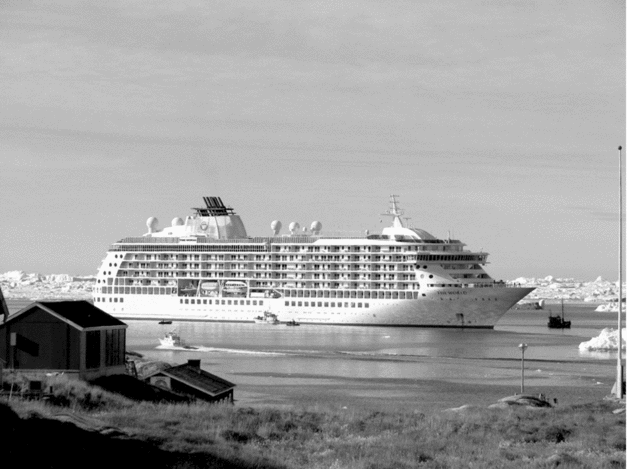
In September 2012, The World, Fig. 1, the largest privately owned residential yacht on Earth, became the largest passenger ship to transit the northwest passage, unescorted. Built in 2000, and having a displacement of 43,524 tons and a length of 196 m, the vessel first set sail in 2002, and has visited more than 800 ports in some 140 countries, including Antarctica for three austral summers, 2003–2004, 2006–2007, and 2010–2011. The ship is operated by ROW Management, Ltd. which is based in Miramar, Florida, and is registered in the Bahamas. The World is a member of the International Association of Antarctica Tour Operators (IAATO).
The World off Ilulissat, Greenland. Photo by Patrick Toomey.

With a continuous worldwide itinerary that enables the vessel to span the globe every two to three years, the ship is a floating city, equipped with luxurious amenities. The World has 165 residences ranging from studios to expansive three-bedroom units and a palatial six-bedroom penthouse suite. Residents own the homes onboard, and along with its Captains, choose the ship itinerary. Average occupancy is 150–200 residents and guests who spend an average of four months onboard each year.
Roald Amundsen was the first to transit the northwest passage in Gjøa, a 21 m auxiliary sloop, in 1903–1906, wintering at locations along the route. Lists of transits since 1906 to 1990 were compiled by Pullen and Swithinbank (Reference Pullen and Swithinbank1991), and Headland (Reference Headland2010). Headland maintains an annual tally of all vessels transiting the passage, and as of the end of sailing conditions in the 2012 summer there are 183 vessels listed beginning with Amundsen's. The types of vessels vary, including a condominium (The World), motor boat, sloop, tanker, ketch, trimaran, schooner, converted tug, ice-strengthened ship, icebreaker and Amundsen's Gjøa. Following the break-up of the Soviet Union in 1991, a number of vessels became available for tourism. The first Russian icebreaker to transit the passage was the Kapitan Khlebnikov, in 1992 (Splettstoesser Reference Splettstoesser1993). Among other ‘firsts’ was the Lindblad Explorer, a tour vessel carrying passengers, starting in St. John's, Newfoundland, and ending in Yokohama, Japan, in the summer of 1984. The largest ship that has transited the passage was S.S. Manhattan in 1969, an icebreaking supertanker constructed to illustrate a means of delivering Arctic oil to the eastern U.S. Two known transits by submarines have been reported, in 1960 and 1962.
Itinerary
The voyage began at Nome, Alaska, on 17 August 2012, with additional residents and expedition staff joining on 19 August at Kotzebue as a result of flight delays. The total voyage from Nome to Nuuk, Greenland, the end of the cruise on 12 September 2012, covered 4,815 nautical miles (7,408 km). This distance covered all diversions from the main track, any re-tracing of route and exploratory sight-seeing routing, such as the Smoking Hills in Franklin Bay, and a diversion north into Prince of Wales Strait.
Stops were made at Herschel Island, Cape Parry, Walker Bay, Holman (Ulukhaktok), Johansen Bay, Cambridge Bay, Bellot Strait; on Devon Island, on Beechey Island, Radstock Bay etc; on Baffin Island at Pond Inlet, Scott Inlet, Sam Ford Fjord; and in Greenland at Ilulissat and Nuuk. There was a chartered helicopter on board from Herschel Island to Sam Ford Fjord for the use of residents and guests, and for ice reconnaissance.
Ice conditions and wildlife
There was no ice at all on the Alaska Coast or in the vicinity of Point Barrow, and ice-free conditions all the way through the Beaufort Sea, Amundsen Gulf and Coronation Gulf to Cambridge Bay. On the way to Walker Bay the ship took a side-trip north into Prince of Wales Strait to search for ice, finding a thin strip of very open pack along the Banks Island shore, just to show the residents what sea ice looked like, with the hope of seeing polar bears, but no luck with the bears. Open water from Cambridge Bay to Franklin and Larsen Sounds, where very open pack, rotted first-year ice, with some second-year floes, was encountered for a distance of about 100 miles (185 km) to a point just south of Bellot Strait western entrance. Seven polar bears were sighted on this ice. A single sighting of a walrus and pup occurred in Blanley Bay. Very few whales were sighted.
From then onwards it was bergy water all the way to Greenland, with no drift ice at all. In the approaches to Ilulissat there was open pack consisting of glacial brash and fragments with many bergs, bergy bits and growlers for 15 miles (28 km), due to a recent major outflow from the Jakobshavns Isfjord.
Acknowledgements
Steve Wellmeier, Administrative Director of IAATO, R.K. Headland of the Scott Polar Research Institute, Cambridge, and individuals at the office of The World provided useful improvements of the manuscript.