Introduction
The order Raphidioptera includes two extant families, Raphidiidae and Inocelliidae, which are distributed almost exclusively outside of the tropics in the northern hemisphere. The majority of their fossils in the Cenozoic belong to these families, with the exception of one species of the otherwise Mesozoic Baissopteridae from the late Eocene locality of Florissant, Colorado (Makarkin and Archibald Reference Makarkin and Archibald2014).
The extant Inocelliidae is a small family of seven genera and about 40 species (Oswald Reference Oswald2018). Their fossil record comprises two extinct genera with a single species each, Electrinocellia Engel and Succinofibla Aspöck and Aspöck from late Eocene Baltic amber (Carpenter Reference Carpenter1957; Engel Reference Engel1998; Aspöck and Aspöck Reference Aspöck and Aspöck2004), and four species of the extant Fibla Navás from Baltic amber, Florissant, and the late Miocene of Spain (Carpenter Reference Carpenter1957; Nel Reference Nel1993; Engel Reference Engel1998, Reference Engel2002; Makarkin and Archibald Reference Makarkin and Archibald2014). One species was described from the late Miocene of Murat, France (Nel Reference Nel1993), which was not named or assigned to a genus.
Here, we describe a new genus of Inocelliidae with one new species and one undetermined specimen, based on a hind wing from the Kishenehn Formation in Nevada, United States of America (Lutetian, i.e., middle Eocene) and a forewing from Driftwood Canyon in British Columbia, Canada (Ypresian, i.e., early Eocene). These are the oldest known records of the family.
Materials and methods
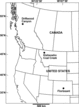
We examined two specimens: a single forewing preserved in lacustrine shale from the Okanagan Highlands locality at Driftwood Canyon Provincial Park, near the town of Smithers in northwestern British Columbia, Canada; and a single hind wing preserved in lacustrine sediment-derived oil shale of the Coal Creek Member of the Kishenehn Formation exposed along the Middle Fork of the Flathead River between Paola and Stanton Creeks, approximately 27 km south of West Glacier, northwestern Montana, United States of America (Fig. 1).
Localities of fossil Inocelliidae in western North America.

The Driftwood Canyon locality
Driftwood Canyon is the northernmost known occurrence of the Okanagan Highlands series, which were deposited in early Eocene lake basins scattered over roughly 1000 km southeast to Republic in northcentral Washington, United States of America. An Ypresian age for Driftwood Canyon sediments of 51.77 ± 0.34 million years ago (mya) is indicated by U–Pb analysis of zircons recovered from a tephra layer intercalated within the fossil-bearing shale (Moss et al. Reference Moss, Greenwood and Archibald2005). Okanagan Highlands sites preserve fossils of life from temperate (mostly upper microthermal) montane forests during the warmest sustained interval of the Cenozoic (Archibald et al. Reference Archibald, Greenwood, Smith, Mathewes and Basinger2011). Various floristic proxy analyses indicate that Driftwood Canyon was the coolest of the series (Greenwood et al. Reference Greenwood, Archibald, Mathewes and Moss2005). The climate and flora have been characterised by Greenwood et al. (Reference Greenwood, Archibald, Mathewes and Moss2005) and Moss et al. (Reference Moss, Greenwood and Archibald2005).
The fossils from Driftwood Canyon were recovered from very fine-grained shale and, unlike fossils from other Okanagan Highlands localities, are often preserved only on one side of the split rock, without a counterpart, and only become visible upon wetting.
The Coal Creek Member
The geology of the Coal Creek Member of the Kishenehn Formation was described by Greenwalt et al. (Reference Greenwalt, Rose, Siljeström, Goreva, Constenius and Wingerath2015). It has been estimated to be Lutetian, 46.2 ± 0.4 mya by 40Ar/39Ar analysis and 43.5 ± 4.9 mya by fission-track analysis (Constenius Reference Constenius1996), supported by biostratigraphic correlation of mammal fossils (Pierce and Constenius Reference Pierce and Constenius2014; Dawson and Constenius Reference Dawson and Constenius2018). Fossil insects are found at the base of the middle sequence of this member.
High mean annual temperature has been assumed for the Kishenehn Formation based on the presence of vertebrates and invertebrates that today range in tropical low latitudes (Greenwalt et al. Reference Greenwalt, Rose, Siljeström, Goreva, Constenius and Wingerath2015). However, plants and animals today restricted to the tropics also occur in the Okanagan Highlands, which has estimates of cooler, mostly upper microthermal mean annual temperature values (Archibald et al. Reference Archibald, Bossert, Greenwood and Farrell2010, Reference Archibald, Greenwood and Mathewes2013, Reference Archibald, Morse, Greenwood and Mathewes2014). This may be explained by their restriction to low latitudes today by coldest month mean temperatures, i.e., their inability to persist in regions of harsh winters (Archibald and Farrell Reference Archibald and Farrell2003), and so mild winters with few if any frost days in the Okanagan Highlands may have allowed their presence there despite cooler mean annual temperature. Therefore, the presence of such organisms in the Kishenehn Formation does not exclude the possibility of mean annual temperature values similar to those of the Okanagan Highlands. Detailed paleoclimate analysis for the Kishenehn Formation, as has been done in the Okanagan Highlands, is needed to resolve this question.
Greenwalt et al. (Reference Greenwalt, Rose, Siljeström, Goreva, Constenius and Wingerath2015) published a study of the lithology of Coal Creek Member shale and the taphonomy of its fossils. Preservation of its insects is strongly biased towards small (lengths < 1 cm) specimens, except for larger disarticulated wings. Evidence suggests that insects were captured on or within cyanobacterial mats prior to sinking to the bottom of a relatively shallow, near-shore lake. Like those of Driftwood Canyon, Coal Creek Member specimens are often preserved only on one side of the split shale and usually only become visible when wetted; counterparts usually do not exist (Greenwalt et al. Reference Greenwalt, Rose, Siljeström, Goreva, Constenius and Wingerath2015). In this way, the Kishenehn Coal Creek and Driftwood Canyon shales appear more similar to each other than they do to shales of any other Okanagan Highlands site or of the Green River or Florissant Formations.
Terminology
We use the venational terminology of Makarkin and Archibald (Reference Makarkin and Archibald2014) with the following alterations. First, the forewing CuA of Inocelliidae is here restricted to two proximal branches, conforming to the configuration of CuA in the hind wing of Inocelliidae and the forewings and hind wings of Raphidiidae. Accordingly, the distal part of CuA of Makarkin and Archibald (Reference Makarkin and Archibald2014, Fig. 2A) is here the posterior branch of MP, and the designations of respective crossveins are changed (see Fig. 2).
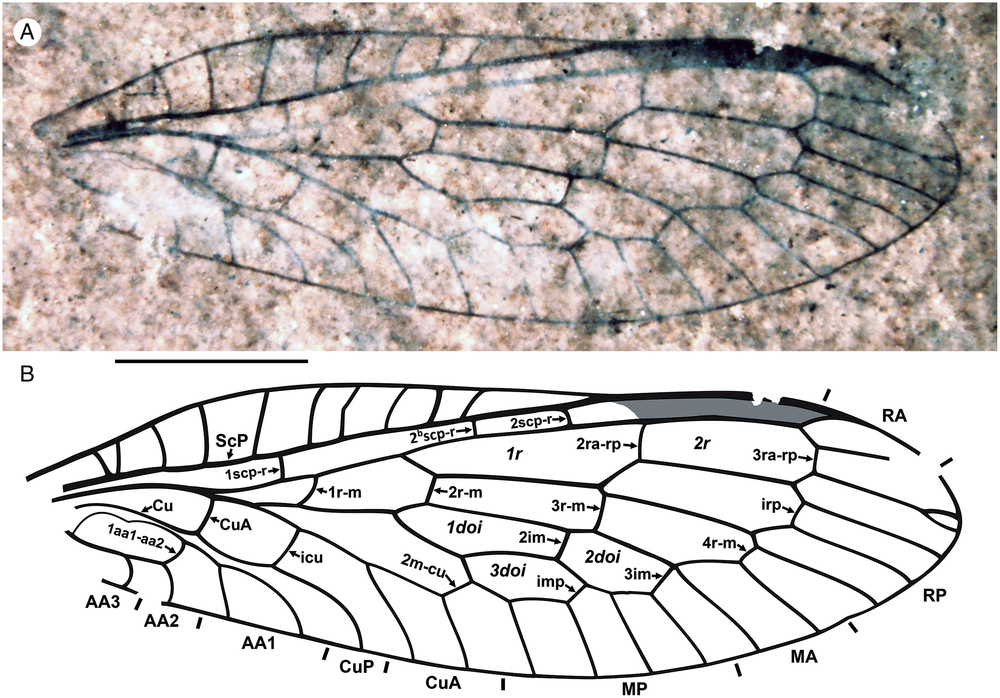
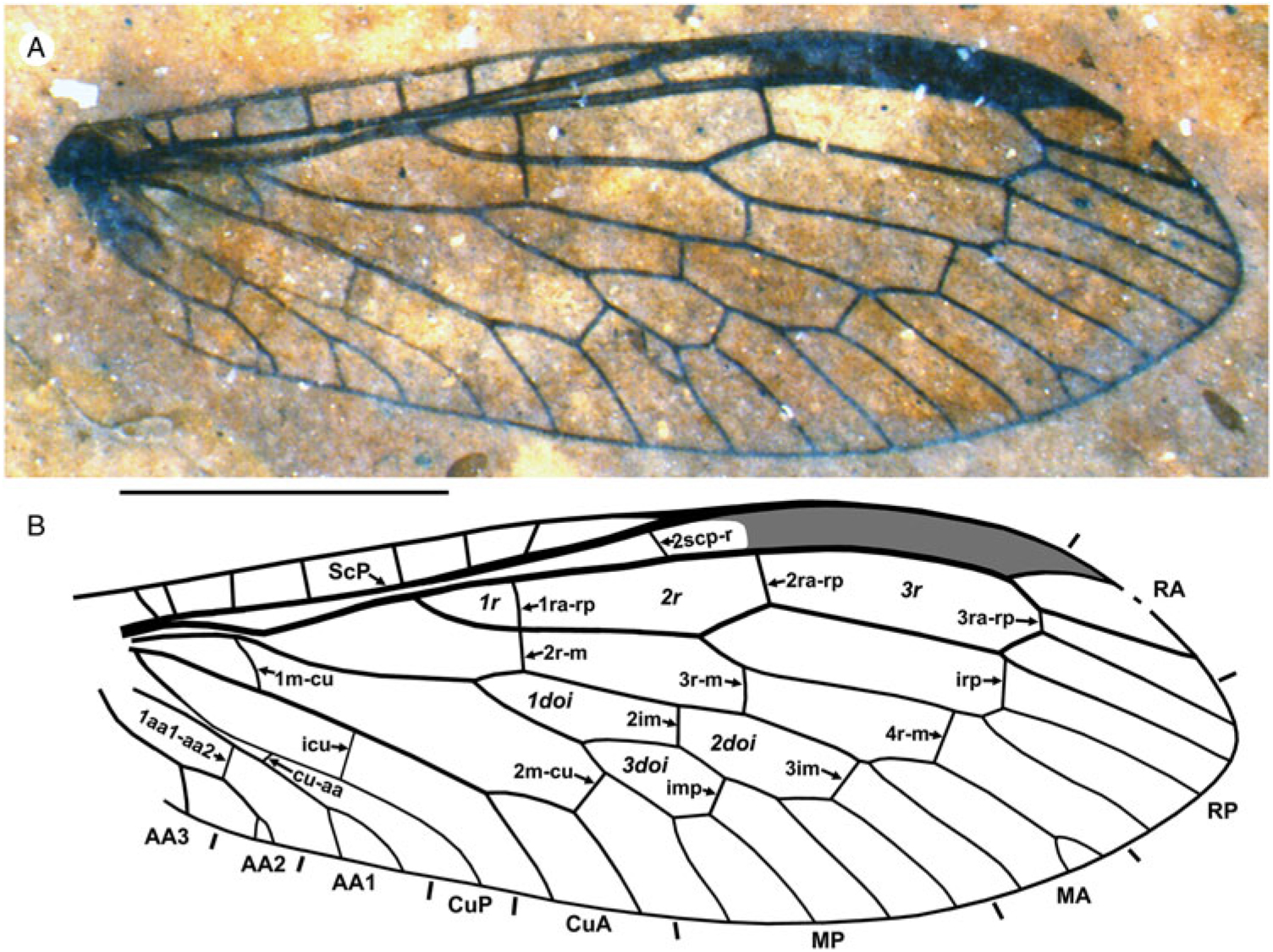
Paraksenocellia borealis from Driftwood Canyon, holotype RBCM.EH2018.129.1. A, Specimen wetted with ethanol; B, forewing venation (both converted to standard view, with apex to the right). Scale = 2 mm (both to scale).

Secondly, we use a different interpretation of the anal veins of the hind wing. It is now generally accepted that Raphidiomorpha plesiomorphically possess three anal veins in both forewings and hind wings, although only two are apparent in the hind wing of extant members of both extant families. This is supported in Raphidiidae by pupal tracheation (Withycombe Reference Withycombe1923; Fig. 2A).
In the hind wing of Inocelliidae, AA1 is a separate vein for its entire length, but the distal or only middle parts of AA2 and AA3 are fused for most of their distances. This is inferred from the short free basal parts of AA2 and AA3 that are sometimes visible (see, e.g., Aspöck et al. Reference Aspöck, Aspöck and Rausch1991, fig. 44; Liu et al. Reference Liu, Aspöck, Zhang and Aspöck2012; Figs. 1–3). The AA2 of Inocelliidae of Makarkin and Archibald (Reference Makarkin and Archibald2014; Fig. 2B) is then AA2+3, i.e., in that species the distal parts of AA2 and AA3 are fused to the wing margin. In the new genus (as in many other extant species), only the middle parts of AA2 and AA3 are fused, and the distal parts of AA2 and AA3 are separate.
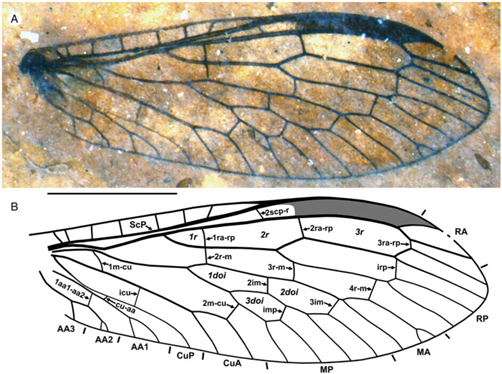
Paraksenocellia species from the Coal Creek Member of the Kishenehn Formation, holotype USNM 625900. A, Specimen wetted with ethanol; B, hind wing venation (both converted to standard view, with apex to the right). Scale = 2 mm (both to scale).
It appears that this is quite different in the Raphidiidae. Aspöck et al. (Reference Aspöck, Aspöck and Rausch1991, fig. 23) interpreted AA1 and AA2 as fused basally for quite a long distance and AA3 as entirely separate. We agree with this, finding it highly likely. Therefore, the anterior (distal) branch of AA1 of Raphidiidae of Makarkin and Archibald (Reference Makarkin and Archibald2014; Fig. 2D) is AA1, the posterior (proximal) branch is AA2, and AA2 is AA3.
Genera of the paraphyletic family Mesoraphidiidae show different tendencies in the fusion of their anal veins in the hind wing, indicating that this family might be polymorphic in this regard. Unfortunately, basal parts of the hind wings are not clearly preserved in most Mesoraphidiidae, but AA1 and AA2 are clearly medially fused in Burmoraphidia reni Liu et al. and appear to be basally fused in Nanoraphidia electroburmica Engel, both from mid-Cretaceous Burmese amber (Engel Reference Engel2002; Fig. 3; Liu et al. Reference Liu, Lu and Zhang2016, fig. 9).
Crossveins are designated after the longitudinal veins with which they are connected and are numbered in sequence from the wing base, e.g., 2scp-r, distal crossvein connecting ScP and RA; 2bscp-r, intermediate crossvein connecting ScP and RA; icu, crossvein between CuA and CuP; 1im-3im, first to third crossvein between MA and MP. Terminology of wing spaces and details of venation (e.g., veinlets) follows Oswald (Reference Oswald1993).
Abbreviations. AA1–AA3, first to third branches of anterior analis; CuA, anterior cubitus; CuP, posterior cubitus; 1doi-3doi, first to third discoidal cells; MA and MP, anterior and posterior branches of media; 1r-3r, first to third radial cells; RA, anterior radius; RP, posterior radius; RP1, proximal-most branch of RP; RP2, branch of RP distad RP1; ScP, posterior subcosta.
Paraksenocellia Makarkin, Archibald, and Jepson, new genus
http://zoobank.org/urn:lsid:zoobank.org:act:5D0B1CC2-DE20-40F9-BD0F-2B21FFBDA1DE
Diagnosis (contrary character states of compared taxa are provided in parentheses). Distinguished within Inocelliidae by: both forewings and hind wings: pterostigma very long, extending to ScP in both wings (other genera: not extending to ScP); very long terminal parts of branches of RA and RP (i.e., distad distal crossveins) (other genera: moderately long to short); forewing: three crossveins in subcostal space (possibly adventitious in this specimen) (other genera: two); two radial cells (other genera: normally three); three discoidal cells (four discoidal cells in vast majority of species with few exceptions, see below); AA1 deeply forked (other genera: simple, with few exceptions, see below); hind wing: basal crossvein 1r-m absent (shared with most genera of Inocelliidae); icu (crossvein between CuA, CuP) far distad 1m-cu (proximad or opposite 1m-cu in other Inocelliidae with few exceptions, see below); AA1 deeply forked (other genera: simple with few exceptions, see below).
Etymology. From the Greek paraksenos, strange, and Inocellia, a genus group name, referring to its unusual venation. Gender feminine.
Type species . Paraksenocellia borealis new species, here designated.
Species included. Paraksenocellia borealis new species.
Paraksenocellia borealis Makarkin, Archibald, and Jepson, new species
http://zoobank.org/urn:lsid:zoobank.org:act:4061A2A7-A16D-47E8-B768-9AF2C22C0424
See Fig. 2.
Diagnosis. See forewing character states in the genus diagnosis.
Material. Holotype: RBCM.EH2018.129.1 (also bearing collector number SBA-5915), collected by S.B. Archibald on 12 June 2012, and deposited in Royal British Columbia Museum (Victoria, British Columbia, Canada). A well-preserved complete forewing.
Etymology. From the Latinised Greek boreus -a, -um, northern, as the holotype is the more northern occurrence of the genus.
Description. Forewing elongate, 9.6 mm long, 2.9 mm wide. Costal space strongly dilated at one-fifth wing length; subcostal veinlets simple (including humeral veinlet), widely spaced. ScP terminating on costal margin at about three-fifth wing length. Subcostal space broad, with three crossveins: basal crossvein 1scp-r located proximad 1r-m; intermediate crossvein 2bscp-r located slightly distad distal-most subcostal veinlet; distal crossvein 2scp-r located well proximad termination of ScP. Pterostigma long, extended to termination of ScP, heavily pigmented. Branch (veinlet) of RA at distal end of pterostigma strongly oblique, distinctly curved (convex). RA stem probably simple (as preserved, but incomplete), strongly bent posteriorly after origin of distal branch, terminating at margin before wing apex. RA space with two crossveins: 2ra-rp located opposite proximal end of pterostigma; 3ra-rp located well distad end of pterostigma. RP originates far from wing base (at about 40% complete wing length), with two branches: RP1 deeply forked at outer gradate series of crossveins; RP2 simple. Stem of RP shallowly forked near wing margin. One crossvein in radial space, between anterior branch of RP1, RP2. Four crossveins between R/RP, M: 1r-m curved, connecting R, M; 2r-m connects stem of RP, MA; 3r-m connects RP1 near its origin and MA; 4r-m connects posterior branch of RP1 and anterior branch of MA. M appears fused basally with R for considerable distance, then with CuA for short distance; forked nearly opposite origin of RP. MA deeply forked. MP dichotomously branched, with four terminal branches. Three intramedian crossveins form three doi: two crossveins between MA, MP, one between branches of MP. One crossvein between M, Cu (2m-cu) connecting posterior branch of MP, stem of CuA. Cu basally not fused with R+M; divided into CuA, CuP far from wing base. CuA crossvein-like before fusion with M, perpendicular to Cu, then fused with M for short distance, deeply forked distally. CuP simple, rather aligned with Cu. One crossvein between CuA, CuP (icu). AA1 deeply forked. AA2, AA3 fused proximally; separate, simple distally. One crossvein between AA1, AA2 connecting AA1 well proximad its fork, AA2.
Locality and age. Driftwood Canyon Provincial Park (public face exposure), near Smithers, British Columbia; mid-Ypresian, 51.77 ± 0.34 mya.
Remarks. An oblique incorporated pterostigmal veinlet of RA appears possibly visible in the middle of the pterostigma with some lighting; however, this is clearly not present when clarified by wetting with ethanol.
Paraksenocellia species
See Fig. 3.
Material. Specimen: USNM 625900, deposited in the Department of Paleobiology, National Museum of Natural History, Smithsonian Institution (Washington, District of Columbia, United States of America). A well-preserved complete hind wing.
Description. Hind wing 7.2 mm long, 2.6 mm wide. Costal space moderately broad; all seven subcostal veinlets simple. ScP stout, short. RA stout, distally with one strongly oblique, smoothly curved (convex) branch (veinlet); RA distad 3ra-rp long, straight. Subcostal space with one distal crossvein 2scp-r, connecting ScP, RA near termination of ScP. Pterostigma very long, heavily pigmented, extended to ScP. RA space (between RA, RP) with three crossveins: 1ra-rp located opposite to 2r-m; 2ra-rp located opposite proximal end of pterostigma; short 3ra-rp located distad termination of pterostigma. RP originates relatively close to wing base (at 33% complete wing length), with two branches. RP1 deeply forked, with branches very long; RP2 very long, straight, simple. One crossvein between branches of RP as part of a gradate series. Three crossveins between RP, MA; 1r-m lost; 2r-m connects stems of RP, MA; 3r-m connects RP1, stem of MA; 4r-m connects RP1 before fork and anterior branch of MA. M not fused basally with R, forked into MA, MP distad origin of RP. MA deeply forked, with branches very long; its anterior branch shallowly forked. Two crossveins between MA, anterior part of MP form two long cells (1doi, 2doi), nearly equal in length. MP dichotomously branched, with four very long terminal branches. One crossvein between branches of MP forming slightly elongate 3doi. Two crossveins between M, Cu: basal 1m-cu rather long, oblique, slightly sinuate, located near wing base; 2m-cu connecting posterior branch of MP, anterior branch of CuA. CuA deeply forked. CuP thin, simple. One long crossvein between CuA, CuP (icu), located far distad 1m-cu. One short crossvein between CuP, AA1 located distad level of 1m-cu. AA1 deeply forked. AA2, AA3 fused proximally; distal (free) part of AA2 long, shallowly forked terminally; distal (free) part of AA3 rather long, simple. One long crossvein between AA1, AA2, joining AA2 in middle distal (free) part.
Locality and age. Middle Fork of the Flathead River, between Paola and Stanton Creeks, approximately 27 km south of West Glacier; the Coal Creek Member of the Kishenehn Formation, northwestern Montana, United States of America; Lutetian (see age discussion above).
Remarks. We assign the Coal Creek specimen to the same genus as P. borealis, as they share the distinctive pterostigma and very long terminal parts of the branches of RA and RP. These character states are unusual and do not occur or are very rare in other members of the family.
The specimens present difficulties in separating them at the species level, however, as P. borealis is based on a forewing with no known hind wing, and the Coal Creek specimen is a hind wing with no associated forewing. Their age difference suggests that they might represent distinct species – Driftwood Canyon is a maximum of about nine million years older than Coal Creek – but this is not conclusive. Grimaldi and Engel (Reference Grimaldi and Engel2005) speculated that insect species persist on average perhaps 3–10 million years, and Hörnschemeyer et al. (Reference Hörnschemeyer, Wedmann and Poinar2010) discussed cases of much greater time spans; indeed, Möller Andersen et al. (Reference Möller Andersen, Spence and Wilson1993) reported a specimen of the water strider genus Limnoporus Stål (Hemiptera: Gerridae) in Driftwood Canyon shale that is extremely close to a modern species.
The distance between Driftwood Canyon and Coal Creek appears consistent with their separation, as most modern raphidiopteran species have small ranges (Aspöck Reference Aspöck2002) – but some do range more widely. They differ in size, but this might be accounted for by sexual dimorphism. While we suspect that they may represent two species, lacking sufficient differences between the Driftwood Canyon forewing and the Coal Creek hind wing, we treat the Coal Creek wing as P. sp. pending discovery of a complete specimen of either that clarifies their relationship.
Discussion
Paraksenocellia is assigned to the Inocelliidae with confidence based on several character states. In both forewings and hind wings: 1) the crossvein 2scp-r is shifted proximally, clearly proximad the pterostigma (located at proximal end of the pterostigma in all Raphidiidae and many Mesoraphidiidae); in the forewing: 2) the basal crossvein 1r-m connects R and M (shifted distally in other Raphidiomorpha connecting the stem of RP and M/MA, except in the Middle Jurassic Styporaphidia magia Engel and Ren); 3) the crossvein 2ra-rp is located within (rarely just proximad) the pterostigma (it is markedly proximad the pterostigma in the vast majority of Raphidiidae); in the hind wing; 4) the basal crossvein 1r-m is lost (it is normally present in all other Raphidiomorpha); and 5) CuP and AA1 are separate (they are partially fused in all Raphidiidae, except the Baltic amber Succinoraphidia Aspöck and Aspöck). A combination of character states 2 and 4 occurs exclusively in Inocelliidae. We consider character state 2 in Styporaphidia magia to be homoplasious relative to its presence in Inocelliidae.
In Inocelliidae, only Paraksenocellia has a very long pterostigma, extending to ScP in both wings. This is most similar to the pterostigmata of some Mesoraphidiidae, especially the Jurassic Mesoraphidia Martynov, which is long and lacks veinlets of RA within it, and has a far proximal location of the distal crossvein 2scp-r, which sometimes connects ScP and RA, not closing the pterostigma proximally (see, e.g., Lü et al. Reference Lü, Liu and Ren2015, figs. 1–10; Lyu et al. Reference Lyu, Ren and Liu2017; Figs. 1–2). However, the venation of these Mesoraphidiidae differs from that of Inocelliidae by many other features, in particular by character states 2 and 4.
The following character states of the venation of Paraksenocellia are also absent or rare in other Inocelliidae. The three subcostal crossveins of the forewing are unique within Inocelliidae; in other genera of the family there are two. In Raphidiidae, a third (intermediate) subcostal crossvein (2bscp-r) is also rare but can occur more often (see Makarkin and Archibald Reference Makarkin and Archibald2014: 413), at times as an individual aberration (see, e.g., Aspöck and Aspöck Reference Aspöck and Aspöck1974; Fig. 1b).
The two radial cells in the forewing, as found in Paraksenocellia, were hitherto only known in the Baltic amber Electrinocellia (i.e., 1ra-rp is absent in these). All other genera of Inocelliidae normally have three (i.e., 1ra-rp is present). Conversely, all genera of Raphidiidae have two radial cells (except for Mongoloraphidia abnormis Liu et al. with three radial cells: Liu et al. Reference Liu, Aspöck, Yang and Aspöck2010; Fig. 1), as do the great majority of Mesoraphidiidae. Therefore, we assume that the presence of two radial cells (i.e., the absence of 1ra-rp) is a plesiomorphic state in Raphidiomorpha (see also Makarkin and Archibald Reference Makarkin and Archibald2014: 407).
The presence of three discoidal cells and the forked AA1 in the forewing were discussed in detail by Makarkin and Archibald (Reference Makarkin and Archibald2014: 437), who considered these conditions to be very rare in Inocelliidae. They also considered the forked AA1 to be a probable plesiomorphic character state at the family level.
The loss of the basal crossvein 1r-m in the hind wing is clearly an apomorphic character state for the Inocelliidae, which occurs in the family only in five extant genera and the Baltic amber Electrinocellia. A plesiomorphic condition at the level of the order – the long and longitudinally oriented 1r-m – occurs in three inocelliid genera: the extant Fibla and Sininocellia Yang, and the extinct the Baltic amber Succinofibla. It occurs in most other Raphidiomorpha. It is interesting that the oldest known genus of Inocelliidae possesses this apomorphic condition.
The far distal location of icu (the crossvein between CuA and CuP) in the hind wing is extremely rare in Inocelliidae. This condition is known to occur only in the Baltic amber Electrinocellia (Carpenter Reference Carpenter1957; Fig. 1). In other species of Inocelliidae, this crossvein is shifted far proximally, located proximad or opposite 1r-m (extremely rarely slightly distad). Conversely, in all other Raphidiomorpha (including Raphidiidae, fossil, and extant), the crossvein icu is shifted far distally as found in Paraksenocellia.
The forked AA1 of the hind wing occurs very rarely in Inocelliidae, only known in the extant North American Negha infata (Hagen) (Carpenter Reference Carpenter1936, fig. 7) and the Baltic amber Succinofibla (Aspöck and Aspöck Reference Aspöck and Aspöck2004, fig. 8).
Therefore, the venation of Paraksenocellia is distinctive and markedly differs from that of other genera of the family. It appears to be most closely related to the Baltic amber genus Electrinocellia, as they share at least three important character states: 1) the presence of two radial cells in the forewing; 2) the loss of the basal crossvein 1r-m; and 3) the far distal location of the crossvein icu in the hind wing. It is interesting that some character states of Paraksenocellia are characteristic of Raphidiidae and occur very rarely in the Inocelliidae, e.g., the presence of two radial cells in the forewing, and the far distal position of the crossvein icu in the hind wing.
The venation of Paraksenocellia resembles many Mesozoic Mesoraphidiidae based on some character states (e.g., the long pterostigma, the presence of three discoidal cells and two radial cells in the forewing, and the distal location of the crossvein icu in the hind wing). These character states do not occur or are very rare in the extant Inocelliidae, but some of them are present in Electrinocellia. We interpret this similarity as consistent with the opinion previously expressed by two of us (Makarkin and Archibald Reference Makarkin and Archibald2014) that Mesoraphidiidae is a paraphyletic group in which both extant families (Raphidiidae and Inocelliidae) are separately nested.
Acknowledgements
We thank Dale Greenwalt (Smithsonian Institution, Washington, District of Columbia, United States of America) for bringing the Kishenehn raphidiopteran to the attention of J.E.J., and supplying information on the geology of the Kishenehn Formation; Conrad Labandeira (Smithsonian Institution) for arranging the loan of the Kishenehn raphidiopteran; BC Parks for granting a fieldwork permit for Driftwood Canyon Provincial Park, particularly John Howard of the Smithers office; Marlow Pellatt of Parks Canada for use of microscopes and digital photography equipment; Victoria Arbour of the Royal British Columbia Museum for accessioning the Driftwood Canyon specimen into their collections. S.B.A. received support from Natural Sciences and Engineering Research Council of Canada Discovery grants to Rolf Mathewes (Simon Fraser University) that facilitated research, and to David Greenwood (Brandon University, Brandon, Manitoba, Canada) that funded fieldwork at Driftwood Canyon. The study is supported by grant 16-04-00053 of the Russian Foundation for Basic Research to V.N.M.