Introduction
Dietary protein hydrolysates are mixtures of peptides of varying molecular weights and free amino acids, which show a higher absorption rate compared to native proteins. They are widely used in the manufacturing of dietary supplements and food for particular nutritional uses (Clemente, Reference CLEMENTE2000). Enzymatic hydrolysis of protein is mainly carried out under industrial conditions. Processes catalysed by enzymes are highly specific, and their progress can be fully controlled. Protein hydrolysates with a certain degree of hydrolysis are a valuable source of peptides that are characterised by high biological activity and nutritional value (Clemente, Reference CLEMENTE2000; Hartman and Miesel, Reference HARTMAN and MIESEL2007).
Diet has a vital role in shaping the health of the body. Bioactive peptides are good examples of substances that exert different health effects. They are released from food proteins by the action of proteolytic enzymes (Hartman and Miesel, Reference HARTMAN and MIESEL2007). Distinguished opioid peptides have been identified as compounds with immunostimulating, blood pressure lowering, platelet aggregation inhibiting, antimicrobial, antioxidation and mineral absorption-enhancing properties (Mine and Kovacs-Nolan, Reference MINE and KOVACS-NOLAN2006; Hartman and Miesel, Reference HARTMAN and MIESEL2007). The specific activity of peptides is determined by the type and location of amino acid residues contained in their primary structures (Park et al., Reference PARK, JUNG, NAM, SHAHIDI and KIM2001). Proteins from food material are the precursors of biopeptides. This protein may be either of animal or plant origin such as milk proteins (casein, whey protein), muscle proteins (myosin, collagen), soy protein (glycinin, β-conglycinin) wheat (gluten) protein or egg (ovalbumin, conalbumin) (Tsuge, 1991; Ibrahim et al., Reference IBRAHIM, IWAMORI, SUGIMOTO and AOKI1998; Pellegrini et al., Reference PELLEGRINI, THOMAS, WIL, SCHRANER and VON FELLENBERG2000; Saiga et al., Reference SAIGA, TANABE and NISHIMURA2003; Gibbs et al., Reference GIBBS, ZOUGMAN, MASSE and MULLIGAN2004; ; Kim et al., Reference KIM, SEO, KHAN, KI, NAM and KIM2007; Kong et al., Reference KONG, ZHOU and QIAN2007; Li et al., Reference LI, CHEN, WANG, JI B. and WU2007).
Enzymatic hydrolysis of proteins
Hydrolysis of proteins is a process of decomposition into individual amino acids and/or peptides that occurs with the participation of enzymes. The rate of hydrolysis depends on many factors such as enzyme specificity and concentration, substrate concentration, the rate of mass transfer in the enzyme/substrate system, the degree of denaturing of the protein in the substrate, pH, temperature, ionic strength in the reaction medium and the presence of activators and inhibitors (Kołakowski et al., Reference KOŁAKOWSKI, BEDNARSKI and BIELECKI2005). The hydrolysis process can proceed according to two mechanisms, classified as ‘one-by-one’ or ‘zipper’. During the initial stage of the reaction type ‘one-by-one’ (determining the overall level of hydrolysis) it is necessary to partially unfold native protein molecules. As a result, the protein loses its stability, more peptide bonds are exposed on the outside of the molecule (intermediate products) and the enzyme has access to the hydrolyzed peptide bond. In a further step, intermediate products are very rapidly degraded to small peptides. If the reaction equilibrium is on the ‘native side’, then the protein molecules are degraded one by one, so there are no significant quantities of intermediate products; only native proteins and final products are present. In the ‘zipper’ type reaction, native protein is very rapidly converted to intermediate products, and hydrolysis of indirect forms of protein in the final products occurs very slowly (Kunst, Reference KUNST2003).
Proteolysis may occur by the one-or two-step system. In the case of one-step hydrolysis, the pH of the mixture is changed automatically as a result of the reaction, or is maintained at a constant level by the addition of acids or bases. That hydrolysis takes place in a continuous manner. However, during the two-stage hydrolysis, the pH of the reaction varies in subsequent stages of proteolysis through the use of the same enzyme or using a variety of enzymes, e.g. firstly endopeptidase and then exopeptidase (Kołakowski et al., Reference KOŁAKOWSKI, BEDNARSKI and BIELECKI2005).
The hydrolysis of proteins significantly modifies the functional and sensory properties of the product. This is due to changes in the third-row structure of proteins and molecular weight reduction (Vinnars and Wilmore, Reference VINNARS and WILMORE2003). Most enzymatic modifications of proteins are carried out with the participation of enzymes such as pepsin, bromelain, trypsin, chymotrypsin, papain or ficin. Protein degradation and increasing the degree of proteolysis (% DH) significantly improves frothiness, solubility, emulsifying capacity and gelling (Vinnars and Wilmore, Reference VINNARS and WILMORE2003; Agyare et al., Reference AGYARE, XIONG and ADDO2008). For example, selective enzymatic hydrolysis under controlled conditions is used to improve the solubility, emulsifying and foaming properties of wheat gluten (Agyare et al., Reference AGYARE, XIONG and ADDO2008) and fish protein (Shahidi et at., 1995). Rapeseed protein hydrolysates have much better emulsifying properties and water-binding capacity than the starting substrate. While the use of sequentially alkalase and exopeptidase allows for highly soluble hydrolysates, which can be used as components of specialized high-protein liquids (Vioque et al., Reference VIOQUE, SA´NCHEZ-VIOQUE, CLEMENTE, PEDROCHE, BAUTISTA and MILLAN1999).
Non-specific, far-reaching hydrolysis may lead to loss of functional properties and the appearance of bitter peptides. The bitter taste of protein hydrolysates can be reduced to an acceptable level by means of ultra filtration, activated carbon processing and utilising the plastein reaction (Clemente, Reference CLEMENTE2000). It has been proven that, by using certain enzymes in the hydrolysis process, the bitter peptides can be significantly masked (FitzGerald and O'Cuinn, Reference FITZGERALD and O'CUINN2000). The development of biotechnological solutions to obtain hydrolysates without a bitter aftertaste is already in progress.
Protein hydrolysates are produced on a large scale from various sources such as milk, eggs, fish, rice, legumes, meat, and potatoes (Schaafsma, Reference SCHAAFSMA2009). Their valuable properties make them excellent ingredients for increasing the share of nitrogen in specialty drinks, manufacturing specialist foods for pregnant women, nutritional and cosmetic ingredients and in dietary supplements. They can also be found in foods for people with impaired digestion, for athletes and in hypoallergenic products (Schaafsma, Reference SCHAAFSMA2009). In addition, hydrolysates are useful as a growth media for a variety of desirable microorganisms. Several studies have confirmed the positive impact of the fraction of peptides added to media in order to improve the growth of microorganisms or in the production of recombinant proteins (Duarte de Holanda and Netto, Reference DUARTE DE HOLANDA and NETTO2006).
These days hydrolysates derived from marine products have become particularly popular, mainly due to the fact that they contain a high amount of complete amino acids (Córdova-Murueta et al., Reference CÓRDOVA-MURUETA, NAVARRETE-DEL-TORO and GARCIA-CARRENO2007). Over the years, techniques have been developed in the use and recovery of valuable by-products in biopolymers (Ferrer et al., Reference FERRER, PAEZ, MARMOL, RAMONES, GARCIA and FORSTER1996).
Bioactive peptides - sources and application
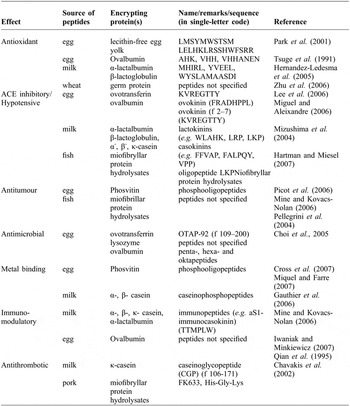
The presence of biopeptides in hydrolysates has aroused great interest amongst scientists (Park et al., Reference PARK, JUNG, NAM, SHAHIDI and KIM2001; Korhonen and Pihlanto, Reference KORHONEN and PIHLANTO2003; Hartman and Miesel, Reference HARTMAN and MIESEL2007). Bioactive peptides are fragments of proteins that are not active in the sequence of the precursors. After enzymatic release they interact with the corresponding receptors to regulate the body and its functions (Kołakowski et al., Reference KOŁAKOWSKI, BEDNARSKI and BIELECKI2005). They cause various health effects, acting as human hormones on the circulatory, digestive, nervous, and immune systems (Hartman and Miesel, Reference HARTMAN and MIESEL2007) (Table 1). The specific activity of a peptide is determined by the type and location of amino acid residues contained in their primary structure (Park et al., Reference PARK, JUNG, NAM, SHAHIDI and KIM2001). Among the bioactive peptides, simple and complex dipeptides, linear or cyclic oligo-and polypeptides exist which may exhibit various activities (Mine and Kovacs Nolan, 2006; Hartman and Miesel, Reference HARTMAN and MIESEL2007). Moreover, some bioactive peptides exhibit chemotactic properties, embryotoxic properties, hemolytic properties, inhibitory activity, cause smooth muscle contractions by stimulating the synthesis of red blood cells and regulate the activity of the stomach mucosa and the flow of ions (Kołakowski et al., Reference KOŁAKOWSKI, BEDNARSKI and BIELECKI2005). Typically, peptides have multiple biological activities (Korhonen and Pihlanto, Reference KORHONEN and PIHLANTO2003).
Antioxidant activity
Oxidative reactions underlie the adverse changes in food products (rancidity, odour and colour change) and most pathological conditions (cardiovascular diseases, degenerative changes) (Saiga et al., Reference SAIGA, TANABE and NISHIMURA2003). Currently, great attention is paid to compounds of natural origin, e.g. in the potential therapeutic role of antioxidants, which are offset by unfavourable changes resulting from the action of oxygen free radicals. Natural sources of powerful antioxidants such as protein hydrolysates are considered useful in preventing disease caused by oxidative stress, such as colon cancer, Alzheimer's disease and Parkinson's disease (Park et al., Reference PARK, JUNG, NAM, SHAHIDI and KIM2001).
Examples of bioactive peptides derived from food.

The antioxidant activity of protein hydrolysates depends largely on the degree of hydrolysis (% DH) and the type of proteases used for enzymatic degradation (Kong and Xiong, Reference KONG and XIONG2006). The crucial factor is the weight, type and position of amino acid residues contained in the structure of the peptides (Park et al., Reference PARK, JUNG, NAM, SHAHIDI and KIM2001). Marcuse (Reference MARCUSE1962) demonstrated that antioxidant properties are determined by the presence in hydrolysates of several amino acids, such as tryptophan, methionine, histidine, lysine, glycine. Kawashima et al. (Reference KAWASHIMA, ITOH, MIYOSHI and CHIBATA1979) found that the aromatic amino acids, present in some di-and tri-peptides, exhibit strong free radical scavenging properties. This is due to the ability of these amino acids (tyrosine, tryptophan and histidine) to readily cleave hydrogen - an electron donor to free radicals seeking to adopt a stable form through their pairing (Park et al., Reference PARK, JUNG, NAM, SHAHIDI and KIM2001; Davalõs et al., Reference DAVALÕS, MIGIEL, BARTOLOME and LÓPEZ–FANDIŇO2004). The mechanism of antioxidative hydrolysates and peptides may be manifested as the scavenging of free radicals, chelation of transition metals, reduction of hydroperoxides, enzymatic elimination of specific oxidants or inhibition of lipid peroxidation in food systems (Elias et al., Reference ELIAS, KELLERBY and DECKER2008).
Many antioxidant peptides have been prepared from wheat (Liyana-Pathirana and Shahidi, Reference LIYANA-PATHIRANA and SHAHIDI2007), maize (Kong and Xiong, Reference KONG and XIONG2006), pig blood haemoglobin (Chang et al., Reference CHANG, WU and CHIANG2007), or eggs. For example, two peptides with aromatic residues, which were obtained from egg yolk proteins under the influence of Alcalase have the potential to inhibit the oxidation of linoleic acid (Park et al., Reference PARK, JUNG, NAM, SHAHIDI and KIM2001). Ovalbumin is the source of three antioxidant peptides containing sequences in the second position the rest of the histidine (Tsuge et al., Reference TSUGE, EIKAWA, NOMURA, YAMAMOTO and SUGISAWA1991). A characteristic feature of these peptides is the presence of the rest of the leucine at position N-terminal, conditioning their bioactivity (Park et al., Reference PARK, JUNG, NAM, SHAHIDI and KIM2001). A similar effect has antioxidant preparation obtained by the action of bacterial proteolytic enzymes (Bacillus sp) on the yolk protein, consisting of a fraction of peptides with molecular weights not exceeding 1 kDa (Sakanaka et al., Reference SAKANAKA, TACHIBANA, ISHIHARA and JUNEJAJA2004).
Further peptides with antioxidant activity are products resulting from the hydrolysis of ovalbumin with pepsin, which have the ability to scavenge free radicals AAPH (Davalõs et al., Reference DAVALÕS, MIGIEL, BARTOLOME and LÓPEZ–FANDIŇO2004). Many valuable antioxidant peptides were also obtained from phosvitin - a highly phosphorylated glycoprotein, represents the major fraction of egg yolk phosphoproteins. Peptides derived from phosvitin are characterised by a high content of phosphorus and amino acids such as histidine, methionine and tyrosine (Xu et al., Reference XU, KATAYAMA and MINE2007). It's also been shown that phosvitin products, by inhibiting iron-dependent ion formation reaction of the most reactive hydroxyl free radicals, are linked to DNA protective properties (Matoba et al., Reference MATOBA, USUI, FUJITA and YOSHIKAWA1999).
Studies in recent years confirm that some protein hydrolysates and peptides exhibit better antioxidant activity than α-tocopherol and may even exceed the activity of potent synthetic antioxidants (BHA, BHT) used in the food industry (Je et al., Reference JE, QIAN, BYUN and KIM2007). In addition, many antioxidant peptides have a multifunctional character, showing other properties such as antihypertensive, opioid, anti-thrombotic and hypocholesterolemic which makes these compounds more useful as dietary ingredients in promoting human health (Davalõs et al., Reference DAVALÕS, MIGIEL, BARTOLOME and LÓPEZ–FANDIŇO2004).
Anti-hypertensive activity
Among the most increasing lifestyle diseases, including those stemming from an unhealthy lifestyle, cardiovascular disease and hypertension are of key importance. Peptides can be considered natural antihypertensive pharmacological compounds. They inhibit the activity of angiotensinogen I-converting enzyme (ACE), a peptidyl-dipeptidase that can cleave a dipeptide from the angiotensin I (decapeptide: DRVYIHPFHL) C-terminal, which causes its conversion to angiotensin II, a blood pressure booster. Inactivation of the enzyme by inhibitors means bradykinin stimulation also, which lowers blood pressure (Miguel et al., 2006). These antihypertensive precursors of peptides are prominently found in egg albumin (Miguel and Aleixandre, Reference MIGUEL and ALEIXANDRE2006; Hartman and Miesel, Reference HARTMAN and MIESEL2007).
Great interest in biologically active peptides has been generated from work investigating ovalbumin – i.e. the proteins present in egg white. When the whole egg is eaten, ovalbumin is transformed into octapeptide under the influence of pepsin called ovokinin, representing fragment (f 358-365) of ovalbumin (Fujita et al., Reference FUJITA, SASAKI and YOSHIKAWA1995; Davis and Reeves, Reference DAVIS and REEVES2002). In addition, under the influence of chymotrypsin, ovokinin (2-7) is released (Matoba, 1999). These peptides act by lowering systolic blood pressure in rats, in a dose-dependent manner (Fujita et al., Reference FUJITA, SASAKI and YOSHIKAWA1995). In the digestive system, these peptides undergo immediate emulsification and are well absorbed by the intestine (Davis and Reeves, Reference DAVIS and REEVES2002).
Anti-tumour activity
Evidence of the benefits of consuming bioactive peptides has been recognized in the case of neoplastic changes (Erdmann et al., 2008). Epidemiological studies show that the incidence of tumours in different parts of the human digestive system is strongly conditioned by the diet (Rose et al., Reference ROSE, DEMEO, KESHAVARZIAN and HAMAKER2007). Studies show that the risk of colorectal cancer may be reduced under the influence of hydrolysates from egg yolk protein (Azuma et al., Reference AZUMA, SUDA, IWASAKI, YAMAGATA, SAEKI and KANAMOTO2000; Belobrajdic et al., Reference BELOBRAJDIC, MCINTOSH and OWENS2003), whereby ingestion inhibits the proliferation of tumour cells in the colon of rats. Specific protective effects against the proliferation of cancer cells have been attributed to phosvitin, as this protein and its peptides, have strong antioxidant properties in vitro (Ishikawa et al., Reference ISHIKAWA, YANO, ARIHARA and ITOH2004) and in human intestinal epithelium (Katayama et al., Reference KATAYAMA, XU, FAN and MINE2006). In addition, they regulate the level of the enzymes responsible for biosynthesis of glutathione (GSH), which plays a key role in the mechanism of cell death (Richman and Meister, Reference RICHMAN and MEISTER1975). Studies have shown that oligopeptides released from phosvitin have the ability to increase intracellular GSH activity and regulate the expression of γ-glutamycysteine in intestinal epithelial cells, which catalyses the synthesis of GSH (Katayama et al., Reference KATAYAMA, XU, FAN and MINE2006; Reference KATAYAMA, ISHIKAWA, FAN and MINE2007). Phospho-oligopeptides obtained from phosvitin also have the ability to regulate the levels of antioxidant enzymes such as catalase and glutathione reductase. For this reason they can be considered as anticancer agents in the colon.
The precursors of anti-cancer peptides are present in the egg ovomucin. The action of pronase enzymes from Streptomyces griseus on both factions β and α of the proteins, released highly glycosylated oligopeptides with masses of 220 (f β), 120 (f β) and 70 (f α) kDa. Direct treatment of the mice tumours with these oligopeptides effectively inhibited tumour growth (Watanabe et al., Reference WATANABE, TSUGE, SHIMOYAMADA, OGAMA and EBINA1998).
Antimicrobial activity
Peptides derived from food protein hydrolysates can exhibit antimicrobial activity, especially those containing tryptophan and arginine. The presence of arginine in the peptide sequence allows the molecule to give a positive charge, which forms a hydrogen bond with the anionic components of the cell membrane, impacting on the peptide - cytoplasmic membrane (Powers and Hancock, Reference POWERS and HANCOCK2003). However, the presence of tryptophan promotes the folding of peptides in aqueous solutions because it has an affinity to the cell membrane. This provides the structure of the amphiphilic peptides necessary for their transport across the cytoplasmic membrane (Chan et al., Reference CHAN, PRENNER and VOGEL2006).
There are several mechanisms of action of peptides against microbial cells. One of them, which is used particularly in relation to gram-negative bacteria, is due to the ability of peptides to bind to the cell lipopolysaccharide wall. As a result of aggregation of peptides in the cytoplasmic membrane, channels are formed that cause destabilisation, leading to cell death. An example of a peptide showing this activity is lactoferricin B.
Peptide precursors with antimicrobial properties include ovalbumin, the major egg protein. Bovine trypsin is used to release of this protein as well as penta-, hexa-and oktapeptides which exhibit strong bactericidal activity against Bacillus subtilis. In contrast, peptides formed by the action of bovine chymotrypsin demonstrate bactericidal activity against Gram-positive bacteria, such as Bacillus subtilis, Micrococcus luteus, Staphylococcus aureus, Streptococcus epidermidis, Streptococcus zooepidermicus and the Gram-negative bacteria Bordetella bronchiseptica, Escherichia coli, Klebsiella pneumoniale, Pseudomonas aeruginosa and Serratia marcesens, as well as fungi, such as Candida albicans (Pellegrini et al., Reference PELLEGRINI, HULSMEIER, HUNZIKER and THOMAS2004). The antimicrobial activity shows that the 9.9 kDa fragment (f 109 -200) of conalbumin (OTAP 92) is active against G+ and G- bacteria. The OTAP peptide 92 obtained from the N-terminal fragment of the polypeptide chain and has a cationic character. The same features have been observed in peptides released by pepsin, of lactoferrin in human milk and cow's milk, or peptides formed during hydrolysis of basic pancreatic trypsin inhibitor by clostripain, (Ibrahim et al., Reference IBRAHIM, SUGIMOTO and AOKI2000). Moreover, the OTAP-92 peptide shows anti-virulence properties, which is effective in the inactivation of Marek's disease virus in chickens.
Lysozyme is another precursor of antimicrobial peptides. Partial hydrolysis of this protein using pepsin gives rise to a mixture of peptides exhibiting activity against bacteria of the genus Bacillus. These peptides retain activity even after 30 minutes heating at 95°C in a pH range from 4.5 to 7, making them useful a natural preservatives in processed food (Abdou et al., Reference ABDOU, HIGASHIGUCHI, ABOUELEININ, KIM and IBRAHIM2007).
Metal binding peptides
Of great importance, especially in the food and pharmaceutical industries, are the metal ion binding peptides. They can serve as carriers of micronutrients, facilitating their absorption, due to the specific transport systems for short peptides in the digestive system (Clemente, Reference CLEMENTE2000). Peptides with chelating ability may therefore be useful for increasing the bioavailability of minerals and to preventing the oxidation of food products, whilst retaining the visual character and quality of food. Phosphopeptides, derived from milk proteins, have chelating properties for metals such as calcium (Cross et al., Reference CROSS, HUQ and REYNOLDS2007), zinc (Miquel and Farre, Reference MIQUEL and FARRE2007) and iron (Bouhallab et al., Reference BOUHALLAB, CINGA, AIT-OUKHATAR, BUREAU, NEUVILLE and ARHAN2002). Similar effects are seen with peptides derived from egg yolk phosvitin, which may increase the bioavailability of calcium (Choi et al., Reference CHOI, JUNG, CHOI, KIM and HA2005). Phosvitin contains more serine residues than casein. In addition, the high phosphorus content gives this protein some specific biological properties. It has been proven that the peptides from phosvitin increase calcium absorption in rats (Choi et al., Reference CHOI, JUNG, CHOI, KIM and HA2005). Other studies indicate that when these peptides are obtained by hydrolysis with trypsin, it increases the binding of calcium in the bones and prevens the formation of insoluble calcium phosphate (Jiang and Mine, Reference JIANG and MINE2001). As a result, phosphopeptides, derived from phosvitin, contain a large amount of phosphoserine and can be widely used as nutritional supplements and pharmacological preparations for people suffering from osteoporosis. Chelating peptides, by protecting the body against free radicals, may also improve the performance of physical and mental activity and delay the aging process in humans (Hartman and Miesel, Reference HARTMAN and MIESEL2007).
Immunostimulating activity
The immune system has a decisive influence on the equilibrium state of health in the body which determines its homeostasis. One possible strategy to increase natural immune protection is the use of a balanced diet rich in probiotics and functional foods (Nakano et al., Reference NAKANO, ANDO, NAKAMURA, HIRATA, YOSHIDA and MATUNAGA2001). In recent years the role of reducing the risk of chronic diseases and enhacing immune protection has been attributed to bioactive peptides derived from food proteins (Ma et al., Reference MA, BAE, LEE and YANG2006).
The mechanism of action of biopeptides may rely on direct interaction with pathogens as well as suppression or stimulation of certain immune responses (Hancock and Sahl, Reference HANCOCK and SAHL2006). Studies show that both immunosuppression and immunostimulation may be important in preventing and fighting various pathological conditions of the body, and peptides have an immunomodulating effect that can be used to reduce inflammation in autoimmune diseases, prevent transplant rejection and improve overall health (Gauthier et al., Reference GAUTHIER, POULIOT and SAINT-SAUVEUR2006). There are numerous examples in the literature of such interactions (Biziuleviċius et al., Reference BIZIULEVIĊIUS, KISLUKHINA, KAZLAUSKAITÉ and ŻUKAITÉ2006), however most are derived from milk.
Prevention of diseases associated with the current way of life, such as atherosclerosis, myocardial infarction or stroke is very important and necessary in many developed countries. The use of anti-peptide seems to be a promising strategy for reducing the risk of thrombotic disease in healthy people and assist or even replace the currently used therapeutic agents.
Conclusions
There is a growing interest in the food, pharmaceutical and cosmetic industries in the use of biopeptide preparations. Researchers are looking for unconventional, high-performance enzymes, and methods and technologies are being developed for specific hydrolytic processing. An example of this focus are the studies carried out in the project ‘OVOCURA’ within the consortium of the University of Life Sciences and Medical Academy in Wroclaw.
Understanding the relationship between physicochemical properties of protein hydrolysates and their functionality can lead to improved quality and stability of nutritional formulations based on the products of hydrolysis (Panyam and Kilara, Reference PANYAM and KILARA1996). Many potential hydrolysates require well-defined and repeatable enzymatic degradation processes. Because minor differences in the hydrolysis lead to changes in biological activity, the need for careful control of the process is paramount. Moreover, most of the identified physiological properties of bioactive peptides have been studied only in vitro or in animal models. Clinical trials on humans are limited or are not performed at all, because it is difficult to determine the level of bioactive peptides in serum. It should also be noted that, despite the great variety of bioactive peptides generated by the process of digestion in the human body, only the di- and tri-peptides are absorbed by the intestinal epithelial cells and transported by erythrocytes (Jones and Tung, Reference JONES and TUNG1983).
One of the problems concerning the efficiency of biopeptides is their oral application. To get into the bloodstream, they must overcome the body's natural barriers, such as a highly acidic stomach environment, pepsin and pancreatic enzymes and intestinal absorption. Therefore, it is necessary to conduct further research to identify the potential therapeutic role of bioactive peptides, derived from various sources, on the human body.
Acknowledgements
Project ‘Innovative technologies of production of biopreparations based on new generation eggs’ Innovative Economy Operational Programme Priority 1.3.1, thematic area ‘Bio’ Co-financed by European Union through European Regional Development Fund within the Innovative Economy Operational Programme, 2007-2013.