The Chernobyl nuclear power plant explosion was a radiation accident on April 26, 1986, which resulted in extreme radioactive environmental pollution in the surrounding areas. A radioactive plume drifted over European countries and the eastern coast of North America for years. In addition, the recent nuclear power plant accident at Fukushima (Japan) reminded us of the magnitude of such a catastrophic event. Terrorist activities and theft of radioactive material from research organizations and hospitals have increased the risk that large populations will be exposed to radiation. The skin is the first line of defense for exogenous exposure of contamination. It works as a physical obstruction to shield the body against environmental hazards. Skin is exposed to oxidative stress both from endogenous and exogenous sources. Ionizing radiation causes a series of detectable changes in the cell and develops cellular, molecular, and physiological changes. The pathophysiology of the system starts getting altered as soon as radiation exposure occurs. Tissues with rapidly proliferating cells, such as those of the skin and gastrointestinal tract, are the most vulnerable to radiation damage.Reference Stone, Coleman and Anscher 1 Ionizing radiation causes cell death by damaging cellular components within the first few divisions following radiation.
Radiation exerts its potential harmful effect on the system in a direct or indirect manner. The absorption of radiation by cells can directly damage the cellular structure, generating biological and physiochemical changes. It can also cause damage to the cell by indirect effect, in which reactive oxygen species (ROS) and reactive nitrogen species (RNS) generated by radiolysis of water damage nucleic acid, protein, and lipid.Reference Hall and Giaccia 2 Skin is the most sensitive organ for direct and indirect effects of radiation damageReference Kohen 3 , Reference Kohen and Gati 4 , as it has a greater surface area. Ionizing radiation initiates a chain of biochemical and molecular changes that may repair the damage or culminate in permanent physiological changes.Reference Spitz, Azzam and Li 5 Dose assessment or screening can play an important role in the epidemiological study of radiation exposure.
Many researchers have believed that skin could be a promising tissue to assess radiation exposure.Reference Kaspler, Chen and Hyrien 6 However, there is limited research investigating the acute effects of gamma radiation on the skin.Reference Hoashi, Okochi and Kadono 7 There is no wide literature available that shows the periodic study of the skin antioxidants as early screening parameters of acute radiation injury (single exposure of gamma rays: cobalt-60). Therefore, the present study was undertaken to discover the likelihood of developing a simple technique for measuring radiation exposure using skin samples on an animal model. The main objectives were to investigate altered levels of superoxide dismuatase (SOD), glutathione (GSH), glutathione peroxidase (GPx), lipid peroxidation (LPx), and catalase (CAT) in animal skin and elucidate the significance of these early changes in skin after single exposure of whole-body gamma radiation (1-5 Gy) in Sprague-Dawley rats.
METHODS
Animals
The animal study protocol was approved by the institutional animal ethics committee of the Institute of Nuclear Medicine and Allied sciences (INMAS, DRDO), Delhi, and the research adhered to the “Principles of Laboratory Animal Care”. Male Sprague-Dawley rats (8-9 wk old; ~200-250 gm body weight) were obtained from animal house, INMAS. Rats were given free access to standard laboratory animal feed (Hindustan Lever Ltd, Mumbai, India) and water ad libitum. The temperature of the animal room was kept at 22°C (±3°C) and relative humidity at 30-70% throughout the experiment. The rats were housed in polypropylene plastic cages. Rats were divided randomly into groups 1-5 according to radiation doses 1-5 Gy, respectively. Four time points were selected for the study: 2 hours (T1), 24 hours (T2), 48 hours (T3), and 72 hours (T4) post irradiation (n=6 at each time point). Sham-irradiated animals were treated as control (T0) for the study (n=6).
Radiation Exposure to Animals
The animals were anesthetized with intravenous (I.V.) injection of 0.1 ml of Diazepam (10 mg/ml) before radiation treatment. The anesthetized rats were placed in plastic cages during exposure. Rats were then irradiated with a single dose of 1-5 Gy whole-body irradiation by means of a cobalt-60 teletherapy unit (Bhabhatron II, Panacea Medical Technologies Pvt. Ltd, Bangalore, India), at a dose rate of 0.85 Gy/minute with a focus to skin distance of 120 cm. Radiation exposure depth was 5 cm. The total radiation field, in which rats were irradiated, was 20×20 cm. D max for cobalt-60 at a source-target distance of 120 cm and a field area of 20×20 cm is about 0.25 cm beneath the surface of the skin, which covers the epidermis and dermis part of the skin. Control animals were treated with sham irradiation. All the experiments were carried out according to institutional guidelines for the care and use of laboratory animals.
Preparation of Animals and Tissue Homogenate
Hair was removed from the lower half of the dorsal surface of the animals before radiation exposure. Skin biopsies from each group were collected at 2, 24, 48, and 72 hour post exposure. Skin samples were taken by punch biopsies (size 8 mm) at different time intervals post radiation exposure. The skin was freed from panniculus carnosus and frozen in liquid nitrogen. The skin tissues were rinsed in cold 0.1 M phosphate-buffered saline (PBS; pH 7.4) to remove blood stains, blotted dry, and homogenized with a homogenizer (IKA T20, Germany). The homogenates were prepared in 0.1 M PBS and centrifuged at 10,000 g for 10 minutes at 4°C, and the supernatant was used for measurement of LPx, SOD, and reduced GSH, GPx, and CAT.
Biochemical Evaluation
LPx Estimation
LPx was measured by the method of Jamall and Smith.Reference Jamall and Smith 8 All chemicals were obtained from Sigma-Aldrich. The principle of the method is based on the pink color produced by the interaction of barbituric acid with malondialdehyde elaborated as a result of LPx. In brief, the tissue homogenate was mixed with sodium lauryl sulfate (8%), acetic acid (20%), and Thiobarbituric acid (TBA) (1%), followed by the addition of double-distilled water. The final volume (4 ml) was heated for 60 minutes in a boiling water bath. After centrifugation, the supernatant was taken and mixed with trichloroacetic acid (TCA) solution (10%), following which absorbance was recorded at 532 nm. Malonaldehyde (MDA) levels were expressed as nanomole per milligram of protein (nmol/mg protein).
SOD Estimation
The SOD was measured by the method of Marklund and Marklund.Reference Marklund and Marklund 9 The ability of the enzyme to inhibit the auto-oxidation of pyrogallol in the presence of Ethylenediaminetetraacetic acid (EDTA) was used as a measure of SOD activity. In brief, 2.6 ml of buffer was mixed with 20 μl of tissue homogenate, followed by the addition of EDTA and pyrogallol. The control consisted of all the reagents except the homogenate, whereas the blank consisted of buffer and EDTA. The absorbance of tissue, control, and blank was measured at 420 nm for 3 minutes (at intervals of 30 seconds), and the enzyme activity was expressed in units (1 U=50% inhibition).
GPx Estimation
GPx activity was estimated by the method of Sazuka et al.Reference Sazuka, Tanizawa and Takino 10 In brief, 100 μl of tissue homogenate was mixed with 200 μl each of EDTA, sodium azide, GSH, H2O2, and 400 μl of buffer. The reaction mixture was incubated at 37°C for 10 minutes followed by the addition of 10% TCA. After centrifugation, the supernatant was collected and mixed with 3 ml of disodium hydrogen phosphate and 1 ml of 5,5′-dithio-bis-2 nitrobenzoic acid (DTNB). The absorbance of the sample was recorded against the blank at 412 nm using a spectrophotometer (Lab India T20+, India). The activity was expressed as micromoles GSH per milligram protein.
GSH Estimation
Skin tissue GSH was determined according to the method of Beutler et alReference Beutler, Duron and Kelly 11 based on the development of a relatively stable yellow color of DTNB with GSH. In brief, proteins were precipitated using a precipitating solution (containing phosphoric acid, EDTA, and NaCl) and then centrifuged at 5000×g for 5 minutes at 4°C. Phosphate solution was added in the tissue supernatant (1.0 ml) followed by Ellman’s reagent. Absorbance of yellow color was recorded at 412 nm within 5 minutes. GSH concentration was calculated from the standard curve.
CAT Estimation
Tissue CAT activity was measured in the supernatant by the method of Aebi.Reference Aebi 12 The decomposition of the substrate (H2O2) was monitored spectrophotometrically at 240 nm. Specific activity was defined as micromole substrate decomposed per minute per milligram of protein (ie, U/mg protein).
Protein Estimation
Protein determination in the supernatant was made according to Lowry et alReference Lowry, Rosebrough and Farr 13 using bovine serum albumin as standard.
Data and Statistical Analysis
The data were analyzed using SPSS for windows (version 20.0; SPSS Inc., Chicago). Median and range were taken as means of central tendency and means of dispersion, respectively, to describe the data because the data were not normally distributed. Intra-group temporal comparison of various parameters was carried out using non-parametric Kruskal-Wallis H test. P value<0.05 was taken as significant. Post hoc comparison of significant results was carried out using Mann-Whitney test. Effect size of the significant differences was calculated using ‘r’ value. Effect size was calculated as follows: r value<0.3 was taken as small effect size, r value between 0.3 and 0.5 was taken as medium effect size, and large effect was considered when r value was >0.5.
RESULTS
GPx
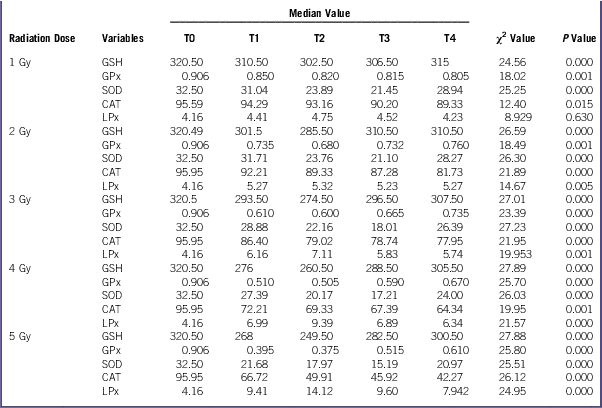
It is evident from Table 1 that the activity of GPx fluctuated with time in all irradiation groups (1-5) with significant changes (P value<0.01), whereas the lowest point in GPx activity was observed at 24 hours post irradiation. Post hoc comparison (see online Supplementary Table S1) revealed that the significance of difference at different radiation doses was observed at all time points with medium effect size (r value: 0.3-0.5, P value<0.01) in comparison with pre-radiation skin sample (T0). A dose-dependent decline in GPx was observed in all irradiated groups. The pattern of change in Gpx activity was almost similar in groups 1-5.
Intra-group Comparison of Skin Parameters Over 72 Hours

Abbreviations: GSH, glutathione; GPx, glutathione peroxidase; SOD, superoxide dismutase; CAT, catalase; LPx, lipid peroxidation.
Degree of freedom: 4, T0 (pre-radiation skin sample, control), T1 (post-radiation 2-hour sample), T2 (post-radiation 24-hour sample), T3 (post-radiation 48-hour sample), T4 (post-radiation 72-hour sample). Median value of GSH, GPx, SOD, CAT, and LPx is nmol/gm tissue weight, µmol GSH per mg protein, U/mg protein, U/mg protein, and nmol/mg protein, respectively.
GSH
A drastic decline in GSH concentration was observed at different radiation doses and a nadir was reached at 24 hours post irradiation at all exposure doses. Table 1 shows the significant decline in GSH concentration (P value<0.01) as observed in groups 1-5. Later it was confirmed by post hoc test, which revealed the medium effect size of differences. The irradiation of animals resulted in a dose-dependent change in GSH concentration in groups 1-5. However, normal concentrations could not be restored even by 72 hours post irradiation in all irradiation groups.
SOD
The exposure of animals to different doses of radiation resulted in a significant decline in SOD activity at 48 hours in all groups when compared with the sham-irradiated group (control). It is evident from Table 1 that SOD activity in groups 1-5 continuously declined until 48 hours and afterward it increased (P value<0.01). Post hoc test confirmed that at all time points there was a significant difference in SOD activity in comparison with control animals with medium effect size.
LPx
The generation of LPx significantly increased with the increase in radiation dose (groups 2-5) and a peak was reached at 24 hours post irradiation. Table 1 showed that significant change in LPx concentration was observed in groups 2-5 with P value<0.01, except in group 1 (P value>0.05). Afterward, LPx concentration declined steadily and reached a nadir at 72 hours post radiation exposure. Post hoc test confirmed the significant differences at all time points in comparison with the control in groups 2-5.
CAT
It is evident from Table 1 that CAT concentration steadily declined until 72 hours and reached its nadir. A dose-dependent decline was observed in CAT concentration from group 1 to group 5 with a P value<0.01. Post hoc test confirmed that CAT concentration was significantly declined at all time points post irradiation in groups 1-5 with medium effect size of differences (r value: 0.3-0.5).
DISCUSSION
Ionizing radiations are toxic to living cells and mediated by the generation of ROS and free radicals. They constantly damage the tissue; hence, skin possesses a comprehensive and integrated enzymatic and non-enzymatic antioxidant and repair system. The increasing use of radioactive materials in industry, medicine, and science within nuclear facilities has significantly increased the potential of large-scale, uncontrolled exposure to radiation and radioactive environmental pollution. However, oxidative stress/changes may continue to arise for days and months after the initial exposure, presumably because of continuous generation of ROS and RNS.Reference Petkau 14 GSH and vitamins E and C are non-enzymatic antioxidants, synthesized endogenously or taken as supplements. SOD, GPx, and CAT represent the endogenous enzymatic antioxidants of the skin.Reference Shindo, Witt and Han 15 GSH is the most important tissue, tripeptide thiol, which is involved in detoxification of exogenous and endogenous compounds and scavenges free radicals.Reference Meister and Anderson 16 Apart from being involved in the synthesis of leukotrienes and prostaglandins, GSH serves as a co-factor of GPx enzyme, which detoxifies hydrogen peroxide and lipid peroxides in cells and tissues. GPx is a selenium-dependent enzyme that protects the cell content and membrane against oxidation by reducing peroxide radicals to the water or alcohol molecule.Reference Brigelius-Fhole 17 GPx has an important role in the biochemistry of GSH, as it keeps GSH in its reduced state. SOD is an important key enzyme in dismutation of superoxide radical.
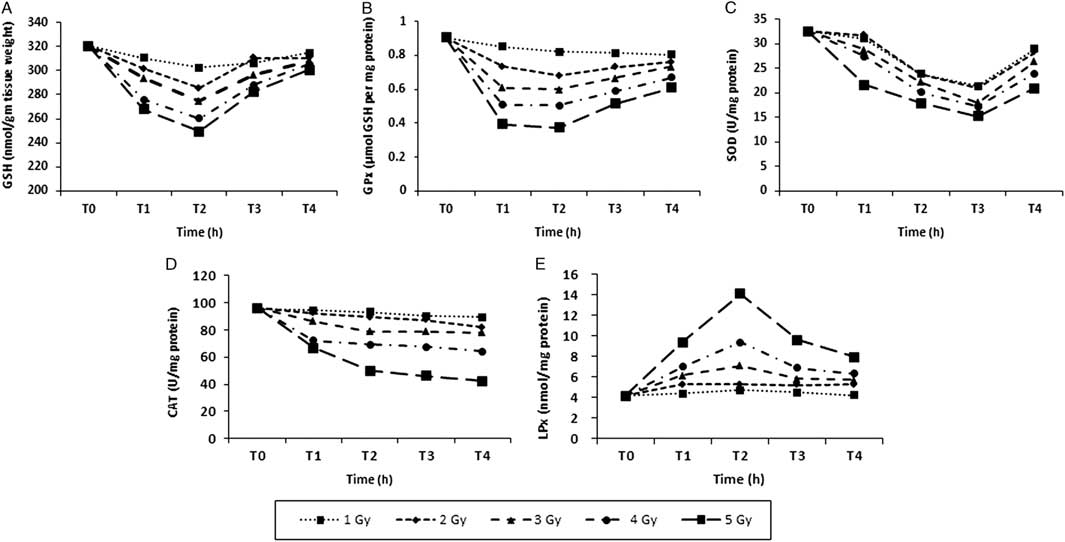
The present study is, to the authors’ knowledge, the first in which animals were irradiated by graded doses (1-5 Gy) of gamma radiation and skin samples were collected at different time points to measure the oxidative stress. Nevertheless, the results of the present study have good agreement with other studies, where similar effects have been reported in different experimental setups.Reference Siems, Gartner and Kranz 18 , Reference Baraboi, Oliinyk and Blium 19 Irradiation of rat skin to fractionated doses of 1-5 Gy radiation resulted in a dose-dependent decline in the GSH, GPx activity, and SOD contents of the skin. The exhaustion in GSH contents after radiation exposure to different doses (1-5 Gy) may be due to the reaction of GSH with free radicals, causing the development of thiyl radicals that react to produce GSSG.Reference Navarro, Obrador and Pellicer 20 , Reference Fuchs, Hufljet and Rothfuss 21 Studies have reported that depletion of GSH causes inhibition of GPx activity and has been shown to increase LPx.Reference Younes and Seigers 22 , Reference Meffert, Diezel and Sönnichsen 23 In the present study, a similar correlation has been observed in GSH, GPx depletion, and increase of LPx in a dose-dependent manner (Figure 1A, B, E). It is very well known to us that SOD converts O2 – radical to H2O2 and stops the formation of ·OH radical through O2 – -driven Fenton reaction and protects against the oxidative stress caused by free-radical injury,Reference Cohen 24 and the H2O2 can be removed by CAT or GPx. In the present study, SOD activity declined in a dose-dependent manner (Figure 1C) along with decline in GSH and GPx and propagation of LPx formation. The activities of antioxidant enzymes (GSH, GPx, CAT, and SOD) are in close relationship with the induction of LPx, where the activities of SOD and GPx decayed with the increase in LPx.
Effect of 1 Gy to 5 Gy radiation dose on skin parameters at different time intervals; (A) GSH, (B) GPx, (C) SOD, (D) CAT (E) LPx. T0 (control), T1 (post radiation 2 h sample), T2 (post radiation 24 h sample), T3 (post radiation 48 h sample), T4 (post radiation 72 h sample).

CONCLUSION
In conclusion, the measurement of biochemical enzymes and antioxidant levels in skin has an additional value for the differentiation of radiation-exposed versus non-exposed individuals owing to their change in a dose-dependent manner. In particular, GSH, GPx, SOD, CAT, and LPx have demonstrated a positive predictive value, which helps in early screening of radiation-exposed individuals. The animal data collected in this study could be further considered to develop new methods of radiation dose assessment allowing for identification of non-irradiated individuals. Further studies are required to support the clinical relevance of present study parameters in a triage of radiation-exposed individuals.
Acknowledgment
One of the authors S.K.S. is thankful to Indian Council of Medical Research (ICMR), New Delhi, India, for providing senior research fellowship (3/2/2/163/2012/NCD-III).
Supplementary material
To view supplementary material for this article, please visit https://doi.org/10.1017/dmp.2018.16