1. Introduction
Micro-organisms and spermatozoa often swim in complex fluids which show non-Newtonian behaviour (Lauga & Powers Reference Lauga and Powers2009). Examples of these include bacteria forming biofilms composed of bacteria-produced extracellular polymeric substances (Hall-Stoodley, Costerton & Stoodley Reference Hall-Stoodley, Costerton and Stoodley2004), spermatozoa swimming through cervical mucus in the mammalian female reproductive tract (Suarez & Pacey Reference Suarez and Pacey2006), Helicobacter pylori colonizing the mucus layer covering the stomach (Montecucco & Rappuoli Reference Montecucco and Rappuoli2001) and Borrelia burgdorferi penetrating the connective tissues in skin (Harman et al. Reference Harman, Dunham-Ems, Caimano, Belperron, Bockenstedt, Fu, Radolf and Wolgemuth2012). In marine environments, bacteria abundance and productivity are elevated within aggregates mainly composed of transparent exopolymer particles referred to as oceanic gel (Smith et al. Reference Smith, Simon, Alldredge and Azam1992). Transparent exopolymer particles contribute to fluxes of carbon into the deep ocean and significantly affect the world’s carbon balance. Rheological measurements show that many biological fluids exhibit both viscoelasticity and shear-dependent viscosity (Hwang, Litt & Forsman Reference Hwang, Litt and Forsman1969; Klapper et al. Reference Klapper, Rupp, Cargo, Purvedorj and Stoodley2002).
Depending on the swimming strategies and the rheological properties of the background fluid, both swimming enhancement and reduction are possible. Helical bacteria swim faster in a viscoelastic fluid compared with a Newtonian fluid of the same viscosity (Berg & Turner Reference Berg and Turner1979), whereas Caenorhabditis elegans, with a planar wave undulation, swim slower (Shen & Arratia Reference Shen and Arratia2011). In recent years, the effects of fluid elasticity have been widely investigated for different types of swimmers, such as squirmers (Zhu, Lauga & Brandt Reference Zhu, Lauga and Brandt2012; Li, Karimi & Ardekani Reference Li, Karimi and Ardekani2014), swimming sheets undergoing planar beating motion (Lauga Reference Lauga2007; Teran, Fauci & Shelley Reference Teran, Fauci and Shelley2010; Riley & Lauga Reference Riley and Lauga2014; Thomases & Guy Reference Thomases and Guy2014) and rotating helical flagellum (Liu, Powers & Breuer Reference Liu, Powers and Breuer2011; Spagnolie, Liu & Powers Reference Spagnolie, Liu and Powers2013). Speed enhancement of up to approximately 20 to 30 % occurs for helices of large pitch angle and small filament radius (Liu et al. Reference Liu, Powers and Breuer2011; Spagnolie et al. Reference Spagnolie, Liu and Powers2013), and for soft flagella undergoing planar beating motion (Riley & Lauga Reference Riley and Lauga2014; Thomases & Guy Reference Thomases and Guy2014).
The effect of shear-thinning viscosity on swimming motion is less understood compared with viscoelasticity. Non-Newtonian viscosity has been considered as the reason behind the enhancement of bacteria speed in early studies (Schneider & Doetsch Reference Schneider and Doetsch1974; Berg & Turner Reference Berg and Turner1979). Based on the concept that a slender body under longitudinal and transverse motions experiences two different apparent viscosities, Magariyama & Kudo (Reference Magariyama and Kudo2002) used a modified resistive force theory and showed enhancement in both the swimming speed and the efficiency with an increase in viscosity in a certain range. Using scaling arguments, a recent study by Vélez-Cordero & Lauga (Reference Vélez-Cordero and Lauga2013) suggested that the shear-dependent viscosity is likely to play a more important role than elastic effects. An experimental study by Martinez et al. (Reference Martinez, Schwarz-Linek, Reufer, Wilson, Morozov and Poon2014) shows that the enhanced swimming of Escherichia coli in polymeric solutions is not related to fluid elasticity, instead it is due to the fast-rotating flagella of E. coli encountering a lower viscosity than the cell body. Swimming enhancement is also observed in simulations of a sperm cell in a shear-thinning fluid (Montenegro-Johnson et al. Reference Montenegro-Johnson, Smith, Smith, Loghin and Blake2012; Montenegro-Johnson, Smith & Loghin Reference Montenegro-Johnson, Smith and Loghin2013). The flow field of a C. elegans is found to be affected by the fluid shear-thinning property. Surprisingly, however, the swimming speed and kinematics are only determined by the fluid zero-shear-rate viscosity, independent of the shear-thinning behaviour of the fluid (Gagnon, Keim & Arratia Reference Gagnon, Keim and Arratia2014). A similar conclusion is derived in the analysis of an inextensible swimming sheet of very small amplitude (Vélez-Cordero & Lauga Reference Vélez-Cordero and Lauga2013). A reduction in swimming speed is also observed in experiments on a cylindrical waving sheet in shear-thinning viscoelastic fluids (Dasgupta et al. Reference Dasgupta, Liu, Fu, Berhanu, Breuer, Powers and Kudrolli2013). Further studies need to be conducted to better understand the different observations reported in the literature.
In this work, numerical simulations are conducted to investigate the effects of non-Newtonian fluid properties on the swimming motion of a planar waving sheet. We verify the numerical code against previous analytical results on a small-amplitude waving sheet in viscoelastic (Lauga Reference Lauga2007) and shear-thinning (Vélez-Cordero & Lauga Reference Vélez-Cordero and Lauga2013) fluids. Our results for large-amplitude undulation illustrate that the speed of Taylor’s swimming sheet decreases in a viscoelastic fluid whereas it increases in a shear-thinning inelastic fluid. A new scaling relation for the power consumption of the large-amplitude waving sheet is provided. We also compare the present results against previous experiments. Since many micro-organisms and biological systems, such as spermatozoa, bacteria and beating cilia, experience non-Newtonian fluids, our findings help us to better understand the motion of low-Reynolds-number swimmers in complex fluids.
2. Governing equations
We model the swimmer as an inextensible infinitely long two-dimensional waving sheet immersed in a non-Newtonian fluid. The prescribed motion of Taylor’s swimming sheet (Taylor Reference Taylor1951) is described by a left-moving travelling wave
 $y=A\sin (x-t)$
, where
 $A$
is the dimensionless amplitude. In all of our results, the length is scaled by
 $1/k$
, time by
 $1/{\it\Omega}$
, velocity by
 ${\it\Omega}/k$
, shear rate by
 ${\it\Omega}$
, and pressure and stress by
 ${\it\mu}{\it\Omega}$
, where
 $k$
is the wavenumber,
 ${\it\Omega}$
is the angular frequency and
 ${\it\mu}$
is the fluid viscosity. Hereinafter, unless otherwise stated, all equations and variables are written in dimensionless form. The velocity components on an inextensible sheet are
 $u=V\cos {\it\theta}-1$
and
 $v=V\sin {\it\theta}$
, where
 $V=1/2{\rm\pi}\int _{0}^{2{\rm\pi}}\sqrt{1+A^{2}\sin ^{2}z}\,\text{d}z$
and
 ${\it\theta}=\arctan A\cos (x-t)$
. The material points on the sheet move in a figure of eight. At length and velocity scales relevant to micro-organisms, inertial effects are neglected. The dimensionless equations for conservation of momentum and mass are
 $$\begin{eqnarray}\boldsymbol{{\rm\nabla}}p=\boldsymbol{{\rm\nabla}}\boldsymbol{\cdot }{\bf\tau},\quad \boldsymbol{{\rm\nabla}}\boldsymbol{\cdot }\boldsymbol{u}=0,\end{eqnarray}$$
where
 $\boldsymbol{u}$
is the velocity vector,
 $p$
is the pressure and
 ${\bf\tau}$
is the deviatoric stress tensor. In a Newtonian fluid, the stress tensor is simply determined by the shear rate tensor
 $\dot{{\bf\gamma}}=\boldsymbol{{\rm\nabla}}\boldsymbol{u}+\boldsymbol{{\rm\nabla}}\boldsymbol{u}^{\text{T}}$
and fluid viscosity, i.e.
 ${\bf\tau}=\dot{{\bf\gamma}}$
in dimensionless form. The hydrodynamic efficiency
 ${\it\eta}$
is defined as
 ${\it\eta}=U^{2}/P$
, where
 $P=\int _{{\it\Gamma}}\boldsymbol{f}\boldsymbol{\cdot }\boldsymbol{u}_{{\it\Gamma}}\,\text{d}{\it\Gamma}$
is the hydrodynamic power,
 $\boldsymbol{u}_{{\it\Gamma}}$
is the velocity along the sheet surface
 ${\it\Gamma}$
and
 $U$
is the swimming speed.
2.1. Swimming in viscoelastic and shear-thinning fluids
To model the elasticity and shear-thinning properties of biological fluids, we use the Giesekus constitutive relation (Giesekus Reference Giesekus1982), in which
 ${\bf\tau}$
can be split into solvent and polymer contributions as
 ${\bf\tau}={\bf\tau}^{s}+{\bf\tau}^{p}$
, where
 ${\bf\tau}^{s}={\it\beta}_{s}\dot{{\bf\gamma}}$
,
 $$\begin{eqnarray}{\bf\tau}^{p}+\mathit{De}\,\overset{{\bigtriangledown}}{{\bf\tau}^{p}}+\frac{\mathit{De}\,{\it\alpha}}{1-{\it\beta}_{s}}{\bf\tau}^{p}\boldsymbol{\cdot }{\bf\tau}^{p}=(1-{\it\beta}_{s})(\boldsymbol{{\rm\nabla}}\boldsymbol{u}+\boldsymbol{{\rm\nabla}}\boldsymbol{u}^{\text{T}})\end{eqnarray}$$
and
 ${\it\beta}_{s}$
is the ratio of the solvent viscosity to the zero-shear-rate viscosity of the polymeric solution. This ratio is equal to the ratio of the infinite-shear-rate viscosity and the zero-shear-rate viscosity. The Deborah number
 $\mathit{De}={\it\lambda}/t_{c}$
is the ratio of the polymer relaxation time
 ${\it\lambda}$
and the characteristic flow time scale
 $t_{c}=1/{\it\Omega}$
. Another important dimensionless number for swimming in viscoelastic fluids is the Weissenberg number
 $\mathit{Wi}={\it\lambda}\dot{{\it\gamma}}_{c}$
, where the characteristic shear rate in this study is
 $\dot{{\it\gamma}}_{c}={\it\Omega}A$
. The mobility factor
 ${\it\alpha}$
, which is in the range of
 $0$
to
 $1/2$
, represents the anisotropic hydrodynamic drag exerted on the polymer molecules by the surrounding solute molecules and affects the viscosity of the polymeric solution. At
 ${\it\alpha}=0$
, the Giesekus constitutive equation recovers to the Oldroyd-B model and has a constant viscosity. The notation
 $\overset{{\bigtriangledown}}{}$
represents the upper-convected derivative.
We use the Carreau constitutive model (Carreau, Dekee & Chhabra Reference Carreau, Dekee and Chhabra1997) to investigate the motion in a shear-thinning inelastic fluid,
 $$\begin{eqnarray}\displaystyle & {\bf\tau}={\it\beta}^{e}\dot{{\bf\gamma}}, & \displaystyle\end{eqnarray}$$
 $$\begin{eqnarray}\displaystyle & {\it\beta}^{e}={\it\beta}_{s}+(1-{\it\beta}_{s})(1+\mathit{Cu}^{2}|\dot{{\it\gamma}}|^{2})^{(n-1)/2}\quad (0<n\leqslant 1), & \displaystyle\end{eqnarray}$$
 ${\it\beta}_{e}$
is the normalized effective viscosity and
 $|\dot{{\it\gamma}}|=\sqrt{\dot{{\bf\gamma}}\boldsymbol{ : }\dot{{\bf\gamma}}/2}$
is the effective shear rate. The Carreau number
 $\mathit{Cu}={\it\lambda}_{c}{\it\Omega}$
(similar to
 $\mathit{De}$
) is the ratio between the characteristic time scale
 ${\it\lambda}_{c}$
of the solution and the characteristic flow time scale
 $1/{\it\Omega}$
, where
 ${\it\lambda}_{c}$
is the inverse of the shear rate at which the fluid transitions from Newtonian-like to power-law behaviour. Similar to the Weissenberg number, the shear Carreau number is related to the shear rate
 $\mathit{Cr}=\mathit{Cu}\,A$
. The power-law index
 $n$
determines how fast the viscosity decreases with increasing shear rate. The larger
 $n$
is, the more slowly the viscosity decreases. At
 ${\it\beta}_{s}=1$
,
 $\mathit{Cu}=0$
or
 $n=1$
, the model recovers to the Newtonian fluid. In biological materials, such as biofilm and mucus,
 ${\it\lambda}$
and
 ${\it\lambda}_{c}$
vary from
 $O(10)$
to
 $O(10^{3})$
s,
 $n$
from 0.1 to 0.9 and
 ${\it\beta}_{s}$
from
 $O(10^{-3})$
to
 $O(10^{-1})$
. The typical beating frequency of the flagellum ranges from 2 to 30 Hz. Therefore, for micro-organisms,
 $\mathit{De},\mathit{Wi},\mathit{Cu}$
and
 $\mathit{Cr}$
vary in a very wide range, from
 $O(1)$
to
 $O(10^{4})$
.
3. Numerical method
Simulations are conducted using a finite-volume method based on a staggered grid. A conventional operator-splitting method is applied to enforce the continuity equation. The spatial derivatives in the diffusion terms are discretized using the central difference scheme. A second-order total variation diminishing Runge–Kutta method is used for time marching. A distributed Lagrange multiplier method is used to numerically resolve the motion of the sheet and satisfy the no-slip boundary condition on the sheet. The details of the distributed Lagrange multiplier method can be found in our previous studies (Li & Ardekani Reference Li and Ardekani2014; Li et al.
Reference Li, Karimi and Ardekani2014). The viscoelastic stress is solved using a commonly used formulation denoted as the elastic and viscous stresses splitting method (Guénette & Fortin Reference Guénette and Fortin1995). The computational domain is
 $2{\rm\pi}\times 40{\rm\pi}$
for an infinitely long sheet. The grid size
 ${\it\Delta}={\rm\pi}/256$
is uniform along the sheet (
 $x$
-direction) and in the domain of
 $[-2{\rm\pi},2{\rm\pi}]$
in the
 $y$
-direction. The grids are gradually stretched in the
 $y$
-direction outside this domain moving away from the sheet. The time step is
 $\text{d}t=10^{-4}$
. Periodic boundary conditions are used at the
 $x=0$
and
 $x=2{\rm\pi}$
boundaries of the computational domain. At the
 $y=-20{\rm\pi}$
and
 $y=20{\rm\pi}$
boundaries,
 $\partial \boldsymbol{u}/\partial y$
is set to zero.
3.1. Verification of the numerical code
The swimming speed
 $U$
and the hydrodynamic efficiency
 ${\it\eta}$
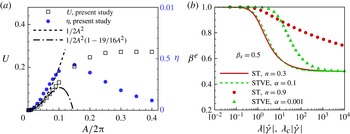
for an infinitely long waving sheet in a Newtonian fluid are shown in figure 1(a). The numerical results agree well with the second- and fourth-order analytical results for a small-amplitude sheet (Taylor Reference Taylor1951) up to
 $A=0.1{\rm\pi}$
. Within this range, the maximum difference between our simulations and the fourth-order analytical results is less than
 $0.5\,\%$
. The swimming speed of the sheet reaches a plateau for
 $A>0.4{\rm\pi}$
. Interestingly, the efficiency of the sheet peaks at approximately
 $A=0.3{\rm\pi}$
, which lies inside the range of typical biological observations, such as C. elegans (Gagnon et al.
Reference Gagnon, Keim and Arratia2014) and sperm (Brokaw Reference Brokaw1965).
(a) Swimming speed
 $U$
and efficiency
 ${\it\eta}$
for an infinitely long sheet of different amplitudes in a Newtonian fluid. (b) Shear-dependent viscosity of Giesekus and Carreau models in a simple shear flow.


In figure 1(b), we compare the shear-thinning behaviour of the Giesekus and Carreau models (2.3b
) in a simple shear flow. The shear rate corresponding to the transition from Newtonian-like to power-law behaviour in a Giesekus fluid is determined by both
 ${\it\lambda}$
and
 ${\it\alpha}$
, whereas the shear-thinning rate remains the same (Bird et al.
Reference Bird, Armstrong, Hassager and Curtiss1977). We can match the effective viscosity of the Carreau fluid to the Giesekus fluid to unravel the effect of both elasticity and shear-thinning behaviour (see figure 1
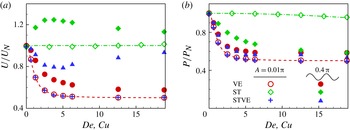
b). Verification of numerical results for a Taylor’s swimming sheet with small amplitude in non-Newtonian fluids is given in figure 2. Our results recover the analytical results for a small-amplitude sheet in both viscoelastic and shear-thinning fluids.
4. Results and discussion
We compare the role of fluid elasticity (VE), shear-thinning behaviour (ST) and combined shear-thinning viscoelastic effects (STVE) on an undulatory swimming sheet of
 $A=0.01{\rm\pi}$
or
 $0.4{\rm\pi}$
(see figure 2). We assume
 ${\it\beta}_{s}=0.5$
, except for small-amplitude oscillations in a Carreau fluid, where we set
 ${\it\beta}_{s}=0$
to directly compare the results with the analytical results. Unless otherwise stated, we set
 $n=0.3$
in the Carreau fluid. In an Oldroyd-B fluid, both the swimming speed and the hydrodynamic power decrease monotonically as (Lauga Reference Lauga2007)
 $$\begin{eqnarray}U/U_{N}=P/P_{N}=\frac{1+{\it\beta}_{s}\mathit{De}^{2}}{1+\mathit{De}^{2}},\end{eqnarray}$$
where
 $U_{N}$
and
 $P_{N}$
are the speed and power in a Newtonian fluid respectively. The reduction in the swimming speed and efficiency is less strong for a large-amplitude sheet. In a Carreau fluid, the swimming speed of a small-amplitude sheet does not change up to
 $O(A^{4})$
and the power follows (Vélez-Cordero & Lauga Reference Vélez-Cordero and Lauga2013)
 $$\begin{eqnarray}P/P_{N}=1+{\textstyle \frac{3}{16}}(n-1)\mathit{Cu}^{2}A^{2}.\end{eqnarray}$$
The above relation agrees well with numerical results in the limit of small
 $\mathit{Cu}$
. At large
 $\mathit{Cu}$
, numerical results show a small enhancement in speed. Equation (4.2) is not valid for
 $\mathit{Cu}>4/\sqrt{3(1-n)A^{2}}$
and leads to a negative power. For a large-amplitude sheet (
 $A=0.4{\rm\pi}$
), shear-thinning effects result in a speed enhancement, with the maximum increase of 25 % at
 $\mathit{Cu}\simeq 1.2{\rm\pi}$
. Montenegro-Johnson et al. (Reference Montenegro-Johnson, Smith, Smith, Loghin and Blake2012) predicted an optimum velocity enhancement at
 $\mathit{Cu}=1.6{\rm\pi}$
for a finite-length undulatory sperm-like swimmer including a head when the fluid power-law index is
 $n=0.5$
. Shear-thinning effects lead to a significant enhancement in the swimming speed. In a shear-thinning viscoelastic fluid, the velocity follows the same relation as in an Oldroyd-B fluid when the oscillation amplitude or
 $\mathit{De}$
is small. The shear-thinning effect is more important at higher shear rates, but the speed is still hindered. The power consumption is less affected by shear-thinning effects in a Giesekus fluid.
The mean-squared polymer distention field
 $\text{tr}({\bf\tau}^{p})$
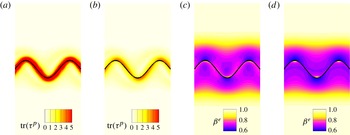
, computed as the trace of the polymer stress tensor, in Oldroyd-B and Giesekus fluids is compared in figures 3(a,b). Previous studies of a planar finite-length sheet in a viscoelastic fluid have shown that the swimming enhancement is related to the concentrated polymer stress distribution at the tail (Teran et al.
Reference Teran, Fauci and Shelley2010; Thomases & Guy Reference Thomases and Guy2014). Here, we see that the polymer stress is stretched along the entire sheet. In a Giesekus fluid, the polymer stress is attenuated, and is mostly stretched along the front-side of an infinitely long sheet. In figures 3(c,d), we compare the effective viscosity in Giesekus and Carreau fluids. The effective viscosity of the Giesekus fluid is evaluated by calculating the effective shear rate (Bird et al.
Reference Bird, Armstrong, Hassager and Curtiss1977). The fluid viscosity around the sheet is reduced and gradually recovers to the zero-shear-rate viscosity away from the sheet. There are some similarities between the two cases, but near the sheet, the Giesekus fluid is less thinned and forms finer structures.
Distribution of the trace of the polymeric stress tensor
 $\text{tr}({\bf\tau}^{p})$
in (a) Oldroyd-B and (b) Giesekus fluid, and distribution of the effective viscosity in (
 $c$
) Giesekus and (
 $d$
) Carreau fluid;
 $A=0.4{\rm\pi}$
and
 ${\it\beta}_{s}=0.5$
in all cases; (
 $a$
)
 $De=2{\rm\pi}$
,
 ${\it\alpha}=0$
; (b,c)
 $De=2{\rm\pi}$
,
 ${\it\alpha}=0.1$
; (
 $d$
)
 $Cu=2{\rm\pi}$
,
 $n=0.3$
.

4.1. Scaling law in shear-thinning fluids
To fully understand the shear-thinning effects on a swimming sheet, we conduct a series of simulations for various oscillation amplitudes
 $A$
and viscosity ratios
 ${\it\beta}_{s}$
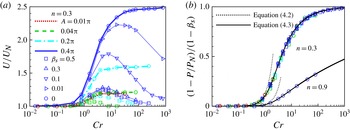
. In figure 4, we plot the normalized swimming speed and power as a function of
 $\mathit{Cr}$
. It is clear that using
 $\mathit{Cr}$
instead of
 $\mathit{Cu}$
leads to a much better collapse of the data. The swimming speed is less affected at small values of
 $\mathit{Cr}$
 $({<}0.1)$
, since the fluid viscosity does not vary at such a low shear rate. The analysis of Vélez-Cordero & Lauga (Reference Vélez-Cordero and Lauga2013) is valid in this range. The rheological effects begin to matter when
 $\mathit{Cr}\sim O(0.1)-O(1)$
. The transition occurs at a smaller
 $\mathit{Cr}$
as the undulation amplitude increases and
 ${\it\beta}_{s}$
decreases. There is a maximum speed for cases with non-zero
 ${\it\beta}_{s}$
. In the limits of zero and infinite
 $\mathit{Cr}$
, the swimming speed of the sheet is the same as its Newtonian value because the normalized viscosity is constant in both cases, equal to 1 and
 ${\it\beta}_{s}$
respectively. The maximum speed and the corresponding Cr number,
 $\mathit{Cr}_{max}$
, depend on the oscillation amplitude
 $A$
, as well as the viscosity ratio
 ${\it\beta}_{s}$
. Larger speed enhancement and
 $\mathit{Cr}_{max}$
are observed for larger
 $A$
and smaller
 ${\it\beta}_{s}$
. The value of
 $\mathit{Cr}_{max}$
ranges from the order of
 $O(1)$
to
 $O(10^{2})$
, which corresponds to the range where the fluid viscosity is effectively thinned but before it reaches the infinite-shear-rate plateau (see figure 1
b). Interestingly, experiments show that the circulation generated by C. elegans first increases with
 $\mathit{Cr}$
and then decreases (Gagnon et al.
Reference Gagnon, Keim and Arratia2014). In the limit of zero
 ${\it\beta}_{s}$
, the swimming speed monotonically increases due to the absence of infinite-shear-rate plateau.
The power consumption of an undulating sheet follows a universal scaling law. As shown in figure 4(b), all of the data collapse onto solid curves defined as
 $$\begin{eqnarray}\frac{1-P/P_{N}}{1-{\it\beta}_{s}}=1-\left(1+\frac{3}{8}\mathit{Cr}^{2}\right)^{(n-1)/2},\end{eqnarray}$$
in which the constant
 $3/8$
is chosen so that the first term of the Taylor expansion of (4.3) matches the power consumption calculated for small-amplitude oscillations, i.e. (4.2). The power consumption of an undulating sheet is equal to the energy dissipation integral
 $P=\int _{S}{\it\beta}^{e}|\dot{{\it\gamma}}|^{2}\,\text{d}S$
, where
 ${\it\beta}^{e}=1$
in a Newtonian fluid. Assuming that the magnitude of the shear rate is roughly unchanged and using (2.3b
), we get the following scaling for power consumption
 $(1-P/P_{N})/(1-{\it\beta}_{s})\sim 1-(1+\mathit{Cu}^{2}|\dot{{\it\gamma}}_{t}|^{2})^{(n-1)/2}$
, where
 $|\dot{{\it\gamma}}_{t}|$
is the typical shear rate. This equation can be simplified to (4.3) if the effective shear rate scales with the oscillation amplitude (
 $|\dot{{\it\gamma}}_{t}|\propto A$
). Later, we will confirm both these assumptions.
Normalized (a) swimming speed and (b) hydrodynamic power as a function of
 $\mathit{Cr}$
.

The present numerical results extend the analytical results by Vélez-Cordero & Lauga (Reference Vélez-Cordero and Lauga2013) for a small-amplitude waving sheet. Our results are also consistent with the simulations of Montenegro-Johnson et al. (Reference Montenegro-Johnson, Smith, Smith, Loghin and Blake2012, Reference Montenegro-Johnson, Smith and Loghin2013) for a finite sperm-like swimmer, in which the velocity peaks at a certain
 $\mathit{Cr}$
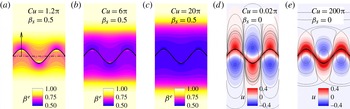
. Montenegro-Johnson et al. (Reference Montenegro-Johnson, Smith and Loghin2013) related this velocity peak with the maximal viscosity gradient along the sheet, but their explanation does not hold for an infinitely long sheet. Here, we propose another explanation for the speed enhancement caused by shear-thinning viscosity. The fluid viscosity around the sheet is reduced due to the high values of the shear rate and it gradually recovers to the zero-shear-rate viscosity away from the sheet (figure 5
a–
 $c$
). As a result, the sheet swims inside a corridor of low-viscosity fluid surrounded by a higher-viscosity fluid. If
 ${\it\beta}_{s}=0$
, the fluid viscosity can be reduced to the solvent viscosity, which is infinitesimal compared with the unstirred fluid. The sheet swims as if it is inside a confined channel and gains an enhanced speed due to the confinement (Katz Reference Katz1974). The differences in the streamlines of two cases with different
 $\mathit{Cr}$
are shown in figure 5(d,e). The effect of this corridor of low-viscosity fluid is weakened with increasing
 ${\it\beta}_{s}$
due to the increased viscosity ratio inside and outside the channel, but the same mechanism still exists. The further decrease in the fluid viscosity inside the channel at larger
 $\mathit{Cr}$
strengthens the confinement effect. On the other hand, the enlarged shear-thinning region weakens the confinement effect by increasing the width of the low-viscosity layer. These two competing effects lead to a peak in the swimming speed. For a finite-length waving sheet, this mechanism as well as the mechanism proposed by Montenegro-Johnson et al. (Reference Montenegro-Johnson, Smith and Loghin2013) exist and may work in tandem to enhance the swimming speed.
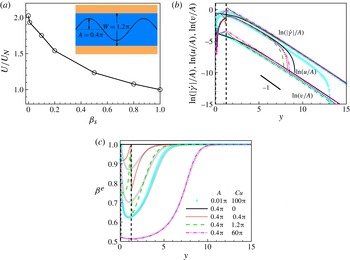
To further test the role of corridors of low-viscosity fluids, we have conducted simulations of a waving sheet swimming in a layer of low-viscosity Newtonian fluid surrounded by an outer layer of high-viscosity Newtonian fluid. The ratio of inner fluid viscosity to outer fluid viscosity is
 ${\it\beta}_{s}$
. As shown in figure 6(a), the swimming speed of the waving sheet increases as
 ${\it\beta}_{s}$
decreases (for
 ${\it\beta}_{s}<1$
), and it approaches the swimming speed between two solid walls as
 ${\it\beta}_{s}$
approaches zero. We should note that the swimming enhancement of a waving sheet in shear-thinning fluids is weaker than that swimming between two solid walls due to continuous change in the fluid viscosity as well as the finite ratio of the fluid viscosity near the swimmer to the zero-shear-rate viscosity.
(
 $a$
–
 $c$
) Distribution of effective viscosity around a waving sheet at
 ${\it\beta}_{s}=0.5$
and (d–e) the velocity field and streamlines around a sheet at
 ${\it\beta}_{s}=0$
; in all of the cases,
 $A=0.4{\rm\pi}$
; (
 $a$
)
 $Cu=1.2{\rm\pi}$
, (
 $b$
)
 $Cu=6{\rm\pi}$
, (
 $c$
)
 $Cu=20{\rm\pi}$
, (
 $d$
)
 $Cu=0.02{\rm\pi}$
, (
 $e$
)
 $Cu=200{\rm\pi}$
.

In figure 6(b,c), we plot the distribution of
 $|\dot{{\it\gamma}}|,u,v$
and
 ${\it\beta}^{e}$
along the
 $y$
-direction at
 $x={\rm\pi}/2$
. Independent of the fluid rheology and the oscillation amplitude, the magnitude of the shear rate roughly follows the same relation (light grey line),
 $$\begin{eqnarray}|\dot{{\it\gamma}}|=2Ay\,\text{e}^{-y},\end{eqnarray}$$
which confirms the assumption we used for the derivation of (4.3). This scaling is the same as for the small-amplitude analytical results, in which the first- and second-order velocities are not affected by shear-thinning effects. In this case, the shear dependence of the viscosity affects the third and higher orders of the shear rate (Vélez-Cordero & Lauga Reference Vélez-Cordero and Lauga2013). The
 $u$
velocity component for the case with maximum speed changes its direction earlier than other cases, and the
 $v$
component is the lowest, indicating the strongest confinement effect in this case. The effective viscosity
 ${\it\beta}^{e}$
of Carreau fluid can be derived as a function of
 $\mathit{Cr}$
and
 $y$
using (2.3b
) and (4.4) (light grey lines in figure 6
c). The effective viscosity obtained from (2.3b
) and (4.4) has a minimum at
 $y=1$
, which agrees well with our numerical results for a small-amplitude sheet. For a large-amplitude sheet at low
 $\mathit{Cr}$
, the viscosity near the sheet is lower than the abovementioned prediction on one side, while it is less thinned on the other side. At high
 $\mathit{Cr}$
, where the viscosity reaches its minimum value near the sheet, the prediction holds well.
(a) The normalized swimming speed of a sheet inside a channel of low-viscosity fluid. Distribution of (b)
 $|\dot{{\it\gamma}}|,u$
and
 $v$
and (
 $c$
)
 ${\it\beta}^{e}$
along the
 $y$
-direction at
 $x={\rm\pi}/2$
. The light grey lines correspond to (4.4) in (b) and (2.3b
) in (
 $c$
) after substituting (4.4) for the effective shear rate. The vertical dashed lines represent the sheet of
 $A=0.01{\rm\pi}$
and
 $0.4{\rm\pi}$
respectively;
 ${\it\beta}_{s}=0.5$
in all cases in (b,c).

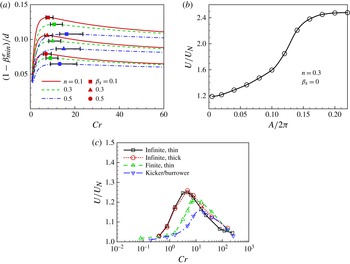
Using this prediction, we can estimate
 $\mathit{Cr}_{max}$
by evaluating the strength of the shear-thinning effect,
 $(1-{\it\beta}_{min}^{e})/d$
. Here,
 ${\it\beta}_{min}^{e}$
is the minimum effective viscosity and
 $d$
is the thickness of the shear-thinned layer, which is defined as the location where the viscosity recovers to the zero-shear-rate viscosity. Figure 7(a) shows
 $(1-{\it\beta}_{min}^{e})/d$
as a function of
 $\mathit{Cr}$
. The
 $\mathit{Cr}$
corresponding to the maximum value of
 $(1-{\it\beta}_{min}^{e})/d$
is close to the
 $\mathit{Cr}_{max}$
obtained from our numerical simulations. At
 $n=0.3$
,
 $\mathit{Cr}_{max}$
is approximately
 $10$
and increases with decreasing
 ${\it\beta}_{s}$
and increasing
 $n$
. In typical biological fluids, where the viscosity ratio
 ${\it\beta}_{s}$
is usually low, we expect the microswimmers to benefit from the speed enhancement. In figure 7(b), we plot the normalized speed as a function of the amplitude at
 $\mathit{Cu}=200{\rm\pi}$
and
 ${\it\beta}_{s}=0$
. This is approximately the maximum speed enhancement of microswimmers for
 $n=0.3$
due to shear-thinning effects. For a small-amplitude sheet, approximately
 $20\%$
speed enhancement is achieved. For a large-amplitude sheet, the speed is more than doubled. Finally, we check whether the thickness, the finite length and the swimming stroke affect the results. The thickness of the thick waving sheet is
 $0.16{\rm\pi}$
, similar to the measurements of C. elegans (Gagnon et al.
Reference Gagnon, Keim and Arratia2014). For the finite-length swimmer, the sheet has one complete waving form. Linearly increasing/decreasing amplitude towards the tail is chosen for kicker/burrower swimmers. As shown in figure 7(
 $c$
), swimming enhancement occurs for all of the cases. The thickness does not affect the speed; the finite length of the waving sheet leads to larger
 $\mathit{Cr}_{max}$
and weaker speed enhancement. Kicker and burrower swimmers have the same swimming speeds.
(a) The strength of the shear-thinning effect,
 $(1-{\it\beta}_{min}^{e})/d$
, as a function of
 $\mathit{Cr}$
for different
 $n$
and
 ${\it\beta}_{s}$
. The symbols show the maximum value of
 $(1-{\it\beta}_{min}^{e})/d$
, with
 $d$
being the distance where the effective viscosity is
 $95\,\%$
of the zero-shear-rate viscosity. The error bars span the range of
 $d$
corresponding to
 $91\,\%$
and
 $99\,\%$
of the zero-shear-rate viscosity. (b) The normalized swimming speed as a function of the amplitude
 $A$
at
 $\mathit{Cu}=200{\rm\pi}$
and
 ${\it\beta}_{s}=0$
. (
 $c$
) The normalized swimming speed for various waving sheets as a function of
 $\mathit{Cr}$
at
 $A=0.4{\rm\pi}$
and
 ${\it\beta}_{s}=0.5$
.

There are some differences between the simulation results and the experimental measurements of C. elegans by Gagnon et al. (Reference Gagnon, Keim and Arratia2014). Even though experiments show that the circulation generated by C. elegans first increases with
 $\mathit{Cr}$
and then decreases, the swimming speed is reported to be the same as that in a Newtonian fluid. The difference may come from the fact that the swimming speed of C. elegans depends on the fluid viscosity, even in Newtonian fluids, while in the simulations, the swimming speed is the same. The difference between these numerical results and the experiments of Gagnon et al. (Reference Gagnon, Keim and Arratia2014) could be due to the three-dimensional nature of the experiments and the subtle viscosity-dependent changes in the swimming kinematics of C. elegans. Additionally, in simulations, the kinematics of the waving sheet is imposed without any limit on the power consumption, whereas in experiments there will be a limit on the power consumption. If we compared the experimentally measured swimming speeds in Newtonian and shear-thinning fluids at the same zero-shear-rate viscosity, we would see a higher speed in shear-thinning fluids, which is consistent with our study. An area of future research could be to evaluate the optimal efficiency in non-Newtonian fluids. The optimal efficiency of a sheet in a Newtonian fluid has been previously studied by Montenegro-Johnson & Lauga (Reference Montenegro-Johnson and Lauga2014).
5. Concluding remarks
We have numerically investigated the effects of the rheological properties of the fluid on the swimming motion of an infinitely long planar waving sheet. In a viscoelastic fluid, the swimming speed and power consumption decrease with the Deborah number, regardless of the sheet amplitude. In an inelastic shear-thinning fluid, the shear Carreau number
 $\mathit{Cr}$
, related to the typical shear rate, is found to mostly affect the swimming behaviour. Therefore, both the beating frequency and the amplitude are important. Our simulation results recover the analytical results for a small-amplitude sheet (Vélez-Cordero & Lauga Reference Vélez-Cordero and Lauga2013), where the speed is not affected and the power is reduced. For a large-amplitude sheet, velocity enhancement and power reduction are observed. The swimming boost in a shear-thinning fluid occurs even for an infinitely long sheet because it swims in a low-viscosity fluid layer surrounded by a high-viscosity fluid. Two competing effects determine the speed enhancement: the viscosity and the width of the inner low-viscosity fluid layer. Increasing
 $\mathit{Cr}$
reduces the viscosity of the inner layer, but enhances its width. Therefore, there exists a maximum swimming speed, dependent on the oscillation amplitude as well as the fluid rheological properties. The power consumption, on the other hand, follows a universal scaling law.
Our results show that the spatial variation of the fluid viscosity greatly affects the swimming speed of a waving sheet. Since shear-thinning viscosity and inhomogeneity are observed in many biological fluids, these results are helpful in better understanding the effects of complex fluids on the locomotion of micro-organisms.
Acknowledgements
This publication was made possible, in part, with support from NSF (grant no. CBET-1445955-CAREER) and the Indiana Clinical and Translational Sciences Institute under grant TR001108 from the National Institutes of Health, National Center for Advancing Translational Sciences, and Clinical and Translational Sciences Award programme. We thank D. A. Gagnon and P. E. Arratia for helpful discussion.