Introduction
Researchers and policymakers increasingly recognise the importance of the emotional dimension in parenting new infants. New publically-funded parenting education programmes are actively concerned with teaching men about the emotional side of fathering, to support them in developing better bonds with their infants (Dermott, Reference Dermott2008). Furthermore, a raft of new paternity-leave schemes have been introduced in OECD countries, targeted specifically at the post-birth period. These leave schemes are explicitly rationalised on the grounds that fathers will use fathering/paternity leave to bond with their children, which will in turn lead to increased paternal care over the child's life and, ultimately, better child outcomes (Rush, Reference Rush2012). For example, the Australian Dad and Partner Pay initiative, which provides fathers with up to two weeks of government funded pay, aims to increase ‘opportunities for fathers to bond with their newborn’ (Martin et al., Reference Martin, Baird, Brady, Broadway, Hewitt and Kalb2014: 105, emphasis added). Similarly, the UK government introduced two weeks paid paternity leave in 2003 (Lewis and Campbell, Reference Lewis and Campbell2007), which was increased in April 2015 so fathers can take up to 39 weeks of Shared Parental Pay, which is paid at the statutory rate. (UK Government, 2015a; 2015b). The responsible Minister argued that with these changes ‘fathers and partners will be able to spend more time bonding with their children during the precious early stages of their development’ (DBIS et al., 2014). This policy interest in paternal bonding is part of a broader policy concern with promoting strong emotional bonds between father and child, rather than simply increasing men's responsibility for childcare and housework (Dermott, Reference Dermott2008; Ives, Reference Ives2015).
Existing social policy research has focused on men's beliefs about good fathering (Chowbey et al., Reference Chowbey, Salway and Clarke2013), fathers’ uptake of paternity leave (Lewis and Campbell, Reference Lewis and Campbell2007), and the impact of this leave on the time fathers devote to childcare and housework (Bünning, Reference Bünning2015; Haas and Hwang, Reference Haas and Hwang2008; Schober, Reference Schober2014). However, even though increasing emotional bonds is one of the central aims of new paternity leave schemes, research has largely not explored how paternity leave policies shape fathers’ emotional connections with infantsFootnote 1 or the degree to which policy aims align with fathers’ own beliefs and desires. This article adds to the current social policy literature on fathering and paternity leave by seeking to understand how this new normative agenda promoting ‘emotional connectedness’ aligns with fathers’ own perceptions of their role (Ives, Reference Ives2014: 1005).
This article begins from the assumption that new paternity leaves will only achieve their aim to increase the strength of men's bonds with their children if fathers themselves believe they are capable of bonding with their young infants and actively engage in activities that help to develop the father-infant bond. Although paternity leave policies appear to be based on the assumption that men will devote themselves to bonding with their infants if they are able to take time off around the birth of a child, research suggests that even when fathers take leave around the birth many feel marginalised and ‘useless’ in the early weeks of their children's lives (Premberg et al., Reference Premberg, Hellström and Berg2008; Shirani and Henwood, Reference Shirani and Henwood2011). Indeed, popular commentary in the United Kingdom has criticised the Government's idea that funded paternity leave will increase fathers’ bonds with their children on exactly these grounds (Letts, Reference Letts2015; Sykes, Reference Sykes2014). However, other research suggests that fathers do feel they can generate an early connection with their baby including by assisting the mother to establish breastfeeding (Fägerskiöld, Reference Fägerskiöld2008; Premberg et al., Reference Premberg, Hellström and Berg2008). This issue of paternal bonding is very important from a policy perspective because research suggests that stronger paternal bonds are associated with better infant outcomes (Brown et al., Reference Brown, Mangelsdorf and Neff2012; Ramchandani et al., Reference Ramchandani, Domoney, Sethna, Psychogiou, Vlachos and Murray2013),
Existing studies offer tantalizingly suggestive insights into contemporary fathers’ constructions, experiences and enactments of paternal bonding, but their findings are limited for three reasons: (1) most of these findings are presented in the context of answering different research questions and were not scrutinized in-depth; (2) no attempt is made to theorize how fathers construct paternal bonding, including how their discourses link to gendered constructions of parenting; and (3) the analyses and conclusions are based on very small (n= 2 to 20), or specific samples (such as stay-at-home fathers) that do not contain sufficient variation to explore how experiences of bonding vary across socio-economic class or different patterns of paid work and leave-taking.
The aim of this article is to present a systematic analysis of: (1) Australian fathers’ beliefs regarding bonding with young infants; and (2) how these beliefs about paternal bonding shape the kinds of father-infant interactions they engage in during the early months, including while on paternity leave. Drawing on in-depth interviews with a large (n = 100), and diverse sample of Australian fathers of infants, and utilising a social constructionist embodiment perspective we examine how fathers construct and enact paternal bonding in the early months of a child's life. Our social constructionist embodiment perspective highlights that although parents’ experiences are socially constructed, parenting practices (such as breastfeeding) are nevertheless connected to particular bodies (Connell, Reference Connell2009).
This article argues that among Australian fathers of infants there are two dominant constructions of paternal bonding: time-focused and physiology-focused. A majority of fathers primarily adhered to a time-focussed construction of bonding, which posits that bonding is a product of physically spending sufficient time with a child, irrespective of gender. These fathers tend to use time spent at home to develop an emotional connection with their infant. In contrast, a sizable minority of fathers primarily adhered to a physiological construction of bonding, meaning they tended to associate early infant-parent bonding with female physiological attributes including breasts and ‘maternal instinct’. These physiology-focused fathers tended to report feeling ‘useless’ in the early months of their child's life. During any leave around the birth they remained distant from the infant, focusing instead on general household chores or the care of older children. These findings highlight the need for social policies to pay greater attention to the central role that social discourses and embodiment play in gendered experiences of parenting, particularly in the first year of a child's life.
The structure of this article is as follows: (1) a brief policy background is followed by (2) an overview of the literature and theoretical framework; and then (3) details of the study. The findings section is divided into three main sections, beginning with (4) a description of the two key ways that fathers construct paternal bonding before (5) examining the relationship between fathers’ leave around the birth of a child and their construction of paternal bonding; and finally, (6) a description of how fathers’ constructions of paternal bonding shapes how they enact this bonding. The conclusion explains how our findings extend the existing social policy literature and link to recent policy developments.
Policy background
Australia is a particularly interesting case to examine due to its unusually strong gendered divisions in paid work and childcare. Although Australia's female labour force participation rate is similar to other liberal welfare states, its rates of maternal employment are significantly lower with only 47.4 per cent of mothers with a youngest child aged less than 3 years employed (or on leave from work) compared to 64 per cent in Canada, 57 per cent in the United Kingdom and 54 per cent in the US (Baxter, Reference Baxter2013; OECD, 2011; OECD, 2014). Furthermore, Australian couples may experience sharper gendered divisions in infant care due to very high rates of breastfeeding initiation (95 per cent of Australian mothers initiate breastfeeding) compared to much lower rates in the US (76 per cent), UK (81 per cent), and somewhat lower rates in Canada (89 per cent) (Australian Government: Department of Health, 2012).
Literature and theoretical framework
Fathers’ perspectives on paternal bonding
Despite increased policy interest in facilitating stronger paternal bonds (Australian Government: DSS, 2013; Raising Children Network, 2012; Rush, Reference Rush2012; UK Government: Department for Employment and Learning, 2014) existing research on the transition to fatherhood tends to focus on gendered divisions in practical infant care (such as feeding and changing) at the expense of attention to gendered experiences of emotional connections (Dermott, Reference Dermott2008). Nursing studies on transitions to fatherhood and breastfeeding find that some men view breastfeeding as a significant barrier to early bonding, while others do not (Chin et al., Reference Chin, Hall and Daiches2011; Fägerskiöld, Reference Fägerskiöld2008; Goodman, Reference Goodman2005; Premberg et al., Reference Premberg, Hellström and Berg2008). Doucet's research on stay-at-home fathers found that men deemed women to have greater sensitivity and this together with the mother's ‘physical connection, associated with pregnancy, birth and breastfeeding’, meant that mothers were perceived to have a much stronger and more profound ‘bond’ with the child (Doucet, Reference Doucet2006: 703; Doucet, Reference Doucet2009). However, Doucet does not systematically explore fathers’ experiences, discourses or constructions of bonding, and largely accepts, rather than critically interrogates, parents’ claims that mothers’ early bonds are necessarily stronger (Doucet, Reference Doucet2006; Doucet, Reference Doucet2009).
A further limitation is that these studies are based either on very small (n= 2 to 20) or specific samples (such as first-time fathers) which excludes the ability to compare the experiences of men in diverse circumstances. In summary, existing research into fathers’ emotional connections with infants provides tantalizing glimpses into fathers’ experiences and constructions of bonding but does not systematically analyse diversity among fathers. Furthermore, it fails to critically examine the ways men construct and enact bonding.
Paternal social embodiment
New leave policies that promote increased leave for men suggest that fathers can become as involved as mothers in early parenting, and in the process they downplay how parenting involves bodily processes (Connell, Reference Connell2009). Mothers’ experiences of the social embodiment of parenting (including the institutionally mediated experiences associated with trying to conceive, pregnancy, birth and breastfeeding) have been extensively examined (Nash, Reference Nash2012). However, relatively little attention has been paid to the social embodiment of fathering, even though fathers’ practices are also shaped by cultural understandings regarding male bodies (Doucet, Reference Doucet2006; Doucet, Reference Doucet2009; Shirani, Reference Shirani2013). Some suggest that good fathering is associated with active play, whereas good mothering is not (Shirani, Reference Shirani2013). Furthermore, effusive affection with children (kisses and cuddles), particularly in public, may challenge men's masculine embodiment (Dolan, Reference Dolan2013; Magaraggia, Reference Magaraggia2012).
Social constructionist approaches to social embodiment provide the resources for unpacking discourses and enactments of paternal bonding because they recognise that ‘bodies have a reality that cannot be reduced’; their materiality matters (Connell, Reference Connell2009: 67; Doucet, Reference Doucet2013: 294–5). We cannot conduct sociological or biological analyses of breastfeeding in isolation from each other because, while the meaning of breastfeeding is socially constructed, this practice is also tied to particular bodies (Connell, Reference Connell2009: 67). This framework enables a critical analysis of bonding experiences because it highlights the role that bodies play in practices of parenting but also the role of culture in shaping our understanding of appropriate gendered bodily practices.
Diversity and fathering infants
Existing studies of fathering in the first year overwhelmingly focus on first time or middle class fathers (Chin et al., Reference Chin, Hall and Daiches2011; Eerola and Huttunen, Reference Eerola and Huttunen2011; Fägerskiöld, Reference Fägerskiöld2008; Finn and Henwood, Reference Finn and Henwood2009; Goodman, Reference Goodman2005; Habib and Lancaster, Reference Habib and Lancaster2006; Hamilton and De Jonge, Reference Hamilton and De Jonge2010; Premberg et al., Reference Premberg, Hellström and Berg2008; Rehel, Reference Rehel2014; Shirani and Henwood, Reference Shirani and Henwood2011). However, it is crucial to recognise diversity among fathers of infants. Men from different social classes and ethnic groups may adhere to different discourses of good fathering (Gillies, Reference Gillies2009; Plantin, Reference Plantin2007; Shows and Gerstel, Reference Shows and Gerstel2009). Where these fathers adhere to similar discourses their abilities to enact them may be differentially constrained due to unequal access to economic resources (Coltart and Henwood, Reference Coltart and Henwood2012; D'Enbeau et al., Reference D'Enbeau, Buzzanell and Duckworth2010; Edin and Nelson, Reference Edin and Nelson2013).
The Study
This article is based on semi-structured interviews with a diverse group (n = 100) of Australian fathers that were conducted as part of an evaluation of Australia's new paternity leave scheme (Dad and Partner Pay (DaPP)), commissioned by the Australian Government Department of Social Services (DSS). Using a comprehensive list of parents with infants held by the DSS,Footnote 2 we selected parents who were living in one of four major cities or a selected regional area, and had an infant born in September 2012 or March/April 2013. Unlike existing qualitative studies on fathering and infants that overwhelmingly focus on first-time fathers, we included fathers of second and subsequent infants. Potential participants were invited (via letter or email) to participate in a face-to-face interview. This invitation was followed up with a phone call from a member of the research team. Interviews lasted between 25 and 90 minutes (with most lasting more than 45 minutes).Footnote 3 The final sample included 115 fathers and 94 mothers with an infant aged between six and eight months. For reasons of space, in this article we focus only on the fathers’ accounts. Furthermore, 15 fathers were excluded from the analysis either because they did not provide any response to the questions about bonding or the interviewer failed to ask the question clearly.
Interviews were piloted and then conducted by three of the five authors together with a team of trained interviewers. Interviewers used a topic guide that focused on the following areas: (i) fathers’ paid work and leave since the birth; ii) involvement in childcare and housework; iii) support for the mother following the birth; and iv) the father's bond with his infant. In terms of understanding the paternal-infant bond and fathers’ involvement in infant care, we sought to: (1) establish fathers’ involvement in infant care immediately following the birth and in the month prior to the interview; (2) understand how the fathers had negotiated the division of childcare with their partner; (3) elicit a finely grained account of the activities fathers felt helped them to connect with their infant rather than a more general description of their beliefs and attitudes; and (4) understand whether fathers felt that their leave or failure to take leave around the birth had affected their paternal bond. Interviewers were encouraged to give respondents the freedom to express concerns and thoughts that were outside the interview guides.
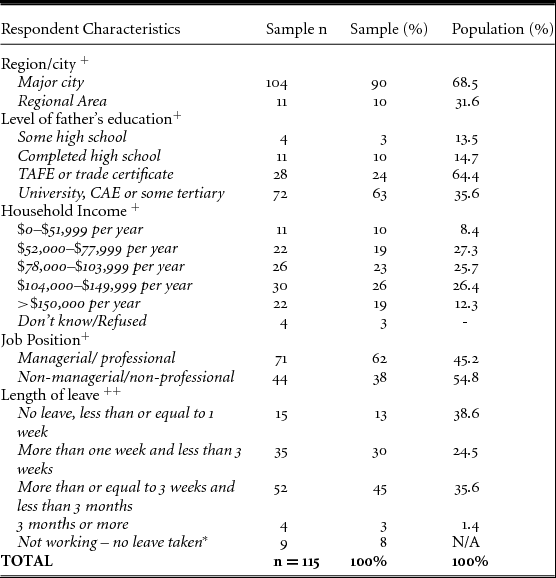
We used established occupational classifications (the Australian and New Zealand Standard Classification of Occupations) to create a binary distinction between men who were working in professional/managerial occupations, versus men who were not (Braun et al., Reference Braun, Vincent and Ball2011). Non-professional/non-managerial fathers were just as likely to respond to the bonding questions as professional/managerial fathers. Not unexpectedly, given the challenges around recruiting men from non-professional/non-managerial occupations to qualitative studies (Miller, Reference Miller2011), our sample has an over-representation of fathers working in professional/managerial occupations (see Table 1). We took this into account in the analysis by focusing on patterns within specific sub-groups and avoiding any attempts to make simple generalisations from the sample to the Australian population.
Fathers’ Demographic Characteristics

+ Estimates based on the Household Income and Labour Dynamics in Australia survey waves 8–12 (2008–2012), with the sample restricted to currently working men who had/adopted a child within last 12 months (N = 1005)
++ Length of leave: DAPP online survey, round 1; sample restricted to working fathers who had a baby in April 2013 (N = 1107).
* Fathers in this category were on workers’ compensation or were a full-time carer of a family member, were made redundant around the time of the birth of the baby, or stopped working around the time of the baby to begin full-time study or to become the primary carer, and thus did not officially take any ‘leave’.
Interviews were coded with a coding framework created from a combination of a priori codes and inductive codes using NVivo 10 data management software. A priori codes were based on the evaluation questions while inductive codes were developed by three members of the team coding a sample of interviews and cross checking their codes.Footnote 4 Using a final coding frame and detailed coding instructions, four team members (which included two of the authors) applied the codes to all interviews. Large blocks of text were coded to enable statements to be read in context.
The first two authors, who conducted a discourse analysis of the material coded under the main codes ‘bonding’ and ‘childcare responsibility’, generated the findings reported in this article. Our discursive approach was informed by a social constructionist embodiment perspective (outlined earlier) which assumes that fathering is a ‘complex and normative’ performance (Ives, Reference Ives2014: 1007) that involves bodies. This framework informed how we critically deconstructed how fathers ‘made sense’ of the experience of paternal bonding, including the rationale they provide for any gender differences, and the links between their constructions and the broader socio-cultural context (Brady, Reference Brady2008; Cameron, Reference Cameron, Jaworski and Coupland1999). Following Graham we completed three key tasks: 1) description — explaining ‘the words’ fathers used ‘to describe things’; 2) recognition — describing the ‘specific bodies of knowledge’ that fathers used to validate their statements; and 3) classification — describing the systems of social classification that underpin particular statements (Graham, Reference Graham2011). After completing these steps we checked our draft conceptualisations against the full interview transcripts, and compared our interpretations with each other. A clear picture emerged of two dominant bonding discourses: time-focused and physiology-focused. Although around half of the fathers drew on both discourses at some point over the course of the interview, all fathers primarily adhered to one discourse or the other. As a result we make a distinction between the 75 fathers who primarily adhered to a time-focused discourse of paternal bonding and the 25 fathers who primarily adhered to a physiology-focused discourse. This article compares and contrasts how these groups of men construct and enact paternal bonding. We use pseudonyms when presenting quotes.
Fathers’ constructions of paternal bonding
One of the aims of Australia's new paternity leave scheme was to increase fathers’ bonds with their children. To uncover fathers’ experiences of bonding we asked the men within the interviews to describe any activities they believed fostered their connection with their infant before inviting them to describe their bond. Fathers’ descriptions of their bonds were usually simple, positive responses such as ‘it's good’. In explaining how they knew their bonds were good the men offered varied responses. Andrew (non-professional, 1 child, 2 weeks’ leave) said ‘he feels comfortable around me I think and I'm comfortable around him’, while others observed a mutual joy in seeing each other − ‘She's always happy to see me’ (Mark, non-professional, 1 child, 6 weeks’ leave). Although we did not ask fathers to compare the maternal and paternal bonds, most men spontaneously raised these comparisons and suggested their own paternal bond was qualitatively different from their partner's maternal bond. Our analysis sought to critically de-construct fathers’ understandings of the source of these gendered differences in parent-infant bonding (Butler, Reference Butler2011; Connell, Reference Connell2009).
A minority of fathers made sense of these differences through what we refer to as a physiology-focused discourse. According to this discourse mothers’ physiology (including instinct and/or breastfeeding) gives them an enormous advantage when it comes to generating an early bond while fathers are placed at a distinct disadvantage because they lack breasts or maternal instincts. This discourse suggests firstly that it is a mothers’ physiology rather than the time she invests that promotes a strong bond and secondly that fathers must postpone efforts to develop a strong bond until the baby is older and more independent. Three typical examples of fathers who primarily adhered to a physiology-focused discourse of bonding were David (professional, 2 children, 2.2 weeks’ leave), who worked as a management consultant in a large multinational company; Alistair (non-professional, 2 children, 1 week's leave), who worked in the trades; and Tim (professional, 1 child, 1.5 weeks’ leave), who worked in finance. Each of these fathers presented the differences between the paternal and maternal bond as a natural and unsurprising result of the mother's breastfeeding role. David explains:
[my wife] was breastfeeding so that was her – so obviously the mother's bond then is much stronger and especially the first six to ten months.
Very similarly Alistair described his bond as:
Yeah, good. She's still mummy's girl though. You sort of expect that though with bubs, with the breastfeeding.
Likewise Tim states:
she [wife] has more of maybe a nurturing, feeding bond: Mummy's going to look after me in terms of that. Then Daddy's more of a – have a bit of a muck around and play sort of side of it. I think obviously with the breastfeeding and all that sort of stuff that's a different attachment there.
These fathers assert that these differences are ‘obviously’ going to occur and are ‘sort of expected’ and seek to validate their claims through an implicit appeal to dominant gendered discourses, which hold that women have natural nurturing abilities (particularly in relation to very young children) as a result of their physiology (Chodorow, Reference Chodorow1978; Rose et al., Reference Rose, Brady, Yerkes and Coles2015).Footnote 5
Although a significant minority adhered to this physiology-focused discourse, the dominant discourse among our fathers was time-focused. According to this discourse most (or all) of the differences in the maternal and paternal bond result from parents devoting substantially different amounts of time to caring for the infant. Thus when time-focused fathers talked about breastfeeding and bonding they focused primarily on how the time involved in breastfeeding helped mothers develop a strong bond. At the same time they did not believe that breastfeeding impeded their ability to bond with their infants and did not feel that they lacked the bodily ‘equipment’ they need in order to develop early bonds. Thus time-focused fathers such as Daniel (non-professional, 1 child, 3 weeks’ leave), who worked in the construction industry, downplayed the idea that physiological processes such as pregnancy generate connections they cannot compete with. Daniel argues:
. . . once you've got him and you're holding him, surely that's going to make up for nine months of chatting to it through the womb when it's a foetus.
Scholars of work and care have repeatedly emphasised that maternal instinct and connections develop out of the time mothers devote to infant care (Chodorow, Reference Chodorow1978) rather than female physiology. Physiological-focused discourses largely erase the conscious and repeated nature of the care work that generates maternal bonding whereas time-focused constructions foreground this labour. Thus time-focused father Daniel underscores the crucial role that time plays in maternal and paternal bonding and downplays the importance of physiology. He explains:
Probably even took a bit of time [to connect with the baby]. One thing that – some people told us the moment you see your baby you know you'll never love anyone else as much and it's changed your life, the instant you see him, and that just didn't happen. We got him and we had him for a couple of days, we didn't – we couldn't settle on a name for a couple of days.
Leave and fathers’ constructions of paternal bonding
Research on the impact of leave on gendered divisions in infant care suggests that when men take three or more weeks of leave around the birth they move from being ‘helpers’ to being active co-parents (Rehel, Reference Rehel2014), indicating that leave length might also shape how men construct the experience of bonding. We found that fathers who took between 3 and 11 weeks of leave were as likely to adhere to a physiology-focused construction as fathers who took less than three weeks of leave. However, fathers who took very long leaves (three or more months) overwhelmingly adhered to a time-focused discourse (all but one of the eight fathers). Fathers’ narratives suggest it is leave itself (rather than simply self-selection) that produced this correlation. For example, Jason (non-professional, 2 children, primary carer), who became the primary carer after the birth of his second child, relayed his ‘discovery’ that the parent who stayed home developed the stronger bond. Jason justified his time-focused construction through an appeal to personal experience, explaining that his older child ‘is more attached to [his mother]’ because she took leave with him whereas their new infant is more attached to him due to him taking the longer leave. He says ‘when I muck around with [the baby] you can see in his eyes he's getting that [strong attachment] — I'm the only one he sees.’ When the interviewer asked ‘What do you think has created that difference?’ Jason referred to patterns of parental leave and explained:
Just the 12-month bonding time I think. That's when [our older boy] was at home with my partner for the first three months. He got that attachment . . .in the mornings. Instead of coming to me – because, generally, if he wakes up he comes in our room – he'll go straight to his mother's side . . .
Interviewer: So do you see that [Baby] is then bonding in that same way with you? Or is it divided?
Jason: I think he's bonding with me, the same way [our older child] bonded with my partner.
Interviewer: Do you think it's about the time spent rather than being mum or dad or . . . //
Jason: Yes, it is true. The person who spends the majority of time with – especially a newborn – you'll get that. . . Yes, I think it is – it's the time that you spend. I'm not saying that [Mother of baby] can't get it. She just needs to spend more time.
//= interruption
Jason's narrative illustrates a pattern that was evident among the eight long leave fathers: engaging in the kind of day-to-day parenting usually only practiced by the mother (Rehel, Reference Rehel2014) shapes how they construct paternal bonding. Another example was Steven (professional, 2 children, 1 day's leave) who was the primary carer for his first child, whereas his wife was the primary carer for the second child. Stephen revealed a similar experience to Jason and he contrasted the quality of the bonds with each child, arguing that his bond with his infant was ‘close’ but much weaker than with his older child due to him ‘being away’ (working in another state during the week). Fathers who take long leaves are thus placed in a position that tests the veracity of the physiology-focused construction of bonding, which they may have partly adhered to prior to the birth of their child. For example, Grahame (an insurance clerk non-professional, 1 child, primary carer) commenced extended parental leave when his son was 4.5 months old and, prior to that, did all the infant care (except breastfeeding) in the evenings and at the weekends. During the interview Grahame reflected that while he believed ‘a mother's bond with a baby is probably going to be different to the bond with a father’ it was not something he had experienced since the birth of his child.
Socio-economic characteristics and fathers’ constructions of bonding
It is perhaps surprising that the physiology-focused discourse is not more dominant among a diverse group of Australian fathers of infants. Existing research has illuminated that parenting in the first year is dominated by deeply engrained gendered assumptions about paternal and maternal bodies, and their appropriate roles (Doucet, Reference Doucet2009). One would further posit that Australia's relatively sharp gendered division in paid and unpaid work would be associated with gendered divisions in emotional relations with infants that were more traditional than in other countries. Also somewhat surprising is that adherence to a physiology-focused discourse of bonding was not noticeably classed. Although existing research suggests men's discourses of fathering are strongly classed (Gillies, Reference Gillies2009; Plantin, Reference Plantin2007; Shows and Gerstel, Reference Shows and Gerstel2009) and although rates of breastfeeding vary significantly by socio-economic class, we found that professional/managerial dads were as likely as non-professional/non-managerial fathers to use the physiological discourse to rationalise any differences that they experienced in the nature of the maternal and paternal bond.
Enacting paternal bonding
Existing studies reveal that experiences of parenting infants are strongly embodied, with mothers strongly emphasising the relationship between strong maternal connections, and the biological processes of pregnancy, birth, and breastfeeding (Doucet, Reference Doucet2009). Social constructionists point out that while parents may believe there is a fixed relationship between sexed bodily differences and parent-infant connections, on the basis of existing research we ‘must reject all models of gender that assume social gender differences to be caused by bodily differences producing character differences’ (Connell, Reference Connell2009: 67). Instead we must recognise that ‘there is a loop linking bodily processes and social structures’; and ‘gender relations form a particular social structure, refer to particular features of bodies, and gender practices form a circuit between them’ (Connell, Reference Connell2009: 68). In the previous section we illustrated how different discourses of bonding refer to particular features of mothers’ and fathers’ bodies, and thereby render some kinds of gendered parenting practices as sensible and others as not. The following compares and contrasts fathers’ enactment of time-focused constructions of bonding versus physiology-focused constructions. Our interviews primarily focused on fathers’ experiences in the first weeks after the birth and the month prior to the interview (when the babies were six to eight months of age) so our analytic focus is on fathers’ enactment of bonding in those periods.
Enacting the physiological bonding discourse
Physiology-focused fathers explained that only when their babies were six to eight months old did they begin to get a clear sense of their own connection to the infant. Although we are not aiming to explain why men take leave around the birth, it is interesting to note that existing studies have found that one reason men choose not to take longer leave is their belief that young babies need maternal rather than paternal care (Rehel, Reference Rehel2014). Fathers who adhered to a physiology-focused construction of bonding often, though not always, framed their leave-taking decisions in this way. An illustrative example is Tim (professional, 1 child, 1.5 weeks’ leave, quoted above linking attachment strength and breastfeeding), who worked in finance and took 1.5 weeks of leave. He explained that his wife took the bulk of the leave because:
She's got the breast milk and all that sort of stuff. So I don't have breasts obviously so she can look after the child a lot better than I can.
Thus he did not want to take longer leave because:
At the end of the day we're almost obsolete at that time anyway, the father is. He just hangs around just handing stuff over and just getting bossed around in his things to do. So . . . I think a week-and-a-half's enough.
Here Tim connects (or possibly conflates) the ability to breastfeed with the ability to care. Furthermore, his statement, that a father is ‘almost obsolete at that time’ and simply ‘hangs around. . . .getting bossed around’, frames the father's role as both unnecessary and essentially passive.
When Tim reveals later in the interview that the baby had been bottle-fed with expressed milk since birth: ‘then [baby] started preferring bottle. So we ended up using the bottle most of the time’, it further becomes clear that his references to breastfeeding operate as a discursive tactic that naturalises his partner's greater responsibility for infant care and his exclusion. Everyday social knowledge about breastfeeding, we argue, operates as a body of knowledge that fathers use to validate their statements about their ‘uselessness’ or ‘obsolescence’. By asserting that the ‘different attachments’ flowed naturally from the fact of breastfeeding, Tim implies that his bond would have remained essentially the same even if he took longer leave or was more involved in infant care.
The physiology-focused discourse of bonding conflicts with policy makers’ and researchers’ assumptions that when fathers take paternity leave in the post-birth period they will necessarily develop an attachment that will motivate them to remain actively involved in childcare. In most cases, physiology-focused fathers did not use their leave around the birth to care for or connect with their infant. Instead they focused on being a general helper around the house or on caring for older children. As Brian (professional, 2 children, 1 weeks’ leave), a manager, who strongly adhered to a physiology-focused construction of bonding, explained, during his two weeks of leave he:
. . . took care of [our three year old] and she took care of [the baby]. Of course she was breastfeeding so there wasn't an argument in that part of it. But yeah, we kind of took on the roles. I'd take care of [our three year old] a bit more and she'd take care of [the baby].
Some physiology-focused fathers such as Tom (non-professional, 4 children, 3 weeks’ leave), a police officer, took a significant length of leave but nevertheless reported spending no time engaged in infant care. As he recollected, during leave, when the baby ‘whinged’ he ‘just picked her up and gave her to her mother’. When asked directly whether or not his leave helped him bond he explicitly rejected this idea arguing that this period was:
mainly mother and baby bonding with the breastfeeding. Yeah, so I probably wouldn't start bonding with her ‘til a bit afterwards, a bit later, so I feel a bit better.
In this quote and throughout the interview Tom argued that his lack of female physiology stood as a barrier to any real involvement including assisting with night care, where he explained ‘well, it's breastfed, so I sleep, she feeds’. For strongly physiology-focused fathers, breastfeeding was an overwhelming, all-encompassing activity that effectively crowded out any possibility for them to spend time on infant care. A gendered embodiment perspective highlights that our embodied abilities, such as the ability to sooth an infant or read their cues, develop out of practice (Connell, Reference Connell2009). Physiology-focused discourses incite mothers to engage in these practices while dissuading fathers from doing so. These discourses allowed some men to rationalise their ‘hands-off’ fathering by positing that women's bodies are better equipped to develop early connections with infants. Although many physiology-focused fathers devoted more time to childcare than Tom did, none of these fathers were active co-parents that regularly engaged in care tasks or spent time alone with the infant. Hence these physiology-focused fathers had little opportunity to develop the skills of ‘reading’ cues and nurturing their infant.
We do not wish to suggest that adherence to a physiological construction of bonding is the only reason fathers are not actively involved in infant care. Among fathers who had little day-to-day involvement, half cited other factors (usually work hours) as the primary constraint, and some of these fathers primarily adhered to a time-focused construction of bonding. However, whereas time-focused fathers who had little involvement expressed regret over not having been able to devote more time to childcare, fathers who adhered to a physiological construction suggested that their lack of involvement was excusable because the child naturally had a stronger attachment to its mother.
Enacting the time-focused discourse of bonding
Fathers who adhered to a time-focussed discourse believed that it was important for them to develop an early bond, and that breastfeeding and the mothers’ connections were not overwhelming impediments to building their own connections. Compared to physiology-focused fathers, time-focused fathers articulated greater confidence in their capacity to actively practice bonding. By the time the infants were six to eight months old these time-focused fathers had developed a set of regular practices that were explicitly oriented to developing their connection with their child. Compared to physiology-focused fathers, they were more likely to describe their own bond as the same (or stronger) than the mother's bond. When these men encountered challenges in their connection they tended to blame circumstances, their parenting practices or the time they had spent with the infant, rather than physiological facts. Time-focused fathers’ bonds were also more strongly shaped by social circumstances (such as work hours) compared to physiology-focused fathers. While these men expressed enthusiasm for practicing bonding activities their capacity to consistently enact them was often limited by their work obligations.
Time-focused fathers whose long leaves allowed them to be enmeshed in daily care revealed the potential for fathers to experience a bond that is qualitatively similar to the mothers’ bond. However, most time-focused fathers did not take long leaves or become the primary carer. Instead they follow a more traditional division of labour that involves a relatively quick return to work while their wife takes many months of leave. How did these fathers negotiate embodied practices, such as breastfeeding? What kinds of bonding practices did they engage in? These time-focused fathers viewed breastfeeding as playing an important role in infant-mother relations because the mother invests a lot of time in this activity, and babies who are exclusively breastfed usually learn that their mother is their sole source of nourishment. However, these fathers did not experience breastfeeding as something that necessarily gave mothers a special and exclusive bond that they could not hope to replicate. For example, Steven (professional, 2 children, 1 day's leave, quoted earlier) talked about breastfeeding being important because it was quality time. He suggested he could also create this quality time. Like other fathers who adhered to a time-focused construction, Steven was careful to contrast ‘time’ with ‘quality time’, reflecting:
You need specific things that you spend time with them, whether it's reading books or colouring in. Because you can spend time with somebody but not necessarily be bonding with them.
Here Steven highlights how time-focused fathers viewed paternal bonding as an active process that required fathers to consciously create quality time with their infants. Usually at least some of this quality time was linked to dominant masculine embodiment through a focus on outdoor and physical activities. For Steven this activity was attending weekly infant swimming lessons. For James (professional, 1 child, 3.5 weeks’ leave), bonding time involved engaging in outdoor and physical activities with his daughter. Steven contrasted this quality time, which his daughter ‘loves’, with ‘just minding her’, which would not have strengthened his bond. Time-focused fathers clearly do not view mothers and fathers as ‘disembodied and completely interchangeable’ (Doucet, Reference Doucet2009: 92) but they do believe that fathers are capable of developing a strong early bond through actively creating quality time which the father and child share (See Goodman, Reference Goodman2005; Premberg et al., Reference Premberg, Hellström and Berg2008 for similar findings).
Compared to physiology-focused fathers, time-focused dads were more likely to report consciously scheduling time with their infant. For example, James intentionally incorporated time for infant care into his work-day routine:
I've made a conscious effort to make a lot of time for her. . . sometimes you feel like you don't have any other life besides work and the baby, I try and make a lot of time. . . .that's why I make sure I just get up with her in the morning and play with her. Every night I'm religiously home at the same time and have a play with her. Even on the weekends – we've talked about it – I used to play golf and stuff and I haven't really been doing much of that because it takes up all day. I usually spend time with the baby.
Between 5:30am and 7am James cared for the infant:
I get her up and change her poo nappy. We play on the mat for 15 minutes, playing with her toys. I bring her up here. We have breakfast together – Weet-Bix or something – I make her porridge, fruit and stuff. So she loves that. She gets it all over herself . . . I clean her face and then take her back to the bedroom and give her to [my wife] while I just clean my teeth and stuff and get – head out the door.
Non-professional/non-managerial fathers also focused on building time for their infants into their routines. For example, Daniel (non-professional, 1 child, 3 weeks’ leave), a self-employed manual worker (quoted earlier) explained he had actively sought to limit overtime at work. Since the birth he ‘made it a point to try and be here from about six o'clock, at the latest’ something he had only ‘failed’ at twice.
Research has repeatedly emphasised that workplace flexibility enables involved fatherhood. Workplace flexibility also shaped time-focused fathers’ experiences of bonding. For example, as a self-employed manual worker Daniel could set his own hours. He explained the link between flexibility and bonding:
So the flexibility that I've had, taking half days off, taking days off, being around during the day I think, hopefully, has improved [the bond], rather than just getting home at 5:30 every day and doing the same routine with him every day.
Daniel's access to workplace flexibility was unusual among manual workers. Reflecting the classed nature of positive workplace flexibility (D'Enbeau et al., Reference D'Enbeau, Buzzanell and Duckworth2010; Williams et al., Reference Williams, Blair-Loy and Berdahl2013), most non-professional/non-managerial fathers had little ability to fit childcare time into their working day, compared to professional/managerial fathers. While the latter frequently reported that they worked from home one day a week, or sometimes unofficially took an afternoon off, most non-professional fathers had fixed work schedules and no ability to work from home. These experiences highlight that although fathers’ adherence to a particular construction of bonding did not vary across occupations, the structural conditions associated with different kinds of employment differentially shaped men's abilities to regularly practice bonding.
Conclusion
Current policy and research expresses hope that paternity leave may help ‘undo’ highly gendered patterns of childcare by enabling fathers to enmesh themselves in their infants’ lives, thereby increasing their competence and level of participation in childcare (Bünning, Reference Bünning2015; Haas and Hwang, Reference Haas and Hwang2008; Schober, Reference Schober2014), as well as deepening their early emotional connections (Rush, Reference Rush2012). Existing social policy research on paternity leave has focused on the details of paternity leave reforms and fathers’ uptake of this leave (Lewis and Campbell, Reference Lewis and Campbell2007), as well as the impact of this leave on the time fathers devote to childcare and housework (Bünning, Reference Bünning2015; Haas and Hwang, Reference Haas and Hwang2008; Schober, Reference Schober2014). The findings are that while there are still large gender gaps in the amount of leave taken around the birth of a child, when fathers do take leave it increases their involvement in childcare even after they return to paid work. However, research has not examined how well the aims of parental leave policies to increase paternal bonding align with fathers’ own perceptions of their role as fathers in the early months of their children's lives. Qualitative research, such as this study, allows ‘connections and misalignments between individuals’ experiences, and policy and program assumptions’ to be traced thereby revealing new contours of a policy problem (Brady, Reference Brady2015: 2). Examining the alignment (or misalignment) between fathers’ own desires and the new normative agenda to increase fathers’ emotional connections is important given that existing research has found that social policy interventions aimed at supporting fathers may fail to adequately address fathers’ values and experiences (Chowbey et al., Reference Chowbey, Salway and Clarke2013). This article adds to the current literature on the alignment between new policy aims to support more involved fathering and fathers’ own desires and experiences (Chowbey et al., Reference Chowbey, Salway and Clarke2013; Cosson and Graham, Reference Cosson and Graham2012; Ives, Reference Ives2014) by illuminating the degree to which father's constructions and enactments of bonding over the first six to eight months of a child's life align with the agenda of new paternity leave schemes to increase early paternal bonding.
Through a close examination of how a diverse group of Australian fathers experience bonding we have found that most fathers’ views and enactments of bonding closely align with current policy assumptions. Although we found that fathers frequently view the mother's bond as qualitatively different from their own, and view breastfeeding as strongly shaping parental connections in the early months (Premberg et al., Reference Premberg, Hellström and Berg2008; Shirani and Henwood, Reference Shirani and Henwood2011), only a minority of fathers adhered to a physiology-focused discourse which implies that there is no space for them to develop an early bond. Most fathers adhered to a time-focussed construction of bonding, which suggests that paternal bonds result from spending quality time with a child, irrespective of gender. Perhaps our most surprising finding, given the literature's consistent finding of class differences in discourses of good fathering (Gillies, Reference Gillies2009; Plantin, Reference Plantin2007; Shows and Gerstel, Reference Shows and Gerstel2009), is that professional/managerial fathers were as likely as non-professional/managerial fathers to adhere to the physiological construction of bonding.
Physiology-focused fathers enacted bonding very differently from time-focused fathers. Within both groups, the vast majority of fathers returned to work shortly after the birth while the mother took on the primary carer role and became more practiced at recognising and responding to the infant's needs (Miller, Reference Miller2010; Rehel, Reference Rehel2014). Physiology-focused fathers viewed this greater competence as evidence of a natural maternal ‘instinct’ and bond, which left little space for them. In contrast, fathers who adhered to time-focused discourses viewed this greater competence as largely about time and practice. Breastfeeding was likewise seen as significant because it involved meeting the infant's needs and a substantial investment of time. Thus these fathers envisaged a space for them to create comparable time to bond with the newborn infant and they described how they had actively realised the possibility by creating quality time and engaging in primary care. By the time the infant was six to eight months old these time-focused fathers were practiced in a range of activities, which they believed strengthened their emotional connection. Physiology-focused fathers in contrast enacted their construction of bonding by avoiding substantial day-to-day involvement in infant care. Our inclusion of second and subsequent fathers (which is relatively unusual in the literature) allowed us to analyse the role that these fathers took while on paternity leave. We found that rather than actively seeking to bond with the infant these fathers primarily devoted their attention to the older child/ren.
This article adds to the current social policy literature on supporting involved fathering by illuminating how fathers’ beliefs about paternal bonding shape the kinds of interactions they engage in during the early months, and particularly what they do while on paternity leave following the birth. In turn the research provides new insights into the need for social policy to consider the role that norms of social embodiment play in parents’ experiences, particularly in the first year of a child's life.
What would a social policy that took norms of social embodiment seriously look like? The findings of this article suggest that such a social policy would not assume that men's leave around the birth automatically translates into hands-on involvement in infant care. To the extent that one of the aims of paternity leave schemes is to help fathers develop early bonds with their infants, this article suggests that many fathers may benefit from greater access to information on how they can physically engage in bonding activities. As this article has underscored, bonding is not something that simply happens but instead is something that is physically enacted. While mothers receive significant advice on bonding activities, such as breastfeeding, this information is not always provided to fathers (Ives, Reference Ives2014). One simple way of making such information more accessible would be to provide a link to websites, such as the government-funded Raising Children Network, on the application form for Dad and Partner Pay (Raising Children Network, 2012). Some fathers may ultimately decide that they wish to engage in a ‘helper’ rather than active fathering role during the early weeks of their infants’ life. For others greater access to information about how to engage in early bonding may encourage them to build earlier emotional connections with their infant.
Acknowledgements
Shortly after the acceptance of this article our dear co-author, Professor Bill Martin passed away. Bill's research focused on work, labour markets and inequality. For most of his career, he focused on the structure and dynamics of various workforces but most recently his focus was on the evaluations of Australia's first national paid parental leave schemes. We remember Bill for his intelligence, commitment to sociology, and collegiality and this article is dedicated to him.
The paper uses data collected as part of the evaluation of the Dad and Partner Pay scheme (2011-14), funded by the Australian Government through the Department of Social Services (previously the Department of Families, Housing, Community Services and Indigenous Affairs). The views expressed in the paper are those of the authors and not necessarily those of any funding body associated with the research. This paper also uses unit record data from the Household, Income and Labour Dynamics in Australia (HILDA) Survey. The HILDA Project was initiated and is funded by the Australian Government Department of Social Services (DSS) and is managed by the Melbourne Institute of Applied Economic and Social Research (Melbourne Institute). The findings and views reported in this paper, however, are those of the author and should not be attributed to either DSS or the Melbourne Institute. We would like to thank Kay Cook, Kristin Natalier, John MacArtney, and Cosmo Howard for helpful comments on an earlier draft of this paper. An earlier version of this paper was presented at The Australian Sociological Association conference, Challenging Identities, Institutions and Communities, 24–27 November, 2014, University of South Australia, Adelaide