Almost half of US adolescents have experienced behavioral or emotional problems during their lifetime (Merikangas et al., Reference Merikangas, He, Burstein, Swanson, Avenevoli, Cui and Swendsen2010). Adolescent behavioral (i.e., externalizing) and emotional (i.e., internalizing) problems have been further linked to difficulties in other domains of functioning, including academic failure, substance use, risky sexual behavior, suicide, and juvenile offending (Harrington, Reference Harrington2001; Hentges, Shaw, & Wang, Reference Hentges, Shaw and Wang2018; Masten et al., Reference Masten, Roisman, Long, Burt, Obradović, Riley and Tellegen2005; Nagin & Tremblay, Reference Nagin and Tremblay1999). In the long term, these behaviors may culminate in serious outcomes, such as incarceration or serious mental health disorders, representing a significant social and economic burden to society (Trautmann, Rehm, & Wittchen, Reference Trautmann, Rehm and Wittchen2016; Vigo, Thornicroft, & Atun, Reference Vigo, Thornicroft and Atun2016) and to individual well-being. While the risk for developing mood or behavioral problems starts to increase during early adolescence (Bongers, Koot, van der Ende, & Verhulst, Reference Bongers, Koot, van der Ende and Verhulst2003; Merikangas et al., Reference Merikangas, He, Burstein, Swanson, Avenevoli, Cui and Swendsen2010; Twenge & Nolen-Hoeksema, Reference Twenge and Nolen-Hoeksema2002), initial processes associated with the development of psychopathology occur much earlier (Cicchetti, Reference Cicchetti1984; Shaw, Gilliom, Ingoldsby, & Nagin, Reference Shaw, Gilliom, Ingoldsby and Nagin2003; Sitnick et al., Reference Sitnick, Shaw, Weaver, Shelleby, Choe, Reuben and Taraban2017). For example, adult psychiatric disorders can be predicted by observed disruptive behavior in 3-year-old children (Caspi, Moffitt, Newman, & Silva, Reference Caspi, Moffitt, Newman and Silva1996). Thus, implementing early preventative interventions is a key strategy for reducing the burden of future mental health disorders.
Dishion et al. (Reference Dishion, Shaw, Connell, Gardner, Weaver and Wilson2008) argue that early interventions are effective at preventing future problem behavior by disrupting the developmental processes (e.g., harsh or punitive parenting) associated with early indicators of risk. In particular, they suggest that preventive interventions that are provided during salient developmental transitions could be especially beneficial because the child and family are likely to be experiencing significant challenges as a result of biological and/or social transitions, which may lead to maladaptive child behavior (Dishion et al., Reference Dishion, Shaw, Connell, Gardner, Weaver and Wilson2008). For example, the Early Risers intervention emphasizes teaching behavioral and emotional regulation and social competence skills to children who show early disruptive behaviors during the transition to elementary school, and it has been associated with fewer internalizing and externalizing problems in high school compared to a control group (Hektner, August, Bloomquist, Lee, & Klimes-Dougan, Reference Hektner, August, Bloomquist, Lee and Klimes-Dougan2014).
However, intervening even earlier during early childhood may prevent the very behavioral and socioemotional problems that school-age interventions use to identify at-risk children (e.g., aggression and social anxiety). In addition, by school age, children's environments have expanded considerably to include school and peer networks, adding to the complexity of an intervention that should ideally address the child's entire ecosystem (Coie et al., Reference Coie, Watt, West, Hawkins, Asarnow, Markman and Long1993). Thus, early family-based preventative interventions that target at-risk families are often considered to be optimal for preventing future mental health problems (Furber et al., Reference Furber, Segal, Leach, Turnbull, Procter, Diamond and McGorry2015). For example, one analysis found that parenting interventions aimed at preventing conduct problems in the United Kingdom had a 25-year return on investment of at least eight times the initial costs of intervention in the form of decreased public expenses associated with health care, social services, and the justice system (Knapp, McDaid, & Parsonage, Reference Knapp, McDaid and Parsonage2011). While there is considerable evidence for the effectiveness of early family-based preventative programs on child outcomes in early and middle childhood (Shaw, Connell, Dishion, Wilson, & Gardner, Reference Shaw, Connell, Dishion, Wilson and Gardner2009; Webster-Stratton & Taylor, Reference Webster-Stratton and Taylor2001), less is known about the long-term effects of family-based intervention programs initiated during early childhood and followed through to adolescence.
Inhibitory Control as a Mechanism of Intervention Effects
There is an increasing need to identify the more proximal mediators that might explain how and why early preventative programs reduce the risk of later emotional and behavioral problems. Emerging research has pointed to individual differences in self-regulation capabilities as key mechanisms linking early risk and later mental health problems (Chang, Olson, Sameroff, & Sexton, Reference Chang, Olson, Sameroff and Sexton2011; Fonagy & Target, Reference Fonagy and Target2002). For example, children exposed to early adversity display deficits in inhibitory control, a core component of self-regulation (Marshall et al., Reference Marshall, Passarotti, Ryan, Kamali, Saunders, Pester and Langenecker2016; Shaffer & Obradovic, Reference Shaffer and Obradović2017; Skowron, Cipriano-Essel, Gatzke-Kopp, Teti, & Ammerman, Reference Skowron, Cipriano-Essel, Gatzke-Kopp, Teti and Ammerman2014). Inhibitory control refers to the ability to suppress a predominant response in favor of a subdominant, more appropriate response (Posner & Rothbart, Reference Posner and Rothbart2000). Lower inhibitory control has been linked to more externalizing behaviors (Morgan, Farkas, Hillemeier, Pun, & Maczuga, Reference Morgan, Farkas, Hillemeier, Pun and Maczuga2018; Sarkisian, Van Hulle, Lemery-Chalfant, & Goldsmith, Reference Sarkisian, Van Hulle, Lemery-Chalfant and Goldsmith2017; Spinrad et al., Reference Spinrad, Eisenberg, Gaertner, Popp, Smith, Kupfer and Hofer2007), which include impulsive, aggressive, or noncompliant behaviors (e.g., stealing a desirable object from someone else) that are not inhibited in favor of approved social behaviors (e.g., asking to borrow the item). Research also suggests that higher levels of inhibitory control may reduce the risk of future internalizing problems (Lengua, Reference Lengua2003; Morgan et al., Reference Morgan, Farkas, Hillemeier, Pun and Maczuga2018; Rhoades, Greenberg, & Domitrovich, Reference Rhoades, Greenberg and Domitrovich2009; Riggs, Blair, & Greenberg, Reference Riggs, Blair and Greenberg2004). Because inhibitory control promotes the effortful regulation of behavioral responses, children with high inhibitory control may be able to more effectively temper their initial emotional reactions to stress or challenge and reorient their attention to more positive stimuli (Lengua, Reference Lengua2003). Conversely, poor inhibitory control may increase persistent negative expectations and rumination based on an individual's impaired ability to disengage from depressive or worrying thoughts (Koster, De Lissnyder, Derakshan, & De Raedt, Reference Koster, De Lissnyder, Derakshan and De Raedt2011).
For these reasons, self-regulatory processes have been identified as key targets of school- and family-based interventions for children at risk of poor socioemotional development (Fonagy & Target, Reference Fonagy and Target2002; Riggs, Greenberg, Kusche, & Pentz, Reference Riggs, Greenberg, Kusché and Pentz2006). In a short-term longitudinal study of second and third graders, the school-based PATHS Curriculum intervention increased inhibitory control after 9 months, which further predicted reductions in both externalizing and internalizing behaviors at a 1-year follow-up (Riggs et al., Reference Riggs, Greenberg, Kusché and Pentz2006). In addition, a previous report using the current sample found that the family-based Family Check-Up (FCU) intervention initiated at age 2 predicted positive growth in self-regulation from ages 2 to 7.5, which in turn was associated with lower levels of teacher-reported disruptive behavior at age 7.5 (Chang, Shaw, Dishion, Gardner, & Wilson, Reference Chang, Shaw, Dishion, Gardner and Wilson2014).
Components of child self-regulation, such as inhibitory control and effortful control, are early emerging and are often characterized as child individual differences in temperament (Posner & Rothbart, Reference Posner and Rothbart2000), with genetic underpinnings (Rueda, Posner, & Rothbart, Reference Rueda, Posner, Rothbart, Vohs and Baumeister2011). However, while self-regulatory capabilities are informed by genetics, research has also highlighted environmental influences on changes in self-regulation over time. In particular, positive parenting practices, including limit setting, responsiveness, and warmth, have been linked to improvements in child self-regulation over time (Eisenberg et al., Reference Eisenberg, Zhou, Spinrad, Valiente, Fabes and Liew2005; Kochanska, Murray, & Harlan, Reference Kochanska, Murray and Harlan2000; Lengua, Honorado, & Bush, Reference Lengua, Honorado and Bush2007). In addition, research has suggested that genetic variants related to attentional and inhibitory processes (e.g., the 7-repeat allele of the dopamine 4 receptor gene [DRD4]) are associated with higher impulsivity and sensation seeking within the context of poor quality parenting (Sheese, Voelker, Rothbart, & Posner, Reference Sheese, Voelker, Rothbart and Posner2007), as well as higher self-regulation within the context of supportive parenting (Belsky & Beaver, Reference Belsky and Beaver2011). Thus, interventions that focus on promoting positive parenting practices could also be expected to increase child self-regulation skills. Research using the same sample has established that early improvements in positive parenting mediate the association between the intervention and increased behavioral control at age 3 (Shelleby et al., Reference Shelleby, Shaw, Cheong, Chang, Gardner, Dishion and Wilson2012) and effortful control at age 5 (Chang, Shaw, Shelleby, Dishion, & Wilson, Reference Chang, Shaw, Shelleby, Dishion and Wilson2017). Positive parenting behaviors such as warmth and sensitivity are proposed to increase children's self-regulatory processes by promoting autonomy, modeling appropriate emotion regulation strategies, and increasing child cooperation and internalization of parents’ values, including those related to behavioral control (Grusec & Goodnow, Reference Grusec and Goodnow1994; Kochanska et al., Reference Kochanska, Murray and Harlan2000; Sanders & Mazzucchelli, Reference Sanders and Mazzucchelli2013).
However, much of the extant literature on the effects of early childhood-initiated family interventions on self-regulation have been constrained to the early school-age period. There is a lack of research examining the longer term effects of early interventions on self-regulation during later in middle childhood, and whether these improvements in inhibitory control further reduce the risk for adolescent behavioral and emotional problems. Previous research has shown that the FCU initiated during sixth grade was associated with reductions in depression and antisocial behavior in adolescence (Fosco, Frank, Stormshak, & Dishion, Reference Fosco, Frank, Stormshak and Dishion2013; Stormshak, Fosco, & Dishion, Reference Stormshak, Fosco and Dishion2010), as well as risky behavior in early adulthood (Stormshak, DeGarmo, Chronister, & Caruthers, Reference Stormshak, DeGarmo, Chronister and Caruthers2018) via improvements in self-regulation. Therefore, this study was designed to replicate and extend this prior work by examining whether the FCU initiated during early toddlerhood would display similar improvements in self-regulation during middle childhood and subsequent mental health symptoms in adolescence.
Middle childhood is a potentially important period to examine these intervention effects, as inhibitory control processes rapidly improve from the early childhood to middle childhood years, followed by slower growth during adolescence and early adulthood (Williams, Ponesse, Schachar, Logan, & Tannock, Reference Williams, Ponesse, Schachar, Logan and Tannock1999). In addition, research from the neuroscience literature suggests brain activity during effortful tasks (e.g., the Wisconsin Card Sorting task) shifts from global to localized activity during middle childhood, which could point to increased neural efficiency that allows for more complex inhibitory processes (Bell, Wolfe, & Adkins, Reference Bell, Wolfe, Adkins, Coch, Dawson and Fischer2007; Best & Miller, Reference Best and Miller2010). Thus, the effects of an early intervention on self-regulation processes in middle childhood represent a salient but understudied area of research. To our knowledge, no study has investigated the role of self-regulation in middle childhood as a mediating mechanism in the link between early initiated intervention and psychological functioning in adolescence.
The FCU
The FCU is a strengths-based individually tailored, home-delivered parenting intervention focused primarily on improving parenting skills for families identified to be at risk for problem behavior (Dishion et al., Reference Dishion, Shaw, Connell, Gardner, Weaver and Wilson2008), and has been utilized from early childhood (Shaw, Dishion, Supplee, Gardner, & Arnds, Reference Shaw, Dishion, Supplee, Gardner and Arnds2006) through adolescence (Connell, Klostermann, & Dishion, Reference Connell, Klostermann and Dishion2012). The early childhood version of the FCU was developed following initial research with early adolescents (Dishion et al., Reference Dishion, Shaw, Connell, Gardner, Weaver and Wilson2008; Shaw et al., Reference Shaw, Dishion, Supplee, Gardner and Arnds2006). The FCU incorporates motivational interviewing (Miller & Rollnick, Reference Miller and Rollnick2002) to provide parents with direct feedback about their child's and family's behavior using data from longitudinal studies to inform feedback about each family's strengths and challenges. By creating dissonance between the parents’ aspirations for their child and his/her current status, the FCU aims to motivate parents to modify their behavior in service of their child's welfare, engaging in post-feedback treatment sessions aimed at learning new skills based on evidence-based practices derived from social learning principles (Patterson, Chamberlain, & Reid, Reference Patterson, Chamberlain and Reid1982). Hence, the FCU was designed to support family strengths while identifying their needs and their willingness to change. The FCU consists of three home-based visits: an initial interview, an assessment, and a feedback session. For the purpose of the current randomized controlled trial, the assessment preceded the initial interview. The clinician-led feedback session is the heart of the FCU, and is used to engage the parent in optional follow-up evidence-based parent management training sessions following the feedback.
In addition to the emphasis on parenting, families who received the FCU chose from a “menu” of topics that are often salient in for families with young children, such as maternal self-care and accessing community resources. The individualized nature of the early childhood version of the FCU has yielded improvements in parenting in two independent cohorts from ages 2 to 3 (Dishion et al., Reference Dishion, Shaw, Connell, Gardner, Weaver and Wilson2008; Gardner, Shaw, Dishion, Supplee, Burton, & Supplee, Reference Gardner, Shaw, Dishion, Burton and Supplee2007) and child conduct problems through early and middle childhood (Dishion et al., Reference Dishion, Brennan, Shaw, McEachern, Wilson and Jo2014; Shaw et al., Reference Shaw, Dishion, Supplee, Gardner and Arnds2006; Shaw, Sitnick, Reuben, Dishion, & Wilson, Reference Shaw, Sitnick, Reuben, Dishion and Wilson2016), in addition to several positive collateral outcomes, including maternal and child depressive symptoms (Reuben, Shaw, Brennan, Dishion, & Wilson, Reference Reuben, Shaw, Brennan, Dishion and Wilson2015; Shaw et al., Reference Shaw, Connell, Dishion, Wilson and Gardner2009), parent–child relationship quality (Weaver, Shaw, Crossan, Dishion, & Wilson, Reference Weaver, Shaw, Crossan, Dishion and Wilson2015), child body mass index (Smith, Montano, Dishion, Shaw, & Wilson, Reference Smith, Montaño, Dishion, Shaw and Wilson2015), academic achievement (Brennan, Shaw, Dishion, & Wilson, Reference Brennan, Shaw, Dishion and Wilson2012), and child inhibitory control (Chang et al., Reference Chang, Shaw, Dishion, Gardner and Wilson2014), among others. It is important to note that the FCU is delivered in-home, is specifically tailored to each family's needs, is strengths based, and allows participants to be empowered during the treatment process—all important factors when serving low-income families with young children who may not have the means or impetus to access treatment outside of the home. As a result, we expected the FCU to continue to demonstrate positive effects on child inhibitory control during middle childhood, which were then expected to lead to reductions in both externalizing and internalizing problems.
The Current Study
Accordingly, the aim of the current study was to examine the potential long-term benefits of the FCU intervention initiated during the toddler years on adolescent internalizing and externalizing problem behavior. In particular, we hypothesized that the FCU intervention initiated at age 2 would be associated with continued improvements in self-regulation skills (i.e., inhibitory control) during middle childhood, which in turn would be associated with lower risk of externalizing and internalizing symptoms at age 14. To test this hypothesis, we used longitudinal data from the Early Steps Multisite study, a randomized control trial of the FCU intervention administered to low-income, racially and ethnically diverse families in urban, rural, and suburban communities. Children growing up in poverty are particularly at risk for deficits in self-regulation and mental health problems (Evans & Kim, Reference Evans and Kim2013; Yoshikawa, Aber, & Beardslee, Reference Yoshikawa, Aber and Beardslee2012), making this sample especially appropriate to investigate the role of early interventions on later child inhibitory control and both behavioral and emotional functioning. Prior reports using the same sample as the current study have indicated that the FCU improved self-regulation skills in early childhood via improvements in positive parenting practices (Chang et al., Reference Chang, Shaw, Shelleby, Dishion and Wilson2017; Shelleby et al., Reference Shelleby, Shaw, Cheong, Chang, Gardner, Dishion and Wilson2012). Therefore, to avoid duplication of previously published findings linking the FCU indirectly to self-regulation through changes in parenting (e.g., Chang et al., Reference Chang, Shaw, Shelleby, Dishion and Wilson2017; Shelleby et al., Reference Shelleby, Shaw, Cheong, Chang, Gardner, Dishion and Wilson2012), the goal of the current study was to establish if the FCU was directly associated with increased child inhibitory control skills in middle childhood, which in turn was expected to predict fewer internalizing and externalizing symptoms in adolescence.
Method
Participants
Participants were 731 caregiver–child dyads who took part in a randomized controlled trial of the FCU, which was aimed at preventing the development of child conduct problems. Caregivers were recruited from Women, Infant, and Children programs in Pittsburgh, Pennsylvania; Eugene, Oregon; and Charlottesville, Virginia. Families who had a child between the ages of 24 and 35 months and met the study criteria of risk were invited to participate. To be included in the study, families had to score at least 1 SD above the normative mean on at least two of the three domains of risk: familial (e.g., maternal depression and stress); child (e.g., conduct problems or oppositional defiance); and sociodemographic (e.g., low income and low educational attainment). Of the 1,666 families approached regarding the study, 879 met the eligibility criteria, and 731 agreed to participate.
At the first assessment period, children (51% boys) had a mean age of 29.9 months (SD = 3.2) and were racially diverse (50% Caucasian, 28% African American, 13% biracial, and 9% other). Thirteen percent of the sample also reported being Hispanic. The sample was low income (i.e., two-thirds had an annual income of less than $20,000), with the majority (65%) of primary caregivers attaining a high school diploma or less. Almost all (97%) of primary caregivers were mothers, and 58% of children lived in two-parent households. The retention rate from age 2 to age 14 was 81%.
Procedure
Primary caregivers, children, and alternate caregivers, when available, completed 2.5-hr in-home assessments, which included age-appropriate tasks, observational assessments, and caregiver reports on family and child functioning. The home assessment protocol was repeated at ages 2, 3, 4, 5, 7.5, 8.5, 9.5, 10.5, and 14, and participants received between $100 and $160 across these assessments. Home assessors were blind to intervention status, and opened a sealed envelope revealing treatment group assignment after the home visit was completed. After the age 14 assessment, children's teachers were contacted via e-mail to obtain questionnaire ratings of the participant children's socioemotional behaviors at school. Teachers were paid $50 for completing questionnaires.
FCU
Families assigned to the FCU condition (n = 367) were invited to participate in the FCU, which began with an initial in-home interview within about 2 weeks of the assessment. This session was parent driven, with parents detailing their individual concerns and priorities, particularly in regard to their child's behavior and well-being. In a second in-home session about 2 weeks later, the FCU parent consultants synthesized information gathered from the initial interview and data obtained from the formal assessment to provide individualized feedback to the families utilizing motivational interviewing techniques to elicit desire for change. At the end of the feedback session, based on the family's goals for the next year, caregivers were typically offered follow-up intervention sessions based on their needs and preferences. These brief follow-up intervention sessions were grounded in the Everyday Parenting curriculum (Dishion, Stormshak, & Kavanagh, Reference Dishion, Stormshk and Kavanagh2011) and focused on parent management training, including positive behavior support, limit setting, and relationship building. If needed or requested, parent consultants also provided support in connecting families to appropriate social services. In terms of frequency, follow-up intervention services at each wave were delivered as elected by each parent participant and could occur at any time after a completed feedback session and prior to the next assessment wave.
The feedback and intervention follow-up sessions ended after the age 10.5 assessment. The FCU (i.e., initial interview and feedback sessions) was repeated after each annual assessment period (with a temporary gap between ages 5 and 7.5 because of a hiatus in funding) to all families in the intervention group. Participation in the feedback session was voluntary and not a condition of participation in the study. We used an intent-to-treat design for our analyses, including all participants who were assigned to the intervention condition regardless of whether they participated in the feedback or follow-up sessions.
Engagement and dosage from ages 2 to 10.5
At each wave, families were only eligible to receive the FCU if they completed a research assessment, as the feedback session depends on the data collected during the home visit. Among the participants who completed the assessment, the following are the percentages of families who engaged in the FCU feedback session at each age: 75% at age 2; 68% at age 3; 70% at age 4; 66% at age 5; 65% at age 7.5; 75% at age 8.5; 69% at age 9.5; and 59% at age 10.5. Of the participants who opted for post-feedback treatment sessions, participants completed an average of 4.1 sessions (range: 2.9 sessions at age 10.5 to 6.5 sessions at age 5; see Smith et al., Reference Smith, Berkel, Hails, Dishion, Shaw and Wilson2018, for additional information, including predictors of engagement). In terms of time spent in follow-up intervention services at each wave, participants received averages of 1.3 hr (age 10.5) to 3.3 hr (age 5) of services.
Parent consultant training and fidelity
Parent consultants were highly trained masters- or doctoral-level clinicians with backgrounds typically in social work, counseling, or clinical psychology. The parent consultants underwent initial training for 2.5 to 3 months using a combination of strategies, including didactic instruction and role-playing. Before working with participant families, parent consultants were initially certified by lead parent consultants at each study site who had been certified by the intervention developer and coauthor Thomas J. Dishion. Certification was established by using videotapes of intervention sessions to evaluate whether the parent consultants were competent and adhered to protocol for all critical components of the FCU. During the course of the study, parent consultants received ongoing supervision of videotaped intervention activity and were recertified annually to maintain treatment fidelity. See Dishion et al. (Reference Dishion, Shaw, Connell, Gardner, Weaver and Wilson2008) for more detailed information.
Measures
Inhibitory control
At ages 8.5, 9.5, and 10.5, primary caregivers completed the 13-item inhibitory control subscale of the Child Behavior Questionnaire (Rothbart, Ahadi, Hershey, & Fisher, Reference Rothbart, Ahadi, Hershey and Fisher2001). Items (e.g., “has difficulty waiting in line for something” or “can easily stop an activity when s/he is told ‘no’”) were rated on a scale of 1 (extremely untrue of child) to 5 (extremely true of child). The scale demonstrated adequate internal reliability (αs = .64, .71, and .68 at ages 8.5, 9.5, and 10.5, respectively). Inhibitory control at these three measurement occasions was specified as an indicator of a latent construct of inhibitory control in middle childhood.
Although inhibitory control was also assessed at 7.5 years, we chose to restrict our analyses to the 8.5, 9.5, and 10.5 assessments for a number of theoretical and practical reasons. First, best practices in structural equation modeling suggest using at least three observed indicators to create a latent variable, and these assessment points reflected the furthest time points from the initiation of the intervention at age 2. Thus, we believed this strategy was the most conservative test of the longitudinal effects of the FCU on inhibitory control over time, controlling for initial inhibitory control at age 2. Second, ages 8.5, 9.5, and 10.5 (which correspond roughly to third, fourth, and fifth grades) are close developmentally and are more likely to exhibit similar self-regulatory capabilities to a 7.5-year-old (or second grader). As such, age 7 is often considered “early childhood” in research on inhibitory control, with middle childhood being demarcated at age 8 or 9 (e.g., Bell et al., Reference Bell, Wolfe, Adkins, Coch, Dawson and Fischer2007; Williams et al., Reference Williams, Ponesse, Schachar, Logan and Tannock1999). In further support of the point, the age 8.5, 9.5, and 10.5 assessments of inhibitory control in the current sample tended to be more correlated with each other (rs = .59–.63) than they were with the age 7.5 assessments (rs = .42–.44). The 7.5 assessment also had a lower loading on the latent factor (ß = .54) than the other three assessments (ßs = .75–.80). Thus, we believe a latent factor composed of the 8.5, 9.5, and 10.5 assessments reflects a robust and stable assessment of inhibitory control in late middle childhood. Finally, the inhibitory control assessments at 8.5, 9.5, and 10.5 all used a 4-point Likert scale ranging from 1 to 5. However, prior to these data assessment points, a 6-point Likert scale ranging from 1 to 7 was used with the Child Behavior Questionnaire. Although these measures could be standardized for analyses, the nonstandardized mean levels of these scales would not be comparable across time.
Adolescent problem behavior
At age 14, teachers completed the Teacher Report Form (Achenbach & Rescorla, Reference Achenbach and Rescorla2001). Teacher ratings were provided for 500 of the 594 families who participated in the age 14 assessment period (84%). However, missing data at the item level resulted in 494 (83% of age 14 sample) children with externalizing ratings and 486 (82% of age 14 sample) children with internalizing ratings. Of those with externalizing scores, 59 (11.9%) had T scores in the borderline clinical range and 7.3% had T scores in the clinical range. For teacher ratings of internalizing symptoms, 8.0% fell within the borderline clinical range and 5.8% were in the clinical range. Internal reliabilities for the broadband externalizing and internalizing subscales were satisfactory (α = .95 and .88, respectively).
Covariates
Prior research suggests that child self-regulation skills and mental health problems differ according to socioeconomic status, race, and gender (e.g., Matthews, Ponitz, & Morrison, Reference Matthews, Ponitz and Morrison2009; McLaughlin, Hilt, & Nolen-Hoeksema, Reference McLaughlin, Hilt and Nolen-Hoeksema2007; Reiss, Reference Reiss2013). In addition, prior research using the same sample has occasionally found differences in child outcomes in regard to location site (i.e., Pittsburgh, Eugene, and Charlottesville; Brennan et al., 2013; Smith, Montaño, Dishion, Shaw, & Wilson, Reference Smith, Montaño, Dishion, Shaw and Wilson2015). Thus, consistent with previous analyses using this sample (e.g., Brennan et al., Reference Brennan, Shelleby, Shaw, Dishion, Gardner and Wilson2013; Chang et al., Reference Chang, Shaw, Dishion, Gardner and Wilson2014; Weaver et al., Reference Weaver, Shaw, Crossan, Dishion and Wilson2015), the following variables assessed at age 2 were included as covariates: (a) maternal education (1 = no formal education to 9 = graduate degree), (b) annual family income (1 = less than $5,000 to 13 = $90,000 or more), (c) child race (White vs. minority), (d) child gender, and (e) location site. In addition, age 2 inhibitory control and internalizing and externalizing symptoms were included as covariates in the model. To assess inhibitory control, primary caregivers completed the inhibitory control subscale of the Child Behavior Questionnaire (Rothbart et al., Reference Rothbart, Ahadi, Hershey and Fisher2001; α = .65). Primary caregivers also completed the Child Behavior Checklist (Achenbach & Rescorla, Reference Achenbach and Rescorla2000). The broadband externalizing (α = .86) and internalizing (α = .82) subscale ratings were converted into T scores, which normalizes for child gender and age.
Results
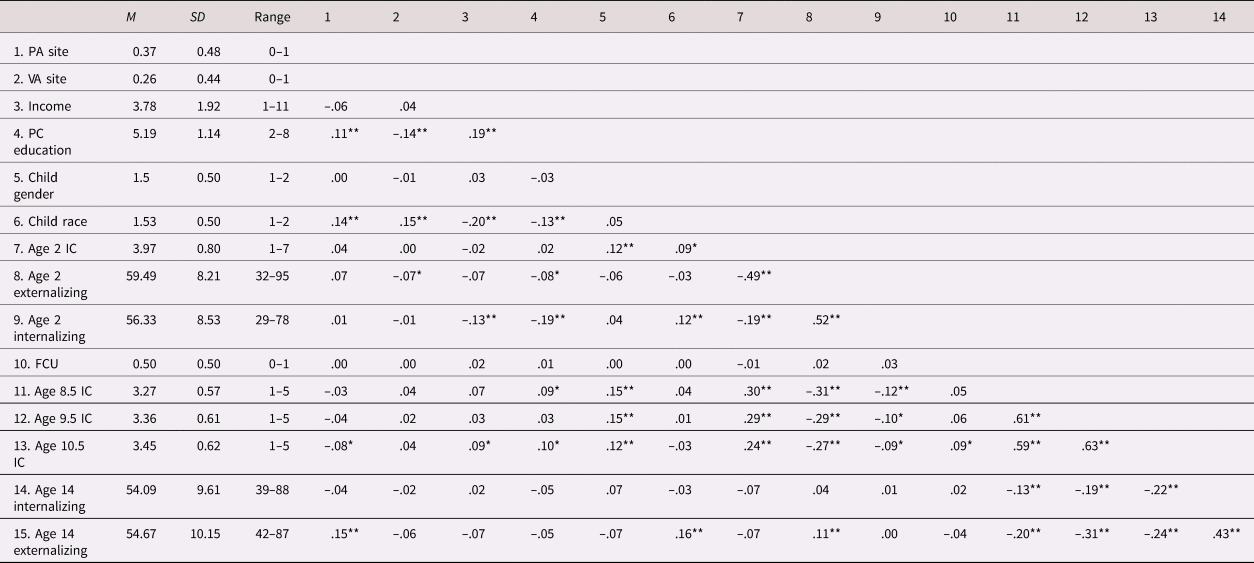
Descriptive statistics and bivariate correlations are provided in Table 1. All variables were normally distributed, with absolute skewness values ranging between .01 and .54.
Means, standard deviations, and correlations for the primary variables

Note: PA, Pennsylvania. VA, Virginia. PC, primary caregiver. IC, inhibitory control. FCU, Family Check-Up. Gender: 1 = male, 2 = female. Child race: 1 = White, 2 = minority. FCU intervention: 0 = control, 1 = intervention. *p < .05. **p < .01.
We conducted a structural equation model in Amos 24.0 to examine the effects of the FCU intervention on inhibitory control in middle childhood and internalizing and externalizing symptoms at age 14. Results of Little's missing completely at random test suggested that data were missing completely at random, χ2 = 226.81, df = 216, p = .29. To retain the full sample, missing data (median = 0.14%; range = 0%–33.52%) were estimated using full information maximum likelihood, which is considered superior to listwise deletion and multiple imputation procedures as it utilizes the raw data in the covariance/variance matrix to establish parameter estimates (Enders & Bandalos, Reference Enders and Bandalos2001).
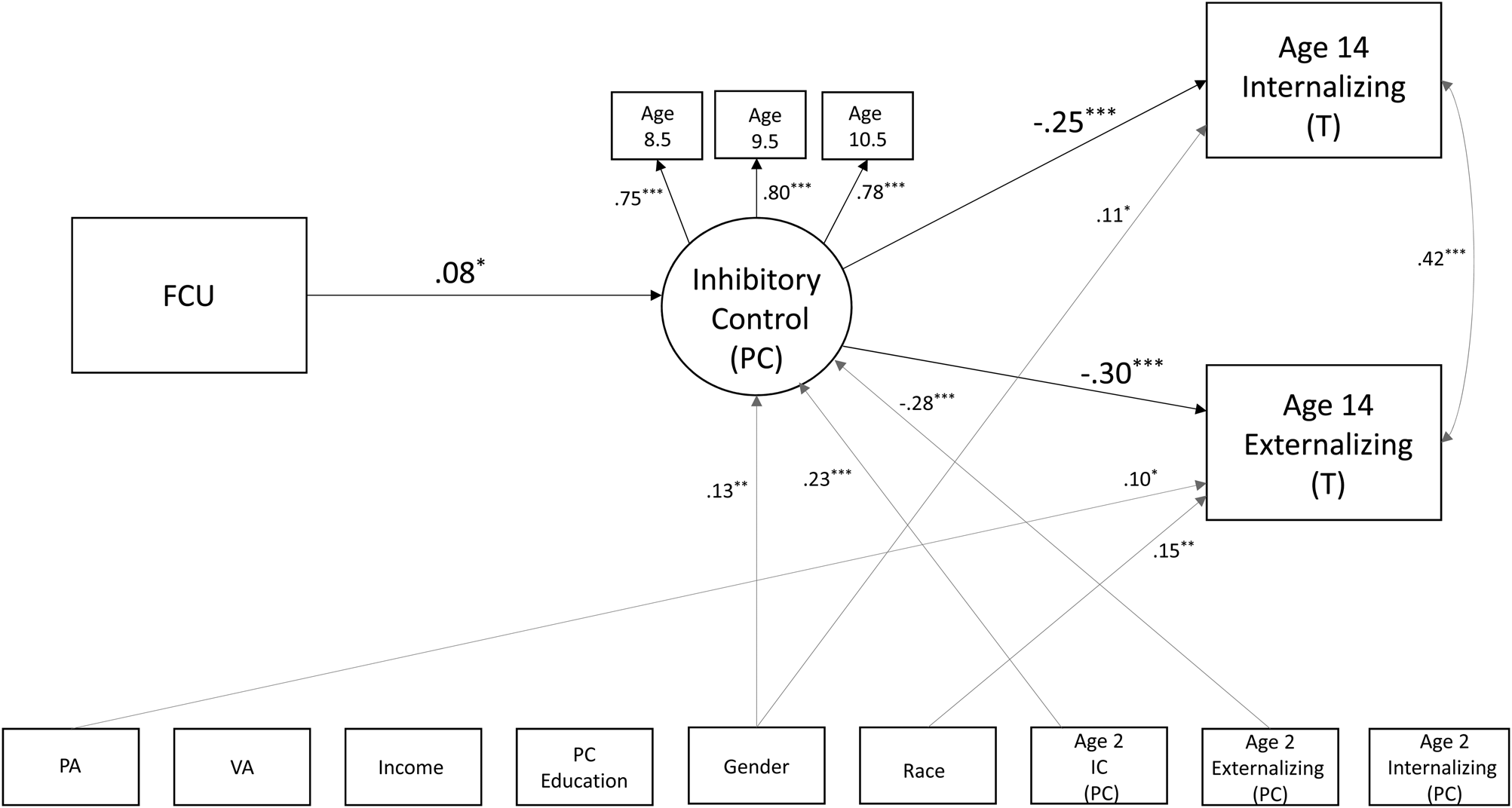
Results of the model are presented in Figure 1. Only significant predictive pathways are shown. However, all possible predictive pathways between exogenous and endogenous variables were estimated, as were covariances between the covariates in the model. Fit indices suggested that the model provided a good representation of the data, χ2 (34, N = 731) = 32.45, root mean square error of approximation = .00, comparative fit index = 1.00, Tucker–Lewis index = 1.00.
Structural equation model. Path coefficients are standardized estimates. Covariates are presented at the bottom, and all outcomes were estimated with only significant pathways shown. Correlations between all covariates, with the exception of the randomly assigned intervention condition, were estimated but are not shown for clarity. Please see Table 1 for correlations between covariates. PA, Pennsylvania. VA, Virginia. PC, primary caregiver. IC, inhibitory control. FCU, Family Check-Up. (PC), primary caregiver report. (T), teacher report. Gender: 1 = male, 2 = female. Child race: 1 = White, 2 = minority. FCU: 0 = control, 1 = intervention. *p < .05, **p < .01, ***p < .001.

Females were rated as higher in inhibitory control, β = .13, b = 0.11, p = .002, and internalizing symptoms, β = .11, b = 2.06, p = .02. Adolescents who were minorities and from Pittsburgh, Pennsylvania, were rated higher on externalizing symptoms, β = .15, b = 3.06, p = .001, and β = .10, b = 2.09, p = .04, respectively. Although family income and parental education were associated with inhibitory control at age 10.5 (see Table 1), these socioeconomic status indicators did not predict the latent factor of inhibitory control in middle childhood. Primary caregiver reports of inhibitory control and externalizing problems at age 2 predicted inhibitory control during middle childhood, β = .23, b = 0.12, and β = –.28, b = –0.01, ps < .001, respectively. However, primary caregiver reports of internalizing and externalizing symptoms at age 2 did not predict teacher reports of internalizing and externalizing at age 14.
The FCU was not directly associated with teacher-reported internalizing, β = .02, b = 0.46, p = .59, or externalizing, β = –.01, b = –0.18, p = .83, symptoms at age 14. However, inclusion in the intervention treatment condition did predict higher inhibitory control in middle childhood, β = .08, b = 0.07, p = .04. Inhibitory control, meanwhile, predicted fewer internalizing, β = –.25, b = –5.66, p < .001, and externalizing, β = –.30, b = –7.01, p < .001, symptoms at age 14. To examine whether the FCU was indirectly related to lower internalizing and externalizing symptoms at age 14 through its effect on higher inhibitory control, we calculated indirect effect (IE) estimates using an online RMediation package (Tofighi & MacKinnon, Reference Tofighi and MacKinnon2011; https://amplab.shinyapps.io/MEDCI/). An indirect effect absent a direct effect can be interpreted as a chain of events that links the predictor (FCU treatment) to the dependent variable(s) (i.e., internalizing and externalizing symptoms) via a third intervening variable (i.e., inhibitory control). Results revealed that the intervention was significantly indirectly related to both lower internalizing, IE = –0.40, 95% confidence interval [–0.89, –0.01], and externalizing, IE = –0.49, 95% confidence interval [–1.06, –0.01], symptoms at age 14, through its effect on inhibitory control in middle childhood.
Gender and racial differences
To examine whether the model fit differed according to child gender or racially/ethnically diverse families, we conducted two multigroup comparison models. To examine whether the model fit differed according to child gender, we specified a two-group model and then compared the model fit between a model in which all structural paths were constrained to be equal (i.e., the relationship between variables in the model were assumed to be equal for both boys and girls) and a model in which all paths were estimated freely (i.e., allowing the relationship between variables in the model to differ between boys and girls). Model fit was not significantly different between the two models, Δχ2 = 24.29, Δdf = 29, p = .71, suggesting that the model results did not significantly differ according to child gender. When constraining only the intervention effect on inhibitory control across gender, model results also did not differ, Δχ2 = 0.90, Δdf = 1, p = .34. Next, we repeated this process estimating constrained and free-to-vary paths in multigroup models for White and minority participants. Results again suggested that neither the overall model fit, Δχ2 = 27.88, Δdf = 29, p = .52, nor the specific intervention effect, Δχ2 = 0.94, Δdf = 1, p = .33, differed by minority status.
Follow-up sensitivity analyses
We also examined two additional models related to the sensitivity of our findings: one with all nonsignificant covariates removed (i.e., parental education, family income, and Virginia site); and one with all covariates except autoregressive paths (i.e., age 2 inhibitory control, internalizing, and externalizing) removed. The pattern of results remained the same across both models, with slight differences in effect sizes (i.e., differences in ßs ranging between –.02 and .03) that were mostly in the direction of stronger effects. In particular, the effect of the FCU intervention on inhibitory control was slightly stronger (ßs = .09) in both models that removed covariates.
Discussion
The current study was designed to empirically test the assumption that early family-based interventions can reduce later risk for behavioral and emotional problems through improving children's self-regulatory processes, specifically inhibitory control. While previous research has found short-term effects for both school- and family-based interventions on child self-regulation (Chang et al., Reference Chang, Shaw, Shelleby, Dishion and Wilson2017; Riggs et al., Reference Riggs, Greenberg, Kusché and Pentz2006), to our knowledge this is the first study to suggest that a family-based intervention initiated during the toddler years is associated with improved inhibitory control during middle childhood (i.e., ages 8.5–10.5). Moreover, the current study also found that the FCU intervention indirectly reduced the risk for externalizing and internalizing problems in adolescence via increased inhibitory control, even after accounting for child inhibitory control and externalizing and internalizing symptoms at child age 2.
Amid mounting evidence of the positive cascading effects of high self-regulation and the deleterious cascading effects of deficits in self-control (Caspi et al., Reference Caspi, Moffitt, Newman and Silva1996; Daly, Delany, Egan, & Baumeister, Reference Daly, Delaney, Egan and Baumeister2015; Galla & Duckworth, Reference Galla and Duckworth2015; Moffitt et al., Reference Moffitt, Arseneault, Belsky, Dickson, Hancox, Harrington and Sears2011), there have been increasing calls for interventions aimed at promoting child self-regulation skills beginning in early childhood. However, a recent meta-analysis on the efficacy of interventions on self-regulation improvements found that most interventions were school based and started when children were about 6 years old (Pandey et al., Reference Pandey, Hale, Das, Goddings, Blakemore and Viner2018); the current sample represents one of the earliest initiated interventions known to assess improvements in self-regulation during later middle childhood. By first grade, children are expected to follow the rules and routines of the home and classroom as well as appropriately manage their emotions and behavioral responses to stress or challenge. Children who do not meet these developmental milestones are at risk of falling behind in both academic and socioemotional competence (McClelland, Cameron, Wanless, & Murray, Reference McClelland, Cameron, Wanless, Murray, Sarracho and Spodek2007; Ursache, Blair, & Raver, Reference Ursache, Blair and Raver2012). Thus, preventive interventions that are initiated in the toddler and preschool periods may be key to managing early emerging disparities among at-risk, low-income children. Few studies have assessed the long-term effects of interventions on self-regulation skills (Pandey et al., Reference Pandey, Hale, Das, Goddings, Blakemore and Viner2018), but a previous report using the current sample provided promising indications that the FCU administered at age 2 could promote and accelerate growth in inhibitory control from 2 to 7.5 (Chang et al., Reference Chang, Shaw, Dishion, Gardner and Wilson2014). The current study extends this previous research to show these gains continue to be evident through age 10.5, which is 8.5 years after the FCU was initiated.
While in the current study the primary aim of the FCU was to reduce conduct problems by promoting positive parenting practices, family-centered interventions likely achieve such improvements in child behavior by improving child self-regulation capabilities. As noted earlier, many of the shorter and longer term gains achieved in child behavior (e.g., internalizing and externalizing problems, and school achievement) from the FCU in the current sample have been mediated by improving positive parenting between ages 2 and 3 (Brennan et al., Reference Brennan, Shelleby, Shaw, Dishion, Gardner and Wilson2013; Dishion et al., Reference Dishion, Shaw, Connell, Gardner, Weaver and Wilson2008; Shaw et al., Reference Shaw, Connell, Dishion, Wilson and Gardner2009; Shaw, Sitnick, Brennan, et al., Reference Shaw, Sitnick, Brennan, Choe, Dishion, Wilson and Gardner2016). Early parenting practices, such as warmth and sensitivity, have been shown to predict children's self-control, emotion regulation, and attentional processes (see Karreman, van Tuijl, van Aken, & Dekovic, Reference Karreman, van Tuijl, van Aken and Deković2006, for a meta-analysis). Thus, an intervention focused on promoting positive parenting behaviors is likely to have an effect on the development of children's regulatory systems (Fonagy & Target, Reference Fonagy and Target2002). In a separate sample, the FCU administered to children in sixth grade has also been shown to directly predict greater self-regulation skills in seventh grade (Fosco et al., Reference Fosco, Frank, Stormshak and Dishion2013; Stormshak et al., Reference Stormshak, Fosco and Dishion2010).
Highlighting the importance of self-regulation processes for youth well-being, greater inhibitory control in middle childhood also predicted fewer internalizing and externalizing symptoms at age 14, an important developmental transition point when many individuals start high school. This time period presents a number of key challenges to the child and family, including differing expectations of child autonomy and parental authority and increased parent–child conflict (Smetana, Reference Smetana1995), which can also coincide with increased risky behavior and emotional problems (Steinberg, Reference Steinberg2005). Individuals who struggle during the transition to high school are more likely to experience later difficulties completing school and gaining employment (McCallumore & Sparapani, Reference McCallumore and Sparapani2010; Neild, Stoner-Eby, & Furstenberg, Reference Neild, Stoner-Eby and Furstenberg2008) and are more at risk for later substance use and mental health problems (McGue & Iacono, Reference McGue and Iacono2005). Therefore, it is notable that the current study found support for an indirect effect of an early initiated family-centered intervention on reduced emotional and behavioral problems during this salient transition period.
Nevertheless, results did not differ by either gender or minority status, suggesting the intervention effects on inhibitory control were similar for both males and females and for both European American and ethnic minority individuals. This is consistent with prior research on the FCU intervention in middle school, which found that gender did not moderate the intervention effects on self-regulation and school engagement over a 3-year period (Stormshak et al., Reference Stormshak, Fosco and Dishion2010). This also extends prior research from the same sample, which has found that the intervention effects of the early FCU on problem behavior in early childhood (Dishion et al., Reference Dishion, Shaw, Connell, Gardner, Weaver and Wilson2008) and risk of obesity in middle childhood (Smith et al., Reference Smith, Montaño, Dishion, Shaw and Wilson2015) did not differ by gender or ethnicity.
Implications
The FCU is a brief, individually tailored and cost-effective family intervention that has shown a range of long-term benefits, including increased positive parenting practices (Dishion et al., Reference Dishion, Shaw, Connell, Gardner, Weaver and Wilson2008) and parent–child relationship quality (Weaver et al., Reference Weaver, Shaw, Crossan, Dishion and Wilson2015); improvements in early childhood self-regulation skills (Chang et al., Reference Chang, Shaw, Dishion, Gardner and Wilson2014); reduced child behavior problems from preschool through middle childhood (Dishion et al., Reference Dishion, Brennan, Shaw, McEachern, Wilson and Jo2014; Shaw et al., Reference Shaw, Dishion, Supplee, Gardner and Arnds2006); and decreased maternal and child depression symptoms (Reuben et al., Reference Reuben, Shaw, Brennan, Dishion and Wilson2015; Shaw et al., Reference Shaw, Connell, Dishion, Wilson and Gardner2009). The current study extends this work by showing prolonged benefits of the early FCU on self-regulation processes in middle childhood, a period characterized by greater responsibility and the further development of key self-regulation skills necessary for navigating the increased demands of peer and school contexts (Liew, Reference Liew2012). In addition, the current study highlights and confirms recent research indicating that self-regulation processes are important for youth well-being and mental health (Morgan et al., Reference Morgan, Farkas, Hillemeier, Pun and Maczuga2018; Sarkisian et al., Reference Sarkisian, Van Hulle, Lemery-Chalfant and Goldsmith2017), as higher inhibitory control in middle childhood was associated with both lower internalizing and externalizing symptomology during the transition to high school. Together, these findings suggest that the early initiated FCU can be an effective preventative intervention program that promotes healthy child development across a range of domains and developmental periods.
However, it should also be noted that the intervention only exhibited a small effect size on inhibitory control in middle childhood. The unstandardized effect size of b = 0.08 can be interpreted as children in the FCU treatment condition scoring .08 point higher on the 4-point inhibitory control scale than those assigned to the control condition. While small, the effect size in the current study is similar to previous reports looking at the FCU's effect on inhibitory control and self-regulation over smaller periods of time (i.e., 1 to 2 years; Chang et al., Reference Chang, Shaw, Dishion, Gardner and Wilson2014; Fosco et al., Reference Fosco, Frank, Stormshak and Dishion2013). Moreover, the effect size is consistent with other preventive interventions for which parents were recruited rather than actively seeking treatment (e.g., Conduct Problems Prevention Research Group, 2002; Haggerty, Skinner, Catalano, Abbott, & Crutchfield, Reference Haggerty, Skinner, Catalano, Abbott and Crutchfield2015; Kogan et al., Reference Kogan, Lei, Brody, Futris, Sperr and Anderson2016). The effects of inhibitory control on adolescent mental health symptoms were larger, with a 1-point increase in inhibitory control being associated with 7- and 5-point decreases in externalizing and internalizing t scores, respectively. Five t-scored points correspond to half a standard deviation in the normed sample, suggesting that improvements in self-regulation could have noticeable differences for child mental health symptoms. Of note, the FCU in the current study was directed toward the parents and did not explicitly involve improvements in child inhibitory control in the intervention protocol. The FCU could potentially exert a greater effect on child self-regulation capabilities if this became a core component of the intervention protocol. Prior studies with the same sample have found larger effect sizes of the FCU on promoting positive parenting and reducing disruptive behavior in children (e.g., Gardner et al., Reference Gardner, Shaw, Dishion, Burton and Supplee2007; Smith, Dishion, Shaw, & Wilson, Reference Smith, Dishion, Shaw and Wilson2013), which were core targets of the intervention.
Limitations
Although the current study has many strengths, starting with its prospective longitudinal and experimental design spanning 12 years, and assessing child and family factors across multiple contexts and using multiple informants, the study also has a few important methodological limitations. Measurement bias is a concern because the main constructs were all assessed using questionnaires. However, we accounted for age 2 autoregressive effects of inhibitory control and age 2 behavioral and emotional problem behavior in an attempt to covary not only baseline effects but also shared method variance. Future research should also make use of behavioral measures of youth inhibitory control (e.g., Go/No-Go tasks) as part of the measurement protocol.
In addition, youth in the current sample were purposefully recruited from ethnically/racially geographically diverse communities (i.e., rural, suburban, and urban) on the basis of socioeconomic, family, and child risk at age 2; thus, the current results are likely not generalizable to higher socioeconomic status samples. As an example, it is unclear whether youth would have to display behavioral risk (and/or socioeconomic and/or family risk) during early childhood to benefit from the FCU in terms of inhibitory control in middle childhood and subsequent improvements in externalizing and internalizing problems.
Finally, there may be third variable mechanisms that link inhibitory control in middle childhood with children's externalizing and internalizing problems. For example, children who lack inhibitory control may be rejected by prosocial peers and accepted by deviant peer groups (Chang et al., Reference Chang, Shaw, Shelleby, Dishion and Wilson2017), which in turn could drive the development of depressive symptoms and conduct problems. Conversely, children with higher levels of self-regulation skills likely demonstrate higher level of social competency and prosocial peer acceptance, resulting in lower rates of emotional and behavioral problems. Future research should investigate the underlying mechanisms that explain how childhood inhibitory control is associated with adolescent adjustment and also inform targets for school-based intervention programs for at-risk youth.
Conclusions
The current study is the first to provide evidence suggesting that a family-based intervention initiated during the toddler years can promote self-regulation in middle childhood, which further predicts lower externalizing and internalizing symptoms in adolescence. While there are a growing number of school-based intervention programs focused on improving children's self-regulation skills, the current study offers initial evidence that a family-based prevention program that is initiated when self-regulation processes are just emerging can also show prolonged effects on improved inhibitory control and lead to cascading effects on reduced externalizing and internalizing problem behavior in adolescence. These results underscore the value of early preventive interventions and add to our understanding of the possible underlying mechanisms in the link between the FCU and decreased child behavioral and emotional problems.
Acknowledgments
We thank the staff and study families of the Early Steps Multisite Project for making this research possible.
Financial support
This research was supported by the National Institute on Drug Abuse Grants R01 DA023245 and R01 DA022773 (to D.S.S, M.N.W., and T.J.D.) and K05 DA025630 (to D.S.S.). T.J.D. developed the Family Check-up intervention but received no monetary reimbursement for its use. R.F.H. is supported by a fellowship from the Talisman Energy Fund in Support of Healthy Living and Injury Prevention and the Alberta Children's Hospital Research Institute.