Introduction
The fauna of western North America, and in particular coastal temperate rainforests of the Pacific Northwest, is shown to have high oribatid mite (Acari: Oribatida) species richness (Lindo and Winchester Reference Lindo and Winchester2008), with many species seemingly endemic to the region. Many new species have been described from this fauna in recent years (Behan-Pelletier Reference Behan-Pelletier2000; Behan-Pelletier et al. Reference Behan-Pelletier, Eamer and Clayton2001, Reference Behan-Pelletier, Clayton and Humble2002, Reference Behan-Pelletier, Eamer and Clayton2005; Lindo et al. Reference Lindo, Clayton and Behan-Pelletier2008) including several in the family Peloppiidae: a new species of Dendrozetes Aoki, 1970 (Lindo et al. Reference Lindo, Clayton and Behan-Pelletier2010), and five new species of Ceratoppia Berlese, 1908 (Lindo Reference Lindo2011). Members of Peloppiidae are found throughout the Holarctic in temperate and boreal forests, and while common, are never collected in high abundance. By contrast, Pacific Northwest forest habitats appear to have high relative diversity of peloppiid mites representing species of the genera Ceratoppia, Dendrozetes, Metrioppia Grandjean Reference Grandjean1931, and Parapyroppia Pérez-Íñigo and Subias, 1979. Yet, compared with other genera within the family Peloppiidae, Metrioppia is poorly known.
Worldwide, eight species of Metrioppia have been described; four of these are known from North America. Metrioppia helvetica Grandjean, Reference Grandjean1931 as the type species for the genus, was noted for its similarity to the genus Ceratoppia but differed in having pelopsiform mouthparts and prolamellae. Hammer (Reference Hammer1952) re-described M. helvetica recorded from arctic areas in North America (Alaska, Yukon, Northwest Territories, and Nunavut) as Ceratoppia microseta Hammer, Reference Hammer1952, and later synonymised it with M. helvetica (Hammer, Reference Hammer1955). Metrioppia serrata (Sellnick, 1931) described the same year as M. helvetica from Mexico, is the most southerly distributed North American species, and is similar to the eastern species M. atlantica Jacot, 1938. Type specimens for M. helvetica (and C. microseta), and M. serrata were not designated, or have since been destroyed (Marshall et al. Reference Marshall, Reeves and Norton1987). Metrioppia oregonensis Woolley and Higgins, Reference Woolley and Higgins1969, originally described from Oregon State, is found along the Pacific coast from northern California, United States of America to southern British Columbia, Canada. Other described Metrioppia species are M. krivolutskyi Bayartogtokh, Reference Bayartogtokh1999 from Mongolia, M. zlotini Krivolutsky, 1971 from Kyrgyzstan and central Asia, M. quadrisetosa Fujita and Fujikawa, Reference Fujita and Fujikawa1986 from northern Japan, and M. tricuspidata Aoki and Wen, Reference Aoki and Wen1983 from central Japan. The main character states differentiating species of Metrioppia are the shape and dentition of the rostrum, length of lamellae and shape of lamellar cusps, length of the interlamellar setae, and number of expressed notogastral setae. There is no consensus of relationship among the species.
Here I describe Metrioppia walbranensis new species from Pacific coastal temperate rainforests on Vancouver Island, British Columbia, Canada, which is differentiated using the character states noted above. The distribution of M. walbranensis and M. oregonensis are approximated from original sampling and museum collection records, mapped and compared. Further, I provide molecular sequence data for the mitochondrial cytochrome oxidase 1 (CO1) gene for these two species and five other members of Peloppiidae from the Pacific Northwest.
Materials and methods
Species description
Morphological terminology is mostly that of F. Grandjean: see Travé and Vachon (Reference Travé and Vachon1975) for general references, Norton (Reference Norton1977) for leg setal nomenclature, and Norton and Behan–Pelletier (Reference Norton and Behan–Pelletier2009), for overview. The following conventions of measurements and description are used: total length, measured dorsally from tip of the rostrum to posterior edge of the notogaster on specimens in lactic acid in cavity slides; total width, measured at the widest part of the notogaster, perpendicular to the circumgastric scissure on specimens in lactic acid in cavity slides; prodorsal setae, measured on slide–mounted specimens; ro, rostral setae; le, lamellar setae; in, interlamellar setae; ex, exobothridial setae; bo, bothridial seta. The unideficience nomenclature is used for the notogastral setation. Setal measurements are averaged from five specimens, unless otherwise specified. Specimens for scanning electron microscopy were stored in 70% ethanol, dehydrated in ethanol and acetone, critical-point-dried, mounted on aluminium stubs with double-sided tape, and coated with gold-palladium.
Molecular sequencing techniques
Three individuals of M. walbranensis and four of M. oregonensis were successfully sequenced for the mitochondrial cytochrome c oxidase I (COI) gene: two M. oregonensis individuals at the Biodiversity Institute of Ontario (Guelph, Ontario, Canada) for inclusion with the Barcode of Life (BOLD) Systems (Ratnasingham and Hebert Reference Ratnasingham and Hebert2007), and the others at the University of Western Ontario (UWO) (London, Ontario, Canada). Primers, polymerase chain reaction (PCR), and sequencing for BOLD followed the methods of Ivanova et al. (Reference Ivanova, deWaard and Hebert2006), while UWO specimens were processed using the following methods.
DNA was extracted from individual mites preserved in 95% ethanol using a modified protocol of the Qiagen DNA extraction kit (Toronto, Ontario, Canada). Mites were crushed in lysis buffer prior to incubation at 56 °C. The final elution volume was 50 uL and each elute was collected separately. A 708 base pair (bp) fragment of COI was amplified using primers LCO1490 and HCO2198 (Folmer et al. Reference Folmer, Black, Hoeh, Lutz and Vrijenhoek1994). Each PCR contained 2 mM MgCl2, 10 mM dNTP, 2 pmol each primer, 0.2 mg BSA (New England BioLabs, Whitby, Ontario, Canada), 1 unit Taq (Applied Biosystems, Burlington, Ontario, Canada) in a total volume of 10 uL. DNA concentration was too low to quantify by spectrophotometry therefore up to 7 uL of DNA was used in the 10 uL PCR reaction to ensure enough template. Cycling parameters were as follows: initial denaturation at 94 °C for two minutes, 36 cycles of 94 °C for 30 seconds, 51 °C for one minute, 72 °C for one minute, and final extension at 72 °C for two minutes. Additional primers were designed to amplify a smaller portion of the COI gene for M. oregonensis where LCO1490 and HCO2198 did not result in clean sequences (ZL-Met-COI-internal-L1: 5′-AACTGGRTGRACTGCGTATC-3′, paired with HCO2198). Amplification protocols were the same as above but the annealing temperature was 50 °C. PCR fragments were cleaned using the Exo SAP kit (USB Affymetrix, Santa Clara, California, United States of America) and DNA sequencing was performed using Applied Biosystems BigDye Terminator v3.1 Cycle Sequencing Kit (Foster City, California, United States of America) on an Applied Biosystems Automated 3730 DNA Analyzer equipped with a 50 cm capillary array. Base calling was performed using Applied Biosystems Sequencing Analysis Software v5.3.1.
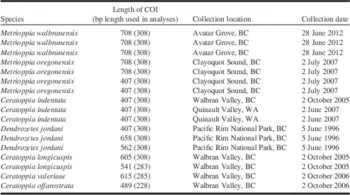
Sequences were aligned in Clustal X version 2.0.10 (Larkin et al. Reference Larkin, Blackshields, Brown, Chenna, McGettigan and McWilliam2007) using default parameters with subsequent visual verification. Sequences of both Metrioppia species were compared with sequences previously generated from five species across two other genera within the family Peloppiidae, also processed through BOLD systems (Table 1). Trees were generated using a 658 and 308 bp fragment of COI using neighbour joining, maximum parsimony, and maximum likelihood algorithms; support of resulting trees was assessed using 500 nonparametric bootstraps in Mega v5.05 (Tamura et al. Reference Tamura, Peterson, Peterson, Stecher, Nei and Kumar2011). The sequences used are in Supplementary appendix 1.
List of specimens in the family Peloppiidae used for COI sequencing, with collection information.

BC, British Columbia, Canada; WA, Washington State, United States of America.
The observed specimens of Metrioppia walbranensis belong to the following collections:

Systematics
Genus Metrioppia Grandjean, Reference Grandjean1931
Type species: Metrioppia helvetica Grandjean, Reference Grandjean1931.
Diagnosis. Adults of the genus Metrioppia are unique among the Peloppiidae in having the following combination of character states: subcapitulum anarthric, associated with pelopsifom chelicerae and modified rutella; lamella with well-defined cusps, pair well separated but may converge, without translamella; prolamella weakly to well developed; parietal carina I well defined; dorsophragma and pleurophragma present; pedotecta I and II well developed; sejugal apodeme conspicuous and continuous; epimeral border IV transverse, curving around genital plate, with anterior facing minitectum present but incomplete adjacent to genital plate; legs heterotridactylous; bothridial seta elongate, typically setiform; six pairs of genital and one pair aggenital setae; two pairs of anal and three pairs of adanal setae; palp setal formula 0–2–1–3–9(1); porose areas dorsolateral and antiaxial on femora of all legs and trochanters III and IV. Tritonymph: relatively unsclerotised, yellowish-white with granular cerategument; four pairs long notogastral setae present on rounded tubercles laterally (three pairs) and posteriorly (one pair); all prodorsal setae well developed; chelicerae pelopsiform.
Metrioppia walbranensis Lindo, new species
Material examined. Holotype: Adult female. Canada, British Columbia, Vancouver Island, Upper Walbran Valley (48°39'N, 124°35'W) 12 July 2011 (Z. Lindo) from forest floor below western redcedar (Thuja plicata Donn ex Don (Cupressaceae)); deposited in the Canadian National Collection of Insects, Arachnids, and Nematodes, Ottawa, Ontario, Canada (CNC), type No. 24060. Paratypes (all adults): four (three males, one female) with same data as holotype (ZLC). Canada, British Columbia, Vancouver Island, Avatar Grove near Port Renfrew (48°36'N, 124°26'W) 24 July 2011 (Z. Lindo) 10 from forest floor litter under Douglas fir (Pseudotsuga menziesii (Mirbel) Franco (Pinaceae)) (ZLC); Avatar Grove, 10 June 2012 (K. Jordan) 10 from forest floor litter under Douglas fir (Pseudotsuga menziesii) (CNC and ZLC); Avatar Grove, 10 June 2012 (D. and C. Copley) 10 from moss on ground under western redcedar (Thuja plicata) (RAN and RBCM).
Other material examined. Canada, British Columbia, Vancouver Island, Caycuse (48°53'N, 124°21'W), three from Heather Mountain Trail, 10 mi. NW Caycuse from moss in creek, decayed stump, and litter in ground-level hollow (CNC); Upper Walbran Valley (48°39'N, 124°35'W) eight from under western redcedar; Upper Carmanah Valley (48°44'N, 124°37'W) three from under Sitka spruce (Picea sitchensis (Bongard) Carrière (Pinaceae)) (PFC).
Etymology. The specific epithet refers to the Walbran Valley on Vancouver Island, Canada, the type locality of this species.
Diagnosis. Adult. Total length 375–420 µm, with character states of Peloppiidae (Balogh Reference Balogh1943; Grandjean Reference Grandjean1954 as Ceratoppiidae), and character states of Metrioppia as described above. This species can be differentiated from other Metrioppia by a unique combination of character states: prolamella very weakly developed; interlamellar setae long; lamellae reaching tip of rostrum with cusps comprising 2/3 their length; rostrum sharply pointed joining with anterior teeth from camerostome creating a partial tube-like structure; three pairs of notogastral setae (p-series) expressed.
Description
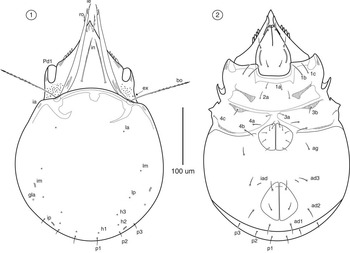
Metrioppia walbranensis new species, adult female. 1, Dorsal aspect; 2, Ventral aspect. Legs removed.

Measurements: Mean total length: females (n=2) 405 µm (range 390–420); males (n=3) 395 µm (range 375–420). Mean notogastral width: females (n=2) 255 µm (range 250–260); males (n=3) 238 µm (range 225–255). Average length-to-width ratio 1.63 (females 1.58; males 1.65).
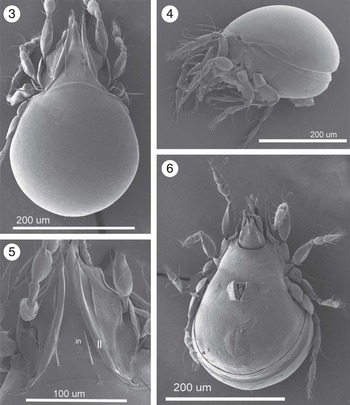
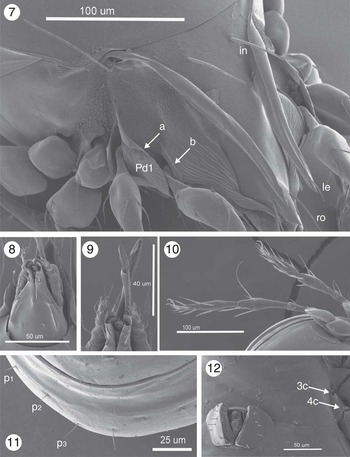
Integument: Mostly smooth to microtuberculate. Integument laterad to bothridial setae between pedotectum I and acetabulum IV tuberculate (Fig. 5). Prodorsum: Rostrum strongly pointed, subtriangular with lateral thickened projections forming a ridge dorsally on rostrum; 4–5 rounded denticles laterally (Figs. 1, 5). Prolamella very weakly developed. Seta ro 28–38 µm thin, straight, acuminate, unilaterally barbed, extending beyond rostrum (Fig. 7). Lamella about 170 µm to end of cusp, extending anteriad insertion point of ro, striate ventrally (Fig. 4), with cusps about 115 µm long comprising ~2/3 lamellar length, ending in denticle (Fig. 1). Posteriorly, lamella merges with bothridial cup. Seta le about 16 µm thin, straight, lightly barbed, inserted ventrally on lamellar cusp about 12 µm from tip (Fig. 7). Seta in 80 µm long, slightly thicker than other prodorsal setae with few long, thin barbs (Fig. 5). Mutual distance of setal pairs ro–ro about 15, and that of in–in about 38 µm. Seta ex not observed; one or two alveoli present lateral to each bothridium. Bothridial seta about 112 µm long, thin, acuminate, with few small barbs. Medial dorsophragma somewhat circular or slightly elongate, ~15.5 (wide)×18 µm (long) (Fig. 1). Lateral region of podosoma: Integument granulate between pedotectum I and acetabulum IV. Pedotectum I rounded anteriorly, crenulated, with dorsal tooth (Fig. 7). Parietal carina I well defined, mirroring outline of pedotectum I (Fig. 7). Longitudinal ridge dorsal to parietal carina I, extending anteriorly as a tooth to the edge of the rostrum, forming partial tube-like structure with medial rostral tooth for pelopsiform rutella and chelicera (Figs. 5, 7–8). Area between parietal carina I and longitudinal ridge highly striate. Notogaster: Slightly longer than wide. Anterior margin arched, slightly overhanging prodorsum, with small humeral projection (Figs. 1, 3). Notogastral seta reduced to alveoli, except for three pairs of posterior seta (p-series). Posterior notogastral seta of p-series simple, straight: p 1 about 14 µm long; setae p 2 and p 3 about 8 µm long (Fig. 11). Lyrifissure ia about 7.5 µm long while lyrifissures im, ip, ih, and ips all about 6 µm long. Ventral region: Epimeral border IV with anterior facing minitectum present extending to level of epimeral seta 4b but incomplete adjacent to genital plate (Fig. 2). Sejugal apodeme straight, conspicuous. Epimeral border II not complete medially. Epimeral setae smooth or with few barbs, acuminate (Figs. 2, 12); formula (epimeres I–IV) 3–1–3–3. Setal lengths as follows: 1a, 1b, 1c about 10, 24, 23 µm, respectively, 2a, 3a, 3b, about 13, 7, 13 µm, respectively, and 4a, 4b about 10 and 13 µm, respectively. Single specimen with asymmetric duplication of epimeral setae 4a on left side. Setae 3c not observed in slide-mounted specimens, originating laterally behind discidium; setae 4c located laterally on discidium ~5 µm (Fig. 12). Six pairs of genital setae about 7 µm, simple (Fig. 2). Aggenital seta about 8 µm, setose, well removed from genital plate. Two pairs of anal seta about 9 µm long, simple, thin. Three pairs of adanal seta decreasing in length; ad 1 about 12 µm, ad 2 about 10 µm, and ad 3 about 9 µm, all simple, thin. Lyrifissure iad 8 µm long, medial to ad 3. Gnathosoma: Seta h, m, and a about 12, 19, and 15 µm long, respectively (Figure 2). Seta m originating anterior to lateral subcapitular ridge (Fig. 8). Approximate lengths of palp segments (femur, genu, tibia, tarsus; in µm): 22.5, 12.5, 12.5, 16.25 (Fig. 9). Legs: Ratio of leg IV to body length about 0.71:1 (Fig. 10). Approximate lengths of leg parts (femur, genu, tibia, tarsus; in µm): I 94, 25, 53, 84; II 79, 20, 46, 75; III 44, 21, 65, 73; IV 59, 39, 83, 105. Pretarsus of all legs with large smooth empodial and thinner lateral claws. Setation (I–IV, number of solenidia in parentheses): trochanters 1–1–2–1; femora 5–4–3–2; genua 3(1)–3(1)–2(1)–3; tibiae 4(2)–4(1)–3(1)–3(1); tarsi 20(2)–15(2)–15–12. Porose areas on all femora, and trochanters III and IV. Femora of legs II–IV with ventral keel. Leg I tibial solenidion φ 1 on tubercle; φ 2 thin, smaller than φ 1. Solenidia ω 1 and ω 2 of tarsi I and II curving, almost recumbent; ω 1 longer than ω 2 on tarsus I; ω 1 and ω 2 subequal on tarsus II. Seta d absent without vestige from genua and tibiae except on genu IV.
Metrioppia walbranensis new species, scanning electron microscope images of adult. 3, habitus, dorsal aspect; 4, habitus, lateral aspect; 5, prodorsum, dorsal aspect, showing lamellae (ll), and interlamellar setae (in); 6, habitus, ventral aspect.

Metrioppia walbranensis new species, scanning electron microscope images of adult. 7, prodorsum in dorsolateral aspect, interlamellar setae (in), lamellar setae (le), rostral setae (ro), pedotectum I (Pd1) with dorsal tooth (a), and parietal carina I (b); 8, gnathosoma, ventral aspect; 9, pelopsiform rutella and chelicera, ventral aspect; 10, leg IV (tarsus, tibia, genu, femur, trochanter) and leg III (tarsus, tibia, genu), ventral aspect; 11, posterior notogastral setae (p 1, p 2, p 3), ventral aspect; 12, genital plate and epimeral region with setae 3c and 4c, minitectum (b).

Comparison and relationship with other Metrioppia species
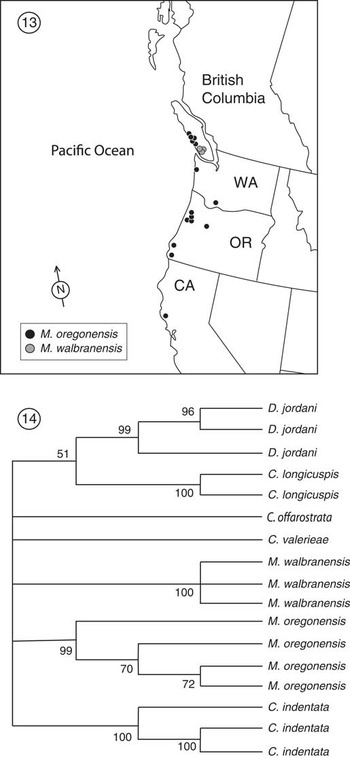
Specimens of M. oregonensis and M. walbranensis were successfully sequenced for the cytochrome c oxidase I (COI) gene (>700 bp) (Table 1) and confirm both species as genetically unique (Fig. 14). Trees generated using a 658 and 308 bp fragment of COI with neighbour joining, maximum parsimony, or maximum likelihood algorithms all gave qualitatively similar patterns, distinguishing species within the family, but provided very low support for relationships among the genera of Peloppiidae.
13, Distributional map for Metrioppia oregonensis and Metrioppia walbranensis in western North America based on previously collected samples and specimens observed from Canada (British Columbia) and United States of America (Washington (WA), Oregon (OR), California (CA)); 14, Phylogenetic tree of Peloppiidae on the west coast of North America based on 308 base pair fragment of COI. Metrioppia walbranensis and M. oregonensis are compared to five other members of the family; four species of Ceratoppia, and one species of Dendrozetes. Bootstrap support values were generated using maximum likelihood algorithms with 500 nonparametric bootstraps.

The main character states differentiating species of Metrioppia are the shape and dentition of the rostrum, length of lamellae and shape of lamellar cusps, length of the interlamellar setae, and number of expressed notogastral setae. Described species generally have been recorded in low abundance, thus many species descriptions are based on only a few individuals. Furthermore, Metrioppia is typically smaller than other members of the Peloppiidae, and features such as the number of epimeral setae are hard to discern in this genus. As such, there is no consensus of relationship among the described species.
Morphologically, M. walbranensis is most similar to M. tricuspidata in having long interlamellar setae, small humeral projections, and three pairs of posterior notogastral setae (p-series) expressed. It differs from M. tricuspidata by being slightly smaller (400×245 µm compared with 455×315 µm); having lamellae with cusps comprising about 2/3 their total length (versus 1/3); having rostral setae approximately twice as long as lamellar setae (versus being subequal); and having the medial rostral tooth longer than the lateral teeth (versus subequal). The other species known from the Pacific Northwest, M. oregonensis, is distinct from M. walbranensis in having minute interlamellar setae, rostral setae shorter than lamellar setae, and 10 pairs of notogastral setae expressed as microsetae (Woolley and Higgins Reference Woolley and Higgins1969) (but see discussion below); with an average length of 360 µm, M. oregonensis is also the smallest known member of the genus.
Epimeral setation appears to vary considerably among species, but this may not be the case. Observed specimens housed at the Canadian National Collection of Insects, Arachnids, and Nematodes (Ottawa, Ontario, Canada) collected from Mexico and the United States of America (Alabama, Virginia, and Missouri) (Missouri specimens from the Ohio State Summer Acarology Program teaching collection, Columbus, Ohio, United States of America) have a distinct 3–1–2–4 setation, with setae on epimere IV in a row along the posterior border. The setations of M. tricuspidata and M. krivolutskyi are both described as having 3–1–2–2 setation (Aoki and Wen Reference Aoki and Wen1983; Bayartogtokh Reference Bayartogtokh1999), while that of M. quadrisetosa is described as 3–1–2–3 (Fujita and Fujikawa Reference Fujita and Fujikawa1986). It is possible that previous descriptions based on light microscopy have missed setae on the third or fourth epimere; when not specified in the text, it is almost always illustrated as 3–1–2–2. Only when specimens were dissected and cleared, or viewed under scanning electron microscopy, were seta 3c and 4c observed in M. walbranensis.
Three described species of Metrioppia possess relatively short or reduced interlamellar setae (M. helvetica, M. serrata, M. oregonensis); thus the dominant form (five out of eight known species) is long interlamellar setae. The rostrum of Metrioppia species typically has some form of dentition or serration, and can be either rounded or squared at the tip (M. krivolutskyi, M. serrata, M. zlotini), or extending to a point. In most Metrioppia species three pairs of posterior seta (p-series) are expressed, the other setae being represented only by alveoli, but only two pairs (p 1, p 2) are expressed in M. quadrisetosa. According to the original description (Woolley and Higgins Reference Woolley and Higgins1969), all 10 pairs of notogastral setae are expressed in M. oregonensis, although minute; however, specimens of M. oregonensis examined were observed to have only the three pairs of posterior setae (the p-series) expressed. The other setae illustrated by Woolley and Higgins (Reference Woolley and Higgins1969) could be alveolar canals, which are similar in length and thinness to setae. Wallwork (Reference Wallwork1964) described the qualitative (reduction) and quantitative (loss) regression patterns of notogastral setae among species of Metrioppia, suggesting that these regressions outline the evolutionary relationship among the various species; i.e., Wallwork considered M. helvetica to be less derived as they retain notogastral setae as microsetae.
The presence of two pairs of exobothridial alveoli was observed in several specimens of M. walbranensis, but not in M. oregonensis. Within the Brachypylina, this character state has been observed previously only in the families Eremaeidae and Megeremaeidae (Behan-Pelletier Reference Behan-Pelletier1993), however, it is unclear whether the second, anterolateral pairs (em sensu Lions Reference Lions1971) are truly alveoli, or whether they are glandular in nature (aperture z sensu Grandjean Reference Grandjean1939; Behan-Pelletier Reference Behan-Pelletier1990) as they were not observed in specimens prepared for SEM.
Natural history and distribution
Thus far, M. walbranensis is known only from moss and litter habitats in old-growth temperate rainforests on the west coast of Vancouver Island, British Columbia, Canada. It has been collected predominantly from forest litter under western redcedar in the Walbran Valley on Vancouver Island, but was also collected from a suspended soil habitat in the canopy (30 m) of western redcedar at the same location (Lindo and Winchester Reference Lindo and Winchester2008). The most recent collection of the species – from Walbran Valley (July 2011) and Avatar Grove (July 2012) – was from well-developed forest floor soils with distinct litter-fermentation-humus horizons that had extensive fungal hyphae mats. The habitat of M. walbranensis is similar to that of other Peloppiidae encountered in Pacific Northwest coastal forests, although some are strictly arboreal (e.g., Dendrozetes jordani Lindo et al., Reference Lindo, Clayton and Behan-Pelletier2010) (Lindo et al. Reference Lindo, Clayton and Behan-Pelletier2010; Lindo Reference Lindo2011). Metrioppia walbranensis co-occurs with Ceratoppia indentata Lindo, Reference Lindo2011 in forest floor samples.
Old-growth forest habitats of Vancouver Island are currently under extensive forest harvesting (clear cut logging, high-grade logging, road building) in the areas surrounding the Walbran Valley and Port Renfrew where M. walbranensis has been collected. With the exception of areas within the Carmanah-Walbran Provincial Park, much of the habitat within the distributional range of this species is strongly threatened by forest harvesting activities, including road building, and potential development of recreational sites. In a study of forest harvesting effects, M. oregonensis abundance was found to significantly decline under forest thinning (Peck and Niwa Reference Peck and Niwa2005). Of the five specimens collected during a study in the Carmanah Valley in 1991, none were found in the clear-cut site, and only a single specimen came from the edge habitat alongside the clear-cut, suggesting that intact primary forest habitat is required by M. walbranensis. As such, habitat loss is believed to be a primary threat to this species.
All collections of M. walbranensis are from Canada, and the distribution appears limited to a localised area (<3000 km2) of temperate rainforest on south-western Vancouver Island, British Columbia (Fig. 13). It has been collected only at four locations: Walbran Valley, Carmanah Valley, Heather Mountain trail near Caycuse (in 1973), and Avatar Grove near Port Renfrew. Samples collected from locations directly northwest (e.g., Bamfield Marine Station, Broken Island Group, Clayoquot Sound) and southeast of this area (e.g., Mesachie Lake, Cowichan Lake) do not contain M. walbranensis (personal observation; Lindo and Winchester Reference Lindo and Winchester2009). Rather, M. oregonensis is found in some of these locations of temperate coniferous rainforest habitats on Vancouver Island (e.g., Broken Island Group, Clayoquot Sound), and in forested areas of Washington, Oregon, and northern California (Fig. 13), suggesting that the two species do not co-occur, and that M. oregonensis has a disjunct distribution.
Acknowledgements
The author thanks to Val Behan-Pelletier and Roy Norton for their continued mentorship, discussions, and feedback on this manuscript. Her sincere thanks to Marilyn Clayton (Pacific Forestry Centre, Victoria, British Columbia) for collection records associated with the Carmanah project; Neville Winchester for providing additional M. oregonensis specimens; Fred Beaulieu, King Wu, Wayne Knee, and Evert Lindquist (Acarology Unit) for help during time spent at the Canadian National Collections of Insects, Arachnids, and Nematodes; Claudia Copley and Rob Cannings for help during time spent at the Royal British Columbia Museum; and Greg Thorn at the University of Western Ontario for lending her his microscope and drawing tube while her laboratory was developing. Funding for this project was in the form of CanaColl grants from the CNC (Ottawa, Canada), and the Jack and Bert Carr Award from the Canadian Entomological Society of Canada. Specimen preparation and scanning electron micrographs were aided by Richard Gardiner, Karen Nygard, and Brent Gowen. Dr. Daria Koscinski worked hard to prepare the genetic material. Special thanks to Kevin Jordan for field help.
Supplementary materials
To view supplementary materials for this article, please visit http://dx.doi.org/10.4039/tce.2014.83