John Kenneth Turner's account of debt peonage in Yucatán—first published in the muckraking journal, the American Magazine— made an immediate impact on Americans' perceptions of their southerly neighbors, and became the text to which all future scholars of Yucatán's labor conditions first turn. Turner built a compelling narrative of slavery and oppression on Yucatecan haciendas and argued that these conditions were due to the policies of Mexico's longtime president, Porfirio Díaz, whose overthrow he advocated. Subsequent scholars have modified Turner's account, carefully detailing the institutional and cultural context of labor conditions on Porfirian henequen haciendas. However, a paucity of data has made it difficult to heavily revise Turner's initial findings, and no one has directly tied the broader setting to the specific timing and function of debts. In this article, we strike a balance between the critics of debt peonage who see it as pure exploitation and apologists who claim that debt peonage in Yucatán was not as harsh or as widespread as critics suggest.Footnote 2
Almost all labor contracts have multiple margins in addition to a wage. When monitoring costs loom large, as they always did in pre-mechanized agriculture, employers negotiated contracts that reduced these costs. In order to attract workers, producers raise salaries but may also alter other margins of contracts.Footnote 3 On henequen haciendas in Yucatán, the most striking aspect of labor contracts is that workers accumulated large debts “on the books” that hacendados never expected to be repaid. While large upfront transfers with no chance of repayment may at first glance seem to be an inefficient means of attracting and motivating labor, we argue that within Yucatán's institutional and cultural setting debt served both of these functions.
In this article, we advance three larger points concerning debt peonage in Yucatán.Footnote 4 First, we argue that even though the institutional setting during this period was coercive and designed to favor hacendado interests, workers still made choices and responded to incentives. Had conditions outside the hacienda been less coercive, bargaining power would certainly have shifted in favor of the workers.Footnote 5 Second, the specific form that debt took in Yucatán was shaped by cultural and social norms. The ruling elite drew on these norms, shared by Maya and hacendados alike, to increase the demand for debt at a young age, in particular by encouraging increases in the size and expense of marriages. Finally, debt was part of a system of paternalism that compensated workers on multiple margins and tied workers to hacendados. By “paternalism” we do not imply that the relationship between the hacendado and his workers was one of affection, but rather that using other margins of a labor contract was more effective than wages in securing and retaining labor. The general mechanism that we have in mind is very similar to the paternalistic agricultural labor contracts used in the U.S. South from the late nineteenth century until cotton was mechanized in the 1960s. Like Lee Alston and Joseph Ferrie, we do not argue the compensation on margins other than wages instilled true loyalty on the part of workers but rather “loyal-like” behavior, which raised the costs to workers of leaving a particular hacienda.Footnote 6
The henequen boom begins with the invention of the mechanical reaper in the United States and the mechanical rasper in Yucatán. Our study ends when the revolution “came to Yucatán,” leading to the cancellation of workers' debts and the establishment of a minimum wage.Footnote 7 Our study therefore roughly coincides with the rule of Porfirio Díaz from 1876 to 1911. While the revolution swept the rest of Mexico beginning in 1910, elites in Yucatán held off its arrival until 1915, when General Carranza sent in his “constitutionalist” troops. The revolution brought to an end the institutional setting within which labor contracting took place during the Porfiriato.
Because of its importance in shaping contracts, we begin the next section with a discussion of the institutional context at the federal level followed by the institutional specifics of Yucatán. In the following section, we discuss how the ecological characteristics of Yucatán and the cultivation of henequen in particular influenced the use of labor. The section after that begins with a discussion of the multiple margins of labor compensation on henequen haciendas, including a description of overall labor conditions. We then review the literature on debt peonage followed by our hypotheses concerning debt and contracting that stress the importance of understanding the formal and informal contexts within which contracting transpires. Finally, in the last section, we present a case study of a henequen hacienda, Itzincab Cámara, from which we provide evidence consistent with these arguments.
Institutional Context: Federal
After decades of almost constant struggle between conservatives and liberals, Porfirio Díaz came to power in 1876 determined to bring stability to a fractured nation. While consistently maintaining his opposition to reelection, he served several consecutive terms in office until he was overthrown by revolutionary forces and forced from office on May 25, 1911.Footnote 8 During his time as president, Díaz sought to modernize Mexico and brooked little dissent from those who opposed his vision of progress. Díaz sought to unify Mexico's distinct regions to create a strong centralized nation by greatly concentrating control in the office of the Presidenct.
Díaz measured progress and modernization with metrics such as the miles of railroad tracks laid and the percentage of land dedicated to export crops (e.g., henequen, chicle, sugar, and cotton). On these measures, the country progressed greatly. Much of the capital for Mexico's economic expansion came from foreign investors. U.S. investors, for example, financed the railroad system and, by the end of the Porfiriato, owned a considerable amount of Mexican land.
The law of the land during the Porfiriato was the 1857 Constitution. Despite violating its provisions when necessary, Díaz did not seek to abrogate it; liberals viewed this constitution as the quintessential symbol of Mexican nationalism. Indeed, a bloody civil war had been fought over it and liberals had triumphed. The enumeration of individual rights in this constitution was, as one prominent Mexican historian put it, “practically exhaustive.”Footnote 9 In terms of labor, the constitution prohibited the rendering of personal service without just compensation and full consent.Footnote 10 The 1856 Reform Laws had abolished all corporate forms of land ownership; the 1857 Constitution reiterated this prohibition, which was primarily aimed at the church. The stripping of corporate property rights also greatly facilitated the privatization and transfer of communal lands from indigenous communities, many of which had previously owned lands as pueblos, or villages. The Reform Laws required village ejido land to be divided among heads of families, each receiving a small parcel.Footnote 11 In effect, the 1857 Constitution substituted group rights and privileges with individual rights. Despite its lofty rhetoric, however, average citizens had little recourse to defend themselves when abuses occurred. Political parties and elections were elite affairs and not expressions of popular will. During the Porfiriato, official candidates were chosen for all regional and local elections, with the president himself often intervening in elections of national importance.Footnote 12 Elections were solemnly observed in strict accordance with the law, serving mainly to legitimize and strengthen the power of the central government to arbitrate disputes among the political elite. Supreme Court justices were also elected for six-year terms and were similarly indebted to the president for their positions.
If the Díaz administration privileged foreign investors, at the other end of the spectrum were workers and peasants, who protested more openly and with greater frequency after the turn of the century. Díaz did not hesitate in using the army to put down strikers and rebel Indians. In 1901 he sent the army north, brutally suppressing a long-simmering rebellion by the Yaqui, a largely nomadic people who lived in relative autonomy from the state.Footnote 13 In the same year, Díaz dispatched General Ignacio Bravo to the Yucatán peninsula to put an end to the decades-old Caste War that had begun in 1847, but was still very much alive in the eastern region of the state. After the most intense years of fighting, from 1847–1849, rebel Mayan Indians fled to the forested jungles of southeastern Yucatán, where they lived in autonomous communities outside the state's reach. In May of 1901, Bravo and his troops captured and occupied the rebels' most important town, declaring the end of a conflict that had been long and bloody.
Institutional Context: Yucatán State
The Díaz years brought more than a measure of political stability to Yucatán, which, like much of the rest of Mexico during the early to mid-nineteenth century, was characterized by frequent changes of government. Between 1848 and 1873, for example, the state had 26 governors, including seven in 1873.Footnote 14 Díaz installed military governors, set up a political machine, and stabilized the rules of the game by which elites in Yucatán interacted. Succession of power in Yucatán during the Díaz years was “without bloodshed or unnecessary emotions,” not something that could be taken for granted before 1876.Footnote 15
Political and economic power overlapped, and in Yucatán economic power increasingly became tied to a single export crop: henequen. During the henequen boom the state was described as “one vast cleared plantation.”Footnote 16 Exports of henequen rose from less than 6 million kilos in 1875 to 43 million in 1885 and to 81 million in 1900. The political power of hacendados increased concomitantly. Perhaps the most blatant example of the relationship between economic and political power was the 1902 election of Olegario Molina as governor of Yucatán. Molina was the owner of the state's largest henequen export house and increased his control over the industry when he became International Harvester's sole supplier in 1902.Footnote 17
As a result of the “green gold,” Yucatán went from being one of the poorest states in the republic to one of the richest. The transformation of the northwestern region of the state into a monocrop economy happened relatively quickly and was moved along significantly by the Caste War.Footnote 18 The early years of the conflict shifted the bulk of the state's population westward toward Mérida and away from the rebels in the southeast, making additional laborers available for work on the expanding lands dedicated to henequen production. Additionally, the heaviest fighting and casualties of the war occurred in the sugar-producing region around Valladolid and Tekax, destroying many sugar plantations in its wake.Footnote 19 Between deaths and displacement, the first decade of the conflict claimed between one-third and one-half of Yucatán's population of 600,000.Footnote 20
From 1750 to 1850, cattle and corn haciendas dominated the rural landscape of Yucatán. As these haciendas expanded, owners used their political power to appropriate communal lands from nearby villages. Antonio Betancourt reports an estimate that, in the three decades after 1878, hacendados gained control of some 134,000 hectares of ejido land, which they acquired through a variety of mechanisms. At the state level, laws were passed in 1843 and 1882 that legitimized the use of debt peonage as a bonding mechanism.Footnote 21 Some displaced peasants were pushed onto haciendas when communal lands were broken up; others were pressured through the accumulation of debt. Paul Eiss notes that by 1841 in the town of Hunucmá, a district on the western edge of the henequen zone, some 24 percent of the total population resided on haciendas and ranches. However, over the course of the second half of the nineteenth century in the same town of Hunucmá, the percentage of peasants living on haciendas rose to approximately 50 percent.Footnote 22
The law also restricted worker mobility by granting an exemption from military service to all permanent laborers attached to haciendas.Footnote 23 State law obliged all males between the ages of 15 and 60 to serve in the militia. The easiest and least expensive way that peasants could avoid the leva, which was widely feared and hated, was to attach themselves to a hacienda as full-time, indebted workers.Footnote 24 Being a peon on a hacienda also exempted peasants from labor drafts for road building or public works, which, though illegal according to Mexican law, was common practice in Yucatán.
While the 1857 Constitution guaranteed male citizens the right to vote and be voted into public office, in practice, poll taxes and other barriers prevented many individuals, including most Mayan peasants, from exercising their rights. Writing about Hunucmá, Eiss argues that local notables and landowners “rotated in power in local government positions, using political office to support the enforcement of forced labor, indebted servitude, and their expropriation of land and labor more generally.” Close ties between local justices of the peace and district-level jefes políticos made it very difficult for poor people to find relief in the court system. Allen Wells and Gilbert Joseph assert that “in many cases, collaboration was cemented by kinship ties between hacendados and state officials.”Footnote 25
In sum, liberal land policies, the lack of enforcement of constitutional guarantees, and state laws that obliged Maya to serve as conscripts and work on road gangs without pay generally reduced Mayan autonomy. The institutional setting raised the cost of living independently in a pueblo and made residing and working on a hacienda more attractive. Besides the institutional forces that kept workers tied to the haciendas, ecological factors also played a crucial role in immobilizing labor.
ECOLOGICAL CONTEXT: YUCATÁN
The Yucatán peninsula consists of a large block of limestone covered by a very thin layer of topsoil, making slash and burn—with a 12-year cycle of land rotation—the standard method of agriculture. The default vegetation is a low-lying tropical forest. During the Porfiriato, water was pumped from wells using windmills or accessed through cenotes, water-filled sinkholes that dot the landscape. Control of these cenotes lay in the hands of haciendas, whose central houses often were located near or on top of them. Weather also played a crucial role in the life of the hacienda. The high temperatures average above 90 degrees Fahrenheit from March through September, making travel and work difficult. Keith Hartman reports that droughts—such as the one from 1903 to 1904—increased the variance of agricultural output. Finally, the peninsula is prone to locust plagues. These hit the peninsula from 1881 to 1886 and led to widespread destruction of the maize crops. Christopher Gill argues that the plagues of the 1880s contributed to an increase in the population on haciendas from 21,000 to 26,000 in those years. According to Wells and Joseph, locust plagues from 1907 to 1911 increased the bargaining power of henequeneros and led to increased violence between workers and bosses.Footnote 26 Droughts and locust plagues left peasants with the choice of starvation or moving to a hacienda.
HENEQUEN
The henequen plant, Agave fourcroydes, is a member of the agave family and is well suited to Yucatán's climate, particularly the relatively drier, rockier northwestern region of the state. Henequen has been grown since pre-Columbian times for the long, tough fibers that can be harvested from its leaves. For centuries, Maya manually harvested, rasped, and treated these fibers to make rope and baskets. Prior to the henequen boom, the most time consuming segment of the production process was the removal of the fibers from the henequen leaf. Cultivation, mostly for domestic use, continued through the Colonial period; any surplus was made into ropes and shipped to Veracruz or Cuba through the Yucatecan port of Sisal.Footnote 27 It was not until the invention of the mechanical rasper (desfibradora) in the late 1850s that production of the crop became commercially viable.Footnote 28 Demand for unskilled labor rose dramatically as production levels increased. Due to the invention of the mechanical rasper, the bottleneck in production switched from rasping to weeding the henequen fields and cutting the leaves, which needed to be done year-round. Daily, a typical worker weeded 1–2 mecates or cut roughly 2,500 leaves.Footnote 29 These leaves needed to be processed within a couple of days or they became dry and unusable. Therefore, the henequen plantation took on some aspects of industrial production, with the machine room and rasping machines at the heart of production.Footnote 30
Henequen plants take five to seven years to reach maturity and produce their first harvest. After that, eight leaves (pencas) are cut three times a year. Since plants mature at differing times, workers are kept busy harvesting almost the entire year. Harvesting involves six distinct operations: cutting the leaf itself; removing the end spine; shearing off the side spines; gathering the leaves; tying the leaves in bundles of 50; and transporting the bundles to the tramway.Footnote 31 In addition to periodic harvesting, over the course of its 25-year life span henequen plants require periodic weeding. Given the long lead time before plants can be harvested, the need for plants to grow between harvests, and the continuous need for firewood to fuel the machinery, henequen production required workers to be dispersed throughout the hacienda, raising monitoring costs.
Compared to haciendas in other regions of Mexico during the Porfiriato, Yucatecan haciendas were small. Roland Chardon notes that many, if not most, were between 1,000 and 2,000 hectares in size. Herbert Nickel provides maps of Yucatán's most extensive hacienda in 1907, San Gerónimo Yaxcopoil, which consisted of about 11,000 hectares, which pales in comparison to the largest haciendas in the north of Mexico.Footnote 32 in 1878 the henequen boom, or auge, was spurred by the invention of the twine-binding harvester in the United States (McCormick reaper). The reaper required a biodegradable twine whose supply was certain. Henequen's three to four-foot long fibers and general imperviousness to disease and pestilence fulfilled that need perfectly. Throughout the auge, Yucatán exported virtually all the henequen it produced to the United States, largely for use as twine. The height of the boom came in the 1910s, when henequen was by far the most important Mexican export crop to the United States, averaging $24 million a year for the decade.Footnote 33 In 1916, 1,100 haciendas cultivated 790 thousand acres of henequen and 850 rasping mills processed the fiber for export.Footnote 34
MULTIPLE MARGINS OF LABOR COMPENSATION
A range of contractual options was available to managers of henequen haciendas in Yucatán.Footnote 35 According to Gonzalo Cámara, four general categories of workers existed in the pre-boom era, but there was substantial mixing and innovation.Footnote 36 Renters and sharecroppers lived either on the hacienda or in a nearby pueblo. They paid either a fixed quantity or a share of output to the landowner. Indebted resident workers, or peones, worked and lived on the estate. They were tied to the estate via the debt they owed the hacendado. Luneros were an intermediate class. They worked one day a week (Monday) for the hacendado, either in compensation for a loan or for housing and water.Footnote 37 Finally, wage earners lived in the pueblo and worked on a casual basis for employers.
During the henequen boom, the lunero contract was largely abandoned in the central henequen zone, as the workers operating under this contract became more indebted to the hacienda and became full-time employees.Footnote 38 Peons were the permanent, indebted work force of the hacienda.Footnote 39 Three other types of workers continued to work on the haciendas. Salaried workers such as foremen and machinists earned a flat weekly or monthly salary. Casual laborers worked intermittently on the hacienda for a piece-rate wage during periods of high labor demand. Less commonly, debt-free sharecroppers continued to exist in some areas, particularly outside of the main henequen zone.Footnote 40 Haciendas drew their labor from a variety of sources: local, national, and international. The most obvious labor source was the local pueblo. The Maya were tied historically to their ancestral lands and had a preference for staying in the region.Footnote 41 This preference shaped the margins of the contracts that hacendados used with their Mayan workers. Despite a preference by “locals” for staying in the area, during the boom times of henequen Mayan laborers also were imported from other regions of the Yucatán peninsula, for instance from regions hit by locust plagues or droughts. Laborers were drawn from other regions of Mexico, most notably from the north—the Yaquis—and from the central highlands.Footnote 42 Finally, experiments in drawing workers from abroad included Koreans, Cubans, Chinese, and Italians.
The exact terms of the labor contracts between peons and hacendados varied widely and are difficult to generalize. Travelers' accounts generally agree that the workday began early in the morning, probably around 3:00 a.m. Turner reports that peons worked from 3:45 a.m. until dark and required the help of family members to fulfill their daily tasks. Henry Baerlein notes that hacendados transformed the traditional communal labor, the fajina, into several “unpaid” hours of work per day. Rosemary Batt states that in the eastern Espita region, the fajina lasted for 4–5 hours and the workday ended at 7:00 p.m. Venancio Narváez, however, reports from an interview with an ex-peon that the workday started at 3:00 a.m. and ended at noon for the majority of the workers. Only those workers assigned to rasping or drying worked through the afternoon. Hartman generalizes that the workday commenced at 4:00 a.m., began with 20 minutes to two hours worth of fajina, and generally ended at 2:00 to 3:00 p.m.Footnote 43
While it is clear that working conditions were harsh during the boom, the lack of clear evidence on the structure of the workday and the duties of the workers makes quantifying the degree of harshness difficult. For instance, while semanarios (weekly reports) indicate that workers during the boom typically cut around 2,500 leaves per day or cleared between one and two mecate of land, Chardon reports that workers on haciendas and ejidos in 1950 harvested between 2,000 and 2,500 leaves per day or weeded between three and four mecate of land, more if they were assisted by their sons.Footnote 44 Comparing productivity between periods is difficult due to the other “unpaid” duties that workers needed to perform during the course of the day.
On Hacienda Tabi, a sugar plantation on the periphery of the henequen zone, Lourdes Rejón reports that eight hectares of vegetables were cultivated with female labor, for which the women were paid a salary of 50–70 centavos per day. While females may have earned a salary on the periphery of the henequen zone, Piedad Peniche and Gill both note that within the henequen zone, women's labor was considered part of the unpaid informal household economy and that the hacienda system exploited this practice. Peniche argues that when temporary workers were needed to cut leaves in the harvesting process, married cutters often employed their wives and children. Women never went to work in the fields alone, but rather accompanied their husbands. In addition to these unpaid agricultural chores, women performed unpaid domestic services in the houses of the hacendados.Footnote 45
Compensation for work occurred on multiple margins. Peons were paid for their weekly work either in cash or in fichas, hacienda- issued coins.Footnote 46 Some haciendas gave a ration of corn to each worker. Haciendas provided some food and water during the workday. Tying themselves to a hacienda also gave many workers milpa, a plot of land used for subsistence agriculture.Footnote 47 The milpa was very important to the Maya since many lost their property rights to land after the liberalization of land laws in 1856. Haciendas offered resident peons housing, medical care, and, in some cases, education for the young. The hacienda store sold staples such as corn and clothing. There is mixed evidence as to whether prices at hacienda stores were much higher than those prevailing elsewhere or if prices were actually subsidized during certain periods in order to maintain social stability on the hacienda.Footnote 48 As noted earlier, classification as a resident of a hacienda exempted workers from conscription, either into the army or into road corvées. Finally, owners provided loans to workers for a variety of purposes.
DEBT PEONAGE IN PERSPECTIVE
Alan Knight provides an overview of the scholarship on pre-Revolutionary debt peonage and categorizes the use of debt into three types: free labor with cash advances; “traditional” peonage in which a worker voluntarily ties himself to a hacienda; and “classic” debt servitude (i.e., coerced wage slavery). Scholars have reinterpreted labor relations for a number of periods and in a number of regions of Mexico, arguing that types 1 and 2 were much more common than previously thought and that type 3 was only prevalent in the south and in the northeastern region of Oaxaca State (the Valle Nacional). Knight summarizes the colonial and early nineteenth century Mexican experience by stating that in general “peonage rested upon noncoercive foundations.” For instance, Jeremy Baskes argues that during the colonial period in Oaxaca, debt was used, but was eagerly sought by Indians. High interest rates reflected the relative riskiness of the investment, and the Crown used its comparative advantage in contract enforcement to ensure compliance. Harry Cross finds that on a central Mexican hacienda from 1820–1880, “of those employees in debt, it was the administrative staff rather than common laborers who were substantially indebted to the landlord.”Footnote 49
Turning to the Porfiriato, Knight argues that cash advances continued to be used in the north, but that all forms of debt declined in importance.Footnote 50 Knight's study of a pulque hacienda, San Antonio Tochatlaco in the state of Hidalgo, finds that debts were not used to tie workers: “They were minutely recorded; they usually rose over time (i.e., they did not figure as initial advances, designed to tie a worker); they sometimes fell (as a laborer cleared his debt); and they correlated with the senior, better-paid workers” (49). While historians are virtually unanimous in viewing southern Mexican plantations as “great bastions of servile debt peonage,” Knight argues that sufficient labor was available in southern Mexico as potential labor, but that these laborers were recalcitrant. They preferred to stay on their own lands and plant subsistence crops. Southern planters, Knight says, had to coax or coerce labor from the subsistence sector. Even in Yucatán, Knight argues that “peonage did not depend on simple coercion” (66).
The exact contractual role that debt played in Yucatán during the henequen boom is often described in the literature in vague terms. Travelers' accounts generally note that debt existed and that laborers became enslaved once in debt. Walter Weyl provides one of the earlier and clearer descriptions of the debt mechanism:
Upon reaching early manhood, at 18 or 20 years of age, the young Yucatecan, in order to be enabled to marry, borrows from $100 to $200 from his patron. It is not expected that he will ever repay this debt, and no effort is made either to repay or reduce it. On the contrary, it is usually increased from time to time through occasional misfortunes which befall the peon or his family, or through additional advances made by the planter. The amount of debt thus represents the cost of emancipation, which is not desired or attempted, especially as it may represent the gross wages of several years.Footnote 51
Channing Arnold and Frederick Frost viewed hacendados as essentially motivated by economic interests: “As a rule it may be said that the Yucatecan is a benevolent master. It pays him to be so, and every Yucatecan's one rule in life is to do what pays him. Indeed there is really no reason for him to be harsh. The average Indian is as submissive as a well-whipped hound, creeping up after a thrashing to kiss his master's hand.”Footnote 52 They highlight the use of debt to tie workers to the hacienda, and claim that the books of the hacendados were cooked to inflate the debt if the worker tried to leave.
Joseph breaks the revolutionary and postrevolutionary literature on debt peonage into critics and apologists. Critics generally portrayed the system as oppressive and exploitative, while apologists highlighted the paternalistic relationship between hacendados and peones. Both groups characterized Mayan workers as docile: the critics to highlight the complete subjugation of the workforce and the apologists as evidence of the consensual nature of employment.Footnote 53
Wells and Joseph strongly critique this narrative of docility, highlighting instead workers' agency and their ability to resist the hacendados in myriad ways. They argue that three forces led workers to choose to stay on the haciendas. First, both legal and ecological factors served to isolate the hacienda from the outside world. Second, hacendados used coercion in the form of debt peonage and corporal punishment to control the workers. Finally, hacendados offered security in the form of a steady supply of food and a “tepid brand of paternalism.”Footnote 54
Nickel has been most critical of the standard interpretation of debt peonage in Yucatán, arguing that the eyewitness accounts of Turner, Arnold and Frost, and Baerlein, combined with the revolutionary narratives seeking justification for Díaz's overthrow, are the primary sources for critiques of the hacienda system.Footnote 55 While not denying that conditions could be harsh on the haciendas, he finds that for the period 1893 to 1912, for which he has generated a sample of 1542 observations on individual's debts, workers held a median of 133.40 pesos worth of debt, equivalent, according to Nickel, to the debt held by workers in other regions of Mexico when adjusted for higher salaries in Yucatán.
Peniche argues that acquiring debt was a way for workers both to meet their physical needs as well as to fulfill social obligations. Physical needs included medical care or large purchases from the hacienda store, while social obligations included baptisms, marriages, and fiestas. According to Peniche, only these large debts, or the nohoch cuenta, were recorded in the debt books of the hacienda, and were not repayable.Footnote 56 Smaller loans were recorded separately and were repaid. Peniche argues that hacienda owners saw the nohoch cuenta as a way of maintaining a stable work force while also establishing relative peace on their haciendas by providing funding for social functions that the workers valued highly.Footnote 57Hacendados and peons used loans to generate a reciprocal relationship. The servants viewed the loans as part of the hacendado's responsibilities—workers offered labor and hacendados offered loans. Peniche argues that this social pact was based on a shared sense of social obligations between hacendados and their servants, which was rooted in the Catholic Church and its religious celebrations and sacraments.Footnote 58 Peniche also notes that non-Mayan workers, those from outside Yucatán who came to work on the henequen haciendas, did not incur large debts to pay for religious ceremonies. According to Peniche, loans were not offered to these workers because religious ceremonies meant less to them, and because hacendados believed that non-Maya would not honor their debts (personal communication).
COERCION, CULTURE, AND CONTRACTING
As noted in the introduction, we make three points concerning debt peonage in Yucatán. These relate to the choices made in a coercive institutional environment, the importance of culture in shaping preferences, and the use of paternalism as the contractual choice to attract, motivate, and retain labor. The choice to become a peón acasillado was made within an institutional context that gave Mayan peasants very little power. Their communal lands had been restricted, their rights to vote were limited, and their recourse to the court system was minimal. As was noted previously, a list of ecological factors can be added to the institutional ones. The climate was a hard one in which to travel, water was restricted to wells or cenotes, and plague or drought often reduced agricultural output. Given the risks, being tied to a hacienda was often the best of a set of bad choices. In this section, we first describe the options available to Mayan workers and then analyze the timing and function of debt.
Broadly speaking, once tied to a hacienda through debt, Mayan peasants had three paths they could take. First, they could accept their circumstances and continue to work on the hacienda within the general framework created by the hacendado. Second, they could stay on the hacienda, but attempt to resist the hacendado's power using explicit forms of resistance and what James Scott has dubbed the “weapons of the weak.”Footnote 59 Third, they could attempt to exit the hacienda, either by fleeing or by demanding their carta cuenta and seeking another hacendado to purchase their debt.
A great deal of variability has been documented in the management styles of haciendas. Given their position as the de facto government, hacendados and their administrators had tremendous leeway in how they treated their workers. While some were more liberal in their policies, other administrators were very cruel, leading to workers being beaten. Oral histories, eyewitness accounts, newspaper reports, and a rich judicial record all provide consistent evidence on the use of physical coercion.Footnote 60 The evidence indicates that managers of haciendas administered beatings mainly for drunkenness, theft, adultery, or failure to meet a specified level of productivity.Footnote 61 Beatings for these purposes seem to have been tolerated by the Maya, or at least did not lead to widespread social unrest. When José Cruz, who was born in 1886 and lived on a sugar hacienda on the fringe of the henequen zone, was asked whether he was ever beaten, he responded: “Never, because my family and I always followed the rules, we never fought. In another oral history, Nicolás Dzul reports beatings for unexcused absences from work, drunkenness, stealing, and adultery. His main recollections, however, were the beatings for drunkenness.Footnote 62
Many instances of peasant uprisings against hacienda authority, both from within the hacienda and from the neighboring pueblos, have been reported. Documented cases of protest include peasant demonstrations against wage cuts, arson, and rustling. Wells and Joseph report that on Hacienda Catmís, a sugar plantation south of the henequen zone whose administration had a reputation for being “notoriously brutal,” the “peons destroyed machinery and carved up the hacendado and members of his family and staff.” Henequen is a long-lived asset, with a lifespan of about 25 years, so hacendados had reason to fear sabotage if they mistreated their workers. Gill reports the destruction by arson of Hacienda Chablé's henequen fields in 1890 and of Hacienda Sinkehuel's dyewood stands in 1892. With long-lived assets of these sorts, peasant unrest had a valuable target. Indeed, Hartman quotes an 1890 article from La Revista de Mérida arguing that it “made very little sense to mistreat men upon whom the harvesting of very expensive crops depended.”Footnote 63 These documented cases of peasant protest were most likely only the tip of the iceberg of informal peasant bargaining power, which included work slowdowns, feigned illness, petty theft, and carelessness with plants and machinery.
The final path down which indebted peasants could travel was exit. On some haciendas, evidence exists of the sale and purchase of peasants' debt through the carta cuenta. Legally, any peon could approach the hacendado and demand his carta cuenta. This carta cuenta could then be taken to another hacienda. If the new hacendado wanted the worker, he could pay off the original debt. The ability to find another hacendado to purchase the carta cuenta was greater in the central henequen zone, where haciendas were closely located. Workers could also flee, and if not captured by a bounty hunter, they typically took refuge in urban centers and villages. By the latter part of the henequen boom, transportation (railroad) and communication (telegraph) had improved the ability of authorities to apprehend fugitives.Footnote 64
Labor relations on a hacienda fell between two endpoints on a spectrum. The first, and relatively more humane, was one in which market-based incentives continued to be used as the primary means of motivating workers, with beatings used for punishment of hacendado-defined “crimes” or unacceptable work effort. The other is one in which hacendado violence and worker protest fed on one another and led to working conditions spiraling down to a highly oppressive state. Evidence of the former type are found in the existing records of the haciendas and the accounts by “apologists,” while evidence of the latter are found in the eyewitness reports, opposition newspapers, and the court records.
Offering a package of paternalism to workers may have been more cost effective than either using violence or raising the salary margin of the contract to increase work effort. We argue that loans were part of this package and served three purposes. First, they were bonuses, usually in the form of a household item or small luxury, for high job performance. Second, they served an insurance function, helping the workers through tough stretches, particularly episodes of illness. Finally, when given for marriages, baptisms, and funerals, they were an important part of the social fabric of a hacienda, elevating the social status of the hacendado among the Mayan workers. In all three cases, the hacendado gave compensation in kind rather than cash, which engendered reciprocity in the form of “loyal-like” behavior.Footnote 65 An alternative would have been to raise salaries, but doing so most likely would have been more expensive. The use of in-kind benefits may have had a greater psychological effect on the perceived status of the hacendado in terms of how he viewed his own behavior or his status among his peers.
Loans for events such as weddings and community fiestas tied locals more closely to other workers on the hacienda and to the hacendado.Footnote 66 It is not surprising that most loans were targeted at settling the worker on the hacienda. During our time period, both the hacendados and the church encouraged workers to marry early.Footnote 67 Within Mayan communities, hosting wedding ceremonies in which the entire community was invited was a fundamental element of social cohesion. While the Christian forms of these ritualized celebrations (baptisms, weddings, and funerals) were introduced by the Catholic Church during the colonial period, the rituals performed on the haciendas were a hybrid of both traditions. The social capital generated from hosting a wedding was location specific to the community in which it was held. Investing in a wedding was a signal of a commitment to the community and the entry of the couple into adulthood. Having a strong social network established bonds and generated greater levels of trust within the community. Being a community insider lowered transaction costs and allowed for risk sharing with other members of the network. Most importantly from a contractual standpoint, it gave ample bargaining power to the hacendado, the central contractual agent on the hacienda.
Loans were part of a larger set of paternalistic goods offered by hacendados to workers, including land for milpa, corn rations when prices were high, access to water, medical care, and, on some haciendas, schooling for children. “Paternalism” reduced risk for both parties. For hacendados, offering paternalism helped ensure a steady year-round labor force. Paternalism protected workers from the vagaries of agricultural life, periodic locust plagues, military and corvée service, and other unforeseen catastrophes. Workers, however, had to weigh these benefits against the costs of living on a hacienda: loss of autonomy, backbreaking year-round labor, separation from traditional pueblo life centered on the milpa, and the uncertainty of hacendado benevolence. These costs made it necessary for hacendados to offer incentives to attract, motivate, and retain workers, even while the institutional context was tilted heavily in their favor.
The way debt functioned on henequen haciendas in Yucatán bears two similarities to the paternalistic agricultural labor system used in the postbellum U.S. South prior to the mechanization of cotton. In the U.S. South, landlords and workers implicitly exchanged goods in kind for loyal labor services.Footnote 68 The in-kind goods valued most by workers in the South were those that could not be purchased in the market, for example, protection from civil rights abuses. Marriages on henequen haciendas in Yucatán were similar in that the workers did not have sufficient funds to pay for a wedding and fiesta, or the necessary household goods needed to establish living independently of one's parents. The debt tied workers to a hacienda and was a preferred outcome for many Maya given the importance of these events in Mayan culture and the lack of outside options.Footnote 69 The following section expands on this discussion of the use of debt by focusing on a single hacienda for which we have detailed records.
CASE STUDY: HACIENDA ITZINCAB CÁMARA
Itzincab Cámara is located in the municipality of Tecoh, roughly 35 kilometers from Mérida and was purchased around 1860 by Camilo G. Cámara.Footnote 70 Cámara was a businessman who came from a family of henequen hacendados; in 1890 Cámara had been elected Manager-Director of Yucatán's Union of Henequen Hacendados (based in Mérida). While Itzincab Cámara served as a place of rest and relaxation for the Cámara family, its principal purpose was commercial. At its height, hacienda lands encompassed 3,903 hectares, of which 1,300 were dedicated to henequen.Footnote 71
Records from the early twentieth century indicate that the hacienda had a standard organizational hierarchy.Footnote 72 Among the salaried workers, the first and highest ranking is the mayordomo, or administrator, who represented the owner in his absence. (This was not as much of an issue at Itzincab Cámara as the owners kept a close watch on the place.) The central function of the mayordomo was to manage the work force, to maintain strict control of the accounts and production, and to procure and administer all the material resources of the hacienda. Under the mayordomo was the personero, in charge of human resources on the hacienda, followed by the maquinista, who was in charge of all matters related to the operation of the rasping machine. Two additional mayordomos, of campo (agriculture) and of rasping, appeared on the list and were responsible for all workers in their area. The hacienda also hired a teacher, listed as la profesora in some years and el profesor de música in others. The weekly reports listed the salaries (but not the names) of the hacienda's administrators. The personero made about 25 pesos, while the managers of the field made about half that.
The weekly reports break down the other workers on the hacienda into several categories. The largest group was the luneros. By this time, the term luneros was used to refer to the full-time, indebted employees of the hacienda. Muchachos, younger workers on the hacienda, did about half the work of adult workers. While workers were not assigned to subcategories in 1905, by 1912 other groups listed on the weekly reports were the máquina operators, who worked the rasping machine, aprensadores, who worked the press, plataformeros, who worked the rail system, diversos, who mostly worked in the orchard, mayocoles, who were Mayan bosses, and masons, carpenters, and cowboys. These additional categories seem to indicate additional levels of specialization on the hacienda over time.
From the beginning of its operation as a henequen hacienda, Itzincab Cámara imported workers from outside the state. Cubans were brought to the hacienda as early as 1898. On the 1905 weekly reports, 22 Koreans are listed starting in May, and Yaqui Indians are listed as a group. Workers frequently deserted the hacienda. In 1905, 11 Mayan workers are listed on the weekly reports as prófugos, or fugitives. The most consistently reported information on fugitives is in relation to the Koreans and the Yaqui. In 1907, for example, there were 20 Koreans reported as being on the hacienda. Later in that same year, the number diminished to 13 while the rest were reported as fugitives.Footnote 73 The evidence of non-Maya being more likely to flee is consistent with our argument that it was much easier to tie local Maya to the hacienda than outsiders.
The total employment on the hacienda seems fairly stable over the first decade of the twentieth century. The weekly reports list 108 Mayan workers and 26 muchachos in 1897; 83 Mayan workers, approximately 12 Yaqui, 22 Koreans, and 16 muchachos in 1905; and 104 Mayan workers and 16 muchachos in 1912.Footnote 74 These workers were full time. The hacienda records also list weeding and other work done by contract workers, most likely drawn from the neighboring pueblos. Their work is listed both in the weekly reports and in record books titled, Pagos por Trabajos (payments for work). Their output indicates that 30 additional workers could have been on the hacienda at peak times.
Compared to other hacendados of their time, the historical record suggests that members of the Cámara family were more paternalistic than many. Gonzalo Cámara Zavala, the son of the original owner of the hacienda, was founder and president of Mérida's League of Social Action (Liga de Acción Social). This organization collaborated with the state government after 1910 to bring rural schools to the state. Indeed, Itzincab Cámara was home to one of the 16 rural schools established at this time.Footnote 75 So while Itzincab Cámara should not be viewed as a typical hacienda, it probably does reflect one management pattern common in Yucatán.
The hacienda records indicate a rich and varied interaction between the hacendado and his workers. Before turning to the patterns of loans, it is useful to paint a broader picture of paternalism on the hacienda. Evidence includes care for the elderly and the sick. In the record book titled Recibos de Tienda de Raya (receipts of the hacienda store), weekly grants of 1 peso to every viuda (widow) are listed.Footnote 76 On the 1905 weekly reports, these widows are also listed as receiving a weekly ration of corn.Footnote 77 Also listed in this book are breakfasts for all workers, consisting of biscuits, coffee, and sugar.Footnote 78 Permanent workers on the hacienda were paid more for their work than contract workers. For instance, resident workers were paid 37.50 while contract workers were paid 25 centavos per mecate for weeding. While the rate for contract workers occasionally increased (most likely due to market pressures), the resident workers were paid the same rate in 1905 and 1912.
The debt ledger of Itzincab Cámara offers several insights into labor practices on the hacienda. The ledger includes entries for approximately 172 workers. The opening date is December 31, 1906 and the closing date is December 31, 1912.Footnote 79 A final tally of debts provided on the last page breaks down the debts into continuing and non-continuing employees. The non-continuing employees included the deceased and non-Maya, such as Koreans, central Mexicans, and Yaqui. All of these non-continuing debts were written off the books in 1912, totaling 2,895.78 pesos. The majority of this sum, 2,400.55 pesos, was for deceased Mayan employees, while the amount written off for imported laborers was quite small, as they tended to have debts averaging less than 20 pesos. For instance, the 11 Koreans listed in the debt book as having arrived in 1905 had an average debt of 14.50 pesos.Footnote 80 Of the 21 workers whose deaths are recorded in the debt ledger, the average debt was 139.64 pesos.Footnote 81 Workers who fled the hacienda continued to be listed in the debt books. These debts summed to 589.96 pesos in 1912.
Debts for continuing Mayan workers were significantly higher than for non-Mayan contract workers. For those 64 workers who opened the debt book in 1906 and were still listed in the weekly activity report from 1914, debts averaged 125.38 pesos in 1912, with a low of 28.15 pesos and a high of 239.36 pesos.Footnote 82 Still focusing on these 64 workers, we see that in the next six years after 1906, eight workers incurred no additional debt, 29 workers added less than 10 pesos worth of debt, 16 workers added between 10 and 20 pesos worth of additional debt, and nine workers added debts of between 20 and 170 pesos. So for the majority of continuing workers, added debt was relatively minor: 2 pesos for a funeral, 2.50 pesos for clothes, or 1.50 pesos for a hoe.Footnote 83
The debt book records ten workers whose cartas cuentas were purchased by the hacienda between 1908 and 1910. The available information indicates that they began with an average debt of about 197 pesos—considerably more than the average worker—and took on approximately 22 pesos more debt by 1912. Based on the date of the entry, the last names of the workers, and the size of the initial debt, we would estimate that the debts of at least another four workers were purchased in order to bring them to the hacienda. This estimate would bring the total number of transferred workers to over 10 percent of the hacienda's adult workforce. If our estimate of the total number of transfer workers is correct, then a total of seven transfer workers were still on the hacienda in 1914, four of whom were performing higher paying jobs: a carpenter, and press and rail operators. These workers were brought to the hacienda after the largely unsuccessful experiments with the Yaquis and Koreans. They may have been
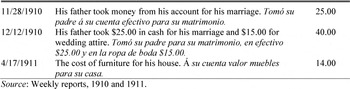
LOANS TO SECUNDINO MAY, 1910/11

Source:
Weekly reports, 1910 and 1911.
more skilled workers, or the market for new workers may have been so thin that the hacendado was forced to pay top price to recruit new local labor.
No effort to record interest on the debt was made, indicating that the hacendado, at least explicitly, was not attempting to keep workers tied to the hacienda through high interest payments. If debt were solely a binding mechanism, one would expect a high interest rate to be used to inflate the debt. A typical worker who added significant debt was Secundino May, whose marriage loans are provided in Table 1. From the civil records of births and parish records of baptisms, we know that he was born on the hacienda on July 1, 1893 and was the son of Norberto May and Damiana Chim, both residents on the hacienda. In 1906, at age 13, he opens the debt books with a balance of 13.51 pesos. In 1910 he marries María Ana Ramos, age 14, daughter of Pedro Ramos and Ysabel Llanes. Footnote 84 At this point, he takes on substantially more debt. Several months later, he takes out more debt to purchase furniture. This pattern of working on the hacienda—in May's case as a muchacho with low debt—followed by a large issuance of debt for a marriage seems to signal a commitment on both the part of the worker and the hacendado to a continuing employment relationship after an initial period on the hacienda.
These debts indicate an ongoing relationship between the hacendado and families that were longstanding residents of the hacienda. In 1914 of the 128 men listed on the hacienda's payroll, 23 had the surname May and five had the surname Ramos.Footnote 85 The debts can be seen as a “gift,” not just to the recipient, but also to the families of the bride and groom and, to a lesser extent, to everyone who attended the marriage
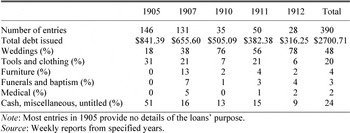
LOANS TO CONTINUING MAYAN WORKERS, 1905–1912

Note:
Most entries in 1905 provide no details of the loans' purpose.
Source:
Weekly reports from specified years.
ceremony and celebration. Underscoring the communal nature of these loans, the weekly reports indicate explicitly that May's father was granted the money for his son's wedding.
On the hacienda, the gifts from the hacendado to the group included marriage celebrations, leniency towards workers, or greater autonomy. The debts may have had a long-run impact on the morale of workers by engendering a reciprocal sense of loyalty on the part of workers or they more simply may have engendered “loyal-like” behavior. Either way, true loyalty or “loyal-like” behavior is especially important given the frequency of workers laboring without supervision. We stress that, given the social relations of the time, debt was useful in tying workers to the hacienda both prior to incurring the debt as well as after the debt was given. Prior to incurring the debt, workers would strive to show loyalty so as to be allowed to borrow. After incurring the debts, workers would display loyal or “loyal-like” behavior either out of gratitude, a sense of obligation, or as simply their best option given the poor alternatives discussed earlier.
Aggregating the debt records of hacienda Itzincab Cámara shows that loans were mostly given for location-specific cultural events, particularly weddings. The timing of large loans for a wedding had the advantage for hacendados of tying workers to a hacienda at a time when males were approaching the peak of their labor productivity. Table 2 shows the breakdown in loans by type for those years for which we have located the weekly reports. The loans only include those granted to continuing Mayan workers. The final column aggregates the loans over five years. While the percentage varied from year to year, 48 percent of the loans were granted
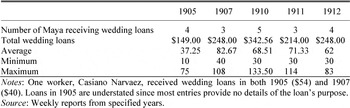
MAYAN WEDDING LOANS, 1905–1912

Notes:
One worker, Casiano Narvaez, received wedding loans in both 1905 ($54) and 1907 ($40). Loans in 1905 are understated since most entries provide no details of the loan's purpose.
Source:
Weekly reports from specified years.
directly for weddings.Footnote 86 Over time, a greater percentage of loans were devoted to funding marriages, due largely to a reduction in loans for other items. Besides the explicit loans for marriages, some entries listed as “cash” were recorded around the time of a wedding, and could be counted in that category.Footnote 87 Furthermore, the timing of furniture purchases often coincided with weddings and settledworkers on the hacienda. Therefore, the costs of marrying and establishing a household could have easily accounted for over 60 percent of the loans issued to continuing residents and in some years reached as high as 80 percent. “Bonus” gifts were largely in kind, such as gifts of clothing, furniture, grinding stones, or hoes. Finally, loans that covered emergencies such as medical expenses were important forms of insurance for Mayan workers.
Total salary paid to continuing workers totaled approximately 26,000 pesos per year from 1905–1912, making loans to workers approximately 1 to 3 percent of total salary. The decrease in the total value of loans over time may reflect an overall downturn in the market for henequen. Between 1905 and 1912, the average price of henequen fell from 15.31 to 10.41 cents per kilogram. While salaries stayed constant on the hacienda, loans to workers fell by over 60 percent. Sixty-seven workers received at least one loan during 1905, while only 19 workers received loans in 1912. Our conclusion is that in good times the hacendado could boost his status with relatively inexpensive gifts, while in tougher times, these gifts could be more easily reduced than salary.
Table 3 provides some summary statistics on the size of wedding loans over time. While recorded levels of loans for weddings varied in size, the range within a particular year was much greater than the year-to-year average variation. One explanation for higher wedding loans is higher productivity workers received more money from the hacendado at the time of his wedding. Higher productivity workers may also have been assigned to more remunerative jobs such as plataformeros. By granting more loans, the hacendado was able to keep higher productivity workers on the hacienda while at the same time solidifying the social status of these workers by financing a more expensive wedding. Debt and salary are therefore complementary mechanisms.Footnote 88
Of the 28 males whose marriage records we have located in the municipal records for the years 1895 to 1912, 21 were still working on the hacienda in 1914. All of these 21 workers incurred debt, indicating a strong link between debt and continuing employment. All workers employed in 1914 whose marriages are listed in the municipal archives incurred debt. Only three male Maya were married on the hacienda, did not receive a loan for their marriage, and did not work on the hacienda in 1914.Footnote 89 Given the strong demonstrated relationship between employment and debt, it is likely that either these three workers planned on leaving the hacienda, or the hacendado did not want to commit to these workers by offering them marriage loans.
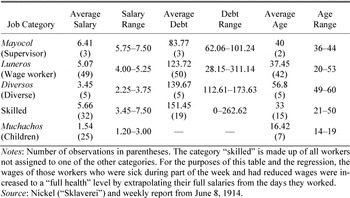
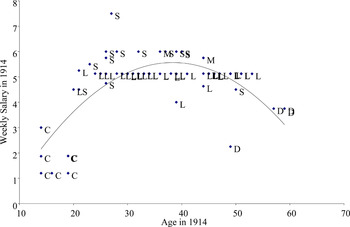
To explain the variation in the size of debts, we argue that debt was a cheaper margin to adjust than salary. Table 4 provides summary statistics on salary and debt in 1914 by class of worker.Footnote 90 Forty of the 50 workers listed as luneros performed the same jobs throughout the course of the week and earned the identical salary (5.12 or 5.13 pesos for the week). On Monday through Wednesday, they gathered firewood; on Thursday and Friday, they spun rope; and on Saturday, they gathered 2,500 henequen leaves. Only those workers who were sick or had a different job description (e.g., plataformero, aprensador, or jardinero) earned a different salary. Indeed, all workers on this hacienda were essentially salaried, with the job description determining the salary for the day. Only in rare cases did two workers assigned to the same job for the
AVERAGE SALARY, DEBT, AND AGE OF WORKERS LISTED ON JUNE 8, 1914 WEEKLY REPORT

Notes:
Number of observations in parentheses. The category “skilled” is made up of all workers not assigned to one of the other categories. For the purposes of this table and the regression, the wages of those workers who were sick during part of the week and had reduced wages were increased to a “full health” level by extrapolating their full salaries from the days they worked.
Source:
Nickel (“Sklaverei”) and weekly report from June 8, 1914.
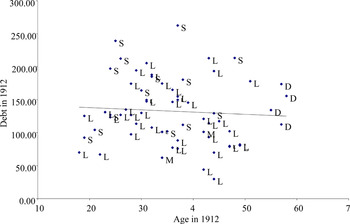
day earn different wages. If we exclude the old (diversos) and the young (muchachos), there were only two major job categories, skilled and unskilled, yet within these categories debt varied more than salary. We can visually see the relationship between age and salary in Figure 1a, which is stepwise, from the young to full adults—with differences in salary for unskilled and skilled—to the old.Footnote 91 Consistent with our observation of “debt clearing the market,” we see in Figure 1b much more variation in workers having more expensive weddings, getting more bonus gifts in kind over the course of the years, or having more unexpected medical expenses.
Generalizing too much from our research on hacienda Itzincab Cámara may be a mistake given the wide variety of reported practices on henequen haciendas. But our findings suggest patterns of salary and debt on this hacienda that were responsive in part to market forces. Salary generally tracked the marginal productivity of workers: older and younger workers, who were generally less productive, earned lower salaries. But most adult workers earned a salary within a very narrow range. Keeping salary relatively constant and allowing debt to clear the market helped the hacendado cast himself in the role of benevolent patron and engendered loyalty and high work effort in reciprocity. Rather than indicating, as Turner suggests, that, “The amount of the debt does not matter, so long as it is debt,” our evidence suggests that the timing and reasons for debt were carefully considered and played important roles in motivating and retaining the workforce.Footnote 92
AGE AND SALARY IN 1914

AGE AND DEBT IN 1912*

CONCLUSION
A great deal of the historiography on Yucatecan henequen haciendas suggests that debt served mainly to coercively bind workers to the haciendas and hacendados. While debt was certainly used as one of several powerful mechanisms to keep workers on the haciendas, our case study indicates that debt was granted in a systematic manner, consistent with a “paternalistic” system of labor relations. We view debt as part of a larger package of paternalism used on the henequen haciendas, which included small pensions, communal land for planting, money for health expenses, and credit at the hacienda store. While we do not argue that this paternalism always—or even often—resulted in loyalty on the part of the Mayan workers, we argue that debt helped solidify “loyal-like” behavior and some degree of reciprocity, particularly on haciendas like Itzincab Cámara, where hacendados were not known to be overly oppressive.
Our view of how debt functioned on the haciendas differs from much of the historiography of the region that suggests a much weaker form of paternalism. Wells and Joseph, for example, argue that paternalism “did not ever foster strong bonds of attachment let alone cultural understanding between the acculturated Maya and their masters.”Footnote 93 While we do not have evidence of strong bonds of attachment or deep cultural understanding between servants and hacendados, it is striking that the majority of loans given to Mayan servants were for wedding ceremonies and fiestas and for settling workers on the hacienda. We argue that these weddings and fiestas were communal affairs and cemented some bond between hacendados and workers within the context of a shared set of Catholic beliefs. We argue further that the institutional context, while not determinative, played a key role in shaping the logic of contractual choices made by actors. In an institutional context in which Mayan peasants had few political rights, had lost access to communal lands, and faced inauspicious ecological conditions, tying oneself to a hacienda, for many Maya, was the best of a limited set of options.
In order to understand the logic of contractual choice, we argue that cultural and institutional norms are an inextricable part of the “economic” logic shaping labor contracts. To be sure, debt was not determined by cultural norms and institutional context. As we have shown, debt was used to bind workers to a hacienda at a young age, to reward more productive workers for their past efforts, and to cover unforeseen expenses. These three functions of debt served to attract, motivate, and ensure the continued loyalty of Mayan peons. A focus only on the “economic” logic of debt, however, would obscure the instrumental role played by culture and institutions in making sense of the unique labor contracts on henequen haciendas in Porfirian Yucatán.