Introduction
Modern taxonomic practices in helminths combine morphological data and DNA sequences, allowing the establishment of a link between larval and adult stages in different host species in an ecosystem. Recent studies on diplostomid trematodes illustrate the usefulness of such approaches, with the internal transcribed spacers (ITS) of ribosomal DNA and the mitochondrial gene cytochrome c oxidase subunit I (cox1) as the most popular molecular markers used for the identification and delimitation of species in these trematodes (Chibwana et al., Reference Chibwana, Blasco-Costa, Georgieva, Hosea, Nkwengulila, Scholz and Kostadinova2013, Reference Chibwana, Nkwengulila, Locke, McLughlin and Marcogliese2015; Georgieva et al., Reference Georgieva, Soldánová, Pérez-del-Olmo, Dangel, Sitko, Sures and Kostadinova2013; Blasco-Costa et al., Reference Blasco-Costa, Faltynková, Goergieva, Skirnisson, Scholz and Kostadinova2014; García-Varela et al., Reference García-Varela, Sereno-Uribe, Pinacho-Pinacho, Domínguez-Domínguez and Pérez-Ponce de León2015; Selbach et al., Reference Selbach, Soldánová, Georgieva, Kostadinova and Sures2015). Further, the development of diplostomid-specific primers flanking the barcode region (cox1), allowed the construction of a large barcode library of diplostomids that includes populations and species from different regions around the world (Moszczynska et al., Reference Moszczynska, Locke, McLaughlin, Marcogliese and Crease2009; Locke et al., Reference Locke, McLaughlin and Marcogliese2010).
The genus Tylodelphys Diesing, 1950 contains species whose adults are found parasitizing the intestine of fish-eating birds, such as ciconiids, anhingids and podicipedids, distributed worldwide (King & Van As, Reference King and Van As1997; Lunaschi & Drago, Reference Lunaschi and Drago2004). Members of Tylodelphys, like other diplostomids, exhibit a three-host life cycle, involving a freshwater snail as the first intermediate host. The metacercaria is found free in the eyes, cranial cavity and body cavity of fish that act as second intermediate hosts (King & Van As, Reference King and Van As1997; Muzall & Kilroy, Reference Muzall and Kilroy2007; Chibwana et al., Reference Chibwana, Nkwengulila, Locke, McLughlin and Marcogliese2015; Otachi et al., Reference Otachi, Locke, Jirsa, Fellner-Frank and Marcogliese2015). Tylodelphys can be distinguished from other genera of Diplostomatidae Poirier, 1866 because they possess a conical hindbody, a tribocytic organ far from the intestinal bifurcation, testes relatively large and anterior testis symmetrical (Niewiadomska, Reference Niewiadomska, Gibson, Jones and Bray2002). The genus currently contains 16 species (Lunaschi & Drago, Reference Lunaschi and Drago2004; Drago & Lunaschi, Reference Drago and Lunaschi2008; Otachi et al., Reference Otachi, Locke, Jirsa, Fellner-Frank and Marcogliese2015). In the Americas only four species have been described from adult specimens: T. americana (Dubois, 1936) Dubois, 1937; T. elongata (Lutz, 1928) Dubois, 1937; T. adulta Lunaschi & Drago, Reference Lunaschi and Drago2004 and T. brevis Drago & Lunaschi Reference Drago and Lunaschi2008 (Dubois, Reference Dubois1970; Lunaschi & Drago, Reference Lunaschi and Drago2004; Drago & Lunaschi, Reference Drago and Lunaschi2008).
The species T. americana has been recorded from central Mexico, from the intestine of podicipedids, Podilymbus podiceps (pied-billed grebe) Linnaeus 1758, in San Pedro Tlaltizapán, Estado de México (León-Règagnón, Reference León-Règagnón1992), and from P. podiceps and Aechmophorus occidentalis Lawrence, 1858 from Lago Tecocomulco, Hidalgo (Andrade-Rosales, Reference Andrade-Rosales2012). Additionally, the metacercariae of Tylodelphys sp. have been recorded in at least 27 localities from five states across central and northern Mexico, parasitizing 20 species of endemic freshwater fishes, belonging to three families (Goodeidae, Atherinopsidae and Cyprinidae), although they seem to infect goodeids preferentially, since 11 of the 20 species (55%) belong to this family (see Lira-Guerrero et al., Reference Lira-Guerrero, García-Prieto and Pérez-Ponce de León2008; Monks et al., Reference Monks, Pulido-Flores, Bautista-Hernández, Alemán-García, Falcón-Ordaz and Gaytán Oyarzún2013; Martínez-Aquino et al., Reference Martínez-Aquino, Mendoza-Palmero, Aguilar Aguilar and Pérez-Ponce de León2014).
As a part of a research programme designed to compile an inventory of the helminth fauna of birds and fishes in central and northern Mexico, we collected adult specimens of a species of Tylodelphys from the intestine of pied-billed grebes, and metacercariae were collected from five fish species belonging to the family Goodeidae and one belonging to the Cyprinidae, in eight localities across central Mexico and one in northern Mexico. Specimens were sequenced for two molecular markers, with the aim of establishing a link between both developmental stages of the life cycle of this diplostomid. Also, sequences were compared with those available in GenBank for other congeneric species; additionally, adults were morphologically compared with species distributed in the Americas. Data derived from morphology and DNA sequences showed the existence of a new species of Tylodelphys. The new species is described herein.
Materials and methods
Specimen collection
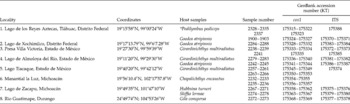
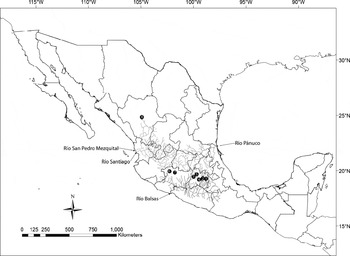
A total of seven birds were collected between June 2012 and September 2014 in Lago de los Reyes Aztecas in Tlahuac in southern Mexico City (table 1, fig. 1). Birds were captured with a shotgun under the collecting permit FAUT 0202 issued by the Mexican government through the Secretaría de Medio Ambiente y Recursos Naturales (SEMARNAT) to M.G.V. Fish were captured with seine nets, minnow traps and electro-fished in eight localities of central and northern Mexico (table 1, fig. 1). Birds were kept on ice, and their intestines examined within 2 h after capture, whereas fish were maintained alive and transported to the laboratory. Individual fish were killed by pithing and examined immediately. Collected digeneans were preserved either in 100% ethanol, for DNA extraction, or in hot (steaming) 4% formalin, for morphology. Avian definitive hosts were identified using the field guides of Howell & Webb (Reference Howell and Webb1995) and the American Ornithologists' Union (1998). Fish were identified following Miller et al. (Reference Miller, Minckley and Norris2005).
GenBank accession numbers from mainly metacercarial stages, host species, locality and geographical locations. The locality numbers correspond to the numbers in fig. 1.

*Adult worms recovered from the definitive host.
Sampling sites (see table 1) of avian and fish hosts infected with Tylodelphys aztecae n. sp., from central and northern Mexico.

Morphological and molecular analyses
Unflattened specimens preserved in formalin were stained with Mayer's paracarmine, dehydrated in a graded ethanol series, cleared with methyl salicylate, and mounted on microscope slides in Canada balsam. Drawings were made with the aid of a drawing tube. Measurements are given in micrometres (μm), with range followed by mean in parentheses. Specimens were deposited in the Colección Nacional de Helmintos (CNHE), Instituto de Biología, Universidad Nacional Autónoma de México, Mexico City. The species identification was conducted following the key of Dubois (Reference Dubois1970), and original descriptions (see Lunaschi & Drago, Reference Lunaschi and Drago2004; Drago & Lunaschi, Reference Drago and Lunaschi2008). Additionally, specimens identified as T. americana deposited in the CNHE under numbers 1504 and 6856 were compared with our specimens. Some individuals collected in this study were preserved in 4% formalin and dehydrated through a graded series of ethyl alcohol and then critical point dried with carbon dioxide. The specimens were mounted on metal stubs with silver paste, coated with gold and examined in a Hitachi Stereoscan Model SU1510 at 10 kV to obtain micrographs of the body surface.
Forty-six metacercariae and nine adult specimens were placed individually in tubes and digested overnight at 56°C in a solution containing 10 mm Tris-HCl (pH 7.6), 20 mm NaCl, 100 mm Na2EDTA (pH 8.0), 1% Sarkosyl and 0.1 mg/ml proteinase K. Following digestion, DNA was extracted from the supernatant using the DNAzol reagent (Molecular Research Center, Cincinnati, Ohio, USA) according to the manufacturer's instructions. The cytochrome oxidase subunit 1 (cox1) of the mitochondrial DNA was amplified using the polymerase chain reaction (PCR) with the forward primer Plant-diploCOXF, 5′-CGTTTRAATTATACGGATCC-3′, and the reverse primer Plant-diploCOXR, 5′-AGCATAGTAATMGCAGCAGC-3′ (Moszczynska et al., Reference Moszczynska, Locke, McLaughlin, Marcogliese and Crease2009). The ITS region was amplified using the forward primer BD1 5′-GTCGTAACAAGGTTTCCGTA-3′ and the reverse primer BD2 5′-ATCTAGACCGGACTAGGCTGTG-3′ (Bowles & McManus, Reference Bowles and McManus1993). PCR reactions (25 μl) consisted of 10 μm of each primer, 2.5 μl of 10 × buffer, 2 mm MgCl2, 0.5 μl of deoxynucleoside triphosphates (dNTPs) (10 mm) and 1 U of Taq DNA polymerase (Platinum Taq, Invitrogen Corporation, São Paulo, Brazil). PCR cycling conditions for both molecular markers included a step of denaturation at 94°C for 5 min; followed by 35 cycles of 94°C for 1 min, annealing at 50°C for 1 min, and extension at 72°C for 1 min; followed by a post-amplification incubation at 72°C for 10 min. Sequencing reactions were performed using ABI Big Dye (Applied Biosystems, Boston, Massachusetts, USA) terminator sequencing chemistry, and reaction products were separated and detected using an ABI 3730 capillary DNA sequencer. Contigs were assembled and base-calling differences resolved using Codoncode Aligner version 5.0.2 (Codoncode Corporation, Dedham, Massachusetts, USA). Sequences were deposited in GenBank (table 1). ITS and cox1 sequences obtained in the current research were aligned with sequences of the genera of diplostomids downloaded from GenBank – Posthodiplostomum Dubois 1936, Ornithodiplostomum Dubois 1936, Diplostomum von Nordmann 1832 and Tylodelphys. In addition, sequences of the strigeids Cardiocephaloides Sudarikov 1959, Australapatemom burti Miller 1923, Parastrigea diovadena Dubois and Macko, 1972, Apharyngostrigea cornu Ciurea 1927 and Ichthyocotylurus, Odening 1969 were used as an outgroup, since this family is considered to be the sister group of Diplostomidae (see Olson et al., Reference Olson, Cribb, Tkach, Bray and Littlewood2003). Sequences were aligned using the software Clustal W (Thompson et al., Reference Thompson, Gibson, Plewniak and Jeanmougin1997). Maximum likelihood (ML) and Bayesian inference analyses (BI) were performed for each dataset. The ML tree was inferred using RAxML 7.0.4. (Stamatakis, Reference Stamatakis2006). Modeltest program version 3.0 (Posada & Crandall, Reference Posada and Crandall1988) was used for inferring the best model of nucleotide substitution. For both alignments the best model selected was GTR+G+I. Tree searches were performed using 1000 (ML) random taxon addition heuristic searches. Clade support was assessed by bootstrap resampling with 10,000 replicates. Bayesian analyses were performed with MrBayes version 3.1.2 (Huelsenbeck & Ronquist, Reference Huelsenbeck and Ronquist2001). Settings were two simultaneous runs of the Markov chain (MCMC) for 10 million generations, sampling every 1000 generations, a heating parameter value of 0.2 and a ‘burn-in’ of 25%. Trees were drawn using FigTree version 1.3.1 (Rambaut, Reference Rambaut2006). The genetic divergence among taxa was estimated using uncorrected ‘p’ distances with the program MEGA version 6 (Tamura et al., Reference Tamura, Stecher, Peterson, Filipski and Kumar2013).
Results
Description of Tylodelphys aztecae n. sp.
Morphological description: adults
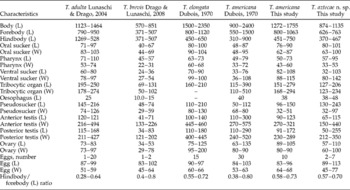
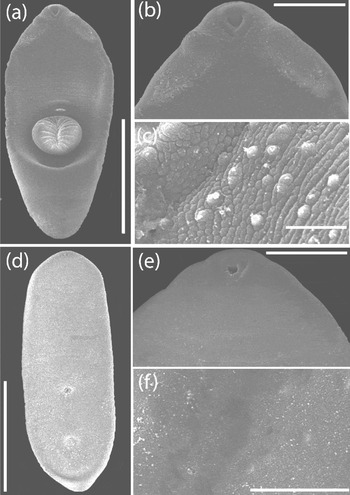
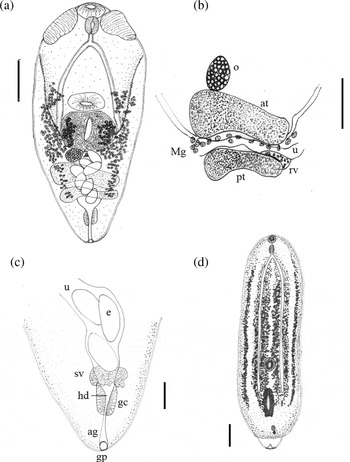
Description (table 2) was based on ten adult specimens. Body linguiform. Forebody slightly spatulate, bearing scattered papillae on the ventral surface of tegument (fig. 2a, c). Total length 874–1135 (1080). Oral sucker relatively small, fairly muscular, terminal, longer than wide, 80–101 (89) long by 63–100 (78) wide; two well-developed pseudosuckers on each side of oral sucker, 130–243 (172) long, 32–97 (57) wide (figs 2b, 3a). Ventral sucker oval, fairly muscular, wider than long, 80–142 (115) wide by 32–103 (64) long. Tribocytic organ, oval, 127–206 (175) long by 123–234 (181) wide. Prepharynx absent; relatively large pharynx, oval, 57–95 (74) long, 33–53 (40) wide; oesophagus long 32–48 (42); two blind intestinal caeca, extending to the tribocytic organ. Testes in tandem, extending transversally, occupying almost all the width of hindbody; anterior testis 65–115 (90) long by 150–440 (295) wide; posterior testis 50–255 (155) long by 212–350 (280) wide. Ovary pretesticular, spherical 57–110 (71) by 60–100 (75), contiguous with anterior testis. Mehlis' gland lateral anterior testis. Vitelline follicles surround tribocytic organ extending to hindbody. Uterus extending from the ovario-testicular area posteriorly to the genital pore opening at the end of hindbody (fig. 3b, c). Eggs 89–113 (105) long by 45–77 (54) wide.
Comparative morphometrics (in μm) of adult worms of Tylodelphys aztecae n. sp., with congeneric species from the Americas.

L, Length; W, width.
Scanning electron micrographs of Tylodelphys aztecae n. sp. (a–c) Adult: (a) entire specimen from Podilymbus podiceps from Lago de los Reyes Aztecas Tlahuac, Mexico City; (b) anterior region showing pseudosuckers; (c) tegument of the ventral surface of forebody showing papillae. (d–f) Metacercariae from Goodea atripinnis: (d) entire specimen; (e) anterior region; (f) tegument. Scale bars: (a) 400 μm; (b, e) 100 μm; (c) 10 μm; (d) 500 μm; (f) 20 μm.

Tylodelphys aztecae n. sp. (holotype) from Podilymbus podiceps from Lago de los Reyes Aztecas Tlahuac, Mexico City. (a–c) Adult: (a) entire specimen; (b) enlarged dorsal view of proximal female genitalia; (c) enlarged lateral view of terminal genitalia. (d) Metacercaria from body cavity of Goodea atripinnis from from Lago de los Reyes Aztecas Tlahuac, Mexico City. Abbreviations: ag, genital atrium; at, anterior testis; e, egg; gc, genital cone; gp, genital pore; hd, hermaphroditic duct; Mg, Mehlis'gland; o, ovary; pt, posterior testis; rv, vitelline reservoir; sv, seminal vesicle; u, uterus. Scale bars: (a, d) 200 μm; (b) 100 μm; (c) 50 μm.

Taxonomic summary: adults
-
Type host. Podilymbus podiceps (Linnaeus, 1758) (pied-billed grebe), Podicipedidae.
-
Site of infection. Intestine.
-
Type locality. Lago de los Reyes Aztecas Tlahuac, Mexico City (19°15′58″N, 99°00′24″W).
-
Type material. Holotype CNHE: 9777; paratypes CNHE: 9778.
-
Etymology. The specific epithet refers to both the Azteca, a Mesoamerican civilization that dominated central Mexico during the early 13th century and founded Tenochtitlan (where currently Mexico City is settled), and the locality where the adults were found, Lago de los Reyes Aztecas, an area used for recreation by the Aztec emperors.
Morphological description: metacercariae
The metacercariae of the new species are commonly found free and active in the body cavity of their second intermediate host. The following characterization is based on 30 specimens obtained from Goodea atripinnis from the Lago de los Reyes Aztecas, Tlahuac, Mexico City (figs 2d and 3d). Body linguiform, 940–1530 (1231) long by 290–590 (444) wide. Entire body containing calcareous corpuscles forming at least six rows along body. Hindbody reduced to a small conical prominence. Papillae absent on the surface of tegument (fig. 2f). Lateral pseudosuckers lacking (fig. 2d, e). Oral sucker small, terminal, almost rounded, 40–80 (55) long by 30–72 (45) wide (fig. 2e). Ventral sucker small, fairly muscular 45–157 (83) long by 37–90 (64) wide. Prepharynx very small; oval pharynx 22–60 (32) long by 12–22 (17) wide; intestinal caeca long, extending posteriorly to level of anterior border of tribocytic organ; tribocytic organ 170–245 (207) long by 67–140 (88) wide. Reproductive system poorly developed (fig. 3d).
-
Taxonomic summary: metacercariae
-
Type host. Goodea atripinnis Jordan, 1880, Goodeidae.
-
Site of infection. Body cavity.
-
Type locality. Lago de los Reyes Aztecas Tlahuac, Mexico City (19°15′58″N, 99°00′24″W).
-
Voucher material. CNHE: 9779.
Remarks
The new species belongs to Tylodephys because it possesses an indistinctly bipartite body, well-developed pseudosuckers, non-trilobate anterior extremity and a copulatory bursa enclosing a small genital cone with a hermaphroditic duct opening terminally (see Drago & Lunaschi, Reference Drago and Lunaschi2008). Only 11 species of the genus Tylodelphys have been reported from the Americas, four as adults and seven as metacercariae (Tylodelphys destructor Szidat et Nani, 1951; T. barilochensis Quaggiotto et Valverde 1992; T. crubensis Quaggiotto et Valverde 1992; T. argentinus Quaggiotto et Valverde 1992; T. jenynsiae Szidat 1969; T. cardiophilus Szidat 1969 and T. scheuringi Hughes Reference Hughes1929) (Hughes, Reference Hughes1929; Lunaschi & Drago, Reference Lunaschi and Drago2004; Muzzal & Kilroy, 2007; Drago & Lunaschi, Reference Drago and Lunaschi2008). Considering that no adults have been described for those species, we decided to consider these seven species as incertae sedis. The other four species are T. adulta, a parasite of the great grebe (Podiceps major Boddaert 1783) from Argentina; T. brevis, a parasite of the wood stork (Mycteria americana Linnaeus 1758) from Argentina; T. elongata, a parasite of the least grebe (Podiceps dominicus Linnaeus 1766) from Cuba, Venezuela and Brazil; and T. americana a parasite of the wood stork (M. americana) and pied-billed grebe (Podilymbus podiceps) from Brazil, Venezuela and Mexico. Tylodelphys aztecae n. sp. can be differentiated from three of the other species from the Americas (T. brevis, T. elongata and T. americana) by having a spatulate and slightly concave forebody, with a larger ventral sucker and two larger pseudosuckers, and by having a small number of eggs (2–7) in the uterus. However, T. aztecae n. sp. resembles T. adulta morphologically, in the body shape and the tribocytic organ size, but the new species differs from T. adulta in the distribution of the vitelline follicles, in the size of the pseudosuckers and in the number and size of the eggs (table 2).
Molecular characterization and phylogenetic analyses
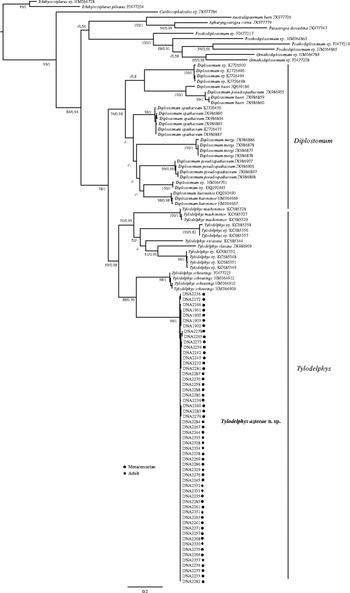
In this study, sequences of the cox1 of 55 individuals of T. aztecae n. sp. (9 adults and 46 metacercariae) from central and northern Mexico (table 1, fig. 1) were aligned with a cox1 dataset containing sequences of the genera of diplostomids Posthodiplostomum, Ornithodiplostomum, Diplostomum and Tylodelphys; and strigeids Cardiocephaloides, Australapatemon, Parastrigea and Ichthyocotylurus used as the outgroup. The alignment consisted of 110 sequences with 466 nucleotides. The genetic divergence among the genera of Diplostomatidae Posthodiplostomum, Ornithodiplostomum, Diplostomum and Tylodelphys ranged from 11 to 23%, and among the species of Diplostomum (D. pseudospathaceum Niewiadomska 1984, D. baeri Dubois 1937, D. mergi Dubois 1932, D. huronense La Rue 1927, Diplostomum sp. and D. spathaceum Rudolphi 1819) from 10 to 15%. Among species of Tylodelphys (T. mashonense Beverley-Burton 1963, T. scheuringi Hughes Reference Hughes1929 , T. clavata von Nordmann 1832, T. excavata Rudolphi 1803 and T. aztecae n. sp.) genetic divergence varied from 12 to 15%, whereas the genetic divergence among the 54 isolates of T. aztecae n. sp. was very low and ranged from 0 to 1%.
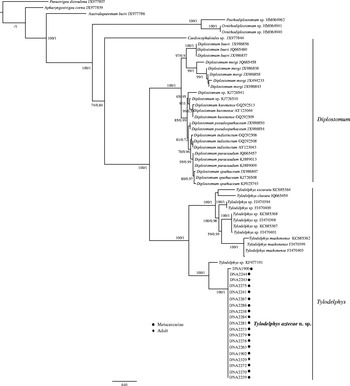
The ITS sequences of T. aztecae n. sp. (1 adult and 18 metacercariae) were aligned with the same genera of Diplostomatidae for which sequences are available, i.e. Posthodiplostomum, Ornithodiplostomum, Tylodelphys and Diplostomum, and sequences from other genera of strigeids available in GenBank, i.e. Parastrigea, Apharyngostrigea, Australapatemon and Cardiocephaloides, which were also used as outgroups. The alignment consisted of 63 sequences with 1151 nucleotides. The genetic divergence among the genera Posthodiplostomum, Ornithodiplostomum, Diplostomum and Tylodelphys ranged from 14 to 18%, and among species of Diplostomum (D. baeri, D. mergi, D. huronense, D. pseudospathaceum, D. spathaceum, Diplostomum sp., D. indistinctum and D. paracaudatum) from 2 to 3.5%. Meanwhile, among species of Tylodelphys (T. clavata, T. excavata T. mashonense, Tylodelphys sp. and T. aztecae n. sp.) divergence values varied from 3 to 11%, whereas the genetic divergence among the 19 isolates of the new species was very low, from 0 to 0.3 %.
Maximum likelihood (ML) analysis inferred with cox1 and ITS datasets each yielded a single tree that was very similar in topology to the Bayesian inference (BI) consensus tree (figs 4 and 5). The ML and Bayesian consensus trees inferred with cox1 (fig. 4) and ITS (fig. 5), showed that all the sequences of T. aztecae n. sp. are nested together within a monophyletic clade, with strong bootstrap support and Bayesian posterior probability values (99/1.0 with cox1 and 100/1.0 with ITS). The cox1 tree shows the new species as the sister taxon to T. scheuringi, for which sequences of the metacercariae are available, and although no information on the morphology of the adults has been published thus far, both species are distributed in the Nearctic biogeographical region. On the other hand, in the ITS tree the new species appears as the sister taxon of an unidentified metacercaria of Tylodephys sp. collected from western Siberia (GenBank number KF477191). Unfortunately, no sequences of ITS are available for T. scheuringi, and no cox1 sequences are available for the species from Siberia.
Maximum likelihood tree and consensus Bayesian inference trees inferred with cox1 datasets; numbers near internal nodes show ML bootstrap clade frequencies and posterior probabilities (BI).

Maximum likelihood tree and consensus Bayesian inference trees inferred with ITS1, 5.8S and ITS2 datasets; numbers near internal nodes show ML bootstrap clade frequencies and posterior probabilities (BI).

Discussion
The phylogenetic trees obtained in this study show that both Diplostomum and Tylodelphys are monophyletic, with a relationship strongly supported by bootstrap and posterior probability values. Trees inferred with both molecular markers placed the metacercariae found in the body cavity of goodeids and cyprinids from central and northern Mexico, and the adults from the intestine of the pied-billed grebe in a single clade, confirming that both stages of the life cycle are conspecific. The genetic divergence estimated among 55 individuals of T. aztecae n. sp. (9 adults and 46 metacercariae) with the cox1 dataset was very low, ranging between 0 and 1.0%. These low values of genetic divergence are similar to those found at the intraspecific level in other diplostomatid species. For instance, the genetic divergence among isolates of Tylodelphys sp., T. mashonense, T. excavata and T scheuringi ranged from 0 to 1.4%, and among isolates of Diplostomum mergi, D. pseudospathaceum and D. baeri divergence ranged from 0 to 1.01% (Chibwana et al., Reference Chibwana, Blasco-Costa, Georgieva, Hosea, Nkwengulila, Scholz and Kostadinova2013, Reference Chibwana, Nkwengulila, Locke, McLughlin and Marcogliese2015; Georgieva et al., Reference Georgieva, Soldánová, Pérez-del-Olmo, Dangel, Sitko, Sures and Kostadinova2013; Otachi et al., Reference Otachi, Locke, Jirsa, Fellner-Frank and Marcogliese2015; Selback et al., Reference Selbach, Soldánová, Georgieva, Kostadinova and Sures2015). With respect to ITS1, 5.8S and ITS2, the genetic divergence estimated among the 19 isolates of T. aztecae n. sp. (1 adult and 18 metacercariae), was also very low (0–0.3%). These ranges of genetic divergence are also similar to those previously described for congeneric diplostomatids, e.g. Tylodelphys sp. and T. mashonense showed a divergence between 0 and 1.4% (Chibwana et al., Reference Chibwana, Blasco-Costa, Georgieva, Hosea, Nkwengulila, Scholz and Kostadinova2013, Reference Chibwana, Nkwengulila, Locke, McLughlin and Marcogliese2015), and among isolates of D. baeri the divergence ranged from 0 to 0.4% (Blasco-Costa et al., Reference Blasco-Costa, Faltynková, Goergieva, Skirnisson, Scholz and Kostadinova2014).
Currently, Tylodelphys contains 16 described species, which are distributed worldwide. Seven of these species were described solely from metacercariae from the Americas (T. destructor, T. barilochensis, T. crubensis, T. argentinus T. jenynsiae, T. cardiophilus and T. scheuringi) and no adults were included in their descriptions (Hughes, Reference Hughes1929; Drago & Lunaschi, Reference Drago and Lunaschi2008). The four species of Tylodelphys adults distributed in the Americas apparently show some level of host specificity. Two species, T. brevis and T. americana, are parasites of ciconiid and podicipedid birds from Argentina, Brazil, Venezuela and Mexico (León-Règagnón, Reference León-Règagnón1992; Drago & Lunaschi, Reference Drago and Lunaschi2008; Andrade-Rosales, Reference Andrade-Rosales2012), whereas T. elongata, T. adulta and T. aztecae n. sp. are only found in podicipedids. The distribution pattern of these species shows that three species occur in the Neotropical region (T. adulta and T. brevis in Argentina, and T. elongata in Cuba, Venezuela and Brazil), one species in the Nearctic region (T. aztecae n. sp.), and apparently one species possesses a larger distribution range (T. americana) since it has been recorded in both biogeographical regions (Brazil, Venezuela and Mexico). The other species distributed in the Americas, T. scheuringi, was described from metacercariae from freshwater fishes in North America (Hughes, Reference Hughes1929), and no adults have been obtained to establish a proper species description. Apparently, the metacercariae exhibit very low host specificity, since they have been recorded in more than 20 species of freshwater fishes allocated to 14 families (Margolis & Arthur, Reference Margolis and Arthur1979; McDonald & Margolis, Reference McDonald and Margolis1995; Gibson, Reference Gibson, Margolis and Kabata1996; Hoffman, Reference Hoffman1999). Interestingly, the cox1 tree shows that T. scheuringi is the sister species of T. aztecae n. sp. and, considering that the current distribution of the new species extends from central to some areas of northern Mexico, it is plausible to postulate that their relationship is due to the fact that both inhabit birds in the Nearctic biogeographical region. More thorough sampling is required in areas of northern Mexico (where the Nearctic freshwater fish component is very abundant; Miller et al., Reference Miller, Minckley and Norris2005) to corroborate the possibility that T. scheuringi is also found in Mexico.
The taxonomy of metacercariae of diplostomid species found unencysted in the brain and body cavity of freshwater fishes in Mexico has been controversial, since these larval forms have been indistinctly classified either as Tylodelphys sp. or Diplostomum sp. (Monks et al., Reference Monks, Zárate-Ramírez and Pulido-Flores2005; Pérez-Ponce de León et al., Reference Pérez Ponce de León, García Prieto and Mendoza Garfías2007; Lira-Guerrero et al., Reference Lira-Guerrero, García-Prieto and Pérez-Ponce de León2008; Martínez-Aquino et al., Reference Martínez-Aquino, Mendoza-Palmero, Aguilar Aguilar and Pérez-Ponce de León2014) and have been found in species allocated to unrelated families such as Cichlidae, Characidae, Heptapteridae, Goodeidae, Atherinopsidae, Poeciliidae and Cyprinidae. Both species conform with the description of a diplostomulum-like larva, and both have a linguiform body, with a hindbody reduced to a small conical prominence, and possess lateral pseudosuckers on the anterior end of forebody (Hoffman, Reference Hoffman1999). Interestingly, we discovered that the metacercariae of the new species possess poorly developed, or actually indistinguishable, pseudosuckers; even at the ultrastructural level, no evidence of the structures was found (fig. 2e), which contrasts with their evident presence in the adults (fig. 2b). We looked at all the metacercariae of Diplostomum sp. and Tylodelphys sp. deposited at the Colección Nacional de Helmintos (CNHE) and confirmed that the development of this structure is variable in the larval forms. Our findings clearly indicate that the taxonomic status of the diplostomulum-like larvae found in freshwater fishes of Mexico needs to be re-evaluated by using a combination of morphological and molecular data, shedding light on the life cycle of these species by linking the metacercariae with the adults found in aquatic birds, which require more intensive sampling to obtain adults, with the potential for discovery of a hidden diversity of this group of trematodes.
Acknowledgements
We thank Luis García Prieto for providing specimens deposited at the CNHE. We thank Berenit Mendoza Garfias for her help obtaining the scanning electron microphotographs.
Financial support
This research was supported by grants from the Programa de Apoyo a Proyectos de Investigación e Inovación Tecnológica (PAPIIT-UNAM) IN207213 and IN219904 to M.G.V. and G.P.P.L., respectively, and the Consejo Nacional de Ciencia y Tecnología (CONACYT) 179048. C.D.P.P. thanks the support of the Programa de Posgrado en Ciencias Biológicas, UNAM and CONACYT for granting a scholarship to complete his PhD studies.
Conflict of interest
None.
Ethical standards
Specimens were collected under the Cartilla Nacional de Colector Científico (FAUT 0202 and 0057) issued by the Secretaría del Medio Ambiente y Recursos Naturales (SEMARNAT), to M.G.V. and G.P.P.L., respectively.