The role of explicit information (EI)—providing learners with information on a target structure—as an independent variable in instructed SLA is largely underresearched (VanPatten, Reference VanPatten, VanPatten and Williams2007b) and has sometimes been conflated with the issue of explicit versus implicit learning (see, e.g., DeKeyser, Reference DeKeyser, Doughty and Long2003; Hulstijn, Reference Hulstijn2005). For example, in Scott’s (Reference Scott1989) study, learners of second language (L2) French were taught relative pronouns and the subjunctive under one of two conditions: (a) explicit rules plus form-focused practice and (b) input passages (short stories) read by the instructor with no rules provided. The results of Scott’s study suggest a slight advantage to the rules group; however, it is unclear whether this is due to the presence or absence of explicitly taught rules because the treatments themselves were different. The results could be due to the superiority of the form-focused practice in the rule group, not to the rules themselves; however, it is unclear because only the form-focused group received rules. If we are to understand the effects of EI in and of itself (and, to be fair, this was not Scott’s purpose), type of treatment should be held constant while EI is either present or absent.
Alenan (Reference Alenan and Schmidt1995), for example, compared four L2 groups on the acquisition of locative suffixes in Finnish using text enhancement: (a) passages with the locative highlighted and EI provided prior to reading, (b) passages with the locative highlighted but no EI provided, (c) passages with no highlighting but EI prior to reading, and (d) passages with no highlighting and no EI. Robinson’s (Reference Robinson and Schmidt1995) design included exposure to sentences on a computer screen with (a) EI prior to exposure, (b) no EI but instructions to search for a rule, (c) no EI with follow-up questions that directed learners to the location of particular words, and (d) no EI with follow-up content questions about each sentence. In both studies, some benefit was observed for the groups that received EI.
VanPatten and Oikkenon (Reference VanPatten and Oikkenon1996) was the first published study that attempted to isolate EI as a variable within instructed SLA. The foundational study for processing instruction (PI)—VanPatten and Cadierno (Reference VanPatten and Cadierno1993)—served as the point of departure for the VanPatten and Oikkenon study. In VanPatten and Cadierno’s study, the authors sought to compare two distinct ways of conceptualizing a focus on grammar instruction. The first, which they called traditional instruction (TI), involves explanation plus a particular kind of output practice widespread at the time in foreign language circles in the United States: the movement from mechanical to meaningful to communicative drills or exercises (see Paulston, Reference Paulston, Allen and Campbell1972). The second way of conceptualizing a focus on grammar instruction, now called PI, involves explanation plus a particular kind of input-oriented treatment designed to push learners away from less-than-optimal input-processing strategies. The idea behind PI was that, if incorrect or less-than-optimal processing strategies could be identified, learners could be taught to process input better. In VanPatten’s model of input processing (e.g., VanPatten, Reference VanPatten1996, Reference VanPatten and VanPatten2004, Reference VanPatten, VanPatten and Williams2007a), a series of principles are claimed to guide or constrain how learners get data from the input to which they are exposed. Of relevance here is the first noun principle (FNP), which states that learners tend to process the first noun or pronoun they encounter in a sentence as the subject or agent of the sentence.Footnote 1 For subject (S)- verb (V)- object (O) sentences, this is not a problem. However, because Spanish (the focus of VanPatten & Cadierno’s work) is not strictly SVO—OV and OVS are frequent word orders—the FNP can cause problems. For example, gustar “to please”-like structures are misinterpreted as are any object pronoun-first constructions. In these constructions, word order has been grammaticalized as indirect OVS as in A Juan le gusta María, literally “To John is pleasing Mary,” and learners tend to misinterpret Juan as the subject. In the same vein, learners misinterpret simple OVS sentences in which the object is a clitic direct object, such as Lo ve María, literally “Him sees Mary.” In this case, learners misinterpret the clitic pronoun as a subject and equate lo with “he.” This interpretation leads to problems in the acquisition of the Spanish pronoun system and to a processing system with a rather strict reliance on word order as the principal means to comprehend sentences.
Within PI, the problem is tackled by providing activities that manipulate input such that learners are forced to abandon a reliance on the FNP (e.g., Farley, Reference Farley2005; Lee & VanPatten, Reference Lee and VanPatten1995, Reference Lee and VanPatten2003; VanPatten, Reference VanPatten1993; VanPatten & Cadierno, Reference VanPatten and Cadierno1993; Wong, Reference Wong and VanPatten2004a, Reference Wong2005). Referential activities within PI usually begin a string of activities and are structured so as to have right or wrong answers. For example, learners hear a mixture of SVO, OVS, and OV sentences in which both the subject and object are capable of performing the action (e.g., a boy looking for a girl or a girl looking for a boy). They are asked to select between two pictures in order to indicate that they have correctly processed and comprehended the sentence. Such activities are designed to force the learners’ internal processors to abandon a strict reliance on the FNP. Affective activities follow referential activities and do not have right or wrong answers but instead allow learners to offer opinions, indicate something about themselves, and so on. For example, learners might see a list of OV sentences that may or may not indicate how they feel about a female relative (e.g., la respeto “I respect her,” la admiro “I admire her,” la detesto “I hate her,” la adoro “I adore her,” la comprendo bien “I really understand her”) and are asked to indicate which ones apply to them. The purpose, again, of PI activities is to push learners away from the FNP (in this case) and to rely on more appropriate cues to determine meaning. In this way, better intake is created for the developing linguistic system. At no point during PI activities do learners produce the target structure, although they may produce isolated words or short phrases that do not contain the structure (unless they are confirming something). In short, learners do not create new meaning and new utterances with the target structure. (For detailed information on PI and structured input activities, see Lee & VanPatten, Reference Lee and VanPatten1995, Reference Lee and VanPatten2003, as well as Farley, Reference Farley2005, and Wong, Reference Wong and VanPatten2004b.)
VanPatten and Cadierno (Reference VanPatten and Cadierno1993) used a standard pretest-posttest design, with several delayed posttests. The tests consisted of a sentence-interpretation task designed to favor the PI group and a sentence-production task designed to favor the TI group. A clear advantage for the PI group was found: The PI group made significant gains on both interpretation and production tasks, whereas the TI group made gains only in production. The PI and TI groups’ production gains were similar with no significant differences. All results were maintained across the delayed posttests. VanPatten and Cadierno concluded that PI was superior to TI because of the two-for-one gains made by the PI group; that is, the PI group improved on two radically different measures (i.e., comprehension and production), whereas the TI group improved on only one measure (i.e., production). VanPatten and Cadierno argued that PI’s intervention at the level of correcting an incorrect processing strategy (i.e., the FNP) caused changes in the underlying grammar of learners that could then be accessed for production, albeit under the limited measures used in their study.Footnote 2 These results have been replicated elsewhere (e.g., Benati, Reference Benati2001, Reference Benati2005; Cadierno, Reference Cadierno1995; VanPatten & Wong, Reference VanPatten, Wong and VanPatten2004). Consistently, the results of these studies show a superiority of PI over TI, with findings that pattern similarly to those of VanPatten and Cadierno.Footnote 3
VanPatten and Oikkenon (Reference VanPatten and Oikkenon1996) perceived a potential problem in the comparison of PI and TI in that EI provided prior to treatment was a confounding variable in VanPatten and Cadierno’s (Reference VanPatten and Cadierno1993) design. In other words, the two groups received different kinds of EI; thus, one could argue that the superiority of PI to TI could be due to the type of EI they received. VanPatten and Oikkenon decided to examine the role of EI within PI itself and compared three groups: (a) regular PI (EI plus structured input activities), (b) structured input activities only with no EI, and (c) EI alone with no activities. They found that EI played no role in PI. The structured input-only group demonstrated gains equivalent to the PI group after treatment, whereas the EI-only group showed no gains at all.
VanPatten and Oikkenon’s (Reference VanPatten and Oikkenon1996) research spawned a number of replications and related studies on the role of EI within PI: Benati (Reference Benati and VanPatten2004), Farley (Reference Farley and VanPatten2004), Sanz and Morgan-Short (Reference Sanz and Morgan-Short2004), Wong (Reference Wong and VanPatten2004b), and Fernández (Reference Fernández2008). The pattern has been clear: EI is not a necessary component of PI, and structured input alone appears to be sufficient to induce change as part of the treatment.
MOTIVATION FOR THE PRESENT STUDY
One of these studies—Fernández (Reference Fernández2008)—suggests that EI, although not necessary, may speed up processing of some structures. Fernández conducted an online study in which she compared two treatments—PI with and without EI—on two different structures and processing problems: object pronouns (FNP) and the Spanish subjunctive (or lexical preference principle). The lexical preference principle refers to the tendency for learners to rely on lexical information as cues to meaning, ignoring grammatical markers in the input if these indicate the same meaning. In the case of the subjunctive with expressions of doubt, for instance, learners ignore mood inflections on verbs and rely on statements such as I doubt that and It’s not true that as the primary indicators of meaning.
Treatment was delivered via computer using e-Prime, which enabled Fernández (Reference Fernández2008) to track learner responses during the course of treatment. Her principal measure of potential EI effects was trials to criterion; that is, how many items it took learners to begin processing input strings correctly (e.g., correctly choosing a drawing based on an aural stimulus). She operationalized this as correctly processing three OVS strings in a row along with a distracter as a fourth item. She discovered that for the subjunctive and the lexical preference principle, the presence of EI seemed to make a difference; the learners who received EI prior to engaging in structured input activities began to correctly process sentences sooner than those who did not. However, for the object pronouns and the FNP, she found no difference between the +EI and −EI groups; that is, they began to correctly process the input strings at roughly the same time.
It is interesting to note that Fernández (Reference Fernández2008) found a differential effect for EI depending on the structure and the processing problem. Because the research has not been replicated, it is difficult to determine to what extent her findings are generalizable to other structures. The present study is a replication of her Experiment 1, which focused on Spanish word order and object pronouns with the FNP. The difference is that we used German as the L2, with accusative case markings on articles as the structure. Research by LoCoco (Reference LoCoco, VanPatten, Dvorak and Lee1987) and Jackson (Reference Jackson2007), for example, has shown that learners of German rely on the FNP to interpret OVS sentences and ignore case markings on articles as cues to who did what to whom. LoCoco had participants listen to simple OVS sentences such as Den Lastwagen schiebt der Junge “The truck-acc pushes the boy-nom” mixed in with simple SVO sentences such as Der Junge schiebt den Lastwagen “The boy-nom pushes the truck-acc” and found that, in the OVS sentences, learners misinterpreted the OVS as SVO sentences 68–76% of the time.
Jackson (Reference Jackson2007) tested learners on sentences with clausal complements in which the complement altered between OSV and SOV word order, such as Peter kann sehen, dass den Trainer das Kind ärgert “Peter can see that the coach-acc the child-nom angers” and Peter kann sehen, dass das Kind den Trainer ärgert “Peter can see that the child-nom the coach-acc angers,” whereas the meaning remained the same, “Peter can see that the child angers the coach.” On these kinds of sentences, Jackson found that the clausal complements with OS word order caused the learners the most problems with correct interpretation at around 50% on the first testing round. (Jackson was interested in development over time and thus tested her participants at three different points during the academic year: September, December, and April. Learners improved with time, but, even in April, they were still scoring below 70% accuracy on sentences with OS clauses.)
Thus, prior research demonstrates that the FNP is applicable in German when it comes to word order and case markings. We thus set out to see if we could obtain Fernández’s (Reference Fernández2008) lack of effect for EI with our learners of German on the same kind of processing problem. Following Fernández’s design, we examined the potential role of EI in the learning of the German nominative-accusative case distinction (Culman, Henry, & VanPatten, Reference Culman, Henry and VanPatten2009). Because we did not present the test items in the same sequence as Fernández (i.e., three OVS sentences preceded and followed by a SVO sentence), the same trials to criterion scoring method could not be employed. For comparability, the test items were subsequently reorganized in a manner that permitted us to apply Fernández’s trials to a criterion scoring method. The findings of the study that included the trials to a criterion scoring method are reported here. Our research question was the following:
1. With PI as the framework, do learners who receive EI (the +EI group) begin processing the German accusative case with inverted word order in German sooner than participants who do not receive EI (the −EI group)?
METHODOLOGY
Participants
The participants consisted of third-semester college-level learners of German at Texas Tech University. Several criteria were to be met for inclusion in the study: (a) Participants must have had English as their first language (L1), (b) they could not have a working knowledge of another L2, (c) they had no impairment that would prevent them from taking part in the study, and (d) they were unable to correctly process German OVS-type sentences at the outset of the study. All participants had received instruction on the accusative case at one point or another in their German classroom experience; however, to be included in the study, learners had to incorrectly process OVS sentences at the beginning of the study, which resulted in a total of 38 participants. Before treatment, learners were randomly divided into two groups: +EI (n = 19) and −EI (n = 19).
Target Form
The target form is the German OVS sentence structure and the marking of accusative case on the definite article. German’s primary sentence structure is based on SVO word order, as in (1). Nevertheless, in German, the subject, object, and indirect objects can move freely within a sentence as long as the verb stays in the second position. An acceptable OVS sentence structure appears in (2).
(1) Der Sohn ruft den Vater.
The son-nom calls the father-acc
“The son calls the father.”
(2) Den Vater ruft der Sohn.
The father-acc calls the son-nom
“The son calls the father.”
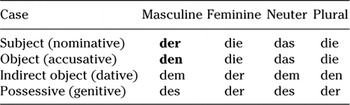
One of the cues German speakers have when interpreting sentences like (2) is that the subject and the object can be identified by their definite article endings, especially if the object is of masculine gender. No matter where the subject or object is positioned within a sentence, its definite and even indefinite article ending will signal its grammatical role. As seen in Table 1, the endings of the definite articles in German change based on both gender and case.
German definite article system

According to the FNP, learners will process the first noun in the sentence as the subject or agent. For example, when the learner hears Den Vater ruft der Sohn “The son calls the father,” instead of taking the cue from the ending of the definite article den “the-acc,” the learner will interpret the first noun as the subject and process the sentence as “The father calls the son.”
Materials
The materials used in this study included a pretest packet, EI for the +EI group, and structured input items for both groups. The pretest packet consisted of a consent form, a language background questionnaire, and a pencil-and-paper screening test.
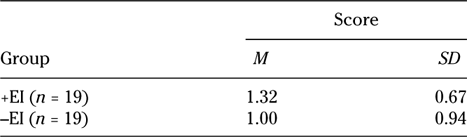
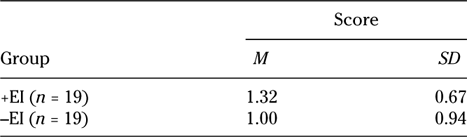
The screening test examined the participant’s ability to process OVS sentence structure correctly. For this test, the learners listened to 11 sentences and had to choose between two pictures (A or B) to indicate what they heard (i.e., who was doing what to whom). Among the 11 sentences, there were seven target OVS items. Each of the target sentences included masculine definite articles because this is the only gender whose article changes in the accusative case. The distracters (SVO sentences) consisted of both female and neuter nouns as well as masculine nouns. Participants were given 8 s between sentences to mark their choices; if they were unable to make a choice, they could circle unsure. Only participants who scored 3 or less out of the seven targets remained in the study. Of the 38 participants, only two scored three out of seven; they were therefore distributed evenly between the two treatment groups (i.e., one became a participant in the +EI group and the other became a participant in the −EI group). The other 36 participants scored 2 or less. Mean scores for the two groups were quite low (between 1.00 and 1.32 with low variability; see Table 2), which suggests an overall inability of each group to make use of case endings to correctly process OVS sentences prior to treatment.
Descriptive statistics for the screening test for OVS sentences
Note:
range = 0–7.
Thirty items composed the stimulus sentences for both the +EI and the −EI groups. Two types of sentences were used: Type 1 consisted of 10 sentences in the canonical (SVO) word order with at least one masculine noun, and Type 2 consisted of 20 sentences of inverted (OVS) word order, which included at least one masculine noun.
(3) a. Type 1
Die Frau ruft den Mann.
The woman-nom calls the man-acc
“The man calls the woman.”
b. Type 2
Den Mann ruft die Frau.
The man-acc calls the woman-nom
“The woman calls the man.”
As learners heard each sentence, two pictures, labeled A and B, simultaneously appeared on the computer screen. These pictures always represented the same action but were reversed for who did what to whom. As an example, for Den Mann ruft die Frau “The woman calls the man,” the two pictures were of a man calling a woman and of a woman calling a man. All visuals had been piloted for clarity of who was doing what to whom and were successfully used in our previous study (Culman et al., Reference Culman, Henry and VanPatten2009).
We understand that the stimulus sentences used here are decontextualized and devoid of extragrammatical cues such as intonation, discourse, or semantics (e.g., animacy), among others. However, the point of PI is to isolate grammatical cues and force learners to attend to them to get meaning. As Jackson (Reference Jackson2007) demonstrated, learners will rely on nongrammatical cues to get meaning—in her study, this was animacy—which defeats the purpose that grammatical inflections play. Thus, in treatments such as the one used here, it is critical to remove such cues.
Sentences were distributed across the treatment so that there were consistently three OVS items in a row followed by a SVO sentence. For example, items 1, 2, and 3 were OVS sentences, whereas item 4 was a SVO sentence; items 5, 6, and 7 were OVS followed by item 8, a SVO sentence. The items were purposely distributed in this manner so that there were multiple points at which a participant could reach criterion (i.e., demonstrate the ability to process word-order cues correctly). The way in which items were presented in Culman et al. (Reference Culman, Henry and VanPatten2009) did not allow a direct comparison with results reported by Fernández (Reference Fernández2008); however, the reorganization of the test items to reflect Fernández’s design permits us to undertake a direct comparison of the results. We note here that, in the follow-up questionnaire, participants did not report detecting any patterns in the distribution of items, and our results suggest that purposeful distribution of items did not affect the outcome. All sentences were prerecorded, and all sound files and matching picture pairs were loaded into e-Prime.
The EI for the +EI group covered three main points: (a) what case is and how articles are marked in German, (b) that German can invert order, and (c) what the FNP is and a warning to avoid this default processing strategy. After treatment was completed, participants received a questionnaire in which they were asked to state the rule for the use of accusative case in German. Additionally, the questionnaire inquired whether participants used additional strategies or tricks as they worked through the items or what they noticed about the treatments.
Procedure
Two days before the experiment, the participants performed the screening test, signed consent forms, and filled out the background questionnaire. On the day of the experiment, participants were first instructed on the e-Prime program and how to participate in the experiment. Following the explanation, the participants received headphones by means of which they would hear the treatment sentences.
The experiment consisted of two phases for the +EI group and only one phase for the −EI group. For phase 1 of the +EI group, the participants received EI on German accusative case and word order. The information appeared on the participants’ computer screen as five different slides that appeared for 30–45 s per frame. The total time of exposure to the EI was 3 min 20 s. The participants were allowed to skip to the next slide if they finished before the allotted time ran out; however, they were not able to review the information during the rest of the experiment. Our previous research showed that the time allotted for reading the EI was more than ample for all participants.
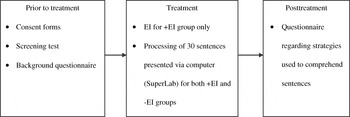
Both the +EI and the −EI groups completed phase 2, which consisted of structured input sentences as illustrated in (3). Participants could press any button to begin the structured input phase and to advance to the next sentence. When the participants heard a sentence and saw the two pictures on the computer screen, they responded by pressing a or b to indicate which picture represented what they had just heard. Depending on the participants’ responses, they either saw Correct! or Incorrect flash up on the screen, with no additional information; then the next item appeared. Once the participants had finished the 30th and final item, they were asked to fill out the postexperiment questionnaire. Participants were allowed to work at an individual pace, but all participants completed the experiment within 26 min, including the EI phase for the +EI group. A visual scheme of the research design is presented in Figure 1.
Schematic view of the research design

Scoring
Following Fernández (Reference Fernández2008), we used a trials-to-criterion measure as a score for each participant. Criterion consisted of correctly answering three target OVS items and at least one distractor SVO item in a row. Trial to criterion was thus the number of items that preceded the onset of correct responses. For example, participant John Smith began answering correctly at item 12; that is, he correctly processed items 12, 13, 14, and 15 (criterion). His trials to criterion would be 11, the number of items that preceded his correct responses.
While scoring, we noticed that a large number of the −EI group did not reach criterion during the 30 trials (63%), whereas in the +EI group, the number was much smaller (16%). For these participants, we could not give a score of 0 because that would indicate they had reached criterion immediately (i.e., they began processing correctly at item 1). Instead, we gave them a score of 30, meaning that they could have reached criterion had the trials extended beyond 30.
Unlike Fernández (Reference Fernández2008), we did not conduct analyses on reaction time or accuracy after criterion. Because of the very large number of participants in the −EI group who did not reach criterion, such measures made little sense. Thus, we limit our analysis to the comparison of trials to criterion.
Analysis
For the screening test, we conducted an unpaired (independent) t test with treatment as the variable. To address our research question, we conducted an additional unpaired t test on the mean scores for trials to criterion for each group.
RESULTS
Table 2 contains means and standard deviations for the scores on the screening test. As can be seen, mean scores are 1.32 or less, with a range of 0–7 as the total score. These means suggest that learners understand OVS sentences correctly less than 22% of the time. Thus, the participants, in spite of previous study and exposure, are not correctly mapping form and meaning in this particular case. The results of the t test showed no difference between the two treatment groups on this measurement, t(36) = 1.16, p = .26.
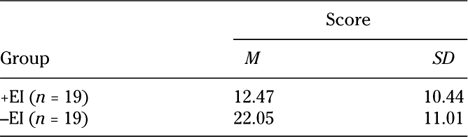
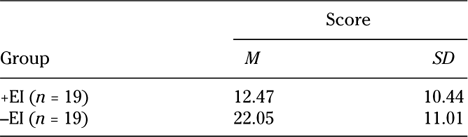
Mean scores and standard deviations for the trials to criterion appear in Table 3, which shows that the +EI group has a much lower mean compared to that of the −EI group. This indicates fewer trials to criterion, which means that the +EI group began to correctly process sentences sooner than the −EI group. The results of the unpaired t tests revealed a significant difference between the two groups, t(36) = –2.75, p < .01. This finding suggests that EI had a positive effect in helping learners reach criterion.
Descriptive statistics for trials to criterion
We understand that some readers might object to the method by which we scored the participants who did not reach criterion: We gave each of these participants the greatest possible score for reaching criterion in our study (i.e., 30). To address this possible objection, we compared the two groups on the actual number of people who reached criterion: 16 for the +EI group and 7 for the −EI group. Z scores were computed by means of a Mann-Whitney test (z = 12.50, p < .01) and revealed that a significantly greater number of participants reached criterion in the +EI group than in the −EI group, which, in turn, supports an effect for EI.
DISCUSSION AND CONCLUSION
These results suggest that the participants who received EI as part of PI began to correctly process input sentences sooner than those who did not. A secondary analysis revealed that more participants in the +EI group reached criterion compared with the −EI group. Thus, EI does have a facilitative effect for L2 German learners with PI. This finding corroborates our previous research in German (Culman et al., Reference Culman, Henry and VanPatten2009) but does not corroborate the findings of Fernández (Reference Fernández2008) for word order and object pronouns in Spanish even though the processing problem (i.e., the FNP) was the same. Instead, our results resemble Fernández’s findings for the Spanish subjunctive and the lexical preference principle. Because we have replicated our own results, we believe, then, that the difference may lie in the intersection of the processing problem and the particular structure involved.
In our study, the two salient points of the EI were (a) the difference between der “the-nom” and den “the-acc” as masculine articles and (b) the problem in relying on word order as the cue to who-does-what-to- whom. With Spanish object pronouns and word order as used in Fernández’s (Reference Fernández2008) study and the research on which it is based (i.e., VanPatten & Cadierno, Reference VanPatten and Cadierno1993; VanPatten & Oikkenon, Reference VanPatten and Oikkenon1996), the EI would have contained the same problem in relying on word order, but the information on object pronouns itself would have been more complicated, involving the morphological inflections for each object pronoun (each one is unique, and even though Fernández focused only on third-person pronouns, learners would have had to be aware of four object pronouns) and how these object pronouns differed from subject pronouns. This information may have been a bit too much for average learners to keep in working memory as they began working through the items in Fernández’s study. Note that there were no other differences between our study and hers; even the sentences that formed the treatment items were kept to short strings that consisted of noun phrase plus verb plus noun phrase (e.g., The cat sees the dog). Therefore, there was nothing about sentence structure or individual item difficulty that varied between the two studies. The reason for the difference in findings, then, might be related to the nature of the EI and whether it was portable (i.e., whether the information can be kept in working memory while the learner is simultaneously processing novel incoming data) enough to use during processing.
This explanation is supported to a certain extent by the reports that participants provided after treatment. In the questionnaire that was administered as a posttreatment, we asked the learners to describe any tricks they used to interpret sentences. For the +EI group, 11 of 19 participants said they were using the definite article as the cue to who did what to whom. Only 2 of 19 from the −EI group reported such a strategy. It would seem, then, that the distinction between der “the-nom” and den “the-acc” was portable enough to use during sentence processing for the +EI group. To be sure, our research is limited to the nominative-accusative distinction for masculine only. This is the only case marking that is consistently clear for nominative and accusative across the classes of nouns in German. We do not intend to make any claims about what PI (with or without EI) can do for the rest of case markings in German and leave that to future research. Additionally, like all PI and sentence processing research, this study is limited to sentence-level stimuli; it thus remains to be seen whether EI is portable and useful during discourse-level input activities.
The reader should be reminded that the intent of this study was not to show that PI and structured input-only resulted in equal gains after treatment; such an intent would have involved a different research design, similar to that used by VanPatten and Oikkenon (Reference VanPatten and Oikkenon1996) and other research that followed. Thus, we cannot and never intended to make claims about the relative outcomes of PI and structured input-only. Our focus was on what learners do during the treatment and whether EI would help learners process case sooner than if they did not receive EI. For this reason, our design was similar to that in Fernández (Reference Fernández2008). Our findings point toward a different outcome from her study in that EI helped during the treatment. However, it is also apparent that the structured input-only group never caught up with the +EI group; that is, substantially fewer −EI participants reached criterion. One could interpret this finding to mean that there are differential outcomes for full PI and structured input-only. This is supported by the results of the Mann-Whitney test, in which we compared the total number of people who reached criterion in each group. However, there is another way to look at these findings. One could attribute the overall effects of +EI to frequency effects; there simply were not enough items (N = 30) during the treatment period so that the −EI group could catch up, as seems to be the case in offline studies like that of VanPatten and Oikkenon. VanPatten and Oikkenon, who borrowed the entirety of their materials from VanPatten and Cadierno (Reference VanPatten and Cadierno1993), had over 100 tokens in their classroom study (not including additional tokens due to repetitions as instructors repeated items, said the stimuli more than once, and so on). We will soon be turning our attention to research in which we increase the number of items used during the treatment. In the meantime, we believe our data are clear: EI had effects during processing for the target structure in this study. This finding does not support the observations or conclusions found in Fernández, but it does not quite disprove them either. Our conclusion is that not all EI is the same, not all structures are the same, and the interaction of EI, structure, and processing problem may yield different results in different studies. Thus, the door is open to continued research in which EI is isolated as a variable in instructed SLA—not just in PI, but in all interventions. Additionally, we agree with Fernández’s call for the use of online techniques in investigating the effects of instructional interventions. These techniques would allow one to determine what occurs during treatments, something not afforded by offline posttreatment assessments.