“Perhaps one of the most outstanding weaknesses of contemporary psychological theory is the relative neglect of the environment by many of the most influential theoretical viewpoints.”
—Isidor Chein, The Environment as a Determinant of Behavior Reference Chein 1Introduction
History may not repeat itself, but there seem to be reverberating themes. One such theme is the challenge of “how” and “where” to manage people who behave in dangerous, scary, or unacceptable ways. Throughout time, these individuals have been placed in institutional settings or facilities; the names of which often belied the philosophical approach popular at the time. Reform schools and correctional institutions were providing discipline, instruction, and behavioral guidance while asylums and sanatoriums were places of rest and recovery. In the 1840’s, Dorothea Dix began to argue that individuals with mental illness were distinct from criminals and should not be housed in jails or prison.Reference Dix 2 Her descriptions of inhumane treatment within jail settings resulted in the establishment of state psychiatric hospitals around the country. Now, after nearly 200 years of advancements in medicine, penological research, psychological treatments, and public policies, the question of “how” and “where” to best manage people remains unanswered. Modern day jail diversion programs and mental health courts continue to promote Dix’s perspective that mentally ill individuals should be provided appropriate treatment, not languish in jail or prison. However, this ideal has not become a reality. The living conditions and medical treatment for people with mental illness within facilities remains a primary public policy issue for the American Civil Liberties Union and the National Alliance on Mental Illness with large class action lawsuits occurring each year. Similarly, the Department of Justice continues to order jails and prisons into receivership for inadequate care.
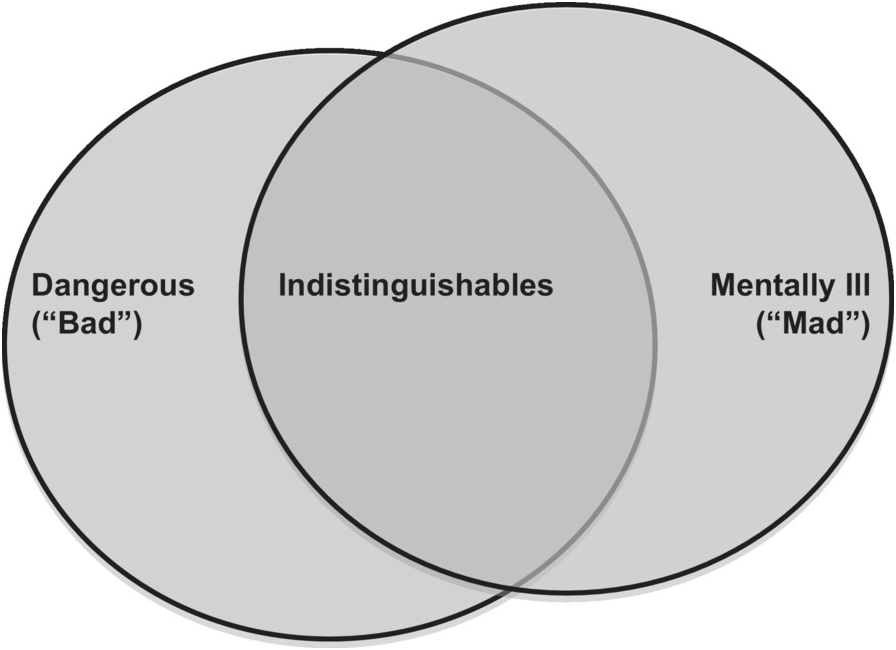
Dix’s proposition was a simple one. Criminals and antisocial individuals should be housed and safely contained in jails and prisons but individuals with mental illness should be admitted to hospitals for treatment. Unfortunately, the question of “how” and “where” remains because the reality of people who behave in dangerous, scary, or unacceptable ways is much more complex. We argue that there is a population of individuals not so clearly criminal or mentally ill (see Figure 1). Furthermore, individuals in this indistinguishable group can be incorrectly placed either at a correctional institution or psychiatric facility and experience possible harm, poorer outcomes, and potential for further misclassification.
The criminalization of mental illness—the “bad” versus “mad” dichotomy.

The Sorting Hat
In the Harry Potter Reference Rowling 3 book series, the Sorting Hat magically determines which college or house at the wizard school each new student should be assigned. Once the Sorting Hat is placed on the students’ head, it can hear their thoughts and then makes a determination about their appropriate placement within minutes or even seconds. According to the books, the hat makes very few errors. When examining individuals entering the criminal justice system, there is no such magical sorting mechanism available. Instead of wizard houses, the classification is whether the person is dangerous or mentally ill. Indeed, the initial options for classification are whether the person is “bad” or “mad.” Often, the police officers first called to the scene of a disturbance or crime are forced to immediately determine whether the subject is dangerous, mentally ill, or under the influence of an intoxicant. Based on their training and initial impressions, the police officers then determine if it is necessary to ticket or arrest the person, take them to jail, or transport them to a local hospital for treatment. Each of these actions requires presumptions about whether the person is dangerous and requires containment or is ill and needs treatment. These assessments occur very quickly and often with little to no background information.
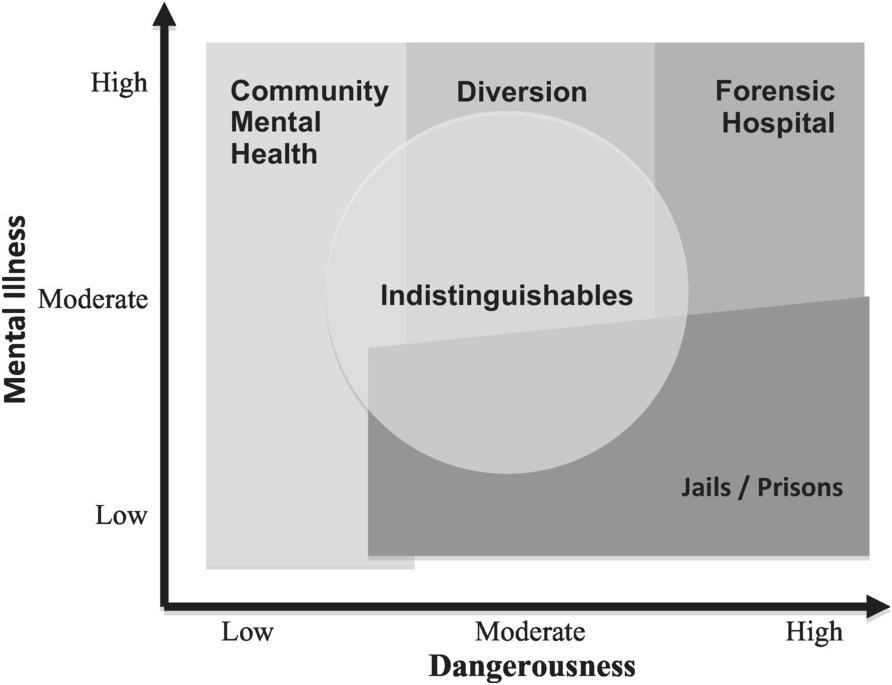
Although some people are easily identifiable as dangerous while others undoubtedly require immediate mental health care, there is a population of individuals that are not so clearly sorted. These indistinguishables encompass a wide range of presentations. Some may have a mild mental illness that is typically well managed but currently exacerbated by substance abuse; others may have no mental illness but are unexpectedly acting aggressive or bizarre; while another may appear belligerent and socially inappropriate but not necessarily violent or even mentally ill. Indeed, the kinds of indistinguishables are innumerable. For this reason, the simple distinction between either dangerous or mentally ill is incomplete. Not all individuals with a diagnosis of a mental illness require inpatient treatment. Similarly, not all individuals who have engaged in illegal behaviors require incarceration to ensure community safety. The binary distinction between dangerousness and mental illness ignores the dimensional nature of these constructs (see Figure 2). Dorothea Dix would likely agree that only the most dangerous require incarceration and only the severely mentally ill require hospitalization. People demonstrating both significant mental illness and dangerous behaviors are appropriate for inpatient forensic treatment but those with less serious illness can remain in community settings.
Decriminalizing mental illness—a dimensional model.

Even with this more nuanced view that incorporates spectrums of dangerousness and mental illness, the indistinguishables remain. Where is the appropriate placement for an individual stabilized on anti-psychotic medication but continuing to act aggressively? What about the patient who intermittently decompensates and then sets fires? We propose that inappropriate placement into the incorrect facility, treatment location or security rating can result in poorer clinical outcomes, longer lengths of stay, and violence.
From Deinstitutionalization to Transinstitutionalization
In 1939, the British psychiatrist Lionel S. Penrose observed that the availability of psychiatric beds for the mentally ill reduced the incidence of crime and therefore decreased the number of people in prison.Reference Penrose 4 This inverse relationship between the proportion of people in psychiatric hospitals and prisons became known as the Penrose hypothesis.Reference Penrose 4 – Reference Kalapos 7 Empirical support for the Penrose hypothesis continues to be debated; however, the basic premise that individuals are categorized as “mad” (mentally ill) or “bad” (criminal) remains a ubiquitous part of our social ecologies.
Since Penrose’s observation, two significant trends have taken place in the United States. First, as a result of the deinstitutionalization movement, there are fewer psychiatric beds available to serve the growing number of mentally ill individuals. Coinciding with the advent of psychotropic medications in the 1950’s, psychiatric hospitals began releasing patients with the promise that these patients could receive more humane and effective treatment in the community. In 1955, for instance, there were 559,000 state hospital beds for a population of 164 million people; however, only 40 years later that number dropped to 72,000 state hospital beds for a population of 250 million.Reference Chaimowitz 8
The second trend is the exponential increase in incarceration rates and prisons. Since the early 1970’s, the United States has witnessed an unprecedented increase in the total number of incarcerated individuals. 9 The total number of people incarcerated between 1980 and its peak in 2008, rose from 501,836 to 2.3 million in the United States. 10 When adjusting for population, the rates of incarceration from 1980 to 2008 rose from 310 inmates per 100,000 adults to 1,000 inmates per 100,000 adults. 10 To provide a global comparison, the United States has more persons in jail and prison than what is reported in China (approximately 1.6 million inmates) and Brazil (approximately 673,000 inmates). 10
The transinstitutionalization trends have resulted in blending of individuals with the full range of mental illness and the full range of dangerousness at prisons, jails, forensic hospitals and psychiatric hospitals. In other words, a patient at a forensic hospital may show the identical pattern of illness severity and dangerousness as a prison inmate. The only distinction may be how they were originally sorted. Importantly, research suggests that there can be critical consequences when an indistinguishable does not have both the mental health services and containment they need.
Mental Illness in Prison and Jails
Penological research over the last decades has argued that for some inmates, prison and jail can create new symptoms and exacerbate pre-existing symptoms of mental illness. Solitary confinement and entire supermax facilities that utilize isolation as a key method to deter violence, contraband trading or escape have received the most attention.Reference Collins 11 Now called extended control units or ECU’s, these units typically have inmates locked into a single cell with no windows 22 to 23 hours per day. The inmates in ECU’s have limited access to exercise, work, religious services or rehabilitation programs. The amount of interaction between staff and inmates varies from facility to facility with some being characterized as total deprivation of human contact.Reference Riveland 12 Research on these populations has demonstrated that some ECU inmates have psychosis that quickly resolves when they are transferred to a less restrictive area of the prison and that many develop “SHU Syndrome.”Reference Grassian 13 First coined in 1983, SHU Syndrome was characterized by severe confusion, mutism, hallucinations, hyper-responsivity to any stimuli, and delusional beliefs that include persecutory thoughts or ideas of reference among inmates with no history of mental illness.Reference Kupers 14 , Reference Grassian and Friedman 15 During two high profile court cases, Madrid v. Gomez Reference Gomez 16 and Jones’ El v. Berge, Reference Berge 17 the courts concluded that ECU prison housing “is known to cause severe psychiatric morbidity, disability, suffering and mortality” and required screening procedures to ensure that inmates with existing diagnoses of schizophrenia spectrum disorders, past suicidality, or intellectual disabilities could not be sent to the ECU because the risk of exacerbating their symptoms was too high.
The creation or exacerbation of mental illness in this type of extreme prison setting may not be surprising but additional research suggests that some general population inmates also experience an increase in their psychiatric symptoms. A recent reportReference Bronson 18 suggested that about 14% of state and federal prisoners and 26% of jail inmates reported experiences that met the threshold for “serious psychological distress” (SPD). Moreover, about 37% of prisoners and 44% of jail inmates had been informed by a mental health professional that they have a mental disorder.Reference Bronson 18 Of those prisoners with a mental disorder, major depressive disorder was the most common disorder (24% for prisoners and 30% for jail inmates), with bipolar disorder the second most common (17% and 25% respectively). When compared to the standardized adult population of the United States (5%), three times as many prisoners met the threshold for SPD (14%). Jail inmates were five times more likely to meet the threshold of SPD (26%) than the adult general population. Female prisoners and jail inmates were even more likely to meet the threshold for SPD than males.Reference Bronson 18 These findings suggest that the environment of the prison or jail setting may be disproportionately detrimental to some inmates more than others. It is possible that this group of inmates would experience fewer psychiatric symptoms, require less medication and have better community re-entry if they had been in a non-prison setting such as a diversion program or forensic hospital.
Violence in Psychiatric Hospitals
With shifts in the law that now require dangerousness (and not the need for treatment alone) as the primary legal criteria for involuntary treatment, more civilly committed patients are being admitted to state hospitals with an increased risk for violence. For example, an analysis of patients within the California Department of State Hospitals (DSH), found that civilly committed patients engaged in more acts of physical violence towards staff and other patients than forensically committed patients.Reference Broderick, Azizian, Kornbluh, Warburton, Warburton and Stahl 19 Research on the rate of inpatient aggression varies considerably in the literature, which is likely due to how violence is defined, measured, and documentedReference Convit, Isay, Otis and Volavka 20 ; however, approximately 20%–40% of psychiatric inpatients exhibit violent behaviors while in hospital settings.Reference Cooke, Wozniak and Johnstone 21 Notably, patients within inpatient psychiatric settings have higher rates of violence than individuals with mental illness living in the community.Reference Swanson, Monahan and Steadman 22 , Reference Swanson, Swartz and Van Dorn 23 In sum, these large studies highlight that patients needing mental health treatment may also simultaneously need containment and security to manage their dangerousness.
A host of patient factors, including severe and chronic psychiatric symptomatology, cognitive impairment, personality disorders, impulsivity, criminal justice system involvement, and trauma histories, play a significant role in violent inpatient behaviors among psychiatric patients. Additionally, research into the relationship between situational and environmental factors and inpatient aggression have suggested that the physical environment, crowding, ward organization, hospital management style, institutional responses to violence, staff mixture, staff training, patient population, uninvolved psychiatric leadership, as well as temporal and location factors can all influence the frequency and severity of aggression within psychiatric hospitals.Reference Clements 24 – Reference Katz and Kirkland 28 Studies have shown that violent patients can evoke anger and fear in staff members leading to team splitting and treatment disagreements, Reference Lion and Pasternak 29 staff members becoming passive and engaging in scapegoating, Reference Cornfield and Fielding 30 and experiencing strong negative feelings (countertransference) towards patients.Reference Rossberg and Friis 31 Based on this literature, patients who are psychiatrically stable and continue to be violent towards staff might create even stronger reactions in staff and significantly undermine the therapeutic milieu that the inpatient psychiatric unit is attempting to facilitate. Indeed, the psychiatric and forensic hospitals intended for treatment may not incorporate the necessary safety and security measures inherent to prison settings.
Solutions: The Appropriate Environment for Indistinguishables
This research highlights that many individuals are likely incorrectly sorted into facilities that do not match their dangerousness or mental health needs. Our current binary system of “mad” versus “bad” does not allow for full assessment of the indistinguishable to determine their ideal placement. There are some model programs and research findings that suggest solutions to this dichotomy. First, we propose that settings designed to fulfill dual needs, both containment and mental health milieu treatment, may be the most apt placement for the indistinguishables.
The indistinguishables require admission to a facility appropriate for their both their psychiatric and security needs. Jails, prisons, and forensic hospitals must be prepared for individuals across the entire spectrum of mental illness and dangerousness. Marrying the necessary security measures with a treatment focus can improve the outcomes of a larger range of inmates and patients, reducing the possibility of SHU syndrome or violence. Indeed, human–environment interactions are based on a variety of complex psychological processes occurring both at the individual level, as well as at the social group levels, all in the context of our social and environmental ecologies.
Research into the impact of environmental characteristics and situational factors on mental health have been examined in a variety of human living spaces. Environmental factors such as space design, crowding, lighting, indoor air quality and flow, and light all have been demonstrated to have a direct impact on mental health.Reference Evans 32 For example, HolahanReference Holahan 33 observed that rearranging the furniture (eg, placing the chairs around a table, chairs at a comfortable distance facing each other) promoted social interactions among hospitalized patients, thereby decreasing isolative, passive behaviors. Psychological adjustment was improved by simple amenities such as hallway decorations and weather protections at doorways.Reference Timko 34 The architectural design of the living areas also impacted psychological adjustment and engagement. Patients showed improved mental alertness and social interaction living in small corridors and suites, but no change was observed in the large open sleeping wards (eg, 15–20 patients in cubicle like space).Reference Zimring, Weitzer, Knight, Baum and Singer 35 EvansReference Evans 32 also found that chronic exposure to noise, crowding, and malodorous pollutants were linked to apathy about recovering and that limited exposure to daylight was correlated with increases in depressive symptoms.
Despite these studies about the importance of environmental factors on mental health in general, much of this information has not been incorporated into the design of prisons or psychiatric facilities. These facilities tend to be underfunded and outdated, in deteriorating states, and buildings are often repurposed for use other than the intended design. A focus on environmental aspects will allow facilities to meet the needs of the wide variety of indistinguishables admitted while also maintaining treatment and security requirements. Indeed, this type of ecological perspective reminds us that it is not just the individual who warrants our focused attention, but also the complex environmental systems in which the individual lives.
Second, there is a need to implement frequent assessment to determine if a person’s current level of dangerousness and mental illness requires placement into a facility. Indeed, it is possible that many indistinguishables could show long-term success if they remain in the community. The Eleventh Judicial Circuit Criminal Mental Health Project (CMHP) 36 in Miami-Dade County is one of the most promising examples of coordinated systems solution to decriminalizing mental illness. The Honorable Steve Leifman initiated the CMHP in 2000 to address the high number of untreated and undertreated mentally ill defendants cycling through the courts and jails. Miami-Dade County is uniquely challenging in that it has the highest percentage of residents with serious mental illnesses (nearly 3 times the national average) but exists within a state system that is ranked 48th in the nation for state funding for community mental health services.Reference Iglehart 37 The CMHP goes beyond community strategies that attempt to keep mentally ill individuals out of the criminal justice system, by incorporating a comprehensive host of policy and procedural changes that include training law enforcement to recognize signs of mental illness and pre- and postbooking jail diversion programs. In a 5 year period, officers within the two largest police departments have responded to approximately 50,000 mental health crisis calls resulting 9000 diversions to mental health services and 109 arrests; moreover, the daily census within this jail system dropped from 7,200 to 4,000.Reference Iglehart 37 As stated in the New England Journal of Medicine, Reference Iglehart 37 “the [CMHP] initiative’s success is largely attributable to an effort to structure patterns of service delivery and deploy existing resources in ways that are better aligned with the needs of the people coming out of the justice system.” In essence, the CMHP has conceptualized a more nuanced solution that transcends the outdated binary model by creating treatment and containment strategies that are contingent upon the defendants’ severity of mental illness and level of dangerousness. This model reserves placement in facilities (eg, jails, prisons, and forensic psychiatric hospitals) for the smaller percentage of individuals that can be best served within them. Programs like the CMHP can increase the chance of indistinguishables receiving the appropriate security and treatment and improving long term outcomes.
Conclusion
Arguably, there is not just one mental health crisis in America; rather there are multiple mental health crises, one of which involves the criminalization of the mentally ill. The old “mad” versus “bad” dichotomy fails to appreciate the complexity of justice involved individuals. Innovative programs and policies that address both mental health and dangerousness can result in a greater variety of answers to the remaining question of “how” and “where” to best serve the indistinguishables.
Disclosures
Sean Evans and Shannon Bader have nothing to disclose.