Introduction
Among malignancies of the head and neck, salivary gland carcinomas are particularly diverse in their histological features, and each of the many subtypes has unique pathological characteristics. There have been several attempts at histopathological classification of salivary gland tumours,Reference Evans1–Reference Spiro, Huvos, Berk and Strong3 and in 2005 the World Health Organization (WHO) published a new histopathological classification scheme (as part of a revised head and neck tumour classification system).Reference Goode and El-Naggar4
In the 1972 WHO classification, epidermoid carcinoma was classified as an epidermoid tumour and considered benign. In 1991, the term epidermoid carcinoma was introduced to describe malignant epidermoid tumours.Reference Seifelt5 Finally, in 2005 the WHO presented a new classification scheme that included a classification by malignancy grade, based on the histopathological characteristics of these tumours.
We investigated the association of the 2005 WHO classification scheme and other prognostic factors with survival among patients with mucoepidermoid carcinoma who had been registered with the Niigata Prefecture Head and Neck Malignant Tumour Registration Committee since its founding in 1986.
Materials and methods
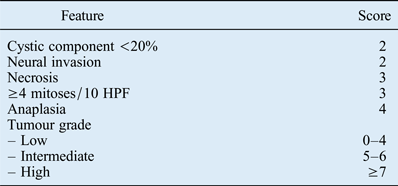
Fifty cases of mucoepidermoid carcinoma were registered with the Niigata Prefecture Head and Neck Malignant Tumour Registration Committee during the 25-year period from 1986 to 2010. We retrospectively investigated the clinicopathological characteristics of 45 patients who had received treatment and undergone follow-up examination. Duration of follow up ranged from 2 to 249 months (mean, 59.0 months). We classified histological grade according to the 2005 WHO classification scheme (Table I), and we examined the association of histological grade and other clinical and pathological prognostic factors with disease-specific five-year survival.
Histopathological features and scoring used to grade mucoepidermoid carcinoma

HPF = high-power fields
All analyses were performed with the SPSS software program, version 19 (SPSS Inc, Chicago, Illinois, USA). Survival rates were calculated using the Kaplan–Meier method, and the log-rank test was used to assess differences between groups. Multivariate analysis was done using the Cox proportional hazards model. A p value of less than 0.05 was considered to indicate statistical significance.
The 1997 tumour-node-metastasis (TNM) classification of the Union for International Cancer Control was used, and histopathological grade was determined in accordance with the 2005 WHO criteria.
Results and analysis
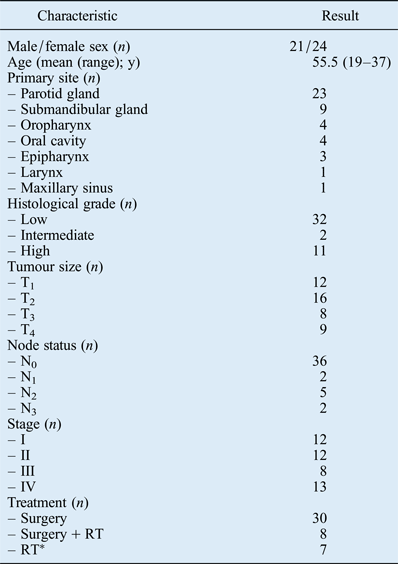
Table II shows the clinicopathological characteristics of the 45 patients. There were 21 men and 24 women, and the average age was 55.5 years (range, 19–87 years). The primary lesion was located in a major salivary gland in 32 patients (involving the parotid gland in 23 patients and the submandibular glands in 9) and in a minor salivary gland in 13 patients (involving the oropharynx in 4 patients, the oral cavity in 4, the epipharynx in 3, the larynx in 1 and the maxillary sinus in 1).
Patient characteristics
*Two patients also received simultaneous chemotherapy. Y = years; T = tumour; N = node; RT = radiotherapy
On the basis of the 2005 WHO classification scheme, 32 tumours were classified as low grade, 2 as intermediate grade and 11 as high grade. Of patients with high-grade tumours, six lived (one developed pulmonary metastasis), two died of other causes, and three died due to their primary mucoepidermoid carcinoma (the tumour recurred in its original location in all three patients). The two patients with intermediate-grade tumours both died of cancer (pulmonary metastases developed in both patients). Of patients with low-grade tumours, 28 lived, 2 died of other causes and 2 died due to their primary mucoepidermoid carcinoma (1 from cancer recurrence and 1 from pulmonary metastasis).
Regarding patients' TNM classification, tumour size was classified as T1 in 12 patients, T2 in 16, T3 in 8 and T4 in 9. Node status was N0 in 36 patients, N1 in 2, N2 in 5 and N3 in 2. No distant metastases were observed. As for staging, 12 patients were stage I, 12 were stage II, 8 were stage III and 13 were stage IV.
Regarding treatment, 30 patients underwent surgery, 8 received surgery and radiotherapy, and 7 underwent radiotherapy (2 of whom also received simultaneous chemotherapy). Reasons for selecting radiotherapy included tumour invasion of the carotid artery, tumour growth into the intracranial area, and patient refusal of surgery.
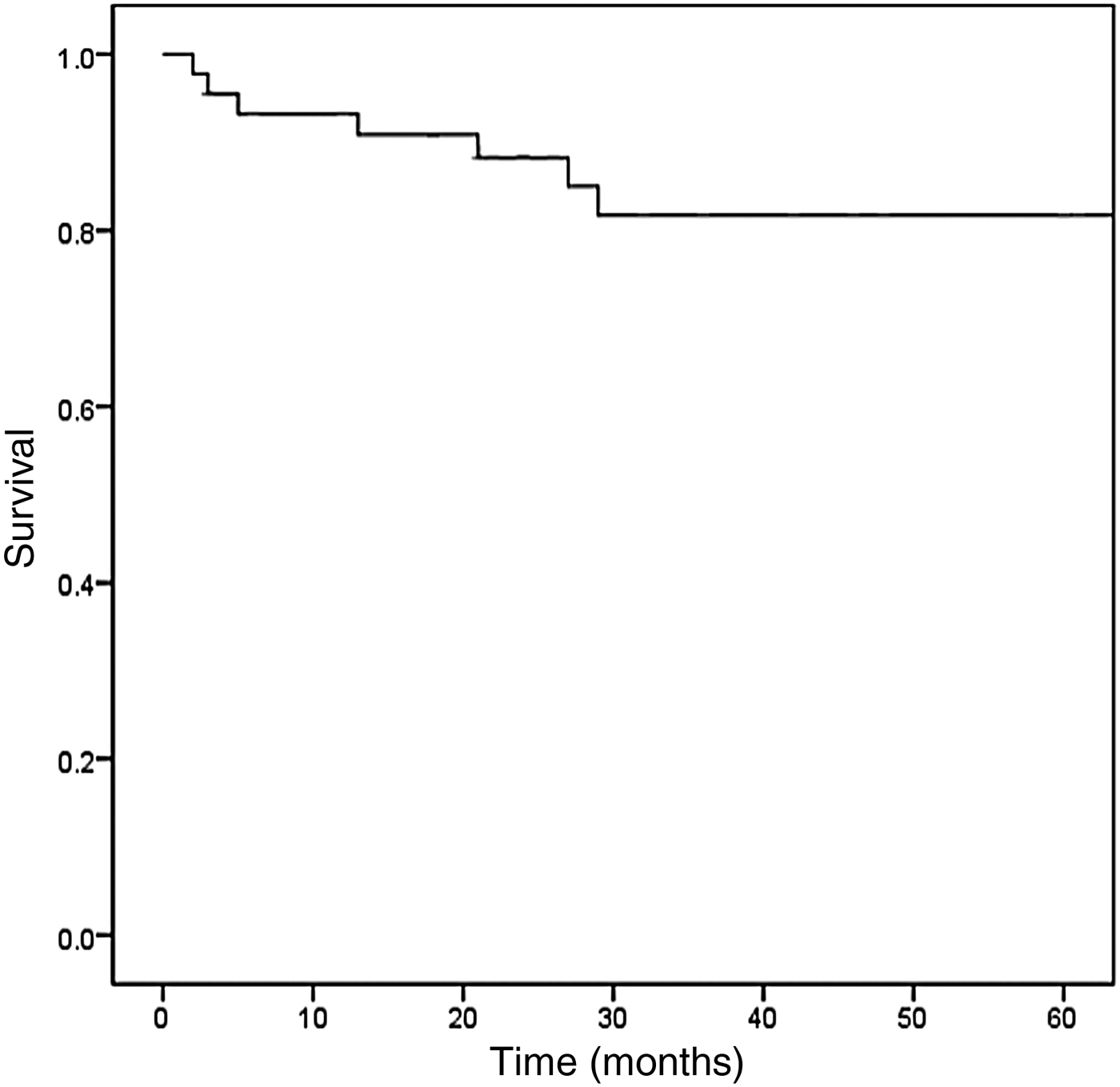
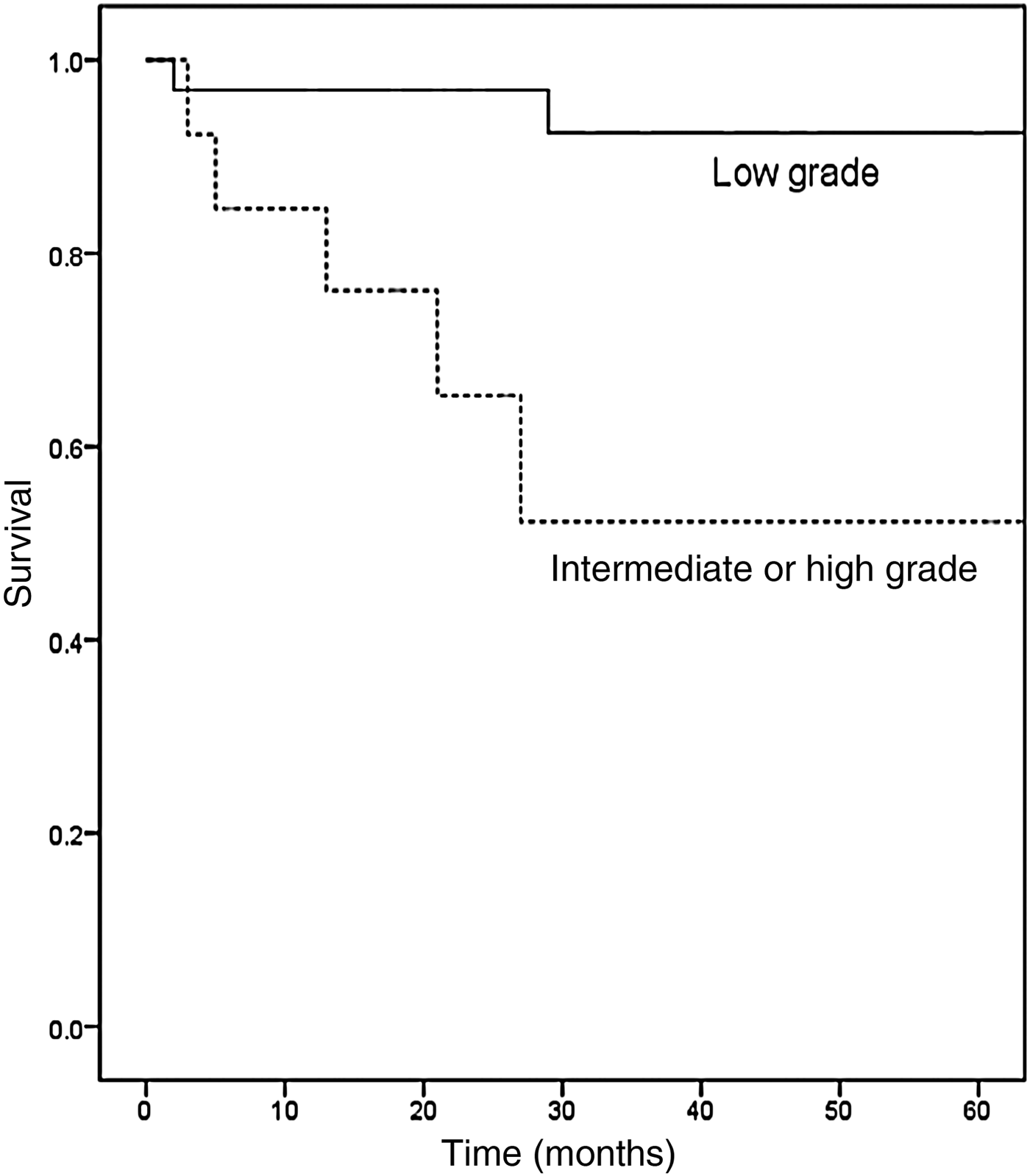
As for disease progression, the disease-specific 5-year survival rate was 81.8 per cent overall (Figure 1), 92.5 per cent for patients with low-grade tumours, and 52.2 per cent for patients with intermediate- or high-grade tumours (Figure 2).
Kaplan–Meier curves for overall disease-specific survival for the 45 patients with mucoepidermoid carcinoma.
Kaplan–Meier curves for disease-specific survival by histological tumour grade.
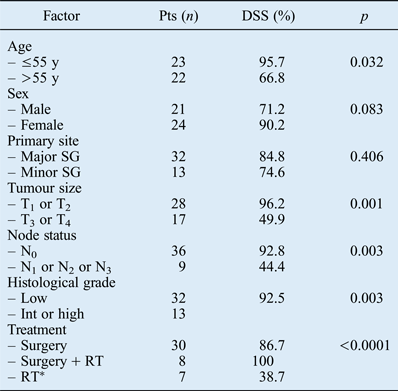
Table III shows the results of univariate analyses (log-rank test) comparing survival rates by age, sex, location of primary lesion, T classification, N classification, histological grade and treatment. Patients aged 55 years or younger (n = 23) had a survival rate of 95.7 per cent, which was significantly higher (p = 0.032) than the rate for those older than 55 years (66.8 per cent; n = 22). The difference in survival between men (71.2 per cent; n = 21) and women (90.2 per cent; n = 24) was not significant (p = 0.083). Also, no significant difference in survival (p = 0.406) was observed between patients with a primary lesion in the major salivary glands (84.8 per cent; n = 32) and those with a primary lesion in the minor salivary glands (74.6 per cent; n = 13).
Univariate analysis results
*Two patients also received simultaneous chemotherapy. Pts = patients; DSS = 5-year disease-specific survival; y = years; SG = salivary gland; T = tumour; N = node; Int = intermediate; RT = radiotherapy
There was a significant difference in survival (p = 0.001) between patients with T1 or T2 cancer (96.2 per cent; n = 28) and those with T3 or T4 cancer (49.9 per cent; n = 17). A significant difference in survival (p = 0.003) was also seen between N0 patients (92.8 per cent; n = 36) and patients who were N1, N2 or N3 (44.4 per cent; n = 9). There was also a significant difference (p = 0.003) between the survival rate of patients with low-grade tumours (92.5 per cent; n = 32) and those with intermediate- or high-grade tumours (52.5 per cent; n = 13). The survival rate was 86.7 per cent for patients who underwent surgery (n = 30), 100 per cent for those who received both surgery and radiotherapy (n = 8), and 38.7 per cent for those receiving radiochemotherapy (n = 7) (p = 0.0001 for the comparison among the 3 groups).
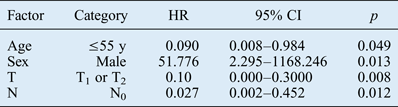
Multivariate analysis using the above variables revealed significant differences in survival with respect to age (p = 0.049; hazard ratio = 0.090), sex (p = 0.013; hazard ratio = 51.776), T classification (p = 0.008; hazard ratio = 0.10) and N classification (p = 0.012, hazard ratio = 0.027) (Table IV).
Significant multivariate analysis results*
* For variables associated with 5-year disease-specific survival. HR = hazard ratio; CI = confidence interval; y = years; T = tumour; N = node
Discussion
When first described in 1945, the tumour later termed mucoepidermoid carcinoma was designated as a benign salivary gland tumour containing both epidermoid and mucous cells, and was named mucoepidermoid tumour. However, metastases were reported in some patients, and these tumours came to be regarded as borderline lesions, i.e. between benign and malignant.Reference Evans1–Reference Spiro, Huvos, Berk and Strong3 A previous WHO classification scheme categorised these lesions as benign mucoepidermoid tumours; however, in 1992 the term mucoepidermoid carcinoma was used as the new designation for malignant tumours,Reference Seifelt5 and this designation was maintained in the 2005 WHO classification.
Mucoepidermoid carcinomas are composed of squamoid cells, mucus-producing cells and intermediate cells, and comprise a wide variety of histological types. Because of this histological variation, there have been a number of attempts to categorise malignancy grade.Reference Evans1–Reference Spiro, Huvos, Berk and Strong3 In the 2005 WHO classification, malignancy grade was assigned based on the cystic component of the tumour (≤20 per cent vs more), presence and extent of neural invasion, tumour necrosis, mitoses (≥4/10 high-power fields vs fewer), and anaplasia. The total score from these five categories is used to identify low-, intermediate-, and high-grade tumours.Reference Goode and El-Naggar4 In the present study, we used this 2005 WHO classification in our clinicopathological analysis.
Of the 45 patients analysed in the present study, 32 had low-grade tumours, 2 had intermediate-grade tumours, and 11 had high-grade tumours. The overall disease-specific 5-year survival rate was 81.8 per cent, similar to rates reported in some previous studiesReference McHugh, Roberts, El-Naggar, Hanna, Gerden and Kies6, Reference Rapidis, Givalos, Gakiopoulou, Stavrianos, Faratzis and Lagogiannis7 and slightly worse than results from another previous study.Reference Boahene, Olsen, Lewis, Pinheiro, Pankratz and Bagniewski8 This discrepancy may be due to the fact that 21 (46 per cent) of our patients had stage III or IV disease.
Patients with low-grade tumours had a disease-specific 5-year survival rate of 92.5 per cent, which was significantly higher than the 52.5 per cent rate among those with intermediate- or high-grade tumours. This finding indicates that the 2005 WHO classification has clinical value in determining prognosis.
Pre-operative histological diagnosis of salivary gland tumours is difficult.Reference Lin and Bhattacharyya9–Reference Al-Khafaji, Nestok and Katz11 Because malignancy grade cannot be accurately determined before surgery, it is sometimes necessary to develop a treatment plan based on clinical prognostic factors other than malignancy grade. Factors putatively associated with mucoepidermoid carcinoma prognosis include age, disease stage and histopathological malignancy grade.Reference Vander Poorten, Balm, Hilgers, Tan, Loftus-Coll and Keus12–Reference Carrillo, Vazquez, Ramirez-Ortega, Cano, Ochoa-Carrillo and Onate-Ocana14 The present univariate analysis showed that disease outcome was significantly associated with age, tumour size classification, lymph node status, histological grade and treatment method.
Tumour size classification was strongly associated with resection margin status and, in patients with parotid gland carcinoma, facial paralysis. Furthermore, patients with high-grade tumours were more likely to have a high T stage.Reference Calearo, Pastore and Storchi15 Metastasis to cervical lymph nodes is common among patients with high-grade tumours.Reference Ozawa, Tomita, Sakamoto, Tagawa, Fujii and Kanzaki16 In the present study, among nine patients with metastases to lymph nodes, four had high-grade tumours. Furthermore, among the 11 patients with high-grade tumours, 4 developed metastases to neck lymph nodes. In addition, multivariate analysis revealed that age, sex, tumour size classification and lymph node metastasis were significantly associated with outcome.
Surgery is the standard first-line treatment for mucoepidermoid carcinoma of the salivary glands.Reference McHugh, Roberts, El-Naggar, Hanna, Gerden and Kies6–Reference Boahene, Olsen, Lewis, Pinheiro, Pankratz and Bagniewski8 In the present study, outcomes were generally successful among patients who underwent surgery, which suggests the importance of surgical treatment as a prognostic factor. However, it is often difficult to diagnose mucoepidermoid carcinoma by means of biopsy or fine needle aspiration, and there are numerous reports of tumours initially diagnosed as benign which were found to be mucoepidermoid carcinomas upon post-operative pathological inspection.Reference Lin and Bhattacharyya9–Reference Al-Khafaji, Nestok and Katz11 Such misdiagnosis could easily lead to inadequate surgical margins during resection. We did not investigate the association between resection margin and disease outcome, partly due to the limited number of patients; however, in cases of adjacency to the resection margin or margin positivity, a second operation would probably be required.
• Salivary gland carcinomas have diverse histology and many subtypes
• This study tested the new (2005) World Health Organization classification for mucoepidermoid carcinoma
• The classification was useful for predicting disease progression
• Patients with high-grade tumours, older age, male sex, larger tumours and/or lymphadenopathy should be carefully evaluated and monitored
In general, it is difficult to achieve local control of mucoepidermoid carcinoma with radiotherapy alone,Reference Mendenhall, Morris, Amdur, Werning and Villaret17 but there are reports of post-operative radiotherapy being successfully used for local control in patients with positive margins.Reference Rapidis, Givalos, Gakiopoulou, Stavrianos, Faratzis and Lagogiannis7, Reference Hosokawa, Shirato, Kagei, Hashimoto, Nishioka and Tei18 In the present study, patients who underwent surgery (with or without post-operative radiotherapy) had more successful outcomes, while those receiving radiotherapy alone had worse outcomes. This again suggests the importance of surgery, including resection with adequate margins. Nonetheless, patients receiving post-operative radiotherapy had much better outcomes than those receiving radiotherapy alone, which suggests that post-operative radiotherapy should be considered in patients with high-grade tumours or inadequate surgical margins.
At present, an effective chemotherapy regimen has not been clinically established, and among regimens that have been attempted, the success rate has been quite low.Reference Laurie and Licitra19 Thus, additional research and development of new pharmaceuticals (including molecularly targeted drugs) will be required to achieve satisfactory rates of local control and to improve survival.
Conclusion
Mucoepidermoid carcinoma displays considerable cytological variation and diverse histomorphological characteristics. There have been several investigations of the clinicopathological progression of the disease. Our results highlight the usefulness of the 2005 WHO malignancy classification system and confirm the prognostic importance of patient age, sex, tumour size classification and lymph node status.
In the treatment of mucoepidermoid carcinoma of the salivary glands, adequate surgical margins are important in patients with an unfavourable prognosis. Post-operatively, after determining malignancy grade and evaluating the resection margins, other treatments – including radiotherapy and additional surgery – can be given as required.