On March 11, 2011, the Great East Japan Earthquake, a massive magnitude 9 earthquake, hit northeastern Japan. The earthquake triggered a powerful tsunami, which subsequently resulted in a major (level 7, nuclear reactor meltdown) nuclear accident at the Fukushima Daiichi Nuclear Power Plant (FDNPP) complex1 located in close proximity. This cascade of natural disaster and man-made crises brought about an unprecedented “complex” catastrophe that claimed more than 20 000 lives including missing people and disaster-related deaths.2 The residents of Fukushima were challenged with a quadruple crisis: the earthquake and its aftermath, the tsunami, the nuclear accident, and the ambiguity of information that delayed the provision of aid and distribution of food and basic amenities and perpetuated confusion in regard to infrastructure and transportation. Emergency transportation of patients was greatly delayed due to the nuclear accident. The Disaster Medical Assistance Team, which is typically dispatched within 48 hours after a disaster, was not fully functional in this complex disaster.
The crisis led to a severe shortage of medicine, medical equipment, supplies, and medical personnel. The catastrophe was combined with fear and uncertainty concerning radioactive contamination. Residents feared long-term consequences of the radioactive contamination on their health, such as thyroid cancer, leukemia, congenital disorders, bloody noses, sleeping disorders, and psychological influence.
As a result, a large number of residents left their hometowns, including health care providers (HCPs), particularly nurses, who were mostly women in their 20s and 30s with children. The displacement of the HCPs led to acute and mid- and long-term shortages of human resources in the local medical and health care facilities. This put an excessive workload and stress on the HCPs who chose to stay in the area and continue to work. According to the Medical Governance Association report (April 2012),3 prior to the onset of the Great East Japan Earthquake 8 hospitals and 38 clinics were in operation in Minamisoma, located 25 kilometers north of the FDNPP. Two hospitals and 13 clinics had to close due to the disaster. Moreover, 57% of full-time medical doctors, 55% of full-time nurses, and 42% of other medical staff were forced by the circumstances to leave their duties at 5 hospitals in the emergency evacuation preparation zone.
Despite the critical emergency state and the fear of radiation contamination, some HCPs chose to stay in the affected areas and continued to fulfil their duties. Due to their occupational culture, sense of duty, and the societal expectation of HCPs,Reference Yamazaki and Tanno4 they sacrificed their own and their families’ safety to prioritize their patients.
Objectives
Although there are studies of rescue workers and emergency teams, only a few have focused on the affected nurses. Furthermore, the studies are mostly quantitative. Qualitative studies are lacking worldwide and are particularly limited in Japan. Furthermore, due to the unique characteristic of this crisis, being a complex disaster (natural and man-made), a study to explore the psychosocial consequences of the nurses in the affected area may be beneficial for complex disaster preparedness among HCPs.
This study had 3 main aims to fulfil the aforementioned research gaps: (1) to assess the psychosocial consequences among the nurses affected by the complex disaster of the Great East Japan Earthquake of 2011, (2) to identify the nurses’ coping strategies, and (3) to explore possible countermeasures against complex disasters.
METHODS
Setting
The study was conducted in 1 general private hospital in Minamisoma, Fukushima Prefecture, located 25 kilometers from the FDNPP, within the emergency evacuation preparation zone. The hospital had 188 beds and 96 nursing staff before the disaster.
Participants and Recruitment
The participants were licensed nurses recruited from all departments of the hospital using a purposive sampling strategy. They were recruited regardless of age, gender, or whether they were full-time or part-time. A total of 96 nurses worked in the hospital before the disaster, but only 17 worked there after the disaster. During the study period (July to October 2012), the number of nurses increased to 75, of which 43 were recruited for this study. Two nurses refused to participate, and 3 were unable to arrange their schedules for the interviews. The reasons for refusal were (1) could not allocate time for the interviews amidst busy work and personal schedules and (2) did not want to recall the disaster.
Study Design and Instrument
The study was a qualitative study that involved methodological triangulation among (1) ethnography (participant observation including taking of field notes), (2) informal interviews, and (3) in-depth interviews and focus group interviews guided by a semistructured questionnaire. The interviews were audio recorded for data transcription and analysis. Hideko Sato, a nurse by profession, was the only interviewer for the study.
Ethnography and Informal Interviews
Prior to the formal interviews, Hideko Sato worked in 1 of the inpatient departments as a full-time registered nurse in the targeted hospital for 4 months to build good relationships and trust and to gain useful information by careful observation.
Most of the nurses lived within the city during data collection. The city was divided into 3 zones: the evacuation zone, the emergency evacuation preparation zone, and the unrestricted zone. Some nurses commuted to work from the unrestricted zone to the emergency evacuation preparation zone.
Ethnography confirmed that there was a psychological tension between the nurses who evacuated and those who remained in the hospital during the emergency state.
Preinterview Questionnaire
Prior to the interviews, we used a preinterview questionnaire to collect (1) demographic information, (2) work shifts at the time of the disaster, (3) affecting conditions (loss of family members and assets) and living conditions, (4) changes after the disaster (household, living environment, work conditions, relationships, and health concerns), and (5) current health status. For the assessment of posttraumatic stress disorder (PTSD), we used the Japanese versionReference Asukai, Kato and Kawamura5 of the Impact of Events Scale-Revised (IES-R).Reference Weiss and Marmar6 The IES-R is a 22-item self-reported measure that assesses subjective distress caused by traumatic events. Items are rated on a 5-point scale ranging from 0 (“not at all”) to 4 (“extremely”). The IES-R yields a total score (range, 0-88), and subscale scores can also be calculated for the intrusion (32 points), avoidance (32 points), and hyperarousal (24 points) subscales.7
The Formal In-depth Interviews and Focus Group Discussions
The formal interviews were either in-depth interviews or focus group interviews. Each interview lasted approximately 1 hour. They were conducted in private quiet spaces as preferred by the participants, mainly inside the hospital. We strictly ensured privacy and anonymity. We also implemented an informal debriefing strategy whereby the nurses and their colleagues and family members could talk and share stories spontaneously. Informal debriefing is known to be associated with lower risk of psychological stress.Reference Ohtsuka and Matsumoto8
The interview flow was designed based on formative participation observation, informal interviews, and literature review. The following topics were discussed: (1) primary response to the disaster, (2) evacuation status; (3) affecting conditions (loss of family members and assets) and current living conditions; (4) concerns at present; (5) current health status and treatment, if any; (6) strategies for stress management; (7) the participant’s motive for remaining in the affected areas; and (8) the participant’s emotional state at present.
Data Collection
Data collection was conducted from July 1, 2012, to October 31, 2012, roughly 16 months after the disaster.
Data Analysis
Each participant’s verbal and nonverbal information was recorded verbatim throughout the interviews. The data were analyzed following the guidelines of the grounded theory approach (Glaser and Strauss, 1967) as modified (M-GTA) by Kinoshita (1999/2003)Reference Kinoshita9 through a constant comparative analysis technique. M-GTA is an approach through theoretical sampling and the constant comparative method of data analysis to generate conceptual codes by making analytical worksheets and categories. We used MAXAQDA 11 (2012 Japanese version, VERBI Software GmbH, Berlin, Germany), which is a computer-assisted qualitative analysis software program. We also employed research triangulation (HS, MOK, and MK) for data analysis and interpretation.
Ethical Considerations
This study received ethical clearance from the Kyoto University Graduate School and Faculty of Medicine Ethics Committee (E1497). It was conducted in strict compliance with the ethical guidelinesReference Kim10 on research on criminal and/or disaster victims, 2011. We also obtained approval from the hospital’s director. All the participants provided written informed consent.
RESULTS
Participants
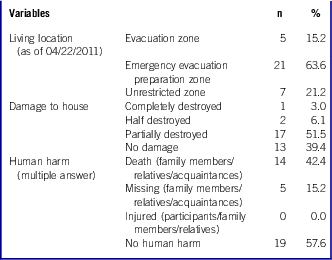
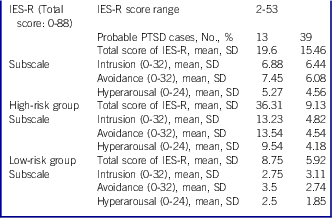
In total, 38 nurses participated in our study through 27 in-depth interviews and 5 focus group interviews (2 or 3 participants per session). The demographic information is presented in Table 1. Tables 2 and 3 show the disaster situations and IES-R results, respectively. Five nurses were excluded because they were from different prefectures and were not in the hospital during the disaster.
Participants’ Attributes (Total of 38 Affected Nurses)

Conditions of the Affected Nurses (Total of 33)

Results of Japanese Version of the Impact of Events Scale-Revised (IES-R) (33 Affected Nurses)

Impact of Event Scale-Revised (IES-R)
The mean IES-R score was 19.6, indicating a tendency toward “avoidance.” Overall, 39% of the participants were categorized as at high risk for PTSD (score ≥25), demonstrating a strong propensity for “avoidance” and “intrusion.”
Qualitative Results
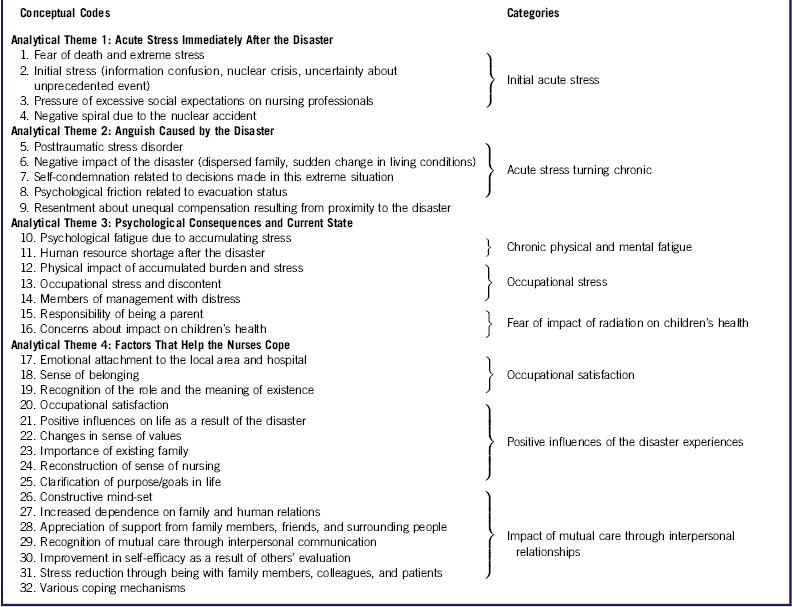
As shown in Table 4, four themes (32 conceptual codes and 8 categories) emerged from the data analysis: (1) acute stress immediately after the disaster, (2) anguish caused by the disaster, (3) psychological consequences and current status, and (4) factors that helped the nurses cope.
Conceptual Codes, Categories, and Analytical Themes

Explanation of Conceptual Codes
Some of the important conceptual codes and narrations are shown below.
Theme 1: Acute Stress Immediately After the Disaster
Category: Initial Acute Stress
Although the nurses also feared for their own lives, they were preoccupied with their patients immediately after the earthquake. Many panicked following the news of the nuclear accident. They felt extreme fear and distress due to the uncertainty of the information regarding radioactive contamination.
Group 1
A public announcement was made: “This bus will be the last one, please evacuate …” When I heard the announcement, we were still working just right here where we are now … (Female, age 58)
Like a final farewell … (Female, age 55)
“Keep morale high as a health care provider” said the director. But we all were in a panic. We also heard that the other hospitals already had started evacuating their patients. One professor said, “It is going to be all right as long as we are inside a building.” Nevertheless, a few nurses started crying frantically. (Female, age 33)
Theme 2: Anguish Caused by the Disaster
Category: Acute Stress Turning Chronic
Some participants recognized that they developed PTSD-like symptoms such as panic attacks, depression, avoidance behavior, insomnia, and moodiness. A few reported that they were still suffering from those symptoms at the time of the interview.
Group 2
I still have nightmares about the tsunami. Especially, every 11th of the month reminds me of the tsunami. I didn’t have the nightmare for a few months, but I had it this month … (Female, 40s)
I don’t want to see the ocean even now. To be honest, I wish I could be away from here. I have lost my “human emotions” (in Japanese, kidoairaku: joy, anger, sorrow, and pleasure). I haven’t had a sound night’s sleep since the disaster … (Female, age 37)
In order to fulfil their duties, the nurses were pressed to choose between their professional and familial roles. They had regret and guilt no matter which they chose. They felt self-condemnation for the decisions they made during the extremely dire situation.
Group 3
I told my son, “I can’t leave the patients who cannot eat or move by themselves.” He replied, “Not only do the patients need you, but I also need you, Mom. You are my only Mom in the world.” So I’m indebted to my son until I die. (Female, age 48)
I have felt guilty since then. I have not been sleeping well at all. I should not have evacuated. (Female, age 55)
Theme 3: Psychological Consequences and the Current State
Category: Chronic Physical and Mental Fatigue
It was very difficult for the nurses, especially those at the managerial level, to take a day off. They worked continuously before and after the disaster. The cumulative stress intensified their physical and emotional fatigue. The acute shortage of human resources caused the nurses excessive workloads, stress, and insomnia, and also affected their personal chronic illnesses. Simultaneously, they also had to manage, organize, and support the influx of volunteers while dealing with the media.
Category: Fear of Impact of Radiation on Children’s Health
Some of the participants were very concerned about the long-term impact of radiation exposure on their children’s health. They had a strong sense of parental responsibilities amidst the conflict between parental and professional roles.
Category: Occupational Stress
Some of the upper management nurses were promoted or demoted into different hospital units because of a shortage of staff following the disaster. As a result, they were uncomfortable and felt a lack of self-efficacy in performing tasks at which they were unskilled or inexperienced. Furthermore, some nurses from different prefectures did not feel welcomed by the local nurses.
Group 4
Dismissed! I was fired despite a staff shortage. I was really depressed. I thought I was useless … (Female, age 60)
I would like to be demoted from chief nurse. I wish I could have been promoted in a normal situation, not under such special circumstances. (Female, age 33)
I don’t think I am needed here. I feel I am unwelcome here. The local staff was tired of welcoming new staff from other prefectures. (Female, age 35)
Theme 4: Factors that Help the Nurses Cope
Category: Occupational Satisfaction
The nurses reported occupational satisfaction from their experiences of the disaster as follows: (1) occupational pride, self-efficacy, and self-confidence; (2) connectedness and a sense of belonging to the community and hospital as well as understanding and support from family and coworkers; (3) gratitude or words of appreciation from their patients; and (4) recognition of their roles and the meaning of their existence, which led them to think that they were needed and useful to others.
Category: Positive Influences of the Disaster Experiences
The nurses lost almost everything in the disaster. They were thankful to be alive and eventually realized what was really important. After the disaster, the nurses appreciated the value of life and their relationships and placed less priority on material things. The experience made them reconsider their life goals, roles, and the importance of their existence, which led them to a clearer sense of purpose, not only as individuals but also as professionals.
Group 5
I had the opportunity to meet peers from other areas, and was inspired by their sincerity and high motivation to work. As a result, my goal has become clear. I would like to work for community health care in remote areas. (Female, age 33)
Category: Impact of Mutual Care Through Interpersonal Relationships
The nurses became much more appreciative of their lives and were grateful even for small things. They realized the importance of social cohesion and expressed appreciation for their family members, close friends, and the social support around them.
Group 6
Not only myself but also my children started being thankful whenever we ate. I was really glad to be able to cook. I had not done such daily chores for months, since our evacuation. So I cried at meals with my family. (Female, age 42)
The nurses were more confident and felt encouraged by others, including their neighbors, those inside or outside of the hospitals, the volunteers they met, and even the media.
Group 7
For some reason, I survived. There might be some meaning to this, so I will do my best. (Female, age 53)
The understanding of their family members, words of appreciation from their patients, and peer support from coworkers greatly helped reduce stress.
Group 8
Many coworkers quit their jobs. I have lost them. If I do my best, I can only hope that the coworkers will come back some day and we will work together like we used to before the earthquake. I almost felt lost. Then one patient said to me, “Thanks to you, I am here and I am alive.” I realized I had missed the truth. (Female, age 48)
My relatives and acquaintances are dead. My parents’ house is completely destroyed. I saw many people confronting a harsh reality. So I thought I was luckier than the others … (Female, age 53)
DISCUSSION
To our knowledge, this is one of the few studies that has qualitatively explored the psychosocial consequences of the Great East Japan Earthquake of 2011 and the Fukushima Complex Disaster among the affected nurses.
This study had 3 main aims: (1) to assess the psychosocial consequences among the nurses affected by the Great East Japan Earthquake of 2011, (2) to identify their coping strategies, and (3) to explore possible countermeasures against complex disasters.
Psychosocial Consequences Among the Affected Nurses
The results revealed that the affected nurses had strong self-condemnation; separation; and accumulated fatigue, stress, and other difficulties that were observed in studies from other countries.Reference Yonemoto and Mano11–Reference Shiga, Kida and Yokoyama13
The nurses demonstrated a strong tendency to have PTSD, with a high score of “avoidance” to shun unpleasant conditions of intrusion and hyperarousal. The participants tended to avoid activities and reactions that might cause emotional paralysis. The participants in our study had a higher possibility of developing PTSD than those of past disastersReference Kawamura, Goto and Matsuda14, Reference Kobayashi15 or from other areasReference Matui, Yamazaki and Kohama16 affected by the same Great Tohoku earthquake and Tsunami, such as the coastal regions of Iwate and Miyagi prefectures.Reference Matsui, Yamazaki and Kiyoshi17 This could imply that the nurses in the Fukushima region in areas close to the FDNPP probably faced twice as much stress (natural disaster and nuclear accident) as nurses in other areas. A previous quantitative study also presented very similar results regarding affected nurses working near the coastal area in Fukushima.Reference Matsui, Yamazaki and Kiyoshi17
Our study revealed that the participants who were female,Reference Kuwabara, Shioiri and Toyabe18 middle-aged and older, in a managerial position, from the restricted zone, had severe property damage,Reference Kuwabara, Shioiri and Toyabe18, Reference Abramson, Stehling-Ariza and Garfield19 and lived in coastal areas (with a greater threat of tsunamis) had a comparatively high risk of developing PTSD.
Furthermore, female professionals in disaster medicine have unique qualities. Nursing jobs mainly engage women, especially young nurses who work for the inpatient department. They may become pregnant and/or be raising small children. Furthermore, HCPs are more likely to assume responsibility not only for their patients’ lives at the hospital but also for their children at home. They must face great distress under difficult conditions, as the physical and mental impact of the nuclear crisis will be long lasting. Yonemoto pointed out that the nuclear event affected the nurses’ group dynamics, work and family relationships, and mental health.Reference Yonemoto and Mano11 Holly stated that the majority of public health workers reported difficulty balancing the demands of home and family with work.Reference Herberman Mash, Fullerton and Kowalski-Trakofler20
Coping Strategies Among the Affected Nurses
Despite the high PTSD scores, most of the affected nurses explained the disaster’s personal significance to them in terms of the value of life, fruitfulness, and fulfilment. Fu-Jin noted that rescue experiences helped strengthen most Taiwanese nurses’ professional competence, reinforced their commitment to nursing, and caused them to have positive life goals; they recognized the impermanence of life and decided to lead more significant lives and had a better appreciation of the value of nursing and their own self-worth.Reference Shia, Liao and Chan21
Yamazaki pointed out that many nursing professionals felt mentally stressed when they were blamed or criticized for not going to work. On the other hand, many felt relieved and wanted to continue with their jobs when they were encouraged or appreciated for working throughout the disaster.Reference Yamazaki and Tanno4 They also recognized the value of life and felt a sense of renewed commitment to nursing.Reference Shia, Liao and Chan21
Mutual care through interpersonal relationships, such as with their family members, coworkers, and other supporters, had an especially positive impact on the nurses in both assisting recovery and enhancing their own psychological well-being.Reference Herberman Mash, Fullerton and Kowalski-Trakofler20 Shih indicated that it was very important for nursing colleagues to work together and form a relief team to provide adequate mutual support.Reference Shia, Liao and Chan21
There were some similarities concerning psychological responses and coping mechanisms in the disaster recovery process between our results and those of previous studies from the United States.Reference Gloria, Orlando and Savage22, Reference Geisz-Everson, Dodd-McCue and Bennett23
However, there were some differences between our study and other Japanese research.
Specifically, people living in the affected area had a great perception of helping each other in the community. This indicates that enhancing relationships with others can support their coping process. Similarities were found in the previous study of the Niigata-Chuetsu Earthquake of 2004. For example, 1 studyReference Fukazawa, Yamada and Ishioka24 pointed out that the recovery process among Japanese nurses was more likely to be affected by interpersonal relationships.Reference Tsujiuchi25–Reference Nihei27 On the other hand, previous research has shown that secondary stress among HCPs who faced or listened to disaster victims was likely to cause them to re-experience and relive the disaster.Reference Ohtsuka and Matsumoto8, Reference Collins and Long28 Overall, the present study has several new findings. The first is that HCPs obtained more encouragement than secondary stress through actively listening to their patients.
Possible Countermeasures Against Complex Disasters
We found factors that were unique to this disaster. It was a complex disaster, wherein the natural disaster triggered a nuclear crisis, and the challenges of a complex disaster were clarified, such as the impact of radiation exposure on health, increased fear due to uncertain information, delays in response by the government and municipality, and a lack of safety precautions at the hospital.
The findings of our study suggest that, to support the affected nurses, countermeasures should address various aspects, such as a safety and precaution manual, human resource management, special training on nuclear crises, interpersonal relationships, human resources at the workplace, and safety precautions. Concrete countermeasures should be proposed to the targeted hospitals as follows: create a support system for affected areas in a sustainable way (manpower support, building capacity, and safety enhancements), consider regional peculiarities and social backgrounds, maintain a comfortable work environment, create a taskforce for medicine safety and guidelines, support fulfilling career progress and growth, enhance mutual understanding, and manage human resources. It is most important to disseminate appropriate information for understanding and preparing for complex disasters to the nursing association as well as to nonaffected nurses. In light of the long-term impact of the nuclear disaster on physical and mental health, further research is needed in order to help the affected nurses cope with their stress.
Limitations
The present study is a qualitative and cross-sectional study conducted at 1 hospital with a small sample size. The results cannot be generalized. We could not measure the natural features of psychology and behavior or the sense of religion and how that affected the current psychological status of the participants. Furthermore, there is a possibility that sampling bias could lead to higher PTSD scores. Management personnel accounted for a large proportion of the participants because the author asked each department to cooperate with the interview process. Interviewer bias might have had an effect on the results.
CONCLUSIONS
Mutual care through interpersonal relationships had a positive impact on both assisting recovery and enhancing psychological well-being among the affected nurses who were suffering from negative psychological consequences of working in the disaster sites. The nuclear crisis created a severe shortage of health care providers. Disaster management should reflect the unique aspects of conflicting roles between professional and family responsibilities among nurses affected by a crisis. The present study suggests that enhancing mutual relationships, increasing human resources, and providing appropriate safety precautions are urgently needed to help affected nurses balance their professional and personal lives.
Acknowledgements
We sincerely thank the hospital staff for cooperating with this study, especially the director and nursing director. We also thank the nurses for participating even though they faced tremendous stress and difficulties at the time.
Author Disclosure
The authors declare no conflicts of interest.