



Introduction
The Longshan period (c. 2500–1900 BC) was a crucial time for state formation in central China. During this period, inter-regional networks developed rapidly, transmitting shared material forms and cultural practices across wider areas and contributing to changes in social organisation and ideology that foreshadowed the rise of states and cities at the end of the third millennium BC (Yan Reference Yan1981; Chang Reference Chang1989; Zhao Reference Zhao2000; Li Reference Li2017). Human mobility is likely to have played an important role in these processes; however, our knowledge of the scale and type of movement is limited. In this article, we use isotopic analysis of individuals from a Longshan-period cemetery to identify and characterise the nature of human mobility and its significance in relation to the intensification of inter-regional networks during the late third millennium BC.
The Taosi culture (c. 2300–1900 BC), located in the area of present-day southern Shanxi Province, was the first group in the middle Yellow River Valley to establish cities of a royal character and it became the most complex society of the Longshan period (He Reference He and Underhill2013, Reference He2018). The site of Taosi, extending across an area of more than 300ha, is one of the largest settlements in Neolithic China, featuring a palace enclosure, astronomical ‘observatory’ and royal tombs with many ritual vessels symbolising royal power as well as extensive areas of hierarchically organised settlement activity (He Reference He2011). Approximately 25km north of the Taosi site area is the Xiajin cemetery, which features the largest number of Taosi-culture burials excavated to date. The organisation of the cemetery demonstrates clear hierarchical differentiation and social inequality, with high-status (noble) males accounting for more than 90 per cent of the social wealth attested by the size of tombs (Gao et al. Reference Gao, Gao and Zhang1983; Linfen & Shanxi 1999; Shanxi & Shanxi 2022). The Taosi culture appears to have been a patriarchal society, with males controlling property through succession; marriage was likely the only way for females to obtain wealth and higher social status (Li Reference Li1985).
The Taosi culture was located in Jizhou (冀州), one of the regions of the Jiuzhou (九州) or Nine Provinces recorded in the Yugong (禹贡), or ‘Tribute of Yu’, a chapter in the Shangshu (尚书) or ‘Book of Documents’. It is possible that the Taosi site was the capital city of Yao (尧) (Li Reference Li1985; Zhang Reference Zhang2010; He Reference He2015). Archaeological discoveries in this region reveal the incorporation of numerous foreign cultural elements, including the use of jade and copper, alligator drum (wooden frames covered with alligator skin), painted pottery and various funeral customs (Xu Reference Xu2014; Wu Reference Wu2018; Qin Reference Qin2020). The network that brought these elements to the region extended from the highlands to the west to the coast of the Shandong more than 700km to the east, and from the Yangtze River Valley in the south to the steppe in the north. Over a period of five centuries during the late third and early second millennia BC, encompassing the transition between the Taosi (c. 2300–1900 BC) to Erlitou (c. 1900–1500 BC) cultures, the middle reaches of the Yellow River rapidly developed from a series of chiefdoms into a single territorial state (Liu & Chen Reference Liu and Chen2012).
In this article, we focus on the Xiajin cemetery of the Taosi culture (Figure 1), utilising multi-isotope analyses to trace the geographical origins of some of the individuals buried at the site in order to assess the patterns of human mobility during the late Longshan period in southern Shanxi and evaluate the inter-regional social networks that underpinned wider cultural and political developments.
Location of Xiajin and related archaeological sites. 1) Xiajin (highlighted in red); 2) Taosi; 3) Zhoujiazhuang; 4) Qingliangsi; 5) Wanggedang; 6) Meishan; 7) Wadian; 8) Haojiatai; 9) Pingliangtai; 10) Qinglongquan; 11) Xiazhai; 12) Xiawanggang; 13) Shangzhuang; 14) Dawenkou; 15) Xigongqiao; 16) Liangwangcheng; 17) Lingyanghe; 18) Dantu; 19) Liangchengzhen; 20) Simatai; 21) Lushanmao; 22) Shengedaliang; 23) Shimao; 24) Bicun; 25) Dianhe; 26) Xiahaishi; 27) Shangsunjiazhai; 28) Liuwan; 29) Zongri; 30) Yuanyangchi; 31) Xichengyi; 32) Jiaojia; 33) Shijiahe; 34) Qujialing; 35) Liangzhu; 36) Lajia (figure by the authors).

Xiajin cemetery
Xiajin cemetery (36°1′12″N, 111°26′24″E) is approximately 10km south-west of the present-day city of Linfen and 25km north of the Taosi site (Figure 1). The site is situated on a well-developed river terrace at 450m above sea level. Excavations in 1999 identified 533 burials across an area of 2000m2 (Linfen & Shanxi 1999; Shanxi & Shanxi 2022; Figure 2). The original extent of the cemetery is estimated at nearly 6000m2, with potentially more than 1500 burials. The cemetery is thought to have served the 40ha settlement site at Dongdeng, located south of the cemetery in the Fenhe River valley. Large storage pits at Dongdeng, suggest it may have functioned as a land and water transportation hub on the route to the ‘capital’ at the Taosi site (He Reference He2011).

The cemetery at Xiajin demonstrates an orderly layout, with clear hierarchical differences between individual burials expressed in terms of grave size and funerary goods (Figure 2). Despite the extensive robbing of graves, the surviving grave goods of high status, such as jade and stone objects, and the presence of coffins, are almost exclusively associated with the largest graves (Linfen & Shanxi 1999; Shanxi & Shanxi 2022). The mean size of graves containing male individuals is also significantly larger than those containing females (Figure 2). A similar arrangement is seen at the Taosi site, where all of the occupants of a large, royal grave are male with adjacent smaller graves of females, probably the rulers’ wives (Gao et al. Reference Gao, Gao and Zhang1983). At the contemporaneous Qingliangsi cemetery 150km to the south of Taosi, sex-based inequality is even more pronounced: there, most of the large burials are of males, while females were typically buried alive in the same grave as sacrifices (Shanxi 2016). Thus, Taosi burial practices indicate that male-biased inequality, or the lower status of females, was the social norm during the Longshan period in southern Shanxi.
Based on AMS radiocarbon dating of six human teeth (Figure 2), the cemetery dates to 2464–2018 cal BC (Figure 3; online supplementary materials (OSM) Table S1). He (Reference He2006) divides the Taosi culture into three periods spanning c. 2300–1900 BC (previous studies had suggested earlier dates, c. 2600–2000 BC; Gao et al. Reference Gao, Gao and Zhang1983). The radiocarbon dates from Xiajin are therefore consistent with the new chronology with all six individuals corresponding to the early Taosi phase. Individual M521, the earliest of the group, dates to 2464–2290 cal BC (at 95.4% probability), a phase that overlaps with the late Dawenkou (2800–2400 BC) and late Liangzhu (2800–2300 BC) cultures to the east and south-east of the Taosi, respectively. The decline of the Liangzhu culture and expansion of the Dawenkou culture, c. 2300 BC, are major factors in early state formation on the Central Plain (Zhang Reference Zhang2021; Zhang & Zhao Reference Zhang and Zhao2021).
Calibrated radiocarbon dates for human teeth from Xiajin cemetery calibrated in OxCal v4.4.4, using the IntCal20 atmospheric curve (Bronk Ramsey Reference Bronk Ramsey2021; Reimer et al. Reference Reimer2020) (figure by the authors).

Similar to the Taosi site, the Xiajin cemetery demonstrates evidence for some non-local funerary practices and grave goods, with the jade yue axe (玉钺) and the jade bi-disc (玉璧) as two prominent funerary objects. The jade yue was generally placed on an individual's body as a symbol of military power, whereas the jade bi-disc was worn on the wrist as a symbol of wealth and status (Figure 4), customs influenced by the Dawenkou culture (Figure 4). Several of the individuals at Xiajin (Shanxi & Shanxi 2022; Figure 4) and the Taosi cemeteries (CASS & Linfen 2015) were buried wearing turquoise-inlaid bracelets, a practice possibly originating in the Gansu-Qinghai region (Figure 4; see also OSM).
Burials of Xiajin site (Southern Shanxi Region), Jiaojia site (Haidai Region) and Zongri site (Gansu-Qinghai Region) (figure by the authors).

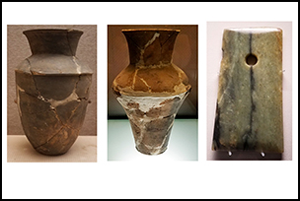
Many of the grave goods from Xiajin cemetery reflect the influence of the Dawenkou and Longshan cultures in the Haidai (海岱) region of eastern China, such as jade yues, jade knives with double holes, cong-shaped jade bracelets, T-shaped jade bracelets and jade discs (Figure 5; see also OSM). Some of these objects are also found at Taosi, Qingliangsi and other sites in southern Shanxi during the Longshan period. The influence of Dawenkou, Liangzhu and Xuejiagang cultures on southern Shanxi through the transmission of jades, musical instruments and burial customs is widely attested (Zhao Reference Zhao2000; Song Reference Song2003; Luan Reference Luan2010; Wu Reference Wu2018, Reference Wu2019; Xu Reference Xu2021). Archaeologically, however, it has proven difficult to establish the role of human mobility in the spreading of these cultural influences and, specifically, the migration of individuals to the Taosi culture area. To help identify potential migrant populations and determine their geographical (and hence cultural) origins, we conducted multi-isotope analyses on 36 males and 31 females from the Xiajin cemetery (see OSM for detailed methods).
Comparison of burial objects from the Xiajin cemetery with those from the Dawenkou and Longshan culture in the Haidai region (non-uniform scale). Xiajin cemetery: 1 & 2) pottery bottles; 3) jade Yue; 4) jade knife with double holes; 5) jade bracelet with repair; 6) cong-shaped jade bracelet; 7) T-shaped jade bracelet; 8) canine teeth of boar; Dawenkou and Longshan culture: 9 & 10) pottery bottles (Lingyanghe); 11) jade Yue (Liangchengzhen); 12) jade knife with double holes (Dantu); 13) jade bracelet with repair (Dawenkou); 14) cong-shaped jade bracelet (Shangzhuang); 15) T-shaped jade bracelet (Simatai); 16) canine teeth of boar (Dawenkou) (figure by the authors).

Results of multi-isotope analyses
The 87Sr/86Sr results
The results of strontium isotope analysis for Xiajin individuals are summarised in Table 1 (see Table S2 for detailed results). Geochemical studies have documented the 87Sr/86Sr ratio of soluble carbonate in the Quaternary loess of southern Shanxi Province as approximately 0.7110–0.7120 (Chen et al. Reference Chen, Qiu and Yang1997; Currell & Cartwright Reference Currell and Cartwright2011). These soluble carbonates are taken up by plants and water in the region and, when consumed by humans and animals, incorporated into teeth and bone. The bioavailable 87Sr/86Sr range available through the consumption of plants and water in the loess region typically show little variation (Zhao et al. 2011; Zhao et al. Reference Zhao, Wang and Ye2016; Cao Reference Cao2021).
Results of strontium isotope analysis of human dental enamel from Xiajin cemetery.

The five local plant samples analysed demonstrate narrow 87Sr/86Sr ratio range of 0.711235–0.711356, with a mean of 0.711299 ± 0.000044 (1SD, n = 5). This result is close to the isotope signatures of a sample of archaeological pig tooth enamel (0.711311) and the soluble carbonate minerals in a sample of loess (0.711429). The mean 87Sr/86Sr ratio of these plant, faunal and mineral samples from Xiajin (n = 7) also closely matches that of a faunal sample from Taosi (0.711170 ± 0.00006, 1SD, n = 9, including 8 pig and 1 dog; Figure 6 & Table S3). Similarities in the age and underlying geology of the Xiajin cemetery and the Taosi site allow us to estimate a local bioavailable 87Sr/86Sr ratio range for the area within a 25km radius around Xiajin of 0.711042–0.711428 (2SD, n = 16; Figure 6).
87Sr/86Sr ratios of human enamel from the Xiajin cemetery. Grey bar shows the local bioavailable 87Sr/86Sr range of Xiajin site with a radius of 25km defined by 16 local non-human samples; red dotted line shows the range defined by Xiajin human samples (mean ± 2SD, n = 67) (figure by the authors).

Table 1 shows that Xiajin females have a greater range and variation in 87Sr/86Sr ratios than males. More specifically, the isotopic signatures of 23 of the individuals fall outside the local bioavailable 87Sr/86Sr range, including 16 females and seven males (Figure 6). More females than males may therefore be categorised as non-local, though most of these individuals still fall within the bioavailable 87Sr/86Sr ratio of the loess zone beyond the 25km radius area of Xiajin Cemetery. Exceptions are three adult females (M273, M308 & M521) who clearly stand out with 87Sr/86Sr values of 0.71070–0.71204 defined by Xiajin human individuals (0.711368 ± 0.000668, 2SD, n = 67) (Figures 6 & 7; OSM Tables S2 & S3). We infer that at least three individuals buried at Xiajin cemetery came from beyond the Linfen Basin.
Bioavailable Sr isotope distribution in the Yellow River Valley and surrounding areas. Yellow circles represent data from this study, green circles represent published data, numbers indicate sites listed in Table S3 (figure by the authors).

The δ13C results
The δ13C values of human tooth enamel from Xiajin range from –4.5 to –0.7‰, with a mean of –1.7 ± 0.65‰ (1SD, n = 67; Figure 8, Table S2). Assuming a dietary enrichment factor of 12–14‰ (Passey et al. Reference Passey2005, Cerling et al. Reference Cerling2013), these results suggest that the local Xiajin people consumed a predominantly C4 diet. This finding is consistent with archaeobotanical evidence for the predominance of millet in Taosi agriculture (Zhao & He Reference Zhao and He2006) and with the results of previous isotopic analyses of humans and pigs in southern Shanxi during the Longshan period (Zhang et al. Reference Zhang, Qiu and Bo2007; Chen et al. Reference Chen2012). Two individuals (M83 & M124), both female, demonstrate δ13C values that are significantly lower than the range (−3.1 to −0.5‰) defined by Xiajin human samples (Figure 8). Plotting at –4.3‰ and –4.5‰, respectively, these values indicate a mixed C3/C4 childhood diet that is inconsistent with known cultivation strategies in southern Shanxi during this period (Song et al. Reference Song, Wang and Fuller2019).
Scatter diagrams of 87Sr/86Sr vs δ18O and δ13C vs δ18O of human enamel from Xiajin cemetery. Red circles represent females, blue circles represent males. Grey dashed lines show ranges defined by mean 87Sr/86Sr ratio, mean δ13C and mean δ18O (± 2 SD in each case, n = 67 human individuals). Red shading shows the 87Sr/86Sr ratio range defined by 16 local non-human samples (figure by the authors).

The δ18O results
The δ18O values of human tooth enamel from Xiajin have a range of –10.1 to –6.6‰, with a mean of –8.2 ± 0.64‰ (±1SD, n = 67). Using two standard deviations from the mean, we define a range of –9.5 ‰ to –6.9‰ for those individuals growing up around Xiajin (Figure 8, Table S2). The δ18O values of three females fall outside of this range, with M83 showing an elevated value and M269 and M329 showing depressed values in comparison with other individuals from the area (Figure 8). We infer that M269, M83 and M329 were non-locals who migrated to the Xiajin area during early childhood.
Discussion
Multi-isotope (87Sr/86Sr, δ13C, δ18O) analyses indicate that 24 out of the 67 individuals from the Xiajin cemetery potentially grew up in areas more than 25km away from their final resting places. This group includes 17 females and seven males. These non-locals account for 36 per cent of the sampled population and 55 per cent of the 31 females. At least seven females (M83, M124, M269, M273, M308, M329, M521) appear to have migrated to Xiajin from three different areas outside the Linfen Basin (Figures 8 & 9). M273 has the lowest 87Sr/86Sr ratio, which may indicate a childhood in the Shandong coastal area (Figure 7, Table S3), while M521 and M308 exhibit the highest 87Sr/86Sr ratios. Although most areas in southern Shanxi have uniform strontium isotope ratios under the influence of the loess soils, the northern foothills of Zhongtiao Mountain and the Taihang Mountain, more than 100km away in southern Shanxi, are composed of gneiss, granite, sandstone and other rocks with high Rb/Sr ratios. The radiogenic strontium content of water and plants in that area is thus high, with strontium isotope ratios averaging between 0.7120 and 0.7130 (Figure 7, Table S3), and it cannot be ruled out that M521 came from the Zhongtiao Mountain or Taihang Mountain area. The isotopic signatures of M273 and M308 lie beyond southern Shanxi, however, and these individuals are likely to have come from coastal areas and the southern Haidai region, respectively, more than 700km to the east.
Three-dimensional scatter plot of 87Sr/86Sr, δ18O and δ13C of human enamel from Xiajin cemetery (figure by the authors).

The δ13C values for individuals M83 and M124 indicate a mixed C3/C4 diet in early childhood. Although rice (a C3 plant) was cultivated in southern Shanxi during the Longshan period (Song et al. Reference Song, Wang and Fuller2019), archaeobotanical and stable isotope studies reveal that C4 crops, including foxtail and broomcorn millets, dominated diet in this area (Zhao & He Reference Zhao and He2006; Zhang et al. Reference Zhang, Qiu and Bo2007; Chen et al. Reference Chen2012). In contrast, in the Haidai region and Upper Huai River Valley, crop cultivation was more diverse (He et al. Reference He2017) and isotopic signatures indicate a mixed C3/C4 diet at sites such as Liangchengzhen (Lanehart et al. Reference Lanehart2011), Xigongqiao (Hu et al. Reference Hu2005), Wadian (Chen et al. Reference Chen2012; Zhou Reference Zhou2017), Haojiatai (Zhou Reference Zhou2017; Li et al. Reference Li2021), Meishan (Zhou Reference Zhou2017) and Xiazhai (Zhou Reference Zhou2017). Individual M83 further demonstrates the highest δ18O value of all individuals (–6.6‰; Figure 8), indicating a childhood at a lower elevation and closer to the sea. M83 and M124 therefore probably originated from the Haidai region. In contrast, the more negative δ18O values of M269 and M329 combined but with 87Sr/86Sr and δ13C values similar to the rest of the Xiajin sample suggest that these individuals came from an area further from the sea, at a higher altitude and with a lower average temperature, perhaps the north-west highlands.
Multi-isotopic signatures are more variable among female than male individuals in Xiajin cemetery and almost all outliers are female (Figure 9). These results suggest a high proportion of female mobility within a wide geographical region, and the long-distance migration of several individuals from beyond the Taosi cultural area. At the contemporaneous sites of Lajia and Xichengyi (Figure 1), all the individuals with non-local isotopic signatures are female (Zhao Reference Zhao and Wei2012; Zhao et al. Reference Zhao, Wang and Ye2016). This greater variability in the geographical origins of females compared with males at Xiajin, and other Taosi sites, suggests a pattern of female exogamy (Ericson Reference Ericson1985), a practice that is widely cited as a key factor in high female mobility in other world prehistoric contexts (Knipper et al. Reference Knipper2017).
During the Taosi cultural period (c. 2300–1900 BC), societies in the Middle Yellow River Valley became increasingly patriarchal (Zhang Reference Zhang1987, Reference Zhang2000). Social differences between the sexes are apparent in burial customs at the Taosi and Xiajin cemeteries, where the large graves are all of males. Exogamous marriage systems are often observed within patrilineal clan societies resulting from a prohibition of marriage within the clan (Zhang Reference Zhang1987; Yu Reference Yu2000). Female mobility for marriage generally occurs during adolescence and these individuals may be buried in the place to which they moved; however, their teeth maintain an isotopic record of their early childhood home. Analysis of the third molar (in which enamel forms between the age of eight and 16 years) of non-local individual M269 gives an outlying δ18O value that suggest this female did not relocate to Xiajin until aged 16 or older. Such results are consistent with a system of female exogamy.
A survey of family genealogies in rural districts of Shanxi Province in the 1930s found that the majority of women who moved for marriage came from villages within 5km of their husbands’ homes (Han Reference Han2017). During the Longshan period this 5km radius around a central settlement represented an area of self-sufficiency, within which production, intermarriage and ritual met the social needs of the population (Sun Reference Sun2020). Multi-isotope analyses suggest that seven males (19.4%) from the cemetery grew up beyond the Xiajin area (within a 25km radius), but all still within the wider Taosi culture area. These males probably came from villages in the region near the central settlement. In contrast, of the 17 females with non-local isotopic signatures, only 10 moved from surrounding areas; at least seven females migrated to Xiajin from more distant regions. Why did these individuals travel so far, even from Shandong and the north-west highlands, when most exogamy occurred within 5km of the central settlement?
Shangshu Yaodian (尚书⋅尧典) records that emperor Yao (尧) married his two daughters to Shun (舜), who then inherited the throne from him. The archaeological discoveries of the Taosi city are highly consistent with the recorded “Pingyang, the capital of Yao”, therefore many scholars believe that the Taosi city is the capital of Yao (Li Reference Li1985; Zhang Reference Zhang2010; He Reference He2015). Historical studies suggest that the Yao belonged to the Huaxia (华夏) ethnic group. The Huaxia ethnic group is distributed in the Loess Plateau and the middle reaches of the Yellow River (Xu Reference Xu1985). Shun was from the Dongyi (东夷) ethnic group (Li Reference Li1983; Dong Reference Dong2000) which may be represented by the Dawenkou and Longshan culture in the Haidai region (Li Reference Li1983). Marriage between Shun and Yao's daughters united these two regions and created a political alliance between the Huaxia and the Dongyi that may have formed the foundations for the Erlitou state in the Central Plain.
Recent research on ancient DNA suggests that matrilineal genetics—measured through mitochondrial DNA—were relatively straightforward in Shandong before and during the Dawenkou period, but from the Longshan period onwards matrilineal genetics became more complex (Liu et al. Reference Liu2021). Xue and colleagues (Reference Xue2022) have recently found that during the Longshan period Taosi populations were genetically similar to Shimao groups in northern Shaanxi and to the Longshan in Shandong. These results reflect the prevalence of inter-regional marriage during the Longshan period. Yu (Reference Yu2000) points out that around 5000 years ago chiefdom alliances grew in size, with female exogamy facilitating multi-generational political alliances between ruling families. Our results suggest that inter-regional alliances at Xiajin were not focused on just one region but rather extended over several areas, stretching from the coastal Shandong to the Gansu-Qinghai region in the west.
As early as the late fourth millennium BC, there was a network of long-distance cultural connectivity between the elites of different regions across China (Li Reference Li2015). During the Longshan period, however, these connections diversified to encompass not only the exchange of material culture and ideas but also political unions, leading to cross-regional alliances; marriages were an important means of maintaining these relationships. Bronze inscriptions of the Zhou Dynasty (1046–256 BC) record a large number of vassal state marriages (Falkenhausen Reference Falkenhausen2006; Liu Reference Liu2019) and this system of political alliance may already have been maturing in the late third millennium BC.
Beyond China, archaeological evidence from central Europe suggests that patrilocality and female exogamy were also widespread in that region during the Late Neolithic and Early Bronze Age of the third millennium BC (Haak et al. Reference Haak2008; Müller et al. Reference Müller2009; Sjögren et al. Reference Sjögren, Price and Kristiansen2016). In Bronze Age Germany, females were often buried in locations that differ from the isotopic signatures of their childhood homes, while males show continuity of residence throughout their lives. At seven Late Neolithic/Early Bronze Age archaeological sites in the Lech River Valley, Germany, the majority of females not only have isotopic signatures indicative of post-adolescent migration to the area but also lack genetic kinship with other members of these communities; in contrast, biological kinship was apparent between contemporaneous male individuals (Knipper et al. Reference Knipper2017; Mittnik et al. Reference Mittnik2019).
If the rise of patriarchal societies is viewed as a consequence of the acquisition of valuable resources—such as copper and tin, as well as the growing importance of war at the outset of the Bronze Age—then exogamy and political marriages can be seen to be common phenomena in the development of Eurasian societies. Marriage across distant regions not only wrought political alliances but also facilitated the rapid spread of knowledge, technologies and materials. Sheet-cutting jade techniques and bronze metallurgy pioneered elsewhere appear to have been adopted at the Taosi site at this time (Jaang Reference Jaang2015). Jade zhang blades, yues and knives found in Xiajin burials strongly resemble those of the highland Longshan groups (Deng Reference Deng2017; Wang & Yang Reference Wang and Yang2018) and a copper bell, unearthed at the Taosi site and the earliest example of a multi-cast copper artefact in the Central Plain (Hwang Reference Hwang2014), is compositionally and morphologically similar to artefacts from Shimao and Xichengyi sites (Wu Reference Wu2018). Two of the females from Xiajin with low δ18O values may have come from inland areas, such as northern Shaanxi, Gansu and Qinghai; evidence of smelting and numerous bronze artefacts dating to c. 2000 BC have been recovered from these areas (Gansu 2014; Sun et al. Reference Sun2018). Just as female cross-regional migration may have aided the spread of metal technologies across central Europe, female exogamy in the Longshan period may have been an important medium for the spread of metallurgy from the north-west region to the Central Plains.
Conclusion
Multi-isotope analyses of the Taosi culture population at the cemetery of Xiajin indicate high levels of long-distance female mobility; most males either grew up in the immediate environment of Xiajin or within a radius of 25km. These results point to exogamous inter-regional marriages between different ethnic and cultural groups. During the Longshan period, states competed to form alliances for political, economic and military advantage, fuelling the expansion of long-distance networks. Marriage between elites played an important role in creating and maintaining these alliances. Alliance through marriage between the Huaxia and Dongyi at the end of the Longshan period not only facilitated the political and cultural integration of these regions but also possibly laid the foundations for the formation of the Erlitou state in the Central Plain.
Acknowledgements
We would like to thank Xinming Xue and Jianwen Tian of Shanxi Provincial Institute of Archaeology for sample collection. We also thank the anonymous reviewers for their extremely helpful advice.
Funding statement
This work was supported by the National Social Science Foundation of China (22CKG025).
Supplementary material
To view supplementary material for this article, please visit https://doi.org/10.15184/aqy.2023.173.






