Introduction
Community-based psychosocial rehabilitation programs have provided support and treatment for adults diagnosed with schizophrenia over the past 40 years (Barton, Reference Barton1999; Anthony et al. Reference Anthony, Cohen, Farkas and Gagne2002; Drake et al. Reference Drake, Green, Mueser and Goldman2003). There have been numerous studies on functional outcomes from community-based programs (see Olfson, Reference Olfson1990; Solomon, Reference Solomon1992; Test, Reference Test and Liberman1992; Bond et al. Reference Bond, McGrew and Fekete1995; Scott & Dixon, Reference Scott and Dixon1995; Penn & Mueser, Reference Penn and Mueser1996; Mueser et al. Reference Mueser, Bond, Drake and Resnick1998; Dixon, Reference Dixon2000; Bustillo et al. Reference Bustillo, Lauriello, Horan and Keith2001; Mueser & McGurk, Reference Mueser and McGurk2004; Kopelowicz et al. Reference Kopelowicz, Liberman and Zarate2006 for reviews). These studies have consistently reported that a variety of psychosocial interventions can increase housing stability and diminish hospitalization rates; in some cases aspects of psychosocial functioning in work, social or independent-living domains have been improved. Despite the general success of these community-based rehabilitation interventions, there is considerable heterogeneity in their impact across individuals (Brekke et al. Reference Brekke, Long, Nesbitt and Sobel1997a, Reference Brekke, Hoe, Long and Green2007; Brekke & Long, Reference Brekke and Long2000) and the individual and service factors that contribute to or influence the effectiveness of the intervention are not well understood (Bellack & Mueser, Reference Bellack and Mueser1993; Mueser et al. Reference Mueser, Bond, Drake and Resnick1998; Barton, Reference Barton1999; Brekke & Long, Reference Brekke and Long2000). As Barton (Reference Barton1999, p. 525) stated: ‘Outcomes research strongly supports use of psychosocial rehabilitation but is insufficiently developed to determine the effects of service components used at varying levels of intensity and the interaction of those components with client characteristics, medication levels, or phase of the illness.’ Continued research is needed to increase our knowledge about the individual and service factors that influence the effectiveness of community-based psychosocial rehabilitation (Mueser et al. Reference Mueser, Bond, Drake and Resnick1998; Brekke et al. Reference Brekke, Hoe, Long and Green2007). This knowledge will provide an understanding of the conditions and mechanisms that can be used to increase the impact of community-based psychosocial rehabilitation interventions for individuals with schizophrenia and other severe mental illnesses.
Over the past decade there has been increasing knowledge about how neurocognition in schizophrenia is related to functional outcomes and treatment responsiveness. Neuropsychological correlates of psychosocial functioning were demonstrated (Brekke et al. Reference Brekke, Raine, Ansel, Lencz and Bird1997b; Penn et al. Reference Penn, Spaulding, Reed, Sullivan, Mueser and Hope1997) and have been replicated continuously (Green et al. Reference Green, Kern, Braff and Mintz2000 for review; Velligan et al. Reference Velligan, Bow-Thomas, Mahurin, Miller and Halgunseth2000; Gold et al. Reference Gold, Goldberg, McNary, Dixon and Lehman2002; Malla et al. Reference Malla, Norman, Manchanda and Townsend2002). Longitudinal studies have shown that neurocognition at baseline predicts later functional outcome (Brekke et al. Reference Brekke, Kay, Kee and Green2005; Green et al. Reference Green, Kern and Heaton2004 for a review) and functional improvement during rehabilitation (Dickerson et al. Reference Dickerson, Boronow, Ringel and Parente1999; Brekke et al. Reference Brekke, Hoe, Long and Green2007). There has also been theoretical speculation, and some findings, to support the notion that neurocognition moderates the impact of psychosocial interventions on rehabilitative outcomes (Green & Nuechterlein, Reference Green and Nuechterlein1999; Brekke et al. Reference Brekke, Hoe, Long and Green2007). These findings suggest that neurocognition facilitates rehabilitative change both directly and as a moderator.
Given the importance of neurocognition to functioning and rehabilitative change, there has been a focus on interventions to improve neurocognition in schizophrenia. Two meta-analytic reviews of cognitive remediation interventions (Kurtz et al. Reference Kurtz, Moberg, Gur and Gur2001; McGurk et al. Reference McGurk, Twamley, Sitzer, McHugo and Mueser2007a) conclude that global neurocognition, and also many specific domains of neurocognition such as verbal working memory, can be improved by cognitive remediation.
Based on the assumption that neurocognitive change could be a foundation for functional change, there have also been attempts to integrate cognitive remediation and psychosocial rehabilitation interventions (Twamley et al. Reference Twamley, Jeste and Bellack2003; Gold, Reference Gold2004; McGurk et al. Reference McGurk, Mueser, Feldman, Wolfe and Pascaris2007b). Although cognitive remediation seems to facilitate functional rehabilitative change (McGurk et al. Reference McGurk, Twamley, Sitzer, McHugo and Mueser2007a), Spaulding et al. (Reference Spaulding, Reed, Sullivan, Richardson and Weiler1999) (though not randomizing to high- and low-intensity conditions) showed that there is significant neurocognitive change due to intensive psychosocial rehabilitation inputs that are not specifically designed to change neurocognition. Therefore, a fundamental question concerns whether neurocognitive change (whether from neurocognitive specific or non-specific inputs) is linked to functional rehabilitative change (Brekke et al. Reference Brekke, Hoe, Long and Green2007). In this regard, there is evidence from meta-analyses that adding cognitive remediation to existing psychosocial rehabilitation interventions produces greater cognitive and greater functional change than psychosocial intervention alone (McGurk et al. Reference McGurk, Twamley, Sitzer, McHugo and Mueser2007a). There are also two psychopharmacological treatment studies that found that the change scores on neurocognition were correlated with the change scores on social competence (Harvey et al. Reference Harvey, Patterson, Potter, Zhong and Brecher2006; Keefe et al. Reference Keefe, Sweeney, Gu, Hamer, Perkins, McEvoy and Lieberman2007). However, there is a need to examine the empirical link between neurocognitive change and functional change during psychosocial rehabilitation interventions, where functional change is the targeted outcome and where the mechanisms related to functional change can be addressed.
Service intensity has also been related to the effectiveness of rehabilitative interventions. In several studies Brekke et al. (Reference Brekke, Long, Nesbitt and Sobel1997a, Reference Brekke, Ansel, Long, Slade and Weinstein1999, Reference Brekke, Hoe, Long and Green2007) have found that more days of service are linked to greater rates of functional improvement. They also found that the pretreatment level of neurocognition (including social cognition) interacts with service intensity to influence the level of functioning and the rate of rehabilitative change during an intervention. As a next step, the aim of the current study was to examine neurocognitive change as a factor in rehabilitative interventions.
Based on the literature cited above there is a need to understand how much neurocognitive change occurs in community-based psychosocial intervention, whether neurocognitive change and functional change are linked, and how neurocognitive change combines with service level factors, such as treatment intensity, to facilitate functional rehabilitative change. Addressing these issues is essential to understanding the conditions and mechanisms that facilitate rehabilitative change during community-based psychosocial interventions. For example, if neurocognitive improvement influences the rates of rehabilitative change, or if it moderates the relationship between service intensity and functional change, this would suggest that neurocognitive change (due to any factor) could be a foundation for responsiveness to psychosocial interventions, and would provide further empirical evidence for the role of cognitive remediation as a potentiating factor in psychosocial rehabilitation interventions.
This study was designed to test the following hypotheses relating to the effectiveness and the mechanisms of change in community-based psychosocial intervention: (1) there will be significant neurocognitive improvement for schizophrenic individuals during 1 year of community-based psychosocial intervention; (2) there will be a significant relationship between neurocognitive change and functional change; and (3) neurocognitive change will moderate the relationship between service intensity and the rate of functional rehabilitative change during the intervention, such that greater neurocognitive improvement will strengthen the relationship between service intensity and functional improvement.
Method
Subjects
The sample consisted of 130 individuals diagnosed with schizophrenia or schizo-affective disorder who were recruited upon admission to one of four community-based psychosocial rehabilitation programs in Los Angeles County (Brekke et al. Reference Brekke, Hoe, Long and Green2007). The four program sites were part of a county-mandated mental health service initiative (Young et al. Reference Young, Sullivan, Murata, Sturm and Koegel1998). These programs were comprehensive service environments that provided integrated and comprehensive rehabilitative services: mental health treatment, housing services, social and vocational rehabilitation, substance abuse treatment, 24-hour crisis response, and on-site psychiatric care. Diagnoses were determined using two sources of diagnostic information and a three-step diagnostic checklist used by research staff. The two sources of information were: (i) an automated on-line diagnostic record system operated by the County; and (ii) the chart diagnosis that was completed by an on-site psychiatrist after a client interview. In the small number of instances where there was inconsistency between the two sets of diagnostic data, the psychiatrist was consulted to reach a final study diagnosis. Subjects were included if they met the following criteria: (1) diagnosis of schizophrenia or schizo-affective disorder; (2) residence in Los Angeles for at least 3 months before study admission; (3) age 18–60 years; and (4) no primary diagnosis of alcohol or drug dependence in the previous 6 months, no mental retardation diagnosis, and no identifiable neurological disorder.
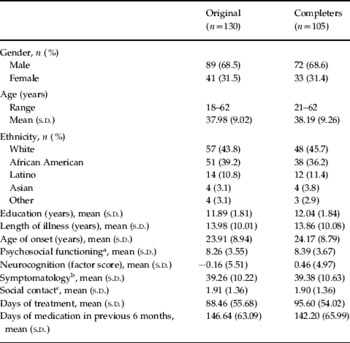
Fifty-six per cent of the subjects came from program site 1, 16% from site 2, 16% from site 3, and 12% from site 4. One hundred and five subjects (81%) completed the 12-month protocol on the study variables. Descriptive data on the sample are reported in Table 1. There was no statistically significant differential attrition across the program sites. There were no statistically significant differences between the study completers and non-completers, nor were there significant differences across the four sites on the variables in Table 1 or on neurocognition change scores. Approximately 40% of the sample came from more restrictive treatment settings or homelessness and the remainder came from other residential or out-patient settings; overall, their functional status was low at study entry. All subjects signed an informed consent under protocols approved by the Institutional Review Boards at the University of Southern California and VA Greater Los Angeles Healthcare System.
Characteristics of the samples: full baseline sample and 12-month completers

s.d., Standard deviation.
a Role Functioning Scale (RFS): total of social, work and independence subscales.
b Expanded Brief Psychiatric Rating Scale (BPRS).
c Social contact scores on the Strauss and Carpenter Outcome Scale (Strauss & Carpenter, Reference Strauss and Carpenter1972).
Study design
Data were collected using a prospective naturalistic design. Psychosocial functioning and psychiatric symptomatology were measured at baseline and then prospectively at 6 and 12 months. Neurocognition was measured at baseline and at 12 months by trained testers who were blind to the scores on psychosocial measures. The neurocognitive data came from laboratory-based assessments in a testing facility designed for this study. Psychosocial and functional data were generally collected within 2 weeks of neurocognition testing by trained interviewers who were blind to the neurocognitive testing results.
Measures
All psychosocial data were gathered in face-to-face interviews conducted at a place of the subject's choosing. The interviewers were masters'-level clinicians trained using a protocol described in detail previously (Brekke et al. Reference Brekke, Levin, Wolkon, Sobel and Slade1993). The Role Functioning Scale (RFS; Goodman et al. Reference Goodman, Sewell, Cooley and Leavitt1993), a scale of choice for measuring community functioning for this population (Green & Gracely, Reference Green and Gracely1987), was used as the functional outcome measure of this study. The RFS uses specific probes and also data from the Community Adjustment Form interview (Test et al. Reference Test, Knoedler, Allness, Burke, Brown, Wallisch, Tamminga and Schulz)1991), which covers multiple areas of community functioning. The RFS contains items capturing the community functioning of individuals in the domains of work, independent living and social functioning. The items on the RFS are anchored so that higher scores reflect decreasing reliance on agency-related support and increasing independence of community functioning. After interview training, the intra-class correlation (ICC) among three interviewers on the RFS items was >0.80. Interviewers were trained on the Brief Psychiatric Rating Scale (BPRS; Lukoff et al. Reference Lukoff, Gioia-Hasick, Sullivan, Golden and Nuechterlein1986) using a protocol described in Ventura et al. (Reference Ventura, Green, Shaner and Liberman1995). After training, the reliability of raters was excellent (median ICC=0.82).
Service intensity was measured with a method successfully used in a previous study of similar sites (Brekke et al. Reference Brekke, Long, Nesbitt and Sobel1997a). Intensity was calculated as the number of days that a consumer received at least one service contact from the admitting rehabilitation agency in the 365 days subsequent to admission to the study. The service contact data were collected by staff on a daily basis for billing and administrative purposes, and were eventually transferred to a county billing system. There was large individual variation in the number of days and minutes of rehabilitation contact. Clients were seen on average about twice a week with an average treatment day representing more than 2 hours of service contact. There were no cross-site differences in service intensity. Although service intensity has been related to functional improvement (cited above), it cannot be assumed that it reflects other potentially important treatment characteristics such as type or comprehensiveness.
Five neurocognitive test measures were used representing five neurocognitive domains: verbal fluency, immediate/working memory, secondary/episodic memory, sustained attention, and mental flexibility. The five tests were the Controlled Oral Word Association Test (Lezak, Reference Lezak1995), the Digit Span Distractibility Test (Oltmanns & Neale, Reference Oltmanns and Neale1975), the California Verbal Learning Test (Delis et al. Reference Delis, Kramer, Kaplan and Ober1987), the Degraded-Stimulus Continuous Performance Test (Nuechterlein & Asarnow, Reference Nuechterlein and Asarnow1992) and perseverative errors from the Wisconsin Card Sorting Test (Heaton, Reference Heaton1981). These domains have been linked to functional outcome in numerous studies (see Green et al. Reference Green, Kern, Braff and Mintz2000, Reference Green, Kern and Heaton2004 for reviews).
Data analysis
Structural equation modeling was used to test the study hypotheses. For testing hypothesis 1, which predicted change in neurocognition between baseline and 12 months, latent mean difference tests were used based on the framework of measurement invariance (Horn & McArdle, Reference Horn and McArdle1992; Byrne & Watkins, Reference Byrne and Watkins2003; Ployhart & Oswald, Reference Ployhart and Oswald2004). Latent mean difference tests are superior to traditional ANOVA or t tests in testing group mean differences (Ployhart & Oswald, Reference Ployhart and Oswald2004). In the context of the current study, the latent mean of neurocognition at baseline is set to zero, and the latent mean of neurocognition at 12 months is tested to determine whether it is significantly different from zero (see McArdle & Woodcock, Reference McArdle and Woodcock1997; Ployhart & Oswald, Reference Ployhart and Oswald2004). In addition, the hypothesized latent mean difference model of neurocognition change is compared with an equal latent mean model, which represents no change in neurocognition between baseline and 12 months.
For testing change in psychosocial functioning over the 12-month study period, the Latent Growth Curve Model (LGCM) was used (Bollen & Curran, Reference Bollen and Curran2006). The LGCM is an analytic tool for examining change in repeated measurements. It permits the estimation of random intercepts and random slopes for each individual and also individual growth trajectories over time. For testing the hypothesized relationship between neurocognitive change and functional change, a linear LGCM was applied simultaneously to two subsamples that reflected the presence or absence of neurocognitive improvement. This method is called the multiple-group LGCM (Duncan et al. Reference Duncan, Duncan and Strycker2006). The variable of service intensity was introduced as a predictor into a multiple-group LGCM to examine the hypothesized relationship between service intensity, change in neurocognition and functional change.
The adequacy of model fit was assessed using the Comparative Fit Index (CFI), the Normed Fit Index (NFI) and Steiger's Root Mean Square Error of Approximation (RMSEA) as multiple fit indices have been recommended (Kline, Reference Kline2005). Following conventional recommendations (Arbuckle, Reference Arbuckle2006), a value >0.95 for the CFI and NFI indicates an acceptable model, and values of the RMSEA <0.05 reflected acceptable model fit. All analyses were carried out with Amos 7 (Arbuckle, Reference Arbuckle2006).
Results
Sample
Sample characteristics are presented in Table 1. Of the 130 subjects at baseline, 105 subjects completed the 12-month protocol. As selective non-response in a sample can cause biased results, we examined selective non-response in the three repeated measurements of psychosocial functioning (RFS). There were four missing patterns in which 101 subjects had no missing value on the three RFS measurements, but 29 subjects across the other three patterns did not have a score on at least one of three measurements over 12 months. ANOVA tested whether the four missing patterns were associated with RFS scores at baseline. No significant association was found; therefore, missing data on the RFS were assumed to be missing at random, which is required to produce unbiased parameter estimations in longitudinal data analyses (Allison, Reference Allison2001; Little & Rubin, Reference Little and Rubin2002). On average, 15% of the subjects had missing data on one or more of the neurocognitive tests at baseline or 12 months. This missingness was handled using Full Information Maximum Likelihood Estimation, which allowed for inclusion of subjects with missing data in the estimation procedure (Arbuckle, Reference Arbuckle, Marcoulides and Schumacker1996).
Hypothesis testing
Hypothesis 1
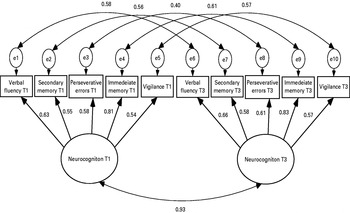
The hypothesized model of neurocognition change (Fig. 1) fitted the data very well [χ2(42)=48.003, CFI=0.987, TLI=0.983, RMSEA=0.033] and was significantly different from a competing model in which latent means were constrained to be the same at baseline and at 12 months (χdifferences2=6.718, dfdifferences=1, p<0.05). The estimated latent mean of neurocognition at 12 months was 1.11 when the mean of neurocognition at baseline was constrained to zero. This mean difference in neurocognition between baseline and 12 months was statistically significant [z(129)=2.575, p<0.01, Cohen's d=0.45], revealing that neurocognition increased during 12 months of community-based rehabilitation. t tests on the five measures found significant improvement on working memory [t(129)=2.5, p<0.02], episodic memory [t(129)=4.5, p<0.001] and verbal fluency [t(129)=2.9, p<0.005].
Hypothesized model of latent mean differences between neurocognition at baseline (T1) and at 12 months (T3). All values are standardized coefficients.

To examine this neurocognitive change in more depth, two factor scores representing neurocognition at baseline and at 12 months were estimated using the regression imputation method in Amos 7 (Arbuckle, Reference Arbuckle2006). The two factor scores were generated from the model in Fig. 1, assuming that the population means and covariances of all variables in the model were equal to their maximum likelihood estimates. After producing the neurocognition factor scores, a grouping variable was created by subtracting individual neurocognition factor scores at baseline from their scores at 12 months, which indicated neurocognition change. Individuals whose change score was >0 were defined as neurocognitive improvers, whereas those whose change score was ⩽0 were defined as neurocognitive non-improvers. Seventy-six subjects (58.46%) showed neurocognitive improvement over 12 months, and 54 subjects (41.54%) did not. There were no statistically significant differences at baseline between improvers and non-improvers in participant age [t(128)=1.71, p=0.09], days of treatment [t(128)=−0.53, p=0.59], BPRS total scores [t(128)=1.22, p=0.22], psychosocial functioning [t(128)=−1.77, p=0.08] and days of medication in the previous 6 months at baseline [t(127)=1.43, p=0.15]. Mean differences at baseline between improvers and non-improvers were found in neurocognition [t(128)=−6.10, p<0.01] and also in education [t(123)=−2.05, p<0.05]. Neurocognitive improvers showed better neurocognition at baseline and more years of education than neurocognitive non-improvers.
In addition to the latent mean difference test described above, neurocognitive change was examined with paired t tests using the five neurocognitive test scores for the improvers and non-improvers. Neurocognitive improvers showed large improvements over 12 months in neurocognition [mean difference=1.29, t(74)=9.27, p<0.001, Cohen's d=1.5], and there was a statistically significant improvement in each of the five tests of neurocognition with medium and large effect sizes. Neurocognitive non-improvers showed significant decline in neurocognition [mean difference=−0.96, t(53)=−6.27, p<0.001, Cohen's d=1.2], and there was statistically significant decline on three of five neurocognitive domains with medium to large effect sizes.
Hypothesis 2
The hypothesized relationship between neurocognitive change and functional change was examined using a multiple-group LGCM. Before testing the hypothesized relationship, a preliminary analysis was conducted. As the present study was predicated on the presence of functional change, we tested a linear LGCM of psychosocial functioning, which showed significant functional change: the initial level (z=26.82, p<0.001) and the rate of change (z=5.43, p<0.001) were both significant with excellent goodness-of-model fit [χ2(3)=1.24, CFI=1.00, NFI=0.99, RMSEA=0.00]. Additionally, the functional change slope was positive and significantly greater than zero at all sites, and there was no difference across sites in the magnitude of functional change [F(3, 129)=0.88, p>0.4].
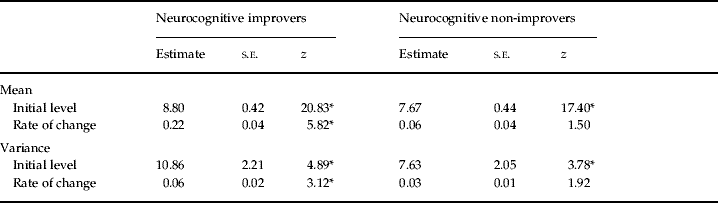
Using the linear LGCM of functional change, we ran a multiple-group LGCM to examine whether there were differences in the rate of functional improvement between the neurocognitive improvers and non-improvers. This multiple-group LGCM fit the data well [χ2(7)=4.12, CFI=1.00, NFI=0.98, RMSEA=0.00] and was significantly different from an alternative model that assumed no difference between the neurocognitive improvers and the neurocognitive non-improvers [χdifference2 (dfdifference=2)=13.62, p<0.01]. The results in Table 2 show that there was a large difference in the rate of functional improvement between the neurocognitive improvers and the neurocognitive non-improvers (0.22 v. 0.06). In addition, the rate of functional improvement was statistically significant in the neurocognitive improver group whereas it was not significant in the neurocognitive non-improver group.
Comparison of psychosocial functioning improvement between neurocognitive improvers and non-improvers
s.e., Standard error.
* p<0.01.
Hypothesis 3
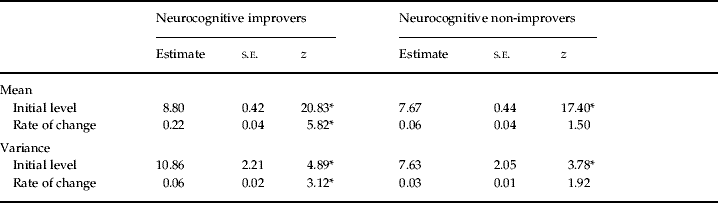
To test the third hypothesis, service intensity was added to the multiple-group LGCM to predict the rate of functional improvement. The aim was to test whether service intensity had a differential impact on rate of functional change for neurocognitive improvers or non-improvers. A preliminary analysis found that there was no difference in treatment days for the neurocognitive improvers and non-improvers. The service intensity model fit well with the data [χ2(14)=11.793, CFI=1.00, NFI=0.94, RMSEA=0.00] and was significantly different from an alternative model that assumed no difference in the effect of the service intensity on the functional improvement between the neurocognitive improvers and the neurocognitive non-improvers (χdifference2=11.26, dfdifference=2, p<0.01). The results in Table 3 indicate that the effect of service intensity on functional improvement was different between the neurocognitive improvers and the neurocognitive non-improvers. Service intensity was positively associated with the rate of functional improvement in the neurocognitive improver group but was not a significant predictor of functional improvement in the neurocognitive non-improver group.
Comparison of the effect of service intensity on psychosocial functioning improvement between neurocognitive improvers and non-improvers

s.e., Standard error.
* p<0.01.
Concerning the magnitude of neurocognitive change, our neurocognitive change groups were based on either neurocognitive change >0 or ⩽0. To examine the significance of our findings in terms of a cut-off for the presence of meaningful neurocognitive change, we examined our hypothesis 2 and 3 results using at least a 0.3 standard deviation change in neurocognitive for defining either improving or declining. Using this cut-off there were 56 neurocognitive improvers and 32 neurocognitive decliners. The results for hypotheses 2 and 3 when using this cut-off are nearly identical to those already presented (available on request). This suggests that the results generalize when using this definition of meaningful neurocognitive change.
Potential confounds
Baseline symptom level (BPRS scores) and days on antipsychotic medication did not confound these study results when they were entered as covariates. The sample's BPRS scores are comparable to other out-patient samples (Brekke et al. Reference Brekke, Hoe, Long and Green2007), and the sample was largely made up of medication users. There was statistically significant symptom improvement in the sample over 1 year [b=−0.22 (09), z=−2.45, p<0.05] but the magnitude of symptom change did not differ between the neurocognitive improver and non-improver groups [t(100)=0.69, n.s.].
Discussion
This study tested three hypotheses relevant to understanding the conditions that facilitate functional change during community-based psychosocial rehabilitation for individuals with schizophrenia. The first hypothesis was supported, indicating that there was significant improvement in neurocognition for this sample during 12 months of intervention. The magnitude of aggregate neurocognitive change reflected a medium effect size, which is at the lower end of change found from cognitive remediation interventions (McGurk et al. Reference McGurk, Twamley, Sitzer, McHugo and Mueser2007a). There was, however, no direct attempt to improve neurocognitive functioning during the intervention so these effects on neurocognition are similar to the non-specific effects found by Spaulding et al. (Reference Spaulding, Reed, Sullivan, Richardson and Weiler1999) in their study of psychosocial rehabilitation interventions delivered during in-patient stays. This magnitude of neurocognitive change is larger than the short-term practice effects found in a study of neurocognitive change in patients and normals who took neurocognitive tests three times over a 4-month period (Goldberg et al. Reference Goldberg, Goldman, Burdick, Malhotra, Lencz, Patel, Woerner, Schooler, Kane and Robinson2007). Although notable practice effects are unlikely in two test administrations 12 months apart, it could be argued that the stimulation available in the psychosocial intervention provided neurocognitive change greater than that produced by repeated practice of neurocognitive tests. In essence, it is possible that these intensive psychosocial environments provide cognitive challenges and exercise that promote aggregate improvement in neurocognitive functioning through a range of non-specific neurocognitive inputs.
A potentially notable finding was that there were two subsamples based on their neurocognitive change scores: those who showed neurocognitive improvement and those who showed neurocognitive decline over 12 months. Thus, although there was aggregate neurocognitive improvement in the sample, the rates of neurocognitive improvement and decline in the two subsamples were substantial and reflected large effect sizes. Specifically, there was a rate of improvement among the neurocognitive improvers that was as large as the effects found in studies of cognitive remediation (Kurtz et al. Reference Kurtz, Moberg, Gur and Gur2001; McGurk et al. Reference McGurk, Twamley, Sitzer, McHugo and Mueser2007a). The rate of decline among the neurocognitive decliners was equally large. These findings point to several considerations. First, the sometimes large within-group variation in neurocognition scores found in studies of cognitive remediation (see McGurk et al. Reference McGurk, Twamley, Sitzer, McHugo and Mueser2007a) or other studies of neurocognition in schizophrenia (e.g. Albus et al. Reference Albus, Hubmann, Mohr, Hecht, Hinterberger-Weber, Seitz and Küchenhoff2006; Pukrop et al. Reference Pukrop, Schultze-Lutter, Ruhrmann, Brockhaus-Dumke, Tendolkar, Bechdolf, Matuschek and Klosterkötter2006) could reflect subgroups of improvers and non-improvers embedded in these samples. Therefore, rather than looking only for aggregate neurocognitive change, it might be important to look for groups of neurocognitive improvers and decliners. Second, the neurocognitive decliners could represent a group that generally shows decline over the course of the illness (Pukrop et al. Reference Pukrop, Schultze-Lutter, Ruhrmann, Brockhaus-Dumke, Tendolkar, Bechdolf, Matuschek and Klosterkötter2006), whereas the improvers might be a subgroup that shows neural plasticity in the face of environmental challenge and stimulation and that results in neurocognitive improvement from specific and non-specific neurocognitive inputs, also called experience-dependent neural plasticity (Klein & Jones, Reference Klein and Jones2008). Third, it is important to try to find ways to characterize the subsamples of neurocognitive improvers and decliners to determine whether they form empirical subgroups based on demographic, functional, clinical or other discriminating variables. If these subgroups are substantiated, they might require different approaches to both neurocognitive remediation and psychosocial interventions.
Concerning hypothesis 2, we found a strong association between neurocognitive change and functional change. Significant functional improvement was only present when neurocognitive improvement also occurred. In the presence of neurocognitive decline, psychosocial functioning did not improve. In addition, the rate of functional change for the neurocognitive improvers was 350% greater than that for the neurocognitive non-improvers. This suggests that neurocognitive improvement and functional improvement are closely linked and these are the strongest data yet linking neurocognitive change and functional change in schizophrenia. These findings suggest that neurocognitive improvement could be a facilitative condition or contribute to a potentiating mechanism for functional change during rehabilitative interventions. It is also possible that there is an underlying and as yet unidentified predisposition to both cognitive and functional improvement in schizophrenia (perhaps an organismic change readiness factor), or that functional improvement and neurocognitive improvement have a reciprocal relationship over time.
Hypothesis 3 proposed that neurocognitive improvement moderated the relationship between service intensity and functional improvement. We found that neurocognitive improvers and non-improvers had the same overall intensity of treatment. However, our findings suggested that neurocognitive improvers showed a very strong positive relationship between more days of treatment and a higher rate of functional improvement, whereas neurocognitive non-improvers showed no significant relationship between the days of treatment and functional improvement. This represents a powerful person–environment interaction in that neurocognitive improvement moderated the relationship between days of treatment and rate of functional improvement. In essence, neurocognitive improvement seemed to facilitate treatment responsiveness. These findings could suggest that neurocognitive improvement activates the relationship between treatment intensity and functional improvement. It is also possible that treatment intensity activates the potential for neurocognitive change. Alternatively, it is possible that the causal relationship between treatment intensity and neurocognitive change is reciprocal over time for the neurocognitive improvers but not for the neurocognitive non-improvers.
In summary, we found aggregate neurocognitive improvement and aggregate functional improvement. As in previous studies, we can conclude that, in general, people with schizophrenia can benefit from these psychosocial interventions in terms of neurocognitive and functional improvement. Very importantly, however, we also found that: (i) neurocognitive improvement is very strongly related to the rates of functional improvement in community-based psychosocial rehabilitation; (ii) the positive impact of treatment intensity on functional outcomes seems to be contingent on the presence of neurocognitive improvement; and (iii) neurocognitive improvement seems to be central to the conditions that facilitate functional rehabilitative improvement and responsiveness to community-based rehabilitative interventions. These are important findings for understanding the role of neurocognition in schizophrenia and for understanding the conditions that facilitate functional rehabilitative change.
There are several important questions that need to be addressed in future research. Who are the neurocognitive improvers? What distinguishes them from the non-improvers? What can be done to help the non-improvers? Is there a difference between naturally occurring neurocognitive improvement and that facilitated by cognitive remediation interventions, especially in terms of associated functional improvement? These questions are fundamental to increasing our understanding of the complex relationship between neurocognitive change, rehabilitative change and psychosocial treatment responsiveness in schizophrenia. It is also possible that functional change could be driving neurocognitive change as new functional roles could be stimulating change in neurocognitive capacities. These causal relationships remain to be studied more carefully.
This study had several limitations. The study did not use a random sample, the sample self-selected for a psychosocial rehabilitation intervention. It is not clear how these findings would generalize to a sample that was not entering psychosocial rehabilitation. There was no active cognitive remediation condition. Adding such a condition within a prospective follow-along study design would allow us to address several of the important questions outlined above. Service intensity is only one of many potentially significant treatment variables that could be studied. The type of services, their comprehensiveness and quality could also influence the relationship between neurocognition and outcome, and they might show similar or dissimilar influences to those found in this study. This is an important area for future research on treatment mechanisms. Finally, although the findings on specific neurocognition indicators generally reflected those on our global neurocognition construct, we did not analyze specificity effects between specific neurocognition indicators and distinct psychosocial outcomes such as work, social and independent living; thus, these specificity effects were not addressed.
Acknowledgments
This research was supported by grant no. R-01 MH53282 from the National Institute of Mental Health awarded to J.S.B.
Declaration of Interest
None.